Category Archives: Business & Economy

From Bean to Cup

The Coffee Board of India serves as the friend, philosopher and guide to the coffee sector in the country covering the entire value chain

CoffeeBeansKF12mar2015

The saga of Indian coffee began on a humble note, with planting of ‘Seven seeds’ of ‘Mocha’ during 1600 AD by the legendary holy saint Baba Budan, in the courtyard of his hermitage on ‘Baba Budan Giris’ in Karnataka. For quite a considerable period, the plants remained as a garden curiosity and spread slowly as back yard plantings. It was during 18th century that the commercial plantations of coffee were started, thanks to the success of British entrepreneurs in conquering the hostile forest terrain in south India. Since then, Indian coffee industry has made rapid strides and earned a distinct identity in the coffee map of the world.

The Coffee Board

During 1940s, the coffee industry in India was in a desperate state due to the World War II resulting in very low prices and ravages of pests and diseases. At this time, the Government of India established the Coffee Board through a constitutional act – Coffee Act VII of 1942 – under the administrative control of the ministry of commerce and industry. The Board comprises 33 members including the chairman, who is the chief executive and appointed by the Government of India. The remaining 32 members represent the various interests such as coffee growing industry, coffee trade interests, curing establishments, interests of labour and consumers, representatives of governments of the principal coffee growing states and members of Parliament.

After pooling was discontinued in 1996, Coffee Board serves as the friend, philosopher and guide to the coffee sector covering the entire value chain. The core activities are primarily directed towards research & development, transfer of technology, quality improvement, extending development support to growing sector, promotion of coffee in export and domestic markets. The activities of the Board are broadly aimed at (i) enhancement of production, productivity and quality; (ii) export promotion for achieving higher value returns for Indian coffee and (iii) supporting development of the domestic market.

Research and Export Promotion

Organised research in coffee was initiated during 1925 by the erstwhile Mysore Government by setting up the Mysore Coffee Experiment Station near Balehonnur in Chikmagalur district. After formation of the Coffee Board, the research station was brought under its administrative control. Presently the Research Department of the Board with its headquarters at the Central Coffee Research Institute and five regional stations has a sanctioned strength of 113 scientific personnel and is involved in development of improved varieties with tolerance to major pests and diseases and standardisation of technology for improving production, productivity and quality.
CoffeeAreasKF12mar2015

After liberalisation in 1996, the marketing functions were deregulated. The Coffee Board plays the role of facilitator and promoter of Indian coffee exports. However, registration of exporters is the responsibility of the Coffee Board. Under the Export Promotion scheme, exports of value added coffees in retail packs and export of coffee to high value far-off destinations are incentivised to offset the transaction costs to some extent and enable the Indian exporters to be competitive in the export market. These incentives provide opportunities to expand the footprint of Indian Coffee in higher value destinations like USA, Japan, Canada, Australia, New Zealand, etc on one hand and reinforcing presence in traditional markets i.e., European Union/ Russia and CIS etc.

Besides, the Board regularly participates in leading coffee trade shows/ exhibitions held in major consuming countries to promote awareness about quality of Indian coffee to the overseas roasters, traders and consumers. The Board also conducts Flavour of India – The Fine Cup competitions to select fine coffees and expose them to the export market. It also promotes coffee consumption in the country through 12 India Coffee Houses located in major cities across the country.

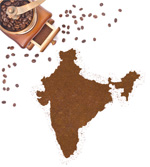
In India, coffee is traditionally grown in the Western Ghats spread over Karnataka, Kerala and Tamil Nadu. Coffee cultivation is also being expanding rapidly in the nontraditional areas of Andhra Pradesh and Odisha as well as in the North East states. Coffee is predominantly an export oriented commodity and 65 per cent to 70per cent of coffee produced in the country is exported while the rest is consumed within the country. Indian coffee industry earns a foreign exchange to the tune of about Rs 4000 crore. In the international market, Indian coffees earn a high premium, particularly Indian Robusta which is highly preferred for its good blending quality. Arabica Coffee from India is also well received in the international market.

Arabica is a mild coffee, but the beans being more aromatic, it has higher market value compared to Robusta beans. On the other hand Robusta has more strength and is, therefore, used in making various blends. India is the only country that grows all of its coffee under shade. Typically mild and not too acidic, these coffees possess an exotic full-bodied taste and a fine aroma.

India cultivates all of its coffee under a well-defined two-tier mixed shade canopy, comprising evergreen leguminous trees. Nearly 50 different types of shade trees are found in coffee plantations. Shade trees prevent soil erosion on a sloping terrain; they enrich the soil by recycling nutrients from deeper layers, protect the coffee plant from seasonal fluctuations in temperature, and play host to diverse flora and fauna.

Coffee plantations in India are essential spice worlds too: a wide variety of spices and fruit crops like pepper, cardamom, vanilla, orange and banana grow alongside coffee plants.

Training courses in coffee culture and management

The Central Coffee Research Institute, popularly known as CCRI, has grown as an internationally recognised, state-of-the-art research centre for carrying out research on all aspects of coffee cultivation. CCRI is committed to introducing emerging technologies and sustainable package of practices to benefit the coffee farmers. It plays an important role in the development and growth of the coffee agricultural sector. CCRI has 133 dedicated scientists working for the development of newer technologies in close association with a number of international institutes, reputed national institutes and pure science and agricultural universities.

The CCRI, apart from the development of new technologies, is involved in imparting training on scientific coffee cultivation to the benefit of all the stakeholders since 1953. The institute is recognised as an international centre of excellence for training in coffee culture by the FAO, Rome. Candidates from several coffee growing countries are being sponsored for these training programmers by the world organisations like UNDP, FAO or by their respective countries.

CHART

Coffee regions of India

Anamalais (Tamil Nadu): Wildlife sanctuaries in this region are the abode of spotted leopards,while the plantations are home to fine, high-grown Arabicas, including the exotic Kents.

Araku valley (Andhra Pradesh):
 Home to colourful parrots, it is not unusual to see a flock of chattering red and green birds, darting through trees in this scenic valley.

Bababudangiris (Karnataka): Bababudan brought seven ‘magical’ beans from Yemen and planted them in the lofty hills of this region. Deer is often spotted, grazing alongside plantations abundant with full-bodied Arabicas.

Biligiris (Karnataka/Tamil Nadu):
 Besides full-bodied Arabicas, this region is noted for the sambar – the largest Indian deer with huge antlers.

Brahmaputra: The mighty Brahmaputra which flows through the North Eastern states is the lifeline of this region which is home to the one-horned rhinoceros. This sturdy animal is found in large numbers at the Kaziranga National Park in eastern Assam.

Chikmagalur (Karnataka): Chikmagalur’s forests and wildlife sanctuaries are abundant with beautiful peacocks, India’s national bird. The peacock loves to show off its colourful feathers, especially during its elaborate courtship dance.

Coorg (Karnataka):
 Lush coffee plantations are bustling with honeybees which yield the delicious Coorg Honey, collected by nimble-footed tribals

Manjarabad (Karnataka): Gentle sloping terrain with small streams and coffee plants provide a natural habitat for the jungle fowl. This yellow-headed bird with a red comb and multi-coloured plumage is generally seen in pairs, close to the coffee plantations.

Nilgiris (Tamil Nadu): The plantations are home to fine, high-grown Arabicas, including the exotic Kents.

Pulneys (Tamil Nadu): A well-known feature of this region is the bright, bluebell-like Kurinji flower that makes a dramatic appearance, once in 12 years. The high-grown Arabicas however, are a predominant sight, year after year.

Sheveroys (Tamil Nadu): 
The magnificent Gaur or Indian bison is an embodiment of vigour and strength, much like the boldsized Arabicas grown here. This massive animal with its huge head and sturdy limbs grazes on the lower hill tracts of this picturesque region.

Travancore (Kerala): The national flower of India, the lotus symbolises purity and beauty. These bright, fragrant flowers with floating leaves and long stems, grow in shallow waters in this region noted for its Arabicas and Robustas.

Wayanad (Kerala):
 Wayanad is home to the Indian tiger, India’s national animal – a symbol of valour and courage.

source: http://www.financialexpress.com / Financial Express / Food & Hospitality World / Home> Cover Story / March 05th, 2015
City visionaries

HajiIsmailSaitMasjidMPOs05mar2015

by Aliyeh Rizvi

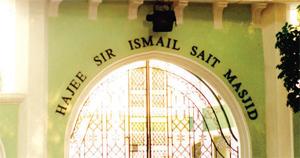
The history of Bangalore is a colourful tapestry whose warp is interwoven with countless political and cultural narratives. But the equally significant weft consisted of traders and businessmen whose lives extended beyond commercial success to large acts of philanthropy. Despite these extensive contributions that benefitted the city and its people, their memories are now preserved primarily in the hearts of old Bangaloreans, personal family records and physical fragments across the city; a memorial, a building or a road. The Hajee Sir Ismail Sait Masjid was built over 100 years ago and gives Mosque Road it name. It was initially meant to accommodate about three hundred people but the largesse of its builder went far beyond its walls.

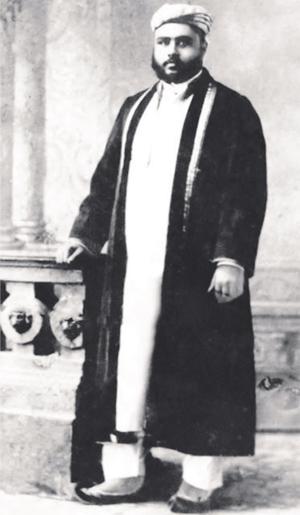
Haji Sir Ismail Sait was born on March 7th 1859 and following his father’s untimely demise, moved from Mysore to Bangalore around 1870. Being from the mercantile Cutchi Memon community, he followed suit after being educated in both Bangalore and Chennai. Arif Hussain, at the Hazrat Haider Shah Jeelani Dargah, tells me an anecdote (unverified) about his early years where he was advised by the saint, his spiritual mentor, to initially trade in goods that were white in colour (like eggs, garlic and milk) to ensure wealth and success. The young Ismail Sait evidently had a nose for business and saintly advice. His English Warehouse near St. Mark’s Road soon sold not just milk powder but every conceivable import from England. Branches were opened in Hyderabad and Chennai, where he was the first to bring in imported kerosene from America in the late 19th century through Spencer and Co.

 
The entrepreneurial streak also ran through trading in military provisions, timber and mining. He was a banker, mill owner and export-importer. Over time, he was also Chairman of Chamber of Commerce Mysore; Director in the Mysore Sandalwood Factory, Binny Mills and the Mysore Iron Works, Bhadravathi. It was a diverse portfolio but India was opening up to the world and opportunities were yours for the taking. Business was supported by memberships in several distinguished clubs including the Willingdon Sports Club, Bombay, Calcutta Club and the National Liberal Club of London. “He had great business sense and wonderful PR skills” says Zafar Sait, his great-grandson.

 
But public service was a priority. Healthcare and education were key concerns. The Gosha Hospital (1925) near Queens Road was built with personal funds for reclusive Mohammedan `purdah nashin’ ladies. It was formally opened with 20 beds. Philanthropic friends donated clocks, beds, `frigidaires’, aluminiumware and other supplies. He also built schools, mosques and rest houses in Bangalore, Whitefield and Mysore. Staggering sums of money were donated to the Mysore State University, Aligarh University and medical institutions including Victoria and Bowring Hospitals. His will made strict provisions for educating family members, `both male and female’ and providing alms to the poor.

 
In 1911, he was nominated to the Madras Legislative Council and received the title’ Fakhr-ut- Tujjar from the Mysore Maharaja in 1919. Family photographs show a dapper gentleman dressed in traditional Cutchi Memon robes, and then in European attire when he was knighted in 1923. When Hajee Sir Ismail Sait passed away in 1934, he left behind his wife Ayesha Bai, five sons, two daughters and a legacy of philanthropy that Shabbir Malik Sait, his great grandson says continues even to this day. He belonged to a time when we gave back what we received in equal measure.

The writer is a cultural documentarian and blogs at aturquoisecloud.wordpress.com

source: http://www.bangaloremirror.com / BangaloreMirror.com / Home> Bangalore> Others / by Aliyeh Rizvi, Bangalore Mirror Bureau / May 05th, 2014

21 doors & a fiery spirit

By:Aliyeh Rizvi

I was standing outside the swank automobile showrooms in India Garage the other day, watching excited owners roll out onto St Marks Road in their ribbon wrapped cars. Ironically, the petrol bunk area inside this graceful building was where around 1920, Hajee Osman Sait, an eminent Cutchi Memon businessman, struck a match and deliberately set fire to all the imported goods sold in the Cash Bazaar as it was called back then.

HajeeOsmaanSaitMPOs03mar2015

This brazen act of arson must have seemed incomprehensible to gentile customers in the Cantonment. The Cash Bazaar opposite Bowring Institute (1868) was where they bought everything from pins and provisions to ‘English vegetables’, fruits and flowers. Setting fire to goods was something a flourishing trader just did not do. The popular shopping arcade was also a family legacy. It had been built by his grandfather Yousuf Pir Mohammed who had moved to Bangalore from Kutch. Each of his seven sons received ‘three doors’ from where they managed their business. The building, therefore, had 21 doors that opened onto a wide verandah with cast iron grills.

 
But while the Cantonment speculated, the Non-cooperation Movement (1920) led by Gandhiji escalated into public meetings and protests across the country. Amongst other things, it also advocated a boycott of British goods. This civil disobedience ran in parallel with the pan-Islamic Khilafat movement (1919-1924) whose leaders, including the brothers Maulana Mohammad and Shaukat Ali, were allied with the Indian National Congress at that time.

 
Hajee Osman Sait, President, Madras and Bangalore Khilafat Committee, was deeply inspired by India’s freedom struggle. He played host to Gandhiji, Pandit Nehru and the Ali brothers at his home on St Mark’s Road (around present day Hotel Nandhini). He sold his property, donated money and apparently even publicly auctioned off his eldest son to raise funds. Ebrahim was returned respectfully and the money, donated. He opened an Indian National School (1921) on his property, Stafford House (now Bishop Cottons Girls School) and sent his own children to local schools. The Cash Bazaar bonfire was yet another contribution to the movement.

 
Masood Ali, Yousuf Sait’s son, says his grandfather was an unbelievably wealthy businessman who owned over 20 acres in the area, including several large bungalows of which four were named after his sons — Yakhoob, Ebrahim, Khader and Yousuf Villas. Four white horses drew his famous buggy. They were housed on Residency Road before the Imperial Talkies was built and then moved to stables at the Cash Bazaar which also sold hackney carriages.
The stables were later occupied by Sir Mark Cubbon’s horses and used by the Bangalore Riders Club (1934). Later on, Addison & Co. sold bicycles, cars (Peugeots and Buicks among them) and motorcycles next door. India Garage’s history of hot wheels began here long before shiny automobiles arrived in India.

 
Haji Osman Sait’s dedication to the freedom movement cost him dearly. He passed away in 1928, in a rented home around the age of fifty-six. Masood Ali says his funeral procession was over 5 kms long and extended from the Jumma Masjid off Commercial Street to the Jayamahal Palace burial ground.

 
India Garage was subsequently sold in an auction in the 1930s and then became the first showroom of the pioneering VST Group founded by V S Thiruvengadaswamy Mudaliar in1911.The building retains the original structure and some trees he planted. But its doors now open out to a free, liberalised India.

The writer is a cultural documentarian and blogs at aturquoisecloud.wordpress.com

source: http://www.bangaloremirror.com / Bangalore Mirror / Home> Bangalore> Others / by Aliyeh Rizvi, Bangalore Mirror Bureau / May 12th, 2014

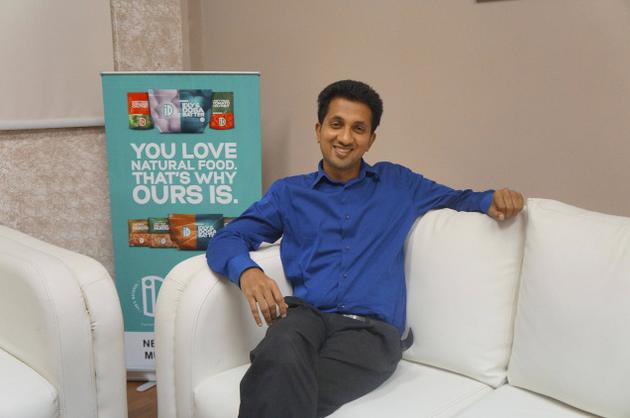
The idly-dosa man of Bengaluru

Success story: Musthafa believes it was team work all the way that helped.

Musthafa P.C, a school dropout who went on to study at IIMB, quit his software job to start an enterprise that sold idly-dosa batter. His is a success story that has trickled down to his 600 –odd rural employees too

A young techie who could just about make himself daal, rice and papad in his bachelor days now runs a company with a 70 crore turnover that provides almost five lakh idlis a day to hungry Bengalureans. Most young working people in the city in a rush, simply fish out the now-famous “iD Fresh” readymade idly/dosa batter from their refrigerator for their quick breakfast fix.

While Bengaluru is where all this began for techie-turned-entrepreneur Musthafa P.C, his idlis and dosas find a place on the breakfast tables in households in Mysuru, Mangaluru, Hyderabad, Mumbai, Pune, Chennai, and even Dubai! And it’s not limited to idlys and dosas anymore. Their oeuvre now includes parotas, chapattis and chutneys too, all made without chemicals and preservatives, Musthafa is quick to add.

It started in a small corner of the city’s Thippasandra locality where Musthafa’s cousins ran a grocery store. “This was eight years ago, and a local supplier would sell idly/dosa batter in an unbranded plain plastic bag tied up with a rubberband, on weekends. There was a great demand, but they couldn’t keep up the quality. That’s when I felt there was a gap in the market,” says the 42-year-old Musthafa, CEO of iD Fresh Food, one of the new-age food startups in the city.

And then, one can conclude, the Malayali business instinct kicked in!

The enterprising cousins set up a 50 square foot kitchen — “our so-called factory” laughs Musthafa, and started a trial in 10 stores in and around Indiranagar. “In a year’s time we were selling 100 packets of batter a day.” During that time, Musthafa had quit his plum job to study his MBA at the Indian Institute of Management-Bangalore (IIM-B). “I did a proper survey and found that Bangalore then had a production requirement of 5,000 kg of batter a day.” The sales and the survey gave them the confidence to set up a 600 square foot kitchen in Kaggadasapura, where Musthafa pumped in six lakh from his savings. They were still using regular household grinders to make the batter. “I had a high-profile job in Dubai. I had worked with Motorola, Citibank, had lived in the U.K., and then later even worked with Intel. But I wanted to come back to India to pursue higher studies, spend time with my parents, and give something back to society,” says Musthafa of making the proverbial switch.

It is with this intent that Musthafa is very particular that they identify “smart guys from rural areas who are unemployed” and provide them opportunities in their company. Today they employ 650 such people from the eight regions they work in across India. “I come from a life of poverty in Wayanad (Kerala) where my dad was a coolie, and breakfast was a luxury. I was a school dropout after I failed my sixth standard. The teacher persuaded me to repeat the class and continue my studies.”

No one supported his decision to quit the IT industry; it was a job that had brought stability to the family, helped him build a home and marry off siblings. Even his wife’s family was upset that he was becoming a “rice merchant”.

But by 2008, his company had expanded into a proper factory in Hoskote, with the help of the Karnataka State Industrial Development Council (KSIDC). Custom-made grinders were brought in from America. “With Indian grinders, cleaning is the most difficult task. Moreover the small grinders would take an hour to grind a kilo of dal. So we had to import these large, modified grinders that self-sterilise at the touch of a button.” Musthafa swears the actual batter making process is “the same that your mom uses at home, starting with the soaking”. “We are only professional assistants to the homemaker. Our products will always be ready to cook, not ready to eat. So they don’t reach the dining table; they first go into the kitchen. If the idli is good, the homemaker gets the credit; if the idli turns out bad, iD takes the credit!” All the products, he says, are first tested on his children aged 12, nine, and five.

Business is of course growing phenomenally with venture capital (VC) firms wanting to invest in them; 60 companies evinced interest in pumping money; mostly American. Finally Helion Venture invested Rs. 35 crore in their expansion plans. “We are targeting expansion to 10 Middle-Eastern cities over the next five years. As well as expanding into north India, especially Delhi.” While initially a friend named it iD for “idly-dosa”, Musthafa says it now stands for their “identity”.

Every employee in the company is an entrepeneur like he is, believes Musthafa.

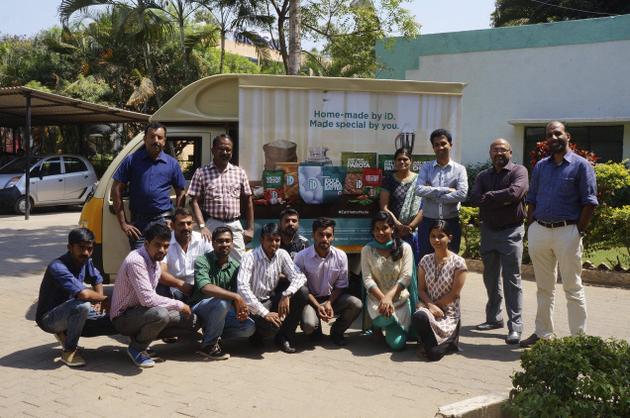
Musthafa makes it a point to stress on the fact that it has been team work all along the way; first his cousins came on board, then his engineering classmates and then family friends, to start the operation in various cities. “We don’t work on an employment basis; there is no fixed pay. Every employee is a micro-entrepreneur. For example, each area sales team is given a vehicle and “they have to maintain their own profit and loss account,” explains Musthafa. Whitefield, Jayanagar, Indiranagar and Koramangala is where they do their best business, he says. They have a SAP-based backend platform so that they have a zero inventory model – 90 per cent of the products are sold on the same day; a mobile app keeps track of sales patterns in each store.

Musthafa’s personal favourite from his company is the wheat parota. “We eat our idli and dosa once a week at home, then three days of wheat parota,” he breaks into a boyish grin.

source: http://www.thehindu.com / The Hindu / Home> Features> MetroPlus / by Bhumika .K / February 26th, 2015

‘Free to Dial’ service launched

Callers can now get local information by giving a missed call to the new service, “Free to Dial”, which was launched in the city on Thursday by Deputy Chief Minister Mohd. Mohammed Ali.

He said the service providers had promised to source accurate information on products and services to pass on to people seeking information. S. Sunil Kumar Singh and S.J. Basha, the promoters of the service, said that people need to dial 040–6644 4466 any time.

The call is disconnected immediately and the executives will call back with an enquiry and present the information needed. The service is available round-the-clock.

The service currently offers information in 60 categories and 3,000 sub-categories and it will be further expanded in the next few months. The service will be expanded to Vijayawada, Visakhapatnam and Bangalore in the next six months.

source: http://www.thehindu.com / The Hindu / Home> News> Cities> Hyderabad / by Special Correspondent / Hyderabad – February 27th, 2015

Research vessel flagged off from Malpe

Geo technical research vessel Fugro Scout setting sail amid cheers at Malpe fisheries harbour in Udupi on Monday.

The state-of-the-art Geo Technical Research Vessel (GTRV) ‘Fugro Scout’ manufactured by Tebma Shipyards Ltd. set sail to Singapore via New Mangalore Port from Malpe fisheries harbour here on Monday.

The company constructed the GTRV in 18 months and delivered it to The Netherlands-based company Fugro here. The Fugro Scout has been registered in Panama and will function under its flag. It was constructed at a cost of Rs. 240 crore.

The vessel is a mini-drill ship capable of drawing soil samples up to 3 km below the sea bed for exploration of oil, natural gas and other resources. When the vessel was flagged off by Pramod Madhwaraj, MLA, there was a loud applause, lot of cheering and waving of hands.

P. Aboobacker, Vice President – Operations, Tebma Shipyards, said the entire ship was constructed at its shipyard here. Since beginning operations in Malpe port in 2008, the company had built 18 vessels.

These 18 vessels included 10 tugs for the Indian Navy, while the remaining vessels were built for commercial purposes. “This is the second GTRV we have built for Fugro. The first one – ‘Fugro Voyager’, was awarded the ‘Best Research Vessel of 2014’ by the magazine ‘Work Boat World’,” he said.

Efficient ship

The Fugro Scout is powered by diesel electrical propulsion systems driven by active front-end drives for best fuel efficient operation. The vessel has an automated pipe and tool-handling equipment to promote safe drilling floor operations for sea bed sampling and testing.

Graeme Alexander, Project Director of GTRVs, Fugro, said the Fugro Scout would start its work in Vietnam in May. Then it was expected to sail to Iceland.

Mr. Madhwaraj said Tebma Shipyards had donated Rs. 1.10 crore for the construction of slipway for the third stage of Malpe fisheries harbour. “We want the company to do more for the fishermen here under their corporate social responsibility schemes,” he said.

source: http://www.thehindu.com / The Hindu / Home> News> National> Karnataka / by Ganesh Prabhu / Udupi – February 24th, 2015

79 tour operators from 27 countries to give global touch to UP’s first Travel Mart

Lucknow :

The four-day long UP’s first Travel Mart, which would begin on February 22 is likely to witness participation of as many as 79 tour operators from 27 countries. This also includes 25 tour operators from India. Director general of tourism Amrit Abhijat said that the Travel Mart would be inaugurated by chief minister Akhilesh Yadav, and would be held at La Martiniere Boys College ground.

He further stated that earlier the event used to be held in Jaipur under the name of ‘great Indian Travel Bazaar’, but under an agreement between FICCI and UP Tourism, the event has been slated for Lucknow, and for the next five years, it would be held in Lucknow.

“The Travel Mart would prove to be useful both for domestic and international tour operators, and at the same time, it would add another dimension to the different tourist places of the state,” Abhijat said, and added that it will also help the foreign tour operators to design better tour packages keeping in mind the historical monuments of the state.

A meeting was also held recently to formalise the preparations of the Travel Mart. The meeting was attended by Amit Gupta (of FICCI), ASI director PK Mishra, head of Heritage Hotel Association PND Singh and Salim Ali and Tariq Khan (of Roomi Foundation). A meeting was also held under the chairmanship of Mahesh Kumar Gupta, divisional commissioner of Lucknow, which was also attended by Amrit Abhijat and other senior officials.

The meeting which is jointly organised by FICCI and UP Tourism is likely to see maximum participation of 8 tour operators from United Kingdom, followed by 7 each from China and Australia, 6 each from Germany and Thailand, and 5 from the USA.

source: http://www.timesofindia.indiatimes.com / The Times of India / Home> City> Lucknow / by Arunav Sinha, TNN / February 17th, 2015

A gift to the olfactory sense, and more

The smell lingers:N. Fakhruddin Attarwala’s shop is perhaps one of the few places in the city where you can still get perfumes in their raw form — without alcohol or gas —Photo: K. Pichumani

When you walk out of a tiny shop — where the shelves are lined with dainty glass vials — on Mannady Road, you smell like a flower bouquet.

And when the shop is run by a veteran perfumer, who loves to please his customers, the blend is unimaginable.

N. Fakhruddin Attarwala’s shop is perhaps one of the few places in the city where you can still get perfumes in their raw form — without alcohol or gas. “It is quite rare to see such perfumes being sold these days. Earlier, people would sell tiny bottles of perfumes with gold-coloured caps at fairs and marketplaces, enticing people with the aromas. They were not just sellers but perfumers who learnt the trade with great difficulty,” recalls D.V. Sainath Guptha, a perfumer himself, who prepares scents only for self consumption.

Several old areas, including Periamet, Royapettah and Triplicane, have such perfume shops but the number of patrons seems to be thinning with most people preferring branded products.

Though one connect such shops with traditional fragrances like  attar ,  marikolundhu  and  javvaadhu,the variety available is surprising. Mr. Attarwala, who has created some 50 fragrances in his 45 years as a perfumer, says some fragrances require up to 200 ingredients.

“The foodie note is the in-thing now, with melons, strawberry and lime vying for favour. One fragrance can contain 40-60 ingredients and take at least two years to perfect. It is a laborious process. No doubt perfumery requires knowledge of chemistry but it should be in your heart. It is only recently chemicals are being used in perfumes. Previously, it used to be just natural oils,” says Mr. Attarwala, whose home is where he creates his magic.

Whatever perfume is made, sandalwood is the basic requirement along with ylang ylang oil and musk oil. These perfumes must be diluted with four parts of water each time they are used.

“The cost of the perfume depends on its quality and not quantity. You can get the same quantity of jasmine perfume for Rs. 30 and Rs. 500,” he explains, as his customers patiently wait their turn to let their olfactory senses decide what they shou ld buy.

Gone are the days of tiny vials of scented natural oils withgold-coloured caps

source: http://www.thehindu.com / The Hindu / Home> News> National> Tamil Nadu / by Deepa H. Ramakrishnan / February 11th, 2015

Flavours of the Lesser Known

Shaad Hassan Damudi
Shaad Hassan Damudi

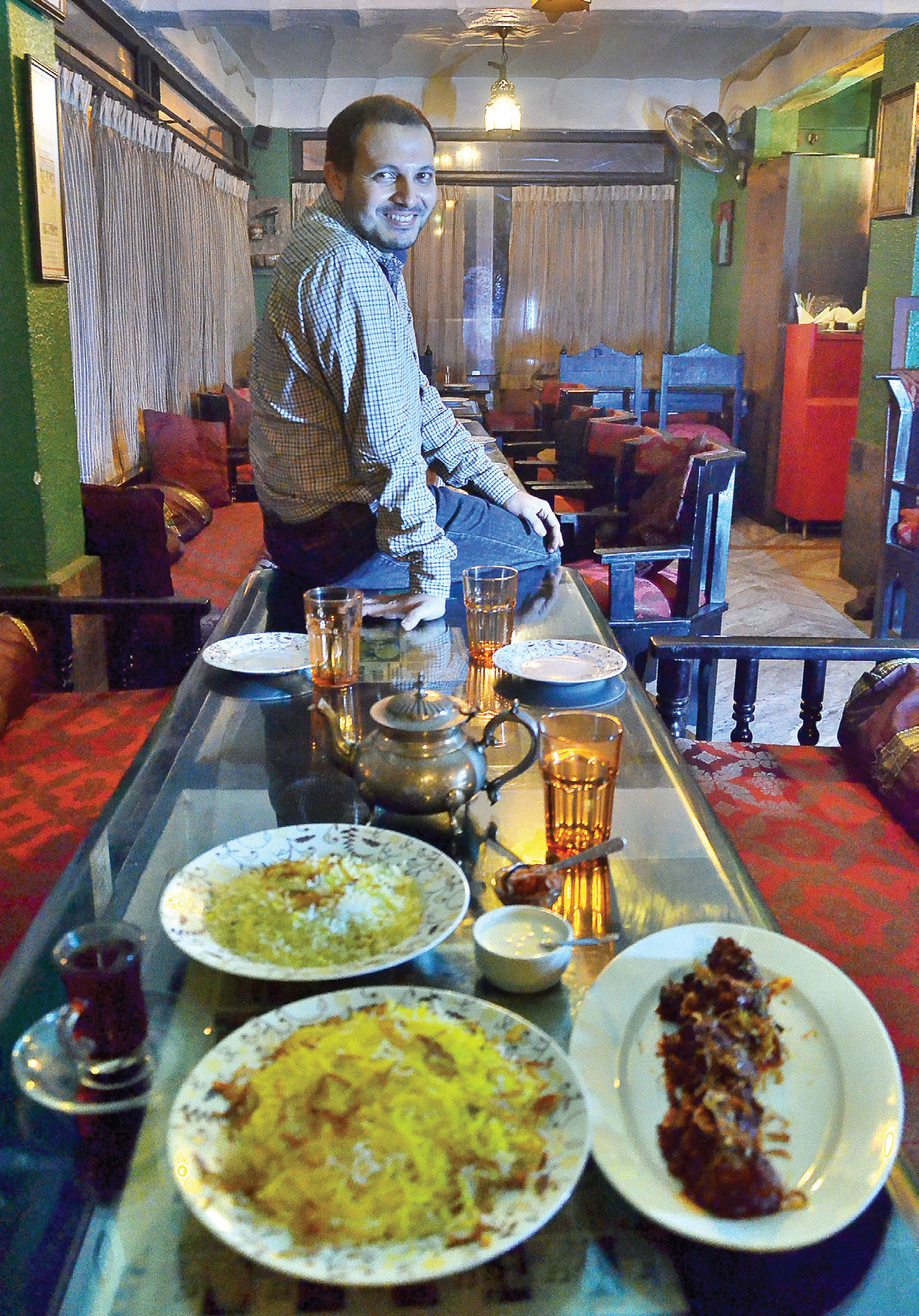
Ali Baba, a small cosy eating place in Frazer Town, Bengaluru, is where you get some Persian and Arabian food at reasonable prices. But what its USP is that its young and handsome owner, Shaad Hassan Damudi, is a Bhatkali Muslim and serves up some authentic Bhatkali food. Bhatkal is a small town in Southern Karwar district of Karnataka and has a rich and relatively unknown cultural and culinary history. The Muslims there are called Navayaths or new people. The Navayaths speak a dialect called Navayathi which is a fusion of Sanskrit, Persian, Arabic, Marathi, Hindustani with Konkani as its base.

Traders from the Persian Gulf—namely Yemen, Iran and Iraq—who traded mainly in horses, textiles, timber, gemstones and spices, eventually settled on the Konkan coast and contributed to the cuisine that is a ménage of Indian, Persian and Arabic cultures.

The most famous dish has got to be the delightful Bhatkali Biryani, half-cooked in steam. Damudi uses Sella basmati rice which is an aged rice and is exported to the Middle East and hence not available in India. “We use a lot of browned onions and tomatoes, and a red chilli paste which add colour. Our food is moderately spicy and whole garam masala is added to biryani which is layered with rice and then the onion, tomato, ginger garlic and garam masala mixture,” says Damudi.

Popular TV foodies—Rocky and Mayur of Highway on my Plate fame—recently visited Ali Baba and gorged on the Bhatkali food and featured it on one of their shows.

The kadang fry is a must-try for vegetarians, its sweet potatoes with the ubiquitous red chilli paste, an interesting blend of sweet and spicy flavours. The boneless chicken tikka cooked on a barbeque does remind me of tandoori chicken but the red chilli paste gives it that distinctly Bhatkali flavour. The people here use vinegar made from sugarcane which is used in salads as well as in finely cut onions as an accompaniment. The predominant flavour of the Chicken Khurma at Ali Baba is sweet.

True to its Indo-Persian origins, this dish is creamy and smooth, thickened and enriched with cashew nut paste. However, the addition of one quintessentially coastal south Indian ingredient—coconut milk—not only sweetens it, but also stamps it as a Navayathi.

Gawa Shaiyo was a pleasant surprise. It is wheat vermicelli with mutton in it. The mutton is amazingly tender, delicately spiced, and enhanced by the nutty flavour of fried wheat vermicelli. For those who thought vermicelli was used only in vegetarian dishes and to make kheer, this should come as a delicious revelation.

The piece de resistance is the vermicelli chicken biryani which is simply mouth-watering, surprisingly light and does not need any accompanying gravy or burhani or raita. “This biryani is best when made with chicken and not mutton,” says Damudi. The prawn fry is pretty crunchy being deep fried with a bit of cornflour added, along with the red chilli paste. Surprisingly, hardly any coconut is used in Bhatkali cuisine.

Tausha sherbat is made with grated cucumbers to which a wee bit of sugar is added. The cucumber releases its own water and this delightfully and refreshing simple drink is ideal on a hot summer’s day. All you need is a spoon to dig into it.

The desserts are pretty exotic. One made from, hold your breath, dill leaves with condensed milk and eggs reminds one of good old caramel custard. It is steamed and very tasty, except for its light green colour!

The ambience is exotic with doors and other accessories from old homes in Bhatkal innovatively used as table tops and decorative pieces. Pricing is reasonable and portions pretty generous.

source: http://www.newindianexpress.com / The New Indian Express / Home> LifeStyle> Food / by Sangeeta Cavale Radhakrishna / February 07th, 2015

Zinda Tilismath scores even during swine flu season

The products from Zinda Tilismath - (from left) a Unani formulation for cough, colds and fever, a balm and a toothpowder.- A file photo
The products from Zinda Tilismath – (from left) a Unani formulation for cough, colds and fever, a balm and a toothpowder.- A file photo

As the swine flu scare spreads, the fastest moving product on the shelves is Zinda Tilismath. People are flocking to buy the time-tested drug which is effective in curing common ailments.

As the name suggests, the ‘living magic’ of the over-the-counter drug prevails nearly a century after it was launched. For hundreds of people it still remains ‘har marz ki dawa.’ From toothache to cold, cough, body pain, nausea, vomiting — it has a ready remedy for every ailment. Since the symptoms of swine flu are much the same, Zinda Tilismath is considered a sure-fire cure.

“We do not claim it offers a cure for swine flu. But it definitely is effective in treating its symptoms,” says Masihuddin Faroouqi, managing partner of Zinda Tilismath.

The basic ingredient of Zinda Tilismath is eucalyptus oil whose efficacy in treating swine flu and bird flu patients was established by a Pune lab in 2004. Even the former Chief Minister, Y.S. Rajasekhara Reddy, commended the effectiveness of this wonder drug in combating the HINI virus. More than 70 per cent content of this Unani herbal medicine is eucalyptus oil and the rest is camphor, menthol, Thymol and Ratanjyoth, the bark of a tree.

“All the ingredients have good medicinal properties in curing common ailments,” says Mr. Faroouqi whose father, Hakim Mohammed Moizuddin Farooqui, established the Zinda Tilismath Karkhana way back in 1920. Since then the liquid formulation remains the pharmacist’s envy and patient’s relief. Wonder what the logo of a coloured man doing on the Zinda Tilismath pack. The founder is believed to have been influenced by the Siddis, who were part of the African Cavalry Guard of the Nizam, in choosing the logo.

Steady presence

Zinda Tilismath has a steady presence in the market. The magic potion, which comes in 5 ml and 15 ml vials, sells about10 million bottles per annum. “Our product goes all over the world and its stronghold remains the erstwhile Hyderabad state comprising parts of A.P, Karnataka and Maharashtra”, says Mr. Farooqui.

Interestingly, Zinda Tilismath can be used both internally and externally and it is another reason for its popularity.

source: http://www.thehindu.com / The Hindu / Home> News> Cities> Hyderabad / by J. S. Ifthekhar / Hyderabad – January 30th, 2015