Category Archives: Business & Economy

Backstage Pass: Dressed to kill


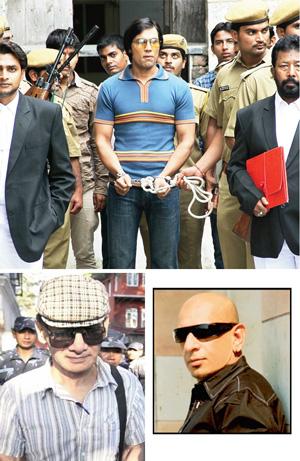
still from Main Aur Charles (top); Charles Sobhraj (Left) & Salim Asgarally (Inset)

BACKSTAGE PASS

FILM: Main Aur Charles

Fashion designer Salim Asgarally doesn’t normally agree to do costumes for films, but transforming Bollywood actor Randeep Hooda into Charles Sobhraj, the Bikini Killer of the 1970s, was an irresistible lure. Charles, who was convicted and jailed for 12 murders between 1976 and 1997, and is currently serving a sentence of life imprisonment in Nepal, was a dapper dresser.

“He is an intriguing character whose journey spans different eras. I was ready for the challenge that Prawaal Raman’s film, Main Aur Charles, offered,” explains Salim. Three months of intensive research yielded several different looks to experiment with.

Charles moves from Bangkok to Delhi and on to Mumbai and Goa with a tenure in the Tihar jail in between. Salim promises a new look for the con man in every city.

“In Bangkok, he’s urbane in trench coats, which make way for suits and blazers in subdued checks teamed with’70s style ties, his trademark beret and designer glasses when he’s trying to pass himself off as a moneyed gentleman in Delhi,” explains the stylist. Salim points out that even when he was jailed, till he was convicted, Charles was allowed to throw Christmas parties, give interviews to the international press and wear his own clothes.

“So, among the prison uniforms was this intelligent, widely travelled, conman with a suave front. The continuity had to be retained even when he fled to Mumbai after a daring jail break. But once in Goa, he turns into a carefree hippie in swimming trunks and shorts,” says Salam, who wanted the clothes to become an aid in storytelling while making Randeep look good on screen.

Usually Hindi films don’t bother with authentic depiction of period styles or the colour palette, but for Salim they were the basic parameters. When designing for Charles, he stuck to muted hues like sky blues, coffee browns and olive green.

And to ensure that everything was in sync, he ordered vintage frames and borrowed costumes from Nepal’s royalty. The ‘Main’ in the title is Amod Kant, the investigating officer on the case, whose observations the film is based on.

Adil Hussain, who plays the character, is mostly seen in his cop’s uniform, but when with the family, he’s a typical middle-class civilian in trousers and bush shirts, a distinct contrast to the flashy Charles.

There are other characters too, like Richard Thomas, the British hitchhiker Charles meets, whom Salim dressed up in casual denims, and Mira, the Delhi law student, who Richa Chadha brings to life on screen. Mira is togged up in Indo- Western wear and junk jewellery from the Janpath market. Smiles Salim, “Main Aur Charles wasn’t an easy film, but it was a satisfying project.”

source: http://www.punemirror.in / Pune Mirror / Home> Others> Leisure / by Roshmila Bhattacharya / July 06th, 2014

The rich legacy of Nizams

Mir Osman Ali Khan receives Prime Minister Lal Bahadur Shastri at Begumpet airport. Responding to Shastri’s appeal, the Nizam donated 5000 kg of gold to the National Defence Fund

OF POWER AND POISON

British Residents in Hyderabad spoke of the mutual antipathy that apparently existed between the Nizam’s eldest wife Dulhan Pasha and her sons Prince Azam Jah and Prince Moazzam Jah.

The mother of the two Sahebzadas was keen to marry them to her nieces, described by the Resident, Lt. Col. T.H. Keyes, as “two half-starved little Hyderabadi girls”. She had even been involved in a public slanging match with the Nizam on the issue of her sons’ marriage, and was supposed by British officials to be not fond of her sons.

To illustrate the discord between the mother and sons, Keyes recalled what Prince Moazzam Jah used to reveal to his guests. The younger Sahebzada claimed that his mother wanted to become the regent on the Nizam’s death. “When someone takes the cue and asks how she could be regent when his brother and he are of age, he replies: ‘We won’t be here. Mother is always experimenting with poisons, and there are no cats left in King Kothi’.”

…The rumours of poisoning in 1932 also led to revival of allegations that Sir Salar Jung I had been poisoned by the Nizam’s zenana as he had been insisting on Mahbub Ali Pasha being sent to Europe for education.

TONNES OF GOLD FOR WAR EFFORT
Mir Osman Ali Khan, Nizam VII, may have delayed his decision on merging Hyderabad State with the Indian Union after Britain left the country in August 1947, but he created a record when he responded to the call of Prime Minister Lal Bahadur Shastri in 1965. The PM visited Hyderabad and requested the Nizam to contribute generously to the National Defence Fund, set up in the wake of the Indo-Chinese skirmish. Without a second thought, Mir Osman Ali announced that he would contribute five tonnes of gold to augment the war fund. In monetary terms, the Nizam’s contribution was about Rs 75 lakh, or about three-fourth of the annual Privy Purse he received from the Centre. In terms of today’s gold price in the international market, this donation translates to a whopping Rs 1,500 crore.

The Nizam’s donation of 5,000 kg of gold to the National Defence Fund in 1965 was the biggest ever contribution by any individual or organisation in India and remains unsurpassed till today.

However, known for his wit and frugality, Mir Osman Ali Khan did not hesitate to seek the return of the empty iron boxes once the gold coins and bars were offloaded in Delhi. “I am donating the gold and not the iron boxes. Do not forget to return them,” the Nizam told the officials even as his son-in-law and confidant Ali Pasha carried trays of gold coins from the Nazri Bagh Palace. The empty boxes were duly returned.

ALBERT ABID AND     THE SILK SOCKS

Hyderabad’s history is full of fables about foreigners who gave Hyderabad a new meaning and purpose. Albert Abid Evans, a Jew from Armenia, gave Hyderabadis their first department store and a new name to an otherwise abandoned locality.

Abid’s, one of the busiest business centres of Hyderabad, owes its name to Albert Abid, who set up a shop that served the needs of Hyderabadis from needle to grains and stationery to clothes.

…As a valet of the Nizam, Abid looked after Mir Mahbub Ali Khan’s wardrobe, the biggest of its kind in the world. It is rumoured that Nizam VI did not like to repeat his silk socks and the enterprising Abid would put the used socks back in the packet they came in and recycle them while his trusting master kept paying for new socks! If rumours are to be believed Abid also helped himself to the rings from his ruler’s fingers when his ruler was in a stupor and promptly thanked the Nizam very profusely the next morning for gifting him the jewellery.

AN UNHAPPY PRINCESS
Niloufer Khanum Sultana, who was called the world’s most beautiful woman, was pained by the fact that she was unable to produce an heir and felt that she had failed in her duty as a princess. It was especially upsetting for her that her cousin Princess Durru Shehvar had given birth to two lovely boys, Prince Mukarram Jah and Prince Muffakham Jah.

On a particular occasion, when Princess Niloufer was in England in response to her mother’s distress call about her financial and social health, Prince Moazzam Jah decided to let everyone know that it was not he who was responsible for their childless marriage. He brought a lady of doubtful repute into his home, and was apparently able to demonstrate his virility. Princess Niloufer returned from England to learn of this treachery and never shared a room with her husband again.

Her husband’s betrayal was not the only fact that pained her. She also returned to find that her personal maid, of whom she was very fond, had died in childbirth. This moved her to open a hospital for children and women. The Niloufer Hospital is still a sought-after medical institution today.

This gesture of the childless princess earned her a place in the hearts of Hyderabadis.

BORN TO RULE
Prince Mukarram Jah had the best of education — Doon, Harrow, Cambridge and LSE. He also trained at the Sandhurst Military Academy in England. …During a visit to Hyderabad, his first wife Princess Esra said he was a bright young man when she married him but was overwhelmed by the fast-paced political developments at home.

In 1969, the Indira Gandhi government decided to discontinue the annual purse to descendants of former rulers of princely states, who numbered around 600. The land bank vanished with the Land Ceiling Act. Mukarram found himself at a complete loss when he lost his privy purse and was compelled to sell off his assets. He would dispose invaluable jewellery to meet his immediate needs without verifying the value of the gems he offered for sale. Not surprisingly, he was taken for a ride by everyone, while the list of those dependent on him kept expanding. This list had grown to include the legion of relatives (14,792), servants (14,000), grandfather’s concubines (42) and children (hundreds of them).

Despairing of the circumstances he found himself in after the demise of his grandfather, this last true blue Nizam protested, “I was taught to be a soldier, not an administrator.”

Given the title of the eighth Nizam and brought up as an imperial prince of the Ottoman Empire, he was not wrong when he once confessed, “I was born to rule. That was the only thing I was prepared for.” Some believe it was the burden of having to deal with so many trusts and their beneficiaries that caused Mukarram Jah to leave for Australia.

3,000 WIVES?

In June 1936, the India Office received a letter from one Irene Cowen from Sheffield, asking how many wives the Nizam had and how many children. “A Hyderabadi had given a lecture on the Nizam’s government and in that had mentioned that the Nizam had over 3,000 wives, but he did not know the exact number, and had described him as having ‘a good many children’,” she wrote. …The Foreign Office sent Miss Cowen this reply: “The statement made by your lecturer is, on (the) face of it, incredible. Nor is any record of the kind suggested maintained in this office.”

The Nizam, however, did have over 100 women in his zenana and was even accused of kidnapping some. As for his progeny, it is claimed that Osman Ali Pasha sired over 147 children. A more modest estimate puts this figure at 28 daughters and 44 sons. However, like most stories about the Nizam, this claim is often exaggerated.

According to his daughter Basheerunissa Begum, it was impossible even for the family to keep track of everyone in the palace as each wife of the Nizam and her children had separate living quarters within the palace and had numbered badges to help the palace guards keep track of their security and identity.

source: http://www.deccanchronicle.com / Deccan Chronicle / Home> Lifestyle> Offbeat / DC Correspondent / June 01st, 2014

From berry to brew…

CoffeeKODAGU21sept2014

Coffee was once a closely guarded Arabian secret until Baba Budan, a Sufi mystic, smuggled seven beans from Yemen and scattered them on the hills of Chikmagalur, from where it spread to the rest of India…Anurag Mallick and Priya Ganapathy spill the beans on the story of coffee, the world’s most popular brew.

It was Napoleon Bonaparte who once grandly announced, “I would rather suffer with coffee than be senseless.” Sir James MacKintosh, 18th century philosopher, famously said, “The powers of a man’s mind are directly proportional to the quantity of coffee he drank.” In The Love Song of J Alfred Prufrock, when T S Eliot revealed, “I have measured out my life with coffee spoons,” he hinted at the monotony of socialising and the coffee mania of the 1900s. German musical genius J S Bach composed the ‘Coffee Cantata’ celebrating the delights of coffee at a time when the brew was prohibited for women.

“If I couldn’t, three times a day, be allowed to drink my little cup of coffee, in my anguish I will turn into a shriveled-up roast goat,” cried the female protagonist! French author Honoré de Balzac wrote the essay ‘The Pleasures and Pains of Coffee’ to explain his obsession, before dying of caffeine poisoning at 51. Like Voltaire, he supposedly drank 50 cups a day! So, what was it about coffee that inspired poets, musicians and statesmen alike?

Out of Africa

Long before coffee houses around the world resounded with intellectual debate, business deals and schmoozing, the ancestors of the nomadic Galla warrior tribes of Ethiopia had been gathering ripe coffee berries, grinding them into a pulp, mixing it with animal fat and rolling them into small balls that were stored in leather bags and consumed during war parties as a convenient solution to hunger and exhaustion! Wine merchant and scientific explorer James Bruce wrote in his book Travels to Discover the Source of the Nile that “One of these balls they (the Gallas) claim will support them for a whole day… better than a loaf of bread or a meal of meat, because it cheers their spirits as well as feeds them”. Other African tribes cooked the berries as porridge or drank a wine prepared from the fermented fruit and skin blended in cold water.

Historically, the origins of the coffee bean, though undated, lie in the indigenous trees that once grew wild in the Ethiopian highlands of East Africa. Stories of its invigorating qualities began to waft in the winds of trade towards Egypt, North Africa, the Middle East, Persia and Turkey by the 16th Century. The chronicles of Venetian traveller Gianfrancesco Morosini at the coffee houses of Constantinople in 1585 provided Europeans with one of the foremost written records of coffee drinking. He noted how the people ‘are in the habit of drinking in public in shops and in the streets — a black liquid, boiling as they can stand it, which is extracted from a seed they call Caveè… and is said to have the property of keeping a man awake.’

It was only a matter of time before the exotic flavours of this intoxicating beverage captured the imagination of Europe, prompting colonial powers like the Dutch, French and the British to spread its cultivation in the East Indies and the Americas. Enterprising Dutch traders explored coffee cultivation and trading way back in 1614 and two years later, a coffee plant was smuggled from Mocha to Holland. By 1658, the Dutch commenced coffee cultivation in Ceylon (Sri Lanka). The word ‘coffee’ is apparently derived from qahwah (or kahveh in Turkish), the Arabic term for wine. Both the terms bear uncanny similarity to present day expressions — French café, Italian caffè, English coffee, Dutch koffie or even our very own South Indian kaapi. A few scholars attribute ‘coffee’ to its African origins and the town of Kaffa in Ethiopia, formerly known as Abyssinia. However, the plant owes its name “Coffea Arabica” to Arabia, for it was the Arabs who introduced it to the rest of the world via trade.

As all stories of good brews go, coffee too was discovered by accident. Legends recount how sometime around the 6th or 7th century, Kaldi, an Ethiopian goatherd, observed that his goats became rather spirited and pranced after they chewed on some red berries growing in wild bushes. He tried a few berries and felt a similar euphoria. Excited by its effects, Kaldi clutched a handful of berries and ran to a nearby monastery to share his discovery with a monk. When the monk pooh-poohed its benefits and flung the berries into the fire, an irresistible intense aroma rose from the flames. The roasted beans were quickly salvaged from the embers, powdered and stirred in hot water to yield the first cup of pure coffee! This story finds mention in what is considered to be one of the earliest treatises on coffee, De Saluberrima Cahue seu Café nuncupata Discurscus, written by Antoine Faustus Nairon, a Roman professor of Oriental languages, published in 1671.

Flavours from Arabia

Coffee drinking has also been documented in the Sufi monasteries of Yemen in South Arabia. Arabic manuscripts dating back to the 10th Century mention the use of coffee. Mocha, the main port city of Yemen, was a major marketplace for coffee in the 15th century. Even today, the term ‘mocha’ is synonymous with good coffee. Like tea and cocoa, coffee was a precious commodity that brought in plenty of revenue. Hence, it remained a closely guarded secret in the Arab world. The berries were forbidden to leave the country unless they had been steeped in boiling water or scorched to prevent its germination on other lands.

In 1453, the Ottoman Turks brought coffee to Constantinople, and the world’s first coffee shop Kiva Han opened for business. As its popularity grew, coffee also faced other threats. The psychoactive and intoxicating effects of caffeine lured menfolk to spend hours at public coffee houses drinking the brew and smoking hookahs, which incited the wrath of orthodox imams of Mecca and Cairo. As per sharia law, a ban was imposed on coffee consumption in 1511. The Grand Mufti Mehmet Ebussuud el Imadi was hailed when he issued a fatwa allowing the consumption of coffee, by order of the Ottoman Turkish Sultan Selim I in 1524.

Though subsequent bans were re-imposed and lifted at various points of time according to the whims of religious politics and power, coffee pots managed to stay constantly on the boil in secret, or in the open, for those desirous of its potent influence. Given the fact that Sufi saints advocated its uses in night-time devotions and dervishes and Pope Clement VIII even baptised the bean to ward off the ill-effects of what was regarded by the Vatican as ‘Satan’s drink’ and the ‘Devil’s Mixture of the Islamic Infidels’ till the 1500s, it is easy to see why coffee is nothing short of a religion to some people.

Coffee enters India & beyond

Surprisingly, India’s saga with coffee began in 1670 when a Muslim mystic, Hazrat Dada Hyat Mir Qalandar, popularly known as Baba Budan, smuggled seven beans from Arabia and planted them on a hillock in the Chikmagalur district of Karnataka. The hills were later named Baba Budan Giri in his memory. From here, coffee spread like bushfire across the hilly tracts of South India.

In 1696, Adrian van Ommen, the Commander at Malabar, followed orders from Amsterdam and sent off a shipment of coffee plants from Kannur to the island of Java. The plants did not survive due to an earthquake and flood but the Dutch pursued their dream of growing coffee in the East Indies with another import from Malabar. In 1706, the Dutch succeeded and sent the first samples of Java coffee to Amsterdam’s botanical gardens from where it made further inroads into private conservatories across Europe. Not wishing to be left behind, the French began negotiating with Amsterdam to lay their hands on a coffee tree that could change their fortunes. In 1714, a plant was sent to Louis XIV who gave it promptly to the Jardin des Plantes at Paris for experimentation. The same tree became the propagator of most of the coffees in the French colonies, including those of South America, Central America and Mexico.

The importance of coffee in everyday life can be gauged by the fact that its yield forms the economic mainstay of several countries across the world; its monetary worth among natural commodities beaten only by oil! It was only in 1840 that the British got into coffee cultivation in India and spread it beyond the domain of the Baba Budan hills.

Arabica vs Robusta

Kodagu and Chikmagalur are undoubtedly the best places to know your Arabica from your Robusta and any planter worth his beans will trace coffee’s glorious history with pride. The strain that Baba Budan got was Coffea arabica and because of its arid origins, it thrived on late rainfall. Despite its rich taste and pleasing aroma, the effort required to cultivate it dented its popularity. The high-altitude shrub required a lot of tending, was susceptible to pests, and ripe Arabica cherries tended to fall off and rot. Careful monitoring at regular intervals affected production cost and profitability.

Till 1850, Arabica was the most sought-after coffee bean in the world and the discovery of Robusta in Belgian Congo did little to change that. Robusta (Coffea canephora), recognised as a species of coffee only as recently as 1897, lived up to its name. Its broad leaves handled heavy rainfall much better and the robust plant was more disease-resistant. The cherries required less care as they remained on the tree even after ripening. Its beans had twice the caffeine of Arabica, though less flavour, which was no match for the intense Arabica. It was perceived as so bland that the New York Coffee Exchange banned Robusta trade in 1912, calling it ‘a practically worthless bean’!

But in today’s new market economy, the inexpensive Robusta makes more commercial sense and is favoured for its good blending quality. Chicory, a root extract, was an additive that was introduced during the Great Depression to combat economic crisis that affected coffee. It added more body to the coffee grounds and enhanced the taste of coffee with a dash of bitterness. Though over 30 species of coffee are found in the world, Arabica and Robusta constitute the major chunk of commercial beans in the world. ‘Filter kaapi’ or coffee blended with chicory holds a huge chunk of the Indian market. Plantations started with Arabica, toyed with Liberica, experimented with monkey parchment and even Civet Cat coffee (like the Indonesian Luwak Kopi — the finest berries eaten by the civet cat that acquire a unique flavour after passing through its intestinal tract), but the bulk of India’s coffee is Robusta.

As the coffee beans found their way from the hilly slopes of the Western Ghats to the ports on India’s Western Coast to be shipped to Europe, a strange thing happened. While being transported by sea during the monsoon months, the humidity and winds caused the green coffee beans to ripen to a pale yellow. The beans would swell up and lose the original acidity, resulting in a smooth brew that was milder. This characteristic mellowing was called ‘monsooning’. And thus was born Monsooned Malabar Coffee.

Kodagu, India’s Coffee County

Currently, Coorg is the largest coffee-growing district in India, and contributes 80% of Karnataka’s coffee export. It was Captain Lehardy, first Superintendent of Kodagu, who was responsible for promoting coffee cultivation in Coorg. Jungles were cleared and coffee plantations were started. In 1854, Mr Fowler, the first European planter to set foot in Coorg, started the first estate in Madikeri, followed by Mr Fennel’s Wooligoly Estate near Sunticoppa. The next year, one more estate in Madikeri was set up by Mr Mann. In 1856, Mr Maxwell and Mcpherson followed, with the Balecadoo estate. Soon, 70,000 acres of land had been planted with coffee. A Planters Association came into existence as early as 1863, which even proposed starting a Tonga Dak Company for communication. By 1870, there were 134 British-owned estates in Kodagu.

Braving ghat roads, torrid monsoons, wild elephants, bloodthirsty leeches, hard plantation life and diseases like malaria, many English planters made Coorg their temporary home. Perhaps no account of Coorg can be complete without mentioning Ivor Bull. Along with District Magistrate Dewan Bahadur Ketolira Chengappa, the enterprising English planter helped set up the Indian Coffee Cess Committee in 1920s and enabled all British-run estates to form a private consortium called Consolidated Coffee. In 1936, the Indian Cess Committee aided the creation of the Indian Coffee Board and sparked the birth of the celebrated India Coffee House chain, later run by worker co-operatives. With its liveried staff and old world charm, it spawned a coffee revolution across the subcontinent that has lasted for decades.

Connoisseurs say Coorg’s shade grown coffee has the perfect aroma; others ascribe its unique taste to the climatic conditions and a phenomenon called Blossom Showers, the light rain in April that triggers the flowering of plants. The burst of snowy white coffee blossoms rends the air thick with a sensual jasmine-like fragrance. Soon, they sprout into green berries that turn ruby red and finally dark maroon when fully ripe. This is followed by the coffee-picking season where farm hands pluck the berries, sort them and measure the sacks at the end of the day under the watchful eye of the estate manager.

The berries are dried in the sun till their outer layers wither away; coffee in this form is called ‘native’ or parchment. The red berries are taken to a Pulp House, usually near a water source, where they are pulped. After the curing process, the coffee bean is roasted and ground and eventually makes its journey to its final destination — a steaming cup of bittersweet brew that you hold in your hands.

The ‘kaapi’ trail

In India, coffee cultivation is concentrated around the Western Ghats, which forms the lifeline for this shrub. The districts of Coorg, Chikmagalur and Hassan in Karnataka, the Malabar region of Kerala, and the hill slopes of Nilgiris, Yercaud, Valparai and Kodaikanal in Tamil Nadu account for the bulk of India’s coffee produce. With 3,20,000 MT each year, India is the 6th largest coffee producer in the world.

Recent initiatives to increase coffee consumption in the international and domestic market prompted the Coffee Board, the Bangalore International Airport and tour operator Thomas Cook to come together and organize coffee festivals and unique holiday packages like The Kaapi Trail to showcase premium coffees of South India. Coffee growing regions like Coorg, Chikmagalur, B R Hills, Araku Valley, Nilgiris, Shevaroy Hills, Travancore, Nelliyampathy and Palani Hills are involved in a tourism project that blends leisure, adventure, heritage and plantation life.

At the Coffee Museum in Chikmagalur, visitors can trace the entire lifecycle of coffee from berry to cup. In Coorg and Malnad, besides homestays, go on Coffee Estate holidays with Tata’s Plantation Trails at lovely bungalows like Arabidacool, Woshully and Thaneerhulla…
The perfect cuppa

Making a good cup of filter coffee traditionally involves loading freshly ground coffee in the upper perforated section of a coffee filter. About 2 tbs heaps can serve 6 cups. Hot water is poured over the stemmed disc and the lid is covered and left to stand. The decoction collected through a natural dripping process takes about 45 minutes and gradually releases the coffee oils and soluble coffee compounds. South Indian brews are stronger than the Western drip-style coffee because of the chicory content. Mix 2-3 tbs of decoction with sugar, add hot milk to the whole mixture and blend it by pouring it back and forth between two containers to aerate the brew.

Some places and brands of coffee have etched a name for themselves in the world of coffee for the manner in which coffee is made. The strength of South Indian Filter coffee or kaapi (traditionally served in a tumbler and bowl to cool it down), the purity of Kumbakonam Degree Coffee, the skill of local baristas in preparing Ribbon or Metre coffee by stretching the stream of coffee between two containers without spilling a drop… have all contributed to the evolution of coffee preparation into an art form.

With coffee bars and cafes flooding the market and big names like Starbucks, Costa, Barista, Gloria Jean’s, The Coffee Bean, Tim Horton’s and Café Coffee Day filling the lanes and malls in India along with local coffee joints like Hatti Kaapi jostling for space, it’s hard to escape the tantalising aroma of freshly brewed coffee. And to add more drama to the complexities of coffee, you can choose from a host of speciality coffees from your backyard — Indian Kathlekhan Superior and Mysore Nuggets Extra Bold, or faraway lands — Irish coffee and cappuccino (from the colour of the cloaks of the Capuchin monks in Italy) or Costa Rican Tarrazu, Colombian Supremo, Ethiopian Sidamo and Guatemala Antigua. And you can customise it as espresso, latte, mocha, mochachino, macchiato, decaf… Coffee is just not the same simple thing that the dancing goats of Ethiopia once enjoyed.

source: http://www.deccanherald.com / Deccan Herald / Home> Supplements> Sunday Herald / September 21st, 2014
MADRAS 375 – A gastronomic journey with biryani

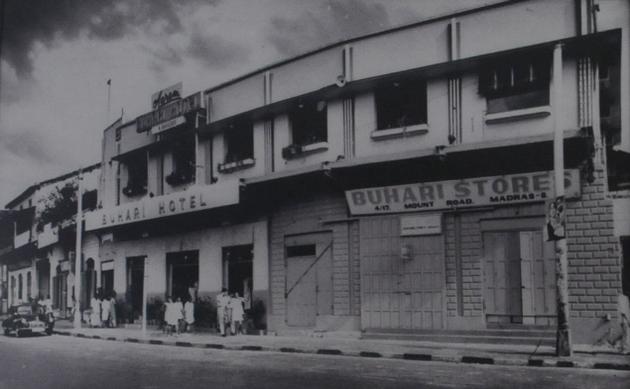
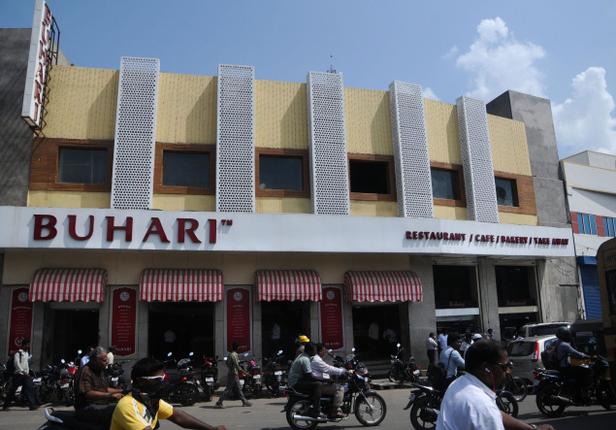
The Anna Salai branch of Buhari Hotel is its most famous -- Photo: Special Arrangement / The Hindu
The Anna Salai branch of Buhari Hotel is its most famous — Photo: Special Arrangement / The Hindu

When Buhari hotel on Anna Salai threw its gates open to the public in 1951, it ushered in a number of firsts: espresso machines making cup after cup of steaming coffee, a jukebox playing tunes of the times, and cutlery and crockery brought from London to give a “fine-dining experience to Madras’ foodies.”

A.M. Buhari, who brought the mildly spiced, fragrant biryani from Colombo, was a pioneer of sorts. Whether it was a boiled egg nestled in a bed of saffron-infused rice or Chicken 65 fried to perfection —called thus after the year it was created in, he set himself apart in the restaurant business early on.

Buhari Hotel's Anna Salai branch is its most famous -- Photo: R. Ragu / The Hindu
Buhari Hotel’s Anna Salai branch is its most famous — Photo: R. Ragu / The Hindu

The brand Buhari that has now become synonymous with biryani in the city emerged out of 200 different blends Mr. Buhari experimented with.

As a ten-year-old, Mr. Buhari had to leave his village in Tirunelveli district and go to Sri Lanka. After a self-sponsored education, it just took a few years to figure out his calling. Starting with trading in food and groceries, he finally set up Hotel De Buhari in Colombo and introduced the brand’s eponymous dish.

“My grandfather then wanted to return to India and came to Madras to set up Buhari,” says Nawaz Buhari, who currently heads the original branch. Today, the brand has proliferated with nine branches in the city and is looking to set up four more in the near future.

______________________________________________________________________

Dates in History
1956
A.M. Buhari introduced a jukebox and a espresso coffee machine at the Anna Salai branch

1965
Chicken 65, a deep fired chicken dish with telltale red colouring, was introduced at the hotel

1996
The one-man show by A.M. Buhari ended, after a 45 year period with his death
Did you know !

Actor M.G. Ramachandran loved the special almond chicken soup and the cassata icecream from buhari so much that a parcel of both was frequently requested to be delivered to his house

______________________________________________________________________ 

While the Anna Salai branch is its most famous, the one at Marina, set up in 1956, became the popular hangout of the 60s and 70s.

Seventy-year-old A.H. Lathif, as famous as the restaurant, has worked in the restaurant for 54 years. “I have served actors Raj Kapoor, Sivaji Ganesan and Sridevi,” he says.

Having lost the branch at Marina beach in the 80s, and the one opposite Central station very recently, the brand, headed by the patriarch till the time of his death in 1996, is now run by the family’s third generation.

With the increase in the number of branches, there are, predictably, differences in the quality and taste of the biryani. “The family has taken a decision to never go for the franchise model of business, because we cannot compromise on the brand image my grandfather worked so hard to build,” says Mr. Nawaz Buhari.

source: http://www.thehindu.com / The Hindu / Home> News> Cities> Chennai> Madras 375 / by Evelyn Ratnakumar / Chennai – August 13th, 2014

Son Of The Soil

Mehmood Khan, Unilever’s global innovation head, goes back to his native village with a plan to turn it around.

Nai Nangla in Haryana’s Mewat district could be just another Indian village, ridden with the usual problems of a people trapped in poverty: Lack of healthcare and clean water, low productivity, high unemployment and illiteracy. But Haji Siddiq Ahmed, a local farmer in his late 60s, sees a different vision. “I want this village to be an adarsh (model) village. Others should look up to this village — that this is what an ideal village should be like,” he says.
The image Ahmed sees is actually taking shape in this quiet village with a majority Muslim population. What’s more surprising is the way the change is taking hold. It may be difficult to imagine the humble folk of Nai Nangla as business executives, but the cool concepts reviving the economy of the village are no less professional.

Take dairy farming, which engages nearly 80 percent of the villagers. Earlier, all they could get was Rs. 12 for a litre of milk; today they can get as much as Rs. 25. Three years ago, female literacy was at 2 percent; today, almost 85 percent of the female population can sign their names and 86 percent of the children in the district are enrolled in schools. Some women are also learning to sew and are setting up their own tailoring units. Companies like insurance provider Aviva, ICICI Bank and Larsen & Toubro are beginning to look at Mewat both as a market and as a field for recruitment. They have hired locals, offering dramatically higher incomes.

Image: Amit Verma / CHARGING UP: Memhood Khan's plans changed Ramzaan's life for the better. The young man treats Khan to a ride on his new motorcycle
Image: Amit Verma /
CHARGING UP: Memhood Khan’s plans changed Ramzaan’s life for the better. The young man treats Khan to a ride on his new motorcycle

The man behind these changes is a Nai Nangla native, someone who left the village nearly 40 years ago in search of an education and a career. His name is Mehmood Khan. Now 54, he is Unilever’s innovation head.

Now, thanks to him an experiment in introducing market economy is taking shape at Nai Nangla and the district of Mewat. An impossible feat for an outsider, but something the people of Nai Nangla have welcomed from one of their own. “Focus on education and use enterprise to bring change by leveraging resources in villages,” he says.

Khan has worked and lived in many countries over the years, making London his home for the last nine. But his link to his roots always remained alive; he would visit his village two or three times a year. He still remembers trudging a couple of kilometres to school everyday and taking cattle out to graze.
“I somehow landed a seat in university and then got into IIM-Ahmedabad. I was ejected by the system,” he says.
For the last five years, Khan has been hard at work to change “the system”.

He is converting a local resource, livestock, into a productive enterprise. He roped in the National Dairy Development Board’s Mother Dairy to spur Nai Nangla’s milk output and break the stranglehold that milk vendors had on local dairy farmers. At one time, these vendors — middlemen really — would lend money to farmers to buy milch animals.
In return, they would demand milk supply at low fixed prices until the loans were repaid. For most farmers, their income was too low to enable them to repay the debt. The result: They remained trapped in debt.
Khan was troubled by this age-old exploitation. He spoke to Mother Dairy and ushered in a new system to break this debt trap. Debt-laden farmers were given loans from institutions so they could repay the vendor and start selling direct to Mother Dairy. “Almost 25 people got loans to buy cattle, without having to pay any bribes,” says Ahmed.

Others who could repay on their own, did so and started selling to Mother Dairy for a better price. This competition forced the milk vendors to match market prices. Overall, incomes improved.
In July 2008, Mother Dairy set up milk collection centres in Nai Nangla and six other villages. In the first week, it got 70 litres of milk. Today, Nai Nangla alone gets 250 litres a day. “Gross income from agriculture has gone up from Rs. 80 lakh to Rs. 1.2 crore,” says Khan. “Milk (has become) a constant income source in a village which has seasonal income due to Kharif and Rabi crops.”

source: http://www.forbesindia.com / Forbes India / Home> Features – Beyond Business / by Neelima Mahajan-Bansal / June 05th, 2009

Syed Mushtaq Geelani passes away

Srinagar: 

 Prominent businessman and President of J&K Chemists and Druggists Association Syed Mushtaq Geelani passed away last evening due to a massive heart attack. He was 74.

Geelani suffered attack at his residence in Sheikhpora (Budgam) and was shifted to Budgam hospital. However, he breathed his last within minutes. He was later buried in his ancestral grave yard in Khankahi Mu’alla.

Fourth day (Rasm-e-Chaharum) will be observed on September 20 (Saturday) at 10.30 AM at Khankahi Mu’alla and later a condolence meeting will be held at their residence- Fitrat Abad Sheikhpora (Budgam).

He was brother-in-law of noted writer and poet Farooq Nazki and uncle of IGP (Crime) Syed Javaid Mujtaba Geelani. Rising Kashmir extends solidarity with Geelanis and Nazki’s over this loss.

source: http://www.risingkashmir.com / Rising Kashmir / Home> RK News / Srinagar – Thursday,  September 18th, 2014

Haj pilgrims opt for Bareilly’s surma

Bareilly :

Scores of Haj pilgrims across the world traveling to Mecca prefer to apply ‘Bareilly-wala surma’ (kohl manufactured in Bareilly) rather than the kohl prepared in other Asian and Arab countries.

A city-based manufacturer claimed that the demand for Bareilly’s surma increases by over 30% during Haj time as compared to other seasons.

The USP of Bareilly’s surma is that it is finely grinded and instantly provides cool comfort to the eyes, he says.

“While preparing surma, other manufacturers based in India and other countries use a grinder and other modern appliances for crushing the semi and precious stones. However, we still stick to our traditional method of using baton stone (sil batta) which helps us finely crush the metal or stone,” said M Haseen Hashmi (67), the manufacturer of Bareilly’s surma.

He claimed that it was his ancestors who made surma popular in the country after setting up their firm in 1794. Since then, generation after generation of Hashmi’s family has been producing surma. At present, hundreds of people in Bareilly work under him.

Even the baton stone used in the preparation of surma is unique. “The stone is black and it is available in Jaipur. The black stone crushes the metal into fine pieces but metal is unable to grind the black stone,” said Hashmi, as he recalled that it was the same black stone with which Shahjahan wanted to build a black Taj Mahal.

He added, “The main ingredient of Bareilly’s surma is the stone of Kohetoor mountain which is located in Egypt. From there, it is exported to India and we purchase it from traders.”

Shabbu Miyan, who is the manager of Khanquah-e-Niyaziya and younger brother of Sajjadanasheen, said, “It is mentioned in the holy Quran that applying surma extracted from the Kohetoor mountain is pious and good for eye-sight. Even Prophet Mohammed used to apply surma made from Kohetoor stone before going for prayers and sleeping.”

Though surma prepared in Bareilly is available in more than 80 varieties, a majority of Haj pilgrims from all over the world opt for surma gulab. “It is a general surma and can be applied by anyone,” said Hashmi. Apart from this, pilgrims prefer to apply ‘surma mamira 777’ and ‘sadi kajal’. ‘Surma mamira 777’ actually causes irritation in the eyes, but cleans all impurities, he claimed.

Sadi Kajal is for women and enhances the beauty of their eyes. The other popular variants help in curing diseases related to eye-sight like red spot in sclera (white area of eyes), eyes pain and also help in improving eye-sight, Hashmi claimed.

The manufacturer provides Bareilly’s surma to agents in Mumbai and Delhi who later export it to Arab countries. As pilgrims offer prayers at Mecca on Eid-ul-Adha or Bakri-Eid, the demand for the city-based surma soars by 30% three months before the festival.

Masqood Hasan, a timber businessman who will be leaving for Haj soon, said, “Applying surma is following Prophet Mohammed. As people across the country are attracted to Bareilly’s surma, I always get surma packed to gift it to my relatives and friends whom we meet during Haj.” Another Haj pilgrim, Shahida Mahmood (42) said, “Bareilly’s surma not only provides comfort but also protects the eyes from all diseases.”

source: http://www.timesofindia.indiatimes.com / The Times of India / Home> City> Bareilly / by Priyangi Agarwal, TNN / September 08th, 2014

Kalam Stresses on Importance of Family in Nation Building

New Delhi :

Economic growth or military strength alone won’t make India strong, a truly sustainable society, at the heart of which is the family, is very much necessary, argues former President A P J Abdul Kalam in his new book.

Kalam and celebrated Jain thinker late Acharya Mahapragya in the book “The Family and the Nation” say that only a strong and happy family can lead to a strong and noble nation.

In writing the book, the ideas of the two authors were shaped by their interaction during the past few decades with millions of countrymen hailing from different walks of life.

“Each interaction enhanced our experience and added to our understanding of the development of a noble family, a noble society and a noble nation,” they write.

While embarking on this journey of writing a book, we realised the magnitude of connectivities involved and the extent of our society’s evolution during the last few centuries,” they say.

“It is true that all of us realise that today’s world is a connected one. Technology and travel have nearly made the world a global village. The world has to become a federation of nations.

A nation is a federation of states, social groups, families and individuals. So what is needed is a situation of live and let live.

“One’s needs, aspirations, accomplishments are all important. But there has to be a concept of a noble nation, where the welfare of the whole nation as a whole is ingrained in the thinking and actions of its people.

This is the need of the hour. How do we achieve this idea of a noble nation,” the authors ask.             According to them, their visualisation of a noble nation is two-fold.

“One is internal, concerned with the individual and encompassing the family, community and society. Another concerns enterprise and covers the issues of livelihood, business, distribution of wealth and respect for individual property and rights,” they say.

The authors do not offer any new theory or postulate any new concept but draw from the heritage of our civilization.

“The bottom line is that a citizen with a value system respects the family, respects society, and thereby respects the nation. Furthermore, the person is conscious that he or she is a part of the world family.

“The operational line is the prosperity of people with adequate earning capacity. We call such a nation a developed nation. Economic prosperity and an embedded value system would promote a peaceful and prosperous society and thereby the evolution of a happy nation,” they write.

The book, published by HarperCollins India, stresses on the values that make for a truly sustainable society, at the heart of which is the family. For it is not economic growth or military strength alone that will make India strong.

Sustainable success comes from values, and these can sustain a society and a nation even in times of hardship. The book expresses an ideal by which Indian society may prosper and speaks of how spirituality can help create a noble nation and a better world. It provides a valuable counterpoint to the modern-day emphasis on consumerism and the philosophy of more is better, highlighting the sanctity of the natural world and its great power to evoke human creativity and love.

The two writers bring their vast experience to bear on this important subject. As the authors put it, it’s only a strong and happy family that will lead to a noble nation, one that can be a true fulfilment of 5,000 years of India’s civilization.

source: http://www.newindianexpress.com / The New Indian Express / Home> Nation / by PTI / August 26th, 2014

Job market on wheels, an initiative by Hyderabad Municipal Corporation, TMI

Hyderabad :

You do not have to now visit offices of placement firms to look for jobs in Hyderabad. Look out for Hyderabad Municipal Corporation’s mobile employment vans in your area.

In a novel initiative, the Greater Hyderabad Municipal Corporation and city-based training and placement firm TMI Group has pressed into service a fleet of eVans (employment vans) which would move around select employment zones in the city.

Job seekers can approach these mobile vans, which will help them look for the right job on the basis of their qualification and experience.

Earlier, the corporation and TMI had together set up Youth Employability Centres across seven locations.  However, it was seen that for many job seekers, it was difficult to approach these centres.  This led to the concept of mobile employment vans.

“These mobile vans are equipped to provide placements in the micro small and medium enterprises, apart from the private sector,” T Muralidharan, managing director of TMI said.

City Mayor Mohammed Majid Hussain launched the eVans today.

source: http://www.thehindubusinessline.com / Business Line / Home> National / The Hindu Bureau / Hyderabad – August 16th, 2014

‘It’s a good time to raise money in India’

Rehan Yar Khan, Founder, Orios Venture Partners

Rehan Yar Khan is upbeat. He has just closed his first fund of ₹300 crore, raised only from domestic investors. “It was not difficult at all. The market and the people were supportive of the product,” he says.

His venture capital firm Orios Venture Partners last week closed a ₹300-crore fund. “We got it done in about eight months, whereas the average fund raising time is 18 months, especially if it is the first fund,” he says. This is an indication of how smooth it was for him to convince investors in India – mainly promoters of companies and wealthy individuals – to put their money in his fund.

He says his track record as an angel investor helped him when he made the pitch with prospective investors. In India, when you approach investors, most of whom are promoters of companies, you better have a track record to show. Else, getting the money will be difficult, is what he has to say for those wanting to follow his route of raising domestic funds. “I would say spend some time building your track record before you talk to them,” is Rehan’s suggestion. Abroad, most of the investors are fund managers.

Weak rupee

In what way is a domestic fund different from one raised abroad? “At least, I won’t have to worry about rupee depreciation,” says Rehan. A depreciating rupee has been the Achilles heel of even some of the best fund managers, for it can wipe out your IRRs (internal rate of returns).

Rehan, who has been an angel investor since 2008, decided to go in for a venture capital fund because he wanted to participate in subsequent rounds of funding of exciting enterprises and not confine himself to just writing out the first cheque. As an angel investor, you are not able to cut larger cheques and venture capital firms also do not allow you to co-invest if you are not going to contribute large sums of money, at least ₹5 crore and more, according to Rehan.

A home-grown Mumbai boy as he describes himself, 42-year-old Rehan, who studied Political Science and Economics at St Xavier’s College, says to be an entrepreneur was always in his blood and his parents encouraged him. He recalls he set up his first venture when he was in the last year in college. His first business between 1992 and 1998, was one that imported seeds. Then he had a venture that was in the telecom space, from 1998 to 2004. From then, he had an online flower service, his first exposure to the Internet space. With the surplus from Flora2000.com, he started investing in start-ups, the most notable ones being Druva. He has invested in 19 start-ups in seven-eight years, before launching Orios.

Orios, according to Rehan, will announce its first investment in the next two-three weeks. It will be in a software products company from Mumbai-Pune that sells in the US. He has known the entrepreneur for a long time. “This is a good time to raise money in India. There are lots of opportunities,” he adds.

source: http://www.thehindubusinessline.com / Business Line / Home> Tech / by N. ramakrishnan / August 25th, 2014