She walked the ramp Saturday at the Lakme Fashion Week Winter-Festive show in a pink long skirt with silver lace work and a pink crop top. She accessorised her appearance with pearl bangles. (Source: Express Photo by Dilpi Kagda)
SUMMARY
Pink is not Shruti Haasan’s favourite colour, but she loved donning designer Shehla Khan’s creation.
Pink is not Shruti Haasan’s favourite colour, but she loved donning designer Shehla Khan’s creation in the same shade and says that she felt like a Victorian princess.
She walked the ramp Saturday at the Lakme Fashion Week Winter-Festive show in a pink long skirt with silver lace work and a pink crop top. She accessorised her appearance with pearl bangles.
“This is not my colour. I don’t wear pink, but this outfit is amazing. It makes me feel so feminine. I am feeling like a Victorian princess in this attire,” Shruti told reporters post the show.
A melange of western and Indian designs, the clothes with bolder embroideries and embellishment in silver and gold, looked elegant and glamorous.
“I have used colours like aesthetic floral, pink… These collections are more for festive season with heavier work on embellishments,” said Khan who presented skirts, dresses, off shoulder long gowns among others.
source: http://www.indianexpress.com / The Indian Express / Home> Entertainment> Bollywood / Indo-Asian News Service / Mumbai- August 24th, 2014
Rehan Yar Khan is one of India’s most prolific angel investors . Known as the trend spotter and an entrepreneur himself (founder of Flora2000.com), Rehan Yar Khan started investing back in 2007-08. He was one of the earliest investors in companies like Druva and Ola Cabs that have gone on to raise more than $100 million together. Rehan has more than 20 investments and now, he has raised the first formal fund of INR 300 cores- Orios Venture Partners (read our interview with Rehan back in 2012). Work has been on with respect to the Orios Venture Fund for close to an year now.
While 30% of the fund was raised from institutional investors, majority 70% of the corpus has been raised from ultra high-networth individuals (UHNIs). Reports say that Khan who has personally contributed 5% of the corpus, and the promoters of a Delhi based listed auto manufacturer are said to be one of the anchors in the fund. The fund will be used to invest in Software Product companies. A majority of the total corpus will be set aside for later stage funding (series ‘A’ and ‘B’), while about 10-15 per cent will be reserved towards seed funding. “While we are not restricting to any segment, we see analytics, Big Data, software for mobile phones and new platforms to be promising,” Khan had mentioned in an interview.
Rehan has had many successful investments apart from Druva and Ola Cabs. There are companies like Jigsee (acquired), Sapience, Unbxd, Pretty Secrets, etc. in his portfolio. Khan says that Software products is 1% of our exports while the rest is services, but in the next 10 years products will be 10-20%, which will create some great companies. Orios will be investing INR 1-20 crores in a company and intends to stay invested for seven years or more. In our earlier interview, we asked Rehan about his advice to someone new who’s looking to pitch to him, here’s what he told us,
” It is very important that when you are going to a pitch event or for raising money, you should ideally study, like in college, or when you go for a job you should ideally study the employer you going to join. So when you go for raising funding, you should study the person you are raising funding from. You should study what works while raising funding, speak to a lot to other entrepreneurs, do a lot of research, attend few events and learn and go prepared. “
source: http://www.yourstory.com / Home> Inspire, Innovate, Ignite / by Jubin Mehta / August 19th, 2014
Jubin Mehta
Jubin is an old timer at YourStory. Deeply entrenched in the Indian startup ecosystem, he has written about more than 1000 startups. With an engineering background and a keen interest in data analysis, his passion for writing and entrepreneurship makes him a perfect match for Yourstory. He operates from the mountains in Dharamshala where he also runs a hackbase. He can be reached on Twitter @jub_in and on mail at jubin@yourstory.com
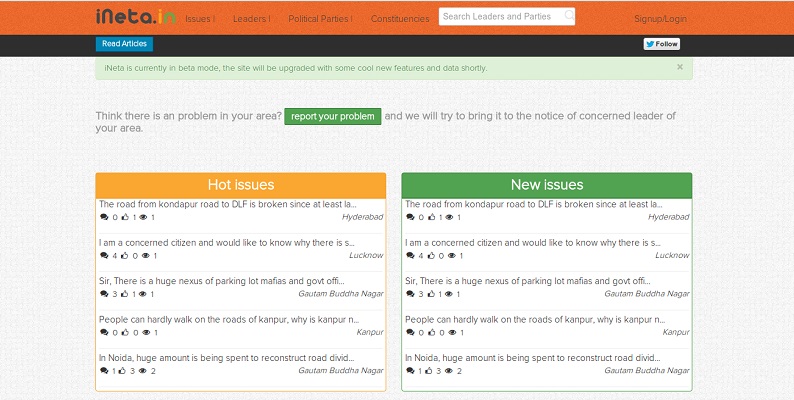
Entrepreneurs are among those who are most influenced by decisions made by the government. And as leaders in different spaces, you would have a strong opinion or two about politicians, governance and the general state of affairs. The problem is, how do you get your ideas across to your elected representatives? That’s where iNeta, a futuristic platform for transparent politics, can make a difference.
The rise of AAP and catapulting of IIT grad Arvind Kejriwal into the chief minister’s seat in Delhi after mass campaigns involving citizens indicates that the time is ripe for initiatives like iNeta. If an awakened electorate wants to have a say in governance, what better way than to use technology and the web to facilitate the process?
An idea whose time has come
Software engineer Akram Khan started thinking about this long before Anna, AAP and Arvind arrived on the scene. He was talking politics with his flatmates in Hyderabad in 2007, when it struck him that there was a need for a new age communication platform to dialogue with elected representatives. He was working with Mindtree then. The consensus was that meeting leaders to tell them about any issue was very cumbersome if not impossible.
Around then, Tata launched the Jago Re campaign, and Akram’s friends thought he had come up with an idea whose time had come. But it remained dormant as Akram didn’t know how to develop on it. He went on to do other things: An MBA, a stint as the business development guy with his friend’s startup Innocent Technosoft – a mobile application and game development company based in Lucknow – and a startup of his own in the software consultancy space.
It was 2012 and a next generation platform that enables open governance still didn’t exist. So, “I thought, why not take it up again? By now, I had enough experience and knowhow to develop it,” Akram told YourStory.
iNeta went live on 2 October 2013 – the birth date of Mahatma Gandhi. The space in which iNeta operates is different from other platforms like Voterite, which are more into campaigning. “iNeta is about solving people’s problems. It is about open governance and taking e-governance to the next level.”
It is based on the idea that people want to talk to elected leaders about issues that affect them. “People need an audience with their leaders. It is an attempt to make governance open source, like how it should be in a true democracy,” explained Akram.
“It is often rightly said that the road to Delhi goes from Lucknow and that is where we are based. It is the hub of political activity in India,” Akram says. He runs iNeta with his friend, Ankur Srivastava, an IT engineer and a clean politics enthusiast.
“We are funding iNeta from our own pockets right now. Since I am a web developer, there are no bills to pay for developing the site. But of course, there are other costs. We are looking to expand and hire cartoonists, writers and analysts. So we have to look at ways this could be achieved,” Akram says.
Risks of the plunge
Akram says it was his basic curiosity to look for solutions to problems around him and see if they succeed or not that led him to entrepreneurship. “I am already working on my next idea while I develop iNeta for scaling.”
Like most entrepreneurs, the big risk for Akram too is financial. He has an education loan to pay off. The EMI makes him “always cash-strapped”, he quips. “Apart from that I am not afraid. I believe persistent effort is required for success and if I keep at it I would be successful.”
Born and brought up in Lucknow, Akram did his engineering from the Manipal Institue of Technology. After eight years in South India, he moved back to Lucknow to startup. “My initial plan was to develop a site like shiksha.com while I was doing my MBA in 2009. But it did not materialize and I had to drop it,” he recalls.
He learnt web development while working at Innocent Technosoft. “I was more of an idea guy and always used to look for someone to develop it. Since I did not have enough funds to get my ideas developed, I thought, let me try building one on my own. I trained myself in web development and started doing web consultancy to make money,” he says.
Akram lives in a joint family, where his mother looks after the house and father runs a manufacturing unit for textile accessories. His younger brother is a doctor. He has two sisters. One is a journalist with a leading Urdu newspaper in Noida and the other is doing her M.Tech in Biomedical engineering.
Getting politicians to respond
The political climate of India is such that it would take mainstream parties a lot of time to understand the power of a platform like iNeta and how to effectively utilise it, Akram feels. “We have spoken to several political leaders who liked the idea but are not quite keen to get on board as they think it might hurt them – which could be true, but this kind of platform is the future.”
The problem iNeta tackles is quite universal. People elect their leaders and then get to see them only when their elected term is about to get over. Even if a leader really wants to connect with people, there is no dedicated platform for this. It is impossible for him to meet every individual in his constituency anyway. This is where iNeta comes in with a web-based interactive solution.
Talking numbers, there are 790,000,000 (79 crore) voters in India. Of these, 120,000,000 (12 crore) are first-time voters. “We consider all the voters as part of our market because everyone at some stage or the other has a problem and would like their leader to be available to at least listen,” Akram says.
Currently, they have a working product ready and live. “We are improving it on a daily basis. Funding would really speed up our expansion plans.”
The best part about iNeta, he says, is seeing how happily people receive the idea when he talks to them about it. “When we tell someone about iNeta there is a big smile on their face as if this is something which they have been looking for and would love to use.”
To take it forward to a larger audience, they plan to try an SMS module, where people would get to know more about the contestants in their constituencies by sending an SMS. “We would be creating a blog and introducing our website in our Facebook and Google+ groups and other online forums. Later on, we might go for online advertisements as well,” he says.
Right on top of their list of priorities, though, is to get political parties on board, using the platform to engage with voters. “As they are the ones who would eventually answer to the people, unless they come on board, it is a useless idea. So that is top priority as of now.”
If enough people get on to iNeta, we bet politicians will soon follow, in this election season.
Are you curious about how Arvind Kejriwal won over Delhi in a year of starting the Aam Aadmi Party? You might like this: 5 secrets to the success of AAP
source: http://www.yourstory.com / Your Story / Home / by Malavika Velayanikal / February 10th, 2014
For 30 years, the face of Dastkar has worked with craftspeople, documenting their art and preparing them for an urban clientele
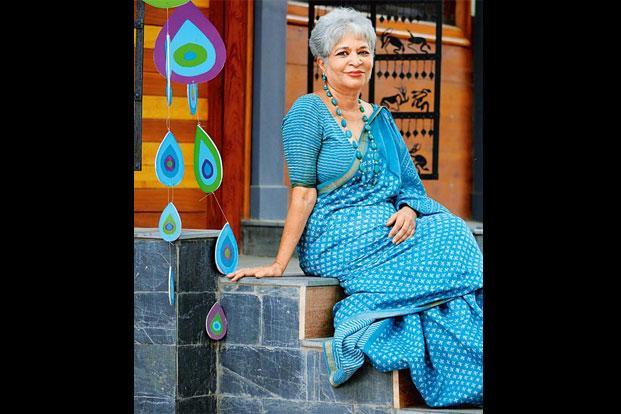
Laila Tyabji at Kisan Haat, New Delhi. Photo: Priyanka Parashar/Mint
Freedom to use skills | Laila Tyabji In 1949, a two-year-old girl came to Bombay from Belgium, where her father had served as India’s first ambassador. She was pale-skinned, cute, funny and only spoke French. “I was such a joke in India,” recalls Laila Tyabji. She promised herself that she would never be laughed at again, lost her French and became the Indian child she was. Tyabji was born a few months before the metaphorical midnight into a Sulaimani Bohra Muslim family of Delhi in 1947.
In 2012, Tyabji was honoured with the Padma Shri Award for her long and inspiring contribution to India’s crafts sector as a co-founder, and now the chairperson, of Dastkar—a society for crafts and craftspeople. Her only regret receiving it was that it was given by Pratibha Patil, who Tyabji felt was an inappropriate choice as president. “Especially as the attempt was to tell us that her appointment was a triumph for women,” she adds.
Clarity of thought and commitment to larger goals in life distinguish her from the six purposeful women who founded Dastkar in 1981. The other five founding members moved on with goals of their own, while Tyabji stayed on and became the face of Dastkar and its Nature Bazaars held all over India. Despite a large, well-delegated team, people only want to speak to Tyabji when they call the office. Even if it is just to ask for directions to Kisan Haat, now the permanent venue for the bazaars in Delhi. Tyabji spent years trying to get a permanent venue.
As a young student at the Welham Girls’ School in Dehradun who would later study art in Vadodara and go on to work with Japanese artist Toshi Yoshida in Tokyo, her perseverance has never deserted her. Spirited and outspoken, Tyabji rode motorcycles in the 1970s before feminism gained momentum in India. Tyabji remembers feminist activist Kamla Bhasin telling her many years ago that it was because she painted her toenails that she saw her as a social butterfly. That was till Bhasin saw her working assiduously in the villages of Bihar and yet fitting in perfectly in south Delhi’s drawing rooms.
In the late 1970s, Tyabji got a three-month assignment from the Gujarat State Handloom & Handicrafts Development Corporation Ltd’s Gurjari outlet, to go to Kutch as a visiting designer. Her belongings in a steel trunk, she drove through villages, documenting the work of craftspeople, finding things for Gurjari, preparing them for an urban clientele. “Three months became six. I would sit with the women to do the embroideries and the patchwork. The only way to teach is with personal intervention, that’s how you can hone skill,” she says.
Kutch became the hotbed of work and inspiration for her, its crafts evoking a lifelong quest; its craftspeople, her friends and protégés. “Beyond her image as a sophisticated and stylish woman, Laila could make and hold a bridge with craftspeople. She has been there for them through calamity and crisis; from teaching them how to price their products to valuing themselves. The respect and affection they have for her is rare,” says Archana Shah, founder of the chain of Bandhej stores and author of Shifting Sands, Kutch: Textiles, Traditions, Transformations, launched by Tyabji in New Delhi earlier this year.
“I would sit with the women to do the embroideries and the patchwork. The only way to teach is with personal intervention, that’s how you can hone skill.”
After returning from Kutch, Tyabji, whose personal style then was about motorbike helmets and textiles, worked as a buyer and merchandiser for Taj Khazana, the store known for finely curated Indian arts and crafts, at New Delhi’s Taj Hotel on Man Singh Road. “A small logistics issue about the Assam state emporium not being able to supply handmade cane baskets to the city-based Taj Khazana propelled the Dastkar idea. That rural craftspeople needed new and commercially viable markets and a bridge to meet their customers and sell directly to them,” she says. The first Dastkar crafts bazaar was held at the Triveni Kala Sangam in New Delhi in 1981.
Mapping the personal and creative direction for craftspeople, forming a link between them and their city buyers, and doggedly working on design issues, pricing, sizing and policy changes for the evolution of the crafts sector as a business model could sum up Tyabji’s work at Dastkar. “They are skilled professionals and should not be treated as downtrodden or as relics as they often are,” insists Tyabji, who has also been associated with Sewa (the Self Employed Women’s Association) of Lucknow. Designer Aneeth Arora of péro, who has been following Tyabji’s work for the last 10 years, says this assimilation of crafts and textiles at Nature Bazaars helps her tremendously as a designer keen on textile exploration and use. The bazaars, feels Arora, are research centres to understand innovation and locate weavers to work with from different regions.
Tyabji’s path, though, is not always well-paved. Craftspeople are deeply conservative, averse to experimentation, nervous about newness. They don’t understand fast colours, form or financial management, she explains. “When you begin you are cocky and romantic, but craftspeople can also start misbehaving. Sometimes you put in so much work but what comes out is a mouse.”
That’s why she has always been a hands-on mentor. Till Tyabji turned 50 and decided to cut her hair short and only wear saris, thus creating the lasting image we have of her, she only wore clothes she had hand-stitched and hand-embroidered. In her closet hangs a fine collection of pherans, anarkalis and a variety of long kurtas with Lambani, Kutchi and Chikankari embroidery done by Tyabji—each piece stunning.
She still paints her toenails. And still hand-embroiders in her free time. She stopped wearing a watch 25 years ago, when she realized that being chronically punctual while working in rural India, where time was a flexible concept, was stressful. She is more nonchalantly stylish than ever before. Short, salted hair, handloom saris, Kolhapuri chappals, kohl-lined eyes, jewellery that is distinctive but never too craftsy, Tyabji cuts a tall figure on India’s “most stylish” lists.
“Laila is knowledge-oriented, decisive and endlessly patient without using her personal influence to change the tide of things,” says Shelly Jain, personnel and programme head at Dastkar and Tyabji’s colleague of 17 years. Her home mirrors her; it is modern Indian without ethnic monstrosities for artefacts. And as its mistress, the only daughter among four siblings, she cooks, bakes, knits and sews enviably.
She admits she came close to getting married a few times but “shrank back” because she was never sure how she would feel 15 years down the line. She shrugs in her characteristic way even as her god-daughter Urvashi Kumari Singh comes up to hug her amma. “She is a fair, cool and sometimes irritable mom,” says Singh.
Is there a retirement age when the trajectory of Dastkar and its chairperson might move in different directions? “I have been trying to retire for the last five years, but haven’t been successful so far,” says Tyabji. That’s when a little emotion wells up—who on earth wants her to retire anyway.
“You can’t imagine Dastkar without Laila,” as Jain says.
source: http://www.livemint.com / Live Mint & The Wall Street Journal / Home> Lounge> Business of Life> Indulge / Home – Leisure / by Shefalee Vasudev / Saturday – Augut 09th, 2014
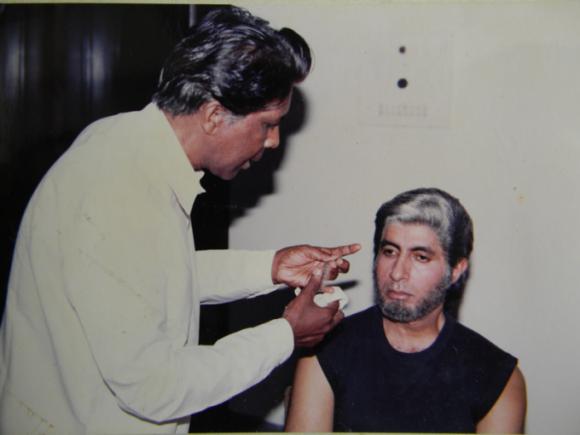
Kabir created hairpieces for many major stars, including Amitabh Bachchan in the 1988 action film Shahenshah / Photo: S Kabir / Siraj Sheikh
SURENDRA’S NATURAL HAIR STUDIO isn’t easy to find. But for the wigged wooden heads marking the entrance, this workshop in a grimy alley off Mumbai’s SV Road looks just like any other. Inside, however, it becomes clear that the studio belongs to one of Hindi cinema’s most sought-after wig makers, Surendra Salvi. The foyer walls are lined with photos of Salvi with actors—everyone from Salman Khan to Prem Chopra—sporting his toupees, beards and moustaches.
Salvi ushered me into a workshop where five uniformed employees created mesh bases for new wigs, and wove hairpieces and hair extensions. Almost all of Salvi’s wigs are made of natural hair, but he uses various amounts of synthetic material for those on tight budgets. “Natural hair is expensive,” he explained. Even-length, pre-sorted hair can cost up to Rs 70,000 per kilogram.
Salvi, a Mumbai native, told me he always wanted to be part of the film industry, though it took some time to break into the business. “First I did clerical work,” he said, “then I fitted car lamps for an auto company. Then I worked in a talcum powder factory. Then I had enough.” In the early 1980s, he started assisting the makeup duo of brothers Anil and Pradeep Pemgirikar by making wigs and beards for extras and body doubles. Over the following decades, he made it big on his own. His hairpieces have been used by Boman Irani in 3 Idiots, Shahrukh Khan in Ra.One, Akshay Kumar in Action Replayy, and many other superstars. When I visited two months ago, Salvi was fashioning wigs for director Anurag Kashyap’s upcoming Bombay Velvet. He also does work for regional films, television commercials, and individual clients.
Pradeep Pemgirikar, Salvi’s mentor, oversaw makeup, wigs and prosthetics for the films of director Manmohan Desai in the 1980s. He now runs Mod Wig Centre from his humble three-room house in Dadar, taking whatever work he gets from the Marathi and south Indian film industries. Pemgirikar, who said his best work was on the 1992 film Khuda Gawah, rued changing trends in the movie business. “Everyone wants a natural look now,” he said, “but in those days, every third character in a Manmohan Desai film had a wig.”
If the 1980s and 1990s had the Pemgirikars, the 1960s and 1970s—when bouffants, pompadours and beehives were all the rage—had S Kabir and Victor Pereira. Kabir came to Mumbai from Kolkata in the 1950s to assist his older brother S Amin, who was then already a makeup man and wig maker of repute. Kabir worked with almost all the leading men of the time, his son Siraj told me, and made wigs for such classics as China Town, Mirza Ghalib, Aandhi, Padosan, Sholay, Shahenshah and Kalicharan. But his most illustrious client was Pran, whose memorable get-ups from Upkar and Zanjeer to Amar Akbar Anthony and Don cemented his reputation as one of Hindi cinema’s greatest character actors.
Kabir passed away in 1994. Siraj is keen to keep his father’s legacy alive, and, with his brother Farooque, now runs the wig studio S Kabir & Sons, established by Kabir in the late 1950s, in Andheri East. “Wig making is an art, but it never gets the respect it deserves,” he said. “Even personal drivers and spot boys who serve chai to actors get mentioned in film credits. We often don’t.” An online search showed S Kabir credited for his work on only three movies, though Siraj claimed he actually worked on between seven and eight hundred films. Siraj also lamented the end of the era when prevailing fashions meant greater demand and profits, and more time to craft great wigs. He remembered being called on to make a hairpiece for Amitabh Bachchan several years ago. “They wanted it in three days,” he scoffed. “Is three days enough time to make a wig?” Sorting hair bought from wholesalers is a gruelling process, and the average wig requires at least five to seven days of work.
Victor Pereira, S Kabir’s contemporary, now lives in Mangalore, near his home town of Moodabidri. Although no longer associated with the film industry, he was happy to talk about his glory days over the phone. Having learned his trade in Mumbai from S Amin, Kabir’s brother, Pereira got his break on the 1969 film The Killers, starring Dara Singh and Helen. Although the film was a dud, he went on to craft all of Helen’s wigs from then on, putting his stamp on her looks in song videos such as ‘Piya tu ab toh aaja’ and ‘Mehbooba mehbooba,’ and films such as The Train and Don. Victor also worked, among others, with Hema Malini, Vyjayanthimala, Sharmila Tagore, Mala Sinha and Rekha. His most challenging project, he said, was director Kamal Amrohi’s 1983 release Razia Sultan. “Kamal Amrohi was such a stickler. Woh ek ek baal dekhte the (He used to check each strand of hair). He told me, ‘Hema Malini rani hai (Hema Malini is a queen). I want the best. Nothing else will do.’”
source: http://www.caravanmagazine.in / The Caravan / Home> Reporting & Essays / The Lede / by Roshini Nair / July 01st, 2014
Mughal carving, as the name suggests, is a tradition that traces back to Persia and was aimed at royal palaces. / By Special Arrangement / The Hindu
Hapur-based Sardar Hussain lends freshness to Mughal wood carving.
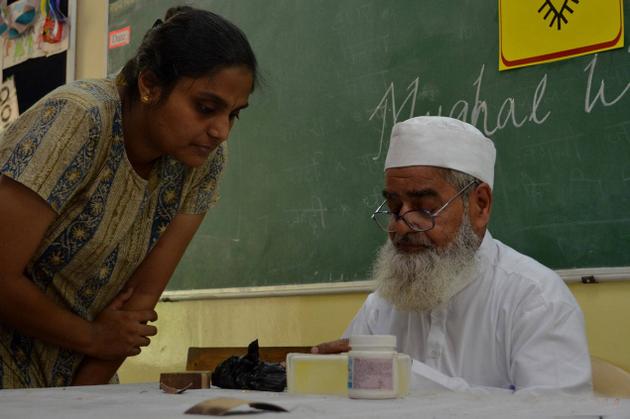
Surrounded by eager participants who show off their handiwork, Sardar Hussain has a beatific smile on his weather-beaten, bearded face as he patiently explains the nuances to the youngsters at one of the intensives at the recent SPIC MACAY’s International Convention. That the shilpa guru is the fourth generation craftsman who has mastered the Mughal technique of wood carving and is the recipient of many a National and international recognition (UNESCO Seal Of Excellence Award) for his craft sits easy on his fragile shoulders.
Mughal carving, as the name suggests, is a tradition that traces back to Persia and was aimed at royal palaces. So, the work itself is a smooth marriage of intricate floral patterns on a grand scale. Sardar Hussain’s family began small but over generations, things have changed. He came into prominence when he was conferred the National Award for making wooden blocks in 1981. He says, “Traditionally, we made blocks but soon we realised that it was not a perennial source of income. So, I reinvented the craft by exploring and expanding the vocabulary during the Golden Age Exhibit at the Festival of India in 1985. I manufactured a wooden box and a round block. I used that block as a lid. I tried a similar thing with square boxes and blocks. What I also did is to use brass inlay on the carved works. And viola! a new craft was born.”
Sardar Hussain has a beatific smile on his weather-beaten, bearded face as he patiently explains the nuances to the youngsters at one of the intensives at the recent SPIC MACAY’s International Convention. / by Special Arrangement / The Hindu
Today, Sardar Hussain runs a thriving export business called Sajawat Handicrafts in his hometown in Chhipiwara, Hapur District of Uttar Pradesh. He is assisted by his sons, both also National Award winners. And among their clients are Fab India and CCI. Says Hussain, “We work with designers from these outlets and create articles according to their requirements. That way we are sure of our work reaching customers.” Taking about the craft itself, he says, “The most important aspect here is the finish. The end product is a reflection of your skill and unless that is in places, the piece falls flat.” The wood used is mostly sheesham but the artisan also uses mango wood these days. “The advantage of mango wood is that its texture allows for it t be painted in different colours.”
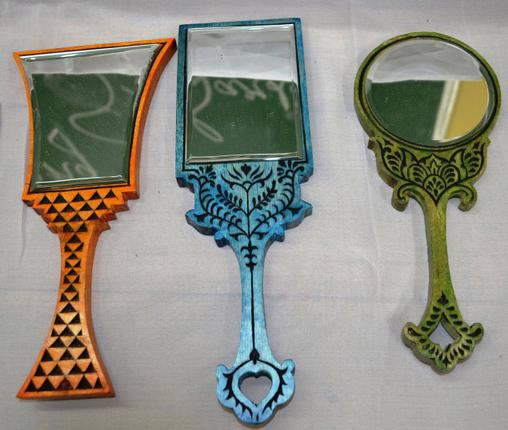
Today, Sardar Hussain’s oeuvre includes jewellery boxes, pen stands, brightly hued hand mirrors, bangle boxes, wall hangings, photo frames and of course, blocks. Though he does workshops off and on, he feels “What is needed today is for the youngsters to take to a craft with sustained interest. And keep at it till they perfect it. That is somehow lacking today.”
And yes, the wizened craftsman has kept pace with technology, thanks to his children. His entrepreneurial venture is accessible on the Internet (sajawathandicraft.com) and he can be contacted at sajawat.handictaft@gmail.com
source: http://www.thehindu.com / The Hindu / Home> Features> Friday Review / by Savitha Gautam / New Delhi – July 31st, 2014
Prestige Group head Irfan Razack buys a 4000-sq ft plot once owned by the late Ambaram Fakirbhai. The property is just a block away from a shop from where the rags-to-riches story of the construction group began
Irfan Razack says he bought the property since it is close to their first store, Prestige Men’sStore, on Commercial Street
Virgin land in the heart of the city is priceless. Those with ramshackle old buildings on them command a hefty price. But the benchmark was raised on Monday when a plot on upscale Commercial Street was sold for Rs 62,500 per square foot — the highest in the city so far.
Irfan Razack, head of the Prestige Group, the top realty firm, purchased the 4,000-sq ft plot from the heirs of late Ambaram Fakirbhai, the textile businessman who once owned large swathes of land in the area now known as Indiranagar. Razack was the lone bidder in the auction.
The plot, which bears municipal registration numbers 15 and 16 and includes a dilapidated building, was bought for a staggering Rs 25 crore at a public auction. This is the second largest realty deal in Bangalore in the last fortnight; the previous one was an eight-acre plot in Koramangala which sold for Rs 345 crore.
“The going rate around Commercial Street is in the Rs 40,000 – 45,000 per sq ft range,” a realtor who monitors transactions in the central business district said. “But the Ambaram deal is a real stunner.”
The Prestige Group are not saying what they plan to do with the plot just as yet, but a source said, “The area is close to the hearts of the Prestige Group founders as they started with a cloth shop on Commercial Street close to the Ambaram plot. By buying land a stone’s throw away from their old store, they have shown that they want to stay attached to their Commercial Street roots.”
Confirming the transaction, Razack told Bangalore Mirror, “The property is very close to my property – Prestige Men’s Store. I bought this because there is only one property between this and our property. The Prestige Men’s Store is a family business run by me and my brothers (two of them). It was a matter of pride to buy a property on this street.”
On the exorbitant price, Razack indicated that he had little choice. “The court had fixed a minimum price of Rs 25 crore for the property,” Razack said. “We were the only ones to participate in the bidding as two others who had registered their names, didn’t participate. Though the price is on the higher side, I don’t think I will regret my decision five years later. It is a family deal and my company has no role in this. This was a personal decision.”
The auction brought the curtains down on a 43-year-old feud by heirs of Ambaram over the land. “Since the heirs could not reach a consensus on sharing the prime property, the court decided to auction it,” sources said.
According to the copies accessed by Bangalore Mirror, the original propositus was Ambaram Fakir Bhai. He married Jeeva Bai and after her death, he married Girija Bai. They had six sons — Thakurdas, A Venilal, A Ramanlal, A Sukhlal, A Krishna, A Narayan — and five daughters — Umiya Ben, Vichkore Ben, Parvathi Ben, Narmada Ben and Tara Ben.
After the death of Ambaram, his eldest daughter, Vichkore Ben, filed a suit for partition of her 1/12 share in the estate left behind by her father. Though the suit was still pending, she sold her right, title and interest in favour of four of her brothers — Krishna, Venilal, Sukhlal and Narayan. Similarly the other four daughters received a certain sum of money from these four brothers in lieu of their share in full and final settlement. Thakurdas and Ramanlal were each allotted 1/7th share.
The above suit culminated in final decree proceedings initiated by Thakurdas in 1981. A commissioner was appointed to work out the modalities of actual partition. He reported to the High Court that the properties were not divisible and that it should be disposed in a public auction. Dispute arose in regard to the mode of partition of shop premises No 15/15, Commercial Street and premises No 27 F, E and D of Hospital Road. It resulted in a civil revision petition before the High Court (CRP No 2920/1973).
All the brothers, however, had reached an agreement that Thakurdas and Ramanlal were to be given first option to purchase 5/7 share of the parties to the suit by depositing Rs 10.71 lakh in the trial court on or before November 14, 1974. When they failed to deposit the amount, the other brothers – Venilal, Sukhlal, Narayan and Krishna — purchased the share of Thakurdas and Ramanlal by depositing a sum of Rs 1.75 lakh each.
Since the four brothers did not have funds, they had obtained a loan from Vijaya Bank to buy their bothers’ shares. It was also agreed that immediately after the purchase of share of Thakurdas and Ramanlal’s shares, premises bearing No 15 and No 16 of Commercial Street and premises No 27 F, E and D of Hospital Road will be substituted as security for the repayment of the loan in place of the individual properties of Venilal and Sukhlal.
Property was locked for 15 years
The three brothers entered into possession in April 1976, while another brother, Narayana, took actual possession of the entire premises in 1978. But he kept the premises under lock and key for 15 years, rendering it unfit for human habitation. Moreover the loan obtained from Vijaya Bank had not been repaid despite repeated reminders. A fresh suit was filed in 1991 for partition of the property. The suit was contested and during the pendency of the suit, two brothers, Venilal and Sukhlal, died.
During the pendency of appeal, parties decided to settle the matter amicably and they filed a compromise petition before the High Court on September 5, 2005. The court decided to auction the property.
Earlier bids unsuccessful
The court’s reserve price for the Commercial Street property was set at Rs 12 crore, while that of the Hospital Road properties was Rs 6 crore. All bids were to commence for a price higher than the reserve price indicated above.
Advocate K N Krishna Rao, representing the family members of Ambaram, told Bangalore Mirror, “During 2005, the Hospital Road property was sold for Rs 18 crore at an auction, but there was no buyer for the Commercial Street property. The Commercial Street property was again put up for auction in 2008 and again there were no bidders. Finally on Monday, the auction was conducted with the initial bid amount of Rs 25 crore and if was successful.”
source: http://www.bangaloremirror.com / Bangalore Mirror / Home> Bangalore> Cove Story / by Atul Chaturvedi, Bangalore Mirror Bureau / July 23rd, 2014
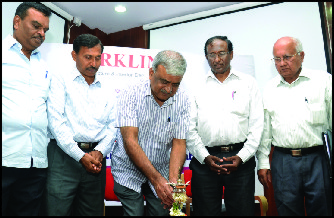
SJCE Principal Dr. Shakeeb-Ur-Rehman is seen inaugurating the workshop at SJCE premises this morning as architects M.P. Nagaraju, Chandrashekar, Shashi Kumar look on.
Mysore :
Arklines Architecture and Interior Design Studio, Kuvempunagar, in association with Sri Jayachamarajendra College of Engineering (SJCE) had organised a day-long workshop on architectural solutions for eco-habitat system at SJCE premises here today.
The workshop was attended by over 100 architects, designers and students.
Inaugurating the workshop, SJCE Principal Dr. Shakeeb-Ur-Rehman said that a serious thought should be given to check environmental pollution. He suggested to make use of the solar and wind power to its best, to tide over energy crisis. He added that the common man should be made aware of environmental protection and energy conservation. Arklines President and Architect S. Shashi Kumar, Architect Chandrashekar and others were present.
source: http://www.starofmysore.com / Star of Mysore / Home> Sports General News / July 10th, 2014
A lavish Annual Day party was organised for the entire staff of AMA Herbal in Lucknow on Tuesday . The directors of the company , along with their families and staff, got together to celebrate the occasion.
The evening began with a vote of thanks by Yawar Ali Shah, one of the directors, to all the employees who had helped achieve this success. Awards were given out to all those who had worked hard for this.
Yawar Ali Shah
Amid applause and cheers, trophies were given to more than 35 employees of the company . While Anshul Shukla and Neeraj Choubey jointly won the award for Employee Of The Year, while Khalil Ahmed was felicitated for 40 years of continuous service.
Several more awards were announced for excellent performance in administration, production, marketing, etc.
AMA Herbal, is a world renowned company dealing in natural textile dyes and herbal colours, Telling us more about the company , Yawar Ali Shah said, “Our herbal products are the result of our dedicated research and development team, which is responsible for making eco-friendly products for consumers.
Our natural products with Bio Active ingredients are well recognized by dermatologists in India and the world. The credit for our success goes to our team and that is what we are celebrating today .”
The guests again erupted in cheers as the launch of four new products was announced at the party .
AMA is in the process of introducing the Vegetal Bio Hair Colour in the US market in the coming year along with promoting natural dyes and gulal, in the European market.
The company also has plans to expand in the domestic market with wellness clinics and more herbal products.
source: http://www.timesofindia.indiatimes.com / The Times of India / Home> City> Lucknow / TNN / July 10th, 2014
Prominent Indian businessman and head of Middle East’s retail major, Lulu group, MA Yusuff Ali has won the prestigious Abu Dhabi Chamber election for the third time.
Ali, 58, Chairman of the Abu Dhabi-based EMKE who had won previous two elections to elect 15 board members of the Abu Dhabi Chamber of Commerce and Industry, retained his seat with 1,721 votes, highest among expatriate candidates.
The elections held yesterday during which 14,555 votes were cast also elected 13 local citizens to the board of directors for a four-year term, his office said today.
Four panels representing 70 Emiratis, including five women and eight expatriate candidates, participated in the elections.
Abu Dhabi Chamber is the only government organisation in the world where expatriates can get elected to the director board through a democratic election process, a statement said.
“I am pleased with faith reposed on me by the business community of Abu Dhabi and I thank them wholeheartedly for helping me to come out victorious once again,” Yusuff said.
“I am fully aware of the responsibilities and I will strive to further enhance the business and investment relationship between India and UAE and work closely with all stake holders for mutual benefit,” he said.
Sheikh Nahyan bin Mubarak Al Nahyam, UAE minister for Culture, Youth and Community Development congratulated Yusuff Ali on his hat-trick victory and asked him to continue his work and contribute to the growth of the UAE in general and Abu Dhabi in particular.
Abu Dhabi Chamber is an autonomous entity under government supervision which works towards streamlining and regulating business and industrial affairs in the Emirate of Abu Dhabi.
source: http://www.outlookindia.com / Outlook / Home> News / Dubai – June 27th, 2014