As the Ramzan season is all set to begin during the end of this month, remittances to Kerala is expected to rise 20-25 per cent than normal levels. Usually Ramzan is the period when the remittance to the state is high.
Normally remittances will be in the range of around Rs 5,000 crore in a month but during Ramzan season it is likely to go up to over Rs 6,200 crore. It is expected to surpass the Rs 85,000-crore mark in 2014.
To cash in on the opportunity, companies and banks are busy in formulating campaigns to rope in customers.
Industry sources said that fresh customers will also be added during the period.
The NRK population is 16.25 lakh and a sizeable number of people are Muslims. They normally send money back home for their relatives to celebrate the festival and to buy gifts, said Sudhakar, Chief Marketing Officer, UAE Exchange.
He added that since June, July, August is also a peak season, majority of the NRKs stay overseas as air fares are high during the period.
The money is being remitted through money transfer firms and banks.
“Kerala is one of the largest remittances receiving state in India. In 2013, non-resident Keralites have remitted Rs 75,000 crore. With Ramadan just round the corner, a significant increase of 20 per cent is expected this year. There has been a phenomenal growth in infrastructure requirements across GCC countries due to events such as Expo 2020, which in turn have boosted the percentage of overseas workers’ from Kerala,” said Sudhesh Giriyan, Vice-President and Business Head, Xpress Money.
Out of the total NRK population of 16.25 lakh, as many as 14.26 lakh are employed. In Kerala, the lives of around 50 lakh people depend on these NRIs. The country which is home to maximum number of Malayalis is UAE (35 per cent), followed by Saudi Arabia (28 per cent). Most of the NRIs from Kerala are from Malappuram (18 per cent).
source: http://www.newindianexpress.com / The New Indian Express / Home> Business> News / by Pramod Thomas / June 21st, 2014
This executive director unwinds on horseback, and admits to being emotionally connected to his horse
Faiz Rezwan (34) Executive Director, Procurement and Contracts, Prestige Group
As a 14-year-old child, Faiz Rezwan would watch his father and uncle ride their house — Matador, around their Hennur farm. Sometimes, his indulgent father would hoist him up too. That boyhood experience has translated into him owning two horses–Dragon Lady, a warm blood German mare bred for jumping, and Mr Bean, a thoroughbred ex-race horse that Rezwan has given to the Embassy Riding School to help children learn how to ride.
Despite a back problem, nothing stops Rezwan from riding at 5.30 am, at least five times a week. “I have to ride no matter what,” he says. “It’s important to stay in touch with the horse every day.” His beloved pets also get five-star treatment — a few years ago, at the stable at Equestrian Centre for Excellence, he flew down a saddlemaker from France, and around a year and a half ago, a vet was flown down from Germany to work on the acupressure points of the horses. Dragon-Lady is also given regular supplements for her joints, and her horse-shoes are changed every two weeks.
A rather expensive hobby, this. But his “investments” have also paid dividends. Five years ago, Rezwan, who also handles award-winning golf development Prestige Golfshire, got into show jumping. He even competes in the Equestrian Premier League at Embassy International Riding School every year, and took part in the Delhi Horse Show two years ago. “My passion is show jumping,” he says, hoping to make it to the Asian Games some day and even shows in Europe.
Being with Dragon-Lady keeps Rezwan fit and “is a stress buster,” he says. The animal-lover also owns a cat, two dogs, half a dozen birds, and fresh water and marine fish at home. But “Dragon-Lady is my star,” he says. “I’d never want to sell her and get another horse. Starting my day with her sets me up for the day,” he says, admitting to being emotionally connected to her. Rezwan recently bought another horse from Ireland, a Belgian-born warmblood called Valentino.
“If there was no work, I’d be riding all day,” he says. The dream life.
source: http://www.bangaloremirror.com / Bangalore Mirror / Home> Columns> Work / by Khushali P. Madhwani, Bangalore Mirror Bureau / May 19th, 2014
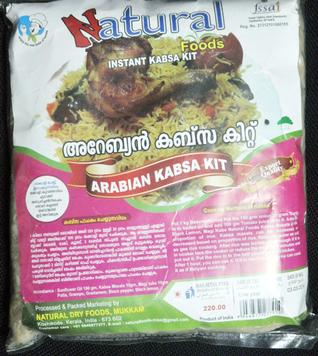
‘Instant’ kabsah kits are in much demand in Kozhikode. / The Hindu
Shawarma, Shawaya, and Khubuz came to Kerala crossing the Arabian seas several years ago. They were served in wayside eateries and fast-food outlets, initially started by the Gulf-returned cafeteria employees.
These dishes, however, did not make their way to the Malayali kitchen even in the Malabar region, where most of the households have at least one member employed in the Middle East.
Of late, a few Arabian dishes such as Mandi, Kabsah, and Majboos, which figure on the main course menu of Arabian countries have become popular in Malabar. These rice-meat combination dishes are not only cooked in the kitchens of the region, but are also served as “prestige” dishes on occasions such as weddings.
Some places like Koduvally, with a huge expatriate population, also have exclusive Mandi and Kabsah eateries. “I know many who come from the city just to eat these dishes,” says P. Abid, a native of Koduvally.
Author and sociologist Hafiz Mohammed says this is only a continuation of the culinary influence Arabia has cast on Kerala for the past 30 years. “The close socio-cultural association between the two countries has paved the way for these dishes’ smooth entry into our society,” says Dr. Mohammed. Ready-to-cook kits of these dishes, including Majboos, the regional variant of Kabsah, are available in shops and supermarkets here now. Dealers of these kits also provide cooking instructions in regional languages on their cover. “I prepare them at home quite often,” says A.K. Ali, who returned from Saudi Arabia a few years ago and is settled at Kalanthode in Kozhikode.
The dishes are much in demand for weddings and parties in the region. Local chefs, with some experience in eateries in the Gulf, have started advertising their skills here, says Mr. Ali.
Dr. Mohammed sees ‘status symbol’ in play here. “Many affluent families in Malabar serve these Arabian dishes during wedding parties for this reason,” he says.
The trend is here to stay for some time at least. “My father, who was in the Gulf for several years, prepared Kabsah at home a couple of years ago during his vacation. All of us liked it. Now I too can prepare the dish,” says Sayed Junaid, from Ayencheri near Vadakara in Kozhikode.
source: http://www.thehindu.com / The Hindu / Home> News> Cities> Kozhikode / by Jabir Mushthari / Kozhikode – May 10th, 2014
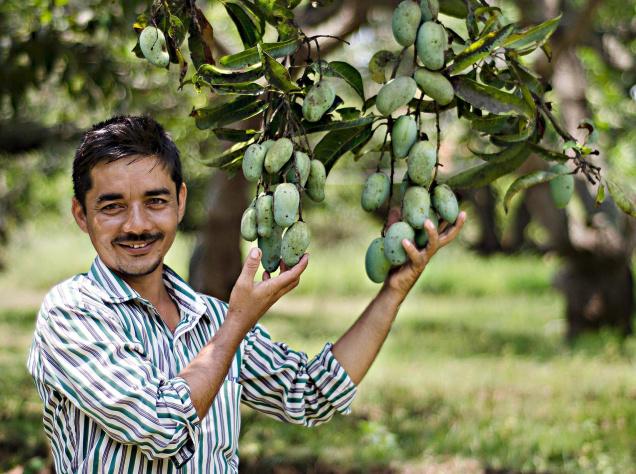
LUSCIOUS: Syed Ghani Khan in his orchard at Kirugavalu village in Malavalli taluk of Mandya district. / The Hindu
Kirugavalu farmer has 116 mango trees which are 200-year-old
This farmer from Kirugavalu village in Malavalli taluk of Mandya district has preserved 116 mango trees dating back to the times of the then Mysore ruler Tipu Sultan.
Carbon dating and other scientific assessment by the Genetics and Plant Breeding Department of the University of Agricultural Sciences, Bangalore, have shown that these trees are more than 200 years old.
This 20-acre orchard, popularly known as ‘Bada Bagh’, is said to have been raised by those in the palace of Tipu, who was a great lover of fruits, especially mangoes. The orchard was later gifted to a farmer by Tipu. Syed Ghani Khan (39), who has inherited this from his forefathers, is preserving it with care.
According to Mr. Khan, the trees yield exotic varieties of fruits. “While some trees yield fruits that taste like sweet lime, others produce fruits with cumin flavour. There are some trees that yield fruits resembling the shape of fish,” he said.
In great demand
Till recently, his family used to sell the fruits locally. But from the last two years, he has been selling the fruits at organic outlets in Mysore apart from exporting them to Dubai and Abu Dhabi, where they are in great demand and also fetch a premium price.
In fact, Mr. Khan, who was passionate about becoming a curator at an archaeological museum, he did his graduation in archaeology and museology. But he had to return to his native village from Mysore to take care of his farm and support his family after his father became bedridden due to an ailment. “I then decided to turn my exotic farm itself into a live museum and started working on it,” he said.
Paddy varieties too
Mr. Khan also pursues another avocation passionately. He collects native varieties of paddy and grows them mainly to preserve those rare varieties. “Presently, I have a collection of about 600 native varieties of paddy, including ‘rakta dham’, ‘naadikeli’ and ‘jugal’,” he said.
His efforts paid off as his farm caught the attention of Delhi-based Protection of Plant Varieties and Farmers’ Rights Authority, which has started registration of the exotic varieties of mangoes in the garden. He will get legal right over the plant species after the registration.
Mr. Khan was also honoured with the ‘Plant Genome Saviour Farmer Recognition’ award by the authority in 2012.
Mr. Khan now wants other farmers to grow these rare varieties of mangoes. He, however, is unable to take up propagation of these rare varieties systematically by constructing a poly-house as it requires big investment. As none of the government agencies offered him any help, Mr. Khan himself started an organisation to train farmers and students about local varieties of crops.
He is looking forward to getting government assistance to take his mission forward and ensure that these exotic varieties of mangoes are grown in the orchards of many more farmers.
source: http://www.thehindu.com / The Hindu / Home> News> National> Karnataka / by B. S. Satish Kumar / Bangalore – May 12th, 2014
Nwazuddin Siddiqui was initially hesitant and nervous about the brand engagement. ( Source: Varinder Chawla )
Bollywood actor Nawazuddin Siddiqui has signed up for an ad featuring the introduction of a new smartphone Spice Stellar 506 into the market.
Along with the ad, the cell phone company will also showcase a digital film showcasing how smartphone technology is changing lives of the youth of India today.
‘The Lunchbox’ actor was initially hesitant and nervous about the brand engagement. But apparently, after a sit-down with the team and understanding the campaign’s objective, Nawazuddin felt more at ease.
“The film resonates with my own life journey and my belief that the size of one’s dreams isn’t defined by the size of one’s town. Shooting the film was a nostalgic trip down memory lane. When I was growing up I’d trek miles, in the same manner as shown in the film, and finally reach the city exhausted. But as soon as I saw the cinema theatre all my exhaustion would just vanish and everything would be worth it,” said the actor.
The ad will feature Nawazuddin’s life of struggle, deprived of comfort and luxury and has been shot in the town where Nawazuddin spent most of his time growing up.
source: http://www.indianexpress.com / The Indian Express / Home> Entertainment> Bollywood / by Express News Service – Mumbai / May 12th, 2014
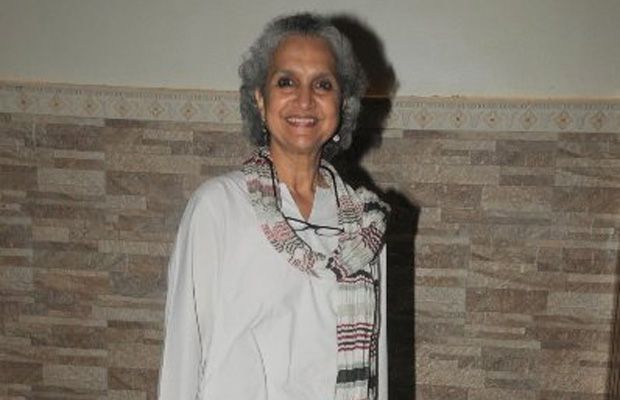
Miss India (1972) and mother-in-law of actress Vidya Balan, Salome Roy Kapoor. (Photo: PTI/File)
Hyderabad:
Thursday evening saw a gathering of people who one would assume were strangers; but in real life they have known each other for as long as they can remember.
Miss India (1972) and mother-in-law of actress Vidya Balan, Salome Roy Kapoor, designer James Ferreira, make-up artist Cory Walia, jewellery designer Suhani Pittie, fashion designer Shravan Naresh, Shilpa Reddy and others were present at the launch of the Deccan Institute of Design (DID), which they will be part of when it starts operations.
“I last came to Hyderabad many, many years back. I used to be a model and we had come to the city for a show,” says Salome, who dances, choreographs, directs plays, fashion shows and also conducts grooming classes. Her role as a visiting professor would be to conduct grooming sessions, which include deportment, etiquette, table manners, body language etc.
Salome’s sons — Siddharth, Kunaal and Aditya — are all connected with Bollywood and talking about the latest addition to her family from the industry, Vidya Balan, she says, “Vidya is down-to-earth and a lovely daughter-in-law. There have been times when people have tried to get in touch with Vidya through me regarding some event or something else, but I have never encouraged that. She has a busy schedule and I can’t interfere.”
Salome has known the “talented James” (Ferreira) for over 40 years, having also been the one to give him his first break. “It was right after college and I was very nervous, but she saw my work and pretty much gave me my first job,” says James, who is also the creative head of the institute.
DID is an institute by Mohd. Azhar Mujahid and Ayesha Azara Mujahid of the Lakhotia Institute of Fashion Design. Talking about the institute, James says, “Our (institute’s) aim is to make Hyderabad the fashion capital of South India. Not only is Hyderabad the most happening place down South, but it also has the most number of affluent people. We are going to take people back to the roots.
There are 108 ways of wearing a sari, 45 ways of wearing a turban and 60 styles for wearing a dhoti; but in this fast-food age, we have not given our Indian traditions much importance and we hope to change that.”
source: http://www.deccanchronicle.com / Deccan Chronicle / Home> Nation> Current Affairs / by ADC / May 03rd, 2014
The residents of Mysore, especially in the neighbourhoods of Bannimantap and Rajeev Nagar are now familiar with a big truck parked on the roadside near JSS Dental College with shining lights and people surrounding it eating costly food. But wait a minute! Costly food in a big truck? Well, it seems to be costly as the big truck sells fresh American-Mexican food but that’s not really costly. “A Mysorean can now fill his stomach with some classy food for just Rs. 80 on an average,” said Syed Manju while speaking about his big boy “Tindipotha.”
Syed Manju previously held the position of an Area Manager handling Public Relations and Marketing for 28 years in Costco, USA, the Number 3 retailer in the world which directly competes with Walmart, before heading towards Mysore to come up with his dream boy. “I had a passion towards cooking due to which I quit the job and came to Mysore with an interest in doing something unique, something which never existed here. That’s when Tindipotha was born,” commented Syed Manju while speaking about how it all started. The ecstatic and energetic Syed Manju keeps travelling back and forth between Mysore and Bellingham (90 miles north of Seattle in the United States) where his wife (Diane Houston), little girl Zara (16) and a little boy Iyan (14) lives.
Originally born in Channapatna and brought up in Mandya, Syed Manju is a self made man. He studied B.Sc and Diploma in Film Acting. He soon landed into Kannada Film Industry during his late 20s by directing films like Neenakkaga and Kanoonige Sawaal after which he travelled to USA for a trip to stay with his brothers and sisters for a while. Manju said, “Don’t ask me how, but I got my green card over there” with a wink and also added, “I never wanted to be there forever. Infact I had plans of directing more films in Kannada, but my fate made me stay there,” with a sweet smile. The last film produced by Manju was Appaji starring late Dr. Vishnuvardhan in the lead role released in 1996.
Coming back to Tindipotha, it all started roughly an year ago when Syed Manju and his brother Rafi Manju bought an old truck and got it rebuilt in Mandya to bring the new fancy boy to the streets of Mysore. “I was scared in the beginning. It was something new, something which the Mysoreans never experienced before. A new food to a new market. We had to prepare American-Mexican style foods with the ingredients available in Mysore and it didn’t seem easy for us in the beginning. But we did it and still doing it. It’s been an year and we are doing good,” said Syed Manju while speaking about Tindipotha.
Tindipotha has recently transformed itself from being just a food truck into a youth junction where we can find college going kids spending their cool evenings eating the sizzling new dishes like Nachos, Chicken Melt, Roti Lapat, Gilli Chicken, Turpi Chicken, Rollito, Apple Dream, Lava Pie, and many more summing up to over twenty different types of food.
“My brother Rafi Manju manages the front end and cash while my nephew Syed Umair Manju is our grill master. He even looks after the crew. Farhan, the cousin of Umair, assists the crew inside out and Tausif does all the deep fry and plating. Siddique and Atiq have been newly added to the crew and are learning ropes. Tausif, Siddique and Atiq are all family friends. We are all family and its a family business. The whole crew, except me and my brother, are college going kids,” said Syed Manju while introducing the team of Tindipotha.
People love the food. We had an interactive session with some regular customers of Tindipotha who expressed their hearts out. Bashar and Abdur Razzak, who stay in Bannimantap said, “This is really nice. It’s different than what we find elsewhere. We don’t find such tasty food at any other place, especially the Nachos! We come here for Nachos,” when asked to express how they feel about Tindipotha. Areb and his friends Mohammed Fahad and Rakshad, who come all the way from Bangalore just to eat at Tindipotha, said that they still haven’t yet got over the taste of Chicken Melt. The trio commented, “Its been a year and we still come here to eat the same thing,” with a laugh. Dental students Alley and Ahmad, who are from Iran visit Tindipotha atleast twice a week and mentioned that they love the tasty food and also the hospitality given to them by Syed Manju and his crew.
While speaking about the unpredictability of such food business in a city like Mysore, Syed Manju said, “Usually weekends are the busiest days for us, yet we can never predict. Sometimes customers ask me, which is the best dish prepared here! Well, I tell them to close their eyes and put their finger on the menu and we will serve it. If they don’t like the food, let them not pay us but if they like it, they need to pay us double.” He also added, “We are different from other eating places in the city saying that we smile at our customers which we can never find in any other hotels in Mysore. We also appreciate each and every customer, thank them and enquire in person whether they liked the dish. The food is also custom made for every single customer according to his likes and dislikes and we keep changing the taste one plate at a time.”
Tindipotha is for sure a place to be cherished and one of its kind in Mysore. It’s both vegetarian and non-vegetarian food truck with some tasty healthy and classy American-Mexican food at low prices. Do you want to try some different custom made food? Just head towards Tindipotha in Bannimantap near JSS Dental College between 7 pm and 11 pm any day! For more details, type in TINDIPOTHA in facebook and you will get the fan page.
source: http://www.starofmysore.com / Star of Mysore / Home> Feature Articles / May 04th, 2014
People generally go by sellers’ claims on the quality of Omani frankincense. However, a Sultan Qaboos University study has found that there is nothing such as ‘high quality’ or ‘low quality’ frankincense – all varieties are equally good and have the same antibacterial properties.
Commonly known as frankincense worldwide and luban in Jebeli and Dhofari Arabic, the resin is an extract of the Boswellia Sacra tree and has various medicinal and aromatherapy applications.
Omani frankincense is commercially available in four grades under the names hoojri, najdi, shathari and shaabi, based on four geographic locations in Dhofar from where the resins are harvested.
“Our study has found that hoojri – the first grade luban – and shaabi – the fourth grade luban – which greatly differed in price, closely resembled each other in essential oil composition, yield and physiochemical characteristics, except colour and texture,” said Dr Hisham Abdul Khader, associate professor of chemistry in the College of Sciences at Sultan Qaboos University.
The market price of the four grades varies considerably according to their colour, clump size and texture. Resin value is determined not only by fragrance but also by colour and clump size, with lighter colours and larger clumps being priced higher.
Hoojri, a first grade resin, which has the lightest colour and a large clump size, is collected from trees in the north of the Samhan mountains in Dhofar, and costs RO32 per kg. Najdi, a second grade resin with a pale yellow colour, is collected from a plateau behind the Dhofar mountains and costs around RO26 per kg.
Shathari, a third grade resin which is darker in colour and collected from the northwest of Dhofar, costs RO12 per kg while shaabi, a fourth grade luban of a darker colour that is collected from valleys, costs RO6 per kg.
Khader said, “As per our study, hoojri, the first grade luban, had the highest oil content of 8.5 per cent whereas the yield of the second and third grade samples – najdi and shathari – were 5.5 and five per cent respectively.
“The oil yield of the fourth grade shaabi was seven per cent, which was higher than that of the second and third grade and closer to that of the first grade, thereby indicating an inconsistency between the oil yield and grade.”
Titled ‘Composition and antibacterial activity of the essential oils of four commercial grades of Omani luban, the oleo gum resin of Boswellia Sacra flueck’, the study also tested frankincense oil for effectiveness of its anti-bacterial properties.
“All four grades were tested for their anti-bacterial properties and showed pronounced activity against a panel of bacteria. The oil killed all the bacteria irrespective of the grade it belonged to, in varying extent. The antibacterial activity of the oils suggests their potential use in food preservation,” Khader said.
“If you go to Salalah, you will notice that the prices are different. The best variety is sold for around RO36 while the lowest grade is sold for RO6. So this study is an eye opener. It will be of use to industries who have so far gone in for the high quality luban. They can now get the same benefits from a less expensive and low quality luban.”
Salim al Saidi, K B Ramesh Kumar, Nallusamy Sivakumar and Salma al Kindy also participated in the study.
source: http://www.muscatdaily.com / MuscatDaily.com / Home / Muscat Daily Staff Writer / December 30th, 2012
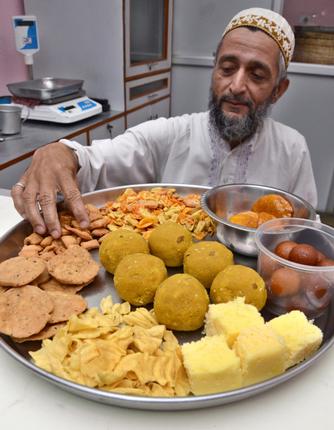
A taste for community spirit: Saifuddin, the mithai wallah./ Photos: M. Periasamy / The Hindu
The Dawoodi Bohra Muslim Community, originally from Gujarat, has made Coimbatore its own, yet it retains its distinctive cultural and culinary identity
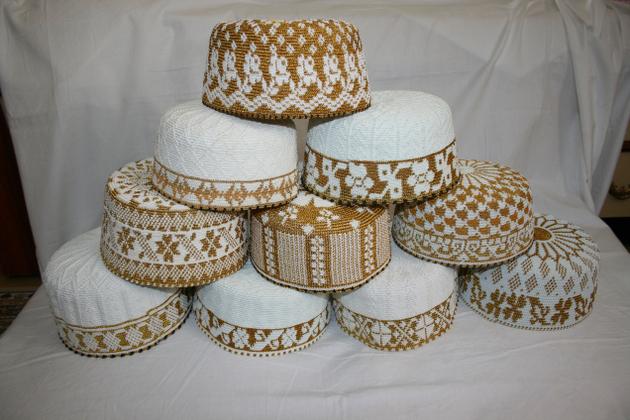
Evening Namaz has just ended. Men in topis and flowing white kurtas emerge from the mosque. Women in colourful gowns zip through the lanes on their two wheelers. The smell of hot khakras wafts from the nearby sweet shop. Children returning from their evening Arabic and Quran classes, buy savouries from there and run home. The conversation one overhears in a language that sounds like a mix of Urdu, Gujarati and Persian. It is called Lisanud-Dawat. Sound of laughter comes out of a home. The Burhani colony of Coimbatore in Peelamedu wakes up to its night life.
“Many of us have settled here for generations since the time of our great grandfathers,” says Alifiya M Mamoowala who has volunteered to be my guide for the day. “There are around 392 families here. And, we have become a part of this city.”
Topis worn by Bohra men./ The Hindu
At the same time we hold onto our tradition,” adds Feroz Y Dak, as he leads me to the office of Aamil Saheb, the community’s religious and administrative head.Aamil Saheb hails from Madhya Pradesh and has been holding this office for the last two years. “The community settled in Coimbatore in the early 1930s. We originate from the Khambat district in Gujarat,” he explains. And they believe they must abide by the law of the land where they live, says Aamil. “I am learning Tamil. And, my children go to a Tamil medium school,” he smiles.
Next, I visit the burhani mithai stall, where Saifuddin Bhai Ahmedabadwala fries hot mathris. His shelves are laden with laarvas, a typical burhani laddoo made of besan and stuffed with raisins. His sweet puris drip sugar syrup and I am told they are a must during Shab-e-barat. But Saifuddin’s road to fame is his gulab jamuns, made with khoya. “Even the locals love it,” he says with pride.
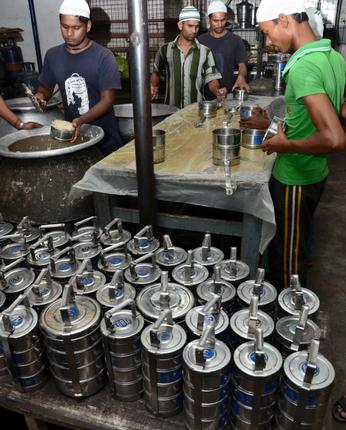
I meet another Saifuddin who is head chef at the Community Food Hall. “I have worked across India I have learnt other recipes by working with the local chefs.” “At the Community Food Hall they prepare free dinners for all the houses in the colony. This is one way of making sure that the ladies of the community get some free time to do what they want,” says Feroz.
The food hall./ The Hindu
“Looks like it is biryani today,” says Feroz as we sniff appreciatively. Inside, there are huge davaras of chicken biryani. Hundreds of tiffin boxes are neatly arranged on the floor. They will be despatched along with rose lassi and raitha. “Each tiffin box carries a number allocated to a house. So, no one uses the vessel used by the others,” says Feroz. Residents can either collect their tiffin boxes at the hall or get them delivered at their door steps. As dusk falls, lights pop on in the kitchens. At Alifiya’s house, Gulshan Y Mamoowala has whipped up a grand meal. As soon as we enter, she welcomes us with a bowl of crystal sugar. “That’s the bohra custom of welcoming the guests with a sweet note,” says Yunus Bhai Mamoowala, her husband. Gulshan’s lemon yellow skirt and a blouse that she wears with a pretty shawl is called jori. “We wear these inside the house. The burqas are called ridas and are worn outside,” says Alifiya.
“Ridas and joris have become a big style statement,” adds Munira Gheewala, who has dropped in to apply mehendi on Alifiya’s daughter’s hands. “During weddings women wear ridas with zardozis and elaborate embroidery, floral panelling and tatting.” Bohra weddings are grand, says Munira. “We apply mehendi on the entire arm of the bride! Our designs are mostly Arabic motifs, featuring creepers and flowers.”
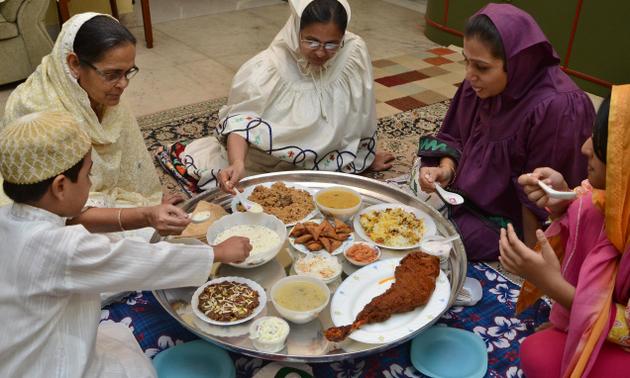
Conversation ceases as Gulshan brings the huge thaal and places it on a stool. The entire family sits around the thaal. “The whole point is to drive home the message of togetherness,” says Feroz. “This strengthens our bond.”
The first thing I am offered is a pinch of salt! “It opens your taste-buds,” says Gulshan. And in bohra cuisine, desserts come first, says Alifiya. Sodena (sweet rice and badam) and Shir khurma, (something like semiya payasam) kick start the fare. The main course has a shoulder of lamb hot from the tandoor, dal chawal palidu and rotis with khichda (haleem). “The signature dish in a burhani cusine is the simple dal, rice and palidu combination. Palidu is a little like rasam. It is cooked with tuvar dal stock, drum stick and regular spices,” explains Gulshan.
We round off the sumptuous meal with sweet paan. As we sit back on the cushions, Yunus shows me the pictures of their ancestral home at Sidhpur, Gujarat. Magnificent havelis, with a dozen windows, mark the bohra colony. “All the traders used to live here. Each house is built close to each other to create community spirit,” says Yunus. “Our family came to Coimbatore 25 years ago to set up business here. We still go back there once in a year,” says Yunus.
As I bid farewell to the Mamoowala family, Gulshan sprays attar on my hands and tells me to rub it on my clothes. “This is for you to always remember the beautiful memories of the evening you spent with us,” she says.
I smell my hand again and smile as the fragrance recreates in my mind the lanes of Sidhpur and its airy havelis.
source: http://www.thehindu.com / The Hindu / Home> Features> MetroPlus> Melanage / by Parshathy J. Nath / Coimbatore – April 25th, 2014
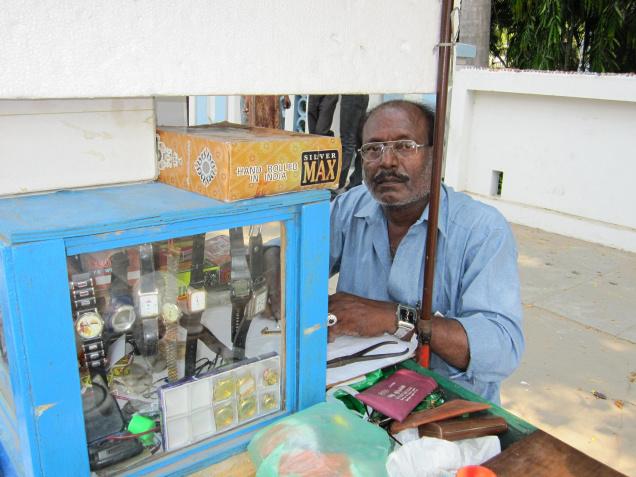
S. Amjad Ibrahim says sometimes business is dull and sometimes there is no business at all. / by Special Arrangement / The Hindu
On some days, I earn around Rs.150-200. Sometimes, there’s no business at all. Then I just sit here and watch the world go by until it is time to go home
It’s just been a few months since I set up my mobile stall here; before this I was selling agarbatti (incense sticks) and attar (fragrant essential oil used in perfumes). I also offer lucky birthstones and sunglasses for two-wheeler users.
Customers can both buy watches and get them repaired by me.
Usually it’s nothing more than a battery change. But watches stop working when they get wet. The water cuts off the battery wire within and also rusts the metallic buttons.
Most of the parts are electronic these days, so they can be replaced piecemeal without damaging the entire watch.
It takes me around 20-30 minutes to repair a watch. And there are days when a watch refuses to work despite all the time I spend on it – I put it away and return to it after a break.
I usually charge Rs. 10 or 20 for watch-repair. Of late I have taken to selling spectacle frames as well.
Shops charge in the hundreds of rupees for a single frame – I buy cheap frames and used ones as well, and sell them for around Rs.20-30 to people who cannot afford the pricey ones.
I push my cart from home, around 2 kilometres away and reach here (Bharatidasan Salai) by 10 a.m.
The traffic policemen often complain about vendors like us being in the way – but as you can see, I’m just minding my own business without troubling anyone.
There’s no breakfast, just a cup of tea at home. For lunch, I usually have a serving of ‘kool’ (porridge) from the stall nearby. It keeps me full until sunset, when I pack up my cart and push it back home in time for dinner. It’s good exercise for me.
On some days, I earn around Rs.150-200. Sometimes, there’s no business at all. Then I just sit here and watch the world go by until it is time to go home. I have six grown-up children, three sons and three daughters.
Most of the watch spares are easily available in Singarathope – you have to ask for ‘China movement’. I’ve spent roughly Rs. 6000 on my stock; I do hope I’ll be able to earn a profit soon.
I’ve dabbled with many other jobs and businesses before – I used to own a grocery store once, but had to close it down because I couldn’t manage it alone.
It’s important to keep earning something, no matter how old you are.
source: http://www.thehindu.com / The Hindu / Home> Features> MetroPlus> Society / by Nahla Nainar / Tiruchrapalli – April 11th, 2014