The first and second runners-up received Rs 50,000 and Rs 25,000 respectively.
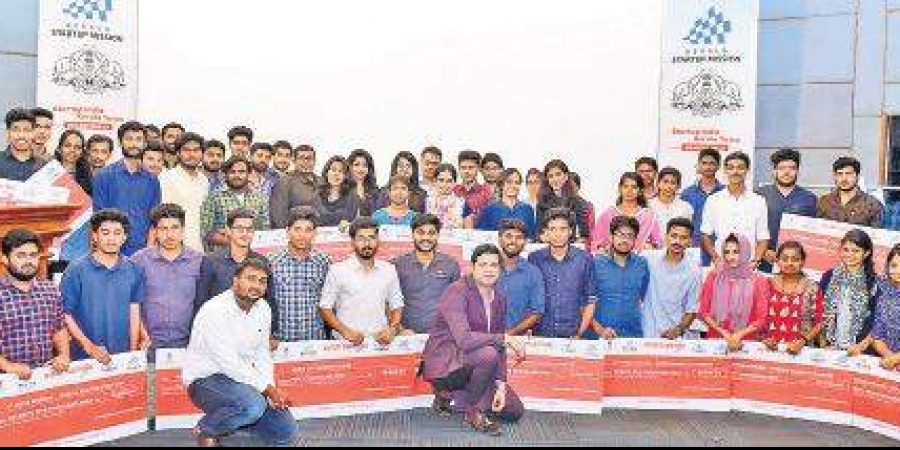
Winners of the grand finale of the Startup Yatra with Kerala Startup Mission CEO Saji Gopinath in Technopark, Thiruvananthapuram on Tuesday | Express
Thiruvananthapuram :
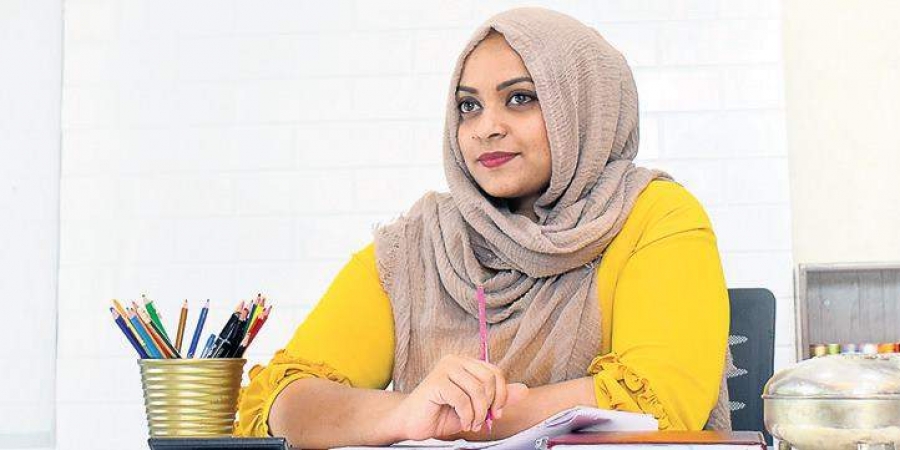
Final year Mechanical Diploma Polytechnic student Arunima CR from Wayanad, who developed a solid waste cleaner that helps clean up water bodies sans manpower, bagged the Best Womenpreneur Award at the grand finale of the ‘Startup Yatra’ held at Technopark on Tuesday.
According to Arunima of Government Polytechnic College, Meenangadi, who won the award that carries a cash award of Rs 75,000, “Solid waste cleaner can also clean drains and remove solid waste from water sources, including streams, rivers and ponds. Significantly, it can avoid the workers’ direct contact with waste materials.”
The event marked the conclusion of the state-wide initiative by the Kerala Startup Mission (KSUM) to nurture aspiring entrepreneurs in Kerala’s tier 2 and 3 cities and help them realise their startup dreams. An Android app developed by Rashida V P from Kasargod for farmers in agriculture sector emerged the first runner-up. Andrea Antony from Kottayam won the second runner-up for her idea Min_Rov (Mind Rover), a concept for functioning a brain-control wheelchair.
The first and second runners-up received Rs 50,000 and Rs 25,000 respectively.
Around 80 innovative ideas were pitched in the finale by as many as 180 participants and 20 ideas notched-up honours. Heroes of the eight boot camps held in various districts were given a cash award of Rs 50,000 each.
The winners included :
Devi V S (Thiruvananthapuram), Jithin J (Kollam), Thomas Syriac (Kottayam), Sachu Sivaram S (Ernakulam), Varsha J (Thrissur), Mohammed Shaheer (Kozhikode), Aneesh (Wayanad) and Harris (Kasargod).
Other awards:
Best Technology Startup: Winner Amal C Saji (Ernakulam), First Runner-Up-Rahul KS (Ernakulam), and Second Runner-Up Annie Sam Varghese (Thiruvananthapuram); Best Social Startup: Winner – Risvan Ahammed K (Kasargod), First Runner-Up – Ushanandini (Ernakulam), and Second Runner-Up- Nowrin N (Thiruvananthapuram); Best Sustainability Startup: Winner- Kevin R (Kottayam), First Runner-Up – Amaljith S B (Thiruvananthapuram), and Second Runner-Up – Ragesh (Kottayam).
source: http://www.newindianexpress.com / The New Indian Express / Home> Cities> Thiruvananthapuram / by Express News Services / November 28th, 2018
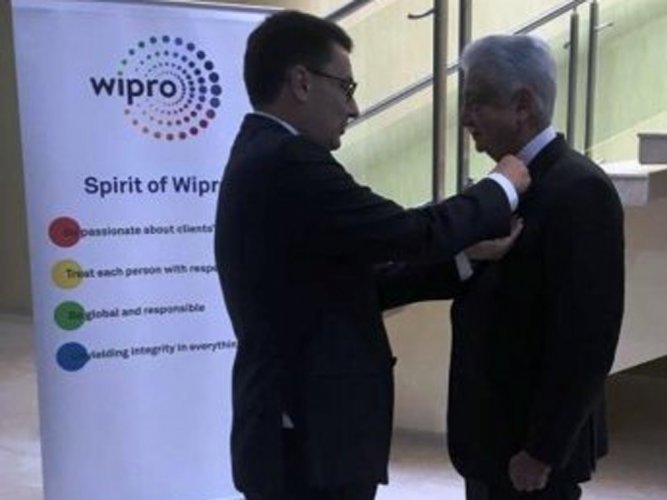
Wipro Limited Chairman Azim Premji receives the highest French civilian distinction, Chevalier de la Legion d’Honneur (Knight of the Legion of Honour), from Ambassador of France to India Alexandre Ziegler, in Bengaluru on Thursday.
Azim Premji, philanthropist and Chairman of Wipro Limited, on Wednesday received the highest French civilian distinction, Chevalier de la Legion d’Honneur (Knight of the Legion of Honour) from Ambassador of France to India Alexandre Ziegler.
Speaking on the occasion at the Wipro campus, Ziegler said the award was bestowed on Azim Premji for his outstanding contribution to developing the information technology industry in India.
“Also, for his economic outreach in France, and his laudable contribution to society as a philanthropist through the Azim Premji Foundation and Azim Premji University,” he said.
TheLegion d’Honneur , instituted in 1802 by Napoleon Bonaparte, is the highest civilian award given by the French Republic for outstanding service to France, regardless of the nationality of the recipients.
The President of the French Republic is the Grand Master of the Order of the Legion of Honour.
In his acceptance speech, Premji said he is extremely honoured by the award bestowed on me. “The vibrancy of the French democracy and its diversity is an inspiration to all across the world,” he said.
Wipro’s association with France spans over 15 years and the company enjoys a close relationship with several French organizations. Nearly 65% of Wipro’s employees in France are locals.
France is a key market for Wipro and the company is committed to continues investments there. Large French digital companies already have a strong footprint in India, employing over 1.3 lakh people at their R&D centres and facilities.
source: http://www.deccanherald.com / Deccan Herald / Home> Business> Business News / by N.V. Vijayakumar / DH News Service, Bengaluru / November 28th, 2018
Two decades after taking an initiative for promotion of girls’ education in his native town, a Mumbai-based entrepreneur is testing his fortunes in the Assembly election in the Sikar constituency in the Shekhawati region of Rajasthan .
The Excellence Knowledge City for Girls, established by Wahid Chowhan, has made the dusty district of Sikar one of the educationally advanced ones in the State.
Mr. Chowhan, 70, has been fielded here by the Rashtriya Loktantrik Party, which was floated by Hanuman Beniwal, Independent MLA, recently. Mr. Beniwal wants to create a third front in the State, where the BJP and the Congress have been elected alternately since 1993.
Mr. Chowhan’s college offers free tuition, books and uniforms to girls, and the curriculum is a mix of madrasa teaching and mainstream subjects.
It is probably the first institution which has introduced Sanskrit along with Urdu and Arabic as the languages taught.
While seeking votes, Mr. Chowhan speaks of the difficulties he had faced when he started the college. The local people had suspected that he wanted to corrupt the minds of innocent Muslims or he intended to set up a five-star hotel.
“From the earlier imbalance of girls being deprived of education, we have now reached the opposite extreme. Girls are now highly educated compared with boys,” he says.
The initiative has given an impetus to girls’ education in Sikar. “No girl, especially in the minority communities, stays at home. With higher education, they are all moving up the social ladder,” social activist Ashfaq Kayamkhani says.
Open to both Muslim and Hindu girls, the college offers education in mainstream subjects from science and humanities to business administration. Muslim girls can opt for the madrasa curriculum.
Mr. Chowhan is pitted against Ratan Jaldhari, MLA and BJP candidate, and Rajendra Pareek of the Congress, who was defeated in 2013.
source: http://www.thehindu.com / The Hindu / Home> Elections> Rajasthan / by Mohammed Iqbal / Sikar – November 24th, 2018
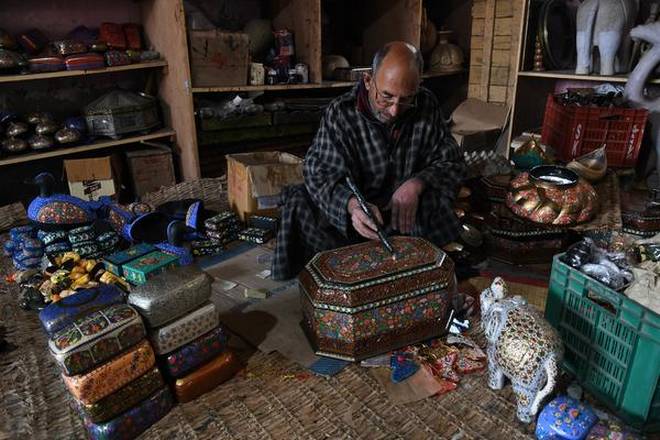
The credit goes to the Shia community of Kashmir for keeping alive papier mache art — colourful, exquisite, highly decorative and delicate — in the Valley since the 14th century. “This wealth has been handed down to me by my father who inherited it from my grandfather and so on. The colours and the shapes we carve from paper is what adds meaning to our lives,” says Zahid Rizvi, 40, a papier-mache artisan at Zadibal in Srinagar.
Over the centuries, the Shia community, now forming about 14% of the Valley’s population, has been perfecting the art. Historians believe that papier mache became popular as an art in the 15th century. Legend has it that a Kashmiri prince was sent to a jail in Samarkand in Central Asia, where he acquired the fine art, which is often equated with patience and endurance. The Muslim rulers of India, particularly Mughal kings, were fond of this art and were its patrons.
The process begins with soaking waste paper in water for days till it disintegrates and then mixing it with cloth, paddy straw and copper sulphate to form pulp. The pulp is put into moulds and given shape and form. Once it dries, the shape is cut away from the mould into two halves and then glued together. It is polished smooth with stone or baked clay and pasted with layers of tissue paper. Now, it is completely the baby of an artisan. After applying a base colour, the artisan draws a design. The object is then sandpapered or burnished and is finally painted with several coats of lacquer. The art got a major boost from the government in 2016, when the Nawakadal girls’ college in Srinagar introduced it in the craft curriculum. Saleem Beg, who heads the Kashmir chapter of the Indian National Trust for Art and Cultural Heritage, believes the future of papier mache lies in elaborate murals.
(Text by Peerzada Ashiq and photos by Nissar Ahmad)
source: http://www.thehindu.com / The Hindu / Home> News> States> Other States / by Peerzada Ashiq & Nissar Ahmad / November 11th, 2018
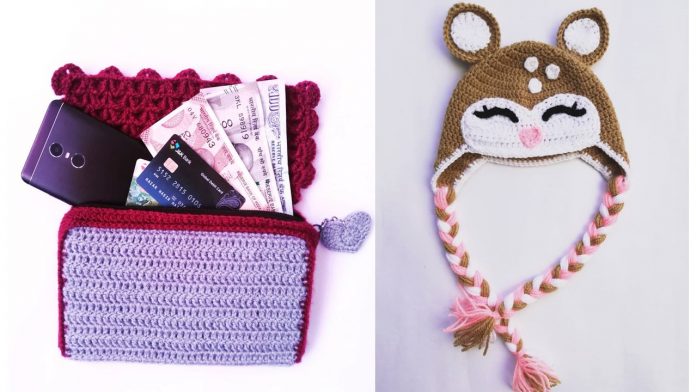
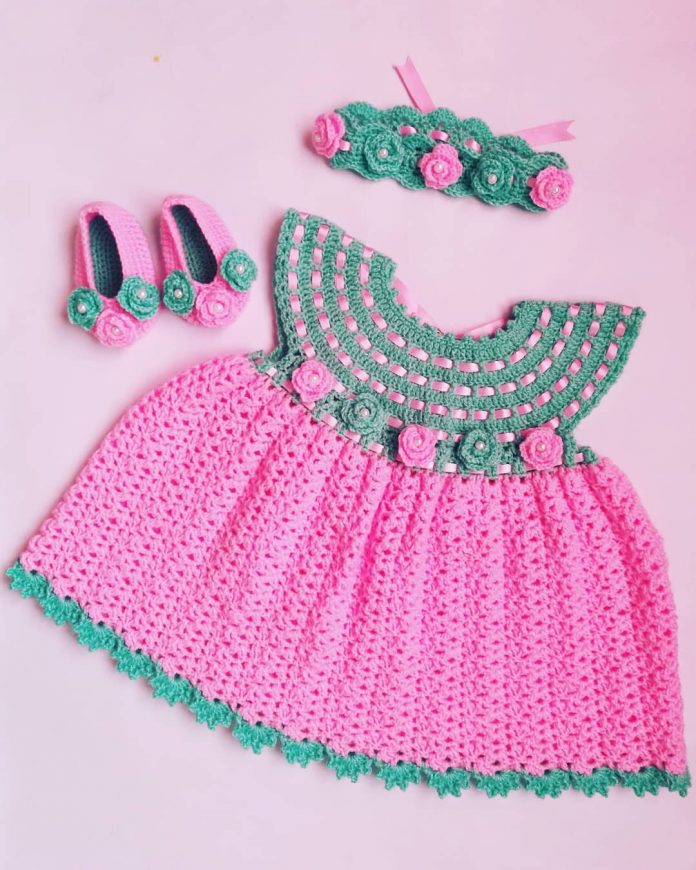
At the age of 19, Nazar Nasir decided to share the idea of him knitting and crocheting with his family members. Their reaction was exactly as he had expected. He was told in blunt words that this line of work didn’t suit males. But Nazar had made up his mind and decide to live his dreams despite the resistance.
Crocheting has been a well-known art amongst Kashmiris but it has been mostly pursued by the women for decades. It is for the very first time that a male while breaking some rigid stereotypes has made a business out of it. Nazar, who wet up Knotty Crafts, is gaining a huge following not only in the Valley but outside the state too.
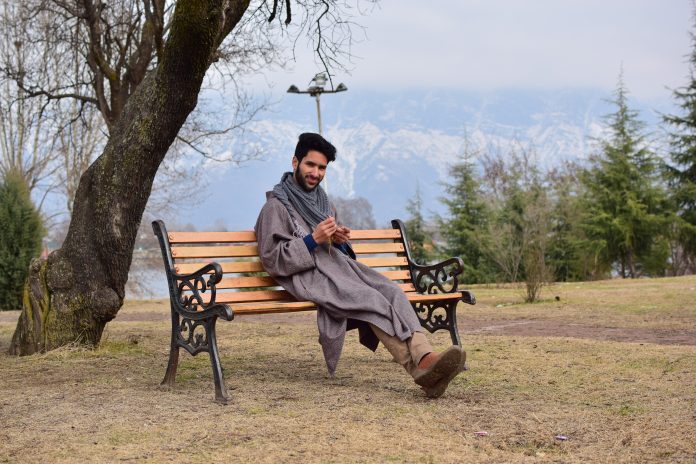
A resident of downtown, Srinagar, Nazar is a student of literature. Apart from being a student, he keeps himself busy with crochet. He is the first and the only male who crochets from Kashmir.
Crocheting is a process of creating fabric by interlocking loops of yarn, thread, or strands of other materials using a crochet hook.
It all started two years ago when his sister brought a crochet hook and some yarn from her aunt and while she was wiggling the hook with the yarn strand, Nazar was so fascinated that he brought himself a hook and some yarn and started experimenting and has never stopped since then.
From being just a mere experimental hobby, his passion for crocheting kept increasing and he turned it into a part-time business.
“For me, crocheting is not just a small business, but an escape from the world as I almost forget my being while crocheting. It’s so healing and so peaceful to me that I can work non-stop without worrying about anything else,” Nazar says during a conversation with TwoCircles.net.
“In a society where knitting and crocheting are considered too feminine a profession to be taken up by men, it was very difficult for me to do something that women usually do here,” he adds.
But paying no need for criticism, Nazar made-up his mind and started crocheting. It has been almost two years now and his business is flourishing day by day.
“People always talk and they say what they have to say, but today those who criticized me are always there for appreciation,” he says.
Nazar says he has been attracted to different forms of art for as long as he remembers.“I first learnt how to crochet and then I got deeper into the world of craft and taught myself to knit, to do macramé and to weave and I’m always learning new things,” Nazar says.
Nazar made his work public through social media apps like Facebook and Instagram and is getting a tremendous response.
“I earned a huge customer base within two years with the help of social media,” Nazar says.
He says he is blessed to be a part of such a big maker community in this age “I can’t describe how perfect I feel being a part of it. I will always try to explore and create more interesting things,” he says.
For people, it’s unusual to see a boy in this field of craft but Nazar says he is proud to call himself, ‘The only male crocheter of Kashmir’.
source: http://www.twocircles.net / TwoCirlcles.net / Home> Indian Muslim> Lead Story> TCN Positive> Youth / by Auqib Javeed, TwoCircles.net / November 09th, 2018
Abdul Gafur Khatri at work at his residence in Nirona village, Kutch | Photo Credit: Vijay Soneji
The Khatris have practised the art for eight generations now
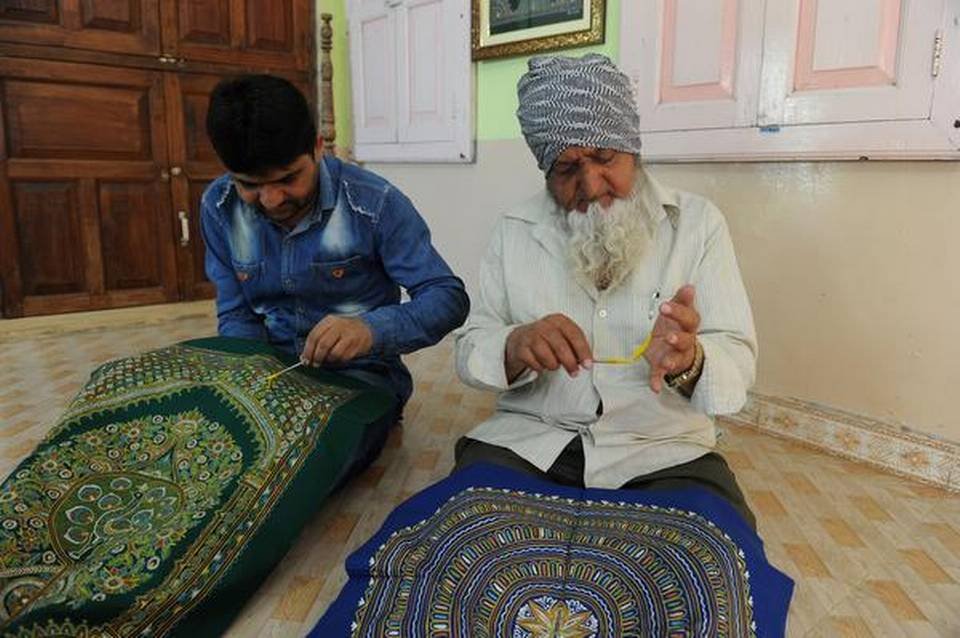
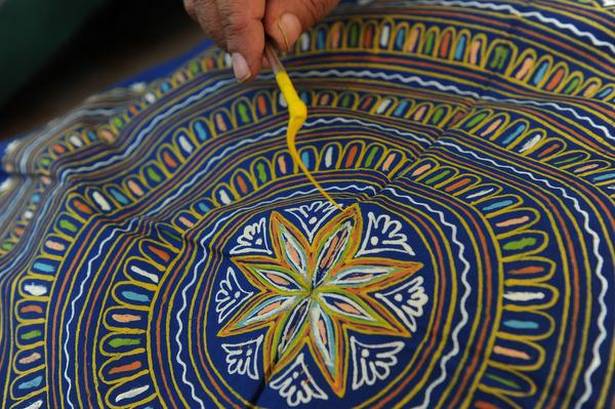
Sitting on the floor, Abdul Hamid carefully twists a thick spool of yellow paint around a metal pin. Stretched out before him is a piece of red cloth, pinned on either side to the legs of his trousers. He dabs the paint on the heel of his left palm — it’s a gummy mass and has to be worked into something more malleable. Hamid then brings the tip of the pin a few inches above the cloth, and as it hovers, an elastic strand of colour streams on to the surface. And the magic begins: an intricate pattern grows beneath the swirling pin that never touches the cloth. The floral design looks like needlework.
Hamid then folds the cloth and, just like that, a flawless mirror-image of the pattern appears and an exquisite piece of Rogan art is born.
“We have practised Rogan for eight generations now,” says Hamid. “The first six generations did not get their due for preserving the art, but now, finally it is widely recognised and we couldn’t be happier.”
‘Rogan’ in Persian means oil: the paint is made with castor oil. Rogan art is believed to have originated in Persia some 300 years ago and was traditionally used to embellish bridal trousseaus. As it crossed borders, it began fading from the collective memory of its creators. But nine members of the Khatri family in Nirona, a small village in Gujarat’s Kutch district, are the last surviving custodians of the art form.
The Khatri community once did Rogan work on the clothes of local animal herders and farming communities. But as machine-made textiles became a more affordable alternative and Khatri youth lost interest in learning the art, Rogan began to disappear. “But our family revived it in 1985,” says Hamid. In fact it is Hamid’s elder cousin, Abdul Gafur Khatri, a national award winner, who is credited with resurgence of Rogan art.
P.M.’s pick
The ‘Tree of Life’, an intricately patterned tree with hundreds of dots and dashes, is their signature painting and most in demand. A 14×17” painting can take 12 days to complete— Prime Minister Narendra Modi chose one to gift to the then U.S. President Barack Obama during his U.S. visit.
“Rogan art is 100% an artist’s imagination on a piece of cloth,” Gafur bhai, as he is better known, explains. “There is no tracing, no drawings to refer to.”
But preparing the base from castor oil is a laborious process and can take two days. The oil is heated and cooled in a (special) vessel and continuously stirred so it doesn’t burn. After two days, the residue left behind is mixed with cold water and it thickens into a sticky paste called rogan. Natural colour pigments are then added to the oil base. “Yellow, for instance, comes from a particular stone that is ground,” says Hamid. The pigments are added to the castor oil base and stored in earthen pots.
Wall pieces made by Abdul Gafur Khatri in Nirona village, Kutch | Photo Credit: Vijay Soneji
The nine artists have six national awards and six State awards between them. They proudly show me photographs of celebrities — politicians, film stars, sports stars — who have either bought their art work or felicitated them at awards functions.
Men last longer
It strikes me as odd that all nine members of the family working on the art form are men. This could perhaps do with the belief that women, once they get married, would pass on their knowledge to their husband’s families, threatening the art with dilution. But as Rogan faces extinction, Gafur bhai, has taken upon himself the task of teaching the technique to 200 girls from his village. And this has breathed fresh life into the dying art.
“We taught most of these girls for free. They can now create at least the basic designs,” Gafur bhai says, adding that 25 girls also help the family with their work. In another effort to popularise Rogan, the family conducts live demonstrations for every visitor at their doorstep. During the 30-minute demonstration, artists patiently answer questions and explain the techniques they use. On an average, the family gets 150 visitors a day. And between November and February, during the Rann Utsav — the Kutch desert festival — the numbers shoot up to 250 or 300.
No tough competition
Unlike other forms of textile art such as Ajrakh that face are under threat by factory-made products, Rogan faces no such competition, but meeting market demand has been a challenge.
“You will not find Rogan art the way you find other arts in the markets. It’s not because we don’t want it to go out to the people, it’s because we have limited resources,” says Gafur bhai. We go to five or six exhibitions around the country in a year, and rest of the time we are at home, working.”
It has been a long journey for the Khatri family: from reviving the art to creating public interest to recovering from the Bhuj earthquake setback. But today, they are only seeing a huge resurgence of interest.
The writer is an independent journalist based in Gujarat. When not researching her stories, she is busy spinning tales for her toddler.
source: http://www.thehindu.com / The Hindu / Home> Society – Rubric / by Azera Parveen Rehman / January 20th, 2018
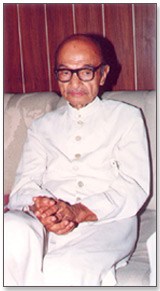
Birth anniversary of noted Hakeem Padma Bhushan Hakeem Abdul Hameed was celebrated on September 14, 2018. Former Rajya Sabha MP and noted journalist Shahid Siddiqui delivered the lecture on ‘Hakeem Abdul Hamed, a great thinker, philosopher and his role in the construction of the nation’ as Chief Guest. The programme was presided over by Prof Syed Ihtesham Hasnain Vice Chancellor Jamia Hamdard. Prof Ihtesham Hasnain said late Hakeem Abdul Hameed was ‘Hamdard’ in the real sense.
Pro Vice-Chancellor Prof Ahmed Kamal, registrar Saud Akhtar, relatives of Hakeem Abdul Hameed from India and Pakistan, a large number of teachers, officers and students were present on the occasion.
Late Hakeem Abdul Hameed, a renowned physician, was the Founder-Chancellor of Jamia Hamdard, which he established with his own resources. A great philanthropist, thinker and visionary, he set up several institutions with the funds of Hamdard Wakf Laboratories. Some of the esteemed institutions established by him include Hamdard National Foundation, Hamdard Education Society, Hamdard Study Circle, Hamdard Public School, Hamdard Institute of Historical Research, Ghalib Academy, Centre for South Asian Studies and Business & Employment Bureau.
Hakeem Abdul Hameed was honoured by several national and international awards including the Avicenna Award presented by the erstwhile USSR in 1983. He was conferred with Padma Shri and Padma Bhushan by the Government of India. He was also an honorary member of the Academy of Medical Science of the Islamic Republic of Iran and Chancellor of Aligarh Muslim University, Aligarh. In October 2000, the Research Centre for Islamic History, Art and Culture (IRCICA) Istanbul, Turkey, presented IRCICA Award for Patronage in Preservation of Cultural Heritage & Promotion of Scholarship to Hakeem Saheb posthumously.
source: http://www.siasat.com / The Siasat Daily / Home> India> News / by Rasia / September 15th, 2018
Nusaiba, the sole working woman from her family, runs her own boutique on Commercial Street. A fan of Sabyasachi and Manish Malhotra, she was once recognised as a homemaker alone, but today aims to turn her designs into a brand one day. Her journey till this point, she claims, has been a result of maintaining a fine balance between her household expectations and her passion for her dreams. “My kids were young and I had to attend classes to learn more about designing. It was tough but I had my mind set on opening a boutique, so I managed it,” she recalls.
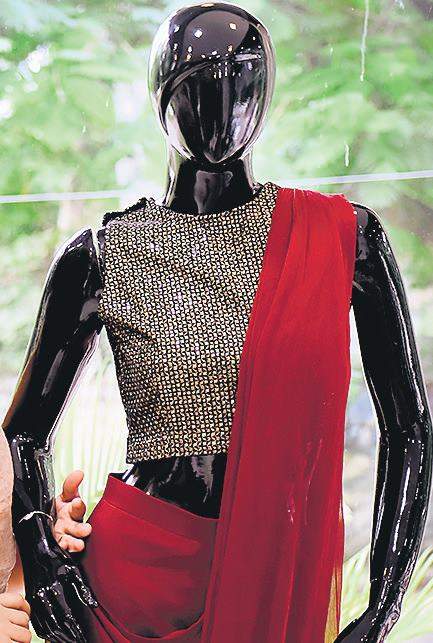
One of Nusaiba’s designs
Now, she says, her kids are proud of her. “Their school bus passes by my store. They feel happy to tell their friends that this is their mother’s store. On the opening day, my daughter struck off my occupation as ‘housewife’ and wrote ‘fashion designer’ in her school diary.”She also goes on to give credit to her family members, saying, “My husband, a businessman, is a great support. All my family members are supportive,” she adds.
Popularly known as Dadu, the passionate fashion designer has named the boutique on Promenade Road after this nickname. “My customers ask me about the name of the boutique. They say it is intriguing,” Dadu says with a smile.Speacialising in Indo Western wear, Dadu provides customised services. “I discuss client requirements and design the attire accordingly. I show them my colour charts and once it’s all finalised, we work on designs. I give my suggestions and draw them out for my customers,” she explains.
It takes Dadu two weeks to complete an order. “It takes time because we source fabrics from Kolkata and Mumbai. We source white fabrics, dye them to the client’s preferred colour, and then polish them,” she says. Behind this successful woman, is a team of 15 who aid her.
“Only after the trial is done and the fitting is right, we deliver the order,” she says, adding that she always maintains client relationships even after orders are delivered.On an average, she gets at least four to five orders a day. “We have many regular customers. I have customers from the UK and the US as well, who have liked the designs I share on social media, and have gotten in touch with me. I have been getting a good response,” she says.
Dadu is a diploma holder in fashion designing, with a one-year diploma course in Calicut and another 1.5 year diploma course in Bengaluru. With the sky as the limit for her dreams, she is planning to expand her venture to Kochi, Hyderabad and Chennai in two years.
source: http://www.newindianexpress.com / The New Indian Express / Home> Cities> Bengaluru / by Akhila Damodaran, Express News Service / October 23rd, 2018
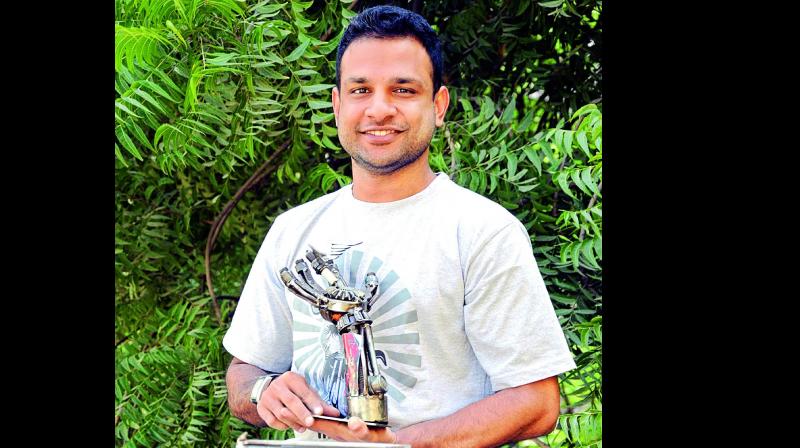
Md Saaduddin is on an artsy journey where he utilises scrap metal to construct purely artistic as well as functional sculptures.
I was always inclined towards art but I never had the nazakat that is needed to wield a paint brush. The hammer and grinder are a better fit for me. (Photo: DC)
It is quite common for a young boy to fall in love with machines. But what is not so common is translating that love into beautiful art. Although Md Saaduddin is today an artist, he does not work on canvases, but with scrap iron, steel and sometimes copper to make beautiful sculptures and functional art pieces like lamps and furniture, some set in the backdrop of interesting storylines.
With Saad’s father being a vintage car restorer, he, along with his brother Hamzauddin, grew up around machines, albeit with a unique perspective. On how he took up the hobby, the mechanical engineer and self-made artist says, “I was always inclined towards art but I never had the nazakat that is needed to wield a paint brush. The hammer and grinder are a better fit for me. I love it also because of the physical work that is involved in creating it.” Saaduddin spends time on his artwork in the evenings, after work, and has made furniture for a couple of breweries in the city.
Explaining his style of work, he shares, “I try to incorporate a sense of movement. A bird just about to take flight, for instance! I’ve learnt the art by watching other people online and practicing. I used to help my dad in his workshop, and that’s how I got introduced to it. Just once a year, my brother and I collect all our savings and build a modified bike. We ride it around to our heart’s content and then sell it.”
He further reveals, “I’m also getting into blacksmithery now; I usually make the handles of spatulas and ladels with this. People appreciated my work and said I should get on Instagram. That’s how I started IRONic”
His brother, Md Hamzauddin is another bundle of talent, whose digital art is recognised around the world. He goes by the name ‘Hamerred’. Hamzauddin’s works have been showcased in countries like the US, Mexico and many others. In fact, he was also one of the only 13 artists from around the world to display their art at the Oil and Ink Expo, a motorcycle art show. Hamza’s signature style features paint dripping from motorbikes.
source: http://www.deccanchronicle.com / Deccan Chronicle / Home> Lifestyle> Books and Art / by Nikhita Gowra, Deccan Chronicle / December 04th, 2017
P B Abdul Razak’s body was taken to his house at Naimarmoola in Kasargod. Later in the evening, the body was taken to Uppala in Manjeshwaram constituency for the public to pay their last respects.
Razak, a two-time MLA, registered a dramatic victory in the 2016 Assembly election by defeating K Surendran of the BJP by 89 votes. The slender margin shook the party, but he gifted himself a car and took 89 as its registration number. He first became an MLA in 2011, when he defeated C H Kunhambu of the CPM by 5,828 votes in Manjeshwaram constituency.
Razak, a businessman, was also a member of IUML national working committees.Born on October 1, 1955, to Beeran Moideen and Beefathima, Razak’s schooling stopped at class 4.
He entered politics through the Muslim Youth League and went on to become the general secretary of the organisation.In 1979, he went abroad to make a living, and returned in 1990 and dived into active politics.
In 2000, he became the president of Chengala grama panchayat and held the post for seven years. In 2008, he was elected to the district panchayat council and became the district panchayat president in 2009.
He is survived by wife Safiya Abdu Razak, and children Saira, Shafeeq, Shyla and Shyma.
Those who paid their last respects include ministers E Chandrasekharan and Kadannappally Ramachandran; Opposition leader Ramesh Chennithala, deputy opposition leader M K Muneer; MPs P K Kunhalikutty, E T Mohammed Basheer, P V Abdul Wahab and M K Raghavan, MLAs K N A Khader, V K Ebrahimkunju, P K Abdu Rabb, K K Abid Hussain Thangal, T V Ibrahim, Manjalamkuzhi Ali, P Ubaidulla, C Mammootty, N Shamsudheen, K M Shaji, N A Nellikkunnu, C Krishnan, K Kunhiraman, Sunny Joseph, Shafi Parambil, P Abdul Hameed, M Rajagopalan, P T A Rahim and Karat Razack and party leaders Panakkad Sahid Ali Shihab Thangal and Munavvar Ali Shihab Thangal.
source: http://www.newindianexpress.com / The New Indian Express / Home> States> Kerala / by Express News Service / October 21st, 2018