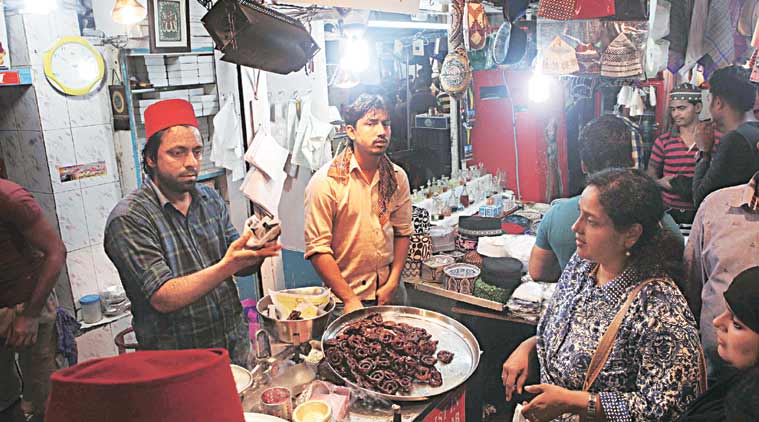
In a narrow lane, Burhanpur Mawa Jalebi is a 4×4 sq ft shop, no bigger than a kiosk.
Peak hours of business during Ramzan begin after 10 pm for Burhanpur Mawa Jalebi. (Source: Express photo by Vasant Prabhu)
Tight coils of pale yellow turn dark brown within minutes. As soon as they rise to the surface in the kadhai of hot oil, cooked to their thick core, Mohammed Hussain scoops them out with a frying ladle and deposits them in a shallow dish of thick sugar syrup. Immediately, the customers that have, until now, been watching Hussain intently, close in for the mawa jalebi.
During the month of Ramzan, Mohammed Ali Road in Mumbai wears a festive look. By 6 pm, the air is thick with a mix of aromas as all shops and stalls in the Khau Galli light up with fairy lights. Walk down the crowded lane and one notices that the jalebi is curiously missing from the scene. “That is because Mohammed Ali Road has only one jalebi shop, and not the regular variety but mawa jalebi, available at Burhanpur Mawa Jalebi,” says the cashier at Suleman Usman Mithaiwala, which sits at the Khau Galli junction.
In a narrow lane, Burhanpur Mawa Jalebi is a 4×4 sq ft shop, no bigger than a kiosk. Hussain and his brothers Mohammed Yusuf and Mohammed Hissar cater to the thickening crowd. “Mawa jalebi is a specialty from Madhya Pradesh,” says Yusuf between taking orders. “Our shop introduced Mumbai to this sweet, which is distinct,” he adds.
Made using mawa, arrowroot and milk, it is closer to gulab jamun in taste. “Its crispness comes from arrowroot, which gives the batter a better hold. Unlike the other jalebi, this doesn’t have the tinge of sour taste,” says Hussain.
Burhanpur Mawa Jalebi was started a decade ago by his uncle Nooruddin. “The recipe is original, passed on by a karigar in Mathura to our maternal grandfather,” says Hussain. This shop is a branch of the original, which has been in Burhanpur, for 45 years.
Open from 3 pm to 3 am during Ramzan and till midnight on other days, Burhanpur Mawa Jalebi prices its specialty at Rs 240 a kg. “With a hike in the rates of mawa and other ingredients, we will increase its price after Ramzan,” says Yusuf. Why not during the festive season, when they are bound to do good business? “Ramzan is a holy month; a time to reflect, cleanse self and do good. Acting greedy will bring us sin,” says Yusuf. Upon hearing the azaan at the nearby Minara Masjid, he takes a break and heads in the direction. It is time for namaaz before he breaks his fast.
source: http://www.indianexpress.com / The Indian Express / Home> Lifestyle / by Dipti Nagpaul D’Souza, Mumbai / July 09th, 2015
Entrepreneur, under-the-radar philanthropist and an over-the-top personality — the relevance of Shahnaz Husain 40 years after her first formulation
Shahnaz Husain’s press kit weighs 12.3 kilos, and contains press clippings from around the world. But then everything about her is over the top, and it’s not just her red hair threaded through with gold ribbons. Of her 58 homes, one is in Delhi’s tony Greater Kailash. There is a Rolls-Royce and a Jaguar parked up front, while inside is a sort of Midas-touch shocker. There are swans, a Ganesha, cushions, high-backed chairs, window valances, all in gold. There is an MF Husain on the wall that the artist did especially for her, large urns in the corners taller than people, horses sprinting across the carpet. Curios clutter, and I imagine a dusting nightmare.
She is not short on staff though. There are at least 15 people I have counted, and I am there just for a couple of hours. They appear, to offer food, tea, more food, juice; and to take instruction each time Shahnaz rings her bell to show me something — her first husband’s photograph, a letter from romance novelist Barbara Cartland’s friend’s son whose eyesight she cured, a picture of a man she picked up off the street because he was lame. They are dismissed soon after, with a wave of Madam’s hand.
She is wearing a blue-and-leopard print cassock-like garment, and holds forth for the next couple of hours. While she knows just what to say to the media, often telling the same stories, there is a certain warmth I feel, even as she holds my hand, her 70+ years, showing only in her hands.
Cosmetic shift
She begins with the first of many stories (these are her forte, not the dates or the details): when on a course with cosmetics entrepreneur Helena Rubinstein, she had a friend whose mother would come and sit outside the class because she was blind and had no one to take care of her at home. “She’d been a sought-after model who had worked for an eye make-up company,” says Shahnaz. She had modelled a new line, complaining to the manufacturers that her eyes would feel blurred after use. “They told her to wash them and put Optrix.” The blurring continued, until she simply could not see any more.
Shahnaz was learning what she calls “chemical beauty” at the time — Arnould Taylor, London; Christine Valmy, New York; Lancome, Paris; Swarzkopf, Germany; Lean of Copenhagen, Denmark. “There was no school I hadn’t been to, until Rubenstein started to say ‘we have nothing to teach you’.” She had funded herself through her writing work. Married at 15 to Nasir Husain, who was director foreign trade in the State Trading Corporation, she was determined to study. She did, for eight years.
Back in India when she was about 24, she set up a small factory in Delhi’s Okhla (that she still has) and “employed ayurvaids . I gave them the chemical formulations and asked them to convert them”. She also recruited chemists to make products for “treatment and cures” — falling hair, acne, pigmentation, dark circles, stretch marks. She asked people who came to her home salon to test them and give her feedback, tweaking each product as she went along. They retailed out of Sahib Singh Chemists in Connaught Place, in little white bottles with green caps and handwritten labels. That is the thing, she says. It has never been about beauty, but always about Ayurveda, in the days before it became a marketing tool.
Thinking beyond business
There is no marketing, in fact. At an address at Harvard Business School in 2015, she spoke about how she created a successful business sans advertising. Two years ago she told the same school in an interview how she entered Selfridges and broke a 40-year record, selling products worth £2,700 (approximately Rs. 2,63,500) in the first two hours, even as she displaced half of the space allocated to Pierre Cardin.
Her way of entering a foreign market is often through the Indian government (as in Selfridges, where Ingrid Bergman bought 12 of her cactus cleansing creams at the Festival of India), and by liaising with the press. She says wherever in the world she goes, ambassadors are happy to organise a press conference. She will talk Ayurveda, distribute samples, and get enormous press coverage. She is clear that the future is Ayurveda, not chemicals.
In fact, even as a young girl travelling the world studying, her father, Nasirullah Beg, a chief justice of the Allahabad High Court, would write to the ambassadors in various countries so his daughter could stay with them through the duration of the course.
But it is not just running a business; she is happy to dole out products made for cancer patients free of cost, especially those with patches of alopecia, and will pick people off the street, offering them jobs, connecting them to medical specialists.
Today, the company invests in R&D, with customers from salons testing them out, though it is not clear whether they know they are part of the research. She also talks in terms of “prescriptions” and “fairness creams”, a throwback to an era where protocols, both medical and social, were not as strict.
The label life
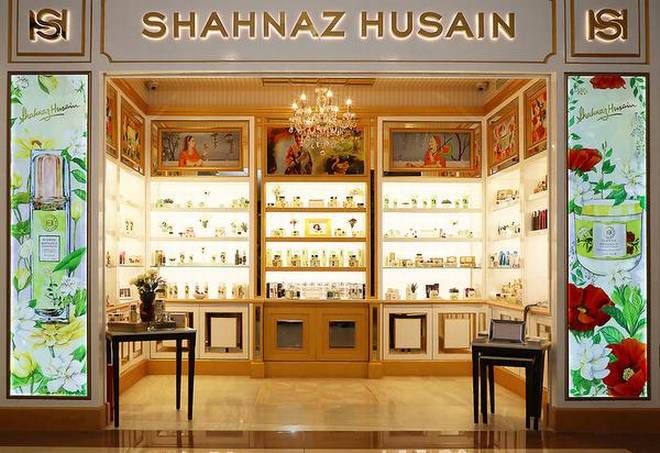
Earlier this year, the Shahnaz Husain brand was relaunched, with a new store at Delhi’s Select Citywalk, with new branding that seems rather mixed, with large pictures of flowers all over the frontage. Her face is still on some of the packaging, not retro-styled, but much like how it would have been done in the ’90s. She is not about to sell out or have anyone invest in the company. The brand is present in 40 countries today, including Iceland and Vietnam.
I dare not ask, ‘What after you?’ For Shahnaz is the brand.
As we conclude, she declares, “I think you have enough for a book now,” in her alto. Then she asks for her matching blue-and-leopard print bag, as we sit in her foyer, surrounded by a garden of plastic flowers, taking photos, with a couple of photographers jumping into the fray, seemingly from nowhere (waiting in the wings for this moment, perhaps). “Now we are best friends,” she declares, after we cut a cake, the done thing when a guest comes to her house for the first time.
She says wherever in the world she goes, ambassadors are happy to organise a press conference. She will talk Ayurveda, distribute samples, and get enormous press coverage. She is clear that the future is Ayurveda, not chemicals.
source: http://www.thehindu.com / The Hindu / Home> Features> Weekend / by Sunalini Mathew / October 13th, 2018
The family had moved to England at the Queen’s behest, bringing great solace to an increasingly homesick Karim, said Mahmood.
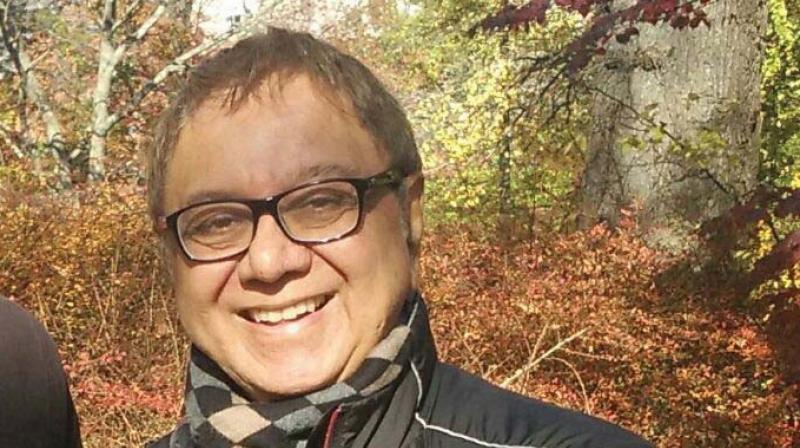
Javed Mahmood, Abdul Karim’s great grandson
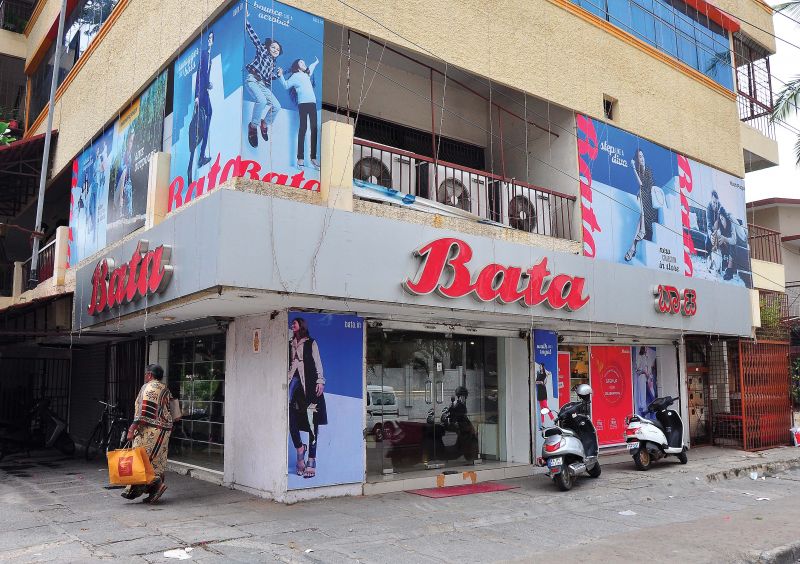
It was an April morning in Bengaluru and Javed Mahmood, as was his custom, sat down to flip through the newspapers. The year was 2010, nearly two decades since he had moved to the city to live a quiet retired life. His relatives were scattered between Bengaluru and Karachi, as they had been since Independence. Very little remained of the family’s rich history, much of what they had left was lost in the traumas of Partition and mostly forgotten. That summer morning in 2010, however, everything changed. Mahmood found, to his astonishment, that Indian author Shrabani Basu’s Victoria and Abdul: The True Story of the Queen’s Closest Confidant had uncovered the truth behind his great grandfather Abdul Karim telling a tale of friendship and loyalty. Mahmood talks to Darshana Ramdev about a family that has been steeped in history since, with his father, Anwar being a founding member of Bata in 1933.
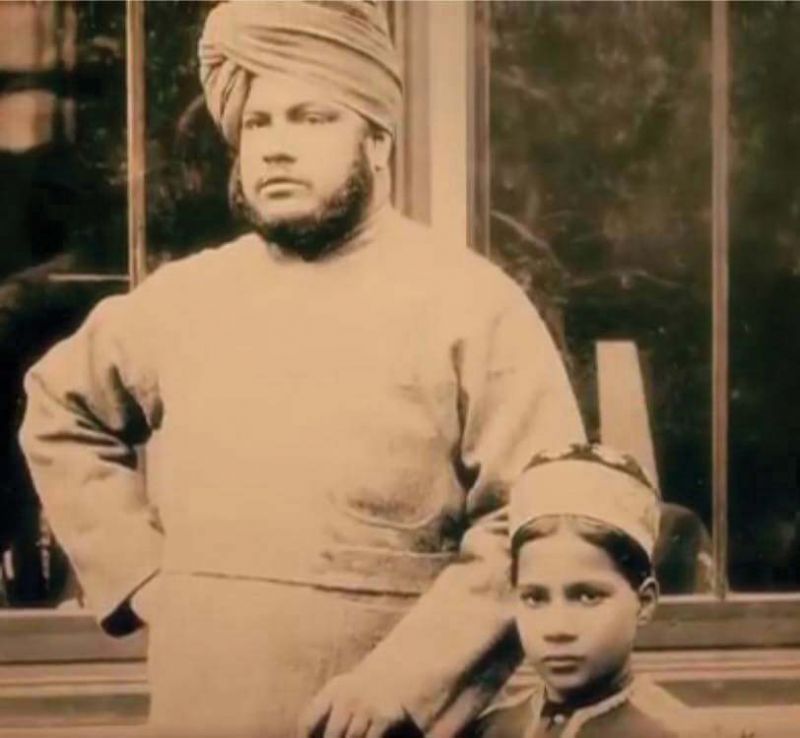
“I rushed at once to the British Council and asked them to help me contact her,” said Mahmood, whose grandfather, Abdul Rashid, was Karim’s adopted son. “We didn’t actually know he was adopted until Karim’s death in 1909 and the inheritance had to be dealt with.” The family had moved to England at the Queen’s behest, bringing great solace to an increasingly homesick Karim. “The Queen made them feel very much at home my grandfather received the same education that Edward VII and the rest of her children had earlier received.” The Queen, who was aware of the couple’s inability to have children, sent her personal physician, Dr. John Reid, to examine (much to his horror) Karim’s wife.
Abdul Karim with his adopted son, Abdul Rashid in England
“Abdul Karim had been greatly maligned by historians the Queen’s family may have wanted to destroy all trace of his presence in the court. Ms Basu had gained access to hidden archives, however. Our family still had a few documents – the diary being one of them, so Shrabani and I hopped on a plane to Karachi at once!” Karim’s descendants there were understandably wary, but Mahmood succeeded in coaxing them to part with the diary. Like most people of the time, Karim maintained meticulous written records into his life, which helped set the record straight on the stream of allegations that had been made against his character. “The diary proved beyond doubt that their relationship was marked by great affection, but had remained platonic always,” said Mahmood.
Javed Mahmood’s father, Anwar Mahmood, was one of the founding members of Bata in 1933. He started the Trot Shoe Company in 1963, setting up a second factory in Whitefield in 1970.
It contained valuable insights into Queen Victoria’s much loved Munshi, or teacher, the prepossessing young man who won the affections of a foreboding monarch with a reputation for a heart of stone. He was presented as an orderly to the Queen, which he didn’t like it was not a fitting position for the son of a landed ‘doctor’. He soon found himself promoted to Munshi, leading the now ailing Empress to a discovery of India. The Queen’s love for her young munshi drew jealousy, hatred and racial prejudice in a society known for its repressive puritanical leanings. Neither cared, however, with the Queen sticking her neck out on numerous instances to defend her young friend. “She was always caring and appreciative of our customs every Eid, she would walk across the grounds to Karim Cottage (on the Osborne House estate) to visit the family.” They were, in turn, invited up to the palace for tea during Christmas “The Queen would even have the windows covered with silk curtains so Karim’s family could keep the purdah. He was also a wonderful cook he would cook for her on occasion, as an act of love.”
Little was known of his life after the Queen’s death in 1901: Karim and his family were unceremoniously deported, almost at once, by a jealous Edward VII, who been aroused to such fits of rage that he had even attempted to force his mother to abdicate from office, on grounds of insanity. “Soon after the Queen’s death, King Edward arrived at Karim Cottage in Osborne House and ordered Rashid, who was a teenager at the time, to scour the house for any heirlooms or documents that contained the royal insignia. The little they could salvage, including Karim’s diary, returned with him to Agra in 1901, where he died eight years later. “He died at the age of 48 and the family was given his inheritance,” said Mahmood.
These remained with the family for some decades, until talk of Partition began to do the rounds. “We were a fairly prominent family and were advised at the time to shift temporarily to Bhopal, until the trouble blew over,” said Mahmood. This they did, greatly underestimating the scope of the problem and packing only the essentials. When the Partition took place, the family was evacuated to Mumbai, but many of the treasures were lost in transit. “The diary was with my grandfather, who was the custodian of Karim’s things.” The family moved to Karachi, save for Mahmood’s mother, Begum Qamar Jahan and two sisters. The diary went to Pakistan with them. “One of the sisters eventually shifted to Pakistan too,” he explained.
Meanwhile, in 1933, Bata, which was a burgeoning Czech company, found itself in hot water after the nation was declared Communist. The company decided to set up a factory near Calcutta, where leather was widely available. The large Muslim population in the area was another perk, providing the tannery services they so badly needed. “My father, Anwar Mahmood, was one of the founding members of the company,” he said. He joined the company at the age of 16 and worked there for nearly 30 years before he started his own business, the Trot Shoe Company. The first factory was set up in Kolkata in 1963 and the second in Whitefield, in 1970. “The organised shoe industry didn’t exist in South India and the Karnataka government had offered businesses a number of benefits, which led us here,” said Mahmood. Natural rubber, an important raw material and was grown abundantly in Kerala, making it easily accessible. “My elder brother managed the factory here, I handled the one in Kolkata and my parents shuttled between the two cities. When my younger brother was ready to start work, we established a third branch in Hosur.” Javed Mahmood and his younger brother still call Bengaluru home.
Mahmood tells his story from San Francisco, where calls have been pouring in from across the world since the release of the film, Victoria and Abdul. “The film is doing very well, it’s being shown at local theatres here as well and friends have been getting in touch to tell me how much they enjoyed it,” he smiles.
“My great grandfather’s relationship with the Queen had been presented as scandalous and sleazy he was falsely accused of every imaginable sin. Ms Basu read Karim’s diary cover-to-cover and brought those insights into the second edition of her book.” And that’s how Abdul Karim’s story received its long overdue re-telling, well over a 100 years after his death in 1909. “Queen Victoria was a woman far ahead of her times, rising well above the prejudices that so plagued her society, to defend the young Indian man she called a friend. I think there’s a lesson in it for all of us even today.”
source: http://www.deccanchronicle.com / Deccan Chronicle / Home> Nation – In Other News / by Darshana Ramdev, Deccan Chronicle / October 14th, 2017
It takes at least two trial sessions before a bespoke suit is ready; a client at Syed Bawkher & Co / PHOTO: R. RAGU
Susanna Myrtle Lazarus visits establishments that offer a bespoke experience for men
You absolutely love that one shirt on display at the store; it’s even available in your size. Just to be safe, you try it on, and to your indescribable disappointment, find that it’s either too narrow at the shoulder or the collar is cutting off your airway or it doesn’t fit around your waist because it’s that dreaded slim cut. And that’s the reason why more and more men are opting to get their clothes tailored, and not just at the corner tailor store, but of the bespoke kind.
But what does bespoke mean exactly? While the dictionary definition is ‘made to order’, in the world of bespoke tailoring, it’s not as simple as that. Unaiz Ahmed of Syed Bawkher & Co in Nungambakkam, says, “It stems from the word ‘bespeak’, which means to be spoken for. It is expressly made to fit one particular man, right from the fabric and pattern to the cut. And it’s not to be confused with made-to-measure, which is derived from a standard block pattern and has superficial adjustments made to it. It won’t account for a peculiar drop of the shoulder or waist. It has limitations, while bespoke tailoring takes all this into account.”
This is one of the main reasons why men prefer to have their suits custom-made to their requirements. “Fit has become an important criteria. In the business world, it’s not very important to wear a suit now; those who do wear them want to have a unique one that showcases their personality and individuality. They also do their research and know what they’re looking for,” says Unaiz.
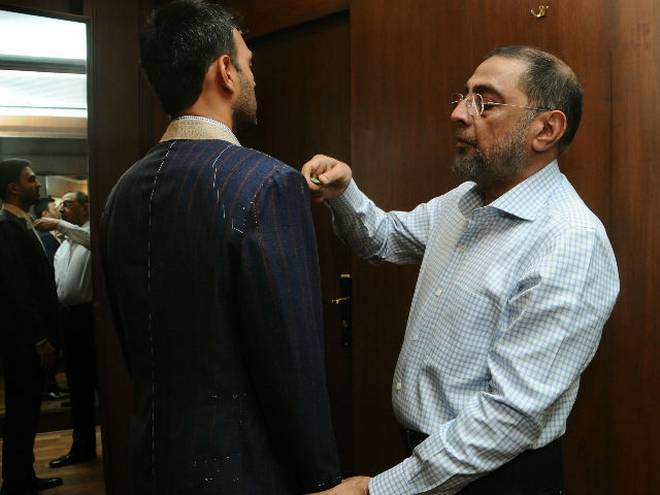
He knows what he’s talking about: his family has been in the bespoke business for four generations now. As he speaks about his education in London, and under the tutelage of his father, Unaiz deftly marks out a pattern on the material of a dark blue suit. “The person who measures and the person who marks and cuts the material should be the same. Two people can have the exact same measurements but completely different body types. That connection is needed to create the perfect garment,” he says.
Generally, the process of creating a bespoke suit, shirt or trousers can take two to three weeks, depending on the time of the year. First, there’s the consultation, where the client decides what he wants. Depending on the budget and occasion for which he will be wearing it, the tailors will recommend fabric, colour, style and cut. Based on this, extensive measurements are taken. About a week later, the client comes in for a trial fitting when adjustments are made as required. In another week’s time, when the garment is almost finished, there’s a second fitting. Once all the final tweaks are made, the finished product is delivered. All the garments are hand-stitched.
If it’s a wedding, a lot of men go in for tuxedos or bandhgalas. Dark, formal prints are best for lounge suits and business meetings, while lighter shades are preferred for luncheons and summer outdoor weddings. Bespoke pieces usually go by classic cuts and not by trends, and tend to focus more on what looks good for a person’s body type. For a slim and tall person, a sleek and athletic cut will work. Shorter men get a more relaxed cut, and if they are stout, pleated trousers are suggested to give a flattering look.
Prices range from Rs. 35,000 for a basic suit and can go up to Rs. 3 lakh, depending on the fabric used, with cashmeres, vicunas, super 200s and fine counts leaving your wallet considerably lighter than the 120 count fabric from Indian mills would. On an average, a suit can cost anywhere between Rs. 55,000 and Rs. 75,000 at this premium store. Behind Unaiz hangs a pale pink linen jacket. “That one is going to New York; our client wants to wear it for the summer,” he says, adding that men are more comfortable with experimenting with their clothing abroad than they are here in Chennai.
However, this is changing, feels Tushar Bansal of Mandira Bansal Studio. The label, which was founded in 2011, has recently launched its design studio in Alwarpet. He shows some examples of how customers are subtly taking their style quotient up a notch: a waistcoat with The Simpsons print lining, a Nehru jacket with a woven design on the collar and another with a translucent houndstooth fabric overlaid on a cream and pink print material. They have also created a monochrome Madras print on request from a client; it features an autorickshaw.
“We also do bespoke kurtas and sherwanis. Not only do clients want a better fit for their wedding wear, they’re not content with off-the-rack pieces. Men have become more conscious about their look; comfort and a personalised touch is what they look for. They pay attention to every minute detail, from the buttons used, to the colour of the thread and the cuffs,” says Tushar, whose clientele is largely from the North Indian community in the city.
Tushar finds that it’s not the younger crowd that does the experimenting. “The more travelled clients who are aware of fashion trends and have met people who push the envelope when it comes to personal style are the ones who are ready to play around with their ensembles,” he says.
Machine-stitched bespoke suits come in the range of Rs. 15,000 to Rs. 18,000, while the same when hand-stitched costs double — it’s labour-intensive and takes 12 days for a single suit to be finished. Sherwanis made of fine fabrics like georgette, net and pure brocade are hand-embroidered at the studio, and can cost upwards of Rs. 35,000.
At Bespoke by Lazaro on Khader Nawaz Khan Road, clients come in asking for very specific detailing on their shirts. “Those who have the confidence to carry off bold colours are the ones who go for it. Otherwise, it’s generally charcoal, greys and blues,” says Tamsil Ahmed, business partner of the firm. Shirts here cost between Rs. 1,500 and Rs. 2,500, while suits go from Rs. 11,500 to Rs. 45,000. Indian brand material on average cost Rs. 1,600 per metre, while Italian and other international brands, retail at Rs. 7,000 to Rs. 10,000 per metre,” explains Tamsil.
“There’s a noticeable difference between a tailored shirt and a bespoke one. Some of our clients are fitness freaks and they don’t get readymade shirts that fit very well. Here, we can give them a garment that shows off their physique,” he says. And when it comes to suits, Tamsil says that accessories like cufflinks, tie pins and pocket squares add an extra dimension to the look. For those particular about their footwear, this store also offers bespoke shoes, ranging from Rs. 7,000 to Rs. 12,000.
It’s not just for occasional wear that men are going in for bespoke clothing. S. Mohamed Sultan Shabeer, a 35-year-old industrialist, is a recent convert to the trend. “I used to get my shirts tailored online, but I wanted better options. A friend recommended I go in for bespoke, so I ordered a couple of shirts and a pair of trousers for trial. I could see and feel the difference immediately and a lot of people commented favourably on my appearance,” he says, adding that he immediately went in for a wardrobe overhaul, ordering 30 shirts at one go.
While Shabeer prefers Egyptian and Italian fabrics, Nawaz, director of a trading company, goes in for linens most of the time. “The fact that I have control over every step of how my clothes are made is what appeals to me. I can get exactly what I want and I don’t have to compromise on anything,” he says. “When I first tried bespoke clothes a few years ago, I did not have the patience. But now, I enjoy the interaction and the process that goes into it,” adds the 43-year-old.
“With more clients going in for bespoke, designers are also working towards giving the same personalised service at a lesser price,” says Tushar.
There’s no doubt about it; men are willing to spend some serious coin when it comes to looking dapper. Unaiz says it’s for the experience of getting something made exclusively for you, a one-of-a-kind piece that no one else in the world has.
source: http://www.thehindu.com / The Hindu / Home> Fashion / by Susanna Myrtle Lazarus / Chennai – April 24th, 2015
RJ and entrepreneur Shabbeer Ahmed turns back the pages to simpler times in a smaller city
I first moved Bengaluru in the year 1995. Back then, all the roads were lined with trees, which looked wonderful when they bloomed, and the traffic situation was not so bad. My favourite road in fact was Bannerghatta road, which in those days was considered the fringe of the city, where people came for a relaxing drive. I actually used to stay near the Meenakshi temple in Hulimavu, areas which were barren a few years back. There used to be a water theme park near Bannerghatta which is no more, and now the area is just like any other part of the city. We spent many days on motorcycle rides in this area, stopping to buy egg puffs from the lovely bakeries that dotted the route.
There are fewer migratory birds these days as well. Until a while back the areas surrounding Madiwala Lake had a lot of birds come around, which has lessened and now you see birds on terraces instead. We even saw water snakes on the banks of the lake, and we’d give them names, like Ka from Rudyard Kipling’s The Jungle Book.
Personally, since I’m a massive food lover, I like to go to Fanoos to grab a roll and then head to Makkah cafe in Johnson Market, where I can sit with a suleimani tea and chat with people. Being a nature lover, I also enjoy trips to Bannerghatta National Park when I can. And there’s nothing like a trip to South Bengaluru for some authentic idli, vada, and dosa.
It is true that Bengaluru has become very commercial and industrial, but that has also led to it gaining in infrastructure and opportunity. There are so many options for youngsters here.
As told to Sooraj Rajmohan
source: http://www.thehindu.com / The Hindu / Home> Life & Style – Insider / by Sooraj Rajmohan / October 03rd, 2018
Wockhardt’s Habil Khorakiwala has looked crisis in the eye, and come out of it stronger
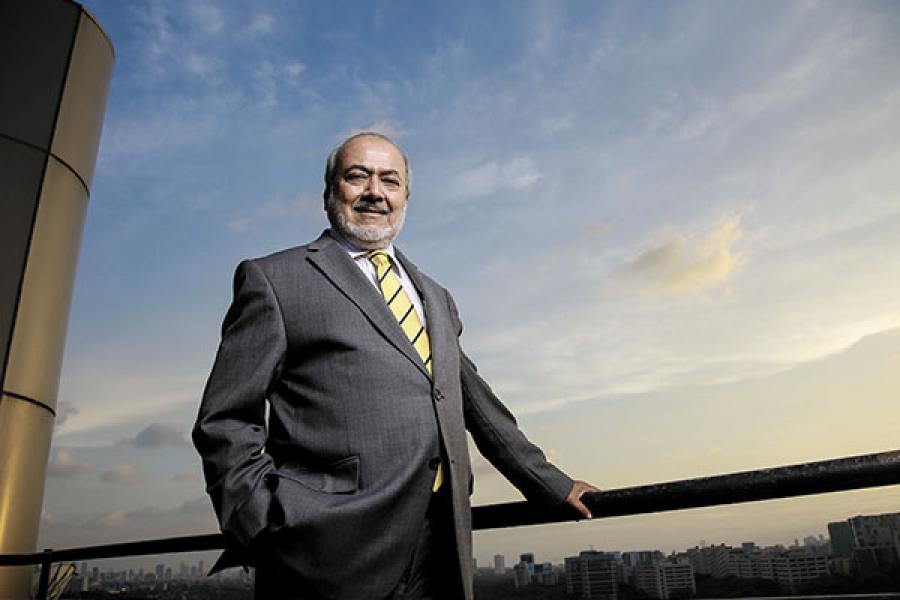
Image: Joshua Navalkar / Habil Khorakiwala, founder chairman, Wockhardt. His tenacity and calm helped the pharmaceutical company tide over recent crises
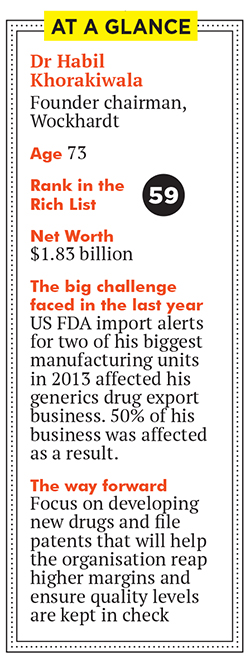
“In your darkest hour you have two options: One, you get overwhelmed by the massive extent of the problem and it paralyses you from any action; the other, you anticipate the worst case scenario and deal with it the best way you can. I choose the latter.” This choice—to fight back and swim against all odds—has brought Dr Habil Khorakiwala, 73, back from the brink. Twice.
The first time was in 2008. Wockhardt was incorporated in 1967 and had done well for itself, growing steadily into one of India’s leading pharmaceutical companies. But, during the heady days of the stock market boom of the mid-noughties, it had bet heavily on foreign exchange and derivatives. The global financial meltdown caught many—including Khorakiwala—unawares: Cross-country derivative deals unravelled and Wockhardt declared a loss of Rs 1,000 crore in FY10. The company experienced near bankruptcy and speculation was rife that it will be sold out.
Enough to rattle the toughest businessman, perhaps. But not Khorakiwala: “I anticipate the worst possible outcome and see if I can live with it. This frees me up to take action.” When he realised that it was indeed a worst-case scenario, he “moved to the next step in figuring out how to reduce the impact, and steps needed for it,” he tells Forbes India.
He had to deal with more than 20 different banks and master the complex world of derivatives. He began by acquiring the knowledge he needed, legal and financial, to deal with the ailment; he read books and consulted experts across the globe, then armed with better understanding, he worked assiduously to resuscitate the company.
He went in for a CDR (Corporate Debt Restructuring) exercise, and made two major divestments: The profitable nutrition business (brands such as Farex and Protinex) to dairy giant Danone for about Rs 1,280 crore, almost 25 times Ebitda; and the veterinary pharmaceuticals business to a French company, Vetoquinol (the price was not disclosed). These funds helped him reduce debt substantially.
Also, at this time, the Wockhardt Hospitals venture that he had built with his own money (it is not connected to the listed pharmaceutical entity) had begun unravelling. Debt had piled up due to borrowings-led scaling up and expansion across India. Khorakiwala decided to swallow another bitter pill: In August 2009, he sold 10 of the most profitable hospitals—from the 17 in the chain at that time—in cities like Delhi and Bengaluru, to Fortis Healthcare. Khorakiwala is phlegmatic about this phase: “It is not a mental or emotional barrier for me to hold on to [companies].”
What worked in his favour was that their pharmaceuticals were doing well. This helped him convince his creditors and Wockhardt’s dealers and distributors to not give up on the company. The family also communicated with employees during the crisis. All of which helped stem attrition at the top as well as keep the core business largely unaffected.
Habil’s son, Dr Murtaza Khorakiwala, 43, who is managing director of the pharmaceutical business sums it up: “What the company was facing was a financial issue, not a business issue, and financial issues are transient.”
There wasn’t much time to enjoy the fruits of these labours, however. In 2013, two of Wockhardt’s drug manufacturing facilities in Aurangabad, Maharashtra were the subject of import alerts from both the US Food and Drug Administration (FDA) and the UK’s Medicines and Healthcare Products Regulatory Agency (UKMHRA). Naturally exports, 80 percent of Wockhardt’s Rs 5,721 crore revenue in FY13 (half of which came from exports to US), took a large hit, falling to Rs 4,830 crore in FY14.
Wockhardt took corrective steps immediately, improving technology and raising quality standards across all its manufacturing facilities in India and abroad (Ireland, UK, USA). The UKMHRA has now eased restrictions on one of the plants, while the US FDA has re-inspected the facilities.
A side-effect of the export crisis was that the Khorakiwalas and the management team paid more attention to building the India business, which has, over the last two years, grown at a compounded annual growth rate (CAGR) of more than 30 percent.
The cumulative effect of both crises and the way the company reacted to them has made it a leaner, healthier enterprise. Murtaza Khorakiwala says that they have focussed more on operational efficiencies to do “more and more with less and less”. Optimisation drives in all plants and offices helped reduce operating costs: Every line item was carefully looked into, staff across all departments rallied to cut any wasteful expenditure they came across. People cost, as a percentage of sales, came down from 15 percent to about 11 percent over the last three years.
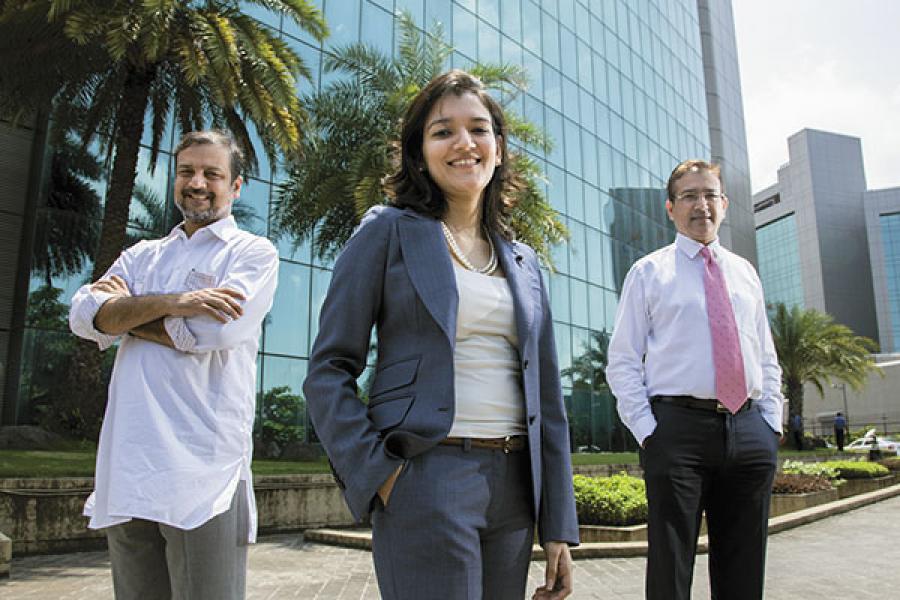
Image: Joshua Navalkar / Wockhardt Foundation head Huzaifa Khorakiwala (left), Zahabiya Khorakiwala (centre) who runs Wockhardt Hospitals and Murtaza Khorakiwala who handles the pharmaceutical business at Wockhardt
One spend hasn’t been cut, however: R&D. Khorakiwala launched Wockhardt’s drug discovery programmes 15 years ago, and budgets have never been cut even during the company’s toughest financial years, because, he says, “I always believe it’s a long-term gain. Never sacrifice any part of the future to save the present.”
No action, he says, is trouble-free; even inaction has a cost. “Running a business will lead to problems. Don’t run away from it. Have discipline and work at it.”
The tenacity and calm in times of crisis are traits that define him. This is also what his colleagues and friends often single out about him. And these qualities have inspired, and rubbed off on, the next generation.
Daughter Zahabiya Khorakiwala (33), who is managing director of Wockhardt Hospitals, says her father remained as cool as a cucumber throughout the troubled years: “He is a fighter and will never resign [himself] to any situation because he firmly believes that every problem has a solution.”
Mentored by her father, Zahabiya has opened two new hospitals (to add to the seven left after the sale to Fortis), and taken revenues from Rs 180 crore in FY10 to Rs 350 crore in FY15. With the most recent launch, a hospital in South Mumbai, she personally looked into every detail, from the dozens of permissions required to run a 300-bed hospital to recruiting the surgeons, doctors and specialists. She follows the principles that her father espouses; with hospitals, he says, financial success is secondary, “Establishing a benchmark in clinical care is more important.”
For the Khorakiwalas, a business family, social responsibility is deeply ingrained. They owned Akbarallys, which was originally India’s first true department store. Habil’s father, Fakhruddin Khorakiwala, had bought Worli Chemical Works (which was later renamed Wockhardt)as part of a backward integration plan for the pharmacy in Akbarallys. A busy man, Fakhruddin Khorakiwala made time to serve as Sheriff of what was then Bombay. Habil Khorakiwala made CSR activities a regular part of his agenda, and in 2008, he merged all those activities into a formal entity, the Wockhardt Foundation. This was partly prompted by his eldest son, Dr Huzaifa Khorakiwala (44).
An MBA from Yale, Huzaifa had worked with Wockhardt’s international operations in the US and later the UK, before returning to India to work alongside his father in India, handling the veterinary pharmaceuticals business which was sold in 2008. Always spiritual, he had read many religious books and developed a desire for care-giving. “My son walked up to me in 2008 and said, ‘I want to focus on the Foundation work, and don’t mind spending more time on it.’ I said, ‘go ahead and do it.’” Huzaifa became CEO and trustee of Wockhardt Foundation.
The foundation raises its funds not just from Wockhardt, but also from other organisations seeking to conduct professionally-run CSR activities. It employs 300 people and runs a number of activities. Its 60 mobile medical vans—fitted with the latest equipment, stocked with necessary medicines and staffed by experienced doctors—provide healthcare in remote villages and areas in ten Indian states; corporations can sponsor these vans in return for branding, and they get regular reports on the operations and number of people it has helped. It has also built 1,000 clean toilets in villages, started 25 toy libraries to encourage children to read and absorb good values (an initiative spearheaded by Huzaifa’s wife Samina), and has started an e-learning project to cover 200 schools in Thane, Aurangabad and Rajasthan. From a Rs 1.8 crore corpus in 2008, the foundation has raised Rs 70 crore as of FY15. Huzaifa plans to ramp up activities over the next three years; he wants to expand to 300 mobile medical vans and build 3,000 toilets.
The senior Khorakiwala has good reason to look back on the last few years with a wry smile. In 2012, he was the biggest gainer in the Forbes India Rich List, adding $1.17 billion to his net worth and moving up 47 places in the rankings. The problems with the US and UK pharma regulators later that year saw Wockhardt’s share prices plummet, as did his position on the Rich List: He lost $1.09 billion and dropped 56 places.
Today, he has triumphed against adversity, and come back stronger. His children have come into their own and are growing the family business, in their own ways. He has created value for both his shareholders and the community.
And there’s the little matter of his personal wealth. Wockhardt share prices have surged, and the 74.39 percent promoter and promoter group stake has resulted in a considerably heavier bank balance: His personal wealth went up by $580 million, placing him at 59 in the 2015 Forbes India Rich List. As he likes to say, “If you do the right thing, it will lead to good business.”
(This story appears in the 29 October, 2015 issue of Forbes India. You can buy our tablet version from Magzter.com . To visit our Archives, click here.)
source: http://www.forbesindia.com / Forbes India / Home> Lists> India Rich List 2015 / by Deepak Ajwani / November 27th, 2015
From Marathi to Tamil, and classical to rock, Razzak has it all.
A little corner of analog music on a Mumbai pavement
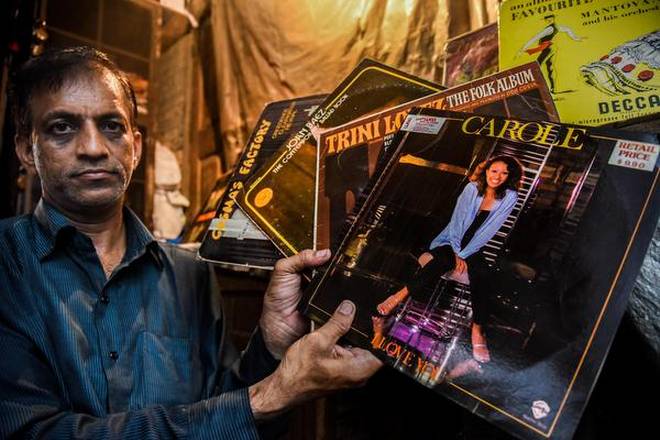
As I walk down the cobbled pavement under the famous blue-and-white arches of Kitab Mahal, I almost walk past ‘Royal Music Collection’ without noticing it. But Lata Mangeshkar crooning ‘Chhod De Saari Duniya Kisi Ke Liye’ lures me to the shop tucked away between others selling helmets and mobile phone covers. I am immediately struck by the hundreds and hundreds of vinyls and cassettes that are immaculately organised in the tiny space.
The shop’s owner is Abdul Razzak, a man of few words. It is difficult to tease answers out of him; he prefers to reply in lists: genres, artists, languages, types, sizes, speeds of vinyl. He has facts about his collection of LPs and EPs and LDs at his fingertips.
“There’s Hindi, English, Gujarati,” he intones, “Marathi, Punjabi, Tamil, Bengali, Indian classical, Western classical, pop, rock jazz, blues, hard rock, soft rock, soft instrumental,” barely pausing to take a breath. If I slip in a word edgeways, he chides me gently, like a parent frustrated their child isn’t solving a math problem right.
A special bond
He pulls out stacks of vinyls, neatly arranged by genre in plastic bags, from a small, almost hidden, cupboard that holds his more expensive collections. He then lists out artiste names in another rapid-fire burst: “Boney M., ABBA, The Beatles, The Doors, Pink Floyd, Jimi Hendrix, Led Zeppelin, The Who.” “I don’t really relate to them or understand them,” he says, but he clearly knows what to stock.
As the conversation progresses, the 54-year-old slowly begins to warm up. He tells me why vinyls are special to him. “When you play it, it feels like someone is sitting in front of you and singing,” he says. Razzak’s father worked at a printing press, and no one in his family was particularly interested in music. As one of five siblings growing up in Mumbai, Razzak would inevitably watch as many films as he could in theatres and religiously listen to their songs on cassette tapes. That is how his love for music began.
“I listened to old Hindi songs,” he reminisces. “I loved Rafi saab’s music. I’d listen to mix collections of Mangeshkar and Talat Mahmood.” Then, as a teenager, Razzak discovered a friend’s collection of vinyl records. There was no turning back. “Once I realised the quality of records, I would only listen to them. The sound is so sweet to the ear.”
One day, the friend gave Razzak his entire collection of 300 records. This was the impetus that kick-started Razzak’s vinyl business in 1980. The collection had songs and dialogues from classics like Raj Kapoor’s Barsaat (1949) and Shree 420 (1955), and Sholay (1975). With these classics, Razzak began to expand his collection and also his network of collectors.
Razzak had gone into business with his uncle, who sold old stamps and coins at the same spot in Kitab Mahal where Razzak now sells vinyl. Uncle and nephew still work together and, in fact, the shopfront abutting the pavement sells coins and stamps during the day, and in the evening after his uncle closes shop, Razzak moves in from the alley at the back where he sits during the day.
Gandhi on 78 rpm
The oldest record in Razzak’s possession is Ashok Kumar’s Jhoola (1941). He also has Mahatma Gandhi’s voice on a 78 rpm. Kanan Devi, Suraiya, Noor Jehan, they all feature strongly in the mix.
The shop has changed little in the 37 years of its existence. A store in Chor Bazaar is offering competition, but that doesn’t appear to worry Razzak. “A lot of the stuff in Chor Bazaar is from scrap dealers, from posters to antique furniture,” he explains, “but they sell at high prices.” Why doesn’t he do the same, I ask. “I don’t want to. I want to run this place as it has always been run,” making enough to cover his family’s expenses.
Kala Ghoda’s famous Rhythm House shut down last year because music downloads proved too big a competition. But online streaming doesn’t affect Razzak whose customers seek him out for a different era, a different sound, for an experience that digital cannot give.
The demand for his wares has slowly grown, as vintage becomes hip and electronic vinyl players buttressed the market. From DJs to interior designers to Bollywood stars, Razzak attracts a tony crowd. He proudly shows me a picture of director Madhur Bhandarkar visiting his shop. Nobody in his family has shown any interest in continuing the shop, but Razzak is unfazed. “I’ll sell them for as long as I can. I can definitely run the shop for another 10 years.”
Anahita Panicker is a Mumbai-based freelance journalist who is as obsessed with cinema as she is with gender rights.
source: http://www.thehindu.com / The Hindu / Home> Entertainment> Music / by Anahita Panicker / September 30th, 2017
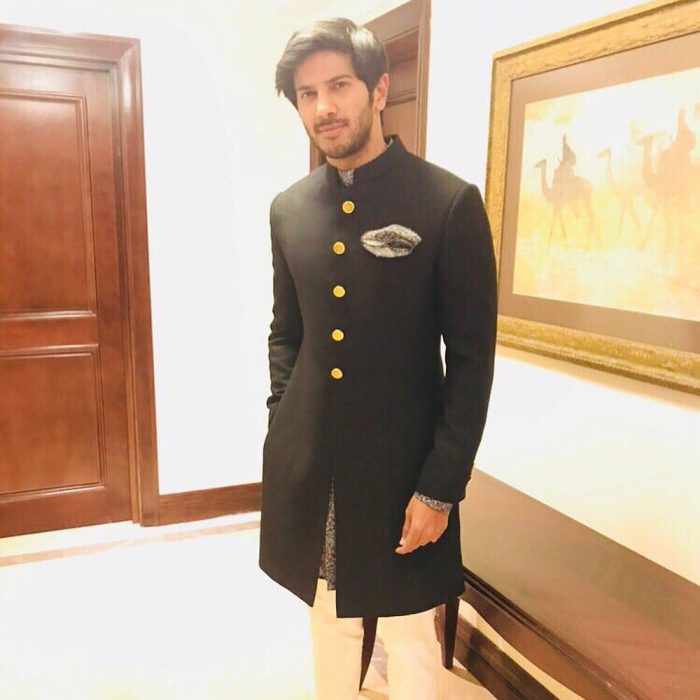
Dulquer Salman slays in a bandh gala as he was spotted at an event.
The super dapper Dulquer Salman was recently spotted at an event looking all debonair.
The popular Malayalam actor wore a black bandh gala with statement golden buttons pairing it up with off-white tapered pants and a grey printed pocket square.
We love how he has kept it simple and formal yet adding a bit of his own style with that pocket square.
We are totally crushing on this look let us know your comments too.
source: http://www.regionalpinkvilla.com / PinkVilla / Home> Tamil> Fashion / by Avantika Gupta / November 18th, 2017
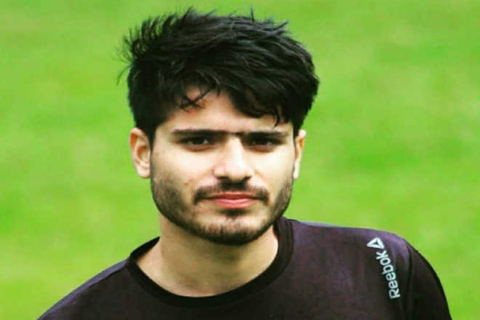
Amir Ali Shah (23) from Bijbehara town of the district has spent more than two years to come up with the website ‘Stop Fake in Kashmir’, reported The Tribune.
Amir Ali Shah
A youth from south Kashmir’s Anantnag district has created a website to tackle the menace of fake news.
Amir Ali Shah (23) from Bijbehara town of the district has spent more than two years to come up with the website ‘Stop Fake in Kashmir’, reported The Tribune.
The website is the first of its kind developed in the Kashmir valley, said the report.
The website is already up on the Internet though it is waiting for formal launch which will take place in coming weeks.
Shah claimed that the website will act as a watchdog to keep tabs on unverified and fake news circulated on the social media where users can upload a link or screenshot of the news they want to verify.
“The website will give a feedback on whether the news is true or fake based on web searches,” Shah was quoted as saying by the report.
He said that the back-end team of the website will also run the information through its sources on the ground and check the veracity of the news.
Shah said he conceived the idea of developing such a platform in January 2016 after the entire Kashmir valley went into mass hysteria following fake news that suggested that the polio vaccine administered to children was expired and had caused some deaths.
source: http://www.greaterkashmir.com / Greater Kashmir / Home> Kashmir / by GK WebDesk, Srinagar / September 24th, 2018
The general meeting of Meenu Marata & Commission Agentara Sangha was held at the office of the sangha here recently.
C M Mustafa was elected president, Bharath Bhooshan elected honorary president, K Ashraf as executive president, K E Rashid as vice president, K Abdul Azeez P P A as treasurer, K M Ibrahim as chief secretary, J B Shiva as joint secretary and C B Azharuddin, K M Bava and S A Saleem were elected executive committee members on the occasion.
source: http://www.daijiworld.com / DaijiWorld.com / Home> Karnataka / by Spoorthy Ullah, Daijiworld Media Network – Mangaluru(EP) / September 21st, 2018