Category Archives: Business & Economy

How to be your own boss at 19

Hyderabad, TELANGANA :

NabhaanTELAN02jun2016

HYDERABAD:

It has once been said, “Follow your own heart, not the world”. To achieve something in life, and to make your mark in the world, you have to have to courage to face the odds and follow your dreams. Here’s someone, from our very own city, who had the courage to follow what his heart said, and has made his dreams come true, at such a young age.

Meet Nabhan Mahmood, a young entrepreneur and the CEO of Iron Threads. The firm in Banjara Hills, deals with clothing and apparel solutions whilst also managing sporting arenas and facilities.

The clothing line manages customised and retail merchandise, ranging from college, corporate to individual orders. He established his very own company when he was 19 in November 2014. Through the past two years, he has successfully made his company an international brand name, signing contracts with Hyderabad Cricket Association, Platinum Motor Cars Detroit, Telangana Basketball, Telangana Hockey, and New York University (NYU) Football, to name a few. Graduated from Amity University, Delhi, this young entrepreneur is presently pursuing Law from Osmania University, Hyderabad.

So what inspired him to start Iron Threads at such a young age? “I was intent on making a difference in my own life and in the lives of those around me. Being an entrepreneur was the most plausible and exciting route to accomplish that. I dreamed of being my own boss.”

He thanks his parents let him venture into something like this at such a young age. “I started my company on a shoestring budget – from the savings I had made from winning football tournaments. My parents initially assumed it was a source of added pocket money so they did not oppose it. As time passed, when they saw that my venture was growing rapidly and that my grades weren’t suffering from my added work load, they too became comfortable with the idea of me going ahead with this venture.”

Other than deciding to work for yourself, what was the single most important decision that contributed to his success? Nabhan says, “The decision to invest my savings in my own venture rather than a mutual fund. It kept me in charge of my money and investments and gave me the drive to use it as tactfully as I could.”

Currently he hires people whenever he needs. “Otherwise, I’m a one-man army,” he adds.

Everyone looks back and wish they had done things differently. If he could time travel back to day one of his start-up and have 15 minutes with his former self, what would you tell yourself? “I’d tell myself to find multiple options of transport of consignment sooner. This would help me avoid dependence on any one agency, as the workload gets too cumbersome for any one agency to handle efficiently and on time.”

“Business has taught me that you’ll only be to achieve the things you’re willing to suffer for and that fear is a phenomenal source of motivation to chase your goals,” he says.”

“It is also okay to be different from your peers. In fact, it is necessary to be different if you want to shape your life according to your ideals and achieve stellar success that would give meaning to your time and efforts. Anyone can be ordinary just as anyone can be special- a disciplined work ethic and passion and fearless approach is what separates those who dream from those who achieve those dreams.”

His mantra is what Walt Disney once said, “If you can dream it, you can do it.”

source: http://www.newindianexpress.com / The New Indian Express / Home> Cities> Hyderabad / by Drishika Adhiya / June 01st, 2016

The waza from the Valley

Jammu & Kashmir :

BashirMPOs31may2016

Bashir Ahmad Concha on how to dish out the traditional multi-course and meat-rich Kashmiri wazwan

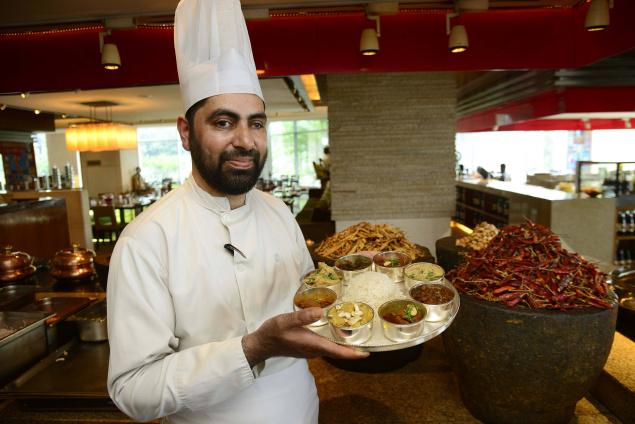
Ask most visiting chefs about their tryst with South Indian flavours and they’d wax eloquent about their love for the crunch of a crispy dosa. But not waza (traditional Kashmiri chef) Bashir Ahmad Choncha. He’s more likely to scowl and say, “The flavours are too unfamiliar.” For, compared to our fluffy idlis, rich coconut chutney and spicy sambar, his familiar food — the spicy and salty lahbi kebab, rich curd-based nadru yakhni and melt-in-the-mouth minced mutton ball in creamy gushtaba — feels decidedly different. Yet, the wazwan is a treat for anyone curious about the possibilities of the unfamiliar.

The wazwan, considered the pride of Kashmiri cuisine, is rich, to say the least. It is made during special occasions, and traditionally served in a large plate that’s shared by four. Most dishes are curd-based and all of them are made with liberal amounts of ghee. To top it off, the spread is meat-heavy. Mutton, mostly, as most Kashmiri Muslims prefer that. The chef’s favourite is the tabak maaz, a mutton appetiser that’s deep fried in ghee. “What can I say? Most people in Kashmir are rich and they want to eat rich food too,” laughs waza Bashir, even as he insists that the ghee will only make one strong, not fat.

The most challenging dishes to make, he says, are the light and spicy rista and the heavy yogurt-based gushtaba, for which the meat needs to be pounded by hand for half an hour. The vegetables have a distinct flavour, as do the spices from the region. It is for this reason that the waza says he brought 400 kg of ingredients for the ten-day Kashmiri Wazwan food festival at Spice Haat, Hyatt Regency.

Waza Bashir learnt his culinary flair from his father, chef Noor Mohammad Choncha, by watching him cook eversince he was eight years old. “My father would have never allowed me to become a waza if he were alive. He never wanted me to come into the family business.” But when his father passed away, Bashir took over the kitchen at 25. For the last 20 years, he has been at the helm of things at ‘Concha Foods’, a restaurant in Srinagar and also, a manufacturing outfit that packages and exports spices from the valley. “There’s a big market for Kashmiri cuisine. Every month, 1,000 kg of tin-packed rista and gushtaba are exported to places around India, the United States and Gulf countries.”

His fame in the packaged food business soon saw him plate up flavours from the valley at food festivals in Bangalore, Pune, Chandigarh and other places.

However, he says, wazas taking the road is rare. Even though his father had close to 1,000 students, most of them have set up their own restaurants in Kashmir. “The wazwan is a big business in Kashmir. A typical Kashmiri indulges in the wazwan about once a week. One plate is priced at Rs. 2,500 even in a small shop. It’s a very exotic spread. So it’s very rare that people leave the valley to make wazwan.”

Kashmiri Food Festival at Spice Haat is open for dinner till May 29. There’s a Buffet is priced at Rs.1,550, vegetarian thali at Rs. 1,000 and non-vegetarian thali at Rs. 1,200, (exclusive of taxes), to choose from. For details, call 61001234.

source: http://www.thehindu.com / The Hindu / Home> Features> MetroPlus> Food / Raveena Joseph / May 23rd, 2016

Morocco: New Delhi Eyes Big Investments, Indian Vice-President to Visit Rabat

KOLKATA (West Bengal) / UTTAR PRADESH / NEW DELHI :

 REUTERS
REUTERS

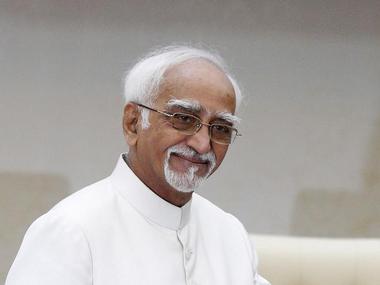
The Indian Vice-President Hamid Ansari is expected in Morocco from May 30 to June 1, a visit expected to highlight by the signing of several Memoranda of Understanding (MoU.)

The Indian Vice-President’s visit is taking place few months after King Mohammed VI visited India to participate in the India-Africa summit held in October last year. The king was the guest of honor of the India-Africa summit.

During this diplomatic visit, the first in 50 years since the last visit of an Indian Vice-President, Ansari will hold talks with Moroccan officials on a wide range of issues including economy and UN Security Council expansion, Indian sources say.

“This visit intends to further strengthen the cordial relations between the two countries, further develop and diversify profile of bilateral economic cooperation and explore new avenues of co-operation and partnership on a wide range of issues of shared interest,” a statement from the Indian external Affairs Ministry said.

The Indian Vice-President will also launch, together with the Head of the Moroccan Government Abdelilah Benkirane, the India-Morocco Chamber of Commerce and Industry, according to Indian sources.

Besides the political dimension of the trip, a special accent will be put on the economic issues as India plans to expand market outreach of its cars and truck manufacturers.

MoUs will be signed in education, IT and communication technology sectors during the visit.

Several economic initiatives have been undertaken by both sides over the past months. Last month, officials of the two countries’ ministries of transports mulled in Mumbai the idea to launch a direct air link between the two countries.

Also in the course of April, a team of Moroccan business people visited New Delhi to study business partnership opportunities that can be established between India and Morocco.

source: http://www.northafricapost.com / The North Africa Post / Home> Headlines> Morocco / by Kamailoudini Tagba / May 27th, 2016

Kerala’s farmers reap a rich plant genome saviour award harvest

Thrissur, KERALA  :

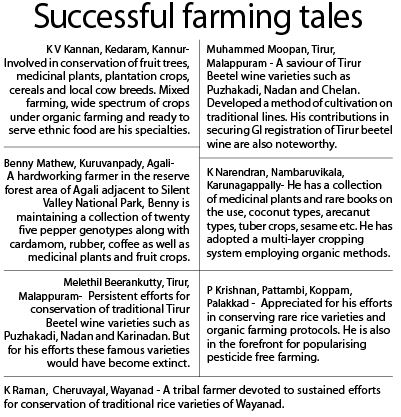
The Kerala farmers dominated the National Plant Genome Saviour Awards-2013 by winning seven out of fourteen rewards announced by the Protection of Plant Varieties and Farmers’ Rights (PPV & FR)  Authority, Government of India.

The seven farmers involved in conservation of traditional crop varieties were nominated for awards by Kerala Agricultural University (KAU).

FarmingTalesKERALA15may2016

K V Kannan ( Kannur), Benny Mathew (Agali, Palakkad), Melethil Beerankutty (Malappuram) and Muhammed Moopan (Malappuram) have been selected for Plant Genome Saviour farmer’s reward  which consists of a purse of `1.5 lakh, a memento and a citation, while K Raman (Cheruvayal, Wayanad), P Krishnan (Palakkad) and K Narendran (Kollam ) will receive Plant Genome Saviour recognition which consists of a purse carrying `1 lakh, a memento and a citation at a function to be held in Delhi shortly.

KAU Vice-Chancellor Dr P Rajendran described the seven awards as a significant acknowledgment for Kerala farming community as well as farm scientists. “Bagging seven out of fourteen awards is very special. The role of KAU in supporting such activists and helping them earn such recognition are often forgotten. I appreciate the efforts of our scientists, especially Dr C R Elsy, Coordinator, KAU IPR cell, Dr M C Narayanankutty, RARS, Pattambi and Dr M R Bindu, ORARS, Kayamkulam, who nominated these farmers,” he said.

The KAU had played a pivotal role in helping the Pokkali Rice farming Community (2011),  Akampadam Padasekhara Samithy (2012) and Ciby Kallungal of Thrissur and N Vasavan of Kannur ( 2012) win the Plant Genome Saviour Awards earlier.

source: http://www.newindianexpress.com / The New Indian Express / Home> States> Kerala / by Express News Service / May 11th, 2016

Who moved my samosa?

Chennai, TAMIL NADU :
HajaMPOs16may2016

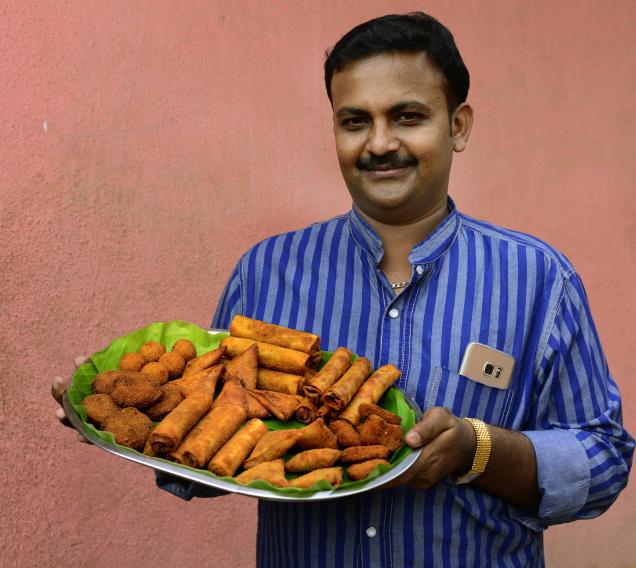
From selling samosas in Pudupet to supplying fried goodies to star hotels and airline caterers, Haja Funyamin speaks to about his momentous journey

It’s a searing hot day and we are lost in the many dusty roads of Red Hills. After going around in circles for 15 minutes trying to locate Hafa Foods, we realise that all we had to do was just ask for it. Passers-by smile with a sense of familiarity. “Ah, samosa kadai,” they exclaim, and direct us towards the unit. An unassuming, candy-pink building sits by the side of the road. It’s calm on the outside, but inside, a group of capped and gloved employees are at work like the Oompa-Loompas in Charlie and the Chocolate Factory. Like clockwork, they stuff vegetables and corn into samosa shells.

Haja Funyamin, 35, the owner of Hafa Foods and Frozen Foods, walks around, sampling cutlets and kieves. “I always taste products from each batch to check the quality,” he says. It’s been quite a journey for the young entrepreneur. Sitting in his air-conditioned office, he says: “I used to make Rs. 1,000 a day in 2006; now, my annual turnover is Rs. 1.5 crore. A small business that started with just three or four people now has 45,” he says.

Regulars at Pudupet market know him as the guy who unfailingly supplied them their evening snack of crispy, golden samosas.

The samosa story started in the early 90s when Haja’s mother would make large quantities of the fried delight. After school, Haja and his older brother would carry the onion samosas and sell them to tea shops in Pudupet. It cost 25 paise a samosa, and between them, the two boys would sell out the batch of 300.

Once Haja got married, his wife helped with the frying. “After four years, in 2006, I received the call that changed my life,” he says, dramatically. A frozen food export company liked his samosas and offered him a business deal. They wanted him to make 5,000 samosas a day, which they would freeze and export. Things were going well for Haja, till the same company decided to stop selling products that cost less than Rs. 5. “Since my product cost only Rs. 1.25, it was stopped. For two months, I didn’t know what to do. I had hired 10 people, and had to pay them. Luckily, I managed a bank loan. With that, I paid the workers and bought myself a flour-mixing machine,” he recalls. The same year, in 2007, he launched Hafa Foods and moved to this 8,000 sq. ft., two-storey unit in Red Hills.

Shortly after that, the same export house told him his products were in demand, and asked him to get in touch with a kiosk named Happy Cool Bar. He started supplying 10,000 samosas a month. As word got around, the demand went up, and so did the range — he added paneer rolls, spring rolls and cutlets.

By 2009, he got bulk orders from amusement parks. The flight kitchens came calling next, followed by star hotels, IT companies and wedding caterers.

“Other than a small outlet in Purasaiwalkam that sells our frozen products, we don’t retail directly through supermarkets and stores. I am sure clients bite into our snacks at hotels and flights and enjoy them, but don’t know who is behind the venture,” he says. Maybe, that’s why part of his future plan is to start a café.

“Now, our catalogue has 16 products,” says Haja, listing out his favourites — chicken pops, nuggets, potato kieves, vegetable wraps, breaded rolls… Next, I plan to introduce vegetable lollipop and sabudana vada. These have been on trial for two months now,” he says. In a week, Hafa Foods makes non-vegetarian goodies only thrice a week. They use 20 tonnes of vegetables and two tonnes of meat in a month. Haja says his wife and he are in the unit from 9 a.m. and stay till 9 p.m., long after their staff leave. Their two children, a 13-year-old daughter and nine-year-old son, study on their own, and he’s happy with how responsible they are. “I am working towards making this an international export company. So, by the time my daughter is 21, she can take charge of it,” he smiles.

source: http://www.thehindu.com / The Hindu / Home> Features> MetroPlus> Society / by Priyadarshini Paitandy / May 16th, 2016
Savour the red mango, a new variety in Medak

Narsapur (Medak District), TELANGANA :

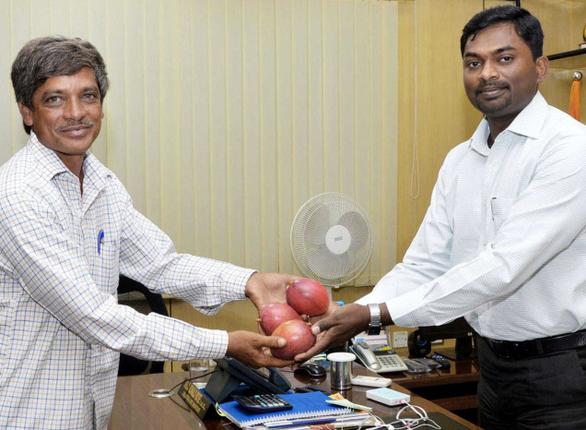
Eye-catching:(Above) Sk. Jalaludduin handing over the red mangoes to Collector D. Ronald Rose in Medak on Tuesday. The red mango sapling at his nursery.— PHOTOS: Mohd Arif

The red-coloured mango, grown by Sk. Jalaludduin of Narsapur in Medak district, was released here on Tuesday.

Mr. Jalaluddin had collected different saplings from forest area for his nursery out of which one was left to grow for a year that yielded red mangoes. Later, he started working on the mother plant and developed seedlings from that. At present, he has five mother trees and about 60 trees grown from the seedlings and he is planning to expand it to another six acres in the coming season. “Even after the harvest, the mango fruit is in good shape and has more fibre. Even the largest fruit will not be more than 300 grams,” Mr. Jalaluddin told The Hindu .

With the expansion, it is estimated that each acre would accommodate about 120 saplings under ultra high density system. He says while the cost for expansion the first year would be between Rs. 18,000 and Rs. 20,000, the annual expenditure would be about Rs. 6,000 from second year onwards. The variety was not yet named and he was in touch with the officials of the Agriculture University.

Mr. Jalaluddin met District Collector D. Ronald Rose

source: http://www.thehindu.com / The Hindu / Home> National> Telangana / by R. Avadhani / Sangareddy – May 11th, 2016

Son may take forward legacy of man who guided Queen Elizabeth, Diana

Agra, UTTAR PRADESH :

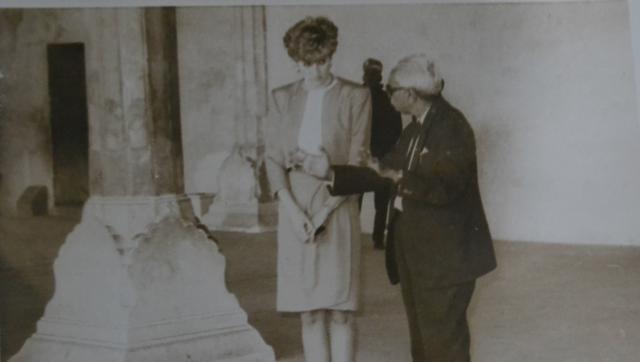
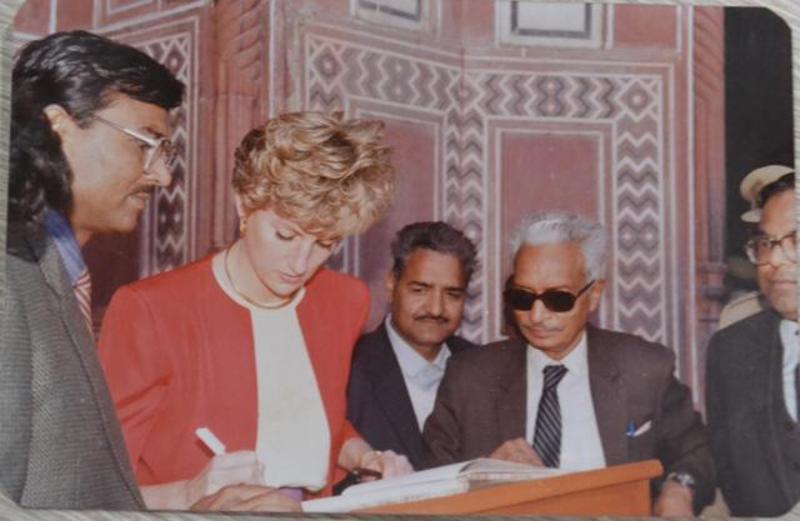
Princess Diana at Deewan-e-Aam at Agra Fort in 1992. (File Photo)

Two guides in Agra have been contacted by British High Commission for the royal couple’s visit on April 16. However, there is still no confirmation as to who will be deputed to guide the Duke and Duchess of Cambridge.

One of them is Varun Rawat, whose father Mukund Mohan Rawat was the official guide to Queen Elizabeth (II) who visited the Taj Mahal in 1961, and Lady Diana in 1992. He was contacted by British embassy about six days ago.

Princess Diana signs the visitor book at Taj Mahal in 1992. (File Photo)

The other guide contacted by British High Commission is Shamsuddin, who is the former president of Approved Guides’ Association.

“My father was the official guide to Queen Elizabeth (II) in 1961 and her daughter-in-law Lady Diana who visited the Taj Mahal in 1992,” Varun said.

“My father used to talk about Lady Diana being a down to earth person with immense interest in the history and architecture of Taj Mahal,” he recollected. “He would tell me how Lady Diana interacted politely with the Taj Mahal ‘khadim’,” Varun said.

Varun had guided former US President Bill Clinton when he visited the Taj Mahal in 2000 and again in 2003.

source: http://www.hindustantimes.com / Hindustan Times / Home / Hemendra Chaturvedi, Hindustan Times,Agra / April 15th, 2016

Weave Me A Warm Magic

Hyderabad, TELANGANA :

She’s helped revive traditional weaves and, like the Mahatma, dreams of a loom in every home

SuraiyaMPOs25apr2016

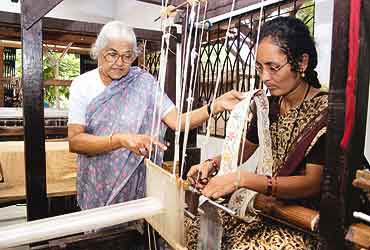
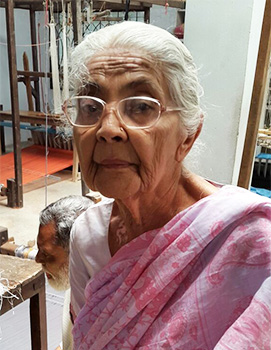
At 75, Suraiya Hasan Bose has energy levels that can put a teenager to shame. But when she chats, she exhibits the languid grace of a long-forgotten nawabi culture. As women work magic on the looms at her weavers’ workshop at Dargah Hussain Shah Wali (a village on the outskirts of Hyderabad), in the adjacent Safrani Memorial School run by her, children race around with unbridled enthusiasm.

Suraiya employs a large number of poor women, many of them widows, from the village. These women are trained to work on himroo, jamawar and paithani—fabrics that were brought into India by the Mughals. “I want to see these women stand on their own feet. I wish to see looms in all their homes and hope they can train future generations too,” she says. Suraiya’s unassuming demeanour envelops the large room as the women go about their work.

On the other side of the fence, the children’s learning curve, under Suraiya’s tutelage, spreads an air of hope. Like the women, students of the school too come from poor households—children of farmers, labourers or vegetable vendors. Suraiya charges them a nominal fee.

Suraiya attributes her passion to her father Badrul Hasan. Mahatma Gandhi too has been her idol. When Gandhi first visited Hyderabad, it was in front of Suraiya’s house that the first bonfire of English mill-made cloth was lit. Suraiya’s father died when she was only five but she had others to look up to. Her uncle Abid Hasan Safrani was the personal secretary to Subhash Chandra Bose and she was married to Bose’s nephew Aurobindo Bose. “My late husband was based in Calcutta, and used to be in and out of jail. Both our families understood the importance of Gandhi’s ideals of preserving traditional handlooms.” It is after her uncle that the weaving society and school are named since he was the one to encourage Suraiya to follow her passion for handspun textiles.

While Suraiya is credited with the single-handed revival of the Nizami-Persian fabrics of himroo, paithani and mashroo in Andhra Pradesh, she has also worked extensively in the village of Kanchanpalli, close to Warangal. In the early ’70s, due to lack of patronage, weavers in Kanchanpalli had almost given up their profession. They merely made decorative calendars woven with portraits. Suraiya encouraged them to make durrees. Today, over 500 weaver families in Kanchanpalli make a living through durrees and other weaves.

In Warangal too, when Suraiya began her efforts to revive weavers and fast-vanishing forms of royal designs, there were just two such families. Following Suraiya’s constant efforts, there are now a thousand families involved in weaving, research and development of textiles. Several of them also come to Suraiya’s workshop to learn the intricate art of himroo. Now, Suraiya plans to train women from the nearby villages of Hafizpet and Miyapur.

Funds are slow to come by but Suraiya believes if the passion is there, money will soon follow. As the school bell rings and children rush out, Suraiya says, “Half my heart is with them. Since they come from the poorer quarters, we also teach them to use cutlery, to speak softly and even pick up any garbage they find on roads and put them into dustbins. We basically want them to be honest and respectful citizens.”

Despite Suraiya’s busy schedule, she is at the school every day at 8 am. “What’s heartening is, marriage is not a priority for the girls passing out from my school. College is. That’s our greatest achievement,” she says, her eyes shining through her bifocals.

Her future plans? Adding weaving classes to the school curriculum. For like Gandhi, Suraiya’s dream is to see a loom in every home.

Contact Suraiya at: Safrani School premises, 1-86, Dargah Hussain Shah Wali, PO: Golconda, Hyderabad: 500008 Tel: (040) 23563792, 23560992.

source: http://www.outlookindia.com / Outlook / Home> Making A Difference / by Madhavi Tata / October 31st, 2005

Suraiya Hassan weaves magic, wants to revive dying textile art

Hyderabad, TELANGANA :

“Mrs. Suraiya Hassan?”

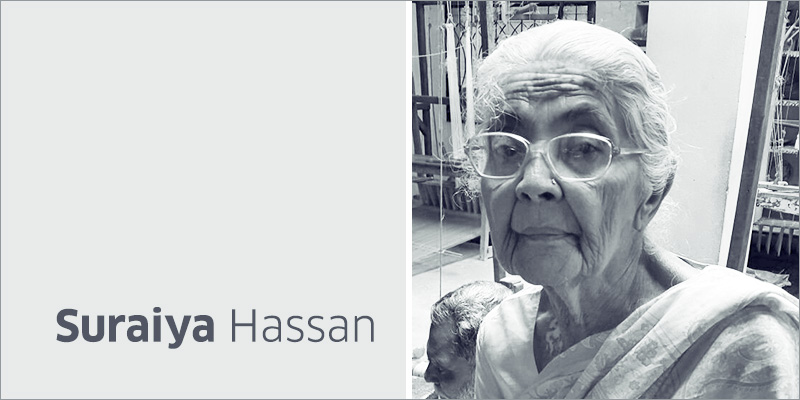
“Haan ji, bol rahi hoon. Boliye..”, the grand old lady of Indian weaving greets me into the conversation.  Engaged in revival work of four different textile forms of Aurangabad, Suraiya has a fascinating tale to narrate.

SuraiyaHassan01MPOs24apr2016

Her journey began soon after she finished her Intermediate. Suraiya joined the Cottage Industries Emporium, a government institution where she learnt the art of salesmanship and production of textiles and handicrafts. It was a great learning experience spanning well over four years, says Suraiya.

It was while working here that a professor from a foreign country, Suraiya says it would be London, came to their Emporium and she was put in charge of showing her around. “She touched and felt everything and was so impressed with me describing the importance of each and every fabric and handicraft product that she thought I was wasting my time here,” says Suraiya on a lighter note recalling her toddler steps into the weaving industry. Eventually it was this lady who introduced Suraiya to her mentor Pupul Jaykar, of the Handloom Handicrafts  Corporation of India in New Delhi.

It was a move Suraiya had not contemplated in life and it truly got her where she perhaps wanted to be. “Maine kabhi aisa socha nahi tha, lekin ye ek achchi opportunity thi, so I decided to go along,” says Suraiya (I had never thought of such a career move but when opportunity came knocking, I didn’t say no).

It helped that she had her uncle (chacha) Abid Hassan Safrani living in Delhi. He was with the Ministry of External Affairs initially and at one point was personal secretary to the legendary Netaji Subhash Chandra Bose, recalls Suraiya.

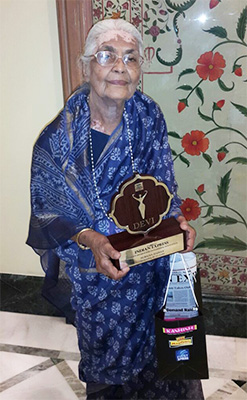
Suraiya Hasan was recently honoured with the Devi Award

Her association with Bose’s family

Suraiya was soon introduced to the Bose family through their ladies. From casual visits, the journeys


Little did she understand the importance of being married to Bose’s nephew except that Aurobindo too was a busy politician. “He was a trade union secretary with many big companies,” says Suraiya of her husband. She however, never got a chance to meet Subhash Chandra Bose.
became personal and Suraiya got to know the family from close quarters. She then got married to Aurobindo Bose, Subhas Chandra Bose’s nephew.

From Delhi back to Hyderabad

After superannuation, Abid Hassan moved to Hyderabadand bought some land there. He was the one who called Suraiya back to the Nizam’s city and asked her to set up an independent handloom production unit.

“I wasted no time and got to my hometown to set up this unit. It was an exhaustive task but I would say worth the effort,” says Suraiya. It was here that she started work on the revival of four signature Persian fabric forms native to Aurangabad – Paithani, Jamawar, Himroo and Mashru. Thus was born Suraiya’s Weaving Studio, Suraiya’s weaving unit in Hyderabad.

During my visits to Aurangabad, I had seen many artisans work tirelessly on keeping this art alive, but in a very small way, often at their own homes. I therefore decided to make this sector a little organized in the hope that this dying art will have people following it

While she concentrated on her art, her husband used to visit her in Hyderabad when he had free time on his hand.

She is still in touch with the Bose family though the visits have dwindled in number after her husband passed away.

SuraiyaHassan03MPOs24apr2016

Social enterprise

Suraiya selected a group of people to pass on her art. It was the widows, with no place to go to and children to feed that she thought would be her right target audience. “I used to sit with them for hours together and help them pick up the nuances. To train one artisan easily takes close to 3-4 months on an average and I later got an expert to help me with the training part. Doing it alone was becoming a Herculean task,” says Suraiya.

While she created an opportunity for widows to pick up the art, she helped by setting up a school in the same compound for their children. Called the Safrani Memorial High School, this institute houses classes for students from Nursery to Std 10, where children of her artisans attend school free of cost.

Aged 84 now, Suraiya says she has lots of work yet to do. When she is not supervising the work of her artisans, she goes to teach students in her school. She takes pride in the fact that they have all performed well and some have even gone abroad.

Well this love for education is not by chance, Suraiya says she would have inherited it from her father. He after all was the proud owner of Hyderabad Book Depot on Abids Road, most likely the first book store in Hyderabad which stocked foreign publications.

source: http://www.her.yourstory.com / YourStory.com / Home> Her Story> Inspiration / by Saraswati Mukherjee / January 12th, 2015

Gujarat built mosques to draw Arab ships

Ahmedabad, GUJARAT :

Ahmedabad :

Can you imagine a non-Muslim building a mosque in 21st century India? May sound impossible today. But, two far-sighted Jains built one of the earliest mosques in Gujarat, a state that has seen some of the worst post-independence communal riots.

And, all this for the sake of business. Between 1178 and 1242, Vastupal and Sheth Jagdusha built mosques in Cambay and Bhadreshwar in Kutch to attract Arab and Turkish traders, who would bring in foreign exchange. While Vastupal was the commissioner of Cambay port, Jagdusha was a merchant of Bhadreshwar port in Kutch. Jains have been an important business community from the earliest time till today.

‘History of International Trade And Customs Duties In Gujarat’, a book by historian Makrand Mehta, says Vastupal encouraged Muslims to settle down in Cambay and Anhilwad Patan, the capital of the Solanki-Vaghela rulers of Gujarat.

The accounts of Arab travellers like Masudi Istakhari Ibn Hauqal and others, who visited Gujarat between the 9th and 12th centuries, amply testify to the settlements of Muslims in Cambay and other cities of Gujarat.

“But the Muslims settlements could hardly have developed without the support of the Solanki rulers. In fact, they attracted the Arabs and Persians to Cambay and Vastupal did it by constructing mosques for them,” says Mehta.

Jagdusha was not officially designated as a customs collector but he had cultivated excellent relations with ship captains and customs staff. Although a devout Jain, as a staunch businessman he understood the value of foreign exchange. “For this reason he also constructed a mosque in Bhadreshwar, his hometown,” according to the book.

source: http://www.timesofindia.indiatimes.com / The Times of India / News Home> City> Ahmedabad / by Ashish Vashi & Harit Mehta / TNN / February 10th, 2010