The World Consumer Day was celebrated recently in Madikeri under the joint auspices of Kodagu district administration, Food and Civil Supplies Department and Kodagu District Consumer Forum.
MirAnisAhmed, DCofKodagu, inaugurated and V.A. Patil, President, Kodagu District Consumer Forum, presided over the programme which was attended by more than 150 people.
C.V. Nagaraj, retired Senior Chemist, Regional Agmark Laboratory, Bengaluru, demonstrated simple tests to detect adulteration in various food items. He also spoke about the harmful effects of various types of adulteration and on the laws that exist in India against food adulteration.
Associations interested in arranging such lecture-demos can contact C.V. Nagaraj ( 2521640, 9945651990).
CULTURAL FEST
The Department of Tourism and Hospitality Management, Pooja Bhagavat Memorial Mahajana Education Centre, has organised an inter-collegiate cultural festival on April 12 and 13. For registration contact festival convener Paul Iruthayaraj on 9739824423, Faculty coordinators Gunarekha B.S. on 9480438394 or Priyadarshan Bhat on 8867204780.
source: http://www.thehindu.com / The Hindu / Home> National> Karnataka / Mysuru – April 11th, 2016
All things Mughlai Biriyani, kebabs and more / Photos:Special Arrangement
Tasneem Ayub Khan will tell you how to make it, writes K. JESHI
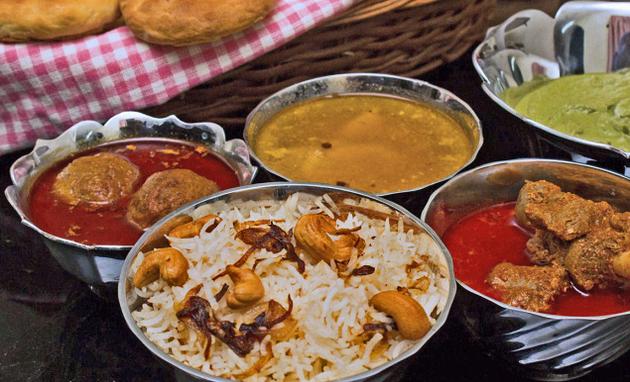
Fourteen ingredients. “That’s all you need to make Dhakni biriyani,” says Tasneem Ayub. “One has to know the right proportion of ingredients, the order in which they have to be added, the time and, most importantly, the confidence. Anyone who loves cooking can easily learn,” she says.
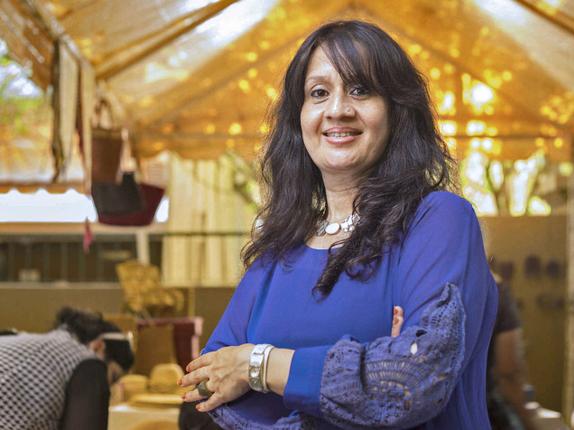
A home chef and home baker, Tasneem runs Ammee’s Kitchen in Chennai. She conducts workshops on how to make biriyani.
“Everyone loves biriyani and so they are eager to make the yummy mughlai biriyani. It is not as difficult as it is made out to be. Keep it simple is what I tell them,” explains Tasneem.
Tasneem draws her inspiration from her mom. “She was a fabulous cook. She worked full-time, as the principal of Ethiraj College, yet she ensured that she made tasty food before she stepped out for work. I have learnt all my recipes from her.”
While Tasneem’s father’s ancestors come from Pakistan, her mother is from Kozhikode in North Kerala, a foodie’s paradise. “I love my mom’s meen moily, a Kerala special; the fish curry, appam and stew. I haven’t changed a thing from my mom’s recipes. ”
Tasneem says it’s a misconception that Mughlai dishes are high on spices. “The Mughals didn’t use spices. It was all about rich, creamy bases made from cashew or almond paste, inspired by Persian and Turkish style of cooking. They never use lime in any of the preparations. I follow the same style.”
She calls herself a traditionalist.
“I stick to the original recipes. Cooking gives me the utmost joy. Even when I am unwell, I crawl to the kitchen and cook. I try out Italian, and Mediterranean cuisines, but there is nothing to beat the versatility of Indian cuisine. I tell people at my classes to try and buy organic ingredients. And, don’t buy anything readymade, even curd or yoghurt. Make them at home. I make my own ginger-garlic paste,” she says.
Tasneem is currently working on a book, a compilation of recipes collected from friends and family members.
“I want to give it a personal touch with the recipes in their own handwriting,” she says.
And, what is her favourite food? “Dal chawal. I love to have it with the pickles I make at home as well!”
To know more about her recipes visit: www.facebook.com/ Ammees
Kitchen Or mail her at ammeeskitchen @gmail.com
source: http://www.thehindu.com / The Hindu / Home> Cities> Coimbatore / Coimbatore – April 06th, 2016
Abdul Aziz was elected as the president of Saw Mill Owner’s Association in the Saw Mill Owner’s meet, held at a private hotel here on Friday March 25.
Honorary president, Haji Abdul Y Kunhi, secretary Mohammed Haji, vice president- Faizal, secretary Vishwanath Nayak, joint secretary, Mukthar, treasurer Govindha Bhai Patel, legal advisor Bhaskar were also elected during the meet.
From Sullia, Harish Kamath, Puttur-Haji Kunhi Mohammed, Mangalore-North-Nasir, Mangalore South- Abdul, Mangalore-Dinesh, Bantwal-Rithesh Baliga, Belthangady, Vaikunta Baliga were elected as the office bearers on the occasion.
The newly elected president Abdul Aziz gave a brief note on the need of the association in contemporary scenario and problem faced by the Saw Mill Owners in the society.
Abdul Nasir compered the programme.
source: http://www.daijiworld.com / DaijiWorld.com / Home> Karnataka / by Daijiworld Media Network – Mangaluru(DV) / March 25th, 2016
The online fashion marketplace is here to provide a fillip to unbranded fashion
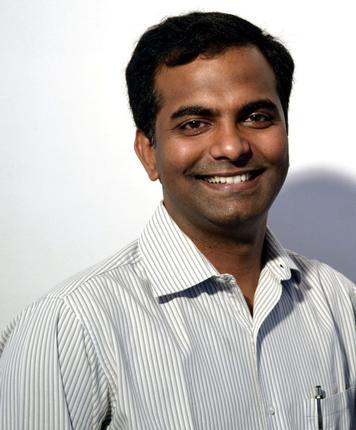
Sujayath Ali, founder of Voonik.com
Voonik.com, (both website and app) was founded with an idea to be a fashion marketplace for women looking for their everyday wear. As it’s labelled as the country’s first personalised shopping app, you’re curious about what it means in this context? “Voonik takes the skin tone, body type and preferences into consideration to see if the fit suits you. We’ve developed a 10000-rule algorithm in coordination with our stylists to assist users,” the founder Sujayath Ali states.
Finalising the criteria was a tough ask, but they’d readied them from a generalised questionnaire of over 150 questions in discussion with stylists that women consider as they shop.
Screenshot of the website
For now, its users are shown a series of celebrities with whom they can compare their body, tone and other preferences. Isn’t that objectification of sorts? “As it was a new idea, we needed a way out to familiarise our user-base. It’ll have an adequate replacement in the coming days,” elaborates Ali.
Voonik respects the fact that not everyone needs to be a fashionista for buying clothes online. “There are so many shopping sites that promote branded fashion but we’re here to show how potent unbranded fashion can also be. We didn’t want to sophisticate things and are clear of catering to the masses,” Ali elaborates. He justifies this saying, most women are focussed on the place and quality where a fabric comes from, than the brand altogether. It looks like their focused strategy has indeed paid off with nearly 6 million app installations in its 18-month run.
Beyond user needs, Voonik’s uniqueness shows up in their ‘Become a seller’ section. They have a one-of-a-kind image recognition platform that’ll help the management assess the quality of the fabric once sellers upload the images of the stock. That has helped them build a vast collection of 15-lakh clothing, the most for an online fashion outlet to date, globally.
They have interesting plans lined up for the times to come. Having just acquired a menswear shopping portal Getsty, they’re on the path to integrate men’s collection to their platform, which users can access through another exclusive app. There are two other acquisitions they remain tightlipped about, but with persistence, we get hints. “There’ll be a premium luxury section that’ll be launched too,” Sujayath manages to say.
source: http://www.thehindu.com / The Hindu / Home> Features> MetroPlus / by Srivathsan Nadadhur /Hyderabad – March 07th, 2016
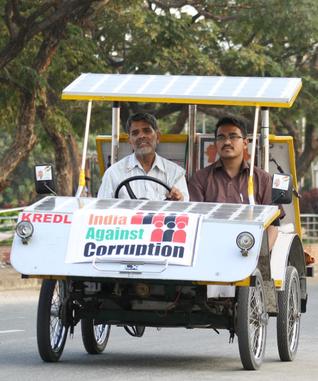
COIMBATORE, 16/02/2012: Syed Sajjad Ahmed (left), a businessman dealing with electrical accessories in Bangalore, with his relative on a solar car in Coimbatore on February 16, 2012 as part of his tour of South India for 1,000 km to generate awareness among the people on pollution and corruption. Photo: M. Periasamy / The Hindu
Syed Sajjan Ahmed travels 3,000 km in self-built four-wheeler.
Bengaluru , KARNATAKA :
Sixty-three-year-old Syed Sajjan Ahmed arrived in Bangalore in a self-developed solar electric-powered car to cover 3,000 km from Bangalore to Delhi to participate in the first India International Science Festival (IISF).
It took Syed 30 days to cover the arduous journey, which included crossing the Vindhyas. Born in Kolar, 70 km from Bangalore, the standard XII dropout began his career as a fruit vendor and went on to set up a shop for electronics repair.
His work included assembly of electronic goods, starting off with transistors, tape recorders and television sets and antennae. Later, he moved on to computers, before attempting to realise his childhood dream to do something for society.
“I had to leave school when I was 15 to start earning for my family. But the fire to create something that would be of use to humanity kept burning within me,” he says.
The break came in 2002. “I told myself that I am 50 now, and I must do something before I become too old and infirm.”
Ahmed started by modifying a two-wheeler to run on electric power, and then a three-wheeler, and later a four-wheeler.
He bagged the Karnataka government’s award for environment protection, instituted in honour of former president A.P.J. Abdul Kalam, in 2006, for his innovation. Ahmed says that the modified car is equipped with a set of five solar panels, each with a capacity of 100 watts.
The power generated by the panels propels the machine through a bank of six batteries, each with a capacity of 12 volts and 100 amps. He takes pride that his small car withstood the test of the 3,000-km trek. “There were times when we thought we would not be able to take the steep climbs on the ghat roads. But, it crossed all the hurdles without much trouble,” he adds.
Ahmed says he has travelled 1.1 lakh km in his four-wheeler across the country so far. He is accompanied by a cousin, Salim Pasha, who travels in a regular car alongside. Both started their journey to Delhi from Raj Bhavan in Bangalore on November 1.
Ahmed, who says his vehicle costs around one lakh rupees at present, would further be driving from Delhi to Dr. Kalam’s hometown of Rameshwaram. “I wanted to make this journey an adventure; I have driven this vehicle for 10 years and hope to keep it going,” he says. He will then return to Bangalore via Kanyakumari.
“Dr. A.P.J. Abdul Kalam is my inspiration. Through my journey, I want to inspire and educate the public, especially students, about Dr Kalam’s Vision 2020 for uplifting the country,” he adds.
source: http://www.thehindu.com / The Hindu / Home> Features> MetroPlus / IANS / December 08th, 2015
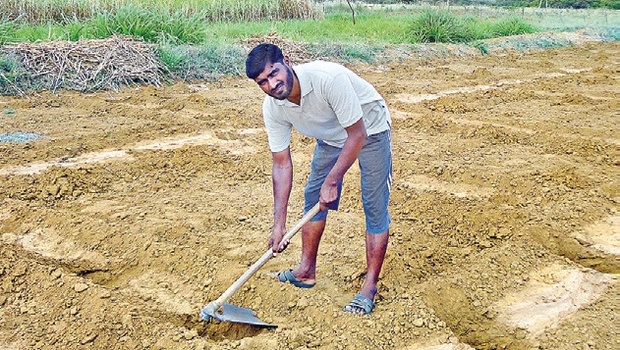
N Sheik Abdullah at work in his organic farm at Kalakudi village near Manur in Tirunelveli | EXPRESS
Tirunelveil :
At a time when agricultural lands are turning into commercial housing plots, a youth has been silently transforming dry land into organic farming plots near Manur in the district.
Giving up his high salary job after working around nine years in West Asia, diploma holder N Sheik Abdullah (34) is busy now turning his integrated organic farm at Kalakudi village near Manur into a farm that grows watermelon, drum sticks and marigold.
“After completing a diploma in mechanical engineering, I worked in production arena in Erode and Coimbatore for around five years. Later, I took up the job of a design engineer in the West Asia. With the support of my family members, I later purchased dry lands at Kalakudi village,” Abdullah said.
He returned from West Asia in March last year to launch into agricultural activities.
Hailing from Pettai in Tirunelveli city, he travels about 25 km to reach his farmland from his house daily.Step by step, he is turning the dry soil into one that is suitable for organic agriculture farming.
Abdullah said he has plans to keep local breeds of cows, goats and chicken in the organic farm.
He has also planted local tree species of banyan, neem, pipul, fig, Poovarasu among others.
Abdullah, who considers organic farm expert Nammalvar as his role model, has undergone training at his organic farm ‘Vanagam’ in Karur district. He has cultivated paddy in the farm and plans expand it to more areas in his plot.
His idea is to produce healthy milk, egg and organic agriculture produces, which has no pesticides and chemicals.
Satisfied with the milk yield of local breeds of cattle, the 34-year-old is also chalking out measures to save them.
source: http://www.newindianexpress.com / The New Indian Express / Home> States> Tamil Nadu / by M. Abdul Rabi / March 03rd, 2016
Dr. T.N. Prakash Kammaradi (second from right), Chairman, Karnataka Agriculture Price Commission, Government of Karnataka, Bengaluru, is seen releasing a brochure during the inauguration of workshop in city this morning. Also seen are (from left) AIR Mysuru Programme Executive N. Keshavamurthy, AIR Bengaluru Station Director M.A. Ahmed and AIR Mysuru Programme Head M. Raghavendra.
Mysuru:
A one-day workshop on ‘Agricultural Finance Management’ organised by Prasar Bharati – India’s Public Service Broadcaster, All India Radio (AIR), Mysuru, on the eve of Radio Kisan Divas, began at Central Institute of Indian Languages (CIIL) auditorium, Manasagangotri, this morning.
Speaking after inaugurating the workshop, M.A. Ahmed, Station Director, AIR, Bengaluru, said that AIR Mysuru ‘Kisan Vani’ programme has been a hit among the farming community.
Giving a brief on the objective of observance of Radio Kisan Diwas, Ahmed said that the programme has enabled the farmers to get clarifications for their doubts and problems. He called upon the farming community to maintain a balance between expenses and income and to utilise available resources in a most judicious manner.
Karnataka Agriculture Price Commission Chairman Dr. T.N. Prakash Kammaradi, who delivered the keynote address, explained the meaning, scope and significance of agricultural finance. Pointing out that Agricultural finance deals with the financial aspects of farm business, including macro and micro financial aspects of an agricultural economy, he observed that such workshops, seminars, etc., will help the farming community to improve productivity, increase profitability and fulfil their long term goals.
Since Indian Agriculture is capital intensive, the farmers’ dependence on lending Institutions, such as banks, has considerably risen, Kammaradi said and called upon the lending institutions to come together with society in setting an overall framework in which the individual farmer can appropriately manage his finances.
Noting that natural disasters and other calamities have put the farmers at great risk with crop loss and un-remunerative prices, he expressed displeasure over media’s hyped reporting whenever prices of agricultural and horticultural commodities shoot up and at the same time remaining silent when prices of agricultural produces crash, resulting in great loss to farmers.
He called upon banks and other financial institutions to chalk out the best cash flow analysis that helps the farmers in determining period wise quantum of loans needed and a proper repayment channel that benefits the farming community.
Stating that agricultural production in the country stands at 250 million tonne per year, he called upon the farming community to judiciously use farm savings and not to spend on unproductive assets.
source: http://www.starofmysore.com / Star of Mysore / Home> General News / February 15th, 2016
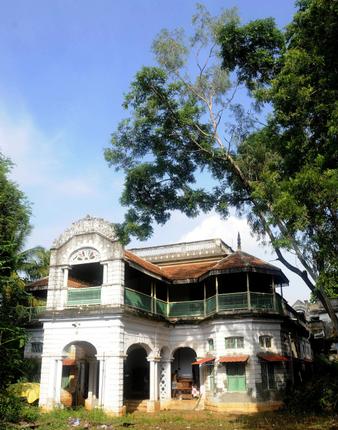
A view of the M.K. Maaligai in Khajamalai, Tiruchi. Photos:A. Muralitharan
Behind the façade of this heritage residence in Tiruchi lies the story of its enterprising owner, M.K. Mohamed Ibrahim Ravuthar.
It is an arresting sight on the Race Course Road in Tiruchi. A stately home, complete with gabled roofs and stained glass windows peeks out demurely from behind black granite walls, willing you to stop and take a closer look.
“It’s a unique building just like the man who built it,” says Dr. M.A. Ansar, describing the mini 11-roomed palace and his grandfather M.K. Mohamed Ibrahim Ravuthar in one breath.
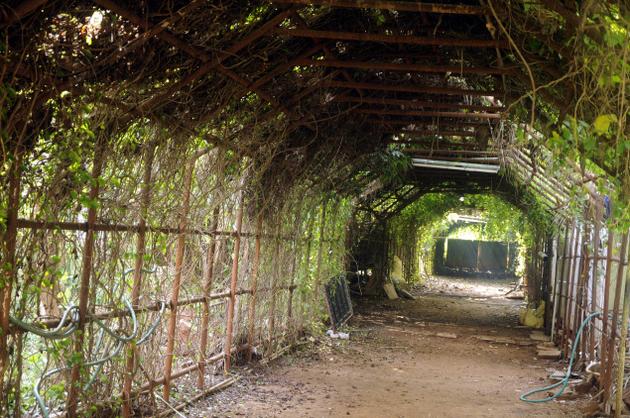
Built in 1928, the M.K. Bungalow was actually the main home in a complex of four residences in this quiet nook off the Race Course Road in Khajamalai. It resembles a structure straight out of a Jane Austen novel, especially when you walk through the green corridor (an iron trellis walkway that is still covered with the ‘December Poo’ or Philippine Violet vines planted by the patriarch) to reach the main entrance.
A trellis ‘green corridor’ leads up to the bungalow. Photo: A. Muralitharan
The garden is overgrown, and the annexes that once housed a live-in washerman, stables for horses and cattle, huge bathrooms and an elaborate pantry and storehouse, clearly have seen better days. Even so, when Mrs. Najma Begum, the current resident of the house and one of M.K.M. Ibrahim’s granddaughters, opens the main door, it is possible to see flashes of another, more flamboyant world that once existed here.
“When Thatha was alive, this house used to be called ‘M.K. Maaligai’ (Palace), today I can hear people calling it the ‘Pei (Ghost) Bungalow,’ when they walk past on the other side of the walls,” says Mrs. Najma.
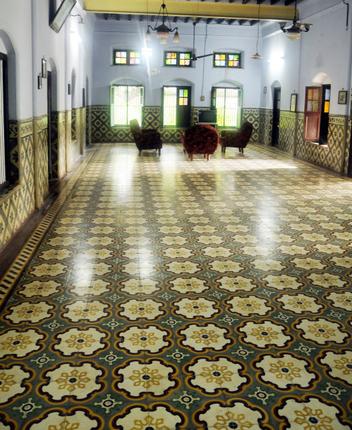
Keeranur tiles brighten up the interior of the M.K. Maaligai. Photo: A. Muralitharan
As room leads to room, each with Keeranur floor tiles and wide windows fitted with cooling coloured glass, the other tales about the house are dusted off and narrated too.
Tales of how chandeliers with red glass and gold paintwork imported from Austria used to adorn the halls. Records that were played on a Polyphon, a coin-operated music box which played metal discs measuring 195/8 inches in diameter, for dance parties hosted for British guests. And how a fountain and a ‘chaukhandi’ (gazebo) used to be star attraction of the garden.
The M.K. Maaligai was the entertainment venue not just for M.K.M Ibrahim’s friends and business acquaintances, but also guests of the State from Britain. On average, some 15-20 people would gather for the daily repasts, made with the finest of produce sourced from nearby towns.
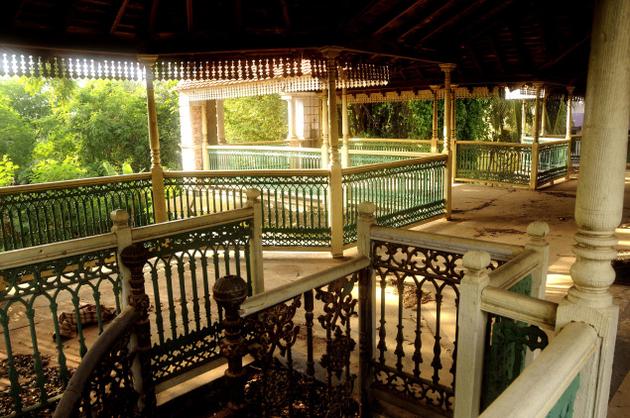
Elaborate decorative work done on the verandah’s eaves and railings. Photo: A. Muralitharan
As the tour continues, up an imported cast-iron spiral staircase (one of two), to the first floor where the master suite looks out on a large decoratively gabled verandah, it becomes clear that this house was meant to be a personal work of art.
Hands-on leader
“My grandfather used to be known as the ‘Prince of Tiruchi’ for his lavish lifestyle,” says Dr. Ansar, whose late father M.K. Abdul Salam was the eldest son of M.K.M. Ibrahim. “Though he didn’t have much education, he used speak English fluently because of his close association with the British. He was among the invitees to a special assembly to commemorate the coronation of King George VI in May 1937.”
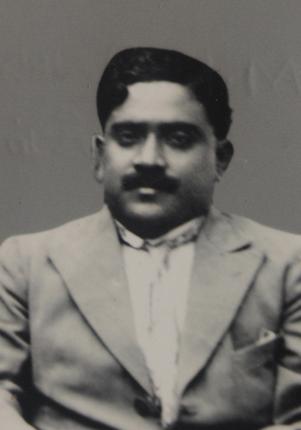
M.K.Mohamed Ibrahim Ravuthar.
Born in 1885, M.K.M. Ibrahim was the second son of M. Kasiappa Ravuthar, a wealthy businessman and landowner who migrated to Tiruchi from Ettayapuram, Tirunelveli district (see related story on Page 4).
Taking over his father’s kerosene dealership and leather tanneries after his elder brother Yusuf died, Ibrahim diversified the family business rapidly, branching out into petrol supply (he owned 18 petrol stations in his heyday), bus transport, and construction, besides starting a third tannery near Hyderabad.
The family made the Palakkarai area in Tiruchi its base.
The contracting projects that his M.K. Constructions company is associated with are still in use – the Erode Railway Junction, a part of Erskine’s Hospital Madurai (now renamed Government Rajaji Hospital), the Kakinada port (Andhra Pradesh), Chikmaglur Railway Station (Karnataka) and Railway staff quarters in Dindigul, besides a number of highways.
He also built a four-storey building in Chennai, close to the harbour, between Angapannaickan Street and Moore Street, where the leather from his tanneries used to be transported to by coal-fuelled lorries, and then exported to Britain.
Despite not being a part of the Independence movement, Ibrahim commanded a lot of popular support in Tiruchi. He served the city as its Municipality Vice-Chairman from 1925-28 and as Chairman from 1928-31.
He was a close friend of veteran freedom fighter P. Rathinavel Thevar, and co-operated with him on numerous occasions to preserve communal harmony in the city.
Known as a hands-on leader who once paid Municipality workers their salaries from his own funds, he donated the land for Ibrahim Park on West Boulevard Road on the condition that it would be put to public use.
He owned homes similar to M.K. Maaligai in Dindigul, Kodaikanal and Courtallam, which became summertime resorts for the family.
A poignant reminder
“The bungalow was still under construction when there was an epidemic of cholera or typhoid in the inner city areas in the late 1920s,” recalls Dr. Ansar. “Thatha decided to shift the entire family to this place from Palakkarai.”
Despite the love with which he built the residential complex, M.K.M Ibrahim was able to spend only around two to three years there, as he passed away at the age of 55 years on December 2, 1940 due to a heart ailment.
“It is astonishing to see how much this person achieved in a short period of 20-25 years,” says Dr. Ansar, whose father grew up in the complex of four residences along with his siblings. “He was inspired by the things he saw and people he met on his travels, and always tried to recreate the best of it for himself.”
Following the partition of his properties, the M.K. Maaligai was bequeathed to his second son M.K.M. Abdul Hakeem in 1949, whose children still maintain ownership of the heritage building.
After a brief spell as a student’s hostel, the M.K. Maaligai is now back to its original role as a family home.
“We clean it out for family functions, and whitewash it sometimes,” says Mrs. Najma Begum, who stays alone on the ground floor of the vast house.
“Even though it needs a lot of effort to maintain, we’d rather not demolish it. This residence is tied to many people’s lives.”
***
Snippets from an eventful life
M.K.M. Ibrahim fell in love with Rukkaiyya Bi when he saw her coming from the Madrassa (Islamic school) while he was working in Palakkarai. She was 9, he was 15. They married two years later, despite initial parental disapproval. They went on to have three sons and two daughters.
Tiruchi observed an unofficial day of mourning when M.K.M. Ibrahim died on December 2, 1940. Shops were closed as the public thronged to catch a sight of the cortege that was taken out from the family home in Palakkarai, through Main Bazaar to Rock Fort, NSB Road, and Main Guard Gate and to the burial ground just a few yards away from where the procession started in Palakkarai.
In the middle of the four homes that he built around the M.K. Maaligai, M.K. Ibrahim had left space for a tennis court that was never completed. The yard has since been sold to a scrap merchant.
His eldest son M.K.M. Abdul Salam showed an aptitude for public office, and was the first Congress Member of Parliament from Tiruchi in 1957.
***
Founding father
It is easy to see where M.K.M. Ibrahim got his penchant for largesse and flamboyance from. His father, M. Kasiappa (a merging of ‘Kasim’ and ‘Appa’), Ravuthar was an businessman who made his fortune in the early 19th century after migrating to Tiruchi from Ettayapuram.
He was the kerosene agent for Tiruchi and Thanjavur districts, and owned residential properties in the city centre called ‘stores’. The ‘Kasiappa Ravuthar Store’ was one such property near the Rock Fort area.
Besides that he had nearly 500 acres of agricultural lands near Samayapuram and Maruthur.
Kasiappa Ravuthar built two tanneries, one for goatskin and another for buffalo skin which used to be sent to Chennai and then exported to England, in the 1880s. Since the British didn’t allow outside sales, the leather used to be auctioned in England, and the money would be sent back to him in India.
As an expression of gratitude for recovering from a severe skin abscess on his back, Kasiappa Ravuthar dedicated a gold ‘kalasam’ to the main stupi (pillar) of the Nagore Dargah weighing 1,000 sovereigns, that stayed intact until it was knocked down by cyclonic winds in 1958.
source: http://www.thehindu.com / The Hindu / Home> Features> MetroPlus> Society / by Nahla Nainar / November 13th, 2015
Our society needs to change; we are generating a society of merits. We need to understand our children in such a way that education is mixed with passion.
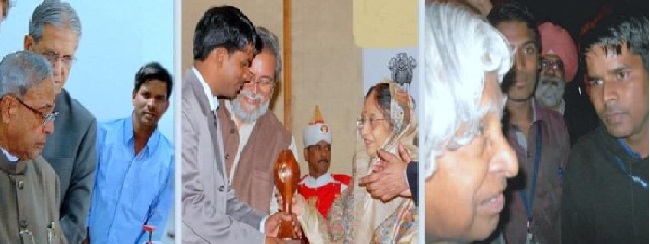
These lines describe Abdul Kaleem’s life in a nutshell. In 2009, Abdul was felicitated by the President of India for his innovations, when he was barely 22 years old. That same year, he was also honoured by the National Innovation Foundation (NIF) for Grass Root Innovation.
Innovator and entrepreneur Abdul Kaleem
But it was never about good grades or staggering dreams; as a student, Abdul always thought a little differently, a philosophy he still lives by:
“Whenever something happens, I think about the logic behind it. I keep questioning.”
And this questioning always took the form of little innovations. In the seventh grade, he saved Rs 2 from his pocket money to buy a crystal bird, which he turned into a greeting machine. It would open out with banner saying Id Mubarak whenever someone entered his room. A theft in his neighborhood caused him to create an alert mechanism that would call the last dialled number on the owner’s phone as soon as the door was opened.
But the contrast of all this sets in when one realises that Abdul was brought up in a small village in Deoria, in Uttar Pradesh born to an Urdu tutor father and an uneducated mother, where an alert mechanism was unheard of!
His parents could never understand what their child was really up to. What they wanted for him was a basic education that would lead to a secure government job. His father was disappointed to see his son’s unconventional ways, and his neighbors constantly felt the need to remind them how he was wasting his time.
But Abdul was only interested in his innovations, electronics, machines, and not the world’s opinion of them. He was undeterred; he smiles and says:
On one hand, Abdul continued to think about wider impact and what the community really needed, while on the other, he finished his high school exams and joined a Psychology course in Deoria. Staying deeply grounded to his roots, Abdul started looking deeper at his inventions. He created a device that could gauge moisture in the soil using sensors, and water pots automatically. The device would stop watering the plants once the sensors gauged enough moisture in the soil.
Next in line was a flood informer system, with a scale fitted at different areas of the river, including the centre and the bed of the river. The minute the water rose to the third level, the sirens would alert villagers to look for higher ground.
Finally, it was a visit by his Psychology professor that put him in the spotlight. He convinced Dr Nagiz Banu to visit his home and the small laboratory where he carried out his experiments. Dr Banu was reluctant, but when she entered the room, she was in for a surprise. Seeing the scale at which Abdul had mastered his experiments, she asked him to send his innovations to NIF. He did and, on 21 November 2009, Abdul was awarded for his grassroots innovations by President Pratibha Patil; what followed was a slew of other recognitions by the state.
We ask Abdul why he pursued Psychology and not Engineering, where his passion truly lay. He replies
“If you see, technology is created by perceiving Psychology, similarly as Psychology perceives the invented technology. So every subject has a correlation, it depends on how you use it.”
When we ask him what we feel is missing in innovations today, he says it is a lack of understanding of Psychology to create technology for the masses, while understanding their needs.
Abdul’s interaction and felicitation from the various Presidents of India
From innovations to business
However, Abdul says that while he may be a good inventor or engineer, he is not a good businessman. He has never understood business numbers.
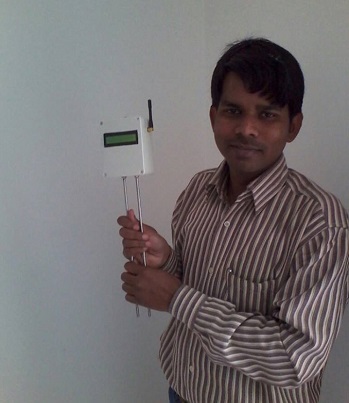
Abdul constantly innovating, with his GPRS sensor
In 2011, Abdul embarked on the Jagriti Yatrawith around 350 strangers, a journey which completely transformed his outlook on where he aspired to use his potential to startup. Immediately after the Yatra, Abdul started working on a low-cost solar table lamp, another basic innovation catering to the masses.
This business idea required an initial capital of at least Rs 5 lakh. Unable to procure the funds, he shelved the idea and pursued other innovations.
Through reference of a customer Siddharth Jettar, in 2014 Abdul was introduced to G.K. Sinha, who was in awe over how solutions to complex issues came so easily to this young man. Abdul had created a universal light controlling remote for Siddharth’s house. G.K. Sinha was an angel investor, having the experience of guiding multiple startups.
He helped Abdul with starting his venture Eco tronica Pvt. Ltd.
Sinha also introduced him to Gautam Kumar, a graduate from Harvard University. Gautam felt the same potential in Abdul’s innovation and worked with him to refine his soil moisture-sensor-driven innovation and mobile weather prediction station to a requirement at Centers for International Projects Trust (CIPT), which is affiliated with the Earth Institute at Columbia University.
The low-cost weather station of sorts, powered by solar power, works on cloud computing and the installation of sensors on rooftops of buildings. The industrial setup costs as little as Rs 15,000, while the user-friendly and domestic models cost up to Rs 10,000 and Rs 5,000, respectively. Jharkhand’s Birsa Agricultural University has planned to set up this technology in the state’s Angara block. This will directly impact 700 farmers of the area.
Today, Abdul is also working on solar powered lighting with dual LED lights, which he claims should work for 24 hours with just five minutes of solar charge. He says he still doesn’t understand the revenues or sales figures because he thinks he is an innovator at heart and will remain one.
Abdul says the biggest challenge in having a manufacturing startup is getting the right vendor, who gives the right product at the lowest cost.
But there is an important lesson for all entrepreneurs when Abdul speaks. Even as Indian entrepreneurs flock to create the next Uber and Amazon, he makes us question what truly comprises innovation for the masses. He makes us question whether business models and revenues are the only success metric for a startup.
For many Indian entrepreneurs taking their product to Silicon Valley – an enduring symbol of innovation – is the highest form of success. But what about innovations for the masses? Is our entrepreneurial ecosystem based on the same system of meritocracy followed in the US?
Innovators like Abdul even make us question our prevailing education system. He rightly says we need to harbor our own culture of innovation. Our challenges are different, and the only way out is to innovate through passion and dedication to solve a problem, rather than look at is as a business.
source: http://www.yourstory.com / YourStory.com / Home> Success Stories / by Tarush Bhalla / January 20th, 2016
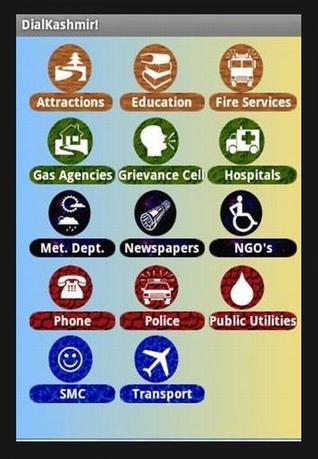
Screenshot of the ‘Dial Kashmir’ app. The application has witnessed an average rating of 4.7 out of 5 with a thousand plus downloads on Google Play.
Srinagar, KASHMIR :
23-year-old girl becomes first Kashmiri to develop Android application ‘Dial Kashmir’ with over 500 contacts of government and private departments — a one stop source for ‘essential information’.
“I don’t want to be a second someone, I want to be the first me,” this is how a 23-year-old ambitious computer engineer, who has become the first Kashmiri to develop an Android application, describes herself on her Facebook page.
The Android application named ‘Dial Kashmir’ contains over 500 contacts of government and private departments — a one stop source for ‘essential information’.
‘Dial Kashmir’ contains important contacts of different departments, officials and public utilities and would be of immense help to the locals and tourists alike, says Mehvish Mushtaq, who holds a Bachelors (B.E.) in Computer Science.
“I felt a need to develop such an application because unlike outside where there are many apps and websites which contain such information, Kashmir had none. ‘Dial Kashmir’ would provide information easily to the people here. There are many users of Android platform based mobile phones here,” Ms. Mehvish, a resident of uptown Barzulla in Srinagar, told PTI.
Ms. Mehvish claims that the application has witnessed an average rating of 4.7 out of 5 with a thousand plus downloads on Google Play.
Ms. Mehvish did an online course on Android application designing in January and put together her skills and desire to develop a “helpful Kashmir centric application” and with an “actually, I can” attitude — as her display picture on Facebook suggests — developed ‘Dial Kashmir’. “I did this online course at the end of which I had to develop something, as part of the project. It took me about 2 weeks to develop this application,” she said.
‘Dial Kashmir’ provides users detailed information like addresses, phone numbers and email ids of various essential services and other departments in Kashmir. It is a one stop source for information on healthcare, education, transport, police and so many others and one does not need to surf through internet pages, official websites and directories,” she said.
A music lover and an ardent Atif Aslam fan, Ms. Mehvish says technology fascinates her and her love for “any-thing-tech” was the sole inspiration behind her “dream of developing something which would help the people of my native place”.
Ms. Mehvish, who did her B.E from SSM College of Engineering and Technology in Pattan area of north Kashmir’s Baramulla district, says girls in Kashmir are “second to none” and “can achieve anything“.
“We just have to keep a dream alive and start working towards realising it. We are second to none and once we set on something, we can achieve it,” she said.
The response to the application, she says, has been “encouraging”.
“Heartening to see a Kashmiri girl develop an android app when everyone claims to be a geek in Kashmir. Good work although app is simple. Keep it up,” one Android user, Rais Bhat, who downloaded the app from Google Play, wrote as feedback.
Another user, Wani Kamraan, wrote, “SPEECHLESS..! Well the application should be improved but this work of you should be appreciated by me, by your own people…So 4 stars for your outstanding work and extra one for being citizen as well as sister of me from my Kashmir… Thank You!“.
Ms. Mehvish says she is now working on making the application “much better” and trying to add “as more details and information as possible”.
source: http://www.thehindu.com / The Hindu / Home> Sci-Tech> Technology> Gadgets / PTI / Srinagar – April 16th, 2013