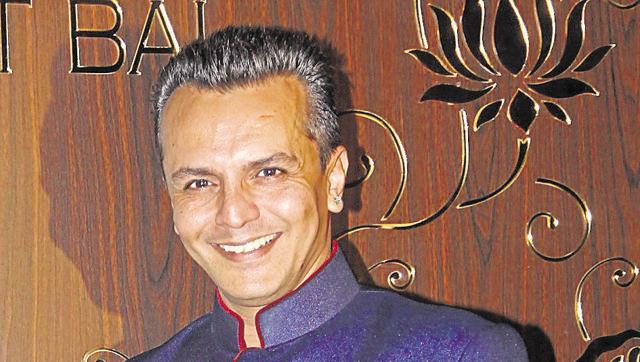
Fashion stylist Imam Siddiqui has always been vocal about his thoughts and when it comes to the popularity he got post participation in the sixth season of Bigg Boss, he is more than happy to talk about it.
“The kind of popularity I got post the reality show has been enormous. I am already signing Hindi films left, right and centre. My film will release in April, in which I play a double role. For heaven’s sake, I am laughing my way to the bank now!!,” says Siddiqui and adds, “My life has changed 180 degrees.”
Siddiqui, who recently participated in the reality show for a week, says the current participants don’t know the worth of the show. “The current lot needs to make better use of the opportunity. They don’t understand the importance of the platform that they have been provided with. The audience does not wish to see just aggression, they also need to give complete entertainment,” he says.
Imam Siddique enters the Bigg Boss house, and that spells trouble for all the contestants, especially Prince Narula! (COLORS)
He does have a word of advice for the participants. “This show can propel their career in the stratosphere like it has done to mine. They must try hard to keep the audience hooked on to them. Otherwise they will lose out on the chance and will regret it,” he says.
source: http://www.hindustantimes.com / Hindustan Times / by Yashika Mathur, Hindustan Times, New Delhi / January 20th, 2016
East African Asian society was complex and contradictory as any truly multicultural society needs to be, and perhaps as only Indians can make it
Toronto, CANADA :
It is amusing to contemplate that if an Indian man, one afternoon in March 1498, had been able to swim, he would have escaped capture by Vasco da Gama off the Mozambique coast, and the world might have been different. The Indian, whose companions had managed to swim away, was called “Davane” by his captors; he was from the Gujarati city of Khambat (Cambay). Davane gave advice to da Gama on local matters and even assisted him in outwitting the local sultan, so that the Portuguese ships eventually anchored safely in Malindi, up north in present-day Kenya. Here he took a pilot, who was possibly a Gujarati, and reached the Malabar coast.
Portuguese sailors plying the Indian Ocean thereafter often wrote about the presence of Indians and Indian ships in Kilwa, Mombasa, and Malindi. Around 1500, Captain Duarte Barbosa observed, “These ships of Cambay are so many and so large, and with so much merchandise, that it is terrible to think of so great an expenditure of cotton stuffs as they bring.” The trading connection between India and East Africa is actually even older, as the carving of a giraffe on a wall of the Konark sun temple indicates.
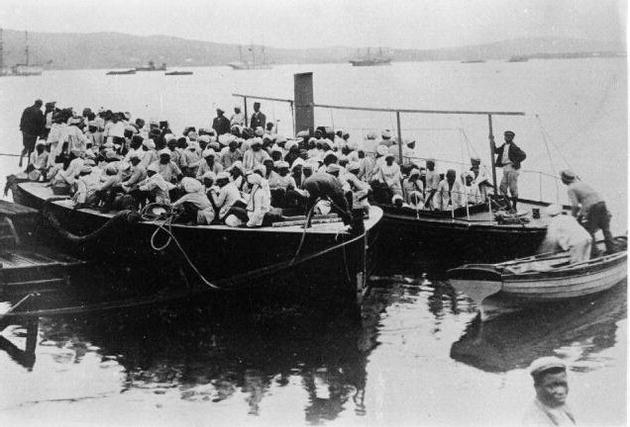
The arrival of Indians in South Africa by boat. / The Hindu Archives
It was in the nineteenth century, however, that Indians began arriving in numbers to trade and settle in Zanzibar, which was by then a major metropolis in the Indian Ocean with international connections, and home to the ruling Omani sultans. The more enterprising men ventured off to the small towns dotting the mainland coast. Most Indians arrived penniless from their drought-prone villages in Kathiawad and Kutch, and remained modest traders, but a few of them went on to become veritable merchant princes with spectacular wealth. Among them were Jairam Sewji, Ladha Damji, and Tharia Topan, to whose firms the sultans farmed out their customs collection and to whom they were often in debt.
Generation of tycoons
With the advent of British and German colonialism in the early twentieth century, Zanzibar’s commercial power and political influence waned, while the interior of East Africa opened up with new infrastructure and increasing trade. As a result, the Indians spread out all over the mainland, which now consisted of the three colonies of Kenya, Uganda, and Tanganyika. (In 1964 Tanganyika and Zanzibar joined to form Tanzania. The Indians went on to be called “Asians”.) The new generation of tycoons included Sewa HajiParoo, whose caravans went from Bagamoyo (near Dar es Salaam) all the way north to the Kilimanjaro region. His apprentice, Allidina Visram, topped him to become “the uncrowned king of Mombasa,” supplying the dukas (shops) that had sprung up from Mombasa to Uganda, and further in eastern Congo and southern Sudan. In 1890 A.M. Jeevanjee, a Bohra from Karachi, arrived in Mombasa and made his fortune supplying goods (and workers) to the Uganda Railway. Much of early wood-and-iron Nairobi was constructed by his firm; the city’s Jeevanjee Gardens was his donation.
By the mid-twentieth century every small town in East Africa had the characteristic Indian strip of shops, and in even the smallest village you would find an Indian family branch running the solitary Indian shop. The Asian population totalled 366,000, with the highest number, 176,000, in Kenya with its total population of around 9 million. Unlike elsewhere, Indians had settled in East Africa as communities; there were Bhatias and Khojas, Jains, Shahs, Patels, Lohanas, Sikhs, Bohras, Memons, Kumbhads, and others. In the cities, the larger communities like the Khojas had their own primary and secondary schools for girls and boys, hospitals, dispensaries, and community halls. Dar es Salaam, with roughly 100,000 people at the end of the 1950s, had at least five Asian cricket teams. Abject poverty was rare, and even the most straitened household could afford three simple meals a day. For us growing up in East Africa, it was India that was poor and backward, as revealed to us in the newsreels and Indian films of the period.
Complex and multicultural
East African Asian society was complex and contradictory as any truly multicultural society needs to be (and perhaps as only Indians can make it). Asians tended to live close to their own communities; caste discrimination persisted, as did Muslims sectarian differences. Yet by the standards we see today in the world, East Africans were largely tolerant. It was understood that you did your thing. The azaan would go off in the mosques, the Khoja ginans would blare out over loudspeakers from their jamat khanas, a temple procession would block a road, the Diwali fatakdas would explode in the Hindu sections (and elsewhere). There was hardly any inter-communal violence, and nothing to compare remotely with the communal and caste slaughter that seems so routine in India.
Undoubtedly the Asians were racist — looking up to the “Europeans” and down on the Africans, by whom, as middlemen, they were often resented. Intermarriage between communities and races was a taboo that was just beginning to yield as I emerged from my teen years. Because the poorest people were among the Africans, it has been broadly claimed and often in Shylockian language that Asians were their exploiters. Asian liberals like to wallow in self-guilt. I have often retorted that my widowed mother worked from eight in the morning to ten at night, running her small shop, barely making ends meet while raising five children; whom did she exploit? Today many Tanzanian African women run small businesses similar to my mother’s. We often forget the wealthy and sophisticated African peoples who owned land and cattle; and while many Africans had homes in their villages, most Asians in Africa did not. If Asians did not marry Africans, the Africans, with ancient traditions of their own, had their own taboos; to imply that they panted to lay hands on Asian women is itself racist.
At the end of the 1960s
Be that as it may, around East Africa’s independence, in the early 1960s, there was a thriving community of Asians who saw themselves as Africans. In Tanzania most would speak two Indian languages plus Swahili and English. Among the elite there was excited talk of the “new African Asian” identity. There were Asian politicians and budding writers — Wole Soyinka’s Poems of Black Africa (1975) includes, significantly, three young Asian poets from Kenya; Africa’s most influential and exciting literary magazine of the 1960s, Transition, was founded and edited by Rajat Neogy of Kampala; and Amir Jamal, Tanzania’s beloved minister of finance for many years, was elected in African constituencies. At the end of the 1960s, there was no doubt in my generation that Africa was our home and we were in the vanguard.
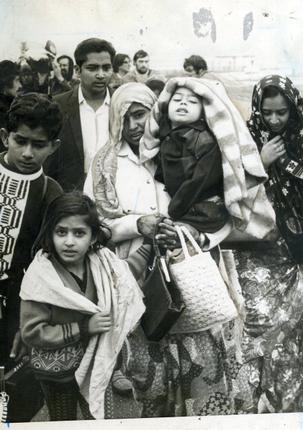
The first set of Ugandan refugees to arrive at Stansted Airport near London after then Ugandan President Idi Amin ordered them on September 18, 1972 to leave the country. / The Hindu Archives
And yet in the 1970s it all fell apart. Kenya’s Asians who had not renounced their British citizenships in time had to leave en masse. In Uganda, Idi Amin had a dream and expelled all the Asians in another “Asian exodus”. In Tanzania, in spite of Nyerere’s enlightened policies, his socialism, combined with the Idi Amin scare, drove out many Asians. What remains of the Asians today is a somewhat insecure and aggrieved population, though most appear dedicated to where they live. Racism of the old sort is gone; intermarriages do happen. At crowded kabab and bhajia restaurants in Dar es Salaam, it is truly pleasing to see Indians and Africans squeezed together at the tables. Indian cuisine has made a big headway especially in Tanzania; country bus stops often have a stand making chapatis; “pilau,” “biriyani” and “sambusa” are Swahili words. What thwarts complete integration is the Asians’ distinct features and cultures, often reinforced by their religious traditions.
A new crop of young Indians has started to arrive. When I see them, they seem foreign and lost. At times I get xenophobic — what are they doing here? do they even speak the language? — when I myself am now Canadian, but also an African Asian.
(M.G. Vassanji is the author of A Place Within: Rediscovering India, and most recently, of And Home Was Kariakoo: A Memoir of East Africa. He lives in Toronto. www.mgvassanji.com)
source: http://www.thehindu.com / The Hindu / Home> Opinion / by M. G. Vassanji / December 27th, 2015
In an obscure bylane abutting the glitzy Commercial Street, Riyaz Pasha is engrossed in some intricate work. He’s giving the finishing touches to an embroidered orange-magenta dress. Ask him who it is for and pat comes a reply. “For Lord Krishna and Radha,” he says before getting back to fine-tuning the chamkis (golden beads) on the skirt.
For 15 years, Pasha, 48, has been the official embroidery designer for Iskcon, Bengaluru. “Everyone has the right to serve god. I enjoy doing this work for the temple,” he told TOI during his first visit to Iskcon on Thursday.
“When we approached him to do the embroidery, he didn’t think twice. And he has no inhibitions talking about our requirements. We have been working in perfect synchronization for 15 years now. We provide the dress material to him and he does the embroidery and other work,” said Bhaktilata Devi Dasi and Chameri Devi Dasi, dress designers at Iskcon.
So far, Riyaz has designed more than 105 dresses for Radha, Krishna, and Balaram. “It takes me two to three days to get one piece ready. Sometimes, it may even stretch to a week,” he said. When asked if his family or community had any reservation to the job, he said: “This is a business for us. All my family members and community leaders understand that and have no problem. No one has opposed what I do. I keep religion out of my work and treat every assignment equally. I will do this work for the Krishna temple all my life”.
Everyday, the attire is changed twice at the temple. “The whole idea of making the deities wear embroidered Kancheevaram sarees is to make them look brighter, even from a distance,” said Bhaktilata.
Not just in Bengaluru but in Vrindavan (Lord Krishna’s birthplace) too, it is a Muslim who designs dresses for the deities. As Vasudev Keshav Dasa, Iskcon vice-president (deities), puts it: “At Iskcon, we do not discriminate based on religion.”
source: http://www.timesofindia.indiatimes.com / The Times of India / News Home> City> Bengaluru / by Seetha Lakshmi, TNN / December 15th, 2015
In school, she would finish all the notebooks her parents bought for her to doodle and design her future clothing collections.
Syma Ahmed
At the age of seven, when the teacher was busy giving important notes that would come for the final examination, Syma Ahmed spent that precious time thinking about what else she could design. By the time she was 12-years-old, she had started designing her outfits that she would show off during festivals like Eid and Bakrid.
She says, “My parents encouraged me from a young age. They would give me the boost that I needed whenever I wanted to design something.” Having completed her Bachelors in Fashion and Apparel from Mount Carmel College, this Bengaluru-born designer is proud to see how much she’s grown in last few years. She was also an intern with Bollywood designer Vikram Phadnis and attended summer school at London School of Fashion. Today, she has carved her own niche with her wedding and Indo-Western collection.
“I think I learnt the most once I started working on my own and branding my own designs. When working under another designer, you need to be on par with their style and execute it accordingly. But here, I have the freedom to experiment and choose what I think looks best, and I’ve also been able to understand the fine line between what people want to wear and my vision in terms of design,” she says.
Syma likes her designs to be elegant and soft, therefore she mostly uses pastel colours. She uses everything around her as an inspiration and decides the colours and patterns accordingly.
Her latest collection is called ‘Wisteria’ and is inspired by a famous garden in Japan. Talking about the collection, she says, “This collection is inspired by the Wisteria Tunnel in The Kawachi Fuji Gardens in Japan. It encompasses 150 Wisteria plants with 20 different spices ranging in colours of white, blue, purple, violet-blue and pink. The clothes also depict these pastel-coloured fairy-tale flowers in their graceful silhouettes, ombre dyeing and intricate embroidery details, making it a complete and rich experience.”
Recalling some of her favourite collections, she says, “The ‘Nur Jahan’ collection that I presented is one of my favourites. It was a lot of fun making because it was something different. All the designs were painted with bright, bold colours, which made it a great collection.” Syma is also proud of her interpretation of the sari. She calls it ‘TMS’ or a two-minute sari, which can be worn as a skirt and wrapped around.
She says, “Wearing a sari is absolutely time consuming. This works well with every body shape. Now people don’t have to go through the hassle of wearing the perfect sari — you can always look perfect with this.”
Apart from designing fashionable clothes, she also makes accessories like clutches and earrings. With an eye for intricate details, she looks up to Zuhair Murad, a Lebanese fashion designer, for his details in embroidery. She also loves the work of Anamika Khanna for her interpretation of the old and the new.
“Designing is something that I’ve always wanted to do and I’m happy that I’ve had so many learning experiences so far. I look forward to experimenting so much more in this industry and bring out the best of designs,” she concludes.
source: http://www.deccanherald.com / Deccan Herald / Home> Supplements> MetroLife / by Anila Kurian / DHNS – December 14th, 2015
Is there such a thing as the art of giving? Apparently there is. Ask Mark Zuckerberg, who recently pledged 99 percent of his wealth to charity during his lifetime, or Warren Buffett, the guru of philanthropy, or Bill Gates. And closer home, Azim Premji, and maybe a handful of other corporate leaders.
Azim Premji believes charity begins at home.
Philanthropy is suddenly attracting a lot of attention. Though traditionally Indians have always donated to charity in their own little ways, it is usually the big billion dollar charities that get talked about. And who better to demystify philanthropy than Azim Premji who started his philanthropic initiatives systematically in 1999 when he set up the Azim Premji Foundation. He donated 40 percent of his shares of Wipro to not-for-profit philanthropic trust which forms the corpus of Rs 52 thousand crores or $8.5 billion. In the last two years, he has been leading an informal effort with like-minded peers to promote philanthropy.
Premji feels there are two reasons why wealthy Indians don’t give as much as Americans. “One is their families are much larger in terms of wealth sharing. Two, a majority of Indians who are wealthy believe that they must leave their entire money as an inheritance to their children.”
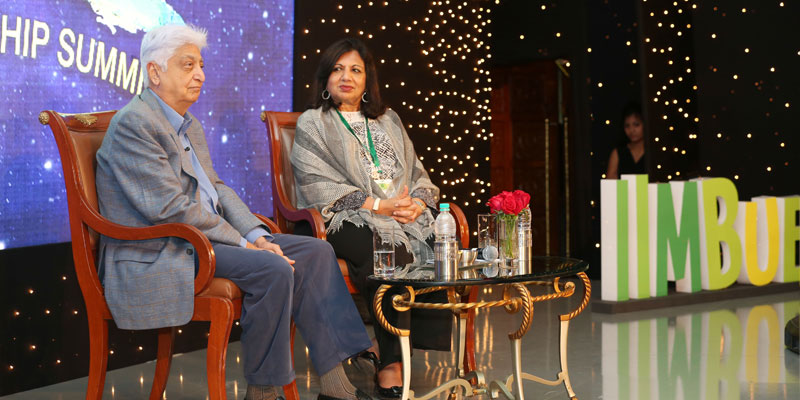
At the first IIM Bangalore Alumni meet, IIMBUE, in Bengaluru on Saturday, Kiran Mazumdar Shaw said if she had to write Premji’s biography, she would call it, ‘Giving it all.’
Here are the excerpts from the engaging fireside chat between Kiran Mazumdar Shaw and Azim Premji.
Azim Premji and Kiran Majumdar Shaw during the fireside chat at IIMBUE.
Kiran Mazumdar Shaw: What is it that influenced you to be so philanthropic? Was it something that was influenced from childhood?
Azim Premji: My greatest influence that encouraged me to go towards philanthropy was my mother. She was a doctor but never practiced medicine. She founded a children’s orthopedic hospital in Bombay (now Mumbai) for polio-stricken children, and children with cerebral palsy. She worked as the chairperson of that hospital from the age of 27 to almost 77. She devoted her whole life to raising money to run this hospital because the hospital depended on government grants which never came on time.
KMS: You have always been someone who has been careful with money. Someone who has avoided staying at five-star hotels and driving expensive cars. In fact, you are known to shun all status symbols. Was there an inflection point in your life that made you take to philanthropy in such a big way?
AP: The reason I give it (money) away is because it is the right thing to do. There is so much poverty, and misappropriation of funds and so many people are majorly disadvantaged.
KMS: There is a great saying that wealth and knowledge must be shared. It is about how we invest in society. How do you send this message to society and ingrain it in people?
AP: My biggest regret is I started too late. It was 14, 15 years back that I started in a small way in education in government schools in villages of India. We’ve really begun to scale in these past four years primarily because we saw such a strong need to uplift the quality of education in government schools. The reality is we started small and we started much later.
In a country like India, sharing your wealth with the unfortunate goes a long way. (Image credit: Getty Images)
KMS: I would like to take you to another part of your philanthropy which is the philanthropic initiative you have started with Bill Gates. And I must say I’m highly impressed by the time you devote to sensitising others in the corporate world about the concept of giving. Why do you think people need to be told and more importantly, why do you think people are so self-consumed and selfish about their wealth?
AP: (a moment’s silence) I think those are very loaded statements (laughter from the audience). You know I don’t think people need to be told. Most people know what their social responsibilities are. The reason I think the wealthy Indians don’t give as much as Americans — in fact, Americans are actually leaders in this – one is their families are much larger in terms of wealth sharing. Two, a majority of Indians who are wealthy believe that they must leave their entire money as an inheritance to their children.That acts as a deterrent. It is more prevalent in certain parts of India than in other parts of India. I think the more generous part of India is South India.
KMS: We are here with the present and future generation of wealth generators. How do you get the message across that they need to give some of their wealth to philanthropy?
AP: I think the present generation of the wealthy and the semi-wealthy demonstrate much more generosity. They either contribute time, effort, or money to philanthropy. So far the older generation is concerned one has to give examples to them. Keep on persuading them and hopefully, we’ll make a breakthrough. Actually, the people you’ve got to convince are the wives (laughter from the audience). Wives are socially more sensible and have more time at their disposal to lead initiatives of philanthropy. The husbands are much too busy making money (loud cheering and laughter from the audience).
Volunteering one’s time and effort to social causes are a good start towards philanthropy. (Image credit: Getty Images)
KMS: I think this is a great testimony to women and wives. You are here at the leadership summit of IIMB…so talking about giving back to alma mater. Is it important to give back to alma mater? Of course, it is a ridiculous question to ask because it is indefensible as an argument. But should one feel guilty about not giving back to the alma mater?
AP: No. I have not given back to my alma mater (loud cheer from the audience). I think the priority of our society far outweighs those of our alma mater. I think it is a matter of individual priority. But most wonderful universities of the world are significantly financed by their alumni.
KMS: But I am sure if your school or college reached out to you for help, you will not say no.
AP: They reach out to me all the time (laughter from audience).
KMS: So why do you say no?
AP: I just want to prioritise my funds to things which are more relevant to our country (applause from the audience).
KMS: I don’t like the applause that you got, Azim (laughter from the audience). Because I do believe that this has to become a part of our giving back to our alma mater. Because I believe that institutions are responsible for making us who we are today (cheer and applause from the audience).
AP: You got a louder applause (laughter from the audience).
KMS: I hope they mean it. Another question I wanted to ask you is when one looks at global business leaders, one associates philanthropy with entrepreneurial wealth whether it is Bill Gates, Elon Musk, Warren Buffet, or Mark Zuckerberg. Yet one sees a lot of other wealth creators in the corporate world like people in banks and hedge funds with huge salaries and stock options, isn’t that wealth creation as well, and shouldn’t they also be philanthropic? Because you don’t hear about that kind of philanthropy being articulated…the salaried class and employees. How do you create that kind of culture?
AP: I don’t know whether they are giving or not giving. I would be hesitant to make a harsh judgment. It just doesn’t get attention or get publicity.
(Image credit: Getty Images)
KMS: I think it is extremely important for media to cover stories of philanthropy from the salaried people.
Talking about philanthropic philosophy, how can businesses institutionalize it? Can we actually introduce a course on philanthropy in business schools?
AP: Oh! yes…and they can make you a professor (laughter from the audience). This kind of a course can generate a spark…
(After the Fireside Chat, Kiran Mazumdar Shaw opened it up to the audience to ask Azim Premji questions. Here are some excerpts.)
To a question on challenges he faced while giving away his money, Premji said, “The biggest challenge we faced is the size of the problem, the scope of the problem, and the depth of the problem. There was a high sense of frustration. However large an organization setup you are there is frustration that you do not have the bandwidth. We do rely on government machinery in what we do, and you have to keep at it, and keep at it.”
Interestingly, to a question on why he is not in politics, Premji replied, “Because it will kill me in a couple of years. I think you need to cultivate a sense of insensitivity to be in politics.”
But the session ended with the most profound thought from him which was an answer to a question on how does one decide when one should start giving.
“We had a meeting of our philanthropic initiative last week, and one of the panel members, whose family has been active in philanthropy, was telling us that as kids whenever they got money as gifts, they were required to give 25 percent of that to charity. And this was inculcated since he was two years old. That’s how you cultivate philanthropy.”
Just the city of Agra and its close neighbour Fatehpur Sikri have five of the top 10 monuments in the country that are most visited by foreign tourists.
Replying to a query in the Rajya Sabha on Wednesday, Union culture minister Mahesh Sharma said Taj Mahal alone has 23% share of foreign tourists travelling to India. Agra Fort got 12% in 2014. He added that foreign exchange earnings through tourism in India during 2012, 2013 and 2014 stood at Rs 94,487 crore, Rs 1,07,671 crore and Rs 1,23,320 crore respectively.
The minister dismissed claims that the tourism industry had witnessed a decline compared to the last few years. “On the contrary”, he said, “foreign tourists’ arrival growth rate in India has more than doubled between 2012 (4.3%) and 2014 (10.2%). In 2013, it was a mere 5.9%.
In terms of exact numbers, a total of 6.58 million tourists visited India in 2012, which increased to 6.97 million in 2013 and 7.68 million in 2014.
Citing Archaeological Survey of India’s data on foreign tourist arrival at centrally-protected monuments in 2014, Sharma said Taj Mahal with 6.4 lakh visitors, Agra Fort with 3.43 lakh and Qutub Minar with 2.76 lakh were the top three tourist destinations in the country.
The other three monuments of Agra which featured in the top 10 list are Fatehpur Sikri (5th position), Akbar’s tomb (8th) and Itimad-ud daula (10th).
To another query on carbon pollution around the Taj Mahal, the minister said that the Taj Trapezium Zone (TTZ) Authority has banned entry of Euro-I model, petrol/diesel-operated auto loader vehicles from July 31 to reduce vehicular pollution in the vicinity of the Taj. He added that TTZ Authority has also decided to convert petrol/diesel-operated commercial vehicles to CNG. So far, 34,302 vehicles have been converted to CNG in Agra, he said.
However, though the Taj Mahal still remains at the top of the most-visited monuments in the country, there has been a constant fall in the number of foreign visitors to the 17th century monument in the last three years. There were 7.9 lakh visitors from abroad to the Taj in 2012. But the number came down to 7.4 lakh in 2013, further dipping to 6.4 lakh in 2014.
Prior to 2012, the average foreign tourist footfall at the world heritage building had been increasing at a rate of 10-15% per annum. In 2010, 6.1 lakh foreigners had visited the Taj. The number went up to 6.7 lakh in 2011 and further to 7.9 lakh in 2012.
source: http://www.timesofindia.indiatimes.com / The Times of India / News Home> City> Agra / Aditya Dev, TNN / December 02nd, 2015
Says the system preserves the identity of every community
Kerala’s traditional multiculturalism has much to offer to the policy and decision makers in modern times, says Ophira Gamliel from the University of Ruhr, the Israeli academic who has been closely associated with Kerala studies.
Ophira Gamliel says the traditional festivals and performing arts in Kerala are highly structured so as to ensure the collaboration of the various communities at different levels
Speaking to The Hindu on the sidelines of the third International Kerala History Conference here on Friday, Prof. Gamliel says a closer look at the multiculturalism inherited by the State would point to a dynamic system which preserves the identity of every community, even as it provides space for each of them to integrate into one system.
“You don’t lose your identity. Even small communities do not get swallowed. Your literature, culture, everything are well preserved. Instead of getting integrated at the personal level, you are integrated at the community level,” she says.
Prof. Gamliel says the roots of this unique system, still preserved, could be traced to the ancient long-distance trade exchanges which were exceptionally different in character from the modern global trade. “Unlike the modern global trade, which is marked by brutal expropriation of resources and labour, the ancient trade between the western coast of India and west Asia was marked by a great amount of cultural and knowledge exchanges at the community level,” she adds.
Documents
The more-than-1,000-year-old Cairo Documents (referring to deals between west Asian traders and those from Kerala) and the 9th century Tharisapalli plates (referring to a grant issued to Syriac Christians of Kerala) are rich evidences to this multiculturalism. “In fact, the Tharisapalli plates are signed in three languages: Persian (in Hebrew script), Pahlavi, and Cufic Arabic,” she says pointing to the efforts taken to preserve the identity of the different trading organisations.
Even the traditional festivals and performing arts here are highly structured so as to ensure the collaboration of the various communities at different levels. Beyond the complexity of what happens on the stage, this underlying structure assured collaboration at the communal level even in performing art forms, she says.
This unique system of multiculturalism should be subject of in-depth research, especially at a time when traditional communities are under threat of being swallowed up in the wave of globalisation, leading to tensions and conflicts at the community and societal level, she adds.
source: http://www.thehindu.com / The Hindu / Home> National> Kerala / by George Jacob / Kottayam – November 29th, 2015
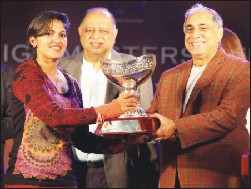
Irfan Razack, Chairman & Managing Director, Prestige Estates Projects Ltd is presenting the winners’ trophy to Mysuru golfer Sonam Chugh who won the Champion of Champions’ Trophy in the Prestige Masters Series Golf Tournament held at Prestige Golfshire recently.
Bengaluru :
Mysuru girl Sonam Chugh of JWGC, registered a narrow win to clinch the final of the Champion of Champions’ trophy event of the Prestige Masters Series Golf Tournament held at the Prestige Golfshire recently.
Sonam took home the title with 28 points and also an expense paid holiday to Mauritius and Dubai. Angad Luthra finished a close second with 37 points and L. Darshan was third with 36 points. Theertha Prasad (closest to the Pin) and Shyam Powar (longest drive) were the other winners.
source: http://www.starofmysore.com / Star of Mysore / Home> Sports News / November 20th, 2015
Every time you flip a page of a book (regardless of its content) you are accosted by a scent that refuses to fade away.
It may be the mustiness of a yellowing page, freshness of mown sides or potent helpings of glue and ink but every page and book has it’s own distinct fragrance. Just like that, it also has its own personality, which shines best when it’s in the hands of its owner.
Whether the book is stacked neatly in a bookshelf, strewn across a table or lying on the ground, it has a story to tell. But this story is always fluid. There was once a time when books sat cloistered in unimaginative and on the whole, utilitarian shelves that only worked to diminish their beauty. But now, people are unabashed about the books they own and want to scream their titles to the world. With this comes an influx of creative thought that makes owning a book an art — much like flower arrangements, every aspect of the showcase matters, including the bookshelf.
Alifia Shabbir, who owns a start-up called ‘Designmint’, works on innovative home decor items, including bookshelves. Maintaining a minimalist theme, she creates shelves that are not only utilitarian but also bring out the best aesthetics. “The shelves I make are from metal and some of them are upcycled from scraps. The idea behind ‘Designmint’ is to create something unique, one-of-a-kind, so that people relate to their home decor,” she says.
Relating to the shelves has become increasingly important as they (along with the books) reflect one’s personality. Says Rohith Subramanian, founder of ‘Fundmydreams’, “When I moved houses, what happened was that all my clothes and other items fit into one bag but I needed a car to fit all my books in. In the new house, I kept these books stacked on the floor for a while but that didn’t work out because my help would grumble each time she swept the room. This is when I decided to get a bookshelf.” After failing to find a good shelf on online stores, he decided to make one of his own. “The ones I found were expensive so I bought some wood, hired a carpenter and made one myself. I’m different from normal ‘jantha’ and your regular, rectangular shelves don’t reflect my personality and who I am,” he adds. The outcome was a large shelf in the shape of a ‘V’, inspired by ‘V for Vendetta’.
Elaborating on his idea, Rohith says, “I love the movie and comic. The idea of standing up for what you want inspires me.” When Maitri Vasudev, a student, was renovating her house, she decided to get a bookshelf that represents her more accurately. “Before, we had a shelf built in the wall with granite slabs and wooden doors. There was nothing unique about it. When we decided to renovate the house, I thought I’d get something different. Now, I have a marble designed back board with nothing but thin slabs of glass to hold the books. I wanted textured material but that was too expensive,” she says.
While open shelves could be a bot tiresome to maintain, it’s nothing people can’t handle. “I love to dust so I don’t mind cleaning the shelf every week. I’d rather people see my collection and borrow them if they like something. Yes, there is a possibility that I might never get the book back (it’s happened before) but I don’t mind that,” says Maitri. Proud of her book collection, she mentions that displaying the books is just as important as owning them.
Alifia, who likes minimal artwork, designs shelves in geometric shapes. She also custom-makes them for the customer. So, whether it’s an invisible shelf, equilibrium shelf, ones made from pipes or in patterns that you like best, there is always space to get creative. “Though these shelves can’t hold as many books as the traditional ones, they look good and brighten up the house. People can opt to rotate their books on these stands,” she says.
source: http://www.deccanherald.com / Deccan Herald / Home> Supplements> MetroLife / by Ananya Revanna / DHNS , November 18th, 2015
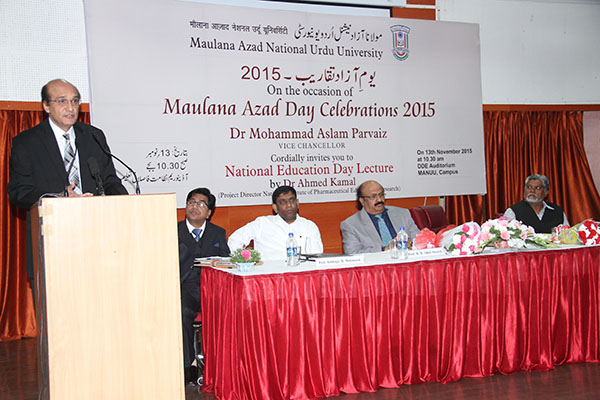
Emphasizing the need for research and discovery of new drugs, Dr. Ahmad Kamal, Project Director National Institute of Pharmaceutical Education and Research, said that innovation is important for Indian pharmaceutical industry to maintain its competitive edge at the international level.
He said the industry can no longer depend on generic drugs alone.
Dr Kamal was addressing the students and faculty of Maulana Azad National Urdu University (MANUU) on the occasion of Education Day observed as the climax of Azad Day Celebrations 2015 that began on November 4.
He said that science and technology could have a real long term effect on the development of our country.
Dr. Kamal also said there is no dearth of talent in our country, but the need is to groom it properly. Advising the students to avoid short-cuts to pass exams or score good marks, he encouraged them to become experts in the subjects they choose to pursue.
Underscoring the importance of Information Technology for research, he urged the students to take advantage of the vast material related to different fields available online.
Paying his respect to Maulana Abul Kalam Azad, Kamal said it is the vision of people like Azad that put India on the path of development.
In charge Vice Chancellor MANUU, Prof. K.R. Iqbal Ahmed congratulated the team led by Prof. Amina Kishore for seamlessly organising the Azad Day Celebrations 2015.
Pointing to the fact that soon India will be a youth-majority country, he said that “young India can do wonders.”
Registrar MANUU, Prof. S.M. Rahmatullah, presented the vote of thanks.
Prof. P. Fazal ur Rahman, coordinator of the programme, gave a brief introduction of the university and the Guest Speaker.
Prof. Siddiqui Mohammad Mahmood, HoD, Education and Training conducted the programme.
Instructional Media Centre of MANUU presented a short audio-visual report on the 9 day long celebrations.
source: http://www.ummid.com / Ummid.com / Home> Business & Economy / ummid.com news network / Friday – November 13th, 2015