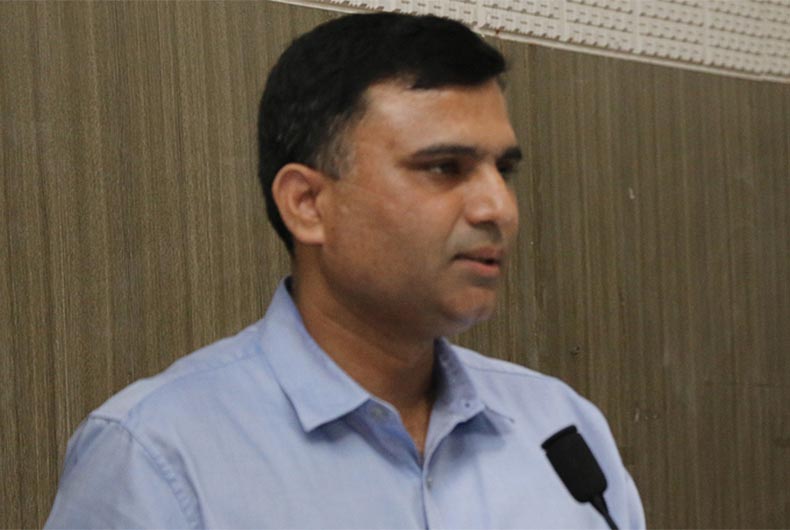
Dr Salman also featured in Stanford’s list in the years 2020, 2021 and continues to be in the prestigious top international scientists list’ of 2022.
Hyderabad:
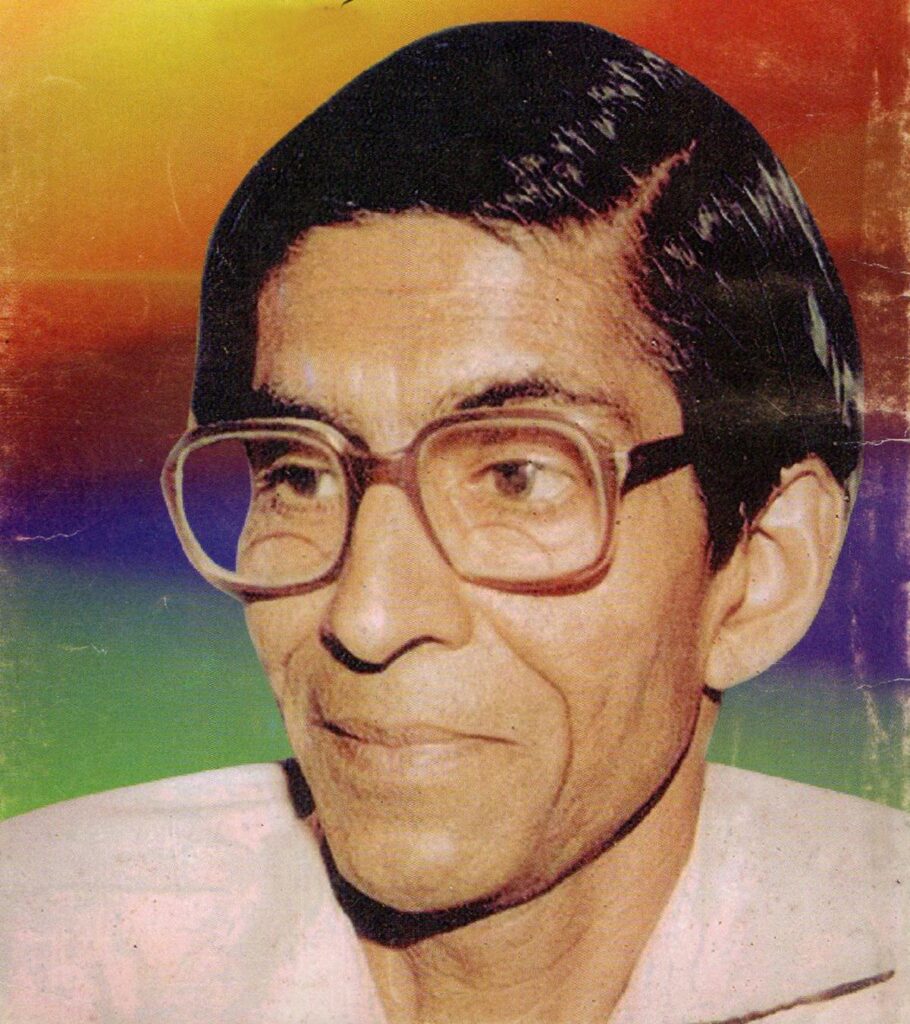
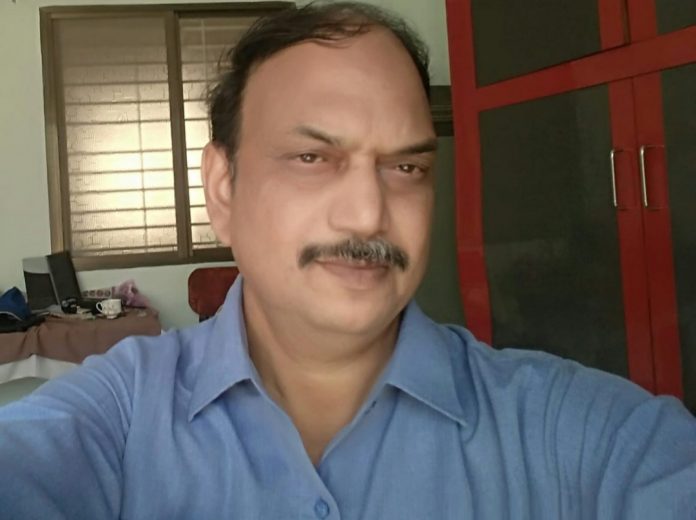
Dr. Salman Ahmad Khan, Professor in chemistry and Dean, School of Science, Maulana Azad National Urdu University (MANUU) featured in the prestigious Stanford University’s list of top 2% International Scientists third year in a row.
The list is also known as ‘Updated Science wide Author database of Stanford Citation Indicators’.
The database was released by Stanford University, USA and published by Elsevier BV on 10 October 2022.
Dr Salman also featured in Stanford’s list in the years 2020, 2021 and continues to be in the prestigious “top international scientists list’ of 2022 in recognition of his exceptional research work.
The selection was among top 100,000 scientists by c-score (with and without self-citations) or a percentile rank of 2% or above in their field from all over the world and was classified into 22 different fields and 176 subfields.
Prof. Syed Ainul Hasan, Vice-Chancellor, MANUU congratulated Prof. Salman. He said that Dr Salman’s achievement highlights our research competencies and university is on a path to find innovative solutions to complex problems of society through quality research work.
Prof. Salman A Khan has published 185 research Articles in reputed journals like Elsevier, Springer, Wiley and has also published 4 books and 2 book chapters.
He completed his PhD from Jamia Millia Islamia University New Delhi.
Back in 2020, Jamia Islamia’s Prof Imran Ali was selected as leading scientist in India in the field of Analytical Chemistry by the Standford University in the US.
In the same year, Professor Ahmed Kamal, Jamia Hamdard Pro-Vice Chancellor was also named among top 2 per cent cientists in the world by Stanford University.
source: http://www.ummid.com / Ummid.com / Home> Science & Technology / by ummid.com news network (headline edited) / October 20th, 2022
As a sweet little six-year-old, when Zain Samdani saw his mother taking care of the household like a pro, he decided to lend her a robotic hand. In all his innocence, he went up to her and said, “I will build you a robot that can do everything.” Today, the same boy has grown into an entrepreneur whose invention goes behind the peripheries of any household.
Meet Zain | (Pic: Zain Samdani)
He won the Young Entrepreneur Award from the Indian Business Forum, Riyadh in January 2018
But before the result came the hard, gruelling work of learning everything there is to learn about robotics.
Born in Hyderabad and brought up in Saudi Arabia, Zain started by reading. And then some. Then came a series of instruction videos and only after he turned 14 came his first robotics kit. In 2013, he pursued the PSSO Robotics Programme at the King Salman Science Oasis in Riyadh apart from participating in international competitions. He topped it off with pursuing online courses leading up to the summer of 2015.
But it is usually when pain hits home that you really put your power into play. And that’s what happened with Zain. “A distant uncle of mine was paralysed and what upset me was that there was hardly any technological help that could be rendered to help him move around. In a quest to help my uncle, I decided to create ExoHeal,” says the youngster.
Zain with Sundar Pichai
Started in May 2016, this start-up offers a modular robotic device based on the concept of neuroplasticity. There are two gloves — one that is sensory and one that is robotic. The sensory one goes on the good hand and the robotic on the other. When you move the good hand, the paralysed hand is almost forced to mimic the action which actually tricks the brain into believing that the paralysed hand is actually okay, forming new neural connections. With consistent usage, movement may gradually be restored in the paralysed hand.
In 2016, his working prototype helped his uncle and since then, the Ashoka Young Changemaker has been trying to perfect the device. He has been adding little touches and enhancements like going wireless, with the help of Bluetooth and radio waves, and the latest, launching an app. “Because of the lockdowns, patients are unable to travel to their physiotherapists and hence, the app helps the doctor track the progress of their patients in real-time,” he explains. The app has a list of exercises the patient can choose from. With the team of five and machine learning, they are trying to adjust the level of assistance offered with the involvement of the doctors so that the latter puts only that much effort as is required from him.
Selected as a Global Teen Leader by We Are Family Foundation in New York, USA in March 2019
Dr KV Rao Scientific Society in Hyderabad has also been of mighty help to this entrepreneur who is pursuing his Higher Secondary Course from the National Institute of Open Schooling due to medical reasons.
The Society started supporting his project in November last year. Currently, the 3D printed model is ready and they hope to conduct clinical trials for further validation. By the way, this innovation has been to the Google Science Fair twice (2016 and 2019) and both times, Zain was the Global Finalist. Even Google’s CEO Sundar Pichai has tried them out too. Now, how’s that for some validation?
www.zainsamdani.org
source: http://www.edexlive.com / edexlive, The New Indian Express / Home> Start-Up / by Seema Rajpal, EdexLive / June 09th, 2021
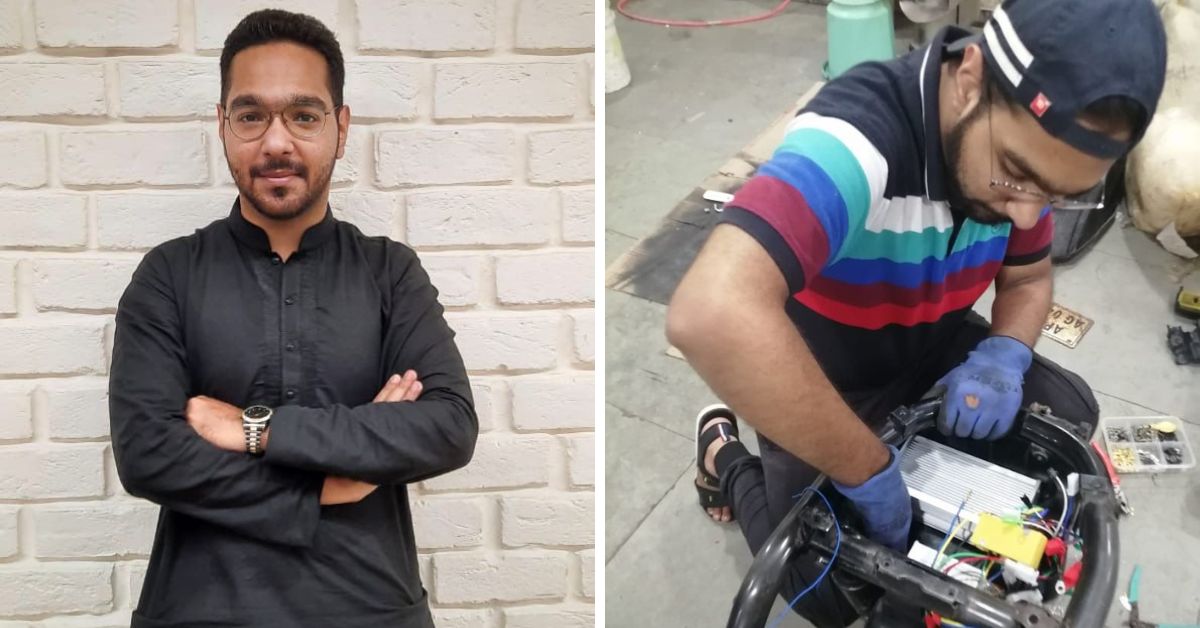
Hyderabad engineer Maaz Ahmed Khan founded his startup Torq Electric to convert old two-wheelers into electric vehicles.
In 2021, Maaz Ahmed Khan was still a mechanical engineering student when his interest in electric vehicles began brewing . “It started when I got into the EV subject of the syllabus in final year,” he recalls, adding that he would look closely into the working of these machines and formulate his own ideas to make his own version of them.
But the 23-year-old’s idea was not to build a new design. Instead, it was to convert existing fuel vehicles — which would otherwise be turned to scrap — into fully functioning EVs.
The then final year student of Methodist College of Engineering and Technology, Telangana, started looking for someone’s help to start building on his vision. This brought him to a non-academic startup incubator EdVenture Park, which focuses on student innovations. He applied for a job here and was selected.
With their support, the youngster began working on his dream project, eventually founding Torq Electric in March 2021.
“A few years ago, I happened to attend the launch of Tata Nexon. Even though the vehicle excited me, I also thought, ‘Why should we buy a new EV if there exists a technology to convert existing vehicles?’,” he tells The Better India.
He continues, “I also had ‘electric vehicles’ as a subject in college. I learned that after 15 years of running, the fuel usage of any vehicle goes up and it contributes to greater pollution. Instead of turning it to scrap, you can convert it.”
On 27 August 2021, Maaz came up with the prototype of a two-wheeler EV, which he built by transforming an old petrol scooter and spending Rs 60,000. The model was covered widely by the media and popularised further through the internet, he recalls.
The EV by Torq Electric.
“Even then, it took time to gain people’s trust. A few months later, I managed to get some customers. A majority of them were unwilling to let go of their two-wheelers due to emotional attachments and similar reasons. Converting these into electric vehicles seemed like a great idea to keep your old favourite bike,” he explains.
Maaz says he has so far converted seven bikes, and received orders for 15 more.
Additionally, he helps engineering students to take up college projects related to EV and supports them with the related technical know-how.
For a greener future
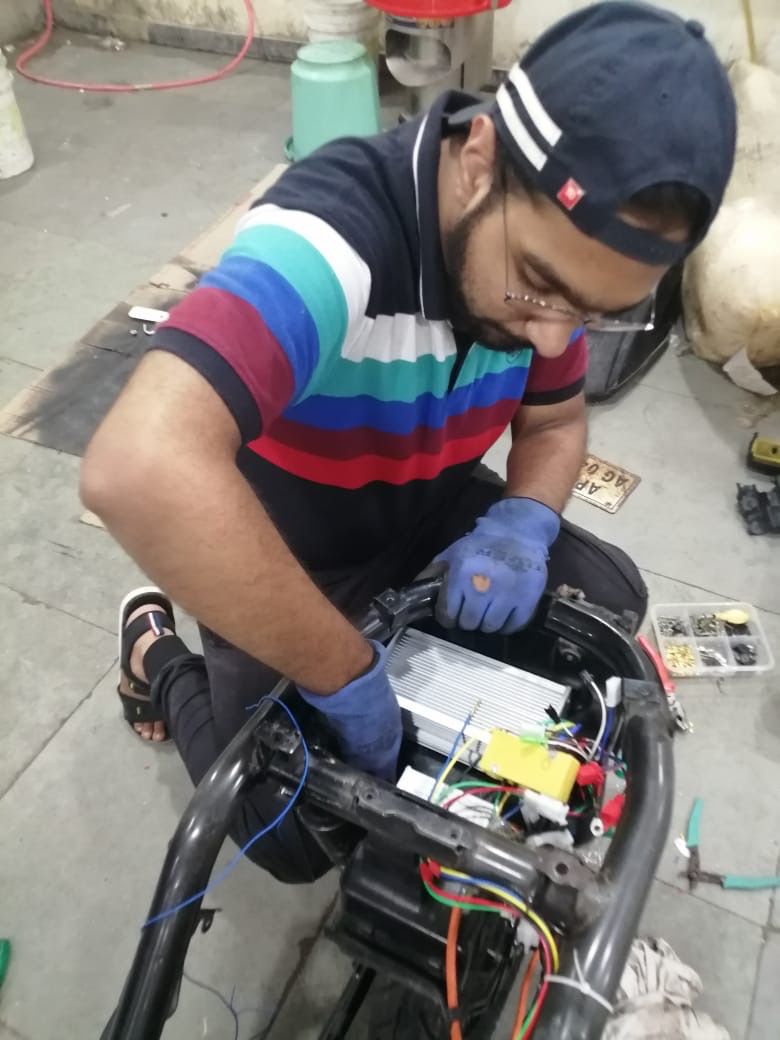
Even though it takes just 5-7 hours to convert a two-wheeler into an EV, Maaz asks for two days to check and ensure the vehicle’s safety after riding.
Maaz busy at work.
He provides two types of models — fully electric and hybrid vehicles. Those who wish to keep fuel as an option can opt for the latter. He says the price to convert any type of two-wheeler into a fully electric EV is Rs 50,000. For hybrid, he charges Rs 55,000.
“In fully electric two-wheelers, the engine and fuel tank are replaced with a powerful motor and batteries. In hybrid conversion, a motor and battery are added to the existing engine. This gives the flexibility of driving on both electric power and engine power,” says the engineer.
The base variant of the vehicle takes about three to four hours to charge, and can run up to 75 km at an average speed of 45 km/hr, Maaz says. Customers can also give their preferences, for which prices may differ.
“EVs are in their early days in India. But undoubtedly, they are the future. It is important to be aware of the pollution from fuel vehicles. Soon, we might be living in a country where breathing feels like smoking a cigarette. But we can prevent this by showing responsibility. Like shifting from plastic bags to cloth bags, or using public transport, opting for an EV is a great step,” Maaz says.
The electric vehicle built by Maaz.
Through his company, he aims to create sustainable living through automotive manufacturing, with the vision to create an eco-friendly world.
Even though his current innovation is receiving great response, the engineer’s dream is to launch his own design of an EV, exclusively for Indians. He also plans to extend the current innovation to three and four-wheelers.
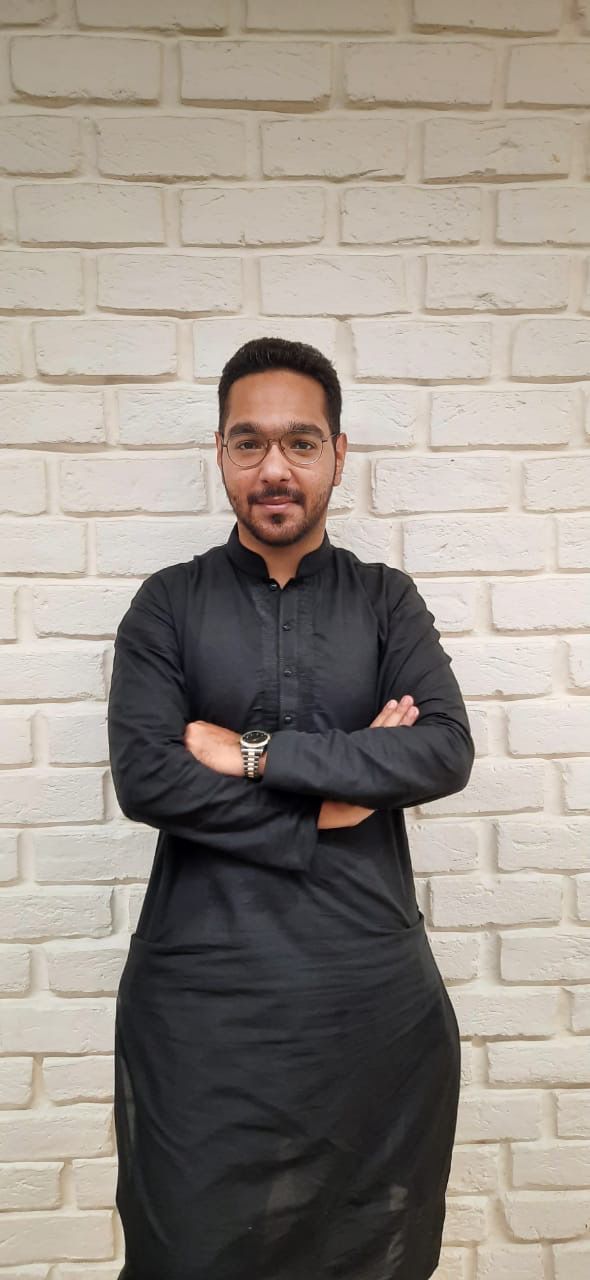
Maaz Ahmed Khan — the engineer.
“The rise in fuel prices has most affected the auto drivers of the country. After a little research, I discovered that if they switch to EVs, they can save around Rs 400 a day. This accounts for Rs 12,000 a month. Thus, my plan is to launch an innovation pertaining to three-wheelers,” he shares.
Visit his website www.torqelectric.com
Edited by Divya Sethu
Photo Credits: Maaz Ahmed Khan
source: http://www.thebetterindia.com / The Better India / Home> English> Electric Vehicles – Sustainability / by Anagha R Manoj / September 20th, 2022
Bal Sahitya Puruskar winner M Khalil | Photo Credit: SOMA BASU
Taking science in Urdu to children is a mission close to the heart of Mohammed Khalil
For years Mohammed Khalil, a veteran writer for children, has written about science and penned essays and stories around 80 scientists during his long fulfilling career. Now he takes science to Urdu-speaking children and the effort has won him the Bal Sahitya Akademi Puraskar for his work, Science ke Dilchasp Mazameen, just before the pandemic.
“Besides the award, the love and recognition of my peers is my greatest reward. I feel happy that my colleagues and friends remembered me. I recall the Urdu magazine Khilona. At one time, I used to read it and also write exclusively for them, contributing essays and stories for children. The Bal Sahitya award has re-energised me as a writer and gives me a new zest to carry on with my work. I have always desired that more children take to science and I am thrilled that my writings on science have clicked with them, “ says Delhi-based Khalil.
Khalil is a widely published author with 15 books in Urdu and a couple of books in Hindi. “It is important to interact with the young generation in the language they are comfortable in. Long ago, when I published Science ki Duniya’s special edition on Dr CV Raman, it was widely praised. Now, I want to communicate with children through short stories based on scientific facts so that their mind develops a scientific bent. The next generation should understand scientific principles and more women also should take to science, he says.”
Khalil was associated with the Council of Scientific and Industrial Research and edited their magazine Science ki Duniya . Some of his widely appreciated works include Ajeeb aur Ghareeb Janwar, Science Aur Hum, Nehru Aur Science, Dr CV Raman: Ek Azeem Sciencedaan and Chachajaan ki Scienci Kahaniyan.
A popular speaker in Urdu medium schools, he has been widely felicitated as he is among the first writers to talk of science in Urdu. Happy to dispel the false belief of Urdu being only a language of poetry and novels, Khalil has brought the language into the domain of science laboratories. The awards have come thick and steady. For instance, he won the NCERT’s national award besides numerous awards from the Delhi Urdu Akademi, West Bengal Urdu Akademi, Sir Syed and Vigyan Bharat award, etc. In fact, his mantelpiece is replete with awards of recognition and appreciation. With the Sahitya Akademi award, his cup of joy brims over. Yet he adds, “The biggest joy is to see a child taking to science in Urdu.”
source: http://www.thehindu.com / The Hindu / Home> Sci-Tech> Science / by Ziya Us Salam / August 19th, 2022
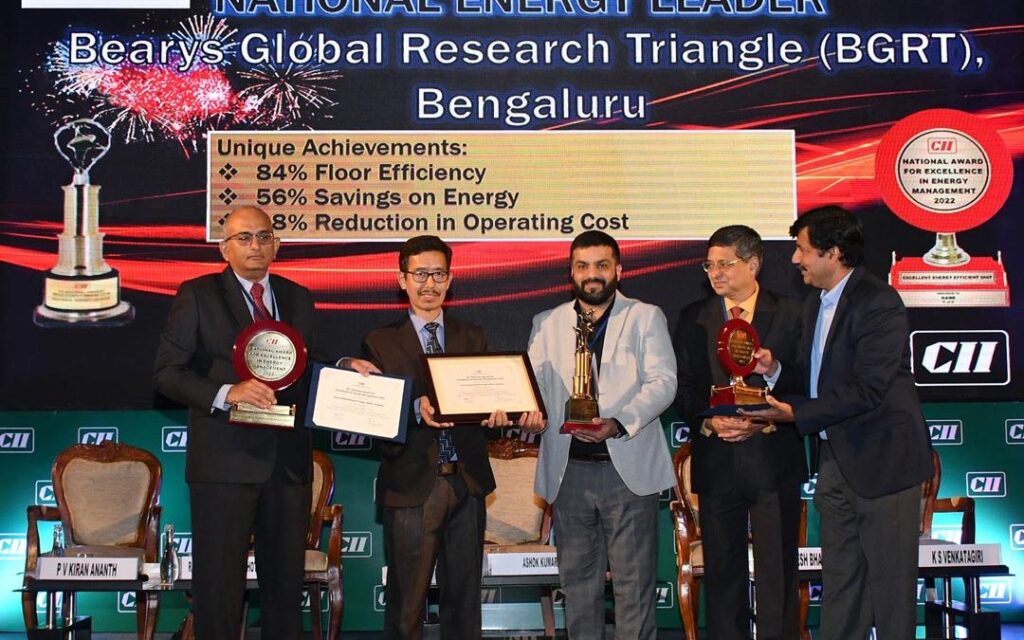
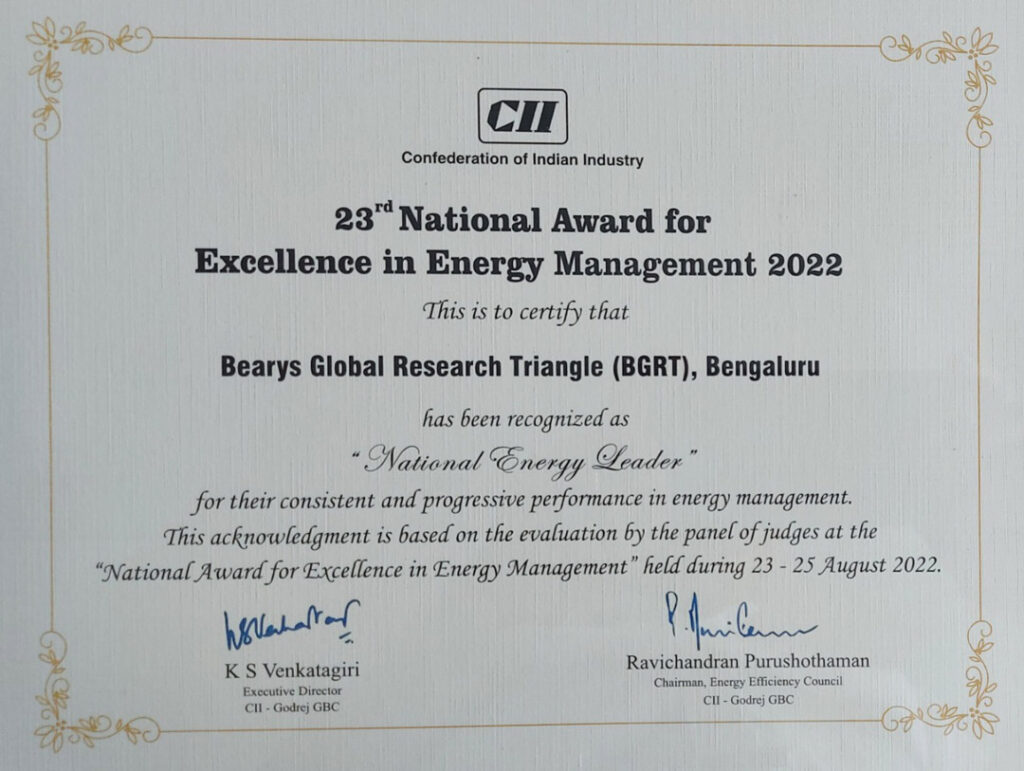
Bearys scores a hat trick by winning the prestigious ‘National Award for Excellence in Energy Management’ by CII for three consecutive years (2020, 21 & 22) for its project Bearys Global Research Triangle (BGRT), Whitefield, Bangalore and was declared the ‘National Energy Leader’.
Bearys was also commended and was awarded another accolade for the ‘Most useful Presentation’ at the award ceremony.
The awards were presented by Dr. Ashok Kumar, Director, Bureau of Energy Efficiency (BEE), Ministry of Power, Govt. of India to Mr. Mazhar Beary, Executive Director, in the presence of other eminent dignitaries at a grand award ceremony held at India Habitat Centre, New Delhi on Wednesday 21st Sept. 2022.
India’s first LEED Platinum R & D Park BGRT is globally recognized by both Industry and Academia as an epitome of sustainable development and an exemplary benchmark project and has become an arche model for sustainable development. A stream of Architects, Consultants, Developers and students from across India are visiting the project to see, learn and understand more about sustainable development and its manifold benefits.
‘We, at Bearys feel elated to receive this award and would like to dedicate this laurel to our mentors the late Dr. Prem C Jain, former Chairman, IGBC and the late Mr. Mahendrarajji, renowned structural consultant, New Delhi, who have inspired and guided us along the way. We now rededicate ourselves to our relentless pursuit to promote Sustainable Development & further the IGBC led ‘Green Building Movement’ in India” proclaims Mr. Syed Mohamed Beary, Founder & CMD.
source: http://www.beads.edu.in / BEADS / Home> News / by BEADS / September 21st, 2022
Hakim Ajmal Khan a philanthropist, freedom fighter, famous hakeem and nationalist is a well known personality.
So I was very surprised when I was told that his grave was I one corner of The Hazrat Rasool numa compound in Panchkuian Road of Delhi
Now it’s a slum
In between a whole row of beds tucked away in one forgotten corner sleeps one of the greatest leaders of our Freedom movement. Revered by Muslims and Hindus alike.
Yes it was Hakim Mohammad Ajmal Khan. I checked up his dated on the net to find they were correct.
The lady who lives there then showed me many graves of Hakeems from his family scattered around the beds and chores of daily life.
Amita Paliwal a Delhi historian and keen heritage lover informs me this is probably the famous Doctor’s lane where Bernier apprenticed to learn Unani medicine.
It may have been famous then but it’s forgotten now and I don’t know why his very rich trust( he had gifted most of his income to charity) and rich family doesn’t do something about it.
You can read more about him below I have taken it from
He was the founder of the Jamia Millia Islamia in Delhi. He is the only person to have been elected President of both the Indian National Congress and the Muslim League, as well as the All India Khilafat Committee.Hakim Ajmal Khan was born in 1863 to the illustrious Sharif Khani family of Delhi, family that traces its lineage to court physicians who served the Mughal emperor Babur, the founder of the Mughal Empire in India.
Khan studied the Qur’an and traditional Islamic knowledge including Arabic and Persian in his childhood, before studying medicine at home, under the tutelage of his relatives. All of whom were well-known physicians.
His grandfather Hakim Sharif Khan sought to promote the practice of Tibb-i-unani or Unani medicine and for this purpose, had setup the Sharif Manzil hospital-cum-college that was known throughout the subcontinent as one of the finest philanthropic Unani hospitals that charged no fees from poor patients.
Once qualified, Hakim Ajmal Khan was appointed chief physician to the Nawab of Rampur in 1892. Soon he met Syed Ahmed Khan and was further appointed a trustee of the Aligarh College, now known as the Aligarh Muslim University.
Hakim Ajmal Khan took much interest in the expansion and development of the indigenous system of medicine, Tibb-i-Yunani, or Unani. Khan’s family established the Tibbiya school in Delhi, in order to expand the research and practice of Unani.
As his family of Hakims served as doctors to the British rulers of India, in his early days Hakim Khan supported the British. He was part of a deputation of Muslims that met the Viceroy of India in Shimla in 1906 and even supported the British during World War I. In fact, the British Government awarded him the titles Haziq-ul-Mulk and Qaiser-e-Hind for his contribution to the expansion of the Unani system of medicine.
But once the British government changed its stance and sought to derecognize the practice of Indian schools of medicine such as Ayurveda and Unani, this turn of events set Hakim Ajmal Khan gathering fellow physicians on one platform to protest against the Raj.
Actually, Hakim Ajmal Khan’s political career commenced with his writing for the Urdu weekly Akmal-ul-Akhbar, which was founded in 1865-70 and run by his family.
Subsequently, when the British clamped down on the freedom movement and arrested many Muslim leaders, Hakim Ajmal Khan solicited Mahatma Gandhi’s assistance and together they joined others to start the Khilafat movement. He was elected the President of the Congress in 1921, and joined other Congress leaders to condemn the Jallianwala Bagh massacre. He was imprisoned for many months by police authorities. Hakim Khan’s pursued his political career side-by-side his medicinal and educational endeavours. Often, the interests overlapped.
Hakim Ajmal Khan resigned from his position at the AMU when he realized that its management would not endorse the Non-Cooperation Movement launched by the Indian National Congress. He envisaged a place of learning that would be free of government control. He worked towards this aim with the help of other Muslim luminaries. Together, they laid the foundations of the Jamia Millia Islamia (Islamic National University) in Aligarh in 1920, in response to Mahatma Gandhi’s call for Indians to boycott government institutions. The JMI subsequently moved to Delhi and slowly grew to be the prestigious university it is today.
Ajmal Khan served as its first Chancellor until his death. He was a key patron of the university, financially bailing it out of sticky situations throughout the rest of his life.
In fact, Hakim Ajmal Khan also established the Tibbia College for higher studies in medicine. Realizing the need for private funding, he simultaneously established a commercial venture the Hindustani Dawakhana to manufacture Unani and Ayurvedic medicines and issued a diktat that doctors practicing in the Sharif Manzil could only recommend medicines from the Dawakhana. The Dawakhana is known to have patented 84 magical herbal formulas.
Tibbia College is presently located Delhi’s Karol Bagh area. As a mark of respect to this man, Karol Bagh’s most popular part is still called Ajmal Khan Road.
Hakim Ajmal Khan died in 1927. In the ensuing years, both the Sharif Manzil and the Dawakhana have languished for want of upkeep and restoration.
Although Hakim Khan renounced his government awards during the freedom movement, Indians who appreciated his work and held him in high esteem conferred upon him the title Masih-ul-Mulk (Healer of the Nation).
Freedom fighter, educationalist and beyond doubt, the greatest contributor to Unani medicine in India in the 20th century: Hakim Ajmal Khan.
Dr. Khan died of heart problems on December 29, 1927. He was succeeded in the position of JMI Chancellor by Dr. Mukhtar Ahmed Ansari.
Rana Safvi is the author of the book “Where Stones Speak”.
source: http://www.twocircles.net / TwoCircles.net / Home> Articles / by Rana Safvi / May 08th, 2016
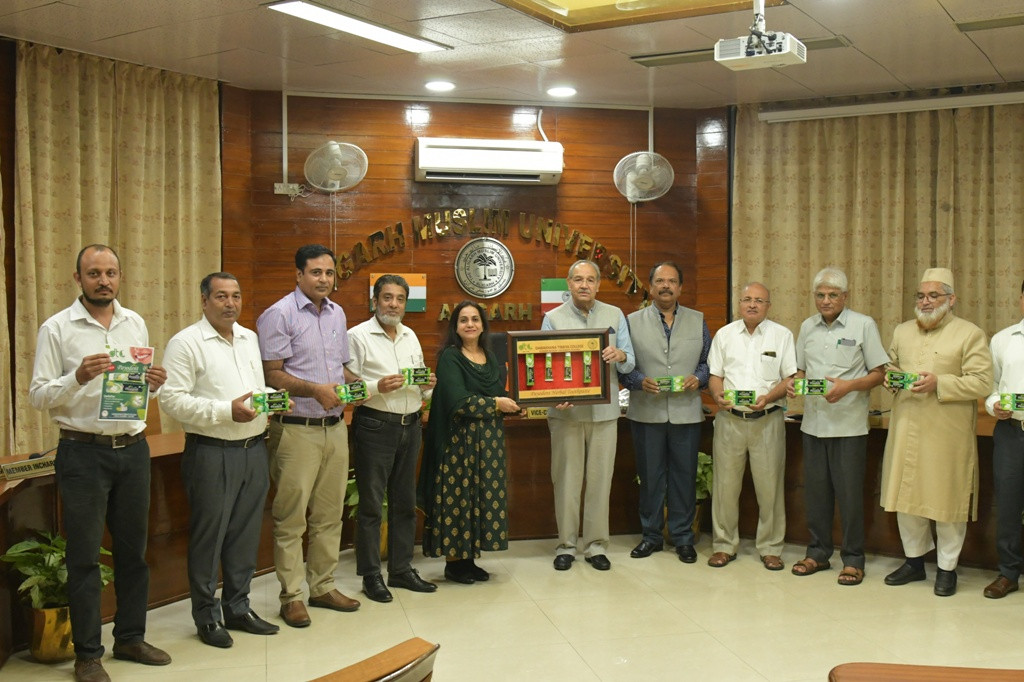
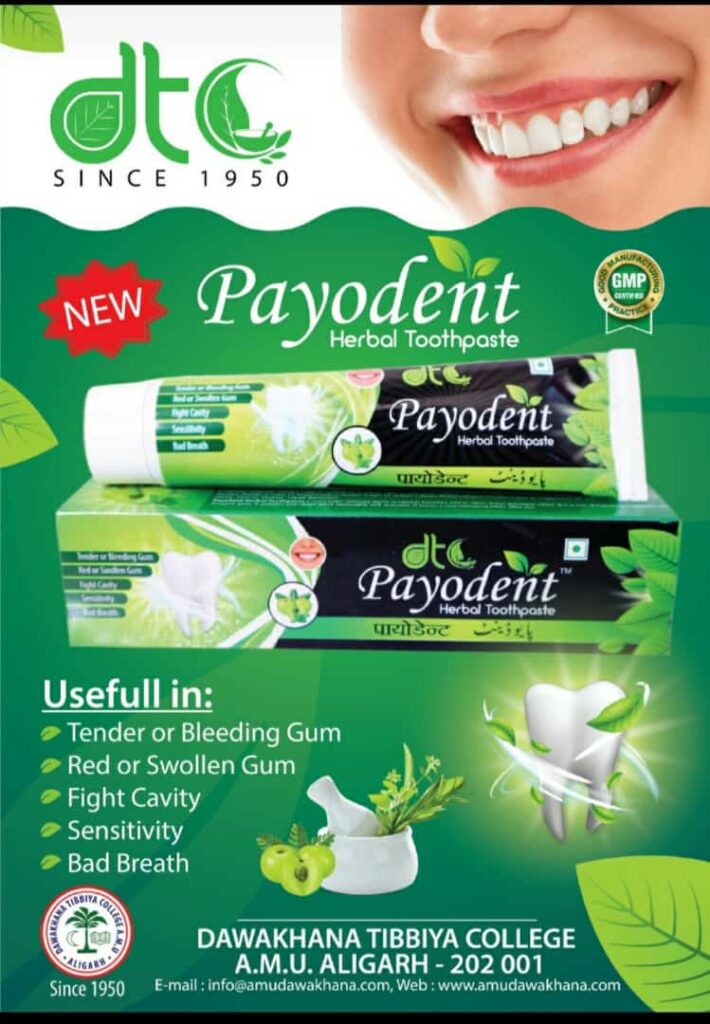
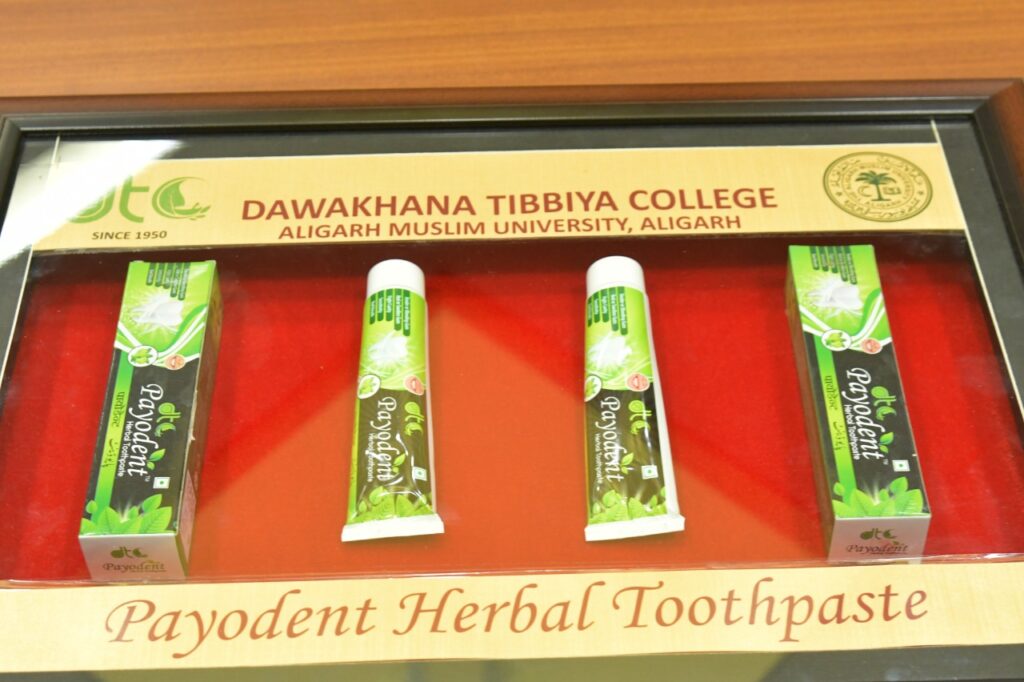
Adding to a large fleet of its world famous and popular Unani medicines, Dawakhana Tibbiya College, Aligarh Muslim University has come up with a trustworthy toothpaste “Payodent”, which holds promises for bleeding and swollen gums and pyorrhea.
The Aligarh Muslim University Vice Chancellor, Professor Tariq Mansoor today launched the toothpaste and called this a big plunge in the field of Unani medicines hoping it to become a common household product all over the country in near future.
“In times when people are anxiously looking for Unani products for all their household needs, especially medicines and other beauty products, this toothpaste will hopefully attract the people who are in search of a remedial toothpaste for safe and dependable remedy for various dental problems”, said Professor Tariq Mansoor.
He, however, urged the Dawakhana management to focus on its reliable and countrywide marketing for maximum reach to customers.
pix: Twitterpix: Twitter
Professor Salma Ahmad (Member Incharge, Dawakhana Tibbiya College) said that this toothpaste is a result of academia-industry interface and an outcome of a collaborative project between the Department of Saidla, Ajmal Khan Tibbiya College and the Dawakhana Tibbiya College.
“It has been patented with the concerned department and the Dawakhana Tibbiya College owns its proprietorship”, she added.
She said that the toothpaste, approved by the Directorate of Unani Services under the Ministry of Ayush, offers effective treatment for bleeding gums, swollen gums, cavity, sensitivity and bad breathing. It also provides a cure to the most common dental ailment, pyorrhea. The toothpaste comes in two packs of 50 gram and 100 gram.
Professor Mohammad Gulrez (Pro-Vice Chancellor), Professor Aejaz Masood (Registrar), Professor Mohammad Mohsin (Finance Offcer), Mr Taufeeq Ahmad (General Manager, Dawakhana Tibbiya College), Dr Azizur Rahman (Principal Investigator), Dr Qazi Zaid Ahmad and Dr Mohd Rashid (Co-investigators), Mr Mohd Sharique Azam (Assistant Manager, Marketing) and Hakim Abdullah (Assistant Manager, Production) were present on the occasion.
source: http://www.amu.ac.in / Aligarh Muslim University / Home> AMU News (headline edited ) / by AMU Public Relations Office / pics from Twitter)/ Aligarh, August 20th, 2022
Relative Motion is redefined; New Transformation Laws Determined.
Bhopal:
Bhopal-based Scientist Mohammad Javed Khilji making forays into established scientific theories to make amends has made the latest breakthrough which reveals that the relative motion violates conservation laws of Kinetic Energy.
Javed Khilji, an independent researcher dedicated to original researches, is working on yet another concept of Relativity to find out if the constancy of speed of light is region-dependent in interstellar distances. He has to his credit of having challenged Einstein’s Relativity Theory in the past more than a decade ago. He has been placed in the list of IBC (International Biographical Centre, Cambridge) top 100 scientists (2014).
The BP International published Javed’s latest research paper in the most recent book titled as: “New Trends in Physical Science Research Vol.7” (https://doi.org/10.9734/bpi/ntpsr/v7/3262A) in July 2022 as the 13th chapter of the book which is headlined as: “jk Transformation Laws of coordinates and composition of velocities”. The paper cracked the case of experimental verification that shows the existing relative motion is the serious violation of laws of conservation of kinetic energy. The author claims his defined relative motion in the book chapter is found to be correct to the degree of millionth part of decimal accuracy.
While the author’s published paper “Modified Transformation Laws of Coordinates and Composition of Velocities”, in International Journal of Advanced Astronomy in 2017 (doi:10.14419/ijaa.v5i1.7385) was selected as a book chapter by BP international. However, the credit of experimental proof goes to book chapter and not to the published paper. The book chapter is intended for researchers, students and scientists to provide a right direction of the future researches in real time because Galilean, Lorentz or post Lorentz researches in transformation laws have existed in relative motion based researches.
In fact, Javed had re-defined relative motion in 2011 in his research paper “Intrinsic Laws of Motion are Invariant” published in Physics Essays (DOI: 10.4006/1.3660803). Then the author was trying to add relativistic framework to his core concept which was kinematic based research paper titled “Modified Field Theory” published after a year-long review in 2004 in a peer reviewed US-based International Journal of Theoretics in its vol. 6-6. Therein, he made corrections to Einstein’s mass velocity relation resolving infinity that occurs at c (the light of speed). The outcome was transformation of matter into energetic photon at c, but not infinity.
Change dynamics of modern science
Javed Khilji’s Transformation laws will change the dynamics of the modern science. Sir Galileo, the pioneer of modern relativity in 1600, later in his honour (in 1800) Galilean equations were determined, but soon after in 1899 Lorentz revolutionized the Transformation laws which are still valid today. However, Javed after re-defining the relative motion determined his own transformation laws in 2017 in his research paper, which now is a book chapter. So, he is making his own legacy of both of relative motion and of transformation laws. It is his solo efforts without any national, international, NGO or institutional support. He is not financially sound but is determined to pursue his passion for research.
It must be noted that Javed Khilji’s achievements are of no mean nature but nation’s assets which should not go abegging. So, NGOs, TFIR and Azeem Premji Research Foundation should come forward to support him. He should be awarded with some suitable national award prior he is awarded by international community.
It may be pointed out here that the researcher had contacted Central government in 2007 but there was no response from the government side which upset him. However, he praises the present setup as in 2018 when he had an invitation to present his work in Istanbul, in an international conference on relativity. Then he had written to Prime Minister Office (PMO), seeking financial support for to and fro and stay expenses in Istanbul. He had then received prompt reply saying that his case has been referred to the Chief Secretary of Govt. of Madhya Pradesh. However, as then the state assembly elections were on, his application could not see light of the day and his visit to Istanbul did not materialize.
Meanwhile, Javed’s work received the maiden recognition in the year 2004 when two of his research papers “Multi Foci Closed Curves” and “Modified Field Theory” were published in the peer reviewed journal “International Journal of Theoretics”. The first paper relates to discovery of unique curves with non-collinear foci and relative focal distances finding their similarity to curve like ellipse with all mechanical justifications. His study underlines significance in Nuclear, Space and Bio-Science. His other paper has brought about a conceptual change in Special Relativity.
Media coverage
Meanwhile, media coverage at local and national level attracted Saudi Arabia’s International newspaper Arab News, which flashed the news “Indian Scientist Challenges Einstein’s Relativity Theory” in its 11th January, 2006 edition.
While contemporary Jiwaji University Vice Chancellor and nominee for the Noble prize in 1997 on Condensed matter physics, Prof. Satya Prakash had commented that Javed Khilji presented Einstein’s mass velocity relation in a very interesting way and attempted to explain two converse processes simultaneously within a process. Prof. Zafar Ahsan, contemporary Head of Mathematics Department of Aligarh Muslim University (AMU), recipient of International Einstein Award 2011 has appreciated author’s work in “Intrinsic Laws of Motion are Invariant”.
Experimental verification in the book chapter further strengthens the line of thought that Javed adopted since 2004. The new findings supports the growth in mass of the object at higher velocities but rejects infinity to occur at c (light-speed) instead it shows transformation of matter into energetic photons giving a clue to the birth of gamma rays of different wavelengths and also of GRBs (Gamma Ray Bursts).
New concept
A new concept of flexible acceleration at light-speed tells us why light ray show wave like property, existing concept of zero acceleration makes the ray as a rigid rod, which cannot exhibit reflection, refraction, interference, scattering, dispersion and deviation etc.
Now, few words about the author Mohammad Javed Khilji who has made the above break-though. He shifted to Bhopal from Gwalior two years back. He is an independent researcher with Masters Degrees in Computer Science and Physics. He is engaged in fundamental and original research work in the field of Relativity and Geometry leading to bring about a conceptual change in the basic researches available hitherto.
source: http://www.muslimmirror.com / Muslim Mirror / Home> Sci-Tech / by Pervez Bari / September 14th, 2022
The new information technology minister of Bihar Mohammad Israil Mansuri belongs to a socially backward Dhuniya community.
Mohammad Israil Mansuri. | Photo: Facebook/Israilmansuriofficial
Patna (Bihar) :
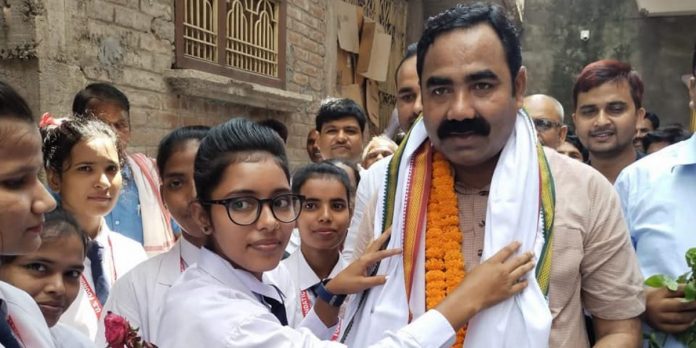
Mohammad Israil Mansuri, a Rashtriya Janata Dal (RJD) MLA is the new minister of Information Technology in the government of Bihar.
Mansuri, 46, belongs to the Dhuniya community and uses Mansuri as a surname. In Bihar, the Mansuris are primarily involved in quilt making. He is considered to be the first in his community to become a minister in the government.
Mansuri started his political career in 2001 as a Mukhiya (village head). Though he calls himself a “servant of all communities,” in political terms he is a Pasmanda (socially backward).
Mansuri completed his early education in his village Mathurapur, Patahi in the Muzaffarpur district. He studied up to I.Sc. and later joined politics.
His father Mohammad Usman does not have prior experience in politics and his wife Zubaida Khatoon is a homemaker. His only daughter Neha Tarannu is studying Unani medicine. Mansuri used to work with his father in litchi gardens and at his grocery shops. He is the third among six siblings of four brothers and two sisters. One of his brothers runs a fruit shop while the other is a teacher. He wanted to be a teacher but could not clear the main examination in 1994 while he had also passed the preliminary test for T.C. in Railways after passing his 12th board examination the same year.
He first joined Nitish Kumar’s party Janata Dal in 1996 and was part of the party till Kumar joined hands with the Bharatiya Janata Party in 2017. He resigned from JD (U) and joined RJD.
Talking to TwoCircles.net, Mansuri thanked the Almighty and his party leaders Lalu Prasad and his son the deputy chief minister of Bihar Tejaswhi Yadav for choosing him to be a minister. “For me being a Mukhiya too was a big dream. Then in 2020, I got a ticket from RJD and got elected as an MLA in my first attempt from the Kanti seat. I was extremely surprised when I got a call to take the oath as a minister. It seems that my struggle in politics has impressed my leaders Lalu and Tejashwi,” he told TwoCircles.net.
“To struggle and strive for something comes naturally to me. I studied in a school where we had to take our Bora (Jute bag used as a mat) and did not have a pen and notebook but slates to write on. I used to cycle 10 to 15 kilometres to bring the grocery items for our shop while I was in school. As I had an interest in social work, I got a chance to meet people. Though I come from the Mansuri community, my popularity in all communities is equal,” he said.
Mansuri was caught in controversy soon after he became a minister. He travelled with the chief minister Nitish Kumar to the Hindu holy city of Gaya as he was the in-charge minister of that district. When he entered the Vishnupad temple accompanied by Kumar, a huge controversy erupted as “non-Hindus were not allowed to the sanctum sanctorum of the temple. “I used to visit all places of worship without caring for the religion. I was not made aware of the restriction at that temple. I entered without any intention to breach the rule.”
When asked what his focus would be as a minister of the IT department, he said, “IT is a fast-changing sector. We would try to keep our state updated in this field. We would also see how many jobs we can provide to the youths from our department as this government aims to give ten lakh jobs.” He checks his emails and runs his Facebook page by himself and has his own website.
All India Pasmanda Muslim Mahaz President and former Rajya Sabha member Ali Anwar told TwoCircles.net that as Mansuri belongs to Pasmanda Biradari his election as MLA and now elevation to a minister is a great morale booster for the downtrodden section of the Muslim community. “Lalu and Tejaswhi took the right decision to induct Mansuri as a minister and many more such steps are needed for the society,” he said.
Former Director of Jagjivan Ram Institute of Parliamentary Studies and Political Research – Srikant sees it as a necessary step to bring upward mobility to the people who belong to the lower strata of society. “Since Mansuri belongs to the most backward section of the society his empowerment in politics is in accordance with the theory of Ram Manohar Lohia and Mahatma Gandhi,” Srikant said.
Srikant added that it was a time taking process to empower the Pasmanda section but a positive step has been taken.
www.israilmansuri.in
Sami Ahmad is a journalist based in Patna, Bihar. He tweets at @samipkb
source: http://www.twocircles.net / TwoCircles.net / Home> Careers / by Sami Ahmad, TwoCircles.net / August 30th, 2022
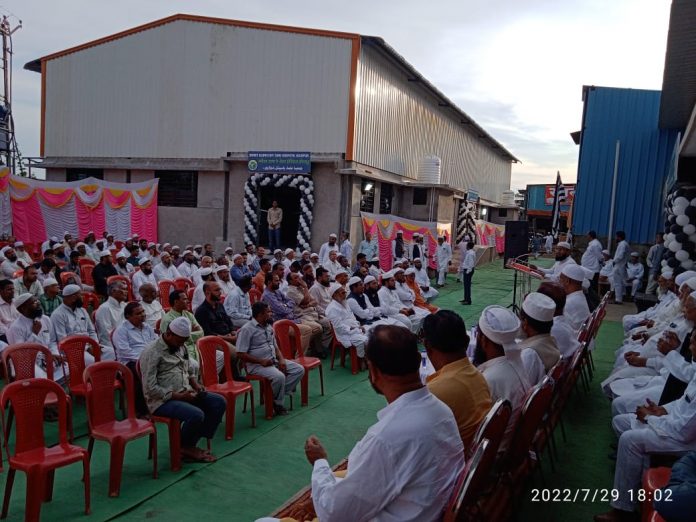
The day of inauguration at the Jamiat-E-Ulema Day-Care Hospital on July 29. | Picture by arrangement
The hospital built by Jamiat-e-Ulema Hind (JUH) in Solapur, Maharashtra will provide healthcare services to poor patients at minimum rates regardless of caste, religion and creed.
Solapur (MAHARASHTRA) :
To meet the healthcare needs of poor and marginalized sections of society, Jamiat-e-Ulema Hind (JUH) has built a hospital in Solapur, Maharashtra.
Thrown open to patients in late July this year, Jamiat-E-Ulema Day-Care Hospital aims to make health facilities accessible to the poor and needy at a minimum charge. The hospital was inaugurated by Maharashtra state president of JUH Maulana Nadeem Siddique and attended by several eminent doctors and activists.
During his address, Maulana Nadeem said that “the hospital will provide excellent services to the poor patients at a very modest rate regardless of caste, religion and creed.”
“The OPD (outpatients department) and a medical store are functioning right now and the daycare facilities will begin soon,” the medical superintendent of the hospital Dr Farooque Mulla told TwoCircles.net.
Dr Farooque said that besides having an OPD, the hospital also administers ESG, and all types of blood tests at 30 to 50% discounted charges. “Specialist doctors also visit us to handle major cases.”
Talking about the need to open such a healthcare facility for the needy, JUH district president Maulana Ibrahim Qasmi told TwoCircles.net that “health and education are basic facilities which should be provided free of cost or lowest fees but unfortunately these two have become a lucrative business.”
“Considering the need of the hour we have started this hospital on a 5000 square feet plot,” he said.
Maulana Ibrahim said that “serving the poor is the aim of the hospital.”
“We are concentrating on the health and education sector by using all our resources. Our new venture will be to prepare students from marginalized communities for competitive exams by holding classes,” he said.
The infrastructure cost of the hospital was borne by collecting donations from people.
“We are doing all this by collecting donations from people. I must say that our city-based Biradaris (sections) have donated wholeheartedly,” Hasib Nadaf, General Secretary JUH told TwoCircles.net.
Nadaf said that during the pandemic, JUH set up a Covid Care centre at the same premises.
“This new multi-speciality hospital is our dream project,” he said.
Social activist Salahuddin Peerzade lauded this initiative by JUH.
“JUH always takes the lead in all humanitarian work. Everyone must come forward and help them to achieve their targets,” he said.
For Ashfaque Bagwan, a young political and social activist, the city of Solapur is in dire need of speciality hospitals, especially for women. “I frequently receive complaint calls from many women who face neglect at government hospitals. The fact is that poor patients always struggle to get their healthcare needs met,” he said.
Bhagwan added that he hoped the new hospital set up by the JUH will have a well-equipped gynaecology department.
Imran Inamdar is a Goa based journalist. He writes positive stories on education and healthcare. He tweets at @ImranIn6379033
source: http://www.twocircles.net / TwoCirlces.net / Home> Lead Story / by Imran Inamdar, TwoCircles.net / August 24th, 2022