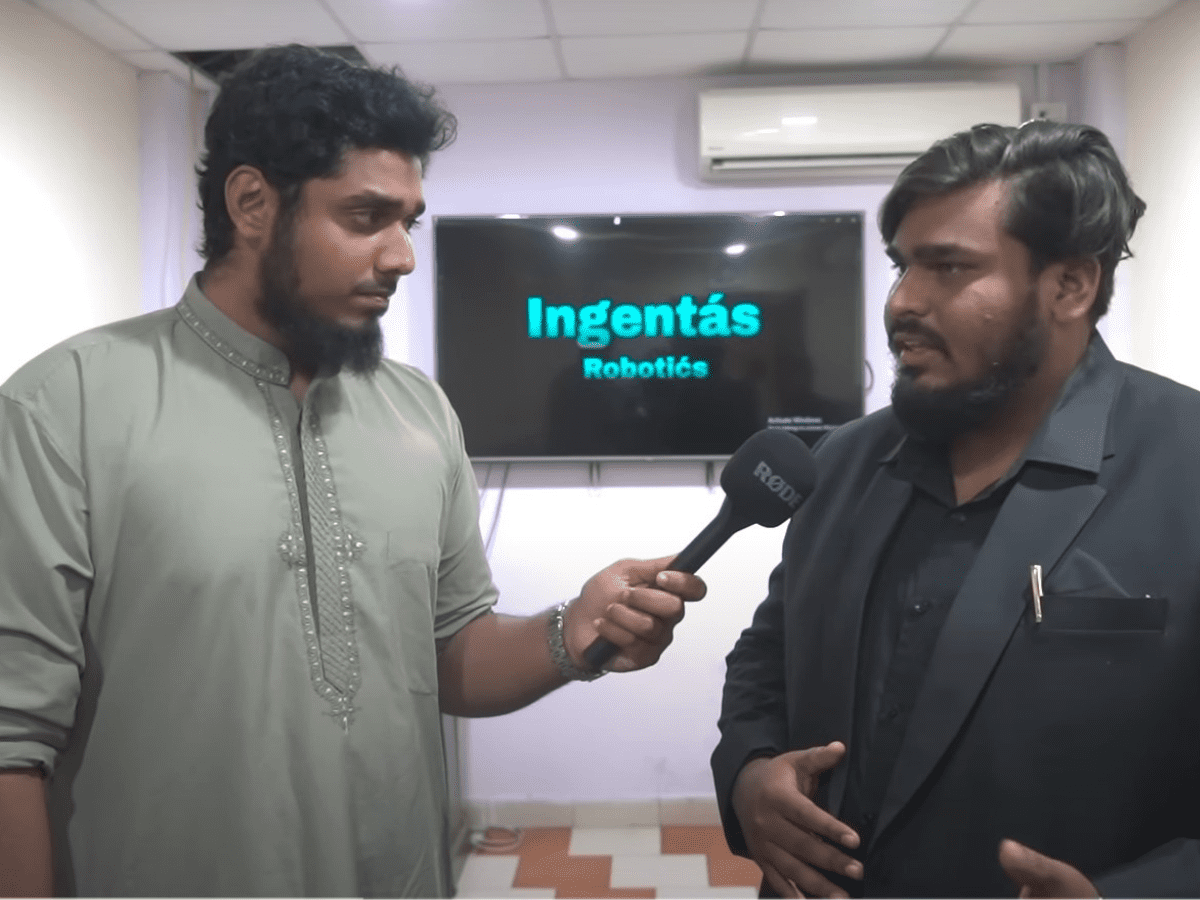
Ingentas is teaching people everything from basic batteries, jumper wires, buzzers, and sensors to the robotic arm, NASA’s Mars rover, and A.I.-driven drones.
Hyderabad:
Realizing that any type of access to learning robotics and artificial intelligence is not available to most people, Ingentas started off in 2021 with its vision to empower local communities by teaching them technologies that will be more relevant in the future. It’s a first-of-its-kind workshop in Hyderabad, completely run by engineering graduates and students that aims to make the city a hub of robotics.
Tahami Mundewadi, who has been in the field of robotics for the last four years is the founder and CEO of Ingentas. Speaking to Siasat.com, he said that joining the Robotics club at Muffakham Jah College of Engineering (MJCET) helped him learn and grow more in the pursuit of his passion.
“Everything from a vacuum cleaner to the robotic arm used to build cars, all are based on robotics and artificial intelligence, we are living in an interesting time where even surgeries are being performed by robots,” Mundewadi remarked.
He further added that the world is moving at a very fast pace in this direction and that we have to be in this race and compete with the others.w
Ingentas is teaching people everything from basic batteries, jumper wires, buzzers, and sensors to the robotic arm, NASA’s Mars rover, and A.I.-driven drones.
Mundewadi stated, “you don’t necessarily have to be an engineering student to learn robotics, anything with passion can come.”
Furthermore, the CEO of Ingentas added that he believes that in 50 years everything will be based on robotics. “And to make anything mainstream in society we have to begin from the school level and that’s why we have classes from third-grade level all the way to advanced post-graduate level,” he remarked.
source: http://www.siasat.com / The Siasat Daily / Home> News> Hyderabad / by Usama Hazari / August 06th, 2022
Some great personalities have remained unknown for quite some time. Their names have long been lost and have remained unheard for centuries; It’s time to un dust and delve into the past to know about these heroes and their families.
DR SULAIMAN KHAN
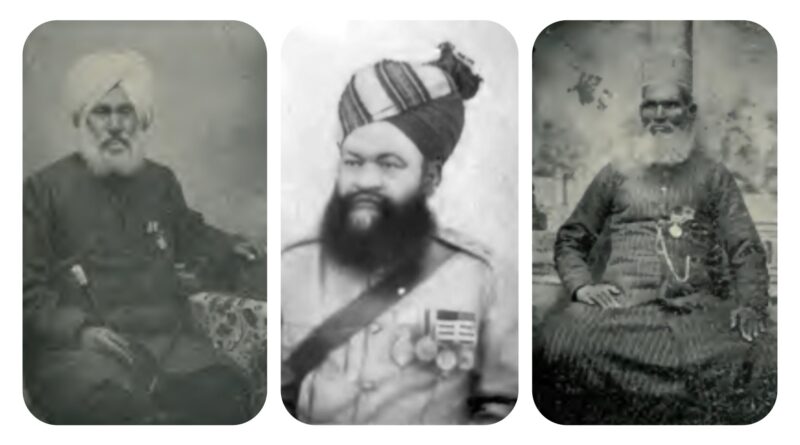
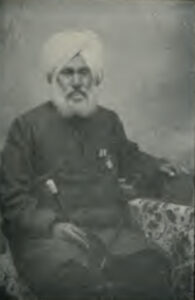
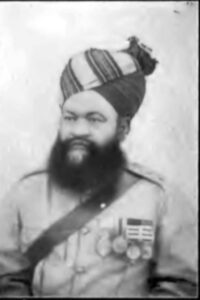
Dr Sulaiman Khan was a senior sub assistant surgeon of the late nineteenth century in the Indian subcontinent. He was popularly known as Khan Saheb among the people. Dr Khan originally belonged from a Pathan clan whose ancestral history can be traced back to Afghanistan. Sulaiman Khan was born in the year 1864. His ancestors came to India during in the sixteenth century along with the Mughal emperor Nasir-ud-Din, better known by his regional name, Humayun.
Dr. Sulaiman Khan
The forefather of Khan Saheb settled in the Amritsar district and held an extremely responsible position under the Mughals where they were allotted the responsibility of several villages.When the Sikhs arose to power, all the villages they owned, except one were lost by the entire family. The only village that remained was the one that was under Dr Sulaiman Khan’s father. Khan Saheb’s father had won a medal in recognition for his service. Khan’s father served in the first Afghans campaign. He was with Lord Roberts in his march from Kabul to Khandahar. Dr Khan earned a degree in medicine from Lahore Medical school and later entered the Government services in 1873 and served for a period of nine tears in the military department. Later in the year 1882 he was transferred to the Civil Medical department of the United province where after he served in Atrauli, Ghaziabad and Meerut. He lived in Meerut.
DR MOHAMMAD YASIN
Just like Sulaiman Khan, Mohammad Yasin was also a senior sub assistant surgeon from Calcutta (currently known as Kolkata). He was born in December 1858 and attained his alma mater from Bankipur Medical School. He belonged to a reputed zamindaar family. His father was Maulvi Mir Hassan Ali, a military personnel who was responsible for taking care of the British families in India during the mutiny when the British were engaged in the fight. In 1877 – 78, Mohammad Yasin performed a special famine duty in Mysore. Later in 1879, Yasin was actively involved in 25th Native infantry. He travelled to Khandahar with this regime and was later sent to Kabul, in 1880. He also witnessed the battles of Ahmad Khel and Ghazni. In the same year he marched to Khandahar with Lord Roberts.
Dr. Mohammad Yasin
He selflessly served the victims during the war for which he was awarded with the Afghan war medal, with two clasps and a bronze star. In 1883 he was sent for a medical duty to Egypt. His distinguished efforts in serving the ailing humanity was recognised and later he was elected as a medical officer in charge. Yasin also remained an in control of the Balrampur Branch dispensary in Lucknow. Later he lived in Ganeshganj, Lucknow. Due to the long and meritorious services, both Sulaiman Khan and Mohammad Yasin earned the title of “Khan Saheb” during the coronation ceremony by the British.
DR MOHAMMAD NAIMULLAH
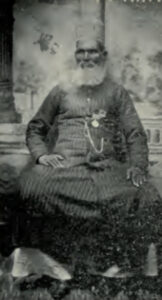
Naimullah, like the above mentioned, was the Senior Sub assistant surgeon. He was born in 1859. He did his schooling from Government high school in Allahabad and Victoria School in Ghazipur. He attained a degree in medicine from the Temple medical School in Bankipur, Bihar. For generations, his ancestors were in the British service. For thirty years both his grandfather and his father served in the British army in India. Just as his forefathers, Dr Naimullah too was in the government service for over thirty years.
Dr. Mohammad Naimullah
He had been the medical charge of the Viceroy’s bodyguard for a period of fourteen years. During the coronation durbar, Naimullah was awarded Kaisar-e-Hind medal in recognition for his outstanding achievement in the field of medicine. Mohammad Naimullah lived in Calcutta.
source: http://www.heritagetimes.in / Heritage Times / Home> Medicine / by Dr Zareen Fatima / September 27th, 2021
Ariba Khan is the founder of Jumping Minds, which promotes mental well-being. Image courtesy: Ariba Khan
Technology and human emotions may seem a mismatch, but at Ariba Khan has fused them for a mental health platform.
As a young, spirited and ambitious 30-year-old, Ariba Khan can relate to mental health challenges that people her age are fighting. The lack of a safe space where such people could open up about their thoughts anonymously is what spurred her business idea – an artificial intelligence-based deep tech mental health app.
With Jumping Minds, this IIT-Rourkee and IIM-Bengaluru alumnus, along with co-founder Piyush Gupta, built a space where people could chat with individuals in a similar situation without exposing their identity.
“All of us require a safe space where you can talk about the challenges you may be facing. It doesn’t have to be clinical stress, but all of us are facing one stress or another – a bad breakup, difficult time at work, adjusting with the family. So, we thought of creating a digital space where you connect to people who may have gone through similar stressors, share your experiences, and release emotions,” Khan tells Health Shots.
Mental health matters
In the past few years, global celebrities have broken their silence on facing mental health issues. Somewhere, destigmatization has happened, but there’s a long way to go. It is because of the continued stigma around mental health that Khan chose to make Jumping Minds an anonymous space.
“Otherwise, there’s always a judgment factor,” says the Delhi dweller, adding that even though her platform is all about tech, at the heart of lies human interaction through technology.
“It helps people to release emotions, clear their head and find solutions,” asserts Khan.
Just five years ago, talking about stress and feeling burnt out at work would have been unimaginable. But the Covid-19 pandemic has pushed people into taking their mental health more seriously.
“The Gen-Z, especially, is more unapologetic about their mental health. They have an aspirational lifestyle, they want to live a well-balanced, happy life. And so, I would say the younger generation is leading the change in mindset and the positive shift towards wellness. Still, there’s a stigma around mental health and limited safe spaces where people don’t feel ashamed or guilty about sharing their story. Instead, people should feel empowered that there are so many other people going through the same,” Khan says.
“It’s okay to not be okay,” believes Ariba Khan. Image courtesy: Ariba Khan
Mental health issues of the young generation
As someone who believes in the adage that “it’s okay to not be okay”, Khan outlines the most common health problems that youngsters in the 20-30 age group are going through these days.
1. Relationship troubles:
Whether you are stressed at work or family life, it directly impacts your interpersonal relationships. People are getting increasingly stressed about how to maintain relationships.
2. Anxiety
This is why people need a digital detox from time to time! “Anxiety is the after-effect of social media. The need to be perfect, with filters on all the time,” explains Khan, stressing on how social anxiety and social comparison are turning out to be spoilers.
“People tend to think, ‘Maybe I am not enough’, ‘I am working so much, but I am not upto that level.’ And that social anxiety has become very prominent in the post-Covid era,” she explains.
3. Sexual wellness:
This is the age when early professionals and college students explore their body and preferences. So, people have a lot of questions around sexual wellness.
4. Career:
The desire to reach career milestones leads to undue pressure and stress on people. They overthink things like, ‘Are we in the right job? Are we working with the right people?’ But talking about these things, instead of keeping the thoughts to yourself, will give you a feeling of validation.
3 happiness hacks for women, suggested by Ariba Khan
Khan has three simple suggestions for women to follow for the sake of their mental peace.
1. Find peaceful breaks in a day
“I know we are women of the 21st century, always leading the way – whether it is in personal life or professional life. But it is very important to have time in a day when you are by yourself, living in the moment,” she suggests.
Khan assures that doing so even for a few minutes every day will help people become more productive and more appreciative of the positive results of the everyday hustle.
2. It’s okay, to err is human
Even research says women tend to have higher stress levels than men ! “The society has made women accustomed to keeping everyone around them happy – be it colleagues, friends, family.
But it is okay to sometimes make mistakes, feel bad or low. We may think we are superwomen, but we are humans after all! We should’t expect ourselves to be perfect all the time, because there’s true beauty in being imperfect,” she adds.
3. Talk it out
Don’t keep your thoughts to yourself. If you are stressed, talk about it. “Don’t feel ashamed about it, and who knows, it may give courage to others to talk about their journey. Once you start releasing the monster from your head, it becomes smaller. And if you do it in a community, you will see magic!”
source: http://www.healthshots.com / Health Shots / Home> She Says> by Radhika Bhirani / August 02nd, 2022
People bade a tearful adieu to Bhopal’s first plastic surgeon Dr. Zaheer-ul-Islam when he passed away here on Wednesday last.
Bhopal:
People bade a tearful adieu to Bhopal’s first plastic surgeon Dr. Zaheer-ul-Islam when he passed away here on Wednesday last. He was in his late eighties. He is survived by his wife and a large number of relatives and friends to mourn his loss.
Dr. Zaheer-ul-Islam was laid to rest in the graveyard near Bhopal Talkies late in the evening after his Namaz-e-Janaza was performed in the courtyard of historic Sufiya Masjid.
Hundreds of people of Bhopal expressed their heartfelt tributes to him. He was known for his work as well as his cheerful behaviour and smiling face.
Education and Career
Dr Zaheer took his MBBS degree from Indore Medical College and did specialisation in Plastic Surgery from Patna Medical College.
In the cases of plastic surgery, 40 years ago, when different types of techniques were not available, in that era, the record of successful operation of big plastic surgeries remained in the name of Dr. Zaheer.
Pioneer in sex reassignment surgery
He was a pioneer and credited with Madhya Pradesh’s first sex reassignment surgery which was the biggest achievement of his life.
In 1977 he performed a surgery to change the sex of a girl to make her a boy. He changed the gender of a girl named Munnibai to Munnalal.
In the history of plastic surgery, Dr. Zaheer, who was honoured with many conferences and awards at international level, was also called abroad.
Dr. Zaheer served in Bhopal’s Hamidia Hospital associated to Gandhi Medical College (GMC), for nearly 30 years. Along with this, he also taught at GMC. From there he took voluntary retirement.
A poet and aerial photographer too
Apart from this he was a multifarious personality with a poetic blood flowing in his veins. He paid poetic tributes to his near and dear ones who departed this world by composing “Qata’t” which was published in Nadeem, an Urdu daily newspaper. Just 24 hours before he went to eternal sleep he recited the last “Qat’a’” of his life in a video recording saying:
“Mere janaze pe pura shahar tha sharik; ek tum nahin the jiska mujh ko intezar tha”.
He was also an expert aerial photographer with a passion to document the evolving city of lakes.
GMC golden jubilee celebrations were held in 2005. Dr. Zaheer was scriptwriter for the documentary ‘Down the memory lane’. For the poet it came naturally. His passion for aerial photography made him many friends and some dubbed him as ‘would be pilot’.
Dr. Zaheer’s aerial photography of Bhopal dates before the age of the internet and satellite imagery. He welcomed anyone who wanted to use his pictures for publication. As early in 2000, Dr Zaheer digitized his collection for preservation. He also was one of the first to use videos in medical conferences for demonstration.
According to GMC’s Assistant Professor Dr. S. K. Patne plastic surgeon Dr. Zahir was one of our favourite teachers in the medical college and was the first to showcase aerial photographs of the GMC campus, proving college building was designed in shape of medical cross from the top.
source: http://www.ummid.com / Ummid.com / Home> Inda / by Pervez Bari / July 30th, 2022
The unit is being run under medical supervision of Dr Shoeb Ali Khan, leading consultant nephrologist and a kidney transplant surgeon.
A patient undergoes dialysis at the unit
Hyderabad :
Probably for the first time in the world, a mosque in Hyderabad has allotted space on its premises for establishing a full-fledged haemodialysis unit. Masjid-e-Mohammadia, located in Langar Houz area now houses a state-of-the-art free dialysis centre that mainly caters to the weaker sections of the society, regardless of caste and creed.
The centre, set up by two NGOs – Helping Hand Foundation and SEED US, has five latest Fresenius brand machines and will acquire five more machines in the next three months. The swanky centre, designed like a corporate hospital, has a separate access for dialysis patients and it is equipped with high quality equipment, clinical care as well as facility to manage onsite emergencies.
The unit is being run under medical supervision of Dr Shoeb Ali Khan, leading consultant nephrologist and a kidney transplant surgeon.A medical doctor, ANMs, dialysis technicians and an ambulance will be available at the centre from 8 am to 8 pm on any given day. “We have invested about Rs 45 lakh for the initial setup of this unit. About Rs 2 lakh per month will be managed by Helping Hand Foundation,” said Mazhar Hussaini of SEED.
To register for free dialysis, one can call Ph: 9603540864.
source: http://www.newindianexpress.com / The New Indian Express / Home> Good News / by Express News Service / July 22nd, 2022
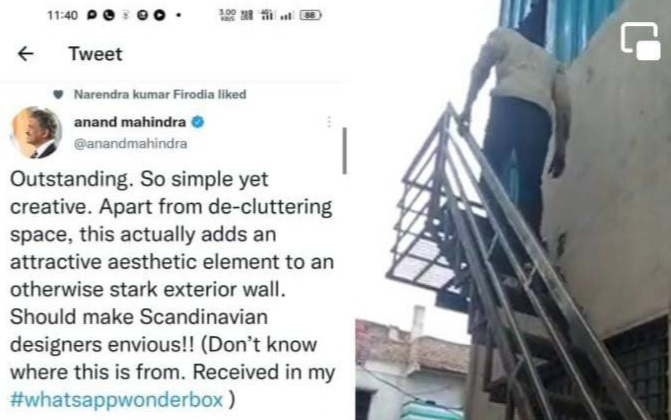
As soon as the construction work began at site, people started complaining about the ladder which was an obstacle for padestrians and
Considering the site conditions sameer decided to make a 14 x 12 size foldable ladder and he within ten days at the cost of only 25 thousand rupees he made the staircase.
Sameer Ishaque Bagban a 31 year old fabricator is originally from Ahmed Nagar city. Interestingly this skilled young man has no relevant qualification, diploma or certification in the field of fabrication, however he managed to complete education till 10 th std.
Sameer is running his firm “Darbar Fabrication” since 5 years.
During conversation with Muslim Mirror Sameer said that our fixed stair case was obstructing padestrians, owner of the firm requested us resolve the issue by doing some Jugad, I took it as a challenge, after four days work and discussion with my partners Eijaz Khan and Asif Pathan we decided to make this staircase foldable.
As we make and design foldable tables and other items, we thought we should try foldable staircase too, and Alhamdulillah we did it. Now it is functioning normally, Sameer added.
Sameer thanked Industrialist Anand Mahindra for his tweet and expressed happiness, he says, I am feeling myself fortune that such high profile person of the country and renowned industrialist has taken note of my work and praised the idea.
He further said after Mahindra sir’s tweet I started receiving calls continuously from friends, relatives and media persons.
source: http://www.muslimmirror.com /Muslim Mirror / Home> Indian Muslim> Positive Story / by Imran Inamdar / July 17th, 2022
Jamia Millia Islam faculty member, Dr. Shama Parveen, to receive prestigious Sayeeda Begum Women Scientist Prize 2018 to be presented by Hon’ble Vice President of India.
Dr. Shama Parveen, Assistant Professor at the Centre for Interdisciplinary Research in Basic Sciences, Jamia Millia Islamia (JMI) has been selected for the prestigious “Sayeeda Begum Women Scientist Prize 2018”, instituted by Jamia Hamdard (University).
pix: @ Twitter
Dr. Parveen is actively involved in research in the area of Molecular Biology of human viruses and focuses on Dengue, Chikungunya, Zika and respiratory viruses (human metapneumovirus, influenza and respiratory syncytial virus). Her research articles published in journals of international repute are being well cited.
The award is given annually in the memory of Late Mrs. Sayeeda Begum, wife of Late Hakeem Abdul Hameed, founder of Jamia Hamdard. The award aims at recognizing the academic excellence of women scientists working at any minority institution of the country in basic and applied research in the areas of biosciences, biotechnology, biomedical, pharmaceutical and environmental sciences. Scientific contributions of the candidate during last 5 years are evaluated for the award. The award carries a citation and prize money.
The award was announced on 14th September 2018 at the Founder’s Day of the Jamia Hamdard University and it will be presented to Dr. Shama Parveen during the forthcoming Convocation of the University on 23rd October 2018 by the Chief Guest, Hon’ble Vice President of India. (PRO, JMI)
source: http://www.milligazette.com / The Milli Gazette / Home> News> Community News / The Milli Gazette Online (headline edited)/ by PRO, JMI / September 21st, 2018
Srinagar, JAMMU & KASHMIR / Philadelphia (Pennsylvania), USA :
pix: youtube.com
‘Such lectures are aimed to provide a vibrant platform for students: Director
Srinagar:
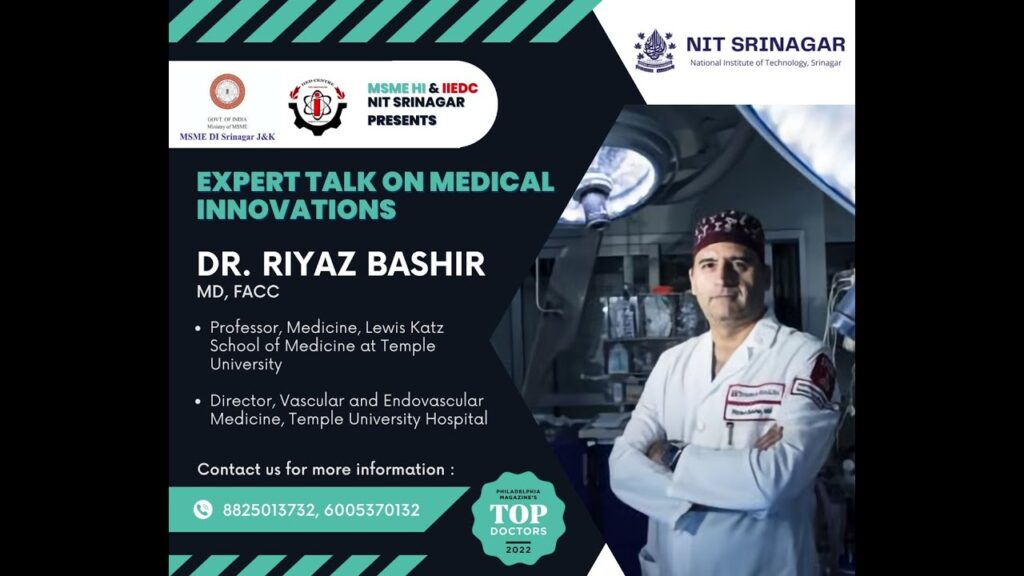
World famous cardiologist Dr Riyaz Bashir MD, FACC, who is Professor of Medicine, Lewis Katz School of Medicine at Temple University, USA, Wednesday delivered an expert lecture on medical innovations at National Institute of Technology (NIT) Srinagar.
The event was organized jointly by MSME, Development Institute Srinagar in collaboration with MSME- Business Incubation Centre and IIED Centre.
The event was presided over by Director NIT Srinagar, Prof. Rakesh Sehgal, and world-renowned cardiologist Dr Riyaz Bashir who is also Director, Vascular and Endovascular Medicine and co-inventor of the Bashir™ Endovascular Catheter was the chief guest on the occasion.
In his presiding speech, Director NIT, Prof. Sehgal said new innovations are important and vital for any engineering institution. From medical sciences to agriculture, India is progressing in every field of science and technology. No technology will be successful until we make it sustainable, he said.
Prof. Sehgal also expressed his gratitude to Dr Riyaz Bashir for delivering a memorable lecture on medical innovations. Hosting such renowned personalities is the need of the hour, he said.
Institute’s Registrar, Prof. Syed Kaiser Bukhari said research and innovation are essential to increase the abilities of young minds. “We need to develop and test solutions; predict outcomes and mitigate harm and make informed policy decisions,” he said.
Prof. Bukhari said research and innovation are critical for generating new knowledge, building new infrastructure, and educating innovators and entrepreneurs.
In his key address, Dr Riyaz Bashir delivered his lecture on medical innovations and shared his aspiring journey from Kashmir to the USA with the young innovators.
“Our team is working on removing the blockage of lung arteries by a blood clot results in pulmonary embolism – a condition requiring emergency care that affects thousands of patients across the globe,” he said.
Dr. Bashir further said existing treatments, however, may not fully remove the clot, necessitating the development of new therapeutic strategies for pulmonary embolism.
His team has developed a device known as the Bashir™ Endovascular Catheter (Thrombolex, Inc.), which effectively dissolves the clots in the lungs, with no major bleeding risk.
Dr Bashir also urged young innovators to focus on a problem and then try to find the best solutions possible. “Universe will conspire to make it successful if your intention is to help people and impact lives,” he said. Assistant Director, MSME Development Institute Srinagar, Saheel Yaqoob Alaqband said the program was aimed to motivate young innovators, and how they will take their innovation to commercial stage.
“Ministry of MSME funds those innovations which have commercial potential and later can change the lives of the people. Dr Riyaz is an example for young innovators,” he said.
On the occasion Head IIED Centre, Prof. Saad Parvez talked about the growing startup culture and how their centre is helping to grow that culture at NIT Srinagar as well as in Kashmir.
He said IIED Centre of NIT Srinagar is the host institute for implementing MSME design and innovation schemes.
The event was attended by Prof. Babar Ahmad, Dr Sheikh Shahid Saleem, G A Harmain, Dr Noor Zaman, Dr Parvez Ahmad Reshi, Dr Dinesh Kumar, Dr Danish Ahmad, Dr Sandeep Rathee, Abdul Hamid (Rahim Greens), Dr Talib Khan (SKIMS), Dr Shiekh GM (Ex. AP, MED) and innovators from NIT Srinagar and MSME.
A formal vote of thanks was presented by Dr Sheikh Shahid Saleem. He expressed gratitude to Dr. Bashir for encouraging the young innovators and boosting their morale. He later thanked all participants for attending the special lecture.
source: http://www.kashmirreader.com / Kashmir Reader / Home / by KR Desk / May 20th, 2022
Innovators at the Islamic University of Science and Technology (IUST) Awantipora in south Kashmir’s Pulwama district have claimed to have set up a prototype of a low cost ventilator to tackle the shortage of ventilators amid the COVID-19 pandemic.
A statement by the varsity said that the innovators at the IUST’s Design Innovation Centre (DIC) had tested the ventilator prototype, named ‘Ruhdaar’ successfully in the laboratory.
It said the ventilator is expected to be handed over to the medical experts at the SKIMS hospital Soura for evaluation purposes which will immediately begin once the innovators are satisfied with its functioning in the laboratory.
The statement said that the raw materials for the said frugal ventilator are easily available within J&K and India.
Team members headed by Coordinator DIC, Dr Shahkar Nehvi, Dr Majid Hamid Koul, ex faculty IUST who recently joined the NIT, Peerzada Shoaib, Assistant professor IUST, two IUST Alumini Asif Shah and Zulquarnain, Jawad, Design Fellow IUST, Dr Saad Parvaiz from NIT Srinagar, Dr Shabir Hassan from Harvard University as overseas mentor and Abdul Rahim from Rahim Greens contributed towards the designing of the said prototype, the statement said.
It further said that there was a possibility that the ventilator is manufactured in A commercial scale once the prototype is approved by medical experts.
Vice Chancellor IUST, Prof Mushtaq A Siddiqi has congratulated the entire team for this huge achievement.
A statement quoted Prof Siddique as saying that he was thrilled over the team members for achieving the feat in a very short span of time adding that the components of the ventilator were mostly local.
The VC IUST said that the university will go for patenting and handover the technology to a start-up or couple of start-ups, so that the ventilator is produced on the large scale. Prof Siddiqi further added that the prototype is fine and alright, but it depends on the medical fraternity to accept it or suggest certain modifications.
source: http://www.kashmirreader.com / Kashmir Reader / Home / by KR Desk / April 23rd, 2020
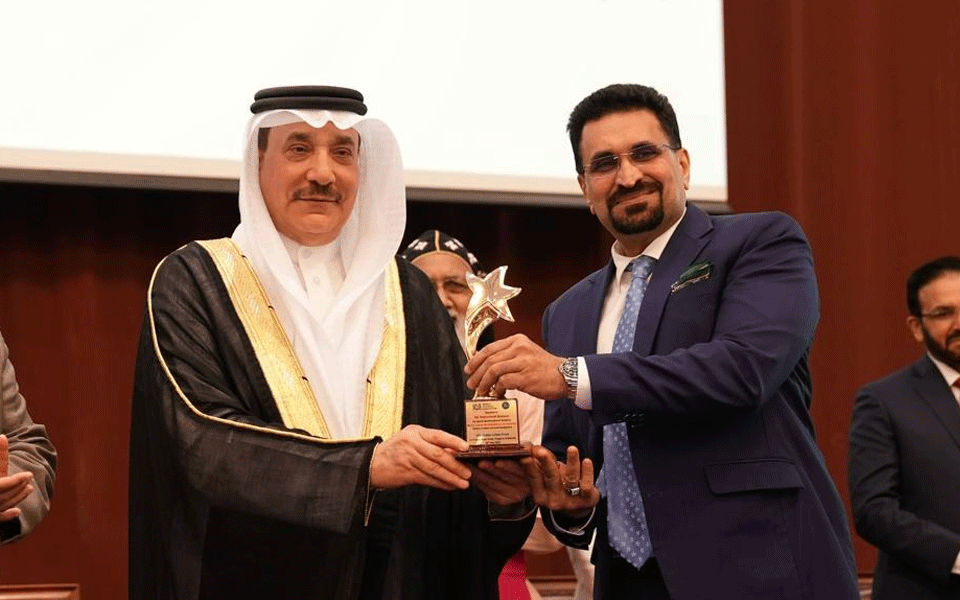
Leading Bahrain-based Indian entrepreneur, Founder and Chairman of the Saara Group, Mohammad Mansoor was honoured for his enormous contribution to sports and international relations by the one of the oldest cultural organisations in Bahrain, the – Kerala Catholics Association.
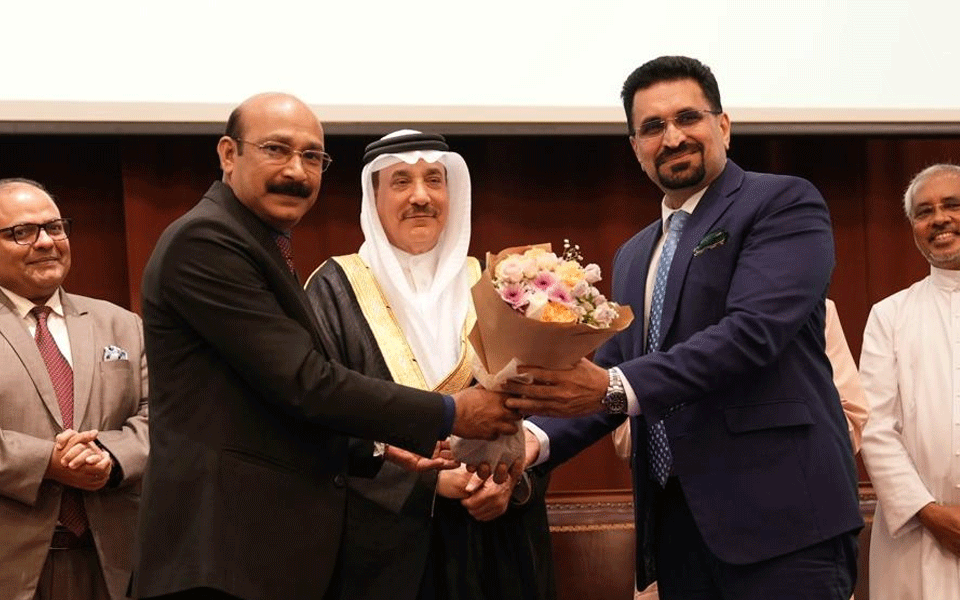
Mansoor was presented the award as presented the award by Minister of Labor and Social Development H E Jameel Bin Mohammed Ali Humaidan at a glittering gala ceremony at the Crowne Plaza hotel, in the presence of Ministers, Ambassadors, VIPs, distinguished guests and community leaders including India’s Ambassador to Bahrain, HE Piyush Srivastava, Bishop Rt. Rev. Dr. Abraham Mar Julios, Peravur MLA Adv. Sunny Joseph.
Mr Mansoor, a serial entrepreneur and venture capitalist, is the Founder & CEO of Saara Group, which has a portfolio of operations across the domains of Information Technology, Energy, Oil & Gas, Digital Media, Sports Infrastructure, Seed Capital Investments, and Social Initiatives.
The operations of the group span across the Gulf Cooperative Council (GCC), United Kingdom, United States of America, ASEAN countries and India.
As an active supporter of an array of social and cultural initiatives to empower community relations and strengthen the social fabric, he has played and played a crucial role in supporting the sports initiatives in the Kingdom of Bahrain under the patronage of His Highness Sheikh Khalid bin Hamad AI Khalifa.
As a cricket enthusiast, he was the brains behind launching the first-ever franchise-based T20 Cricket Premier League which was held under the patronage of His Highness Sheikh Khalid bin Hamad AI Khalifa in 2018. In 2021, he was appointed as the advisor to the newly revamped Bahrain Cricket Federation and was instrumental behind giving the sport a much-needed boost in Bahrain. So much so, that the women’s team has already inked its name in the record books by scoring the highest score in an T20 International.
An active supporter of Bahrain’s flagship sports media property, BRAVE Combat Federation across multiple venues around the world. He spearheaded the KHK Heroes Foundation initiative assisting the economically vulnerable communities and expatriates throughout the Kingdom of Bahrain during the Coronavirus pandemic part from being a director of KHK Venture Holding.
In 2021, he was appointed to the prestigious World Youth Group as director of the Council. The WYG has been designed by Collegiate Congress, in association with United Nations Member States, United Nations Agencies, youth and student groups; All-African Students Union (AASU), European Students Union (ESU), Young Republicans National Federation (YRNF), Young Democrats of America (YDA), higher education institutions, the private sector, and individuals from around the world.
Of the most notable among the awards that he has been conferred with is the Hind Ratan Award.
source: http://www.english.varthabharati.in / Vartha Bharati / Home> Gulf / by Vartha Bharati / June 14th, 2022