Srinagar, JAMMU & KASHMIR / Indiana, USA :
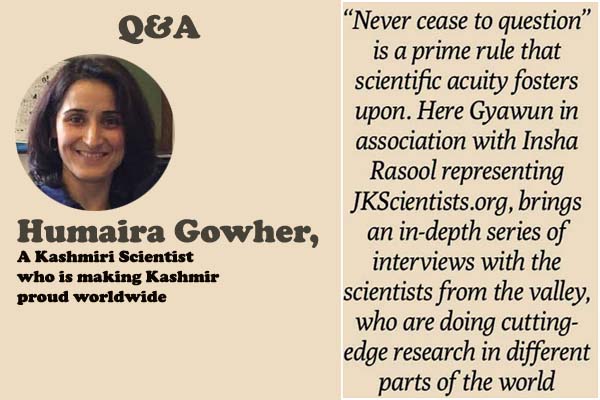
“Never cease to question” is a prime rule that scientific acuity fosters upon. Here Gyawun in association with Insha Rasool representing JKScientists.org, brings an in-depth series of interviews with the scientists from the valley, who are doing cutting-edge research in different parts of the world.
Early inquisitiveness metamorphosed a Kashmiri girl into an expert in molecular biology research at Indiana, USA.Bringing the first in the series, here we discuss with Humaira Gowher, about her early life in Kashmir, her motivations and aspects of science that she finds most exciting and more importantly, the expertise she brings to University of Purdue, West lafayette, USA. Her research currently focuses on understanding the regulation of DNA methylation in development and disease.
Tell us about yourself
My name is Humaira Gowher. I was born and raised in Srinagar until I was 19. I was always lucky being among the first few batches to attend Caset Experimental School, headed by Prof C. L. Vishen, a visionary and an exceptional educationist. He followed Montessori style of primary school teaching. Back then, it was unknown in our part of the world. It was through discussions about inventions and discoveries in Vishen’s classroom, I treasured the feeling of becoming a scientist. The further excitement in the science of life was added by lectures from Physics and Biology professors.
I received my college education from Aligarh Muslim University, where I graduated with Bachelors (Hons) and Master’s degree in Biochemistry. I was again blessed with mentors including Prof. Imrana Naseem, Ms. Aziza Rizvi, who instilled the love for biochemistry and sports during my college years. The supporting culture of the Women’s College wiped every tear and healed wounds of separation from the homeland. Women’s College, AMU, was and still continues to be a place where you experience personal freedom. It creates a no judgment zone for young teenagers, who are given different opportunities to excel in cultural, sports, or academic championships, and I am thankful for those opportunities.
What motivated you to study at IISc, which is the finest institute in India? How comfortable was the transition from AMU to IISc and did your background in biochemistry helped you to adjust there? Share your experience with us; especially in what way did it help you to shape up your career?
During my second year in the Biochemistry Master’s program, I was exposed to experimental research as a summer trainee for a couple of months in Dr. S. E. Hasnein’s lab at the National Institute of Immunology, New Delhi. I always wanted to become a scientist, however, the experience in Dr. Hasnein’s lab gave me a realistic feel of what that means and I yearned for it more than ever. I was looking forward to getting my PhD degree from a premier institution in India. I applied to the Indian Institute of Science, Bangalore and based on my high score in GATE and my performance in a series of interviews at IISc, I was able to secure a position as a PhD student in the Department of Biochemistry.
I stayed in the program for 2 years but due to family reasons, I had to move to Germany where my husband was placed in a Computer Engineering program in Essen-Duisburg University. I continued my PhD thesis work in Germany in the Department of Biochemistry, at Justus Liebig University. The field of research, “Epigenetics”, offered to me was the one I had acquired experience in and was close to my heart. It was very easy to work hard and publish, simply because I enjoyed doing it. With prior experience from IISc, I was able to finish my thesis in 2 ½ years and was awarded Summa Cum laude (Award of Excellence) for publishing 7 first author peer-reviewed manuscripts during this time.
After completion of your PhD, what kept you motivated in Science and how did you choose your position at the National Institute of Health (particularly in terms of place project and funding)?
Motivation to do science comes only from the passion to do it. It needs tremendous perseverance to stay in science given that you have to put up with failures and success is a rare occurrence. The act of doing the experiment excites me and I worry little about its failure. Similarly, I worry less about the experimental result that does not support my hypothesis, because if it does not, then I have more to do and figure out why which often is the fun part.
Like anyone else’s, my life was not just about doing science and publishing papers. It had all the other elements that helped balance it. After I finished my PhD, I continued to work in the same lab as a research associate for 2 more years until my husband got his degree. In 2005, after our first born, Hana Khan, turned 2, we decided to cross the Atlantic to continue our exciting journey. I was offered a post-doctoral fellowship at the National Institute of Health to work with Dr. Gary Felsenfeld’s, while my husband was easily assimilated in the Big IT world in the United States, thus helping us reach our respective career goals. Dr. Felsenfeld is a pioneer in chromatin biology and epigenetics. With my previous experience and his lifetime of expertise, I was looking forward to the most exciting and stimulating time in my scientific career. NIH provides a well-funded environment for your ideas to take the shape of an experiment with little to worry about the cost of doing it. Of course, one has to justify the experiment and make sure it is well-designed and expected to minimally open new ways of thinking in your field. Around Gary, at NIH, I found myself rubbing shoulders with people who had received the highest laurels for their achievements in science, had experienced the growth of knowledge, and understood the complexity of these systems.
Could you tell us about the most exciting project that you have worked on so far. How did the research community respond to the outcome of that study?
Most exciting project….nothing I did until now was less exciting, so it is a tough question. Well, few things I discovered had more impact on the scientific world than others. During my PhD, my work was the first to show that the short catalytic domain of the mammalian DNA methyltransferases Dnmt3a and 3b are active without their large N-terminal part, which led to characterization, crystallization, and many studies of these enzymes by ours and multiple other labs around the world. My current lab continues to work on understanding the regulatory potential of these enzymes during development and in cancer. During my postdoc, my work on the regulatory elements of the genome called insulators was indeed very exciting given that these elements can control the expression of genes that are megabases away from them. It introduced me to the field of chromatin folding and architecture and its role in the regulation of gene expression, which I continue to work on.
What were the critical factors and considerations that you contemplated about while opting for the position at Purdue University, West Lafayette, USA?
I worked at NIH for some years and after gaining some experience decided to take the next step, which was to establish my own research program. In the US, most of the scientific research is supported by universities and medical schools. With my interest in teaching biochemistry, I was inclined to take a position at a state university, if offered. In 2011, due to an economic downturn in the US, only few positions were open and I was competing with over 400 applicants for each position. It took a few rounds of application and few more years and finally in 2013, I was offered a position of Assistant Professor in the Department of Biochemistry at the Purdue University. During my interview, I not only had to consider Purdue for the potential to do the research I wanted to, but also for possibilities for my husband to find a job in the vicinity and an environment where I could raise my children with dignity. Although Purdue offered my husband a possibility to work at the university under a faculty recruitment and retention program, but he got few offers from private industry in Indianapolis which was only an hour away. Purdue is one of the more diverse university campuses I have seen, which is reflected in the diverse population of students attending the neighborhood schools, thus providing a viable solution for my 10yr old Hana and 6yr old Ahmed.
What obstacles and challenges did you face while setting up your laboratory in the initial years?
Setting up a new lab has many challenges. It is like a small business and you have some investment, which you have to spend correctly to ensure the return. To make a decision on hiring people is the most challenging job since I never did it before. You interview a bunch of people for a position and hope you are looking for the right thing. I did take a lot of advice from my senior colleagues and my mentors while making these decisions. Nevertheless, of course, it did not work well every time. The other challenge is time management; you have much more responsibility now, teaching, service, research, home front, kids and yourself too…. switching hats and changing roles and doing it to its best is what drains you in initial years. Then I figured out the best possible ways of doing it. I also needed time to analyze the data, write papers, write grants, write lectures, write, write, write…something I was not previously used to at that scale.
In the recent decade, research has broadened immensely. How different does it feel to mentor a current lot of students as opposed to the training that you received at your time? What is your idea of mentoring in the current academic setting?
I agree that research has broadened and perplexingly, it is intricately connected, which makes it challenging. A student today requires knowing much more than when I started my graduate school. In research, every new idea comes from what we know from the previous research and it is challenging to keep it all together and carve your niche, which is unique. I encourage my students to read more and present the research from other peer-reviewed publications to get them to the speed. Since I traveled various continents during my education, I was exposed to various kinds of mentoring techniques, which are of course influenced by the social setup too. The objective of effective mentoring in an academic setting is to provide your mentee with all information you have acquired through your experiences and help him/her strategize his/her career path. To be able to help your mentee realize their true potential and in an honest but polite manner help them meet the reality. I mentor undergraduate, graduate, post-doctoral fellows and some high school students too. It is the most rewarding feeling when you get a Thank You card from your mentee and he/she got admission in the top school or got a job they wanted. My personal struggles in achieving and retaining the academic position come to a full circle through these achievements.
You have also written a book “How Do I Sing Nursery Rhymes in the Kashmiri Language? ” tell us something about how it happened
I left home, Kashmir, when I was about 19, a long time back. Wherever I went I simply cannot leave behind the person who my culture made out of me, my language, my hospitality, my favorite food, clothing, jokes, curses, poems, music…all that had compiled my personality in those 19-20 years. A couple of decades later, I find myself struggling with transferring this emotional relationship to all that is Kashmiri in me to my kids. Truth is that you know a culture when you can laugh at its jokes that is when you can speak its language. The Kashmiri diaspora in the United States decided to have an annual meeting to celebrate Kashmiri language, art and culture. Many of my friends complained that it was difficult to raise children bilingual with both Kashmiri and English as spoken languages. Most of us also agreed that at the baby/toddler stage, the introduction of English language happens through Nursery Rhymes and that our kids didn’t have a Kashmiri version of the popular rhymes to tune in. We thought it would be easy to have popular English rhymes translated to tune in Kashmiri so that they can simply sing them on the same rhythm.
I took this on me and thanks to a hidden poet gene (from my mother), I was able to translate six common Nursery Rhymes to English keeping the original tune in mind. My own kids could sing these within hours given that the words simply rhymed with the tune that they memorized as babies….it was truly satisfying.
What advice would you give to the students in research who are looking forward to becoming independent researchers?
If excelling is what you work toward, it is enough to advance you towards your goals.