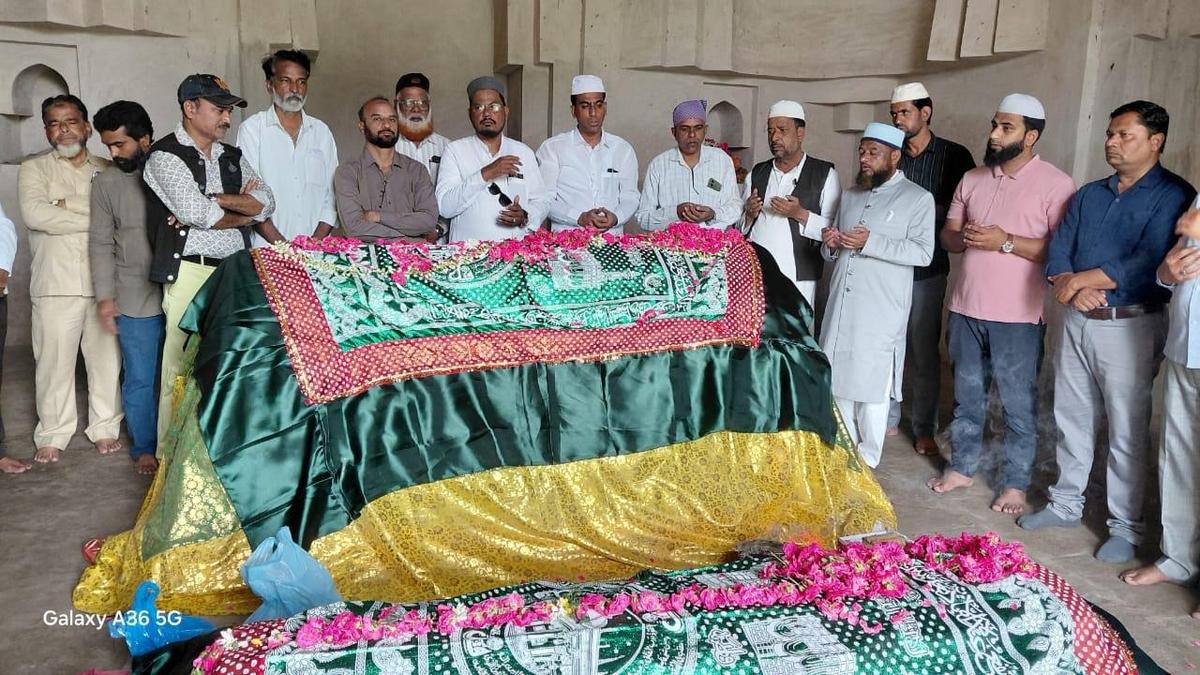
The 679th Foundation Day of the Bahmani Empire was observed at the tomb of Alauddin Hasan Bahman Shah, the founder and first ruler of the Sultanate, in Kalaburagi city on Monday.
The event, organised by the Bahmani Foundation, brought together historians, artists, intellectuals and social activists, who recalled the contributions of the Bahmani Sultanate to the cultural and architectural heritage of the region during its nearly two-century rule from 1347 to 1527 AD.
Speaking on the occasion, advocate Jabbar Gola said the Bahmani rulers played an important role in promoting art, culture and architecture, leaving behind a rich legacy reflected in the monuments and traditions of the region.
Bahmani Foundation president Qazi Rizwan-Ur-Rahman Siddique said the organisation has been commemorating the Foundation Day for several years through seminars, cultural programmes and competitions aimed at creating awareness among students about the history and heritage of the Bahmani period.
Artists Mohammed Ayazuddin Patel and Rehaman Patel, Numismatist Mohammad Ismail and others were present.
source: http://www.thehindu.com / The Hindu / Home> News> India> Karnataka / by The Hindu Bureau / August 18th, 2026
Researchers hope the government will act to protect the cannon at Gulbarga Fort
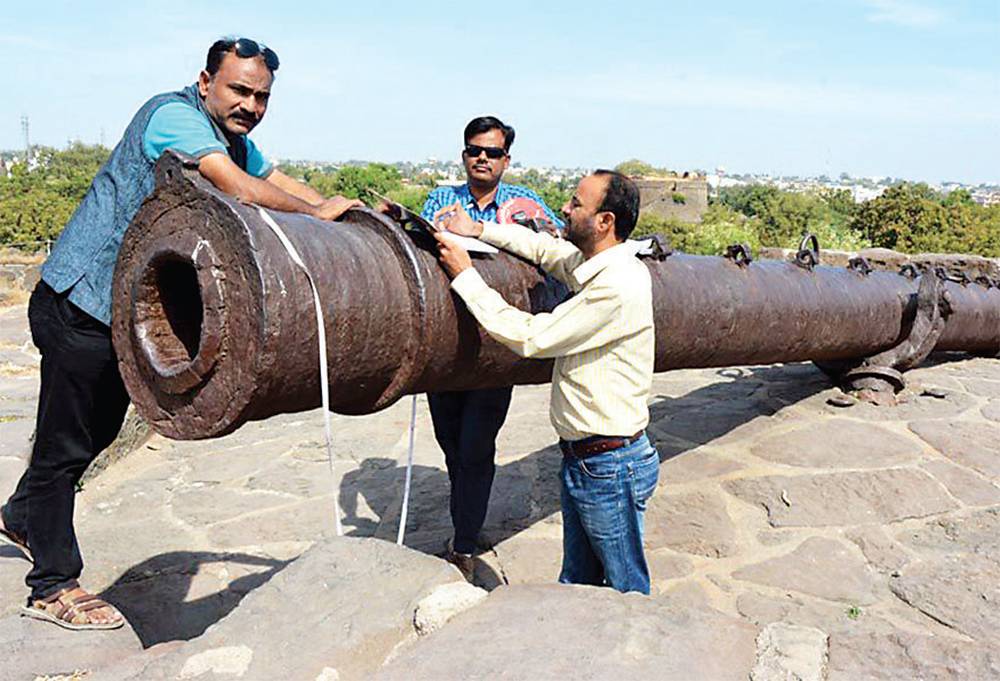
Mohammed Ayazuddin Patel, Dr Rehaman Patel and Mohammed Ismail measuring the Bara Gazi Toph
The three researchers, Mohammed Ayazuddin Patel, the national award winner, artist and photographer, Dr Rehaman Patel, artist and researcher at Indo-Islamic Art, Kalaburagi, and Mohammed Ismail, Bahmani researcher and coin collector who recently discovered a cannon in a fort in Kalaburagi, which they say is the longest in the world, are worried over its preservation.
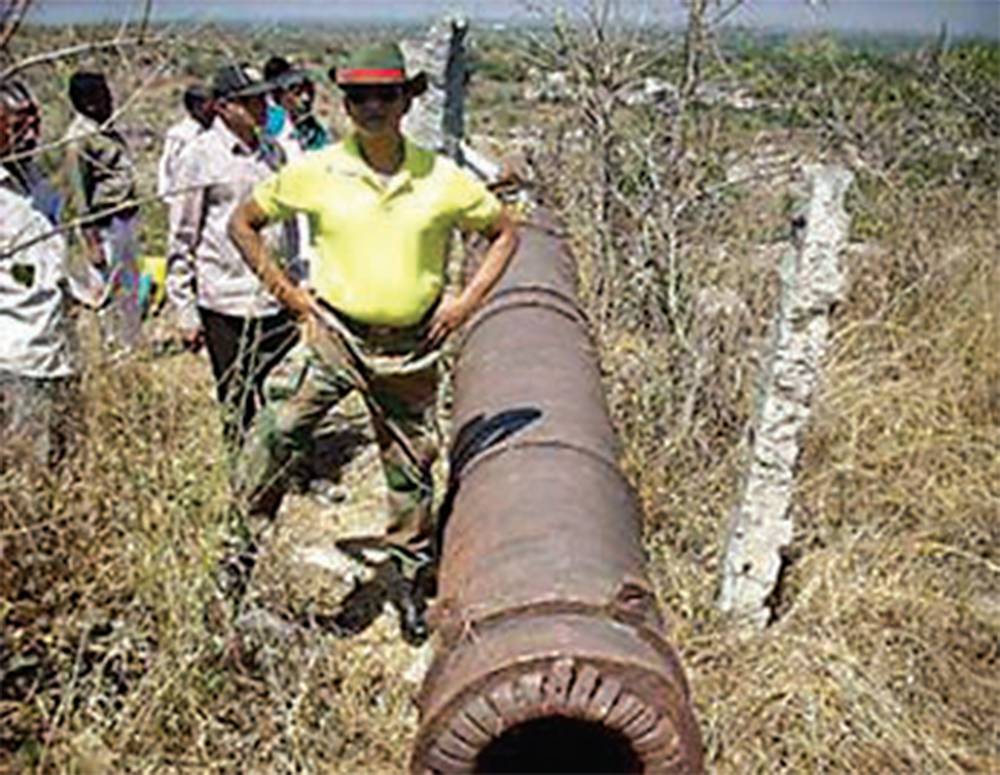
It was their visit to Gulbarga Fort in search of the name of the first Bahmani sultan, Alauddin Hasan Bahaman Shah among the Persian inscriptions on the Jama Masjid that led to its discovery. Speaking of the cannon to Bangalore Mirror, Mohammed Ayazuddin Patel said, “Since 2010, I have been researching on the subject. The existing world record is in the name of Tsar Cannon that is 17.5 feet long and was built in the 15th century in Russia. The cannon has been named in Guinness Book of World Records, when the fact remains that the top three longest cannons exist in India. It is a matter of pride for the people of Kalaburagi and the Hyderabad-Karnataka region that the longest cannon in the world is located in Bahmani Fort and was manufactured during the reign of Bahmani Empire in the 14th century. It is made of the alloy Panch dhatu.”
The cannon is known as Bara Gazi Toph and measures about 29 feet in length. Its circumference is 7.6 feet and diameter 2 feet. The barrel is 7-inch thick. In India, the largest recorded cannon is about 23 feet long and is located in Koulas Fort in Nizamabad district of Andhra Pradesh. Asaf Jah-1 (first Nizam) granted the Koulas Fort to the Rajput king Raja Kunwar Gopal Singh Gaur in 1724 AD for his bravery in the battle of Balapur and Shakkar Keda. The biggest cannon on wheels, built by Raja Mansingh, is in Jaipur and measures 20.6 feet in length.
“The Jaipur cannon weighs about 50 tonnes. We assume that the weight of the Kalaburagi cannon could be around 70-75 tonnes. While, the firing range of the Jaipur cannon is about 35 kilometres, that of Bara Gazi Toph could be 50-55 kilometres,” Ayazuddin Patel said.
The Bahmani monarchs, who ruled from the present Kalaburagi (Ahasnabad), stand out among other rulers for their contribution to the city. The founder Alauddin Hasan Bahaman Shah (1347-1422) made Gulbarga the capital and before his death he became the master of a vast empire. Even as they extended their territory, the rulers made significant contribution to the fields of art, architecture and literature.
The Bahmani sultanate was the first independent Islamic state of the Deccan in South India and one of the larger medieval Indian kingdoms. They ruled for 191 years (1347-1538 AD). Their other capital was Bidar.
The Gulbarga Fort was significantly expanded in 1347 by Alauddin Hasan Bahmani after he cut off ties with the Delhi sultanate. Islamic monuments such as mosques,
palaces, tombs, and other structures were also built later within the refurbished fort. The Jama Masjid built within the fort in 1367, is a unique structure of Persian architectural. It is fully enclosed, and has elegant domes and arched columns, which is unlike any other mosque in India.
The biggest challenge about historic monuments in the state is their protection, a fact not going to be any easy with the region being a backward area. “The Archaeologi-cal Survey of India and state archaeology department should take steps to protect the cannon at the Bahmani Fort and it should be included in the world record list. It should be fenced. The cannon is filled with sand and pebbles, so should be properly cleaned. Also, a signboard stating its details as the longest cannon in the world is a must. The fort and Jama Masjid must be declared heritage centres,” added Ayazuddin.
The team submitted a memorandum with their pleas to the district in-charge minister Sharan-prakash Patil, the deputy commissioner, regional commissioner, as well as the departments concerned.
GIGANTIC CANNONS OF THE WORLD
Jagadamba Bhavani Tope: Located at the historic Koulas Fort in Andhra Pradesh is believed to be the largest cannon in the world. The cannon (left), which is 23 feet in length and weighs 70 tonnes, is predominantly made of iron. It has a 16-inch calibre with an explosive head of 150 kg.
Jaivana: Recorded as the world’s largest cannon on wheels, Jaivana was manufactured during the reign of Maharaja Sawai Jai Singh II (1699–1743) at a foundry in Jaipur, Rajasthan. Jaivana’s barrel measures 20.19 feet in length and 11 inches in diameter. The 50-tonne cannon is mounted on four wheels. The rear wheels are mounted on roller pin bearings, to turn it 360° and fire in any direction. It was designed to fire a 50 kg cannon ball to a distance of 35 km. This cannon was never used in any battle as the Rajput rulers of Amber had friendly relations with the Mughals.
source: http://www.bangaloremirror.indiatimes.com / Bangalore Mirror / Home> News> State / by Deepthi Sanjiv, Bangalore Mirror Bureau / December 28th, 2016