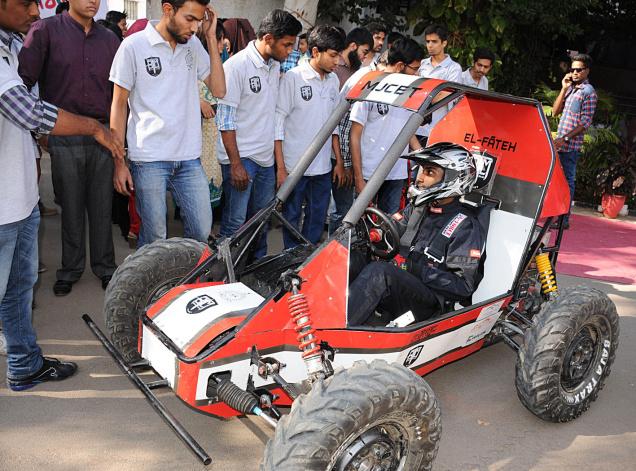
It is a proud moment for Perminder and Sadiq, the two youngsters. Following the scooping of the award by them they are getting praises from their school and others.
Principal of D.A.V. Jasola Vihar Dr. V.K. Barthawal congratulated the winners and wished them luck.
Earlier, the school announced: “Students of D.A.V. Jasola Vihar bagged third position at the Kailash Confluence that was organised by D.A.V. Kailash Hills on August 18.
The young scientist of D.A.V. Jasola Vihar competed with the students from 18 schools. With their excellent performance, the dynamic duo cleared all the three rounds enthusiastically.”
source: http://www.okhlatimes.com / Okhla Times / Home> Local> Okhla Times Reporter, Okhla / OT Aug 20th, 2015
Wipro founder Azim Premji makes it to the tech billionaire’s list
Washington :
Two Indian tech tycoons,Wipro chairman AzimPremji and HCL co-founder Shiv Nadar are in the Forbes’ first-ever list of the 100 richest people in the technology field, dominated by Americans with Microsoft founder Bill Gates at the top.
Two Indian-Americans tech czars, Romesh Wadhwani, CEO and chairman of Symphony Technology Group, and Bharat Desai, co-founder of IT consulting and outsourcing company Syntel also figure on the list released last week.
Premji, 70, with a net worth of $17.4 billion is ranked 13th on the list followed by Shiv Nadar, 70, in the 14th spot with $14.4 billion.
Wadhwani, 67, is ranked 73rd with a net worth of $2.8 billion while Desai, 62, with $2.5 billion is in the 82nd spot.
Premji’s Wipro, India’s third-largest outsourcer, reported a 10 percent rise in revenues to $1.9 billion in the last quarter, on the back of new business from clients such as ABB and Philip Morris, the magazine noted.
Nadar, Forbes noted, has diversified into healthcare with HCL Avitas, a new firm in partnership with John Hopkins Medicine International, which has opened 10 clinics in Delhi.
Wadhwani has a degree in electrical engineering from the Indian Institute of Technology and a PhD from Carnegie Mellon. His Symphony Technology Group is a collection of 20 companies spanning big data, analytics and software.
Syntel, co-founded by Desai and his wife Neerja Sethi, now generates over $900 million in revenue, has a market cap of over $3 billion and more than 24,500 employees across the globe.
While 51 American billionaires are on the list, tech barons from Asia made a strong showing as well, with 33 people hailing from that region. Forty of the 100 live in California.
Bill Gates, who’s also the world’s richest man, ranks number one among tech tycoons, with a net worth of $79.6 billion.
Number two on the list is Larry Ellison, founder of database software firm Oracle, with a net worth estimated at $50 billion.
The third richest on the list is Jeff Bezos with a net worth of $47.8 billion followed by Facebook founder Mark Zuckerberg in the fourth place with $41.2 billion.
Google co-founders Larry Page and Sergey Brin are ranked fifth and sixth respectively.
Altogether, the world’s 100 richest tech billionaires are worth $842.9 billion.
Just seven women made the list, the wealthiest of whom is Laurene Powell Jobs, the widow of Steve Jobs, with an estimated net worth of $21.4 billion.
Nearly all of the 100 are self-made billionaires: 94 made their own luck, 3 inherited their fortunes, and 3 have inherited fortunes but have been actively expanding them.
source : http://www.timesofindia.indiatimes.com / The Times of India / News Home> NRI> US & Canada News / IANS / August 13th, 2015
Syed Usman Taqui of Mysuru has been awarded Erasmus Mundus Fellowship amounting to 1,29,900 Euros (almost equivalent to rupees one crore) to pursue his Doctoral Programme in Membrane Engineering for a period of three years beginning November 2015.
He is the youngest to top the Global Ranking List. The Erasmus Mundus doctorate in Membrane Engineering (EUDIME) is a prestigious European Fellowship programme designed to implement at international level — excellence, innovation, mobility and multidisciplinary in investigation approaches related to membrane science and technology. The consortium includes six leading partner institutions from Portugal, Netherlands, Czech Republic, France, Belgium and Italy.
Syed Usman Taqui pursued his Master Degree in Membrane Engineering under the Erasmus Mundus Master’s Scholarship amounting to 48,000 euros (rupees thirty-four lakh) during 2012-14, then the youngest to be selected among fourteen from all over the world.
Usman’s elder brother Syed Raihan Taqui was the youngest and one among the three from Asia to be awarded Erasmus Mundus Scholarship from European Union to pursue his Master’s Degree majoring in Education Management in 2007.
Usman Taqui is the son of Ayesha Nasreen and Prof. Syed Akheel Ahmed, former VC of Yenepoya University and former Dean and Syndicate Member of University of Mysore.
Usman carried out his project at the Department of Chemical Engineering Technology (IIT), Mumbai, during his undergraduate days. He has bagged numerous prizes and awards from the institutions he studied.
source: http://www.starofmysore.com / Star of Mysore / Home> General News / Saturday – August 08th, 2015
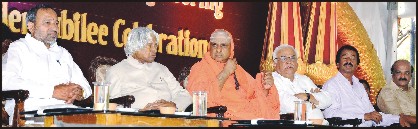
Here we publish the full text of the convocation address delivered by Dr. A.P.J. Abdul Kalam, the then Scientific Adviser to Raksha Mantri and Secretary, Department of Defence, Research & Development, at the 75th Convocation of University of Mysore on Feb. 25, 1995. — Ed.
Dr. A.P.J Abdul Kalam (second from right) seen with the then Governor-Chancellor Khurshed Alam Khan, the then Higher Education Minister and Pro-Chancellor D. Manjunath and the then Vice-Chancellor Prof. M. Madaiah during the 75th Convocation of University of Mysore on Feb.25, 1995.
by Dr. A.P.J Abdul Kalam
Dare to Dream: I am indeed delighted and honoured to participate in this 75th Convocation of University of Mysore. I have been thinking about what to share with you on this important occasion when you are entering the most eventful phase of your life after years of learning. I know that for the past twenty-years or so you have been continuously taught various aspects by teachers. I am, therefore, not going to extend this process. Instead, I would like to share with you a few of my experiences, one at a place very close to you and others at Trivandrum and Hyderabad.
These are the experiences where people have dared to dream and met with success. Of course, we have to recognise that success is always the result of sweat of individuals and also coupled with many failures. The place close to you is the site of pilgrimage not only for me but for every one who practices rocketry in our country. Let me first tell you something about this.
First War Rocket: When I was studying in school and college, Srirangapatna interested me for two reasons — the place was the scene of battle against foreign rule and also there was a reference to a new weapon introduced. In 1960, when I visited Srirangapatna with my friends, we were thrilled to walk around this historical town. We searched for the Turukhan-hally Fort built during Hyder Ali – Tipu Sultan times and used for making rockets, way back in 1794. I had a tremendous disappointment when I did not see any permanent evidence or historical recordings in Srirangapatna regarding creation or development of first war rocket in the world.
Later, in 1963, I was at Wallop’s Island, the rocket launch facility of NASA in USA, in connection with a collaborative programme of launching of sounding meteorological rockets for research of upper atmosphere. In the lobby of their command-control centre, I saw a prominently displayed picture. The war dress and the colour of the soldiers’ skin attracted my attention. Some dark complexioned soldiers were firing rockets on their white skinned opponents. The label on the painting read, “The world’s first war rocket.” It was indeed a great pleasure to see an Indian feat acknowledged on the other side of the planet. I felt excited with happiness.
I started reading the history of rockets. I had a dream I must see Tipu’s rockets. Time continued to pass. Rocket technology engulfed me and India’s first Satellite Launch Vehicle SLV-3 was launched. In 1980, we had an opportunity to visit London. There, I saw two of the war rockets captured by British at Srirangapatna, displayed at Museum of Artillery at Woolwich in London with the heading “India’s War Rocket.” Probably, Europe learnt rocketry from our Srirangapatna rocket in the eighteenth century! It was a great thrill to see an Indian innovation on a foreign soil, well-preserved and with facts not distorted.
I got the performance of these 2 kg rockets, 50 mm in dia. and about 250 mm in length analysed by our designers. What a simple and elegant design, effectively used in war ! Surely, Hyder – Tipu Sultan would have had talented men who could look at propulsion, material, ignition and build rockets and fly them for war operations. In fact, when we look back to eighteenth century ambience, it is a technology marvel.
I would like to declare today that this land is the birth place of war rockets in the world and offer it my reverence and respect. The tradition continues.
Prof. Vikram Sarabhai – Man of Vision: Nations advance along the course charted by great dreamers. Let me narrate to you an incidence which occurred in 1968. We were working on the configuration of India’s satellite launch vehicle in Thumba. One day, Prof. Vikram Sarabhai, the then Chairman, Indian Space Research Organisation (ISRO), brought Prof. Curien, President, CNES, France, to our laboratory. France was developing Diamont satellite launch vehicles at that time. After focussing on our planned efforts, as an almost spontaneous reaction, Prof. Sarabhai proposed that we should fly India’s fourth stage of SLV-3 as the Diamont’s fourth stage. We had not flown even a meteorological rocket by that time, but Prof. Sarabhai was aware of the possibilities and trusted the capabilities of his team. His dream of SLV-3 fourth stage getting into a French launch vehicle finally came true in the form of apogee boost motor for APPLE satellite, flown by ARI
ANE, the European launch vehicle. This is the vision ! He gave us a 15-year jump in our efforts. With three experimental Indian Remote Sensing (IRS) Satellites in orbit and their images being received in the USA, Satellite Ground Stations with Indian Satellite Launch Vehicle PSLV launching our own satellite from our own land, his dream visualised in 1965 has taken form through the people born at different times. Nations are thus built by men of vision who dream and prepare ground for the coming generations.
Super Computer and Parallel Processing: In 1986, Dr. V.S. Arunachalam and myself went to US to buy a Super Computer with 400 mega flop speed. The Deputy Secretary in the Department of Defence at Pentagon first put us into long series of technical discussions and then regretted the sale on the pretext that we will use it to develop long range missiles detrimental to the security interests of the world. Travelling back disappointed, Dr. Arunachalam said, “Let us make our own Super Computer.” Today, India has a 32 node 1000 M Flops PACE SPARC 10 machine available for other countries to buy. Once we decide, we work and realise even tough dreams. That is what India expects from you.
A team of young scientists and engineers under the leadership of Dr.G.Venkataraman formed ANURAG, that is, Advanced Numerical Research and Analysis Group, to develop a parallel processing computer specially for aircraft design. At that time, AGNI also was taking shape. The payload of AGNI would re-enter the atmosphere at 15 times the speed of sound. Even at this speed, we had to keep the vehicle under control and while the payload outer temperature goes to 3000 degrees centigrade, inside of payload the ambient has to be less than 30 degrees centigrade. We have in India supersonic wind tunnel. We needed hypersonic wind tunnel for designing the AGNI payload. Various wind tunnel data could provide the loads experienced during the re-entry phase of the system. There were tunnels abroad but once they knew the application, they were refused.
This time our high-tech academic institutions rose to the occasion. Prof. S.M. Deshpande of Indian Institute of Science (IISc.) with five young bright fresh scientists from DRDL with background of mathematics and fluid dynamics, developed Computational Fluid Dynamics Software for Hypersonic Regimes in just six months. This software is the original contribution with minimum computational facility available in the world. No country would have given us this type of software. But it was done through optimum partitioning, sequencing and paralleling the task. This software solution has established that brain-power excels man-made machines, even super-computers.
I have seen that India can build her own super-computer; India can fly its own rocket system within and outside the country. Both the dreams have come out of visions. This convocation ambience, where hundreds of young graduates are entering their professional lives, is ideal for thinking about the need of visions for the next two decades. What could they be?
Vision for the Nation: With the growing population, increasing unemployment, unaffordable medical care and changing value system, our society is going through certain turbulent situation. The society looks forward to prosperity. In a decade or two, prosperity and good life is possible if the nation has the vision. Vision generates progress. As an example, we can study the period between 1857 and 1947; it was the vision of freedom which not only got us independence but during the same period in India, vision of independence generated many leaders of excellence in politics, philosophy, history, science and technology and industry. Again, can we dream for a vision to make this nation great — a nation with prosperity and peace?
Enlightened Citizens: The vision of “Enlightened Citizens” calls for a mission of integrating education, occupation and health care as one single entity. For development of self, society and nation, it is essential that hundreds of clusters of villages are divided into multiple blocks of 20,000 families. And each block can be considered as a progress group with certain number of hospitals, schools and agriculture farms which could be growing cash crops, aromatic plants or fish farms.
The experience in Kerala and Tamil Nadu indicates that integration of education and occupation resulted in small families, in addition to promoting self- sustained good life. This enlightened citizen package can be extended to the whole country.
Networking of Major Rivers: We recently conducted a workshop on the subject based on Dr. K.L. Rao’s report “National Water Grid” and Capt. Dastur’s proposal of “Garland Canal.” This has all the dimensions of becoming an important vision for the nation. Nation can aim at linking multiple rivers resulting in water distribution, flood and drought control, navigation and power generation.
Above all, this will bring together the country as it happened during the independence movement, with potential revolution in agricultural output and employment generation. Experts have indicated that this is the right time to take this as a major programme as technology exists today and the country has the capability to finance such a programme.
Today we have: satellite mapping of water resources and river flow aspects; capability to use nuclear energy for large tunnelling in mountains to direct the river flows and technological strength in mechanical, civil and communication engineering. It may be a 20-year programme for the nation.
Energy Everywhere: Similarly, the third area is “Energy Everywhere.” We believe by year 2000-plus, we will have to generate almost 50% more power. Probably, we will have to look for environment clean power. In addition to hydro and thermal energy, the non-conventional energy and nuclear energy has to contribute to power generation for which technological innovation is essential. Even hydro and thermal energy would need newer technologies so that they can provide affordable electrical energy.
Conclusion: Friends! Vision for the nation is in front of you. These dreams are bigger than the individual or group of people. Great things do not just occur; you have to dream about them and work to realise them. You can be a partner to the visions for the country and begin to experience dreams coming true. What you are is God’s gift to you. What you make out of yourself will be your gift to God. I wish you a challenging profession in your respective fields and recall the famous lines:
“The chances have just begun
The best jobs haven’t been started,
the best work hasn’t been done.”
source: http://www.starofmysore.com / Star of Mysore / Home> Feature Articles / Saturday – August 01st, 2015
Describing him as one of the most “exuberant boosters” of India’s nuclear capabilities, the US media on Tuesday highlighted the contribution of ‘missile man’ A P J Abdul Kalam to the country’s atomic and space programme.
Kalam, who would have turned 84 in October died after suffering a massive cardiac arrest during a lecture at the IIM Shillong on Monday, plunging his country into overwhelming grief.
Describing him as one of the most “exuberant boosters” of India’s nuclear capabilities, the US media on Tuesday highlighted the contribution of ‘missile man’ A P J Abdul Kalam to the country’s atomic and space programme.
“He was one of the most exuberant boosters of the country’s nuclear program,” The New York Times wrote in a rare obituary for Kalam.
“He used the spotlight to urge India to build up its military strength and to free itself from the threat of domination by outside forces,” the daily said.
The Times said that Kalam spent little time outside India. “For him, it was a point of pride that India had developed its bomb without much help from foreign powers. And he described himself as thoroughly Indian,” it said.
Kalam has been credited with helping develop his country’s first space satellites. In the 1980s, he helped design the nuclear-capable ‘Prithvi’ and ‘Agni’ ballistic missiles, The Washington Post said.
“He played a crucial role when India tested its nuclear weapons in 1998. The test resulted in sanctions against the country but helped elevate Mr Kalam to the status of folk hero in his country,” the Post said in its obituary.
The Wall Street Journal reported that Kalam, who was born into a poor Muslim family in Tamil Nadu, was at the forefront of the country’s efforts to develop a space programme and a strong advocate for India’s self-reliance in defence technologies.
“He encouraged the development of India’s first indigenous satellite launch vehicle that brought the country into an elite club of space-faring nations and guided India’s missile-development programme,” the daily said.
“Dr. Kalam also played a key role in boosting India’s nuclear capabilities, leading to nuclear tests in 1998, a technological achievement seen as pivotal in asserting the country’s place in global politics,” the WSJ said.
“He was the first scientist to hold the office, and was widely viewed as an apolitical figure,” the CNN said.
source: http://www.ibnlive.com / IBN LIVE / IBN Live> World / Press Trust of India / July 28th, 2015
At this non-descript place hidden in the chaotic Kalasipalyam, Mysore ruler Tipu Sultan had stacked his ammunition cache. The 200-year-old armoury of Tipu Sultan behind Bangalore Medical College, which till now was treated like nobody’s baby, will soon be taken over by the Archaeological Survey of India (ASI) and declared a protected monument.
Fort, Palace and Armoury are within 100 metre distance from one another. The ASI has identified Fort and Palace as protected monuments. With armoury being taken over, it will be the third ASI protected monument in the city
It will be the third ASI-listed protected monument in the city after Tipu’s Palace and Tipu’s Fort, all situated near KR Market.
The three monuments – armoury, palace and fort – are situated within a 100 metres of each other. Commissioner, state department of archaeology, museums and heritage, C G Betsurmath wrote to ASI approving the takeover about three weeks ago.
For several years now, the armoury has been in news, albeit for wrong reasons. Lack of upkeep resulting in condition of the structure deteriorating; the unkempt place turning into a gamblers’ den; the state archaeology department and BBMP passing on the buck of responsibility to each other, and so on. Only in 2002, it was, that the 18th century armoury saw some conservation by Indian National Trust for Art and Cultural Heritage (Intach), Bangalore Chapter. The not-for-profit non-governmental organisation shifted a retaining wall and exposed the original steps leading to the monument after removing the compound wall. A toilet illegally built on the southern wall of the structure was also removed.
Of the recent development, Arun Raj T, superintending archaeologist, ASI, Bengaluru circle told Bangalore Mirror: “The state government wrote to us saying they have no objections in ASI taking over Tipu’s Armoury. It is good news and a result of continuous effort of Intach. This is the first step and we have a process to follow. We will have to write to our Delhi office and complete some formalities with the Bruhut Bengaluru Mahanagara Palike. Given the historical importance, it is necessary to protect the armoury and connect the three monuments (fort, palace and armoury) as these three are remnants in the city that date back to Tipu’s period.”
However, there is a small hitch – a school building adjacent to the armoury. ASI and BBMP will have to conduct a joint survey of the place and find a solution. “The school almost abuts the armoury and once the armoury is declared a protected area, the school will have to be vacated considering that a buffer has to be maintained around our monuments. In that case, we would need BBMP’s help in relocating the school,” added Arun Raj.
Intach, Bangalore Chapter, which has campaigned for the armoury is overjoyed. In fact, a month ago, Intach had written to BBMP suggesting that they hand over the armoury to ASI. “ Once it is declared a protected monument, there will be no threat to the armoury in terms of encroachment and will be well maintained. We have been pushing for this for a long time and finally, the move has come through,” said Meera Iyer, co-convener of Intach.
History has it that this armoury was built below the ground level to store ammunition and the structure style is so relevant that it still being followed by the army. Armoury also called magazine is always built below the ground level, has just one entrance and is not exposed to the outside world by growing grass on the exteriors.
According to historian Suresh Moona who has chronicled the city’s history, this armoury in Kalasipalyam housed missiles and ammunitions and in a nearby area, Taramandalpet, rockets were experimented. Taramandalpet is close to Jumma Masjid Road near Raja Market where Tipu’s missile manufacturing unit functioned. Every night, rockets would be fired, which looked like a cluster of stars in the sky – hence the name Taramandalpet.
Pride of the city
» Under ASI Bangalore Circle of ASI, there are 207 monuments.
» In Bengaluru, there are two ASI-listed monuments – Tipu Fort and Tipu Palace; Bengaluru district houses six monuments including the fort at Devanahalli and Hunting Lodge on Nandi Hills.
» Monuments in Hampi are the most well-known; Tipu’s properties in Srirangapatna have also become popular tourist attractions.
source: http://www.bangaloremirror.com / Bangalore Mirror / Home> Bangalore> Others / by Kushala S, Bangalore Mirror Bureau / July 30th, 2015
On April 23, 1976, when Daisy D’Costa was wheeled into the operation theatre she didn’t know she would be the first woman in the country to undergo a bypass surgery. “No one told me. I just vaguely recall someone in surgical scrubs telling my husband, ‘She will live’,” said the octogenarian, 39 years later.
While Daisy was being prepared for the surgery, the mood in the operation theatre was equally tense as the team was about to wield the scalpel for a procedure they had done just once before. “The facilities back then were nothing like what we have now. We had no cath lab (examination room with diagnostic imaging equipment), no cardiologist or cardio-anesthetist. No one in the team had done a bypass surgery before,” said Dr K M Cherian, the doctor in the surgical scrubs who assured Daisy’s husband.
Daisy had been brought to the Railway Hospital in Perambur the previous evening with total blockage in an artery. “I had skipped going to the cinema with my husband as I was really tired. All of a sudden, I couldn’t breathe normally and I felt a tightness in my chest. My son, who was at home, rushed me to the nearest hospital,” recalled Daisy. “The doctors managed to resuscitate me. In my haze, I heard someone say, ‘We need to cut her open’, and I blacked out again.”
Daisy needed a coronary artery bypass surgery. The procedure entailed restoring the blood flow to the heart muscle by diverting the blood around the blocked section by using a harvested vein from the leg. Although the first such surgery was performed in the US in the 60′s, the concept was new in India. In June 1975, Kajah Mohideen, a 42-year-old engineer from Integral Coach Factory, became the first in the country to undergo the surgery.
“The procedure on Daisy was no different from Kajah’s, but Daisy’s veins in her legs were thinner and harder to reach because of the fat. Besides that, we followed the same process. I still remember every conversation and the mood in the theatre,” says Dr Cherian, who had also operated on Kajah. “We didn’t even have a process of magnifying the blood vessels, which is mandatory now. I used my eyes to find the vessels that are 1.5 to 2mm. I was young back then,” said Dr Cherian, chuckling. The procedure took a little more than three hours.
Daisy woke up to find shutterbugs queuing to interview her. “That’s when I realised I was the first woman,” she said, smiling and showing a sepia-tinted newspaper showing a younger version of her. Although through the years she has had minor chest problems, she didn’t have to go under the scalpel again.
source: http://www.timesofindia.indiatimes.com / The Times of India / Home> City> Chennai / by Ekatha Ann John, TNN / July 09th, 2015
Aligarh Muslim University Scholar, Dr Nuzhat Parveen has received ‘Young Scientist Research Fellowship’ with a research grant of Rs 32, 79,000 awarded by Science and Engineering Research Board (SERB), Ministry of Science and Technology, Govt. of India.
She will work on Nanotoxicology at Cytogenetics and Molecular Toxicology Laboratory, Section of Genetics, Department of Zoology, AMU, Aligarh.
Dr Parveen was awarded PhD and M phill degrees from AMU on topics entitled ‘Mitigation of the genomic instability caused by iron induced free radicals through some antioxidants in vivo’ and ‘Genotoxic effects of anti-malarial drugs on human chromosomes in vitro’ respectively under the supervision of Dr G G H A Shadab, Section of Genetics, Department of Zoology.
Earlier, Dr Parveen was awarded ‘Young Scientist Fellowship,’ by Council of Science and Technology, U P (CST-UP) with a research grant of Rs 10, 80,000.
She has participated in 26 National and International conferences and presented 9 papers (3 oral and 6 posters). She has also attended several workshops and hand-on trainings on several latest aspects related with her research. She has published 13 research papers in the peer-reviewed journals of National and International repute and 5 chapters in book.
Dr Parveen is also a life member of Indian Society of Cell Biology and Indian Science Congress Association.
source: http://www.aapkatimes.com / Aapka Times , News Express of India / by Admin / July 03rd, 2015
Alumnus of the Aligarh Muslim University, Syed Ali Jafar wins Blavatnik National Award for Young Scientists
Aligarh, UP:
AMU Alumnus Wins Blavatnik National Award for Young Scientists on 4th July, 2015. An alumnus of the Aligarh Muslim University, Syed Ali Jafar, a computer scientist at the University of California Irvine (UCI), USA, who has changed the world’s understanding of the capacity of wireless networks, has won the 2015 Blavatnik National Award for Young Scientists in physical sciences and engineering. One of the three winners chosen from amongst 300 candidates from highly ranked American universities and research institutions, Jafar will receive a $250,000 unrestricted cash prize and a medal in September at New York’s Museum of Natural History.
“I am incredibly honored and humbled to be recognized on the national stage – from such an amazing cohort of extremely accomplished finalists – by such an illustrious jury of the nation’s most distinguished scientists,” Jafar said. “I am deeply indebted to my brilliant students and collaborators, who are my true miracle workers. It is my hope that this recognition will lead to broader exposure to and appreciation of both the beauty of information theory and the tremendous impact it has on our lives. It’s also a ‘shot in the arm’ for me to continue taking on challenging problems in our research group.”
A professor of electrical engineering & computer science, Jafar explores the fundamental performance limits of wireless communication networks. Determining network capacity – the maximum data rates that can be reliably supported – is the holy grail of network information theory, according to Jafar and others. And with the rapid growth of wireless communication networks, the quest has taken on unprecedented urgency. Jafar’s research group has gained worldwide recognition for its numerous seminal contributions to this topic, including its groundbreaking work on interference alignment in wireless networks. This research found that data rates are not limited by the number of devices sharing the radio frequency spectrum, a discovery that changed the thinking about how wireless networks should be designed.
“Syed Jafar revolutionized our understanding of the capacity limits of wireless networks. He demonstrated that each user in a wireless network can access half the spectrum without interference from other users, regardless of how many are sharing the spectrum,” said one of the judges, Paul Horn, senior vice provost for research at New York University. “This is a truly remarkable result that has a tremendous impact on both information theory and the design of wireless networks.”
Jafar became interested in science in high school. “Einstein’s E=mc2 captured my imagination,” he said. The equation made him wonder about how something so profound could be so simple and beautiful – and it became his lifelong dream to pursue beauty through science. As a graduate student studying information theory at the California Institute of Technology, Jafar found similar elegance in the formula describing the capacity of an information channel. He realized that much about the capacity of communication networks was still unknown and made it his life’s work to solve the mystery.
The Blavatnik National Awards for Young Scientists program, established by the Blavatnik Family Foundation with the guidance of the New York Academy of Sciences, recognizes America’s most innovative and promising young faculty scientists and engineers. The organization’s judges include Nobel laureates, National Academy of Sciences members and National Medal of Science recipients. They select three laureates annually, one each in life sciences, chemistry, and physical sciences & engineering.
Jafar earned a B.Tech. at the Indian Institute of Technology in Delhi, an M.S. at Caltech and a Ph.D. at Stanford University, all in electrical engineering. He’s a fellow of the Institute of Electrical & Electronics Engineers, and he recently received the UCI Academic Senate’s Distinguished Mid-Career Faculty Award for Research. Jafar was also recognized as a Thomson Reuters Highly Cited Researcher and included by ScienceWatch among the World’s Most Influential Scientific Minds in 2014.
Syed Jafar grew up in Aligarh, a city that is home to the Aligarh Muslim University. His father, late Prof. Syed Jafar Raza Zaidi and mother, Dr. Shabnam Zaidi, were both university professors, in the departments of Hindi and English at the AMU, respectively. Syed Jafar finished his secondary school examination at AMU’s STS High School (Minto Circle) in 1991, and the senior secondary exam in 1993. As the University topper in AMU’s senior secondary exam he received the University Gold Medal.
The University of California, Irvine is currently celebrating its 50th anniversary. UCI is the youngest member of the prestigious Association of American Universities. The campus has produced three Nobel laureates and is known for its academic achievement, premier research, innovation and anteater mascot. Led by Chancellor Howard Gillman, UCI has more than 30,000 students and offers 192 degree programs.
Professor Sayeedul Hasan Arif, Department of Pathology, J N Medical College with his colleagues, Dr Kafeel Akhtar, Associate professor Department of Pathology and Senior Residents Dr Shagufta Qadri and Dr Suhailur Rahman has been conferred prestigious William Harvey Award 2015 in Haematology for his paper published in The Journal of Haematology.
The research has a rare case study of Haemaglobinopathy in Aligarh. The paper shows a seven-year-old male child suffering from Haemoglobin C (Hb C) trait.
The case study patient is suffering from Mixed Type of Nutritional Anaemia but despite the treatment, the anaemia is not corrected so the electrophoresis was advised and final diagnosis was made.
Hb C disease is common in West African and Mediterranean countries and big parts of North America. It is so far, rare in Indian subcontinent and Asia.
Prof Arif’s journal is published by Photon Foundation along with other journals of ‘Medical Specialty’ and ‘Super Specialty’ from USA.
After completing MD in pathology in 1991, Prof Arif joined the Department of Pathology, J N Medical College as demonstrator. In 1995, Prof Arif was appointed Lecturer in the Department of Pathology. He was promoted to the post of a Reader in 2004, joining as an Associate Professor in 2007. Since 2010, Prof Arif has been working as a Professor in the Department of Pathology.
Prof Arif also holds the posts of Blood Bank and Central Investigation Laboratory In-Charge. He was member of Medical Education Unit in Faculty of Medicine from 2009 to 2014 and served J N Medical College and Hospital in the capacity of DMS from 2011 to 2013.
Dr Arif’s subordinate in his award winning paper, Dr Kafil Akhtar, Associate Professor; Department of Pathology has special interests in Cytopathology, Hematology and Blood Banking subdivisions of Pathology. He has teaching experience of over 13 years in various topics of the subject. He is a regular contributor to journals of National and International repute.
While, Dr Shagufta Qadri who has also worked with Dr Arif on the award winning paper is a MBBS and MD in Pathology from J N Medical College. She is currently working as a Senior Resident in the Department of Pathology. With her focus on ‘Surgical pathology,’ she has special interest in Oncopathology. She is also experienced in various other subdivision of pathology as Cytopathology, Transfusion Medicine and Clinical pathology.
Another subordinate in the award winning paper, Dr Suhailur Rehman did his MBBS and MD Pathology from J N Medical College and is currently working as a Senior Resident in the Department of Pathology. With work experience in different fields of Histopathology, Cytopathology, Hematology, Transfusion Medicine, and Clinical Pathology, Dr Rehman has also gained experience of teaching Undergraduate and Postgraduate students.
source: http://www.okhlatimes.com / Okhla Times / Home> Dispatches / OTNS-AMU / July 08th, 2015