Category Archives: Science & Technology

Thumbay Group among Forbes ME ‘Top 100’ in Arab world

Ajman :

Thumbay Group has crossed another milestone today. Thumbay Group has been listed in “Top 100 making an impact in the Arab World”, a list compiled by Forbes Middle East Magazine in the May 2013 Issue 14. Rankings, awards, undoubtedly play an important role in recognizing an organization’s success. Thumbay Group, UAE ranks 44 in the list of “Top 100 Making An Impact In The Arab World”.

ThumbayMoideenMPOs12oct2014

Thumbay Group, UAE established in the year 1997 has come a long way. It has developed into a conglomerate having multifarious business activities and operations spread across the globe. The Thumbay Group, UAE today is a leading conglomerate with a host of medical and healthcare institutions under its ambit. The Group encompasses Gulf Medical University, GMC Hospital and Research Centre, Gulf Medical Centre & GMC Pharmacies in Dubai, Sharjah, Ajman and Fujairah.

Gulf Medical University has a student cohort from 67 nationalities, majority of them are locals and Arabs from the GCC, medical professionals and staff from 22 countries. Patients from over 175 nationalities ranging as far as Africa, Iran, Afghanistan, Pakistan, GCC countries and Western Europe receive treatment at GMC Hospitals & Research Centre, a constituent private teaching university hospital with a capacity of 250 beds housed with ultra-modern facilities. The Group also owns and manages international chain of Health Clubs and Coffee Shoppe, Chain of GMC Diagnostic laboratories, Chain of Pharmacies, Chain of Optical Centres.

“In a short span of time we have worked our way to reach to this position today. I thank the Almighty God, the great leaders of this country, all our staff members for their continued support in achieving this proud status today. We have very big and ambitious plans and God willing with each and every immeasurable support we will be able to reach to the pinnacle of success one day” commented Thumbay Moideen, founder president of Thumbay Group, UAE.

source: http://www.daijiworld.com / DaijiWorld.com / Home> Gulf / Media Release / Ajman – May 22nd, 2013 / posted Wednesday – May 22nd, 2013
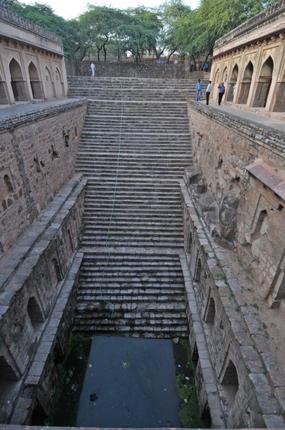
ASI revives three water bodies near Qutub Minar

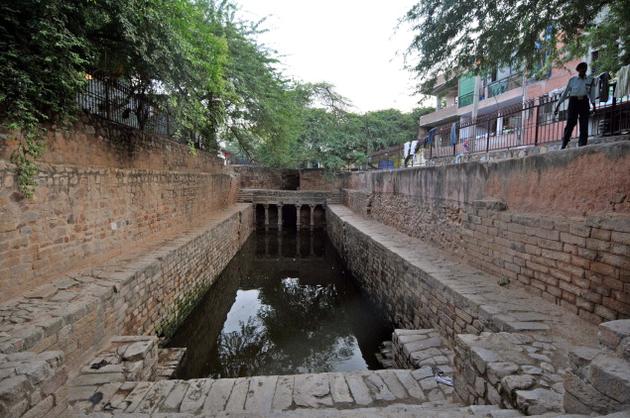
The 13th Century Gandhak ki Baoli. — PHOTOS: SUSHIL KUMAR VERMA

The Archaeological Survey of India (ASI) has revived three water bodies — Rajon ki Baoli, Gandhak ki Baoli, and Hauz-i-Shamsi or Shamsi talab — inside the Qutub premises.

All these baolis, except Shamsi talab, were nearly dry till recently. But for the last couple of months, the water level in these baolis has increased despite negligible rain this season.

“The more the level of water went down in Delhi, the water level in these baolis increased,” said an ASI representative, reasoning constant cleaning of these baolis, which till sometime ago were filled with mud and filth thrown by visitors and people living close by.

While water conservationists opined that the water level increased due to sealing of several borewells in the area, ASI representative argued that the same happened after the cleaning of the choked openings in the baolis, something even the locals agree with.

Ghulam Mohammad, an 80-year-old old resident of Mehrauli village, said: “Sumant Dogra of the ASI used to come here even when the temperature was nearly 49 degrees Celsius and get the baolis cleaned every day for past many months. Soon after the cleaning, we saw water gushing up despite the poor monsoon this year.”

A visit to all the baolis, however, reveals the careless attitude people have towards them.

The 13th Century Gandhak ki Baoli. — PHOTOS: SUSHIL KUMAR VERMA

The Rajon ki Baoli, which dates back to the 15 Century, “was chocked with 20 feet of filth — meaning two storeys of the baoli, leaving only the third or the last storey was visible. We got it cleared. It took us six months. Now the water level has come up to 20 feet. We had to stop intermittently due to lack of funds. We completed the cleaning, which the ASI started in 2004-05, in 2014.”

The baoli is filled with stagnant water covered with algae. One can reach it by climbing down nearly 60 stairs. The ASI official adds: “Visitors throw wrappers, packets and even spit in it. If we don’t clean it every day, the filth will reach 20 feet within a week.”

Gandak ki Baoli is located about 200 meters from this one. The water there “started rising two-three years ago. It now has about 40 feet of water,” he added.

Built in the 13 Century, the water in this baoli, as the name suggests, is mixed with Sulphur, which supposedly has medicinal qualities. Due to this, the locals bathe and wash their clothes in it.

When the reporter visited the spot, a man who has just finished washing his clothes was then seen urinating in the baoli, as a guard looked on helplessly. The ASI official, who comes here daily for inspection, said: “The locals use the baolis as their personal property. Vagabonds roam this area and it turns dangerous by the evening. If we ask them not to dirty the baoli, they take out knives in no time. Even the police is scared of them.”

The third water body or the Shamsi talab, is located in the middle of the Mehrauli market, most of which is unauthorised. The talab was once spread over a huge area, with a tomb in the centre. As the talab started shrinking due to lack of water, the tomb, which is still visible, has been relegated to a side. Water beyond it has dried up already. But “it now has 15 to 20 feet water,” the official adds.

The area around this talab remains unspoilt, filled with the chirps of thousands of birds. A reminder of what the baolis may have looked like in the past.

source: http://www.thehindu.com / The Hindu / Home> News> Cities> Delhi / by Rana Siddiqui Zaman / New Delhi – October 0th, 2014

Moolika Dasara series-3

Eat Mango – Keep your Heart Healthy

by Dr. Sathyanarayana Bhat , Principal, Government Ayurveda Medical College, Mysore

It is Dasara season. How can we remember Mango now? Don’t get surprised. I have seen at Cairns, Australia, a tree full of ripen mangoes during Dasara. Incidentally, Southern hemisphere mango trees yield fruits now. Further more, do you know a mango variety called dusseri!

Let us know more about cardio-protective effects of this divine fruit. Mangifera indica, the indigenous fruit of India, was found wild at Himalayas. Now, it is cultivated world over. In the list of heart tonic medicinal plants, mango occupies first place.

The ripen fruits are not only attractive to look but also good to eat. Amrapali, is a Buddhist site, where mango cultivation was prominent. Kalidasa describes mango flowering and fruiting in his many works. Moghul King Akbar planted over one lakh mango saplings at Lakhibagh, Dhrabanga, North Bihar. Mavalli at Bangalore was mango grove of Hyder Ali times. Even Mysore Wadiyar Dynasty has planted mango trees during Nalvadi Krishnaraja, in pre Independence era.

Every part of this tree is medicinal. Flowers, young leaf, tender, unripe and ripen fruit is used in different forms both for culinary and medicinal uses. Kernel is best in bleeding disorders and diarrhoea. Many diabetics are hesitant in using mango. Ayurveda texts encourage use of mango tree bark and seed kernel to reduce sugar levels in Diabetes. Mangiferin, an active ingredient in mango leaf is a very effective antiviral drug. Particularly it is very effective against herpes, both locally and orally. Regular use of the ripe mango can keep away chronic constipation, both in diabetic as well as cardiac patients.

Anti oxidant properties of mango is evident. Therefore regular use of the fruit can keep you and your heart young.

[Dr. Sathyanarayana Bhat can be contacted on Ph:0821-2444701 or Mob:91-09448081005 or email:sathyanarayana.bhat@gmail.com]

NOTE: Moolika Dasara Expo is being held at Chandravana, a garden of medicinal plants maintained by Government Ayurveda Medical College and Hospital, Mysore, near Kukkarahalli Lake on Bogadi Road. It will be open to public till Sept. 30 between 9 am and 6.30 pm.

source: http://www.starofmysore.com / Star of Mysore / Home> Feature Articles  / Saturday  , September 27th,  2014

Activate your ‘bars’

Ruby Mehmood
Ruby Mehmood

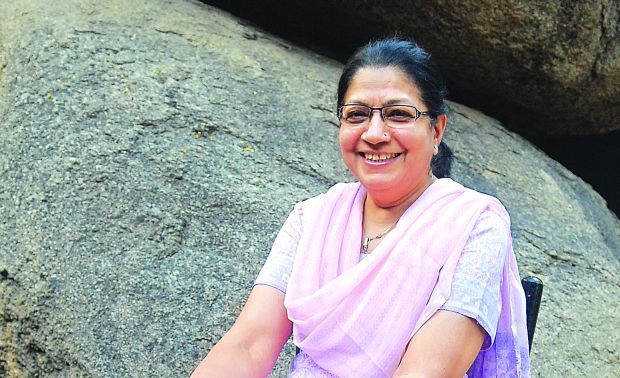
Never judge yourself or others, because that hinders your well-being and even weakens your immune system. It’s a fact and science acknowledges it. This was what Ruby Mehmood’s recent talk at Lamakaan was all about. She was explaining a healing process called “Access Consciousness” and its basic component – “Bars”.

What are Bars?
There are 32 bars of energy that run through and around our heads, storing the electromagnetic component of all thoughts, ideas, attitudes, decisions and beliefs that we have ever had. There are thus bars for healing, body, control, awareness, creativity, power, aging, sex, money, etc.
Activate the Bars
This is what Ruby does as a bars practitioner and facilitator: “I activate the bars by touching points on the head lightly. Because judgments solidify the energy in these bars and limits your capacity to use them.”
A single session with Ruby at her residence in Chirag Ali Lane can clear 5,000 to 10,000 fixed points. This then creates a new space in the body, a space to receive and learn new things. But what judgments is she talking about? Ruby, who had stumbled upon this technique on a visit to Dubai, says, “As simple as ‘I don’t like this food, this job, this world’. ‘He is good or bad’. These judgements limit the ways you deal with a situation.”
Ask questions
Once the bars are activated, it’s time to ask questions and find answers. “Whenever you get stuck in a situation, ask these questions: Who does this (problem) belong to? How does it get better? What does it possibly mean?” says Ruby, who follows it up with body process classes. She can heal 60 body issues with hands-on healing like psoriasis, acidity, eye problems, arthritis and even skin issues like pigmentation and ageing. Ruby also knows 19 other healing modalities including past-life regression and Reiki.
Skeptics vs science
Her doctor-husband, Tehar Mahmood is not her client. Ruby says, “But there have been doctors who’ve come to me. This has helped them find alternate solutions to medical problems.” “I am not saying stop medicines. Never,” she adds.
source: http://www.deccanchronicle.com / Deccan Chronicle / Home> LifeStyle> Health & Wellbeing / DC / Barkha Kumari /March 22nd, 2014

Country’s First Electric Bus Launched in Bangalore

BMTC launched an electric bus at Shantinagar Bus Station on Thursday; Right: A view of the interiors | Sudhakara Jain

The Bangalore Metropolitan Transport Corporation (BMTC) introduced the country’s first electric zero-emission bus in the city on Thursday.

Although the bus has been in Bangalore for over a month now, it was officially launched by Transport Minister Ramalinga Reddy after getting the required permissions from the Transport Department.

The bus will run on a trial basis for the next three months. During this time, it will operate along various routes, beginning with one from Majestic to Kadugodi that is likely to cost `80.

Plans are also afoot to run the bus along the airport routes. The charging point for the bus is at the Volvo depot at Majestic.

“We will study whether the bus is economical and if it can function efficiently in the city. When the battery is fully charged (six hours), the bus can run for about 250 km, which is ideal for BMTC. However, this needs to be tested. We also need to see how it fares on various roads in the city and which routes are best suited to operate the bus,” said BMTC managing director Anjum Parvez.

Transport Minister Ramalinga Reddy said that though the bus is expensive, it is likely to be a good deal as a long-term investment.

“The bus costs about `2.7 crore and this is expensive. But this is one bus in the entire country. Once the demand for the bus goes up and more people express interest in purchasing it, the rates are likely to come down. Moreover, the research and development wings of various bus manufacturers are working on this and it is some only time before the initial cost of the bus is reduced,” he said.

When asked if the state government would be willing to share the cost or offer subsidies, Reddy said, “We will consider various options if the bus is found to be suitable for the city. At present, it is on a three-month trial and following this, a decision will be taken on whether or not to purchase the bus,” he said. He added that what was important was that pollution levels would be brought down by using electric buses, hybrid or CNG-operated buses. The bus, manufactured by Build Your Dreams (BYD), was brought to India by Utopia Pvt Ltd. At least 5,000 such buses are operational in countries such as the United States, Netherlands, Switzerland and some European countries.

GOING GREEN

Zero emission

No oil required

Costs Rs 2.7 crore (Volvo Rs 88 lakh)

Fare from Majestic to Kadugodi – Rs 80

Runs for 250 km with 6 hours of charging

source: http://www.newindianexpress.com / The New Indian Express / Home> Cities> Bangalore / by Express News Service- Bangalore / February 28th, 2014

Solar-powered, self-cleaning eToilet for schools unveiled

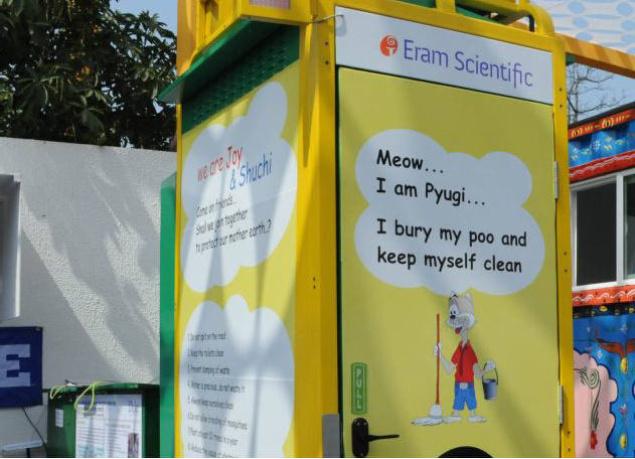
The eToilet has an automatic flush, which works before and after use, sensor controlled water usage and eliminates the need for manual cleaners in schools. / The Hindu

Eram Scientific, manufacturers of the country’s first eToilet, on Tuesday unveiled the world’s cheapest unmanned, self-cleaning eToilet with inbuilt solar panel and metallic platform for schools.

“This is our contribution to the nation and comes as a response to the “Clean India Campaign” announced by the Central Government. It perfectly matches with the “Make in India” campaign as well,” said Siddeek Ahmed, chairman of Thiruvananthapuram-based Eram Group.

Built of stainless steel base, mild steel super structure and occupying 25 sq.ft space, the eToilet comes with a price tag of Rs.99,999 ex-factory, which is inclusive of insurance charges and one-year warranty.

It has got an inbuilt solar panel, which eliminates the need for electricity connection while the metal platform avoids civil construction too.

It has an automatic flush, which works before and after use, automatic floor wash, sensor controlled water usage and eliminates the need for manual cleaners in schools.

“The present problems in sanitations at schools are known to be not because of the dearth of toilets. The lack of maintenance and requirement for manual cleaning has made them dysfunctional. We are out to address that gap and that is why we are now launching this comprehensive solution for schools,” said K. Anvar Sadath, CEO.

source: http://www.thehindu.com / The Hindu / Home> News> Cities> Thiruvananthapuram / IANS / Thiruvananthapuram – September 30th, 2014

Two Brothers Wanting Power For Their Farms Invented A Bamboo Windmill That Is 10 Times Cheaper!

Brothers Mohammad Methar Hussain and Mushtaq Ahmad wanted power for irrigation and they developed a low cost windmill made out of bamboo, which is more than 10 times cheaper than the regular ones available in the market. Now, there are more than 25 such windmills running in Gujarat. Read to know more about their journey and how they did it. 

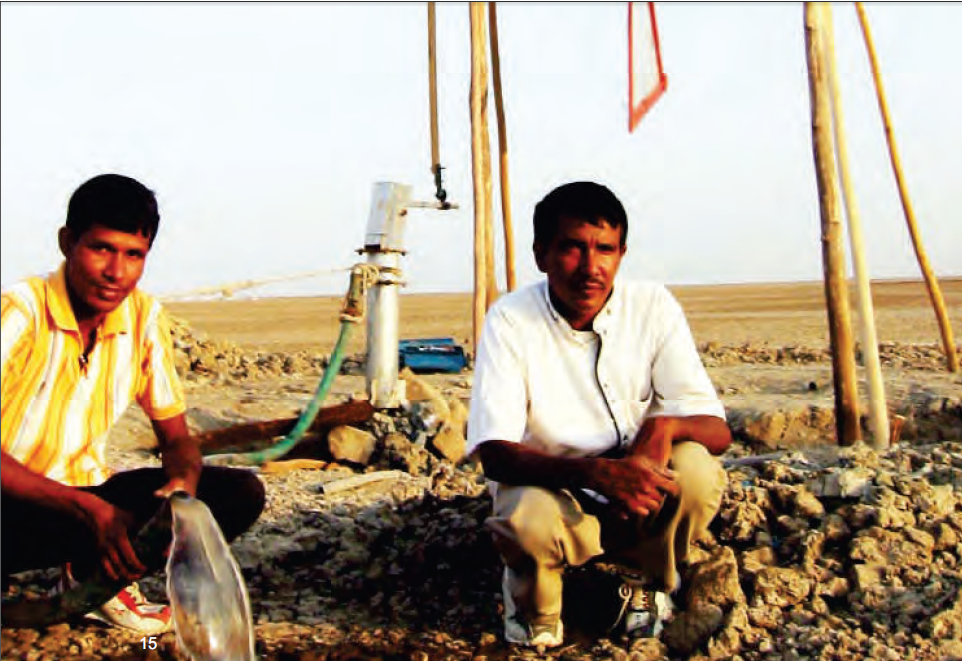
Mohammad Methar Hussain and his brother Mushtaq Ahmad from Darrang district in Assam grew paddy in the winter season (also known as bodo paddy). Irrigation involved a lot of manual effort and using diesel sets for pumping  water was a huge drain on the resources. To tackle this issue, Mehtra thought that if they could run a large wheel on wind power, and connect the wheel to the hand pump, that would serve their purpose quite efficiently.

So, both of them started working on making a windmill unit from locally sourced materials such as bamboo wood, strips of old tyres, pieces of iron, etc. With the help of a carpenter, the first prototype was ready in four days. Since the supporting framework was composed of bamboo, the final product costed Rs. 4500, vis-a-vis the commercially available wind mills which cost over Rs. 60,000.

Mehtar and Mushtaq
Mehtar and Mushtaq 

Innovation Diffusion : Assam —–> Gujarat

India is the third largest salt producing country in the world with an average annual production of about 157 lakh tonnes. The Little Rann of Kutch (LRK) supplies 21% of the total salt production of India.

Salt workers, known as Agarias, are some of the poorest people in the state. Agarias mostly used counterpoise, a method that requires two people, one for lowering the counterpoise and other for straining the water. Some of them started using diesel pumps, but the exorbitant machine and fuel costs made a huge dent in their already diminishing returns from salt farming.

With the mission to improve lives of salt farmers, Gujarat Grassroots Innovation Augmentation Network – West (GIAN W) along with National Innovation Foundation (NIF-India) took the lead in diffusing the innovation in salt farming areas.

Based on the feedback received from salt farmers, GIAN W improved the design and developed a multi-dimensional model which was installed at LRK in 2008. Understanding the diverse needs of farmers to increase the efficiency of windmills, GIAN W joined hands with Alstom foundation for design modification and improvement.

As of 2012, 25 of these windmills have been installed in Kathivadar and Kadiali villages in Amreli district.

Low cost windmill has solved irrigation problems for the village

 Benefits of the Windmill Pump

Thanks to the windmill pump, now salt farmers don’t have to slog for hours with the water pump. The windmill pump saves about Rs.50,000 worth of diesel in six months. It has decreased salt farmers’ reliance on manual labour resulting in savings of about Rs. 28,000 per season per person. Farmers can now easily recover their investments within the harvesting season.

The innovation would also result in the reduction of five tonnes of carbon emissions for every 100 tonnes of salt produced. As per NIF, on an average, every windmill-powered hand pump should generate five Carbon Emission Reductions (CERs) certificates worth Rs.3750.

Every rupee saved and milligram of carbon emission reduced is a glaring testimony of how rural innovations impact the community, society and the world at large.

In the next phase, GIAN W plans to erect more windmills in other parts of Gujarat. The salt farmers of Gujarat are indebted to Mehtar and Mustaq for making their lives more efficient and their occupation, profitable.

For any enquiries related to the machine, please get in touch with NIF-India at bd@nifindia.org.

source: http://www.thebetterindia.com / The Better India / Home> Innovation> Gujarat / by Rahul Anand / July 24th, 2014


Madras miscellany: The Father of Indian Botany

The news that the Schmidt Memorial on Elliot’s Beach was being restored and the area around it landscaped is welcome indeed. But while this memorial has kept alive for several decades memories of the courage of a young Danish mercantile executive (Miscellany, September 23, 2013), there have been at least two other persons with Danish connections in the city’s past who deserve commemoration for significant contributions they made to Madras — and even to India.

John Goldingham was of Danish descent but was more British than Dane. He was the first official head of the oldest modern observatory in the country and of the oldest modern technical school in Asia, both surviving to this day. But better remembered is what was considered his patron Lord Edward Clive’s folly — or entertainment space. Built by Goldingham to host the Governor’s Council, this Assembly Hall became better known as Banqueting Hall (and should I say ‘Ballroom’?) but today languishes as Rajaji Hall. Making me wonder how this splendid building can be revived and given new life.

Goldingham’s contributions may be remembered by a few, but very, very few outside the scientific community are likely to remember a German who made Denmark his home and later contributed significantly to India. Dr. Johann Gerhard König was a Danish-trained physician who served the Madras Government in the late 18th Century but became better known as ‘The Father of Indian Botany’, with scientific botany in India emerging through his efforts.

Born in what is now Latvia, König moved to Denmark in 1748 to study and became a private pupil of Linnaeus at Uppsala University from 1757. He lived and worked in Denmark till he came out to Tranquebar in 1768 to serve the Danish Halle Mission as its medical officer. Simultaneously, he worked with the Nawab of Arcot as his Naturalist and travelled throughout his domain (virtually what became the Madras Presidency) and Ceylon. In 1778, he was appointed the East India Company’s first Natural Historian /Naturalist/ Botanist and served in that capacity till his death near Vizagapatam in 1785. Amongst those who benefitted from his training them as naturalists were the Rev. Christoph John and Rev. Johann Rottler in Tranquebar and William Roxburgh in Madras. It was Roxburgh who treated him during his last days in what is now Andhra Pradesh when dysentery was felling him. J. König, a name to reckon with in Indian botanical terminology, was responsible for South India being the earliest centre for botanical and zoological research in the country.

Until König came along, plants found in India by the ‘greens’ were sent to Europe to be classified and described by scientists like Linnaeus and others. König introduced the Linnaean rules in India and was soon followed by others. Many of these students of Indian vegetation in the Peninsula and Ceylon, like James Anderson, Francis Hamilton-Buchanan, Roxburgh, Rottler, and John and a few others formed a society to promote botanical studies, exchanged specimens and information on new species collected, and, acting in concert as a society, named them. But as they became more confident of their botanical knowledge, some of them began naming their finds themselves without consultation. All this information was sent by them to European botanists who published the information under the names sent to them or under names they had changed the originals to. Later authors of botanical information, like Edward Balfour and Robert Wight, tended to use the names in general use at the time, but also offered the synonyms that had been earlier used. One of the names listed is Murraya Königii, a species of curry leaves.

Footnote: Searching for material for this column constantly throws up new leads to follow. And while writing today’s piece I came across the name of Dr. Francis Appavoo. Here was an Indian who, as early as the 1860s, was in charge of the Conservator of Forests’ office in Madras. I wonder if anyone can tell me more about him.

source: http://www.thehindu.com / The Hindu / Home> Features> MetroPlus / by S. Muthiah / September 28th, 2014

Vizag Boy Excels at Global Meet

Visakhapatnam :

City-based student Syed Tazib Rehman has proved his mettle at the Global Cancer Conference and Medicare Summit 2014. He is one of the 12 students across the world whose online presentations were selected for special appreciation. Rehman is a student of Sri Chaitanya Junior College Visakhapatnam. All the selected students except Rehman were graduates and post-graduates.

The 12 students would repeat their presentation before the President of India and other officials on September 15 at HICC, Hyderabad. Earlier, Rehman  bagged the ‘Bala Ratna’ award for ‘Creative Scientific Innovation’ in  2013.

source: http://www.newindianexpress.com / The New Indian Express / Home> States> Andhra Pradesh / by Express News Service / September 15th, 2014

AMU scientist urges Health min to identify occurrence of NDM-4 bacteria

Aligarh:

 A scientist at Aligarh Muslim University (AMU) has urged the Union Health Ministry to launch a nationwide multi-centered joint project to identify the percentage of occurrence of NDM-4, a deadly bacteria variant which was found by researchers in AMU recently.

Dr Asad Ullah Khan, Chief Coordinator of the Interdisciplinary Biotechnology Lab, AMU headed the team along with other researchers which found the deadly bacteria also called the “super bug” from the hospital’s sewage.

Khan has urged the Health Ministry to launch a nationwide multi-centered joint project for identifying the percentage of occurrence, if at all, of this particular strain and all other strains of this bacteria in the country.

A collaborative effort is the need of the hour if we wish to make an accurate assessment of the situation in the country, he said.

“In Europe, hospitals are collecting hundreds of samples for identifying these bacteria but in India there are just sporadic efforts to identify these bugs. There is certainly no cause for panic as of now but laboratories all over the country which are equipped to handle such studies should launch a collaborative effort for spotting these bacteria in different hospitals,” Khan told PTI.

“It is a fact that hospitals in India are not very co-operative for conducting such tests inside hospital wards and operation theaters but if such studies become a part of a national project then we will have a true picture of the dimensions of this problem,” he added.

Representational Image. Reuters

Khan had recently succeeded in isolating the mutant strain for the first time in India, after studying sewage water samples of a hospital. The original bacteria from which the above strain is derived was identified as NDM-1 and was first detected in 2009.

After recording the presence of “super bug”, a team of officials from the state health department visited Khan’s lab at the Jawaharlal Nehru Medical college, AMU to discuss the fallout of his recent findings. Khan said that he along with his team of researchers were fully prepared to cooperate in any nationwide project to isolate this bacteria in different hospitals.

“The first step which the Union Health Ministry should take is to introduce a move for mandatory hospital infection management systems in the country. Once such a step is introduced our hospitals will be as safe as any hospital in west.”

He also called for a national policy on the over-the-counter sales of antibiotics. “This step should be preceded by a national antibiotic prescription policy wherein no antibiotic can be sold over the counter without a doctors prescription,” Khan said.

He said that indiscriminate overuse of antibiotics for years has led to the birth of the original antibiotic resistant strain in 2009 known as NDM-1.

source: http://www.firstpost.com / FirstPost.com / Home> F.India> Latest News> India News / September 11th, 2014