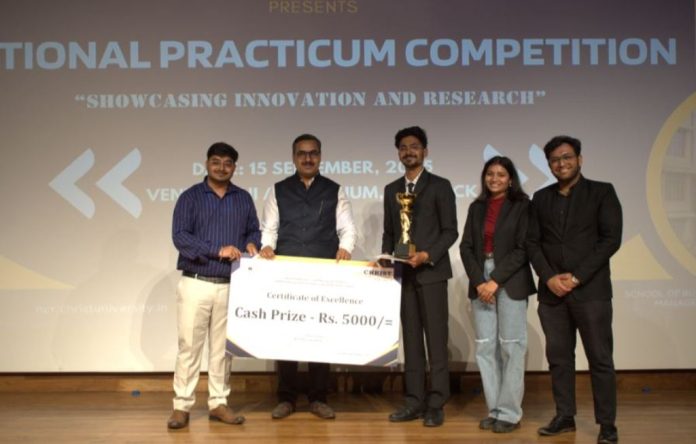
Students of the Department of Business Administration, Aligarh Muslim University (AMU), showcased their talent at the National Practicum Competition organised by Christ University, Delhi.
A six-member team, led by Chairperson Prof. Salma Ahmed, represented AMU in the competition. The participants included Safdar Khan (Travclan), Arsalan Haq (IMCS), Manaal Tehsin (TeleCRM), Arham Ullah Khan (Powergrid), Mohd Arish (ITC), and Mohd Adam (ITC). Each student presented their summer internship work before a panel of experts and an audience comprising students and faculty from institutions across the country.
The event turned into a proud moment for AMU as its students secured both the first and second prizes. Safdar Khan won the first prize for his presentation based on his internship at Travclan, while Arsalan Haq earned the second prize for his internship work with IMCS.
Prof. Salma Ahmed congratulated the winners and praised all participants for their efforts, assuring continued support for students to take part in similar competitions. She said the recognition highlighted the department’s commitment to providing strong academic and practical exposure.
source: http://www.radiancenews.com / Radiance News / Home> Latest News >Markers of Excellence / by Radiance News Bureau / September 20th, 2025
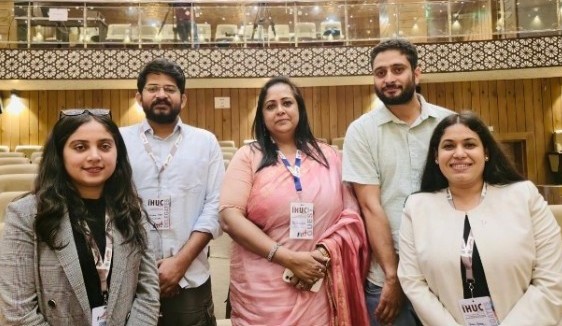
Orus Ilyas with Shahzada Iqbal, Mohsin Javid and Aeimon Hafeez, and Yashi Singh during the 2nd International Conference on Hangul at at SKUAST-Kashmir
Aligarh:
The Department of Wildlife Sciences, Aligarh Muslim University (AMU), under the leadership of Professor Orus Ilyas, made a stellar mark at the 2nd International Conference on Hangul and Other Threatened Ungulates (2IHUC-25), held at SKUAST-Kashmir.
Four research scholars of the department, including Shahzada Iqbal, Mohsin Javid (PMRF fellow), Aeimon Hafeez, and Yashi Singh (both associated with the ANRF-SERB funded Tahr Ecology Project), presented their work at the conference. In a proud moment for the university, Mohsin Javid won the first prize in the oral presentation category, while Yashi Singh and Aeimon Hafeez secured gold and silver prizes, respectively, in the poster presentation segment.
Adding to the department’s achievements, Professor Orus Ilyas delivered an invited lecture on “Ecology and Conservation of Himalayan Tahrs”, drawing upon over two decades of Himalayan field research and insights from her current ANRF-SERB funded project. She also chaired two important technical sessions at the conference.
The conference brought together global experts to deliberate on conservation strategies for Hangul, Markhor, and other Himalayan ungulates, and AMU’s delegation not only earned top academic accolades but also reaffirmed the university’s reputation as a leading centre of excellence in wildlife research and conservation.
source: http://www.radiancenews.com / Radiance News / Home> Latest News > Markers of Excellence> Uncategorized / by Radiance News Bureau / September 17th, 2025
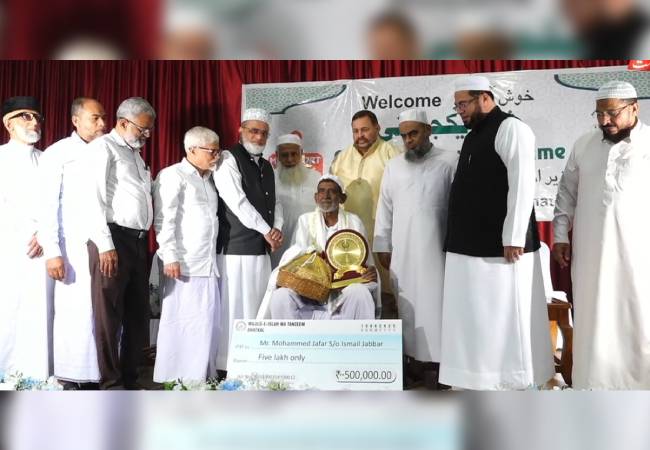
If anyone wishes to see a living example of honesty, loyalty, sincerity, and dedication, they need only look at the life of Mohammed Jaffar, son of Mohammed Ismail Jambar, who recently retired after serving the Majlis-e-Islah wa Tanzeem Bhatkal for more than five decades.
At just 22 years of age, a simple-hearted young man stepped into the Tanzeem office as a humble worker. His journey began as an attender with a monthly salary of only Rs. 125. But for him, this was never just a job. It was a sacred trust, and for half a century he fulfilled it with absolute honesty and commitment. With time, his responsibilities grew, but never once did he complain or show displeasure. His salary may have risen from Rs. 125 to Rs. 19,000 over the years, but his true earnings were the respect, love, and prayers of the community he served.
One incident still shines brightly in the history of Tanzeem. A philanthropist once came to the office to make a large donation. At that time, only Jaffar was present. The donor called the then-secretary and asked if he could entrust the money to Jaffar. The secretary’s reply has become immortal: “You may have doubts about the secretary, but never about Jaffar.” These words stand as the greatest recognition of his lifelong honesty and trustworthiness.
Jaffar witnessed every rise and fall of Tanzeem. Leaders changed, committees came and went, decisions were made and debated – but he kept every secret buried deep within his heart. His service extended beyond office hours: riding a bicycle up Bhaktal’s steep slopes to distribute agendas, arranging files and meetings, ensuring everything ran smoothly. His quiet efforts became the very foundation that kept the institution strong through all seasons.
In his personal life too, he lived with simplicity. He built a small mud house on the hillside of Bhatkal, later covering it with tiles, then adding a concrete slab, and eventually, through a generous contribution during Tanzeem’s centenary celebrations, the humble dwelling was turned into a modest yet permanent home. But simplicity and contentment always remained his true identity.
Now, after 51 years of continuous service, his health has weakened. Walking has become difficult, and illness troubles him, but his heart still beats for Tanzeem. His only wish is to continue visiting the office daily and spend time in the institution he loves so dearly.
The lifelong service of Mohammed Jaffar is a priceless asset for the community of Bhatkal. He is a shining lamp who not only illuminated his own era but also set a lasting example of service, honesty, and loyalty for future generations.
We owe him deep gratitude for devoting the golden years of his life to the service of the community. May Allah grant him complete health and strength. Ameen.
Note: How wonderful it would be if our youth federation were to organize a grand felicitation program in his honour.
source: http://www.english.varthabharati.in / Vartha Bharati / by Mohammed Yahya Damudi / September 08th, 2025
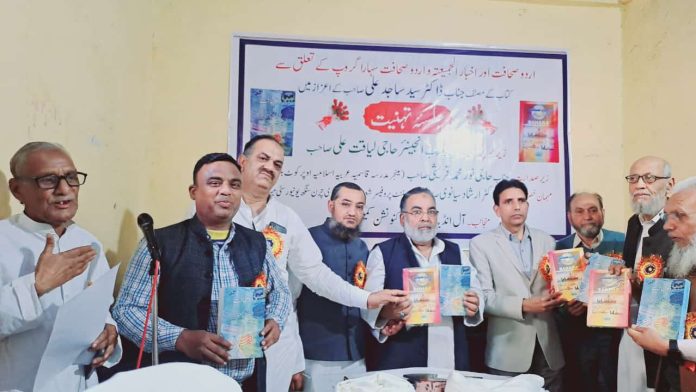
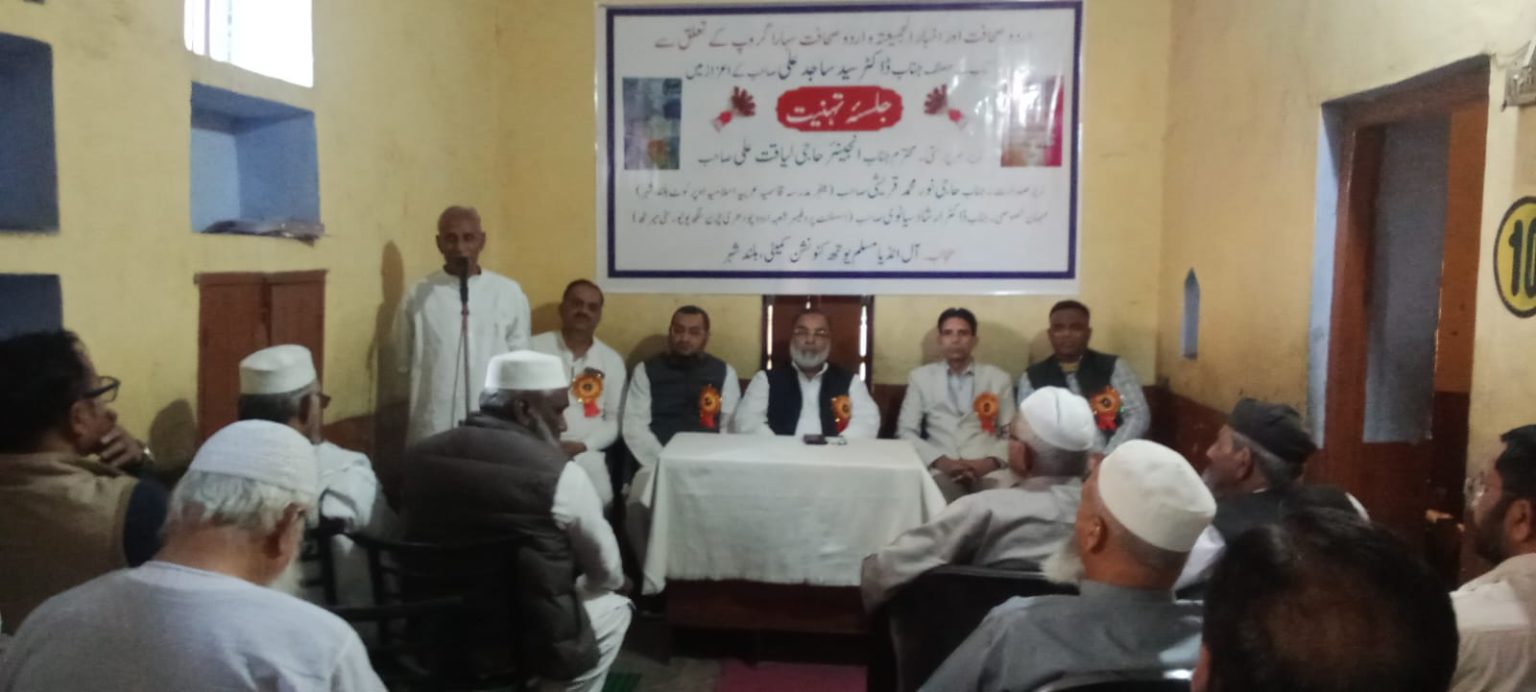
A grand felicitation ceremony was organized at Madrasa Qasimia Arabia Islamia, Kali Masjid, Upper Kot, under the patronage of Engineer Haji Liaqat Ali, to honor Dr. Syed Sajid Ali.
Dr. Ali was recently awarded a PhD degree by Chaudhary Charan Singh University, Meerut, for his research on Urdu journalism and the newspaper Al-Jamiat.
The event, held under the aegis of the Muslim Youth Convention Committee, was presided over by Haji Noor Mohammad Qureshi, the manager of the madrasa, and hosted by Dr. Zaheer Ahmad Khan. It commenced with a recitation of the Quran by Hafiz Shakeel Ahmad, Imam of Ahle Hadith Mosque, followed by a naat recited by Chahat Hussain. Dr. Irshad Siyanvi, Assistant Professor from CCS University’s Urdu Department, graced the occasion as the chief guest.
Following a welcome address by Shujaatullah Khan Polish, Haji Chaudhary Khurshid Alam Rahi, President of Bazm-e-Khuloos-o-Adab, warmly received the chief guest. While introducing him, Rahi highlighted Dr. Irshad Siyanvi’s academic excellence, published books, research papers, and contributions to national and international seminars. He praised Dr. Ali’s efforts in enriching Urdu literature and his relentless dedication to its preservation.
A Tribute to Urdu Journalism
The keynote speaker, Major Dr. Mohammad Fazil DPS, reviewed and analyzed Dr. Sajid Ali’s book on Al-Jamiat, emphasizing its critical importance in Urdu journalism. He acknowledged the author’s extensive research in compiling factual references and hailed the work as a remarkable contribution not just to Al-Jamiat but to the entire domain of Muslim journalism.
Dr. Irshad Siyanvi, in his detailed address, underscored the historical significance of Al-Jamiat, its editorial legacy, and its role in the Indian freedom struggle. He lauded Dr. Ali’s research as an invaluable resource for understanding the evolution of Urdu newspapers and their socio-political impact. Stressing the need to preserve the Urdu language, he remarked, “Urdu is a language of love, brotherhood, and culture, and its survival is a collective responsibility.”
Preserving Urdu for Future Generations
Haji Noor Mohammad Qureshi, the event’s president, expressed his delight at hosting the ceremony and reiterated the importance of keeping Urdu alive. “If Urdu disappears, an entire culture will vanish with it. Our religious, cultural, and intellectual heritage is preserved in Urdu, and its education must be prioritized,” he emphasized. He also congratulated Dr. Sajid Ali on his achievement and encouraged continued efforts to promote Urdu literature and journalism.
Dr. Sajid Ali, the author of the book, expressed his gratitude to the attendees and acknowledged the challenges he faced in his research journey. He dedicated his success to the cause of Urdu journalism, stating that his work would serve as a guiding light for future scholars and journalists.
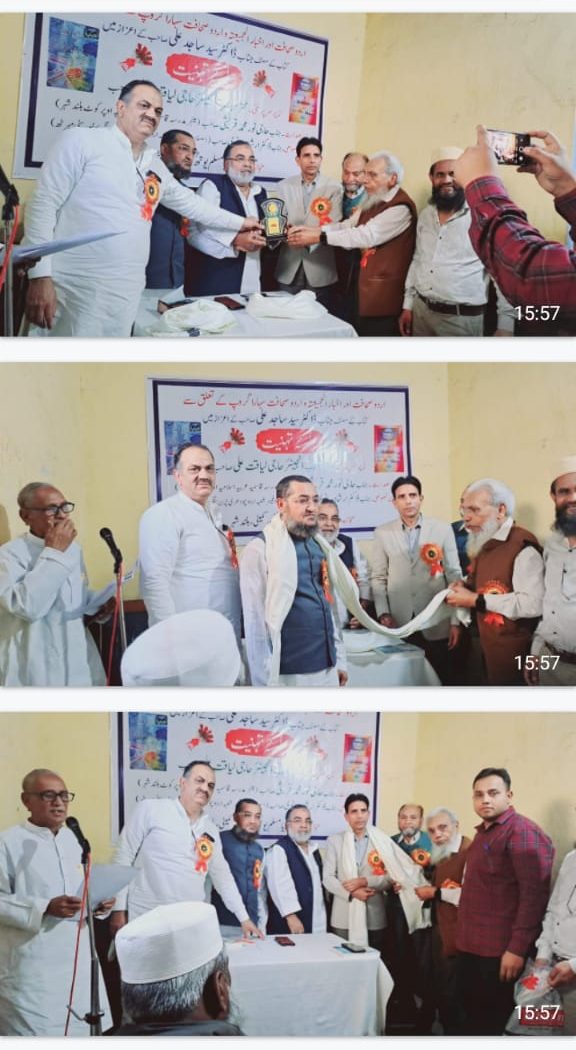
As a token of appreciation, Dr. Sajid Ali and the chief guest, Dr. Irshad Siyanvi, were honored with a shawl. Additionally, Dr. Ali, along with Noor Mohammad Qureshi and Dr. Siyanvi, received the prestigious Javed Habib Award, named after the renowned journalist and founder of the Muslim Youth Convention.
The event witnessed the presence of numerous literary, educational, and social personalities, including Haji Javed Ghazi, Ijlal Ahmad Khan, Arif Saifi, Master Ilyas Khan, Master Mohammad Akram, Abdul Khaliq Ansari, Mohammad Sardar, Master Afzal Barni, Ejaz Ahmad, Abdul Nafi Ansari, Zafaryab Khan, Akhtar Iqbal, Dr. Hasrat Ali Chauhan, Mohammad Afzal, Mohammad Yamin Alvi, Shoaib Qadri, Junaid Akhtar, Dr. Haseeb Ahmad, and Aamir Ghazi Advocate.
source: http://www.radiancenews.com / Radiance News / Home> Arts & Culture> Urdu / by Radiance News Bureau / February 28th, 2025
₹8 crore project for ‘one of its kind’ Azad Gallery will tell the story of revolutionaries in the Indian freedom movement.
Liaquat Ali
From the spirit of the Ghadarites to the sacrifice of Durga ‘Bhabhi’, a section of historians and the political class feel that the contribution of revolutionaries to the Indian freedom movement has not been well-documented. In a bid to strike a balance, the Allahabad Museum is in the process of creating a “one of its kind” Azad Gallery, where the story of the revolutionary struggle of the Indian freedom movement would be told through artefacts and interactive displays.
Named after Chandra Shekhar Azad, who attained martyrdom at about 300 metres from the museum, the gallery is expected to be complete by July 23, 2021, the 115th birth anniversary of the revolutionary.
Backed by the Ministry of Culture and the National Council of Science Museums (NCSM), the infrastructure for the “multi-pronged project is being developed with a budget of around ₹8 crore in 7,500 sq. ft. of space where the revolutionary struggle will be specially depicted, starting with 1857’s First War of Independence to the Azad Hind Fauj,” said Sunil Gupta, Director in-charge of the museum.
Dr. Gupta, who has spent three decades at the museum in different capacities, said the story of this struggle had not been comprehensively told through curatorial display and was being done for the first time by the Allahabad Museum.
Promising a “world-class experience”, Dr. Gupta said the infrastructure would be ready by January and the NCSM would then take over to implement the design.
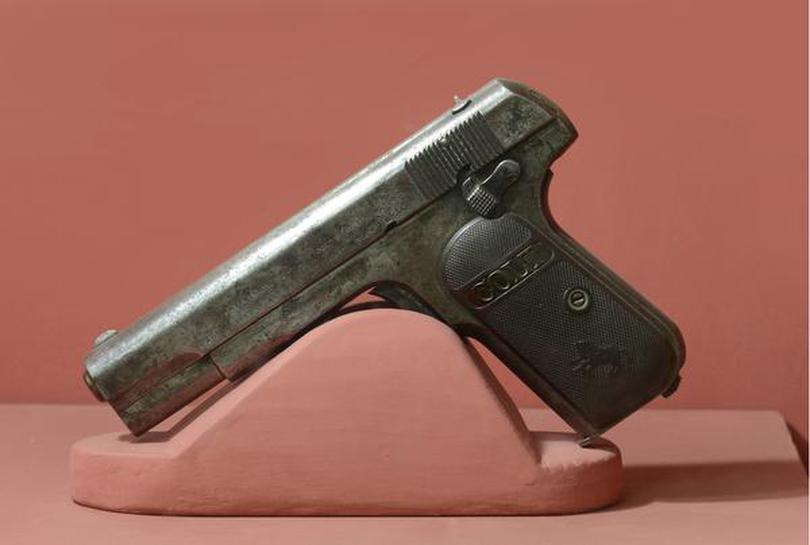
One of the highlights of the museum has been the .32 caliber Colt pistol which belonged to Azad. It is showcased in a bulletproof case and is guarded by U.P. police personnel. “As per our records, the pistol is said to have been received from John Knott Bower, the police officer who led the encounter against Azad,” said Dr. Gupta.
One of the highlights of the museum has been the .32 caliber Colt pistol which belonged to Chandra Shekhar Azad. It is showcased in a bulletproof case and is guarded by U.P. police personnel.
On the theory that although the Colt could have belonged to Azad, it was a Mauser he used during the shoot out, Dr. Gupta said the records of Azad’s associates were being looked into. “Revolutionary Manmath Nath Gupta, in his book They Lived Dangerously , has recounted an incident in which a Mauser pistol owned by Azad went off accidentally. Gupta [the author] also recounted that Azad was also loading other pistols and revolvers that he had with him,” Dr. Gupta said.
Dr. Gupta recalled Durga (Devi Vohra) ‘Bhabhi’, who assumed the identity of Bhagat Singh’s wife to help him escape from Lahore after Saunders’ assassination, grew up in Kaushambi near Allahabad before being married to revolutionary Bhagwati Charan Vohra. “She was no less than Bhagat Singh. A day after Bhagat Singh and his associates were sentenced to death, she fired at a British police officer and his wife from a moving car in Bombay,” he said.
Dr. Gupta argued it was not that she was not celebrated at all but that she was never made an icon. “She almost remained incognito till she died in 1999. She ran a small school in Lucknow and we are in the process of acquiring documents related to her,” he said.
The museum also has a kurta – pyjama and sword of Maulvi Liaquat Ali, who was the leader of revolutionaries in 1857 in Allahabad. “Under him, Allahabad was liberated for at least 10-15 days. His headquarters was the historic Khusro Bagh, where he unfurled the flag of the Mughal emperor,” recounted Dr. Gupta.
In the arms and armoury gallery of the museum, there is a submachine gun of the First World War, “the kind which would have been used by Ghadar revolutionaries in 1915 had the rebellion not been thwarted because of international conspiracies,” Dr. Gupta said.
There are a number of welcome addresses as well which were “gifted to Pandit Nehru when he visited Singapore, Malaya and Burma in 1937-38 before the Second World War. They were given by Indian-origin merchants, who a few years later funded the INA (Indian National Army),” said Dr. Gupta.
There is also an original letter by Vishnu Sharan Dublish, an accused in the Kakori case.
World over, Dr. Gupta said, artefacts are backed by virtual experiences. “It excites children and helps fill the gaps in the narrative. Seven short films made by the Satyajit Ray Film and Television Institute will be on show,” he said.
On the ideological slant of the gallery, Dr Gupta said, “We already have galleries devoted to Gandhi and Nehru. As a student of history, I could say the revolutionaries have been horribly sidelined and in some cases, such as Durga ‘Bhabhi’, I would say it was consciously done. However, we were clear the museum is not just about the freedom struggle and have not parted with the [museum’s] Central Hall. We are located in the middle of the Gangetic civilisation and our sculpture collection is amazing. We are sending six-seven of them [sculptures] for an exhibition in the Metropolitan Museum, London.”
source: http://www.thehindu.com / The Hindu / Home> News> India / by Anuj Kumar / January 03rd, 2021
Today, May 10, 2022, is the 165th anniversary of India’s first freedom struggle.
The first freedom struggle of India, launched in 1857, has essentially become synonymous with figures like Mangal Pandey, Nana Saheb, Tatya Tope, Rani Laxmibai, and Veer Kunwar Singh.
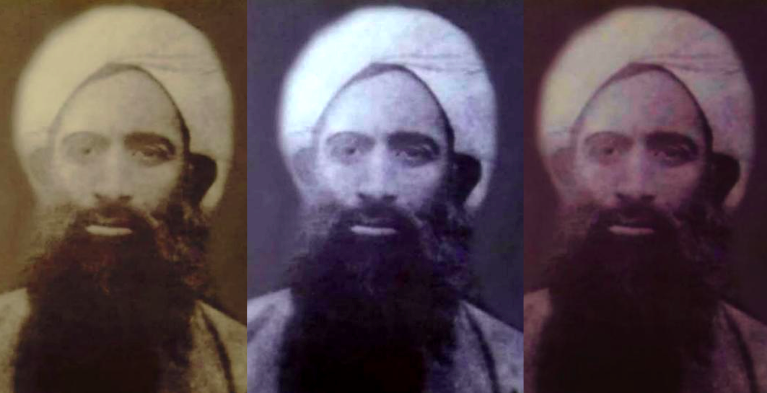
However, being a widespread movement of massive proportions, many of its heroes have been lost in oblivion as we either know very little about them or nothing at all. One such prominent leader of the 1857 Mutiny was Maulavi Liyaquat Ali, hailing from Allahabad, Uttar Pradesh.
Since the Mughal era, Allahabad has been a strategic location from where the monarch exercised control over the whole of northwest India. This is why Akbar built a fort there. This is also why, later, the British also retained it as the control centre for the region, extending from Delhi to Bengal.
During the Revolt, Maulavi Liyaquat Ali led the movement in Allahabad and managed to keep the British forces at bay from June 6, 1857 to June 16, 1857.
Ali was born between 1810 and 1830 in a peasant family at a village called Mahgaon in Chail Pargana (now in the district Kaushambi) of Allahabad. There is little by way of record available now. When he was arrested in 1871, however, his age was recorded in the court as 45 years.
A new mosque at Mahgaon, built where Maulavi’s mosque was located. Photo: K.K. Pandey
His father’s name was Sheikh Meher Ali. His uncle, Dayam Ali, was employed with the Company Bahadur’s army in Jhansi, according to a piece by Arvind Kumar Singh. For a while, Ali also worked for the Company Bahadur with his uncle, but he opposed the ill treatment of indigenous soldiers by British officers. As a result of this, he was dismissed from service.
Maulavi Liyaquat Ali was an eminent Islamic scholar, and was also highly respected in his area. After being fired from his job, he returned to his village, visiting Delhi, Bhopal, and Tonk on the way. In Tonk, he met Sayyid Ahmad Shaheedi, who was by then, already waging a guerrilla war against the British.
This probably pushed Maulavi towards armed struggle. In his village, he opened a madrasa where he taught children. He also delivered sermons at various places. Meanwhile, he began organising local peasants in their struggle against the persecution of the Company Bahadur and his loyal native rulers, especially in rural areas. Popular with small zamindars, talukdars and common people in Allahabad, Mirzapur and Pratapgarh, he soon emerged as a local hero in Rohilkhand, Awadh and Kanpur.
His influence soon extended to the Panda community in Allahabad’s Daraganj, the Pragwal Brahmins of Kydganj and Beniganj, as well as to Muslim majority villages like Saidabad, Ranimandi, Dariyabad, Samadabad, Beli, Nawada, and others.
As a result of his efforts, when the bugle for the war of 1857 was sounded, the people of Allahabad were at the forefront.
Mahgaon village today. Photo: K.K. Pandey
The Battle of Allahabad
As soon as the news of the rebellion in Meerut on May 10 and the capture of Delhi by the rebel army on May 12 spread, the British army turned alert in Allahabad as well.
The Allahabad Fort had the largest stock of arms and ammunition in northwest India at the time. To guard it, the Sixth Regiment Bengal Native Infantry, which was part of the Ferozepur Regiment, had a portion of its Sikh troops stationed there and the rest in the cantonment on the Kanpur Road, which usually consisted of soldiers who hailed from peasant families of Uttar Pradesh, Bihar and Madhya Pradesh.
The British started sending armies to Allahabad.
Maulavi Liyaquat Ali, meanwhile, was training common people for war. All the zamindars of Allahabad supported him in his efforts. So did ordinary farmers and the urban class.
Sensing danger on June 5, British civilians were called inside the fort. Two companies of the Sixth Regiment and 150 Cavalry from Third Awadh were deployed with Lieutenant Alexander at Alopibagh and Daraganj to stop rebels if they crossed the Ganges Bridge.
Meanwhile, Liyaquat Ali was holding meetings throughout the city and was also in contact with soldiers in the cantonment as well as inside the fort. On June 5, Khalid Bin Umar notes in a blog post that a meeting of eight Mewati Muslim villages took place at Saif Khan’s house in Mauja, Shamdabad (where Company Garden is now located and where Chandrashekhar Azad was martyred during the freedom struggle of 1947). All of them joined the struggle the same day, except the host of the meeting, Saif Khan.
On the night of June 6 at 9.20 pm, Indian soldiers stationed at Daraganj, who were guarding the Ganges Bridge, started the rebellion. An order was issued from the fort that the soldiers should deposit their arms, but the soldiers defied the order and started moving towards the cantonment with their guns.
Lieutenant Harvard, who was the officer of this battalion, rushed to Lieutenant Alexander stationed at Alopibagh nearby who ordered his cavalrymen to fire at the rebel soldiers. These soldiers did not obey either. The soldiers killed Alexander when he opened fire.
Lieutenant Harvard somehow managed to escape and reached the fort. At 10 pm, Indian soldiers had killed all Britishers in the city and looted treasure. The next morning 3,000 prisoners were freed from the prison under the leadership of Sepoy Ramchandra.
On June 7, Maulavi Liyaquat Ali declared Allahabad independent and made the historic Khusro Bagh his headquarters. To control the chaos that had been going on for two days, Maulavi Liyaquat Ali marched in the city with the soldiers and all the rebels, delivered speeches and hoisted the emperor’s flag over the city Kotwali.
On June 8, Bahadur Shah signed a decree to appoint Maulavi Liyaquat Ali as the governor of Allahabad, which is still preserved at Hyderabad’s Salarjung Museum. On the same day Maulavi appointed a council and officials for managing the affairs of the city. Sheikh Nemat Ashraf was made the police authority or Kotwal and Sukh Rai was appointed the tehsildar.
Office bearers were chosen from both the communities and a massive council was set up to carry on the struggle. The Bharwari railway station in Allahabad had already been captured on June 7. So the English could not reach Kumuk by rail. There was no line till Allahabad then. By then, railway workers too had joined the movement.
Maulavi enjoyed the supported of all communities. Everyone from city residents to farmers of the Doab region and small land owners of the region extending between the Ganga and the Yamuna and beyond were with him.
Thomas Daniell’s painting, showing the Yamuna and a mosque by it. Source: http://parganachail.blogspot.com/2015/03/maulvi-liyaqat-ali-unsung-hero-of-1857.html?m=1
However, the big princely states of the time, such as Raja Manda, Raja Dahiyabara, and Raja Karchana sided with the British, for which they were rewarded later.
The decrees issued by Maulavi Liyaquat Ali at the time show that he was a man of deep understanding and an overall brilliant general.
“Mulk Badshah ka, hukm Maulavi Liyaquat Ali ka” (‘The emperor’s country, Maulavi Liyaquat Ali’s governance’) was his motto.
Many of his orders, like banning attacks on Anglo-Indians and taking goods from shopkeepers without paying, were exceptionally humane.
By June 10, Maulavi and his men started efforts to capture the fort. Colonel Neil reached Allahabad on June 11 from the other bank of the Ganga. He was accompanied by a large army. Maulavi hoped to receive support from the 400 soldiers of the Sikh regiment stationed inside the fort, but they remained loyal to the British till the end.
Maulavi tried to penetrate the fort by placing an old canon rifle on the Jama Masjid built by Akbar but failed. The keys of the fort were held by a famous Khatri family of the city who had promised to hand them to Maulavi. But when two of the Maulavi’s men visited them, the family betrayed them and both of them were killed by the British.
Finally, on June 15, a fierce battle broke out between Maulavi’s army and the British, outside the fort. Maulavi had more soldiers, yet he was forced to retreat because his weapons were old and his army less trained. Many of his soldiers were injured or killed.
Maulavi returned to Khusro Bagh. On June 16, Colonel Neil’s army laid siege at Khusro Bagh and launched an offensive. By evening, the cleric was warned that the whole city would be set on fire if his men did not lay down their weapons.
Finally, on June 17, dodging Colonel Neil and his army, Maulavi, along with 3,000 of his companions, drove out to Kanpur and met Nana Saheb. On June 18, eight nearby villages of Mewati Muslims, including Samadabad, were burnt down and anyone who tried to escape was shot dead.
Later, all government buildings, the High Court, all Police Headquarters, the Attorney General’s office as well as the Civil Lines were constructed by the British over the remains of these villages. About 6,000 people of Allahabad city were killed in this rebellion.
The British army carried out terrible massacres in the areas near Kotwali, Kydganj, Daraganj, Beniganj, Dariyabad and Saidabad. As per records, nearly 600 to 800 people were hanged on the neem tree at the Chowk. Historian Vishwambhar Nath Pandey has said 634 people were hanged.
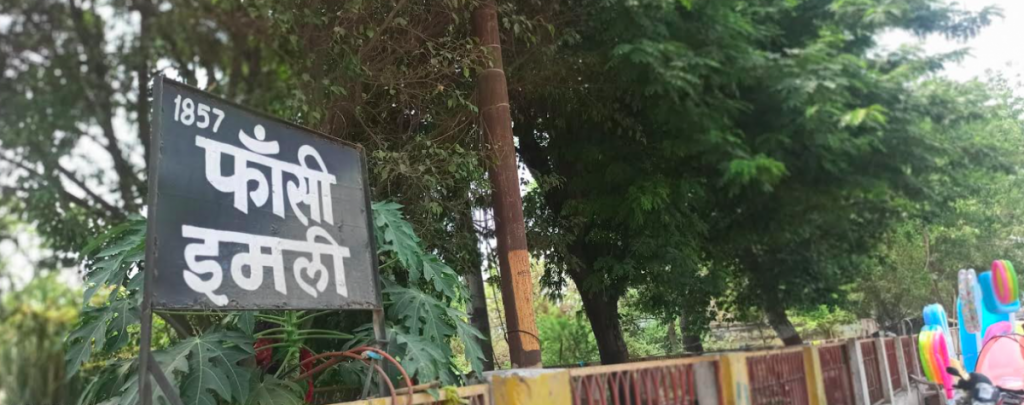
The ‘Phansi Imli’ tree – a tamarind tree witness to the massacre – still stands today on Kanpur Road. Despite this, Maulavi did not stop fighting. Till 1858, Maulavi’s army was in control of the area on the other side of the Ganga. In 1858, Maulavi fought his last battle, against Major Berkeley. He escaped that as well.
The ‘Phansi Imli’. Photo: K.K. Pandey
After the failure of the rebellion, the cleric stayed underground at Lajpur near Surat in Gujarat, disguised as Hakim Abdul Karim and later moved to Bombay. Here, he stayed at the house of a businessman, Bakir Ali. As he was delivering a sermon in a mosque, two people in the audience recognised him and informed British officials.
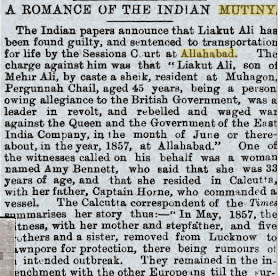
A report on the Maulavi’s trial on The New York Times. Source: http://parganachail.blogspot.com/2015/03/maulvi-liyaqat-ali-unsung-hero-of-1857.html?m=1
He was arrested on July 7, 1871 at Byculla station in Bombay, an event which was reported by the New York Times, Times London and Sydney Morning Herald. After a year in prison, on July 18, 1872, his trial began in the court of Judge A.R. Pollock in Allahabad. Judge Pollock wrote that during the hearing, hundreds of thousands of Maulavi’s supporters gathered outside the court to catch a glimpse of him.
Hearing the news of his capture and trial, Amy Harney, the only English woman to survive the Kanpur rebellion, who was then 17-year-old, reached Allahabad to testify in favour of the cleric. In her statement, she testified that the cleric not only saved her life but also reunited her safely with her family. On hearing testimonies of women like Harney, Sabiha White, and several others, Judge Pollock converted the cleric’s death sentence to a “kalapani” sentence, following which he was shipped to Port Blair.
Maulavi breathed his last in 1892. The state library of Allahabad still has the complete file of his case but it is in Persian, as was the custom then, and thus has few readers now.
After Independence, Prime Minister Jawaharlal Nehru met Maulavi’s descendants in 1957. His sword and torn kurta-pyjama are preserved in the Allahabad Museum. His descendants are settled in Mahgaon and some localities in Kareli. With the efforts of local villagers and his family, an educational institution and a library named after him were opened in Kareli.
In a country where cities and roads are named and renamed every other day and statues are installed at every nook and corner, no such honour has been bestowed upon Maulavi’s memory.
Today, when communal politics and hatred rages, it is worthwhile to remember this unsung hero.
Even though the governments of independent India have failed to honour the memory of its heroes, people have kept them alive in their songs and folklore.
One is reminded of a couplet by Bahadur Shah Zafar expressing his own anguish, which is equally apt for all the martyrs of his time:
How wretched is your fate, Zafar! That as your burial ground Even two yards were not to be had in the beloved’s land.
K.K. Pandey is the editor of a monthly magazine Samkaleen Janmat.
Arvind Kumar Singh’s article for Heritage Times and Khalid Bin Umar’s blog were secondary sources for this piece.
Primary sources for the piece were interviews and discussions with the late Quasi Naseem, a relative of Maulavi Liyaqat Ali. He was the only person from his village who visited Ali’s grave in Yangoon and was the founder of Maulavi Liyaqat Ali Library, Kareli, Allahabad. Interviews with Amir Kazi and Liyaqat who are relatives of Maulana Liyaqat Ali, were also sources of information.
An earlier version of the piece did not have this acknowledgement.
source: http://www.thewire.in / The Wire / Home> History / by K K Pandey / May 10th, 2022
While Allahabad’s sprawling Khusrau Bagh stands as a shadow of its eventful past, there is an attempt being made to convert it into a National Eco-Knowledge Park
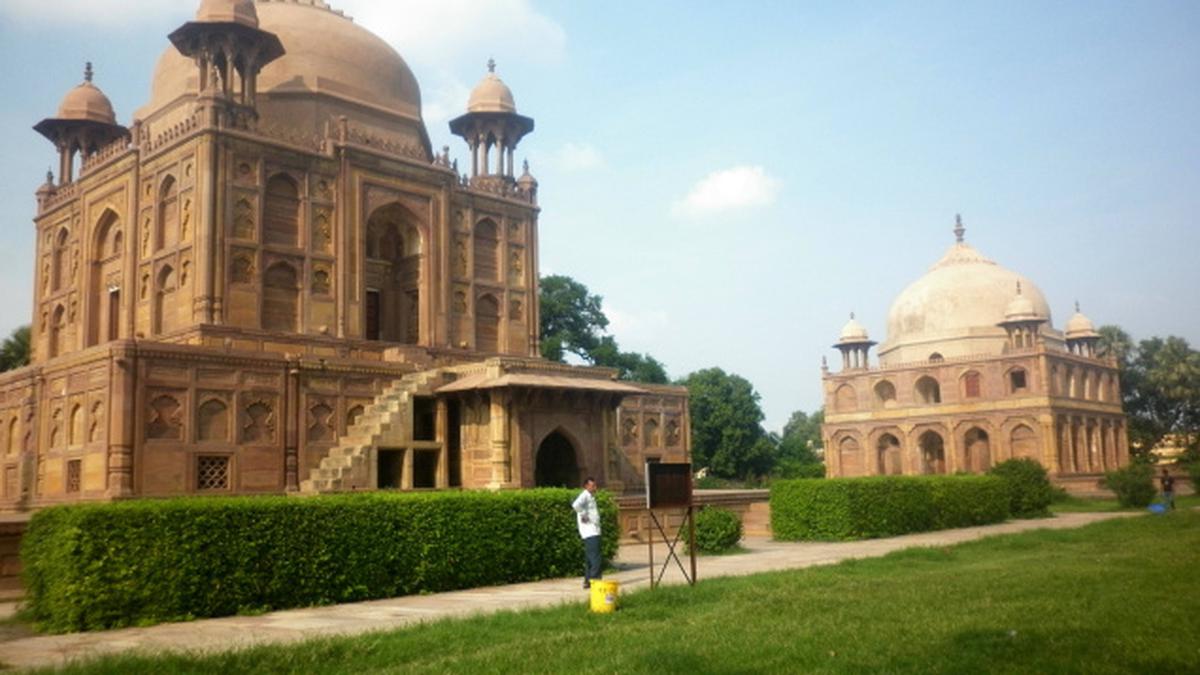
Historic testimony: Nithar Begum’s (left) and Khusrau’s tombs bask in their grandeur. Photo: Omar Rashid
To prove that their amazing escapade in Kafiristan was true, Peachey shows Rudyard Kipling, who was seated in his Pioneer newspaper office in Allahabad, his friend Dravot’s head, still wearing the golden crown.
This epic scene based on Kipling’s audacious novella The Man Who Would Be King fairly evokes the tragedy of Khusrau Mirza.
Like Dravot, Khusrau, the eldest son of Salim (later Emperor Jahangir) and the grandson of Emperor Akbar was the man who would be the king. However, fate meant that he died young, isolated to an insignificant corner of history.
Distraught over Salim’s indulgence in wine and opium, Akbar had considered the unlikely option of entrusting the amiable Khusrau with his throne. And when Prince Salim revolted and started holding court in Allahabad in 1599, Khusrau was driven into an incongruous conflict with his father to be Akbar’s successor.
Soon after and shortly before Akbar’s death, Salim was made Emperor and Khusrau was placed under strict surveillance at Agra. He escaped from there with 350 horsemen, eventually to be captured on April 27, 1606.
In his biography, Jahangir notes: “Kingship regards neither son nor son-in-law. No one is a relation to a king.” Following a futile attempt to escape, Khusrau was blinded, consequently disqualifying him from the throne. He was then transferred to the custody of Asaf Khan, brother of Nur Jahan and father-in-law of Prince Khurram (later Emperor Shah Jahan), the third son of Jahangir. In 1622, Khurram had Khusrau killed.
His body was brought to Allahabad and placed in a sandstone tomb, in a large quadrangle garden — Khusrau Bagh, enclosed by a high masonry wall and a labyrinth of evergreens.
Two other tombs were later built — one belonging to his mother Shah Begum, while the other was made at the instructions of his sister Nithar Begum, but never to be used as a cenotaph.
At first sight, the three tombs appear identical. But after readjusting your lenses, you will observe the major and minor differences, and that flawless Mughal symmetry.
A Hindu princess, Shah Begum (originally Man Bai), was the daughter of Raja Bhagvan Das of Amber. Troubled by the bitterness between Salim and Khusrau, she committed suicide by swallowing tiryaq (opium). Her tomb, designed in 1606 by Jahangir’s chief artist Aqa Reza, has a three-storied terrace plinth but is without a main mound. Experts have compared it to the construction in Fatehpur Sikri.
The Begum’s cenotaph stands under a large chahtri , which is surmounted on the plinth. The floral Arabesque inscriptions on the tomb were carved by Jahangir’s greatest calligrapher Mir Abdullah Mushkin Qalam.
Next to her tomb is Nithar’s tomb, architecturally the most elaborate and vivid among the three. It stands on a high platform, adorned with panels containing a scalloped arch motif. Inside the plinth, there is a small room whose ceiling is painted vividly with stars arranged in concentric circles. This decoration is repeated on the ceiling of the central room while the walls are painted with Persian cypress style plants and flowers.
The third in line and relegated to a corner is the tomb of Khusrau himself. The mausoleum has some high quality fretwork windows. The tomb of his mare gives him company.
Apart from the elegant tombs, the bagh is lacking in the grandeur one would associate with a Mughal garden. The greens outside the tomb area look no better than unkempt hair on an anxious head. The tall palm trees do little to fill that void. This can be attributed, to some extent, to the low footfall as visitors prefer the livelier Chandra Shekhar Azad Park and Anand Bhavan. A spontaneous survey of the bagh revealed five types of visitors; the list is not exhaustive, however.
First are those who consider the tombs just “too pretty to let go” without clicking a portrait. The second is a clan of students, who find solace and good study atmosphere under the palm trees. The third and the least interested in architecture are couples seeking privacy in some corner of the bagh .
The fourth lot are those suffering from indolence; those for whom the large structures provide ample shade for an afternoon nap on a sultry day, especially after a good quantity of litti . The final and the largest category consist of those who confuse Khusrau with the Sufi great Amir Khusro.
And if locals are to be believed, vagabonds make up the sixth category.
Taking view of the neglect and to give the bagh a greener look, district authorities recently announced that it would plant more than 50 bottle palm saplings, among other things to convert the bagh into a National Eco-Knowledge Park.
Drip irrigation system would also be introduced to provide optimum water supply, especially since the famous Allahabadi red guava is cultivated here. While efforts are being made to improve the bagh’s appeal, its relevance in the Indian freedom movement is also not so well-known.
During the First War of Independence or the Revolt of 1857, when several battalions revolted against the British, Maulvi Liyakat Ali took over charge as the Governor of independent Allahabad and made Khusrau Bagh his headquarters. The bagh , however, was recaptured within two weeks.
As for Prince Khusrau, remove the beautiful tomb and the huge garden, and he will be just a man who was blinded by his father and killed by his brother.
source: http://www.thehindu.com / The Hindu / Home> Features> Friday Review> History & Culture / by Omar Rashid / September 22nd, 2012
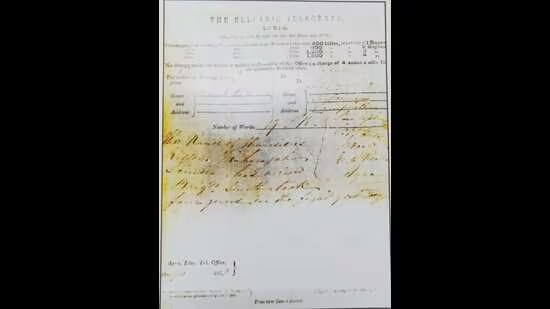
Over 168-year-old original records of the uprising, stored at the Office of the Regional Archives, Prayagraj, bear mute testimony to the British excesses that followed the revolt.
Original telegram sent by Major R. Hamilton from Gwalior to Lord Canning in Calcutta on June 18, 1858, informing him about the death of Rani Lakshmibai, preserved at the Regional Archives, Prayagraj. (Sourced)
On June 5, 1857, the then Allahabad (now Prayagraj) witnessed a key event in the revolt against the British–the First War of Indian Independence–with around 400 soldiers of the 6th Bengal Native Infantry, stationed in Allahabad, launching a massive uprising, also known as the ‘June Kranti’ under the leadership of freedom fighter Maulvi Liaquat Ali.
The soldiers, accompanied by residents from Chail, Khuldabad, Phaphamau, Dariyabad and Rasulpur localities of the city, attacked the mess of the 6th Infantry Cantonment, killed British officers and seized the government treasury.
Over 168-year-old original records of the uprising, stored at the Office of the Regional Archives, Prayagraj, bear mute testimony to the British excesses that followed the revolt.
Records reveal that Colonel Neil, who arrived on June 11—five days later—with three battalions of the British Army from Varanasi, unleashed a full-fledged armed offensive against suspects to regain control of Allahabad.
Records also indicate countless killings carried out through gunfire, along with the hanging of hundreds of suspects, including police constables who participated in the revolt across the localities of Chail, Khuldabad, Phaphamau, Dariyabad and Rasulpur.
A letter written by the secretary of the North-Western Provinces (NWP) to the commissioner of the Allahabad division, dated April 26, 1862, instructs the latter to arrest Nana Dhundhu Pant—also known as Nana Sahib—and others involved in the revolt.
According to Rakesh Verma, technical assistant at the Regional Archives, over a hundred police constables posted at Allahabad Kotwali in 1857 who had participated in the revolt were hanged.
“Administrative records written in Urdu titled Naksha Bagiyan Kotwali Allahabad, listing police constables who forcibly took their salaries for May and June 1857 and participated in the revolt—including Hanuman Prasad, Imdad Ali, Ashraf Ali, etc.—were hung by Major Henry Court on July 14, 1857,” he added.
According to Verma, original records pertaining to the revolt that began in Meerut in May 1857 and later spread to various parts of the state including Allahabad, Lucknow, Kanpur and Jhansi—preserved in the regional archives—testify to the ordeal Indians underwent during the freedom struggle.
Records preserved at the Regional Archives also include documents showing the seizure of property belonging to the Queen of Jhansi, Rani Lakshmibai, after her death while fighting British forces. Among these is the original copy of a telegram sent by Major R. Hamilton from Gwalior to Lord Canning in Calcutta on June 18, 1858, informing him about the death of Rani Lakshmibai in battle and the seizure of four cannons used by her army.
source: http://www.hindustantimes.com / Hindustan Times / Home> Cities> Others / by Kenneth John / June 05th, 2025
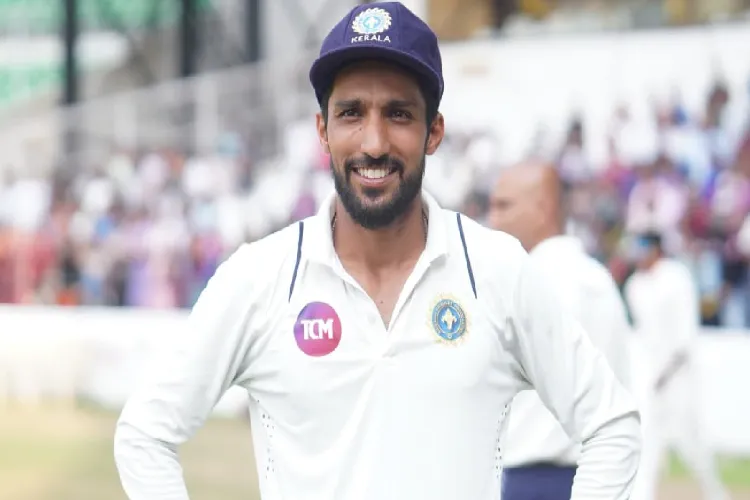
Kerala batter Mohammed Azharuddeen on Sunday replaced Tilak Varma as the South Zone captain for the Duleep Trophy semifinal against North Zone, starting at the BCCI Centre of Excellence on September 4.
Tilak Varma, who was originally named the South skipper, will not be playing the Duleep Trophy after he was named in the India squad for the upcoming Asia Cup.
Azharuddeen was the vice-captain of the side, and now that role has been handed to Tamil Nadu’s N Jagadeesan.
Tamil Nadu left-arm spinner R Sai Kishore too will not be playing in the semifinal for South Zone as he is still recuperating from a hand injury that forced him to skip the recent Buchi Babu Trophy.
Ankit Sharma of Puducherry and Shaikh Rasheed of Andhra have been added to the South squad for the Duleep Trophy last four match.
Both the players were already named in the standbys.
Ankit is a left-arm spinner who has taken 168 wickets from 68 First-Class matches, while Rasheed is a 20-year-old top-order batter who has made 1204 runs from 19 Ranji Trophy games.
He was drafted in by Chennai Super Kings during IPL 2025.
Dr. Hasan Haris presenting his paper at the International College of Surgeons (FICS) at ICS Conference
Aligarh:
Dr. Syed Hasan Haris, Reader at the Department of Surgery in J.N. Medical College of Aligarh Muslim University (AMU) got prestigious fellowship of the International College of Surgeons (ICS) Chicago, USA. He was awarded with the fellowship at ICS conference held recently in Pune, Maharashtra.
Dr. Haris was selected for this fellowship on the basis of his work in the field of Laparoscopy and Endoscopy and numerous presentations at various conferences and publication of his research papers both in international and national journals.
The committee appointed by the ICS recommended his name for the fellowship. He was invited to the conference to receive the fellowship. At the conference he presented his recent work entitled ‘Comparative Evaluation of Laparoscopic and Open Ventral Hernia Repair’.
Dr. Hasan Haris receiving the fellowship of the International College of Surgeons (FICS)
Prof. Abrar Hasan, Dean, Faculty of Medicine, Prof. Ashraf Malik, CMS and Principal, J. N. Medical College and Hospital, Prof. Imran Ghani, Chairman Department of Surgery and other faculty members have congratulated Dr. Haris on receiving the prestigious fellowship.
source: http://www.twocircles.net / TwoCircles.net / Home> Indian Muslim / by TCN News / December 08th, 2010