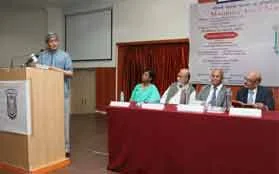
Dr. Mohammad Aslam Parvaiz delivering presidential remarks. (L-R) Dr. Qazi Siraj Azhar, Dr. Qaiser Jameel, Prof. Syed Najamul Hasan are also seen
MANUU organizes Third National Urdu Science Congress
Hyderabad (Maxim News):
People who do not invent either vanish or go into obscurity. These were the thoughts expressed by Dr. Qazi Siraj Azhar, Associate Professor, Michigan University, USA at the inaugural session of the Two-day National Urdu Science Congress 2019 organized by the Maulana Azad National Urdu University (MANUU), Hyderabad on National Science Day. Prof. Azhar was speaking as the chief guest on this occasion.
The two-day congress is being attended by participants from as far away as Lucknow, Delhi and Maharashtra, besides faculty and students of MANUU. The participants include practitioners of science, academicians, students, Urdu writers with interest in science and other stakeholders. Vice Chancellor, MANUU, Dr. Aslam Parvaiz, who presided over the inaugural once again emphasised the university’s efforts to provide textbook material in Urdu to the students of MANUU.
Dr. Qaisar Jameel, Head of the Department, Genetics, Bhagwan Mahavir Medical Research Centre, Hyderabad who has also been the former president of the Organisation for Women in Science in the Developing World, exhorted the students to have faith in their culture, traditions, and ethics if they want to succeed in life.
On this occasion, several books written in Urdu on different topics of science were also released.
Prizes were also distributed among students who participated in elocution, essay writing and other competitions on the topic “Science for people, and people of science” held in connection with National Science Day.
The congress is being jointly organised by the Centre for Promotion of Knowledge in Urdu and the School of Sciences. Prof. Zahid Hussain Khan, retired professor of physics from Jamia Millia Islamia, and Dr. Qaisar Jameel, Head of the Department, Genetics, Bhagwan Mahavir Medical Research Centre, Hyderabad were the guests of honour on this occasion.
Dr. Abid Moiz, Consultant, Centre for Promotion of Knowledge in Urdu & Convener of the congress welcomed the guest & delivered introductory remarks. Prof. S. Najmul Hasan, Dean School of Sciences presented a report on Science competitions and announced the winners. Dr. Ameena Tahseen conducted the proceedings. Later, in the afternoon a special session was held to commemorate 25 years of publication of Urdu monthly “Science”. Dr. Mohammad Aslam Parvaiz it’s Founder Editor was felicitated by Bazm-e-Khawateen, a renowned Women’s Organization from Hyderabad. (Maxim News)
source: http://www.indtoday.com / Ind Today / Home> Telangana / by Ind Gog / February 28th, 2019
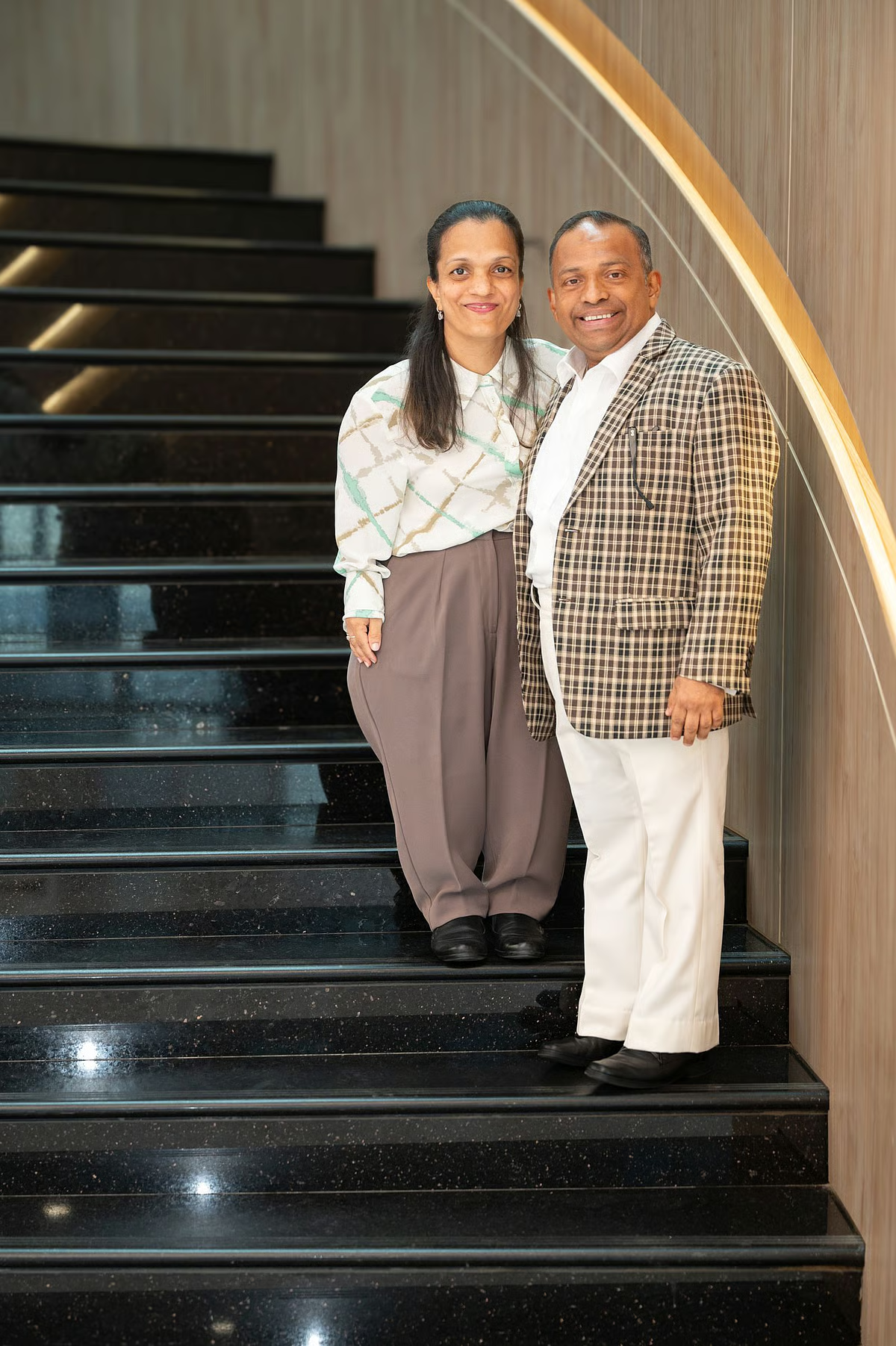
Residents Zahra Khumri and her husband Mufaddal have created a template of success for little people. And much of it entails looking within
Photos: Shihab
Beauty is in the eyes of the beholder. As is the notion of the ‘normal’. At 127cm and 138cm respectively, Dubai residents Zahra and Mufaddal Khumri may not fit into what is deemed normal by society. Not until you start speaking to them and peel off layers of what has been an extraordinary life. Zahra says she was born into a “normal” family (“My mother is 6ft tall,” she says).
And yet, it was in her childhood that she was diagnosed with dwarfism. Mufaddal, on the other hand, had induced dwarfism, which means his limbs were not proportionate to his body. It’s a diagnosis that tends to snatch hope away from people’s lives. But Mufaddal and Zahra have been, in every way, an embodiment of what human determination can achieve.
Growing up in Mumbai, neither Zahra nor Mufaddal had ever imagined companionship for themselves because we do not create templates of hope for those who are different than us. As Mufaddal says, “The world has been structured and ergonomically, it is meant for people of a certain height. I don’t blame the world for it. When you travel in a plane or train, you need to carry a foot rest so that your legs are comfortable and you don’t get pain in your thighs or lower part of your limbs,” says Mufaddal.
Zahra has had her own share of struggles. “Travelling in public places, particularly overcrowded spaces, has been a nightmare because there are no separate facilities and when we stand, we are at the height of a normal person’s buttock area, which is not very pleasant,” she says.
When everyday living is more challenging than others, how do you make room for hope? The daily jibes and amused stares are enough to break your spirit every day, every moment.
Take, for instance, the time when Zahra and Mufaddal were in their respective colleges. It’s not that they never liked others who are “normal” but the fear of rejection was enough to suppress any desire they ever had. “I began to channelise my pent-up frustration in books and music. I felt if I spouted poetry or recited ghazals, girls would get attracted to me. And none of them got attracted because for them, even a poet had to be a tall, dark and handsome man, right?” says Mufaddal. “And then there is the possibility of the offspring being short that often frightens people.” Zahra agrees that when the love part leaves a void, you tend to make up for it by excelling in education because there are fewer substitutes to knowledge.
Or take, for instance, the time when Mufaddal was told of Zahra by a cousin and they decided to meet on a date in Bandra, Mumbai. What was otherwise a memorable evening at a Chinese restaurant was also marred by curious onlookers staring at the couple. And then came their nikaah (wedding) ceremony. “The crowd was like, ‘Please go and have a look at this couple’. They were amused to see us,” recalls Zahra.
And the time when the couple thought of having a family. As Zahra decided to go for genetic counselling, the doctors advised that there was 50 per cent chance that her daughter would inherit the condition. “We were prepared,” says Zahra. “We told the doctor that we had led our whole lives as little persons, so we were really okay if our child had it.” Mufaddal and Zahra’s daughter Zoya did get bullied a lot as a result of which she had to change three schools.
“My daughter asks us to not accompany her to the mall because then people tend to laugh at us. When she is with her friends, she is calmer,” says Zahra. Mufaddal adds that Zoya feels the need to outshine others in order to get noticed. “But why does a person of short stature have to outshine beyond his or her capacity to get noticed? And once noticed, s/he again has to continue to do the outshining in order to be accepted. How is that fair?”
If everyday life is challenging for us all, imagine how challenging it is for those with short stature. What makes Zahra and Mufaddal’s story inspiring is how they have found their own happiness and fought their way to success instead of letting their condition define who they are. Today, Mufaddal is the CEO of Maldives Islamic Bank while Zahra works with people of determination in the UAE. Zahra is highly indebted to Gulshan Kavarana, the founder of SFS who also gave her an opportunity to work with famous Emirati artist Abdulla Lutfi.
“How many times have you seen CEOs of companies being short? Within organisations, you need to be heard louder than the rest and perform better than the rest. There is always going to be a prejudice that can come in many forms when it comes to increments and opportunities. When I shifted to my last job as the CEO of Maldives Islamic Bank, I thanked the board for taking a ‘short man’ as the CEO. I could not get that in some of my earlier banks, I could not rise to a level that I thought I would achieve,” says Mufaddal.
Inclusivity, he says, is not about gender alone, it is about giving people of “different abilities” the opportunity. Something that did not come easily to Zahra in her prime years. Zahra, who had studied engineering, was passionate about animation. But after her marriage to Mufaddal, she never got a chance to re-establish that career. It was years later that she began working closely with people of determination.
“The reality of becoming financially independent hit very late in life. Now I feel it’s important to be so. That’s what we keep telling our daughter. She wants to be a veterinarian. Thankfully, there is a precedent for that with one little person being a veterinarian.” The duo admits that living in the UAE has shaped their present and future and both are grateful for the facilities the country provides to people of determination.
Today, the couple is in a long distance marriage with Mufaddal’s work keeping him in the Maldives and Zahra’s keeping her in Dubai. Their daughter Zoya is 16, and the couple maintains that all they have taught her is to be confident “to look into the mirror and love each part of her body”. “I tell her that do not at any point feel that you are entitled to anything because you are a person of short stature. The moment you have that feeling of entitlement, you invite pity. You have to create a name for yourself. Let people see value in you,” says Mufaddal. “Even if you are discriminated against, the fire in you will burn much more.”
anamika@khaleejtimes.com
source: http://www.khaleejtimes.com / Khaleej Times / Home> Lifestyle / by Anamika Chatterjee / July 04th, 2025
An enjoyable history of Delhi and the Mughal dynasty that negotiates the end of an old world and the creeping advent of a new, unfriendly one.
The trading post established by the British East India Company at Surat, India, c.1680. From British Merchant Adventurers, published 1942. | Photo Credit: Universal History Archive/Universal Images Group via Getty Images
When the Bishop of Calcutta came to Delhi in 1824, he had a meeting with Akbar II, the penultimate Mughal emperor. It was a tragic affair. The royal audience hall was “full of lumber of all descriptions, broken palanquins and empty boxes”. The throne, meanwhile, was covered in pigeon’s dung. The king of kings, descended from another Akbar of legendary fame, himself lived in “pitiable” conditions, at the mercy of the East India Company. “I heartily hope,” the Bishop wrote, “that [the British] Government will reverence the ruins of fallen greatness, and that, at least, no fresh degradation” would be inflicted on this “poor old man”.
The Broken Script: Delhi Under the East India Company and the Fall of the Mughal Dynasty
Delhi in the age of this old man and his heir—specifically from 1803 until the Great Rebellion of 1857—is the focus of Swapna Liddle’s The Broken Script: Delhi Under the East India Company and the Fall of the Mughal Dynasty. Though the book, especially its second half, contains a good deal about literary culture, education, general life, and institutions under Company rule, its soul and principal substance lies in the tale of the imperial dynasty and their negotiation of decline. In theory, the Mughals remained sovereigns of India. In practice, however, these years witnessed the British chipping away at their claims, subjecting the emperor precisely to the “degradation” the Bishop feared.
It is surprising how many people think that the Mughals vanished somewhere in the 18th century; The Broken Script sketches skilfully the dynasty’s battle for survival in the period that followed, when, as Akbar II’s successor would lament, “nothing was left but the bare name instead of wealth, power and country”. Liddle’s research in resurrecting this time is solid: she utilises palace records, Company documents, files concerning the “mutiny” in 1857, (its chaos marking the end of the book), newspapers, and a host of private accounts. Every second page offers a detail, episode, or anecdote of the variety that makes researchers scribble notes. The writing itself flows with ease, making the text accessible (and enjoyable) to the lay reader.
Politics and control
At one level, Liddle’s book is a study of politics and control. When the British took Delhi from the Marathas in 1803, the Mughal emperor was already weak. Yet, he was still the fount of political legitimacy in the Indian subcontinent. As I discovered in my own research, as far south as Travancore, in present-day Kerala, rulers sought the emperor’s endorsement for their titles and position. Lord Wellesley, the imperialist Governor-General, was fully conscious that custody of the emperor was a political asset. And if the British didn’t take charge of him, a hostile power might exploit the Mughals’ symbolic appeal to unite anti-Company factions. The padshah had no teeth, that is, but even his shadow could be transformed into something potent.
At first, as Liddle shows, the British were courteous: honours were paid, and the Company took a ceremonially subservient pose with the imperial family. But no sooner was control established than the hacking away began. Before long, Company men wanted to assert superiority—one Governor-General in 1815 refused to visit Delhi, for the idea of having to stand in the emperor’s presence was grating. Akbar II possessed de jure sovereignty, but the British were, de facto, his masters. Slowly, the Company took control of the Red Fort, citing security. They meddled in the allocation of stipends to junior princes, exiled those of the royal house who were seen as dangerous, and introduced themselves even into the emperor’s domestic life. These were all political acts, oriented towards ejecting the Mughals from public consciousness. The Red Fort was a living reminder of their erstwhile greatness; so, Company officers began to urge the imperial family to move out and vacate their ancestors’ seat. Similarly, many were the painful negotiations over the dynasty’s pension. Though much was put down on paper, t The padshah was often reduced to pleading, at one time even seeking legal representation in London. The Company conceded certain claims, but only after extracting an advantage or benefit for themselves—it did not matter that he was in the right; they had the power to defy every treaty. Additionally, the British cut off the emperor’s ceremonial links with other Indian courts—the Company, not he, were hereon positioned as India’s supreme authority.
Highlights
Delhi from 1803 until the Great Rebellion of 1857 is the focus of Swapna Liddle’s The Broken Script.
Liddle’s research in resurrecting this time is solid.
She utilises palace records, Company documents, files concerning the “mutiny” in 1857, (its chaos marking the end of the book), newspapers, and a host of private accounts.
Interesting dynamics
Delhi itself, meanwhile, saw interesting transformations. The fall of its Muslim ruling elite, more and more on the margins under Company rule, saw also the corresponding rise of Hindu and Jain mercantile classes; this at times sparked religious animosities. The city was home to heaps of newspapers that reported enthusiastically on palace dynamics, bazaar gossip, speculated on British policy, and more. A degree of anglicisation was also in the air.: elites might serve oyster pate to Western guests, while shops obtained signboards in English. But equally, there were furious debates on whether English or “Oriental” learning should be patronised, and to what extent. To the more conservative, the city’s culture too seemed to be under siege.
Liddle’s study is illuminating, and reflective of how complex even a relatively narrow historical canvas and geographical space can prove. She reminds us that colonialism and empire were not merely about territory and battles, but also more intricate matters of ritual, protocol, and meanings. The book has a rich cast of figures—Anglo-Indian families related to the Mughals by marriage; corrupt British officers who might be manipulated by “natives”; professors and poets—some of whom deserve their own detailed studies. It is a gratifying read, about a dynasty and a city navigating the end of an old world, and the creeping advent of a new, unfriendly one.
Manu S. Pillai is a historian and writer.
source: http://www.frontline.thehindu.com / Frontline / Home> Books> Book Review / by Manu S Pillai / June 02nd, 2023
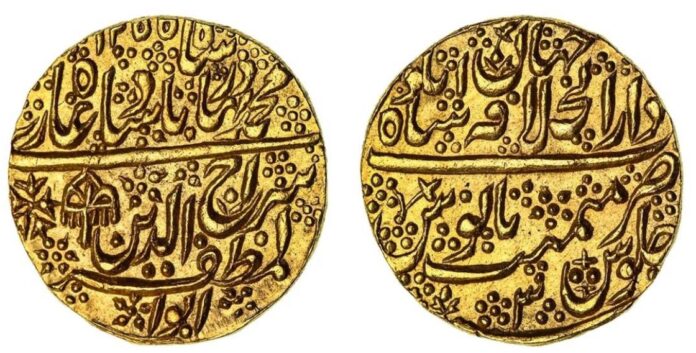
The last Mughal Emperor, Bahadur Shah II, might have been completely forgotten by his country and his people, but the interest in everything associated with him among numismatists and history enthusiasts around the world is soaring high. On August 28 numismatists and historians gaped in amazement when a Nazarana Gold Mohur of Bahadur Shah Zafar from the year 1839 was sold for an astounding sum of £571,500. This amount comes to around Rs 6.8 crore. The auction was conducted by Spink Auction, one of the most credible auction houses with a history of more than 350 years.
Not many are surprised at the interest shown in the nazrana mohur of the last Mughal emperor as everything associated with the doomed emperor is still very attractive to historians and numismatists. Bahadur Shah Zafar, or Bahadur Shah II (24 October 1775 – 7 November 1862) the last Mughal emperor of India was not just a vestige of past, he was a very popular leader, poet, sufi and a great freedom fighter who rose with his people against the tyrannical and brutal rule of the British East India Company. While the mutiny was defeated in a matter of months, Bahadur Shah Zafar lost badly, sacrificing his sons who were butchered by a British officer, faced sham trial where there was no hope of justice and the judge was doing all to punish the King and then faced the worst humiliation possible for any human to endure, let alone the king.
Bahadur Shah II was the 20th and the last Mughal emperor. Born Mirza Abu Zafar Sirajuddin Muhammad he succeeded his father, Akbar II, upon his death on 28 September 1837. His rule ended on 21 September 1857 when the mutineers lost the battle and the Emperor was arrested in Delhi, near Humayun’s Tomb by Major William Hodson. Bahadur Shah II was a titular emperor, or a namesake king as the Mughal Empire existed in name when he ascended to the throne as the authority of the empire had shrunk only to the walled city of Old Delhi or Shahjahanbad.
The country or the community haven’t done justice to the poet king, whose sacrifices for the nation and his opposition to the colonial rule have completely been ignored. Several of his sons and even grandsons were mercilessly massacred by the rampaging colonial officiers in the wake of Bahadur Shah Zafar’s defeat and his eventual arrests. He was also packed off to a faraway Rangoon, Burma where the last Mughal emperor spent his life in extreme penury and helplessness. Merely four years into his crushing and degrading imprisonment in the year 1862, at the age of 87, the last Mughal emperor developed some illness. Due to utter lack of healthcare facilities for the octogenarian emperor and his family, his condition deteriorated and became serious. There was only a farce treatment given to Bahadur Shah Zafar, but he couldn’t survive the humiliation heaped upon him over the last four years by brutal and wicked colonial rulers. The Emperor breathed his last on Friday, 7 November 1862 at 5 am. Instead of allowing the family to mourn the death of the emperor the Raj was more intent to force the king perpetual obscurity by keeping his grave away from the eyes of the world. He was buried at 4 pm and only two male members with a moulwi were allowed to offer truncated funeral prayer.
It should be noted that Nazarana coins struck in the name of last Mughal emperor Bahadur Shah II and minted at Shahjahanabad are extremely rare. For long, British used their coins for transactions in Delhi and other parts of India under their control, though the minting of nazrana coins in small quantities occurred sometimes under the direct supervision of the British officials.
source: http://www.muslimmirror.com / Muslim Mirror / Home> Art & Culture> Indian Muslim / by Muslim Mirror Special Correspondent / September 07th, 2025
Dr. Fakhruddin Mohammed, secretary, MESCO, Hyderabad.
Bhopal :
The head and heart qualities of Dr. Fakhruddin Mohammed, secretary of Hyderabad-based MESCO (Muslim Educational Social & Cultural Organization) were recalled in ample measure in an online condolence meeting which was held on Friday.
Dignitaries paid glowing tributes to the departed soul while recalling his contributions in multiple fields with special reference to health and education sectors. Everyone recalled his memories with Dr. Fakhruddin and prayed for his ‘maghfirat’. The meeting was presided over by Arif Mohammad Khan, Governor of Kerala.
Dr. Fakhruddin Mohammed, 61, passed away on May 5, 2021. He breathed his last at AIG Hospital in Hyderabad after a brief illness. He is survived by his wife, two sons and two daughters. He was a noted philanthropist and son of Dr. Shamsuddin, a leading practitioner and superintendent of Government Fever Hospital. There are more than 55 doctors in his family.
Earlier, the condolence meeting started with Tilawat-e-Qur’an and was attended by the family members of Dr. Fakhruddin, friends and former cabinet ministers & head of the institutions like Salman Khursheed, K. Rehman Khan, Sirajuddin Qureshi, SM Khan, Dr. Abdul Qadeer, Naved Hamid, Kamal Faruqui, Khwaja Shahid, Prof. Akhtarul Wasey, Prof. Iqbal Hasnain, Feroz Bakht Ahmed, Quaiser Mehmood, Dr. Salman Asad, Mohammad Naushad, Dr. Rihan Khan Suri, Dr. Mohammad Iftekharuddin and many more dignitaries.
The condolence meeting was organised by architect, writer, and social activist Kaleemul Hafeez, who was a close associate of late Dr. Fakhruddin.
In the meeting, it was collectively felt that Dr. Fakhruddin’s legacy must go on. On this note, five things were decided which included: 1. Scholarship in his name (proposed by Kaleemul Hafeez); 2. Award in his name (proposed by Mohammad Naushad, (president-Lok Seva Samiti); 3. Dr. FM Memorial lecture in IICC (proposed by SM Khan, Vice President-IICC); 4. Biography (proposed by Sirajuddin Qureshi, president, IICC) & 5. Centre in his name in MANUU (proposed by Feroz Bakht Ahmed, Chancellor, Maulana Azad National Urdu University, Hyderabad).
PFI Condoles The Demise Of Dr. Fakhruddin
Meanwhile, Popular Front of India (PFI) chairman OMA Salam has expressed his condolences on the demise of Dr. Fakhruddin Mohammed.
“It is with heavy heart that we received the news of demise of Dr. Fakhruddin Mohammed, renowned educationalist, philanthropist, community leader and secretary of MESCO”, Salam said.
His death, PFI, in a statement, said, will leave an irreparable loss to the Muslim community in Hyderabad and across the country. A physician by profession and a pious servant of the community, Dr. Fakhruddin spent most of his life in efforts for empowering Muslim community. He contributed remarkably by promoting education, community development, religious training and poverty alleviation among the Muslim community. He played instrumental role in the South India Council, a community empowerment initiative that later gave way to the formation of Popular Front of India.
Popular Front expressed its heartfelt condolences to the bereaved family and friends. May Allah Almighty accept his virtuous deeds and reward him with Jannah.
Meanwhile, it may be mentioned here that MESCO was founded in 1983 by Dr. Fakhruddin along with his team and he was instrumental in bringing Muslim doctors around the world on a common platform. He flagged off ambulance and relief aid services during the first wave of Covid in 2020 in collaboration with the Al Hamd Foundation. He transformed MESCO from a Diagnostic Centre to a group of educational institutions from KG to PG level.
source: http://www.indiatomorrow.net / India Tomorrow / Home> News> Society / by Pervez Bari / May 08th, 2021
Kulsum Sayani, born in 1900, was a freedom fighter, social reformer, and educator. Inspired by Mahatma Gandhi, she joined independence movements, promoted literacy among Muslim women, and edited the magazine Rahbar. Leading education initiatives, she empowered millions. Awarded Padma Shri in 1960, she passed away in 1987, leaving a lasting legacy.
Main Point:
1. Freedom fighter inspired by Mahatma Gandhi.
2. Promoted literacy, especially among Muslim women.
3. Edited “Rahbar” magazine to educate in simple Hindustani.
4. Led education initiatives, making millions literate.
5. Awarded Padma Shri (1960) and Nehru Literacy Award (1969).
———-
15 August 2025, India will complete 78 years of independence. The contribution of Muslim women in India’s independence has its own history which is often marginalized, this month we will remember those freedom fighter Muslim women whose contribution cannot be ignored.
An important name in this series is “Kulsum Sayani” who was the mother of famous radio announcer Amin Sayani.
Apart from being the mother of Amin Sayani, she was also a freedom fighter, social reformer and a great educational worker.
Kulsum Sayani was born on 21 October 1900 in the state of Gujarat, India. Her father Rajbali Patel, a doctor by profession, was the personal physician of Mahatma Gandhi and Maulana Abul Kalam Azad. In 1917, she got the opportunity to meet Mahatma Gandhi along with her father. After meeting Mahatma Gandhi, she was very impressed by him and vowed to follow the path shown by Mahatma Gandhi.
At the age of 18, Kulsum Sayani got married to Jan Mohammad Sayani, who was also a freedom fighter.
With the encouragement received from her husband, Kulsum Sayani used to participate openly in the movements run for independence.
In 1921, when the Prince of Wales visited Bombay, protests started in many places against him. Soon, unrest spread in the city. Lathicharge and arrests started in the city and martial law was imposed. Many people were seriously injured in this lath charge.
Recalling that time, Kulsum Sayani said that
“A new Congress Hospital was established to take care of the injured. My late husband Jan Mohammad Sayani was the first doctor to be in charge of it. We had a small Saxon car on which the Red Cross badge was clearly visible. My husband used to go to the hospital every day, on almost completely deserted roads, with policemen posted on both sides. I would sit by the phone until he called from the hospital and informed me of his safe arrival.”
At that time, along with the struggle for freedom, many programs were being conducted to eradicate the evils and illiteracy prevalent in the society. “Jan Jagran” programs were started to create awareness about social evils. Kulsum Sayani represented Mumbai city and its suburbs in these programs.
Kulsum joined the “Charkha Class” and started teaching the illiterate. “Each person, teach one” was a very effective method in adult education and Kulsum Sayani was the one who started this method.
In 1938, she appointed 2 teachers out of 100 at her own expense and started going to Muslim areas to convince Muslim girls and women to get educated. She went from house to house and convinced people to send their women and girls to classes but it was not that easy. According to Kulsum Sayani, many times people would shut the door on her face and say, “Why should women learn to read?” Even in such difficult circumstances, Kulsum Sayani did not give up but intensified her efforts.
To make her efforts stronger, she joined many committees formed for adult literacy.
Kulsum Sayani joined the first National Planning Committee established by the Congress in 1938 itself. Kulsum Sayani was given the responsibility of taking charge of 50 centres for Muslim women by the Bombay City Social Education Committee formed in 1939. Under Kulsum Sayani’s able leadership, this number soon reached 600. In 1944 she was also appointed General Secretary of the All India Women’s Conference and worked for women’s empowerment.
Noting her dedication and tireless efforts for education, The Times of India’s New Delhi edition (March 10, 1970) wrote, “Since she (Kulsum Sayani) took charge of the Bombay City Social Education Committee in 1939, five lakh adults have become literate in one of the five languages – Urdu, Hindi, Gujarati, Marathi and Telugu. Her days are spent running from school to school to encourage children to teach adults and her nights are spent dreaming up new literacy schemes.”
Kulsum Sayani used to visit many schools and encourage young students to spend at least 15 minutes of their day teaching an illiterate adult a new alphabet every day.
Kulsum Sayani once said, “Lower middle class women, who are forced to work, have no choice but to leave their children on the streets after school, while fashionable women have no time for children after bridge and mah-jong parties.”
In a later interview, Sayani revealed:
The quota of 25 students per teacher could not be gathered in one individual group, hence the teachers had to go from building to building. It was an uphill task. The interest of the women students was difficult to sustain, so dogged perseverance and close personal contact was needed to make the scheme successful….I used to roam from house to house and lane to lane collecting women, persuading them to read and write.
In 1940, Kulsum Sayani, under the guidance of Mahatma Gandhi and along with her son Amin Sayani, started publishing and editing the bi-weekly magazine “Rahbar”. The magazine was published in Hindi, Urdu and Gujarati.
The main objective of the magazine was to educate the newly literate in simple Hindustani language (a mixture of Hindi and Urdu).
In a letter dated June 16, 1945, Gandhiji addressed Kulsum Sayani as ‘Daughter Kulsum’ and wrote: “I like the mission of ‘Rahbar’ to unite Hindi and Urdu. May it succeed.” Rahbar magazine was very popular among the political prisoners in jails. They used to read it aloud and improve their language”.
Rustomji Faridoonji in her letter to Sayani noted about her Rahbar Magazine (1945):
”My heartfelt congratulations on your great and solid work. It’s a wonderful paper & may you live long to increase its activities a hundred fold & may your noble example be followed by hundreds of others in every large town. What a place adult education would take if even half a dozen persons in every town would work on your lines. You are after my own heart as you are doing practical work without talking”.
Kulsum Sayani’s fame as a social worker gave her the opportunity to represent India on many international platforms. In 1953, at the UNESCO conference in Paris, Kulsum Sayani met representatives of many countries and exchanged views.
In 1960, Kulsum Sayani had to stop editing her magazine Rahbar. The red tape that arose after independence forced her to take this step.
Kulsum Sayani was also awarded the Padma Shri in 1960 and the Nehru Literacy Award in 1969 for her unique work and contribution.
Kulsum Sayani passed away in 1987. A strong-willed woman who selflessly dedicated her life to education and development of society said goodbye to this world and left behind an inspiration “to do something for the society and bring about a change in the society”.
—–
Afroz Khan is a teacher by profession, focusing on writings about women and Islam. She holds a Bachelor’s degree in Education.
source: http://www.newageislam.com / New Age Islam / Home> Islamic Personalities / by Afroz Khan / August 05th, 2025
The Rani of Bilehra was an unlikely champion of emancipation
Illustration by Atri
White light fills the room as I open my eyes and stare groggily at the unfamiliar surroundings—a huge room with lime-washed walls, high ceilings with ornate arches and my bed, which sags a bit in the middle because it is a palang—with cloth strips stretched across and wound tightly at the edges. And then I remember: I am inside the mahalsara, the women’s palace, in the heart of the Qila of Mahmudabad, a living fort in the Sitapur district of Uttar Pradesh.
My family and I are guests of Raja Mohammad Amir Mohammad Khan. We will be spending two days here, participating in the mourning rituals of Muharram, one of the most prominent, and sacred, cultural observances by Mahmudabad’s royal family.
The palace is divided into two distinct sections—the zenana, the women’s section, and the mardana, the men’s area. In pre- and newly independent India, the women of the Raja’s family were confined within the zenana, where no men except close family members were allowed. The wings still remain distinct—my six-year-old son, Hasan, and I have been given a room inside the zenana, while my husband is in the mardana. Women walk freely in and out of the zenana, but men, other than the family, still cannot enter.
I get ready, leave my room and walk past the huge courtyard of the mahalsara, flanked by large imambaras. On one end of the courtyard are the chambers of the erstwhile Rani of Mahmudabad, the present Raja’s mother.
***
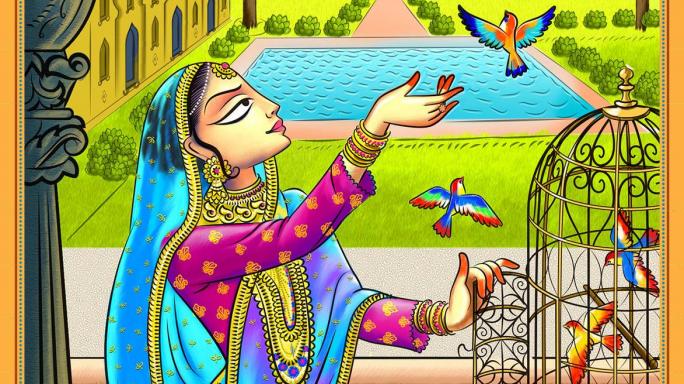
Rani Kaniz Abid was the queen of the estate of Bilehra, a royal in her own right. A strong, self-possessed woman, the Rani had depth of character and a sharp intellect. She had named the zenana, the usaara, which means ‘prison’. This is the place where humans are kept as prisoners, she would say. Once, someone brought a few colourful caged birds as pets for the young crown prince. But the Rani would not hear of it. She walked up to the cage and opened the gate, setting the birds free. This was her silent protest against the invisible cages of the world that women lived in.
At the far edge, to the right of the mahalsara, stands a lush green garden that has at its centre a large rectangular, glimmering pool flaunting a curved bridge over it. Known as the phulwari, this space was once the garden of the royal ladies. Within this very garden was a small menagerie that the late Raja built for his son. This zoo housed a myriad birds and animals for the amusement of the young prince, but it made the Rani uncomfortable. She would, one day, request her husband that as much as she would like her son to look at them and be happy, these creatures should be set free. You cannot cage living beings, was the lesson she instilled in her son.
Rani Kaniz Abid’s longing for freedom also stemmed, perhaps, from traumas of her early childhood, when she faced confinement at the hands of the British. Her brother, who was the heir-apparent, passed away at a very young age, and her father, heartbroken and overcome by grief, followed just three months later. Eight months on, her mother too passed on, leaving her and her three sisters orphaned. As the eldest, Kaniz Abid was to become the next Rani according to the rules of primogeniture, but she was still a Rani-in-waiting until she came of age. During this time she and her sisters were confined to a house where a British collector supervised every aspect of their lives. For her, that was the beginning of life in the usaara. A life of virtual imprisonment. That was also the beginning of her realization of what it meant to long for freedom, which she never lost even as the Rani of Bilehra.
***
Reminiscing, the Raja speaks of his mother’s deep religious convictions. But her spirituality was not in conflict with her championing of freedom. As a Rani who commanded power and respect, her life, she felt, remained cloistered in the usaara by patriarchy. And yet, she voluntarily chose never to reveal her face in public. The Raja recalls that for most of her life, his mother would insist on remaining purdah nashin [A woman who remains veiled in public in accordance with the practice of purdah]. In fact, her first passport had no photograph for identification, only a note saying purdah nashin! It was only much later that she agreed, when her daughter-in-law, with whom she was very close, “persuaded her and took her to England”.
Rani Kaniz Abid’s daughter-in-law Vijaya Khan, the present Rani of Mahmudabad, hails from a renowned family of Udaipur—the daughter of former foreign secretary Jagat Singh Mehta. Interestingly, in spite of the difference in religion, the cultural context of both places was surprisingly similar. Rama Mehta, the present Rani’s mother, in her book Inside The Haveli, has described vividly the separate zenana and mardana sections, and the various regulations within her marital home in Udaipur. Although the book is a fictionalized account based on her own life, it depicts real places and the real culture of the times.
Restrictions upon women existed uniformly across religions and geographies. And it was considered a way of ‘honouring’ the women of the nobility, by not letting a commoner have the privilege of setting eyes upon them. In practice, however, it became oppressive. But Rani Kaniz Abid, the queen who couldn’t stand cages, subtly and gently unlocked the gates of the usaara as well. She never asked her daughter-in-law to observe the restrictions of segregation, reflecting her firm belief that, in time, even the most entrenched systems would slowly but surely transform.
***
Back in the zenana, I am now in front of the Bara Imambara, participating in one of the processions that begin inside the mahalsara. This procession is accompanied by a horse that is decked up in ceremonial regalia to represent the steed of Imam Husain, the Prophet’s grandson, martyred in the battle of Karbala. The horse is a Mewari stallion, gifted to the Mahmudabad family by the royals of Udaipur. A caretaker leads the handsome animal into the zenana, and as they walk by, I take full notice of the man, and suddenly find myself struggling to suppress a wave of laughter in the middle of this sombre mourning procession.
The caretaker is wearing a ghoonghat, a chequered cloth drawn over his head. This veil will prevent him from resting his eyes upon the women inside the zenana. I mull over, with some amusement, this far superior solution for men who complain of being ‘lured’ by the mere sight of women.
He holds the reigns of the horse, while the ladies chant elegies, led by a distinguished woman—the Raja’s first cousin. Gazing at her as she recites, I wonder if the erstwhile Rani resembled her—silver hair, pale skin, almond eyes and a look of utter serenity. I am suddenly overwhelmed by a sense of solidarity and admiration for Rani Kaniz Abid, who may have accepted purdah, but dreamt of freedom, both for herself and for others in her care. Who valued the need for mobility and opportunity, and believed in setting free all living creatures from all sorts of cages—the visible and the invisible.
source: http://www.readersdigest.in / Readers Digest / Home> Features / by Zehra Naqvi / July 16th, 2019
Prof. A.M. Pathan, who headed two central varsities and introduced many new courses, to lay down office as CUK V-C on June 30
Prof A.M. Pathan
Abdul Jaleel Khan M. Pathan, popularly known in academic circles as Prof A.M. Pathan, would be laying down office as Vice-Chancellor of the Central University of Karnataka (CUK) on June 30 after completing his illustrious service in the field of higher education in different capacities, including the rare honour of being the Vice-Chancellor of two Central Universities and serving as Vice-Chancellor of Karnatak University, Dharwad, for two consecutive terms.
During his 14 years as the Vice-Chancellor of Karnatak University, Maulana Azad National Urdu University in Hyderabad, and Central University of Karnataka in Gulbarga, Prof. Pathan had set new standards to improve the quality of education and extend the reach of higher education to all sections of society.
A reputed geologist, who specialised in ore geology, he had completed his undergraduation and postgraduation in Karnatak University before doing his Ph.D. in Bangalore University. A bright student throughout his career, he was awarded the Wrangler Dr. D.C. Pavate Award for scoring the highest marks in B.Sc and won the same award in the M.Sc examinations of Karnatak University.
Prof. Pathan strengthened every institution that he led and was sensitive to the social engagement of the institution with its stakeholders. Life Fellow of the Mineralogical Society of India (MSI), he is presently its Vice-President. He had also held the post of President of the Association of Indian Universities by virtue of being the seniormost Vice-Chancellor.
Market-friendly courses
Dr. Pathan, who served as the Vice-Chancellor of Karnatak University for two terms from July 1996 to July 2002, was responsible for improving and strengthening the infrastructure of various departments and providing state-of-the-art laboratories and had introduced several vocational and market-friendly courses such as seed technology, tissue culture, food processing, corporate secretary, international economic and business, and biotechnology.
As the second Vice-Chancellor of the Maulana Azad National Urdu University, a Central University established by an Act of Parliament, he improved the reach and quality of the distance education offered by the University, benefitting more than 1.56 lakh learners in140 study centres in all the States and Union Territoriesof the country. A study centre was also established in Saudi Arabia for the benefit of the expatriate Urdu learners and he initiated steps to establish similar study centres in the U.K. and the U.S.
Prof. Pathan was responsible for introducing CBSE education in Urdu medium in the model schools established by the university in the educationally backward and Urdu-speaking majority areas such as Darbhanga.
He was a member of the site selection committee constituted by the Union Government and the UGC for establishing the Central University in the educationally backward Gulbarga district.
As the first Vice-Chancellor of the CUK, Prof. Pathan introduced many new courses at the undergraduate and postgraduate levels and was responsible for introducing a unique integrated course for the students coming out of PUC. The Central University of Karnataka also offered PG and Research programmes in English, Kannada, Hindi, Economics, Social Works, Commerce, Applied Geography and Geoinformatics, Psychology, Mathematics, Physics, and MCA, and a diploma in educational counselling.
Prof. Pathan opened the doors of the CUK for girl students hailing from the economically weaker sections by waiving the course fee and hostel fees.
The CUK also offered merit-cum-means scholarship to the extent of 20 per cent of the tuition fees collected in each course and a scholarship of Rs. 5,000 per month in addition to annual contingency of Rs. 12,000 to all the Ph.D. scholars in the University.
source: http://www.thehindu.com / The Hindu / Home> Features> Education Plus / by T V Sivanandan / June 25th, 2012
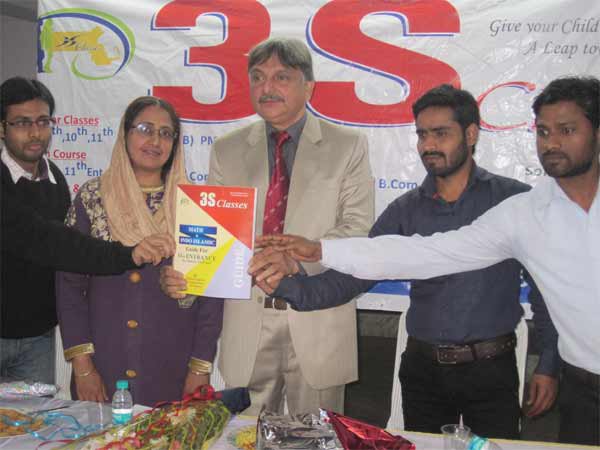
On the occasion of International Women’s Day a seminar on ‘The Rights and Duties of Women in Islam’ was organised by 3S Classes at Medical Road. Speaking in the seminar as Chief Guest President, Sir Syed Awareness Forum, Prof. Shakeel Samdani of Aligarh Muslim University said that the rights which were given by the Islam to the women about 14 centuries ago are still not available to the non-Muslim ladies. The Prophet of Islam (SAW) has done great favour to the women at large that can never be forgotten by the history. He said that the majority of allegations which are labelled against Islam are relating to women’s rights and it is said that Islam neither gives any rights to women nor liberty but the situation is otherwise. The Islamic Sharia gives complete liberty to women and they are allowed to do every work within the limits of Sharia. Islam gives the equality not similarity. Of course Islam does not permit the so called liberty of the west which permits nudity, obscenity, selfishness and frailty.
Replying the criticism of Islam he said that in western countries the rate of divorce and wife beating is the highest but the situation in Muslim countries and Muslim societies is much better. The provision of divorce provided by Islam is not a ‘Zehmat’ but ‘Rehmat’, if it is exercised in accordance with Quran. Even in India the dowry related deaths and the petitions relating to divorce are less in Muslims. As far as polygamy is concerned various reports of government of India have revealed that Muslims are less polygamous than non Muslims. In his marvellous speech Prof. Samdani said that the three women of Islam Hazrat Khadija (RA), Hazrat Fatima (RA) and Hazrat Ayesha Siddiqa (RA) have no parallel in women’s history and these three women have shown a clear cut path of sacrifice and success which will be remembered till the day of judgement. The life history of Hazrat Ayesha (RA), the beloved wife of Prophet of Islam is full of sacrifice and service for the cause of Islam and after the demise of Prophet of Islam (SAW) she lead the Muslim world intellectually and spiritually for decades.
Managing Director of 3S Classes, Imran Khan said that Islam has given all the rights to the women but there is a limit of those rights. Islam has accorded the best status to motherhood and in this way enhanced the status of women which has no parallel in the history.
Mrs. Anjum Tasneem of Uday Singh Jain Girls College threw light on the history of women’s day and said that on this day seminars, symposiums, conferences and processions are organized but the desired results are not achieved. Women are still being oppressed and harassed. While citing various reports she said that the laws are not balanced and the freedom which has been given to the women are immoral, unethical, unreasonable and un Islamic. That’s why instead of relieving them from hardship, their problems are increasing day by day. She advised the audience to turn towards the Islamic laws and lead their lives accordingly.
Mohd. Usama of Madarsa Arabia Tameer-e-Millat, Aligarh said that if the Muslim women want peace and dignity in their lives they should lead their lives in accordance with Sharia. They should also create an Islamic environment within the family.
Other speakers of the seminar included, Suhaib Salahuddin Siddiqui, Mohsin Jamal and Furqan Ahmad. The program was a great success in the sense that a large number of non Muslim ladies and teachers attended the program. In this program a book on ‘ Indo Islamic Culture’ authored by Imran Khan was released by the Chief Guest and other dignitaries.
The seminar was attended among others by Gaurav Sharma, Swati Yadav, Monika Singh, Poornima Singh, Ayesha Samdani, Hilal Asghar, Uzma Almas, Abu Khuzaima, Asma Alisher, Huda Khan Nadim Ahmed, Abdullah Samdani etc.
source: http://www.milligazette.com / The MIlli Gazette Online / Home> Community News / March 10th, 2015
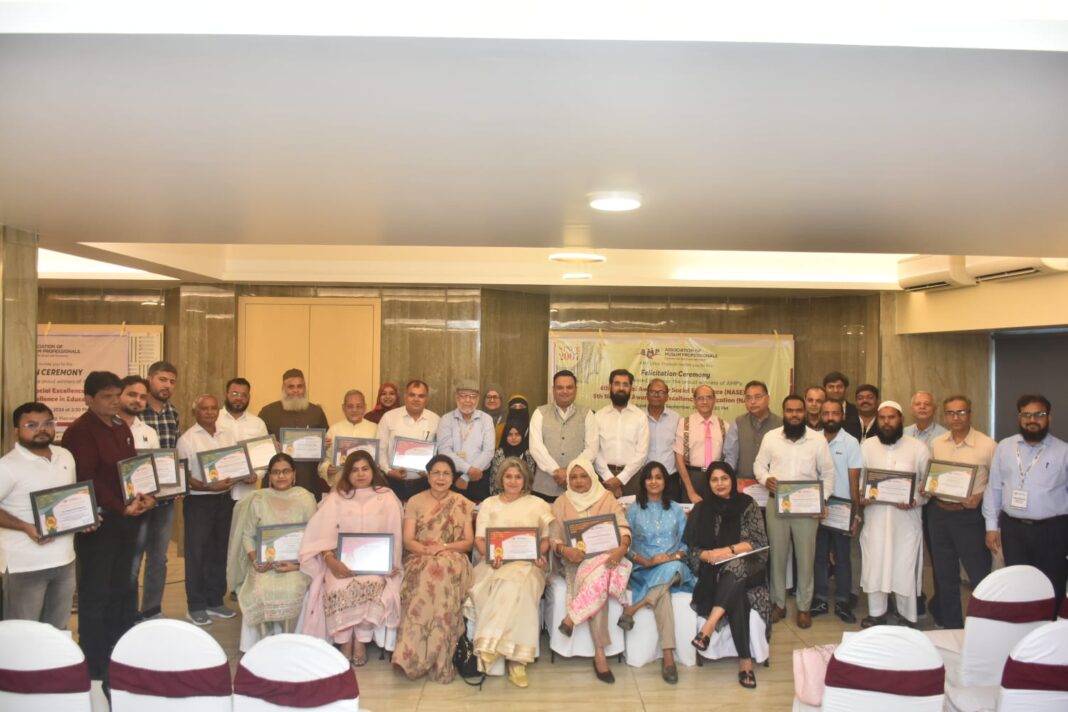
The Uttar Pradesh Chapter of the Association of Muslim Professionals (AMP) organized an ceremony at Hotel Arif Castle for the recipients of the 4th National Awards for Social Excellence and the 8th National Awards for Excellence in Education from Uttar Pradesh.
Among special guests were senior gastro surgeon Dr. Waliullah Siddiqui from Apollo Hospital and Mirza Mubeen Baig from Gautam Budh Nagar. Distinguished educationist and career counsellor Dr. Amrita Das was to attend as the chief guest but could not participate due to health issues, so former senior bureaucrat Zahra Chatterjee filled the role.
The programme began with a recitation from the Holy Quran by Maulana Muhammad Rehan Qasmi.
The welcome address was delivered by AMP’s Zonal Head for Central Zone, Syed Shoaib. AMP’s State Head, Shaheen Islam, introduced the audience to AMP’s objectives and activities, mentioning that this non-governmental, non-political, and non-profit organization was founded in 2007. Over the years, AMP has been engaged in educational, social, economic, and developmental activities aimed at empowering marginalized communities.
Guest of honour Mirza Mubeen Baig emphasized that working for NGOs is becoming increasingly challenging, and only those organizations that serve selflessly and with sincerity will succeed. He stressed the need for collaboration among serious NGOs to benefit from each other’s experiences.
Dr. Waliullah Siddiqui congratulated the awardees for their contributions to education and social services, highlighting that the responsibility for educating and nurturing children lies with both parents and teachers. In today’s changing times, this responsibility has grown even more significant. He shared personal lessons from his life, crediting his parents for playing a central role in his achievements.
Speaking as the chief guest, retired IAS officer Zahra Chatterjee praised AMP’s work and said that every individual’s contribution is crucial for the nation’s development. She stressed the need to reach out to the last individual to ensure educational awareness and economic stability.
Farooq Siddiqui, Head of AMP’s National Coordination Team, addressed the audience, stating that these awards aim to encourage individuals and organizations committed to transforming the nation through their selfless services. He emphasized the importance of collective efforts and mutual cooperation, noting that the welfare of the country and nation lies in unity and partnership.
The vote of thanks was delivered by Mohammad Mohiuddin, Chapter Head of AMP Lucknow, and the event was hosted by Dr. Sumbul Shakeel.
The recipients of the National Awards for Social Excellence included the Best NGO awardees:
Tauheedul Muslimeen Trust, Institute of Social Harmony and Upliftment.
Among the Change Maker Awardees were:
Professor Dr. Nuzhat Hussain from Lucknow, Dr. Mohammad Mubashir, Sabiha Ahmed, Balbir Singh Maan, Dr. Kaleem Ahmed Khan from Kanpur, Dr. Saba Yunus, Shahid Kamran Khan, Sagheer Khaksar from Balrampur, Dr. Saleem Mohammad Khan and Naseem Ahmed Khan from Aligarh, and Ramesh Chandra Srivastava from Ayodhya.
The recipients of the National Awards for Excellence in Education included:
Professor Mirza Mohammad Sufiyan Baig, Professor Naseem Ahmed Khan, Ausaf Azeem Kirmani from Aligarh, Mohammad Shahid Khan, Dr. Mohammad Shamim, Samiullah Ansari from Kanpur, Chitra Maheshwari from Lucknow, Dr. Roohi, and Maulana Mohammad Rehan Qasmi.
Lifetime Achievement Awardees included senior teacher Sheila Lawrence from Lucknow and Jamaluddin Khan from Kanpur.
A large number of attendees were present at the event, including Dr. Anis Ansari (former IAS), Mohammad Khalid Ashu, Mujtaba Khan, Najm-ul-Hasan Rizvi Najmi, Dr. Uzma Mubashir, Syed Abrar, Rizwan Ansari, Mohammad Zeeshan, Mohammad Imran, Javed Akbar Khan Lodi, Shahenshah Ansari, Fahad Mahmood, Ayesha Mahmood, Alma Siddiqui, Ayesha Alvi, Zaheer Baig, and Aqib Rauf.
source: http://www.indiatomorrow.net / India Tomorrow / Home> Education / by India Tomorrow / September 03rd, 2024