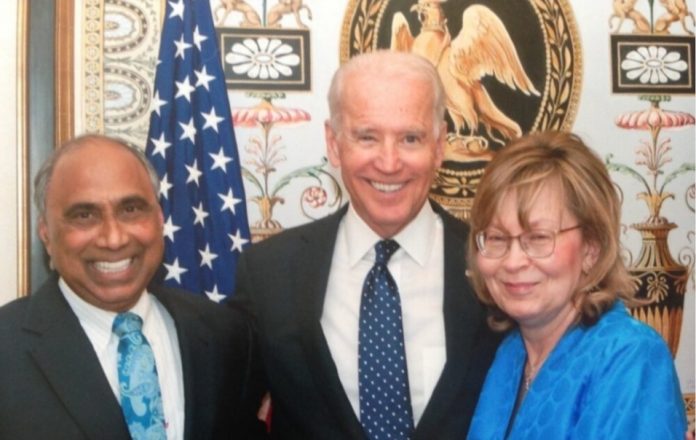
Frank Islam and his wife Debbie Driesman with Joe Biden.
Washington :
President Biden has appointed Dr. Frank Islam as a member of Commission on Presidential Scholars.
The Commission on Presidential Scholars is a group of eminent private citizens appointed by the President to select and honor the Presidential Scholars.
Commissioners are selected from across the country, representing the fields of education, medicine, law, social services, business, and other professions. The Commissioners make the final selection of the 161 Presidential Scholars. The Scholars demonstrate exceptional accomplishments in academics, the arts, career and technical education and an outstanding commitment to public service.
Dr. Frank Islam
Indian born Frank Islam is an entrepreneur, philanthropist, and civic leader with a special commitment to civic, educational, and artistic causes.
He currently heads the FI Investment Group, a private investment holding company that he founded after he sold his information technology firm, the QSS Group, in 2007.
Islam serves and has served on numerous boards and advisory councils including the John F. Kennedy Center for the Performing Arts, the U.N. Foundation, the U.S. Institute of Peace, and the Woodrow Wilson Center. He has also served or serves on boards and councils at several universities including John Hopkins, American University, George Mason University, the University of Maryland, and Harvard University.
An AMU alumnus Islam has written two well-regarded books on the American condition: Working the Pivot Points: To Make America Work Again and Renewing the American Dream: A Citizen’s Guide for Restoring Our Competitive Advantage.
He blogs regularly on Medium and was a contributor to the Huffington Post for nearly a decade.
In 2018, Islam established the Frank Islam Institute for 21st Century Citizenship which maintains a website and publishes a monthly newsletter featuring articles and other material directed at addressing the civic engagement deficit and challenges to democracy in the U.S. and internationally.
Islam received his B.S. and M.S. in Computer Science from the University of Colorado at Boulder.
source: http://www.muslimmirror.com / Muslim Mirror / Home> Education> Indian Muslim> Positive Story / by Muslim Mirror Network (headline edited) / July 16th, 2022
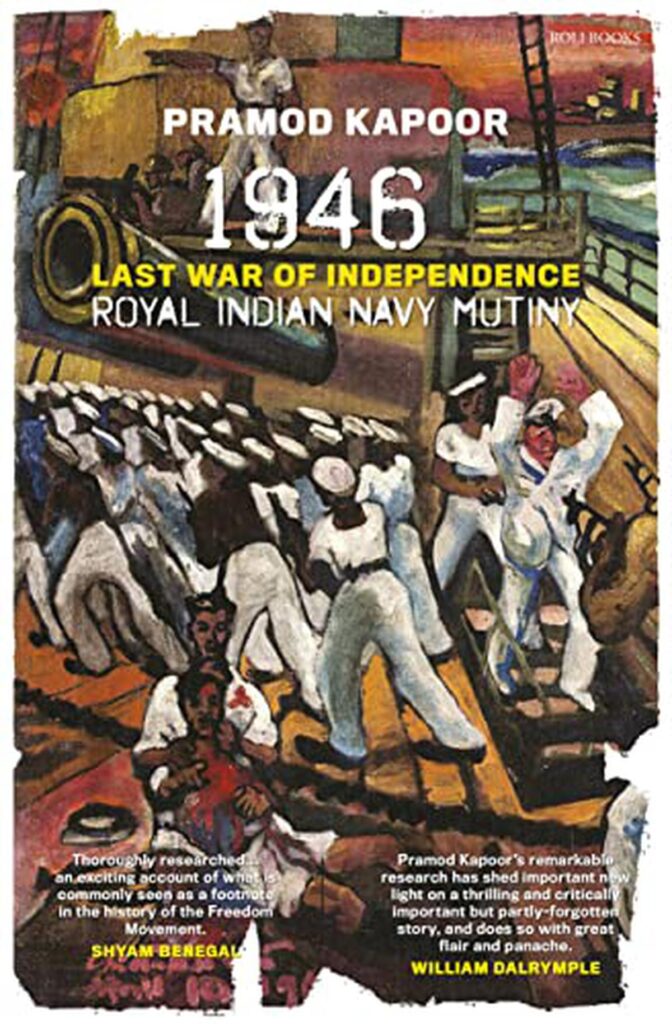
Pramod Kapoor transforms a footnote in history into a remarkable account of a rebellion that convinced the British it was time to leave India
As rightly remarked by Shyam Benegal, a footnote in the history of the freedom movement has been turned into an exciting and important account in Pramod Kapoor’s 1946 Last War of Independence: Royal Indian Navy Mutiny. Pramod himself stumbled onto this forgotten story while researching for his book on Gandhi: “After the draft of the Gandhi book was done, I re-read the Royal Indian Navy mutiny episodes and realised the magnitude of the event.”
Reports of the revolt
When Pramod began his research, he discovered hundreds of reports by British admirals, commanding officers of ships and shore establishments, cables and letters exchanged between London and Delhi, proceedings in the British parliament and debates in the Legislative Council in India. They were “honest,” but were told from the British point of view. For another view, Pramod waded through hundreds of newspaper reports and documents at libraries, met people with knowledge of the revolt and toured HMIS Talwar, the signal school of the Navy at Colaba, where “inflammatory slogans” had been written on the walls and “seditious pamphlets” were circulated. A tour of the dockyard and areas of Navy Nagar in Mumbai helped him understand the “history and geography of the area where the uprising took place.”
In February 1946, ratings, or the lowest rung of sailors in the Royal Indian Navy hierarchy, staged a revolt. The young sailors were protesting against the fact that things they were promised at the time of recruitment had not been honoured: living conditions were horrible; the food worse and there was rampant racial discrimination. Also, says Pramod, inspired by the Indian National Army (INA), they were politically charged and keen to play a part in India’s freedom movement. Within 48 hours, the strength of the mutineers grew to 20,000, and they took over ships afloat and on-shore establishments. Servicemen in the army and air force, and civilians joined the protests.
The sailors pulled down the White Ensigns of the Royal Navy and hoisted three flags — the tricolour of the Congress, the green of the Muslim League and the red of the Communist party, writes Pramod. Their demands included the release of all Indian political prisoners and soldiers who had fought in the Azad Hind Fauj. There was a direct connection, says Pramod, to the INA trials which were going on at the time. In days, the British put down the rebellion with a “combination of brute force and guile.”
Pitched battles were fought in Bombay and Karachi when the British tried to wrest back control of the ships and naval establishments from the sailors. Indian soldiers were reluctant to open fire on fellow Indians. Thus, contends Pramod, though the rebellion was put down, the British realised that it was time to quit India.
For Pramod, however, the politicians did not exactly cover themselves in glory. “They actually helped the British put an end to the uprising, despite widespread sympathy for the ratings across the nation.”
The promises Indian leaders made to the sailors at the time of surrender were not kept, he points out. Pramod also strongly believes that Partition “would have been less bloody if the political leaders had tried to build upon the communal unity created by the events of February 1946 instead of ignoring it.” This had been the view of the firebrand socialist and freedom fighter Aruna Asaf Ali as well. Even after Independence, there have been efforts to “blot out memory of the mutiny,” so much so that the Bengali thespian Utpal Dutt’s fictional play based on it, Kallol (Commotion), faced “obstruction and unofficial censorship.”
Before the protest
In the run-up to the uprising, the British were conducting the open trial of three Army officers of the INA — Prem Kumar Sahgal, Shahnawaz Khan and Gurbaksh Singh Dhillon. “Putting a Hindu, Muslim and Sikh jointly on trial at the Red Fort at a time when most Indians were deeply sympathetic to the INA meant that three major communities stood unitedly behind the call for Independence,” writes Pramod.
But leaders of the Congress were of the view that their idea of a peaceful culmination to a freedom struggle and smooth transfer of power would have been lost if an armed revolt succeeded with undesirable consequences. Thus, it was not an easy situation for political leaders to close ranks with the ratings.
Pramod has done a commendable job in going into all aspects of the rebellion. In the chapter titled ‘The Gathering Storm’, Pramod narrates the genesis and warnings of the brewing revolt. The unjust manner in which the British had treated the INA officers stirred anger and resentment, particularly at the signal school of HMIS Talwar, where the sailors were from a better educational background, and aware of the “rebellious activity taking place beyond the high walls of their barracks.” One of the villains was surely Commander Arthur Frederick King whose rude behaviour and “foul, racist language” sparked the protest at HMIS Talwar. As Talwar was the centre of all communication, the spark soon became a fire, with the strike being disciplined and well-organised.
The chapter, ‘Planning the Mutiny: The Secret Heroes’, reads like a thriller. The initial planning took place in a flat belonging to Pran and Kusum Nair on Marine Drive. The Nairs were friends with two of the key planners, Rishi Dev Puri and Bolai Chandra Dutt, and Pramod profiles the “heroes of the mutiny” in great detail.
He also adds an extensive Epilogue providing a glimpse of the life of the key protagonists post-uprising as also notes on some of the ships and shore establishments. It is an exceptional book and a must-read for anyone interested in the freedom struggle.
1946 Last War of Independence Royal Indian Navy Mutiny; Pramod Kapoor, Roli Books, ₹695.
The reviewer was with the Indian Navy during the Bangladesh liberation war.
source: http://www.thehindu.com / The Hindu / Home> Books> Reviews / by KRA Narasiah / May 07th, 2022
AIMIM led by Hyderabad MP Asaduddin Owaisi has opened its account in Tamil Nadu by winning two seats in municipal elections.
The Hyderabad-headquartered party won two wards in Vaniyambadi municipality where elections were held on February 19 and the results declared on February 22.
All India Majlis-e-Ittehadul Muslimeen (AIMIM) won two of the 16 wards it contested in Vaniyambadi.
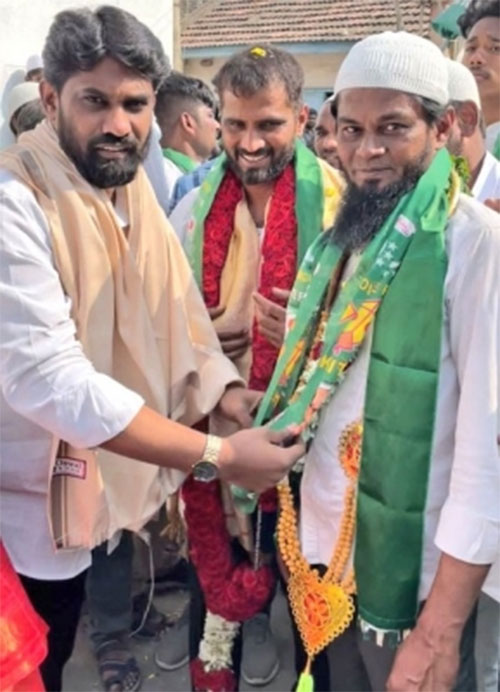
Niyamatullah and R. Nabeela were the two AIMIM candidates elected to the 36-member municipality.
Muslim League had contested the municipal polls in alliance with the ruling DMK. In both the wards won by AIMIM, Muslim League candidates finished second.
According to AIMIM leaders, Nabila secured 50.46 per cent votes in ward number 19, while Nematullah polled 34.10 per cent votes in ward number four.
AIMIM Tamil Nadu unit president T. S. Vakeel Ahmed thanked people for electing two party candidates. Party in charge Rehmatullah Tayyab and party corporator in Hyderabad Rashiduddin Faraz had campaigned for the party.
The victory in two municipal wards in Tamil Nadu came amid AIMIM’s continuing efforts to expand to various states.
This comes months after the party’s unsuccessful bid to open an account in Tamil Nadu Assembly elections. It had fielded candidates in three constituencies under an alliance with Dinakaran-led AMMK but drew a blank.
Tamil Nadu is the fourth state in south India after Telangana, Andhra Pradesh and Karnataka to have its representation in municipal bodies.
AIMIM has two MPs one each from Telangana and Maharashtra and 14 MLAs – seven in Telangana, five in Bihar and two in Maharashtra.
The win in Tamil Nadu came amid the party’s attempts to open its account in Uttar Pradesh Assembly elections. AIMIM chief Asaduddin Owaisi is running a hectic campaign in Uttar Pradesh. The party has announced plans to contest 100 seats in Uttar Pradesh.
source: http://www.daijiworld.com / DaijiWorld.com / Home> National-World / by IANS / February 23rd, 2022
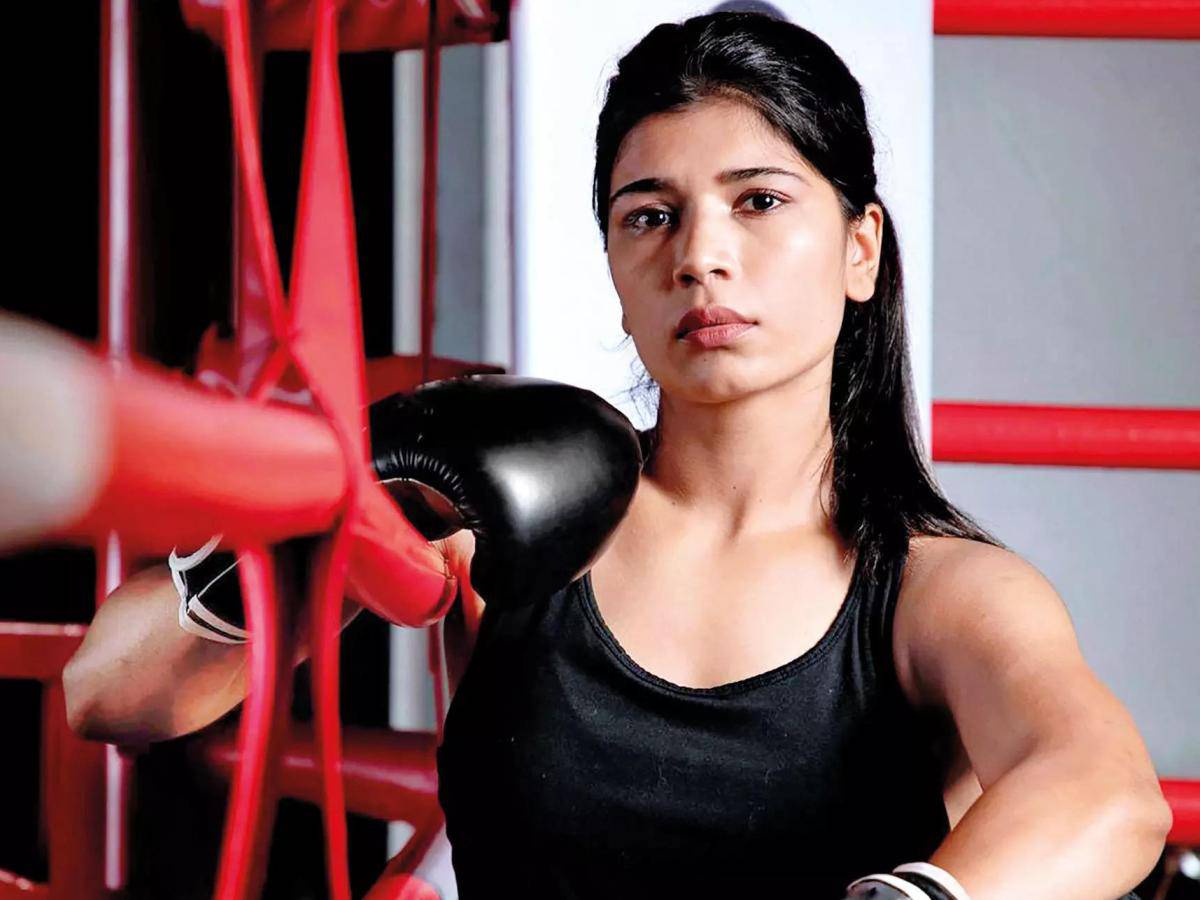
New Delhi: Indian boxers Nikhat Zareen (52kg) and Nitu (48kg) struck gold at the 73rd Strandja Memorial Tournament in Sofia, Bulgaria by notching up thoroughly comprehensive victories in their respective finals on Sunday.
Nitu prevailed 5-0 over Italy’s Erika Prisciandaro, a former youth world championship bronze-medallist. Zareen, on the other hand, outpunched Ukraine’s Tetiana Kob, a three-time European Championships medallist 4-1.
While Nitu produced a wonderful counter-attacking performance by taking full advantage of her longer reach and taller frame, Zareen was engaged in a draining and messy bout which had its fair share of clinching, holding and even some tumbling over in the ring.
“Both of them displayed completely different styles but both produced excellent performances. Credit to Nitu for keeping her composure and trusting her counter-attacks against an aggressive opponent,” national women’s team coach Bhaskar Bhatt told PTI over phone.
“Nikhat had to fight from close range throughout and she did well to land clear punches even though her opponent was not giving her a clear shot,” he said.
India thus finished the tournament with three medals this time, Nandini (+81kg) being the third podium finisher with a bronze.
The Hyderabad-based Zareen, who is a multiple-time national medallist, had won a gold medal at the Strandja Memorial’s 2019 edition as well. With another one added to her kitty this time, she became the first Indian boxer to claim two gold medals at the tournament.
“You can call me the queen of Strandja. I am just so happy right now,” the 25-year-old laughed, out enjoying the snowfall after her triumph.
“This one is the more special of the two as I beat an Olympic medallist (Turkey’s Buse Naz Cakiroglu who win silver in Tokyo Games) in the semifinals. It is a perfect confidence booster when three major events (the world championship, Commonwealth Games and Asian Games) are lined up,” she added.
Nitu is a two-time former youth world champion and is also a former gold-medallist at the Asian youth championships.
The 21-year-old hails from Haryana’s famed cradle of Indian boxing, Bhiwani’s Dhanana village.
The youngster was introduced to boxing by her father, who took a three-year leave without pay from his state government job to help her get coaching in her formative days.
He eventually rejoined work in Chandigarh when she started doing well at the international level.
“He works in the Haryana Secretariat and had a huge role to play in shaping her. She is a very hard-working girl,” Bhatt said.
India won two medals in the last edition of the tournament with Deepak Kumar and Naveen Boora securing silver and bronze respectively.
The performance of the men’s squad was underwhelming this time with none of the seven in fray managing to enter the medal rounds.
In all, the tournament featured over 450 boxers from 36 countries, including traditional powerhouses such as Kazakhstan, Italy, Russia, France and Ukraine, where Russia launched a military operation on Thursday despite global appeal for restraint.
The Strandja Memorial is one of Europe’s oldest boxing competitions and features high quality boxers from across the world.
India’s best ever performance in the prestigious tournament came in 2019, when world silver-medallist Amit Panghal, Zareen and Meena Kumari Devi claimed gold medals for the country in addition to a silver and three bronze medals.
In 2018, India came back with a higher tally of medals — 11 in all — but the gold count was lesser than 2019.
That year the country won two gold, three silver and six bronze medals with the men contributing five of them.
source: http://www.siasat.com / The Siasat Daily / Home> News> Sports / by PTI / February 27th, 2022
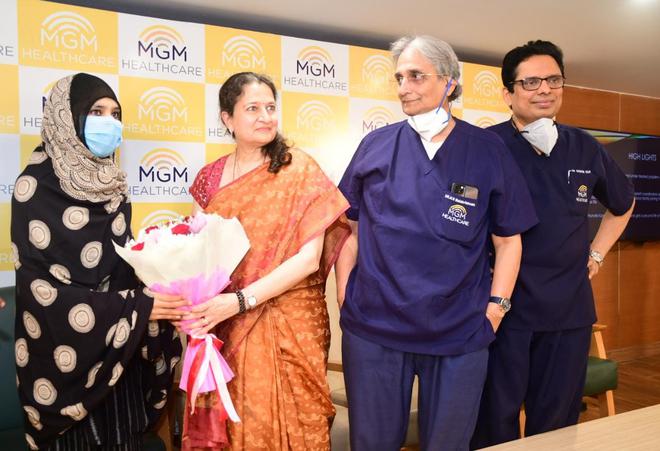
Shahzadi Fathima with the doctors of MGM Healthcare in Chennai. | Photo Credit: K. Pichumani
Shahzadi Fathima from Srinagar was lucky to receive the organ amid little hope of survival
A 33-year-old Kashmiri woman will be heading home with the heart of a Tamil youth. Shahzadi Fathima from Srinagar was lucky to receive the organ amid little hope of survival.
For the past six years, Ms. Fathima had been showing worsening signs of heart failure. Three years ago she was referred to R. Ravi Kumar, senior consultant and clinical lead- Cardiology and Heart Failure Programme at MGM Healthcare.
At that time she was prescribed medicines for swelling in her legs and it helped. But the disease progressed and her restrictive cardiomyopathy, a condition where the chambers of her heart stiffened over time, led to severe heart failure.
“In November we received a call from the doctor asking us to come. They hoped to make some arrangement for transplant,” said Ms. Fathima’s brother Yunis, a daily wager.
The siblings took a train to Chennai and were supported by Aishwarya Trust, a non-governmental organisation that finances cardiac surgeries and heart transplant for children. Chitra Viswanathan, who runs the trust, raised the funds.
Ms. Fathima was admitted to the hospital on Dec. 31 with signs of severe heart failure. On January 26, doctors identified a suitable brain-dead donor in a hospital in Tiruchi.
“An 18-year-old boy lost his life in a road accident and his family was willing to donate his organs,” K. Suresh Rao, co-director of the hospital’s Institute of Heart and Lung Transplant and Mechanical Circulatory Support said.
The heart was flown in and transplanted in Ms. Fathima. He condition is improving and she would be discharged in a couple of weeks. MGM Healthcare provided the transplant at a subsidised cost. Typically, a heart transplant could cost ₹ 25 lakh, doctors said.
K.R. Balakrishnan, who performed the surgery, said: “When she came, she couldn’t walk into her room. We waited three months (for the organ).” The donor had donated several organs of which the hospital used the heart and lungs. A resident of Besant Nagar received a donor lung, he said.
Ms. Fathima would have to visit the hospital six months later for a review. She would receive her supply of immuno suppresants and other medications for a certain period when she leaves for Srinagar. The doctors would monitor her health virtually through medical reports and blood tests that she would be advised to take periodically.
source: http://www.thehindu.com / The Hindu / Home> News> Cities> Chennai / by Special Correspondent / Chennai – February 23rd, 2022
Shruti Nagar has topped the December 2021 CS Professional exam securing the Rank 1 whereas Hari Haran bagged the second rank.
Two Muslim candidates have figured in the Merit List of 21 candidates who have emerged as toppers in CS Professional exam conducted by Institute of Company Secretaries of India (ICSI) in December 2021.
The two Muslims who figured in the CS Professional 2021 Merit List are Abbas Ali Asgar Sabuwala and Tariq Hussain.
While Abbas has secured the 7th Rank in the merit list, Tariq bagged the 14th rank.
CS Professional Toppers
Shruti Nagar has topped the December 2021 CS Professional exam securing the Rank 1 whereas Hari Haran bagged the second rank.
Three candidates – Jyoti Ashok Kumar Sah, Khushi Sanjay Mehta and Jay Jitendra Mehta, have jointly secured the 3rd Rank.
CSI has published the rank and roll number of the candidates. Their mark sheet and score have not been published on the official website.
ICSI declared the CS Professional 2021 result at 11:00 am Friday Feb 25, 2022. CS Executive result will be declared today at 02:00 pm.
Steps to check ICSI CS Professional Dec 2021 Result
1. Click here to go to official website: icsi.examresults.net. 2. Select Examination. 3. Enter Roll Number. 4. Enter 17 digit Registration Number. 5. Click on Submit button.
Along with the result, the Institute of Company Secretaries of India (ICSI) will also release the list of 25 rank holders and toppers.
Candidates should note that ICSI will result in online mode. No physical copy of marksheet will be provided to the candidates who appeared for CS Executive Programme. Candidates who appeared for Professional Programme will get physical copy of their result on the registered address.
“The Result-cum-Marks Statement for Professional Programme (Old and New Syllabus) Examination will be dispatched to the candidates at their registered address soon after declaration of the result. In case the physical copy of Result-cum-Marks Statement is not received by any candidate within 30 days of declaration of result, such candidates may contact the Institute at : exam@icsi.edu along with his/her particulars”, the ICSI said.
The Institute of Company Secretaries of India (ICSI) had declared CS Foundation result of December 2021 on January 20, 2022. Three Muslims had figured in the CS Foundation Merit List.
Meanwhile, ICSI has also released the CS Executive and CS Professional exam 2022 dates. As per the time table released by ICSI, CS Executive and Professional exams will be conducted from June 1 to June 10, 2022.
Online application for June 2022 CS exams will begin on February 26.
source: http://www.ummid.com / Ummid.com / Home> India> Education & Careerts / by Ummid.com News Network / February 25th, 2022
If you thought your handwriting doesn’t matter in the digital world, think again.
Imran Baig,Global Penmanship Academy (File Photo)
Bengaluru :
Growing up, we’ve all heard that handwriting is a skill that never fades. However, over the years, writing has become less and less common thanks to gadgets taking over our existence. But Imran Baig, founder of Global Penmanship Academy, a handwriting analyst, is working on making people fall in love with writing once again, and supporting them to forge their future using the power of a pen.
“It’s a skill that many of us have but just don’t know the right approach to, and that’s why my workshops come in handy for them,” says Baig, who takes three classes over the weekends, teaching one the different tools to write and how to achieve the speed they want.
Baig got certified in 2004 from Handwriting University International, California, at the age of 21, making him the youngest individual in the world to pass out of the university. He has developed specialised programmes on Handwriting Development for children and Grapho Therapy for adults.
“Since children are growing up, starting them out early is a good approach. This way, they will learn about which pen or pencil is ideal for them, based on their finger structure. They will also learn the right speed to write in so they can attend their exams more efficiently,” he says.
“As for adults, finding their right signature is the most important factor as they are often influenced by something we have observed growing up. Through the workshops, I help them analyse and understand which style of theirs showcases their personality. This will help their personality development as well,” adds Baig.
He points out that grapho therapy — usually done after the detailed analysis of the overall personality of someone by studying their handwriting — is a great way to understand the compatibility of a person.
“Though the workshop I had before Valentine’s Day wasn’t really related to the day, it’s important to talk about how one’s handwriting can help understand your compatibility with another person. In a world of texting and typing, I’m trying to encourage people to write more, rewire the way they think and present themselves and develop their personality along the way,” says Baig, who points out that comments like “Thank you for introducing me to myself” from those who attended his workshop is why he does what he does.
source: http://www.newindianexpress.com / The New Indian Express / Home>Lifestyle> Books / by Anila Kurien, Express News Service / February 21st, 2022
REST IN PEACE Akbar and Mariam’s tomb are in close proximity at Sikandra
With a Goan professor claiming her to be a Portuguese lady, the contentious issue of Jodha Bai’s existence refuses to fade away
The controversy over Jodha Bai never seems to die down. After the film Jodhaa Akbar, a Goan Professor of History, Luis de Assis Correia has claimed in his new book “Portuguese India and Mughal Relations 1510-1735” that she was actually a Portuguese lady, Dona Maria Mascarenhas. She and her sister Juliana were rescued from pirates by the Portuguese and handed over to Bahadur Shah of Gujarat who presented them to the court of Akbar.
According to the book, Akbar, then 18 married Maria (17) but the Portuguese were loathe to admit that one of their own was living in the harem. The Mughals on the other hand could not accept that a firangi had wed the Emperor. “Hence the myth of Jodha Bai was created.” However the “myth” did have some substance. As the name suggests, she was the bai from Jodhpur, “daughter of Mota Raja Uday Singh”.
Mughal records pre-dating the book say that Maria and Juliana were honoured ladies of the harem. Juliana was in charge of the Seragilo as harem physician while Maria occupied the position of Akbar’s confidante and companion. Juliana’s was married off by Akbar to the fugitive French prince, Jean Philippe de Bourbon and both died in Agra, leaving behind the Indian branch of Bourbons.
In the old Agra cemetery is the grave of Juliana’s so-called niece, Bibi Ammiana while that of Maria (no longer traceable) was in the graveyard behind Akbar’s Church, a mile or so away. Imagine a Portuguese lady giving birth to the Great Moghul’s heir apparent at the wilderness abode of Sheikh Salim Chisti! Sounds implausible.
Dr Ram Nath, former Head of the History Department of Rajasthan University, tends to agree that there is no mention in history of Akbar having wed Jodha Bai, though she is sometimes referred to as one of Jahangir’s wives, with a Mahal in Fatehpur Sikri adorned with the Star of David (also representing the six Ritus). Dr Shireen Moosvi of Aligarh Muslim University also emphasises that there is no mention of Jodha Bai in the “Akbarnama”. The Rajput princess Akbar married was the daughter of Raja Baarmal of Amber, the aunt of Maharaja Man Singh I, and she is only referred to by her title of Mariam-uz-Zamani, mother of Salim (which prompted some to aver that she was the Emperor’s Christian wife as Mariam corresponds to the name of the Virgin Mary, mother of Christ).
Dr Nath says, Akbar was 20 when he married his fourth wife in 1562. He contracted three other marriages thereafter. The names of all the wives are faithfully recorded and Maria is not among them. “Noteworthy is the fact that the so-called daughter of Raja Baarmal was only 10 or 12 years of age when she was married to Akbar. She lived for 61 years thereafter, and died in 1623, as her son Jahangir has recorded. That Raja Baarmal had a 10 or 12 years’ old daughter in 1562, when even his grandson Mansingh was 12, is neither a historical record, nor is warranted by circumstances as a reasonable proposition,” says Dr Nath. Incidentally, this Rajput princess is commemorated in a mausoleum built near Akbar’s tomb at Sikandra and known as Mariam’s maqbara (in keeping with her title of Mariam-uz-Zamani). This monument housed Sindhi refugees in Agra after Partition and suffered some damage as a result. Even now it is in urgent need of repairs.
Sarai and baoli
“Mariam Zamani (elaborates Dr Nath) is recorded to have built a large sarai (inn) with a monumental gate, a baoli (step-well) and a garden at Barah, a village situated 5 km from Bayana (Rajasthan) in 1613. Jahangir, her son, noted these buildings in his memoirs. The baoli and its Persian inscription have survived. It is surprising, nay, intriguing that she did not raise any building at Agra and Fatehpur Sikri where she mostly lived. She appears to have been more sentimentally attached to this village, than to Amber or any other place. This raises the question: why did the Queen of Akbar and mother of Jahangir prefer this remote obscure hamlet to large metropolitan Mughal towns as Agra, Delhi, Ajmer and Lahore, for this purpose, and how was she connected with this place ? Was she born there? It is all very mysterious as were, in fact, the secrets of the medieval Rajput raniwas and the Mughal ḥarem.”
Facts, however, suggest that Mariam belonged more to Barah than to Amber, asserts Dr Nath, though film-maker Gowarikar has tried to show Akbar’s wife in the form of Aishwarya Rai Bachchan, “an incarnation of feminine beauty who looks more like the mythical Menaka or Urvashi, rather than an ethnic Rajput lady from Rajasthan.” Authenticity, says Dr Nath, “is in fact the most tragic casualty of the Jodhaa Akbar film, an anti-thesis of Mughal-e-Azam where history has been distorted.” As for Dona Maria Mascarhenas, Prof Correia’s claim will add to the riddle of Jodha Bai, who also had a palace and temple in the Agra Fort, not known as Maria Mahal or Firangi Mahal but Jahangiri Mahal.
The Mughals did keep their secrets close to their heart, among them (sic) the mystery of “Akbar’s Christian wife”. After all he had 3,000-odd zenana , including a Turkish Sultana. Maria was one of them but certainly not Salim’s mother, whom the prince called “Jagat-Gosain”.
source: http://www.thehindu.com / The Hindu / Home> Society> History & Culture> Down Memory Lane / by R.V. Smith / April 17th, 2017
Mohamed went for it and most of the paintings were drawn during the pandemic. Out of the 100 paintings, 67 have already been sold.
Farhan Mohamed. (File photo)
Bengaluru :
As a seven-year-ol d artist, we assume that Farhan Mohamed needs his parents’ help to explain his art work, but Fiza Taj, his mother, assures us that Mohamed will be more than happy to do it himself.
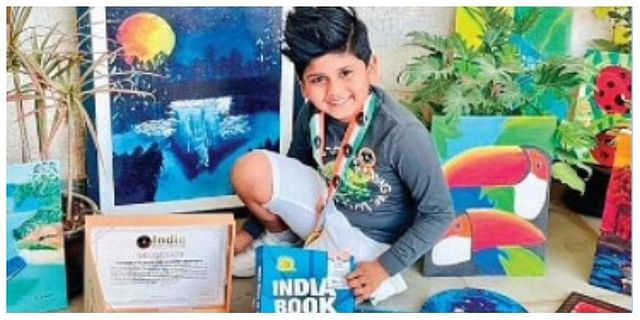
The young artist from the city has received a mention in the India Book of Records 2021 which is recognised by the Government of India, for being the youngest one to create 100 paintings in three years.
The art works were exhibited at the Bangalore International Centre, Domlur. “100 is just a number for the record, but Farhan has painted more than that. He puts up many of his paintings for sale and the proceeds go towards charity,” say Taj, who was told by the team of the India Book of Records 2021 that Mohamed needs to have 100 paintings in hand for the record.
Mohamed went for it and most of the paintings were drawn during the pandemic. Out of the 100 paintings, 67 have already been sold. “We collected around Rs 28,000 from the sale of the paintings. Out of which, a certain amount went towards charity and a token amount has been kept for Farhan,” says Taj , who is a physiotherapist.
Mohamed, who showed inclination towards art when he was merely three months old, was introduced to Tempera paints when he was six months old. “He began dabbling with myriad hues and by the time he was three-anda- half, he had already completed his first art work titled ‘Sunset In Africa’, inspired by a trip to Africa,” says Taj.
Mohamed, who is in Class 2 at Neev Academy, Yemalur, is quite inspired by the works of Van Gogh and Monet.
“Painting relaxes me and makes me happy. Whenever I have a hard day or feel unwell, sad or angry, I just paint. It helps calm me down. As soon as I see a range of colours, my day becomes bright and colourful and I feel better,” says Mohamed, who wants to visit the Van Gogh Museum in Amsterdam and wishes to recreate the famed artist’s series, Sunflower.
Mohamed loves drawing landscapes. “Last year I visited Kashmir with my grandparents. When I returned, I used to pick a picture that I clicked and would paint it,” says the prodigy.
source: http://www.newindianexpress.com / The New Indian Express / Home> Cities> Bengaluru / by Express News Service / January 31st, 2022
His appointment by Cong. is seen as an effort to soothe feelings of Muslims
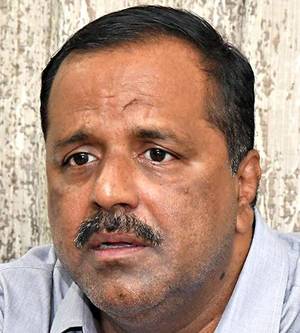
Close on the heels of senior leader C.M. Ibrahim announcing his departure from the party, the Congress on Sunday appointed leader from coastal Karnataka U.T. Khader as Deputy Leader of the party in the Karnataka Legislative Assembly.
While Siddaramaiah became the Congress Legislature Party leader and Leader of the Opposition since the fall of the Janata Dal (Secular)-Congress coalition, the position of his deputy had remained vacant. Mr. Khader’s appointment comes in the light of internal rumblings among Muslim legislators that the community leaders were being ignored in the party platform when it came for distribution of power.
With just over a year away from the Assembly polls, the party has been making crucial appointments keeping caste and regional demands. While KPCC is helmed by D.K. Shivakumar, a Vokkaliga, the party appointed M.B. Patil, a Lingayat leader from north Karnataka as the chairman of the campaign committee.
Both Mr. Siddaramaiah and newly appointed Leader of the Opposition in Legislative Council B.K. Hariprasad belong to backward classes. MLC Saleem Ahmed was one of the four working presidents appointed recently to balance caste and community equations.
Party sources said Mr. Khader’s appointment to the post served the representation to Muslims as well as coastal Karnataka, and that the appointment comes as a damage control exercise after the outbursts of Mr. Ibrahim when he announced that he is set to quit the party and resign from his membership from the Council. Mr. Khader is a senior leader and gets along well with everyone in the party, the sources said.
As Mr. Ibrahim continued his tirade against Congress leaders in Hubballi on Sunday, Janata Dal (Secular) sources said the leader was expected to join the party shortly.
When JD(S) leader and former Karnataka Chief Minister H.D. Kumaraswamy met the veteran Congress leader, the former is learnt to have offered the party president post or head of the campaign committee.
Meanwhile, a congregation of several community leaders that met here on Sunday, under the leadership of Amir e Shariat Moulana Sageer Ahmed Khan to discuss the recent Naragund incident, also discussed political representation for the community.
“The meeting did not discuss about any one party or individual. The community has concerns that were communicated,” Moulana Shabeer Ahmed Nadvi told The Hindu.
source: http://www.thehindu.com / The Hindu / Home> News> States> Karnataka / by Special Correspondent / Bengaluru – January 30th, 2022