Category Archives: Uncategorized

Woman In Khaki

LADAKH / JAMMU & KASHMIR :
ShaheenMPOs14jul2018

Few decades ago, a few women were out and about. With increase in number of enrollment in schools and level of education, we have witnessed increase in number of women working and earning their livelihood. And not just that, they hold powerful and influential designation and are in no way any lesser than their counterpart gender. To bring forth such exuberant women in uniform, whose aura will definitely leave you in awe, ‘We The Women’ brings for you a section ‘Woman In Khaki’.

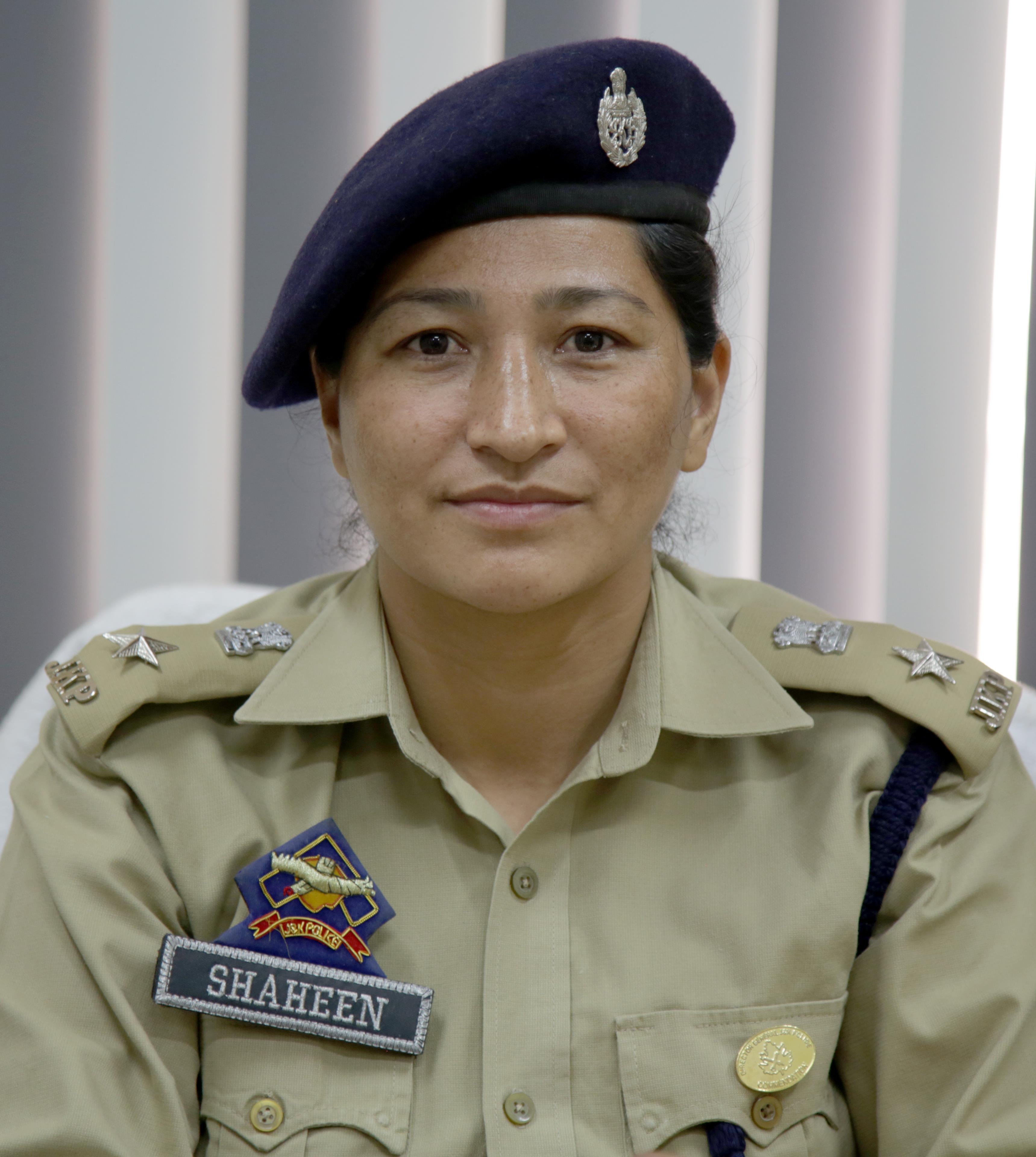
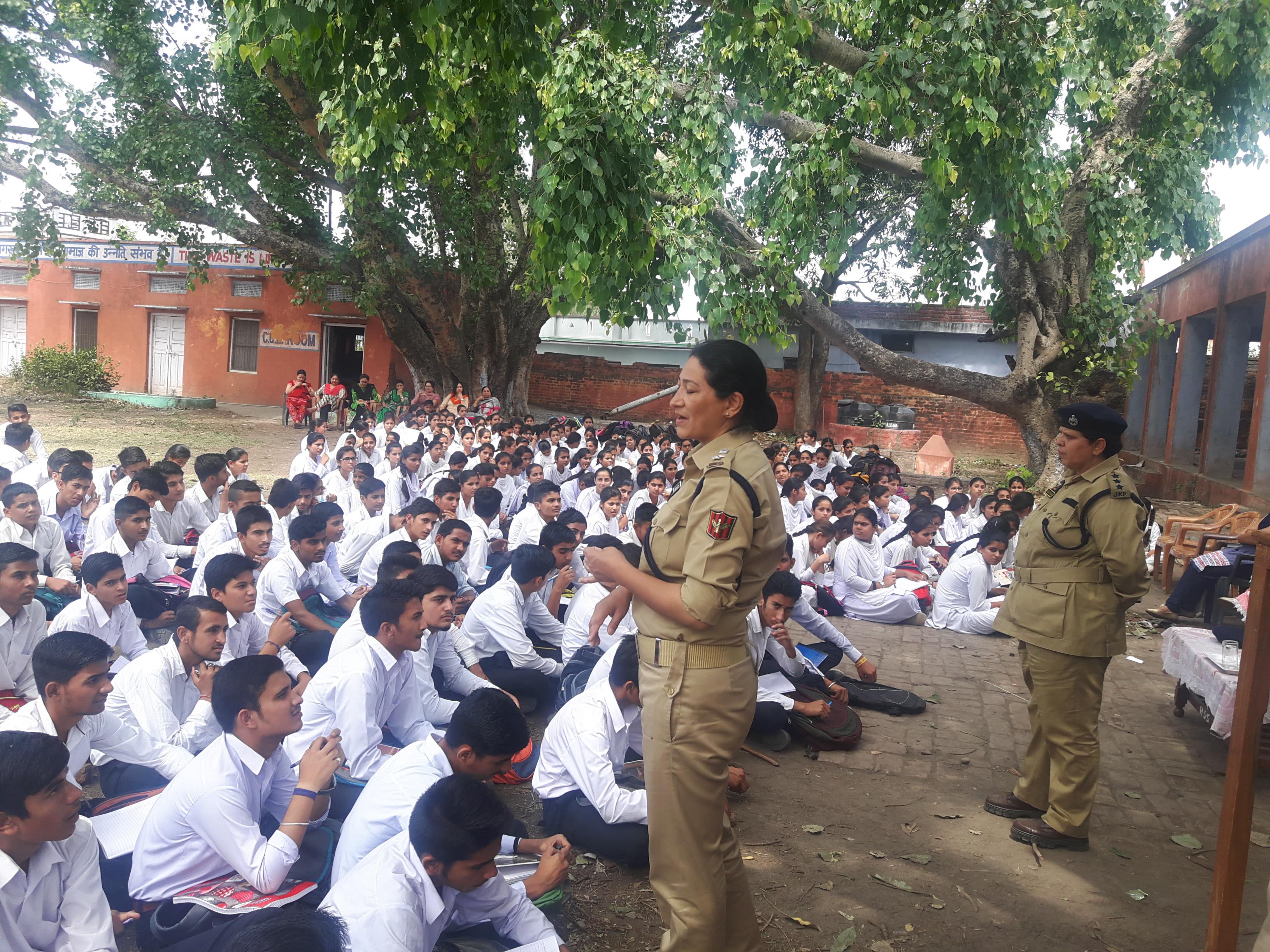
Have you ever come across a woman in uniform? What feelings and thoughts did it induce in you? Well, whatever that may be, I was flooded with feeling of admiration and respect. So, to know more about life of women in uniform we met Shaheen Wahid, SP Traffic Jammu Rural. And the conversation only amplified the pre-existing feelings.

Shaheen was born and brought up in tough terrain of Ladhakh, in a tribal area, where ‘work culture’ prevails and is practiced in every family, whether rich or poor. Which means unlike the excessively comfy environment kids these days are brought up in, children then, were involved in household chores. Shaheen reminisces that despite being first child in her maternal and paternal family she was loved and pampered a lot. But that does not mean that you were allowed to get spoilt. Along with studies, she used to help her mother, break coal for ‘Bukhadi’ (heater), bring home water to drink, go to the streams to wash clothes; but life was adventurous and peaceful. Shaheen shared’ “My parents gave me best of education, they possibly could; the school I was in till 10th was one of the best, where we were encouraged to indulge in mountaineering, trekking and other sports”. After class 10th Shaheen went to Chandigarh for higher education, where she completed her 12th, graduation as well as master’s degree.
Shaheen02MPOs14jul2018

On being asked, if being in Police was planned she told, “It was by chance not by choice”. She explained that she was more inclined towards Civil Services, but when her friend applied for Police, she thought of giving it a chance as well. She adds, although was by chance, but she is content that she made it into this field, because of how much it synced with her individuality. “I used to enjoy the physical activities which others used to find exhausting, because I was already used to leading such tough life” says Shaheen. And so, she encourages others as well, to explore Policing as career option as well.

Shaheen got into the chair of SP Traffic Rural Jammu in February from State Crime Record Bureau, which is completely different. Earlier she used to collect data and conduct surveys regarding Crime rate and so on and submit it to NCRP, NHA and like departments. Today, she has four districts, Rajouri, Poonch, Samba and Kathua under her jurisdiction. Her work includes touring, inspection, surveys, law enforcement and so on. Along with this, since the scenario of work policy in police is transitioning from being brute force to community police, which aims to built a repo among society and work along with it. She mentioned, “Traffic is very big challenge. Although crime rate is very high, think for an instance, number of people you know who have committed any crime and then think of people who are on road for one reason or another, every single day. The more people there are on road, the higher their chances of disobeying the law and order. You cannot bring a change just by mere enforcement of law or by ‘chalanning’; people need to be made aware about the rules and regulations as well as the need to follow them. No doubt that nobody is spared if we come to impose ‘chalan’ but we take a different strategy when it comes to interacting with public”.

Being in such position might appear luxurious and comfortable but is it so? “Uniform gives you a sense of authority but it is also a reminder that we are servant to the society and hence we should not let that sense of power into our head” Says Shaheen. At times Shaheen has to start around 4 in the morning, reach to extreme of her jurisdiction, spend day doing whatever is needed, say inspection, survey or enforcement and then reach back around mid-night. And even when she is in office the work load of such large area can be well estimated. And let’s not assume that she has no personal responsibilities. She is mother of three, elder one aged around six and youngest one around one. Her family also includes her parents-in-law and her husband. Despite having such schedule, Shaheen believes that it is essential to balance between both family and work. Here she emphasis on importance of having a support system to help her through. She thanks her mother-in-law for taking care of her children when she is out and about.

Talking about women in general, according to Shaheen Women is epitome of sacrifice and patience. “In our society, people get sad when a girl is born to them. Even when they provide her with same facilities as they provide their boy, there is difference in their attitude as well as their expectations from both of them. Girls are expected to take care of everyone’s need in family and be dedicated towards their responsibilities. I have no objection with that as I believe everyone should be self reliant. If a girl can be asked for a glass of water when anyone comes home, a boy should be expected to do the same. We need to have parity among both the genders even in our behavior and expectations; only then we can inculcate same set of qualities in males as well. After all, a little patience and sense of putting someone else’s interest can resolve so many issues that are prevailing and hence help us grow as a nation.

On being asked who empowered woman is, Shaheen replied that she believes, every woman is empowered if she exercises her duties as well as rights; every woman who is aware about her strength and the value of her contribution in her family as well as society is ‘Empowered’. She added, “If being at such designation, I am not confident enough that I can execute my responsibilities well, I am not empowered at all, despite that.” To women out there, she says that they should take up every challenge and strongly get through them; never letting the fact that they are women, become an excuse.

source: http://www.thenewsnow.co.in / The News Now / Home / by Akriti Jamwal / July 06th, 2017
A miracle of faith, this Varanasi mosque was built in a night

Varanasi, UTTAR PRADESH :

Varanasi :

Ek Raat Ki Masjid – the name catches one’s attention immediately for its uniqueness.

Believed to have been built in one night, the mosque is located in a narrow lane of Varanasi’s Lallapura, an area famous for the master weavers who turn silk yarn into Banarsi sarees and stoles.

Some of the visitors, who walk through the lanes to watch sarees being woven on handloom, also go to see the mosque.

Dr Abdul Waheed Ansari, a local scholar, says, “The mosque is known as Ek Raat Ki Masjid since it was built in a night around 175 years ago. A faqir had taken the initiative for its construction and locals helped him implement his plan.”

Dr Ansari says many people express surprise when they learn the mosque was built in a night…

source: http://www.htsyndication.com / HTDS Content Services / Varanasi – June 02nd, 2018

First verse of the Koran in 6,000 different styles

Lucknow, UTTAR PRADESH :

New Delhi :

His inclination towards calligraphy was realised way back in school, when he frequently labelled the notebooks of his classmates with their names written in beautiful artistic forms.

However, for 60-year old Hashim Akhtar Naqvi, an architect by profession and calligrapher by interest, the inclination became a life-long devotion when he took upon the task of writing the first verse of the Holy Koran in as many stylised forms as possible.

At last count, the Lucknow based artist had already written the verse in over 6000 styles. His innovative faculties are still as enthusiastic as they were when he started the work, ensuring that he can smoothly go on to add more to his stock.

Recognised by the Limca book of records for his unique venture, the collection of the artist was recently displayed in the capital at the Indira Gandhi national centre for arts, as part of the programme, Aqeedat ke Rang, an exhibition of expressions of devotion in Islam.

When I started blending the verse into artistic designs, I felt I would hardly be able to proceed beyond 8 or 10 forms. But the ideas kept coming and the verse kept repeating itself through my fingers until there was a collection of over 6000 styles, and the venture has not yet ended says Naqvi.

The Arabic verse, Bismillah-ir-Rahman-ir-Rahim, translated as, In the Name of Allah, most beneficient, most merciful, which is recited by Muslims before performing any major or minor task is also represented by the number 786.

Blending his architectural vision to his innate artistic capacity, Naqvi who has been experimenting with the script of the verse for over 20 years, has produced some genuinely original work of calligraphy.

What makes it even more interesting is the fact that his calligraphic pursuits derive very little influence from the existing Arabic calligraphic forms but is largely innovative and in some cases adopts from the scripts of regional Indian languages. I have tried to include the influence of the script of a number of

Indian languages. including Hindi, Bengali, Telugu, Tamil, Punjabi, Gujarati, Malayalam and Kannada, he says.

PTI

source: http://www.financialexpress.com / Financial Express / Home> Archive> Fe300 / New Delhi – April 09th, 2008

Farhana Firdous: Triple medal winner in M.Sc and a dream to help the marginalised

Katlamari Village, Murshidabad District , WEST BENGAL :

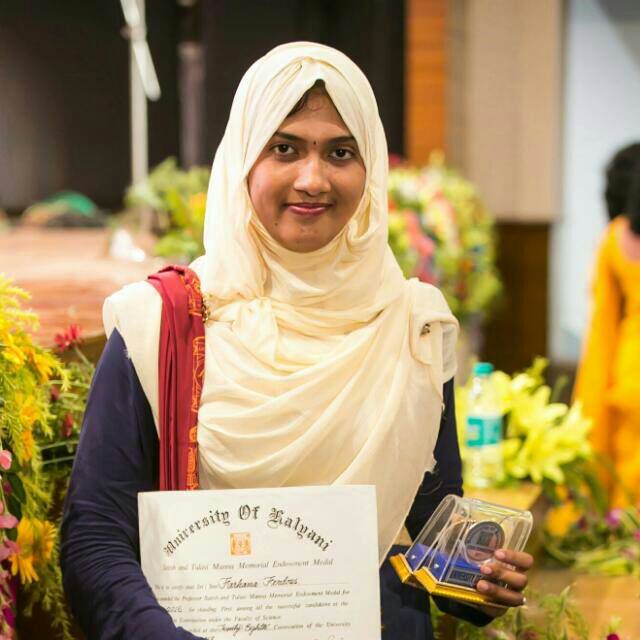
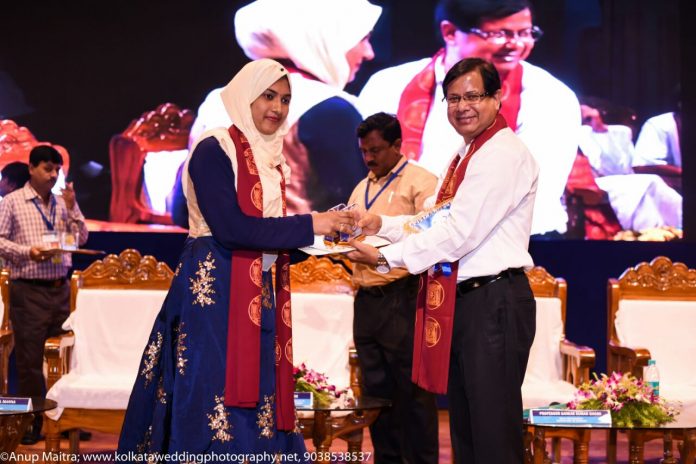
Farhana Firdous receiving her Medal and Certificate from the V.C of Kalyani University.

If our mainstream media is to be believed, nothing good happens near or at the India-Bangladesh border. Every now and then, an ‘expert’ will tell us how the border is witnessing illegal immigration, smuggling and other illegal activities. However, as usual, if you scratch the surface, the truth about the struggles of people living in these areas come out. And the story of Farhana Firdous, a 25-year-old resident of Murshidabad district, is a testimony of how adversity can spark the birth of an incredible talent. Despite much hardships and the daily struggles of being a Muslim woman who wants to study, Firdous has excelled and secured three medals for her Master’s degree in Physiology from the University of Kalyani, West Bengal, in its 28th Convocation held in September last year. Mind you, this is not the first time that she has won medals and given her career path, it is unlikely that this will be the last time her efforts are awarded.

Firdous scored 86.8% in her M.Sc degree that bagged her three medals from three different fields. She was rewarded with silver ‘Professor A.G Datta Endowment Medal’ for standing First Class First for her M.Sc degree, gold for ‘Mitali Memorial Medal’ for obtaining Highest Marks among the recipients of the same degree under the Faculty of Science and bronze ‘Satish and Tulsi Manna Memorial Endowment Medal’ for standing First among all the successful candidates at the Post Graduate Examination under the Faculty of Science.

In 2014, she bagged the fifth position among the undergraduate students of 49 colleges under Kalyani University scoring 67.8% marks. She got 82.4 % in her matriculation and 72% in 10+2 in Science stream.

Though it is a fact that she is really an intelligent student, her journey up to this success was never smooth and clear. The first and foremost drawback for her was opportunities from her very early life. She resides at a 2 k.m distance off from the Bangladesh border where people hardly get most of the social amenities. Her village, Katlamari under Raninagar police station of West Bengal’s Murshidabad district, is about 60 km from where she used to go to attend her tuitions at Baharampur, Islampur, Domkal localities because of the non-availability of tutors in her locality. The distance only increased when she took admission for her M.Sc degree at the University of Kalyani, about 200 km from her home after finishing her schooling at her locality and graduation from Baharampur Girls’ College in 2014.

While talking to TwoCircles.Net, Farhana shared her experiences of the journey. She sets out at 3.a.m from her home to attend her classes. She says, “ Most of the times and even till now, I had to get ready at around 3.a.m of night. I start first cycling to Sekhpara located 2 km from our village to take a bus to Baharampur. After that, I have to take a train to reach my university in order to attend my classes. Many times I missed the first class because of the non-availability of buses at Sekhpara.”

This problem, according to Firdous, is far bigger than the rebukes and rebuffs of the neighbours because of her being a woman coming from a Muslim family. But she kept her endeavour intact to pursue her higher studies and fulfil her dreams at a large.

Firdous says that all she has achieved is thanks to her family, which has always stood by her side in order to fulfil her dreams. In this regard, she says, “While my family supported me in the possible way, many rebukes and rebuffs my family and I had to listen from my localities for my womanhood. Marriage and social settlement were their prime concern that they wanted to impose upon my family and to me, but that was never a matter to introspect to my family until my success.”
Her mother, Nazmun Nesa Begum, a housewife, concurs: “I wish she secures a good career after such a toilsome journey through both social taboos and academic hardships.”

FarhanaFirdous02MPOs29mar2018

While Firdous says that many people have inspired her, her biggest source of inspiration was her late grandmother Nur Nahar Begum. Firdous’ father, Firoz Shahjahan, a contractual school teacher under Matriculation Seva Kendra Scheme, says, “ my mother was her sole strength to reach up to this position. She was the first to come forward to get Firdous admitted to the Kalyani University. Thanks to her blessings, she became the first woman in our family to earn a Master’s degree in Science.”

Among other names who inspired Farhana were her Professors- Dr Gautam Paul, Dr Subhasish Sahu, and Dr LakshmiKumari Lahiri. In fact, it was Dr Paul, Farhana shared, whose inspiration resulted in her success. TwoCircles.net managed to talk to Dr Paul who is the former Head of the Department of Physiology. He says, “She is a very intelligent and diligent girl. She illuminated us coming from one of the most socio-economically minority populated districts of India. I wish she keeps this trend of illuminating success up in her future and let us feel pride for her.”

For the time being, Farhana is preparing for NET Exam and wishes to pursue her research on Human Physiology in her PhD degree.

She now aspires to run a Career Counseling programme in her locality. Sharing her experiences, she said, “ I was not aware of different streams as a part of curricula and hence different lines for job markets until my coming into the university. I believe that if a student has knowledge on many things, he/she can easily choose his/her preference to follow as their career and it lacks among the students of my locality who are in their Matriculation or +2. So, I have a dream to organise frequent Career Counseling for all of them so that they can way out their career.” No matter what path she takes, it is clear that Firdous will continue to prove her doubters wrong.

source: http://www.twocircles.net / TwoCircles.net / Home> India News / by Mirza Mosaraf Hossain, TwoCircles.net / February 09th, 2018

Nagma nets winner for Bandra Packers

Mumbai, MAHARASHTRA :

NagmaMPOs09jan2018

Mumbai :

Nagma Shaikh played a key role in leading Bandra Packers to a solitary 1-0 win against I.C. United in a closely fought women’s league match of the BWFA Football League 2014, conducted by Bandra West Football Association.

The sprightly striker Nagma scored the all-important winning goal to ensure Packers pocketed the full three points.

In other women’s action, Sea View SC riding on Neha Ture’s twin strikes and a goal apiece from Jennifer Rayar and Priyanka Singh romped to an easy 4-0 victory over Magic Bus to notch up their second victory of the tournament.

source: http://www.freepressjournal.com / The Free Press Jounal / Home> Sports / by Free Press Journal Sports Desk / August 19th, 2014

Family which built orphanage for Moplahs donated Rs 100,000 annually for freedom struggle

KERALA :

WarMPOs03jan2018

In yet another instance to show how the Bhartiya Janata Party (BJP) and Rashtriya Swayamsevak Sangh (RSS) distort history to suit their communal agenda and to gain political mileage, the party’s Kerala unit chief Kummanam Rajasekharan called the Malabar Rebellion of 1921, also known as Moplah Rebellion, “the first jihadi massacre” in Kerala.

As the BJP’s Jan Raksha Yatra entered Muslim-dominated Malappuram district last Monday, Kummanam Rajasekharan, said the Malabar rebellion of 1921 was the first jihadi massacre in Kerala.

Rajasekharan, who lead the yatra as it entered Muslim-dominated Malappuram district, said that depicting unprovoked massacre of Hindus as part of the independence struggle is an insult to history as well as the majority community in the state.

“If it were an agitation against British rule, why were thousands of people butchered and temples destroyed? It high time we stopped glorifying this massacre depicting it as freedom struggle. If anyone is given pension on behalf of this rebellion, it should be given to those who had to flee their homes during the riot and the dependents of the victims of the jihadi massacre”, he is quoted as saying by media.

The Malabar rebellion or Moplah rebellion of 1921 was an uprising of Muslims tenants against the British government and Hindu landlords, and the culmination of a series of revolts that recurred throughout the 19th century and early 20th century.

It began as a reaction against a heavy-handed crackdown on the Khilafat Movement, the campaign also supported by top Congress leaders including Mahatma Gandhi, in defense of the Ottoman Caliphate by the British authorities in the Eranad and Valluvanad taluks of Malabar.

In initial stages, a number of minor clashes took place between Khilafat volunteers and the police, but the violence soon spread across the region. The Mappilas attacked and took control of police stations, British government offices, courts and government treasuries. The Hindus loyal to the British rule also came under attack. And it is because of this the right wing Hindu extremists and biased British historians to sow the seeds of communal divide gave it a communal colour claiming “fight against the British ended up as large-scale massacre and persecution of Hindus”.

This is what exactly they did in case of the freedom struggle in Malegaon. On April 25, 1921, a police officer loyal to the British rule was killed by Muslims and Hindus together. It is also on record that two Muslim constables were also killed in the same uprising. Following the crackdown by the British, five freedom fighters were hanged in Pune’s Yerwada Jail and two died during interrogation – all 07 Muslims. But, the right wing Hindu extremist groups claiming that the Malegaon uprising was a communal riot and an attack on Hindus, have till now not allowed to put the names of these seven Muslim martyrs on the memorial built by the government to recognize their sacrifice.

Historians and scholars have recorded in detail how Hindus and Muslims together participated in the 1921 uprising of Malegaon. The union and state governments too acknowledged this in their respective gazettes. But for the right wing Hindu groups, acknowledging the sacrifices of Muslim freedom fighters of Malegaon will serve none of their purposes. Hence they give the entire incident a communal colour and propagate accordingly.

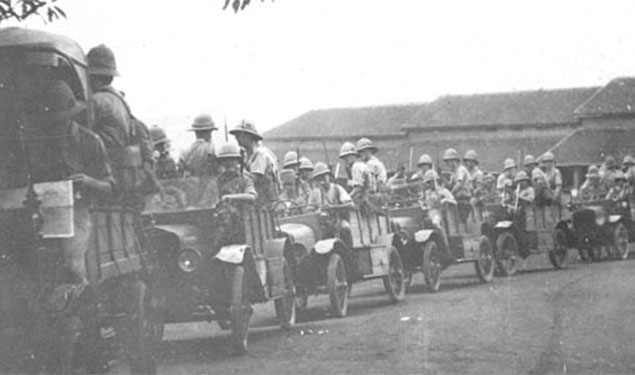
Similar is the case of Moplah Rebellion also known as Malabar Rebellion. According to the Kerala government’s own admission, the British government put down the rebellion with an iron fist, British and Gurkha regiments were sent to the area and Martial Law imposed.

“One of the most noteworthy events during the suppression later came to be known as the “Wagon tragedy”, in which 61 out of a total of 90 Mappila prisoners destined for the Central Prison in Podanur suffocated to death in a closed railway goods wagon”, says the Kerala government’s history section on its website.

The Moplah Muslims and others involved in the uprising were continuously in touch with the national leaders leading the freedom struggle. These leaders were shaken by the reports of the persecution of Moplahs at the hands of the British forces. They became restless and started searching for means to provide relief to this persecuted lot, renowned scholar Abdul Hameed Rahmani, wrote in an article published by monthly At Tibyan March 2008 issue.

“Maulana Abdul Qadir Kasuri rushed his younger brother Abdullah Kasuri and two sons Mohiuddin Ahmed Kasuri and Mohammad Ali Kasuri to Calicut in Kerala. After helping them with immediate relief, they established one of the oldest orphanages for the Moplah victims on over 50 acres of land which besides other things also catered to their educational needs”, he wrote.

A branch of the center was also established later on in Pune.

Born in April 1889, Mohiuddin Ahmed Kasuri, the eldest son of renowned Ahle Hadees scholar Maulana Abdul Qadir Kasuri, was once a close associate of freedom fighter and India’s first education Minister Maulana Abul Kalaam Azad. Maulana Azad invited him to Calcutta from where he published daily “Eqdam”.

In July 1916 when Maulana Abul Kalaam Azad was sent to Ranchi Jail, Mohiuddin Ahmed Kasuri went back to Kasur. The British government detained him from Kasur and kept him incarcerated in Hoshiarpur till 1919.

Abdul Hameed Rahmani recalled that the Kasuri family established businesses in Bombay and the profit earned from these businesses related to salt, textiles and leather industries were used to fund its charity institutions established in Calicut and Pune.

“The family donated for years Rs. 100,000 annually to Maulana Abul Kalam Azad as fund to be used for India’s freedom struggle”, he wrote.

After partition of India, the Kasuri family moved to Pakistan. Former Foreign Minister of Pakistan Khurshid Mahmud Kasuri in Pervez Musharraf’s cabinet belonged to the same family.

[The writer Aleem Faizee is founder editor of ummid.com. He can be reached at aleem.faizee@gmail.com.]

source: http://www.ummid.com / Ummid.com / Home> Views & Analysis / by Aleem Faizee, Ummid.com / Friday – October 13th, 2017

This charitable eye camp in Agra has completed 35 years

Agra, UTTAR PRADESH :

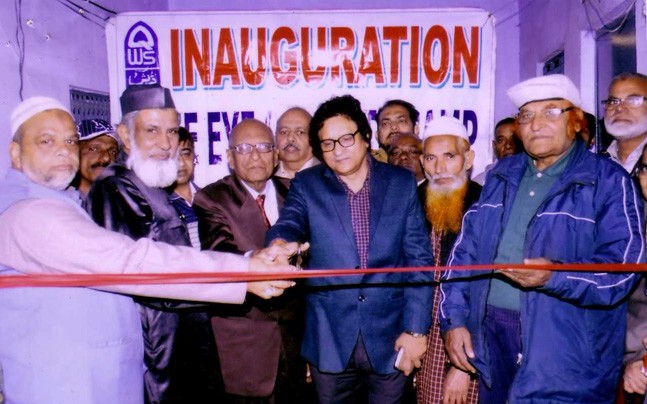
 The eye camp is organised by the Quresh Welfare Society.

Photo: Siraj Qureshi

The Quresh Welfare Society organised the 35th Free Eye Camp in Agra today, which was inaugurated by the Chief Medical Officer of Agra, Dr M K Vats, while the ceremony was presided over by former SN Medical College Principal Dr G U Qureshi.

The chief guest was Dr S K Satsangi, former Head of Department, Opthalmology, SN Medical College, Agra.

Talking to India Today, Dr Himanshu Yadav, current Head of Department, Opthalmology, SN Medical College, Agra said that it was a very impressive feat to be organising such a charitable eye camp for 35 years in a row, and the medical fraternity was proud to be associated with such events where the health services were being made available for the poor as charity.

Society Secretary Mohd Arif Advocate informed that the society had been running this charitable eye camp for 35 years now, without taking any monetary aid from the government.

This eye camp is organised in the areas inhabited by the poor, who are then helped without discriminating them on the basis of caste or religion.

source: http://www.indiatoday.intoday.in / IndiaToday.in / Home> News> Lifestyle> People / by Siraj Qureshi / December 22nd, 2017

Mohsina Kidwai is chief of Haj Commitee

UTTAR PRADESH / NEW DELHI :

Senior Congress leader and Rajya Sabha member Mohsina Kidwai has been elected chairperson of the Haj Committee at its first meeting here, the External Affairs Ministry said.

Hasan Ahmed and Aboo Bucker were elected as the chairpersons at the meeting, the Ministry added.

The Haj Committee was reconstituted recently and the Ministry is the nodal authority for administering it.

source: http://www.thehindu.com / The Hindu / Home> News> National / by Special Correspondent / New Delhi – March 10th, 2010