Category Archives: Uncategorized

“Was A Freedom Fighter…”: Tipu Sultan’s Descendant Counters BJP MLA

KARNATAKA, Kolkata/ WEST BENGAL  :

Karnataka BJP chief Appachu Ranjan mentioned Tipu Sultan looted temples and compelled conversions.

Kolkata: 

After a BJP MLA in Karnataka mentioned classes on the 18th century ruler of the erstwhile Mysore kingdom Tipu Sultan have to be faraway from textbooks, a descendant of the king mentioned that it’s shameful that he being focused for vote financial institution politics.

Chatting with information company ANI, Md Shahid Alam mentioned, “History can never be deleted. Tipu Sultan was a freedom fighter. I will write a letter to the Prime Minister regarding this.”

“Some people are playing vote bank politics which is quite shameful. People cannot deny that he was a freedom fighter. History is like this and will remain so in future,” he added.

On Wednesday, Karnataka BJP chief Appachu Ranjan wrote to Training Minister S Suresh Kumar asking for Tipu Sultan’s reference to be struck off historical past textbooks.

In a letter, Mr Ranjan wrote that Tipu Sultan has been portrayed as a freedom fighter and historical past shouldn’t be written with false details.

“Tipu came to Kodagu, Mangaluru and other parts of the state to expand his territory. He came here just to convert people to his religion and to expand his kingdom,” he mentioned.

He added that king had no respect for Kannada as his administrative language was Persian. “He changed names of places. He looted many temples and Christian churches as well. In Kodagu, he converted 30 thousand Kodavas,” Mr Ranjan wrote in his letter.

source: http://www.heraldpublicist. om / Herald Publicist / Home> News / by Pete / October 24th, 2019

Obituary – Fairoz Mohammed Khan

Kodagu, KARNATAKA :

FairozMPOs23oct2019

Fairoz Mohammed Khan (70), brother of former Rajya Sabha Member late F.M. Khan, passed away at a private hospital in city yesterday.

A bachelor, Fairoz Khan was involved in social work.

Last rites were performed at Rasulpura Muslim Burial Ground near Guddehosur in Kodagu this morning, according to family sources.

source: http://www.starofmysore.com / Star of Mysore / Home> Obituary / October 19th, 2019

Tripura youth, who ran away from home at 16, earns global glory

TRIPURA / Bengaluru, KARNATAKA  :

When Farukh Ahmed ran away from his hometown in Tripura at the age of 16, little did he know that he would develop an interest in baking and that would take him towards the path of success.

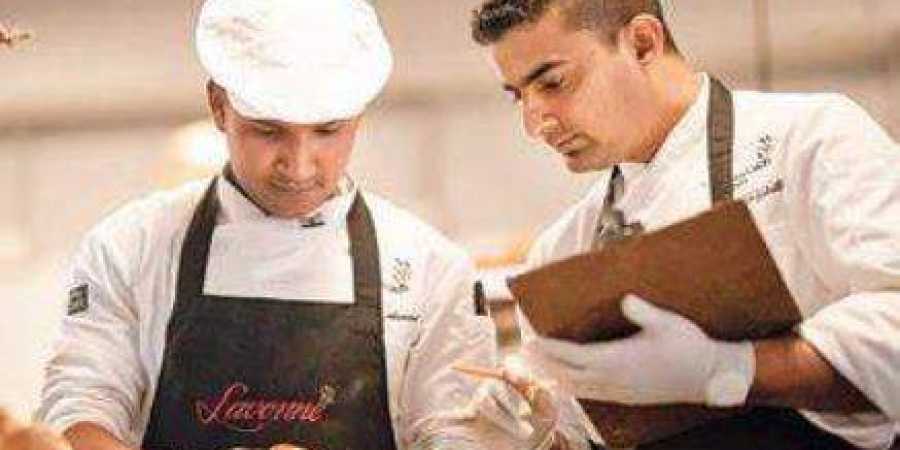
Farukh Ahmed being mentored by Dr Avin Thaliath

Bengaluru :

When Farukh Ahmed ran away from his hometown in Tripura at the age of 16, little did he know that he would develop an interest in baking and that would take him towards the path of success. On August 29, the 21-year-old secured a medallion of excellence for his performance at World Skills 2019 held in Kazan, Russia, where he finished fifth. “I was quite nervous while performing at World Skills.

The aim was to secure gold. Irrespective of the result, the platform gave me a new-found recognition and confidence which I am grateful for and this has really changed things for the better,” he says. Adding to this was his mentor, Dr Avin Thaliath, co-founder and director of Academics, Lavonne Academy of Baking Science and Pastry Arts, who says, “He started from scratch and ended up being recognised on a global platform. He is simply brilliant.”

Struggling from a very young age, Ahmed ended up boarding a train headed towards Bengaluru when he left home, simply because he failed to clear his exams and the fear of confronting his father was looming large. After he arrived in the city in 2014, Ahmed spent the next few months taking shelter on the streets until he was confronted by a steward from a baking academy. Convinced with the fact of initiating a much-needed change, Ahmed went ahead and took up a role with the housekeeping team at Lavonne Academy.

During his tenure, Ahmed gained a sense of interest towards baking. He would further spend time in helping out bakers and grasp the most minute pieces of learning, including long nights after his shifts, to familiarise himself with the field. Taking note of the enthusiasm was Thaliath. Ahmed was given the opportunity to grow and sharpen his skill under Thalia. “Ahmed is extraordinary in every sense, probably the most dedicated student I have ever guided,” says Thaliath.

Under Thailath’s guidance, Ahmed went on to participate at national platforms where he could showcase his skill with finesse and improve on the shortcomings.Currently a supervisor at Lavonne Academy, Ahmed looks forward to further sharpening his skill. “I have had a tough start earlier. I want to work and grow, and the amount of support I have received from my trainer has been crucial. I plan to stay here under his guidance,” he adds.

source:  http://www.newindianexpress.com / The New Indian Express / Home> Cities> Bengaluru / by Muneef Khan /  Express News Service / September 11th, 2019

Professor M. Athar Ali (18 January 1925 – 7 July 1998)

UTTAR PRADESH :

pix 01

Athar Sahib was one of the best teachers ever produced by Aligarh. A man of simple tastes and habits, almost rustic in a way, he had a knack to deliver lectures which none could ever forget! Although trained as a historian, there was an expert lawyer hidden within him. He would build up the arguments as a lawyer would build up a case, slowly but surely, leaving you mesmerised and fully convinced and satisfied. There was no way that a contrary argument would germinate in your mind till his words would keep on resonating in your skull – they still do in my head even decades after having heard him Lecture! In fact there were moments, when as students, I would prefer him over that doyen of historians, Irfan Habib, who in our understanding during those days was hard to follow and understand!

I was quite fortunate to have come in his contact much before I had ever studied history: in school I, like others of my age, was studying Science. To study history was infra dig and only those who could not cope with science used to offer it. Athar chacha, as I knew him then as a school kid in standard IV or V, was a stocky sherwani clad serious – in fact, severe looking – visitor who every year would bring to Abba (my father) an earthen pot full of rasāwal, and sometimes even gurand ras. He we were informed by Abba, was a raīs from Pilakhna, a qasba near Aligarh. I knew no more about him, nor was I ever interested.

And then when on the insistence of Sir Ahmad (the father of Professor Tariq Ahmad), and the recommendations of Professor Zillur Rahman (son in law of Zakir Husain, and Professor of Physics) I took admission in BA (Hons) History and went to a class where Medieval India was taught, I found him to be the teacher (the others were Irfan Habib, Iqtidar Alam Khan and SP Gupta). But now he was wearing a white shirt over very loose pants, and horror of horrors, he refused to acknowledge that he ever knew me!

He would walk in dot on time, rain or scorching heat, order the door to be closed and stop the Lecture the moment bell was sounded: not a second more, not a second less. His timings such that you may set the clock! He would never smile, and had this habit of citing “Truly Yours”. [Once when we were in MA, one of my classmate who later was to become a daughter in law of Professor Nizami, thought that “Truly Yours” was a proper name of some historian! And she did enquire about him from Athar Sahib: and that was the only moment I found his mask fall!]

Each and every word he would utter in the class would sink in and till date when I teach, those words and sentences come back to me as if they were uttered yesterday.

He first taught us Delhi Sultanate. We named him Balban! And then in MA he taught us a course covering Jahangir to Aurangzeb. His dealing with Aurangzeb was spectacular: he would grow with him, age with him, the victory parts were taught in a manner as if Athar Sahib himself had won, and the defeats were dealt equally. When he taught Shivaji, you could make out the contempt which he had for him! His most elaborate lectures however were on the religious policy.

Although he had a very hard exterior, he was very soft inside. There is an episode which I remember. When I was going to join research under Irfan Sahib, the latter warned me not to sit for civil services but only do research. Athar Sahib remained quite. But later he called me to his room, locked the door, and then advised me not to listen to Irfan Sahib on this point and prepare for IAS!

Once in an exam he had asked questions which I and my best friend of that time, Amjad Afridi, had not prepared. Both of us attempted a question which had not been asked. Athar Sahib got confused and awarded the highest marks to us!

He wrote a large number of pathbreaking research papers, quite a few of them unparalleled till date. However I find his paper on Akbar and Islam and that on Passing of an empire outstanding. Most of his pathbreaking papers have-  been posthumously been printed in a book form by the endeavours of Irfan Habib.

pix 02 – Book Cover

Entitled Mughal India Studies in Polity, Ideas, Society and Culture, this work has a preface by Irfan Sahib.

During his lifetime he had two important books published. His The Mughal Nobility Under Aurangzeb was published in 1966

pix 03 – Book Cover 02

SM Afzal honored with gallantry Medal by President, MSO Express Hapiness

UTTAR PRADESH :

AfzalMPOs30jun2019

New Delhi.

Aligarh Muslim University alumnus and former registrar Syed Muhammad Afzal was honored with the Presidential Police Medal in New Delhi on Republic Day today. These awards were given for their 25 years of devotion and honest service.

At present, Syed Muhammad Afzal is serving as the post of Additional Director General of Police in Bhopal Madhya Pradesh (EOW). Earlier, Syed Muhammad Afzal has been awarded various awards and medals for his services. Syed Afzal has been a student of AMU and a secretary of the University Literary Club.

Dr. Ahmed Mujtaba Siddiqui, Joint Secretary, Albarkat Education Society said that he has been the registrar of Jamia Milia Islamia and Aligarh Muslim University.

ShujaatMPOs30jun2019

MSO National President Shujaat Ali Quadri, also expressing his happiness on giving award to SM Afzal. He has congratulated the SM Afzal and Albarkat family on behalf of the MSO.

source: http://www.timesheadline.com / Times Headline / Home> India> New Delhi> Society / January 26th, 2019

Noted historian Mushirul Hasan dies at 71

NEW DELHI :

He was a former vice chancellor of Jamia Millia Islamia university and wrote extensively on Partition and the history of Islam in South Asia.

Professor Mushirul Hasan | YouTube screengrab

Historian Mushirul Hasan, a former vice chancellor of Jamia Millia Islamia university and director general of the National Archives of India, died on Monday morning. He was 71.

Academic Jayati Ghosh, who teaches at Jawaharlal Nehru University’s Centre for Economic Studies and Planning, said Hasan had been on dialysis for a number of years and had sustained head injuries in a car accident in 2014. Though he was badly injured, he made remarkable recovery, she added. “He had tremendous spirit but the last few months he had been very ill and was in and out of hospital,” Ghosh told Scroll.in.

Hasan was awarded the Padma Shri in 2007 for his extensive writings on Partition and the history of Islam in South Asia. He served as the pro vice chancellor of Jamia Millia Islamia between 1992 and 1996 and served as vice chancellor from 2004 to 2009.

Ghosh described Hasan as “a very proactive vice chancellor” and credited him with modernising Jamia Millia Islamia. “He also hired a lot of new faculty from varied backgrounds and was able to attract faculty from Delhi University and elsewhere,” she added. “He was anxious to fill the university with good people but faced some resistance and there were court cases. This is the period when Jamia Millia Islamia emerged as a quality institution and not just a minority one.”

Jayati Ghosh@Jayati1609

Prof. Mushirul Hasan, former VC, JMI, & former Director General, National Archives of India, passed away early morning today 10.12.2018. His namaz-e-Janaza shall be performed at 1.00 pm at Babul Ilm & 2.00 pm at Jamia Mosque and burial shall take place in Jamia graveyard.

Historian Syed Irfan Habib said Hasan was one of the most prolific historians of modern Indian history. “Saw him decline gradually over the past few years after the terrible accident,” he tweeted.

Ghosh said prayers for Hasan will be performed on Monday afternoon and he will be buried at the Jamia graveyard.

S lrfan Habib

@irfhabib

Extremely sad news. One of the most prolific historians of modern Indian history. Saw him decline gradually over the past few years after the terrible accident. RIP Mushir bhai.

atiya zaidi@atiyaz

Tragic news😢
Prof Mushirul Hasan has passed on.
His years of suffering has come to an end. Alwida Mushir Sb.
May you rest in peace🙏🏼

source: http://www.scroll.in / Scroll.in / Home> The Latest> Passing On / December 10th, 2018

JK Police pays tribute to Martyr Parvaiz Ahmad, killed in Batamaloo encounter

JAMMU & KASHMIR :

MartyrMPOs15aug2018

Srinagar, (Scoop News) :

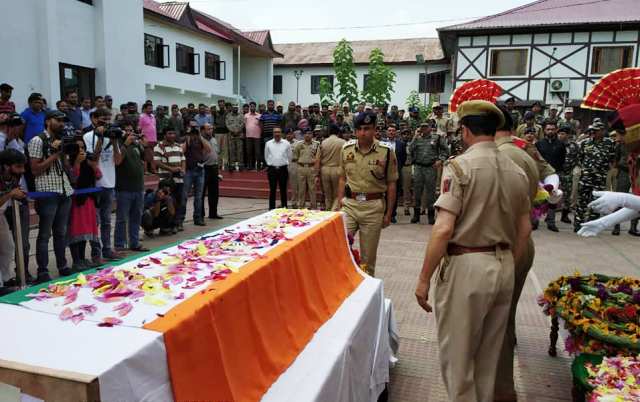
Wreath laying ceremony for martyr Parvaiz Ahmad son of Mohammad Abbas, resident of village Dandote Tehsil Budhal District Rajouri held at DPL Srinagar. Senior Civil and Police officers paid rich tributes to the martyr and laid floral wreaths on the mortal remains for his supreme sacrifice made in the line of duty, today at Batamaloo Srinagar.

Officers who attended the wreath laying ceremony include DGP Prisons, ADGP Armed J&K, Director Vigilance J&K, ADGP CID J&K, ADGP Security/L&O/HG, IG CRPF Ops, Joint Director IB J&K, IG BSF Frt Hqr, Div com Kashmir, IGP Armed Kashmir, IGP Kashmir, Addl Commissioner, IG CRPF Srinagar, BGS OPS 15 Corps, DIG CKR Srinagar, DIG SSB Kashmir/ITBP Srinagar, DC Srinagar, SSP Srinagar, SP PC Srinagar, Commandant IRP 6th Bn, SSP APCR Srinagar and other officers and Jawans.

source: http://www.scoopnews.in / Scoop News / Home> News Details / Srinagar – August 12th, 2018

How this simple, God-loving Indian Muslim left behind such an enduring legacy

NEW DELHI / Rameswaram , TAMIL NADU :

Illustration by Arindam Mukherjee/ ThePrint.in

All communities loved and trusted him, but he rose to be the Muslim most loved by India’s Hindu majority in our entire history, possibly since Mughal Emperor Akbar. 

On his third death anniversary, it’s a reckless way to assess the life of one of India’s most loved public figures, but let’s list some of what former president APJ Abdul Kalam wasn’t.

He wasn’t really a scientist in the classical sense of the term. He didn’t have many peer-reviewed publications. He wasn’t the father of the Indian nuclear bomb. It had been put together collectively by two generations of Department of Atomic Energy (DAE) scientists.

He didn’t quite have the gift of oratory and mostly repeated his platitudes. In a Raisina Hill mansion peopled before him by great men of letters, he wasn’t much of a writer either. He never got married, was not a family man. Nor was he a politician or public figure by upbringing or training. Most of his life was spent in the secretive world of weapon-designing. And, much as he loved to recite Sanskrit shlokas and play the rudra veena, he was a simple, God-loving Muslim.

Then think about what he ended up becoming.

He came to be hailed among our greatest scientists ever, in the class of C.V. Raman and Jagadish Chandra Bose, way above his mentors’ generation of Homi Bhabha and Vikram Sarabhai or his peers in DAE, ISRO and DRDO. He is immortalised in our collective memory as the man who gave us our nuclear deterrent. He became our most popular public speaker across generations, geographies and demographics in India, and never spoke at a hall less than bursting at the flanks with standees.

The books he wrote, India 2020, for example, were in the nature of pontifical DIYs but became the biggest non-fiction sellers in our history and shall remain so for a long time. He became the leader most loved by our children after Chacha Nehru, a benevolent Nana Kalam. His stature grew so phenomenally that he became our most political president, and in an entirely wise and non-partisan manner.

All communities loved and trusted him, but he rose to be the Muslim most loved by India’s Hindu majority in our entire history, possibly since Mughal Emperor Akbar. Way more than Maulana Azad or any other. The perfect detox to Jinnah.

And finally, a fact that even I, with my thick skin, was too scared to put in the list of what he wasn’t: He never had a real doctorate, a PhD. His doctorates were all honoris causa but “Dr” fitted him brilliantly, and not even his worst critics dared to highlight this.

So what did he have that lifted him to such love and respect?

He acquired moral authority that few Indians have had since Independence. It came from his humility, to begin with. You never heard him claim credit for any ISRO-DRDO achievements, never a boast, never heard him complain about anybody or anything. Surely, for somebody who worked all his life in a secretive tech establishment behind an iron curtain of bureaucracy, he had had his share of complaints. He never played to the gallery or used these as excuses for failure.

In April 2001, I wrote the first of my two National Interests deeply critical of him and the failures of DRDO under him (‘Kalam’s Banana Republic’), and the next time I ran into him, literally, jogging from the opposite direction in south Delhi’s Siri Fort Sports Complex, where he walked in the evenings (he lived in a DRDO guesthouse in the Asian Games Village next door), he noticed I was avoiding eye contact in fright. He stopped, with a big smile, and said he wanted to tell me how much he enjoyed that article and how he agreed with it entirely.

“I hope the authorities read it also. There are very serious challenges and shortcomings in DRDO. We need to do something,” he said, as I searched his face for sarcasm. But as anybody who got to know Kalam over time, he never spoke between the lines.

His nomination as president was a Vajpayee-Advani masterstroke. Theirs was India’s first BJP-led government and they were conscious of the need to look-feel inclusive. Someone already a national hero with a Muslim name was going to be an asset. But the way Kalam grew with the job surprised them as well.

His was a most reassuring presence during the stand-off with Pakistan (Operation Parakram) when, for at least a year, we remained a hair-trigger away from war. His was just the healing touch India needed after the Gujarat riots. He intervened with great circumspection and maturity, not sounding partisan in the least, and yet letting his mind be known. His was the most effective intervention of all and delivered in such a sophisticated manner that even the Hindus only ended up respecting him more.

The legacy of Kalam is more profound than just this, though. How profound was underlined by former prime minister Manmohan Singh in Karan Thapar’s fine interview with him for the India Today Group.

He reminded us that without Kalam’s intervention, there would have been no nuclear deal with the US. As the monsoon session of Parliament began in 2008, and Prakash Karat announced that he was withdrawing support to the UPA and would also vote with the BJP to bring down the government on the nuclear deal, the numbers were stacked against Manmohan Singh. He won his riskiest political battle with the defection of Mulayam Singh Yadav.

Originally, and particularly given his Muslim vote bank, Mulayam was strongly opposed to the nuclear deal. The Congress reached out to Mulayam for a backroom give-and-take. But Mulayam needed a fig leaf. This was provided by Kalam as he came out strongly in endorsement of the agreement. From that moment on, Mulayam and Amar Singh only parroted: If Dr Kalam says it’s fine, it must be so. In fact, if you go back to the parliamentary debate on that confidence motion, see the passion with which Asaduddin Owaisi defends the nuclear deal, turning his politics inside out. Kalam, the patriot, provided the cover there too.

Surprisingly, this still remains a relatively less remembered intervention and has not been noted prominently in countless obituaries and tributes written on him. But the fact is, until then, not just the “secular” parties but even the nuclear-scientific establishment had grave suspicions about the deal that would separate military from the civil and bring both out of the closet. Kalam settled these.

He could do it only because he always put the nation first. Just a year earlier, the Congress had humiliated him by denying him a second term that he had agreed to accept if there was unanimity. The Congress vetoed it. This was a perfect moment for Kalam to get even and also return the favour to the BJP, which had rewarded him with Bharat Ratna and the presidency.

So here are some other things Kalam wasn’t. He wasn’t petty, cynical, selfish, vengeful, unprincipled, egoistic. That’s why a billion-plus remember him as their most loved leader in decades.

Postscript: My favourite Kalam story is among my earliest. In 1994, India was hit by the so-called ISRO spy scandal. It was alleged — and widely believed — that two eminent ISRO scientists had been caught by Pakistani intelligence in a honey trap using two Maldives women, and had passed strategic rocket secrets to them. Investigating the story for India Today, I found the entire plot fishy and fictional. The story the magazine published demolished the Kerala Police and Intelligence Bureau case, the scientists were freed with full vindication and honour, cases withdrawn and ultimately the Supreme Court ordered cash compensation to those framed.

One of the scientists, Nambinarayanan, acknowledged as much in his recent autobiographical account. But early on, it was very stressful to go against the folklore that had already been built. And even in those pre-internet days we who busted the myth were subjected to enormous abuse.

Subsequently, at an Army Day (January 15) reception, Kalam, then head of DRDO, caught me for a couple of minutes’ chat. He poked me gently in my chest, to the left, and said, what you have done is like applying balm to the wounds on our hearts. I asked him what that was about. The ISRO story, he said. Those scientists are wonderful people and totally innocent, this false case would have destroyed my ISRO (where he had originally worked), he said. You can read that story on India Today’s website.