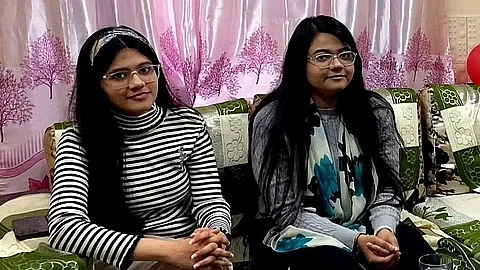
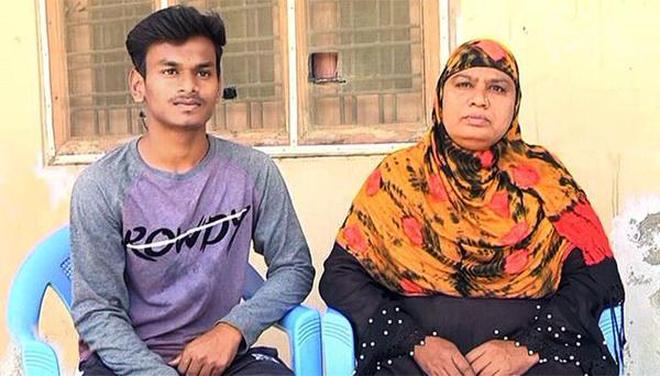
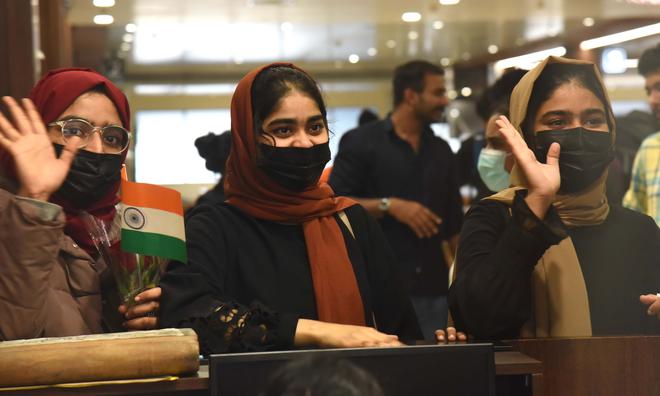
Zenab and Kulsoom, residents of Old Delhi, say they felt completely helpless while returning from Ukraine as they were neither able to speak Ukrainian language nor got any help from Indian authorities.
Zeba and Kulsoom
“We could see three shells falling when we were walking towards the railway station. It was for the first time that we saw death so near,” recollects Zenab, who recently returned from Ukraine’s Kharkiv along with her sister Kulsoom.
These young girls, who saw death from up and close, say they felt completely helpless while returning from Ukraine as they were neither able to speak the Ukrainian language nor got any help from Indian authorities.
The two sisters, residents of Old Delhi, completed their primary education in Dubai before going to pursue further studies in Ukraine. The two young girls stayed together at same hostel and for that they had to fight with the university authorities, but their struggle turned out to be a blessing in disguise as during war they stayed together which was a big relief for both of them.
“I was so tense that they should remain together; even while returning I asked them to hold their hands tightly,” says their mother, Ghazala Salim.
Zenab and Kusoom, who were pursuing MBBS and MBA courses and never witnessed even a street fight during their life, had a horrifying experience of witnessing a full-fledged war. They, along with their friends, stayed in the bunker of a metro station and had to live on one meal a day as there was shortage of both food and money.
“We were allowed to use the washroom only once in 24 hours and we were not allowed to send videos or talk with our parents on mobile as per instructions, as Ukrainian authorities feared that the videos could be used for propaganda by the enemy,” recalls Kulsoom.
They witnessed tanks standing facing their hostel and even saw that certain signs were put on buildings which were to be targeted. The Russian army also hoisted their national flag atop the university.
“Our group finally decided to move out and one of our friends asked everyone to carry only water and food with very few clothes,” says Zenab.
They walked for two hours before reaching the railway station to catch a train for Lviv. Once they reached there, the group faced several problems. “Train authorities were only allowing local people first and after that girls were given permission whereas non locals boys were not allowed to board the train and were even roughed up. Traveling in the train was very suffocating too as it was very crowded,” they recalled.
On way to Lviv, they passed through Ukrainian capital Kyiv where heavy shelling was taking place. When the group reached Lviv, their parents advised them to move towards Romania instead of Poland and Hungary.
“The Romanian people were very nice and cooperative,” recalls Zenab.
Both the sisters said that from Kharkiew to Romania they did not receive any help from Indian authorities except they came to tell us that we have to check in from this point.
These sisters, who went to Kharkiv in December last year, miss studying in the university and want to return as soon as the situation returns to normal.
They said that there was huge a language problem, but otherwise also local people didn’t communicate with foreigners. They used Google Translate for their daily needs but in three months, they grew fond of their institution. “The girls feel terrible watching the news of bombardment in Ukraine, and miss their university a lot,” says Ghazal, the mother of the two girls.
Mohd. Salim, the father of the two sisters, is an engineer and was working in Dubai before he returned to Delhi just after Covid two years back. He is now running an eatery in Delhi and also has a distributorship of cosmetics. “The education is not cheap in these universities, but the education is very good,” he says.
The parents underwent an extremely stressful time for ten days but feel relieved now that their daughters have returned home safely.
“A WhatsApp group of parents was our only source of information from Ukraine as our daughters were so terrified that they just followed the instructions and only messaged that they are safe and not to worry,” says Ghazala.
source: http://www.nationalherald.com / National Herald / Home> India / by S Khurram Raza / March 08th, 2022
The Frank and Debbie Islam Incubation Center at AMU mentors the women in their craft, upgrading their skill base and providing them design and marketing support.
Aligarh:
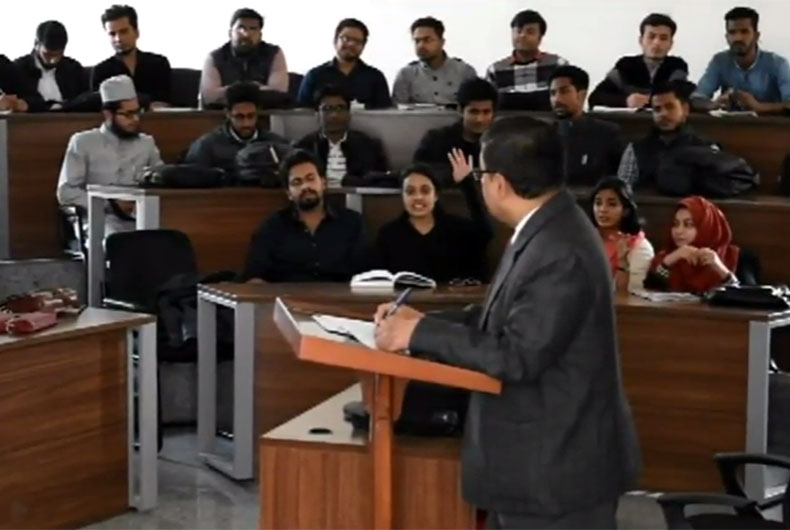
The Frank and Debbie Islam Incubation Center of the Department of Business Administration at Aligarh Muslim University (AMU) is crafting the future of Muslim Women Entrepreneurs in Uttar Pradesh and elsewhere, and definitely the bells should toll for it on the Women’s Day that falls on March 8.
The Frank and Debbie Islam Incubation Center at AMU mentors the women in their craft, upgrading their skill base and providing them design and marketing support. This enables the incubation center to bring applique craftswomen to get trained in entrepreneurial skills to help start their small businesses.
This project was conceived during the world Alumni summit of 2008 when Mr. Ameer Ahmad (MBA1978) and Mr. A.G. Danish (MBA1988) committed Rs. 1 crore and Rs. 10 Lakh respectively for the building project.
The project got a major fillip when Dr. Frank Islam, a Washington-based AMU alumnus originally from Azamgarh and his wife Debbie Driesman, through their Frank Islam and Debbie Driesman, pledged USD 2 million for this project.
In addition to the contribution of Dr. Frank Islam, the project received contributions from other alumni, well-wishers, students, faculty members, and others from India and all over the world.
This building of this innovative project is constructed on a 3-acre plot in the Sir Syed House Complex. The Complex is the new home of the Department of Business Administration and Faculty of Management Studies and Research. The building is a state-of-the-art facility but maintains the architectural legacy of AMU.
The construction began in May 2015 and the foundation stone was laid on 15th February 2016. The Project was completed in a record time of two years, creating a facility of 50000 sq feet, containing an academic block, a faculty-cum-administrative block, a facility block comprising library & IT facilities, and open areas. Phase 1 of this Building was inaugurated on 12 Feb 2017 and it was occupied in June 2017.
Phase 2 of the project is being built with the help of Dr. Nadeem Tarin, another distinguished and committed alumnus of AMU. This phase shall house a seminar hall, an incubation center, additional classrooms, including facilities for executive training.
The additional facilities will broaden the scope of the MBA Department’s offering that has already started two additional Master’s programmes, namely MBA (Islamic Banking and Finance) and MBA (Hospital Management). Another MBA for working executive is due to be started soon. In addition, phase 2 shall provide additional space for other incubating start-ups.
source: http://www.ummid.com / Ummid.com / Home> Business & Economy / by Syed Ali Mujtaba / March 08th, 2022
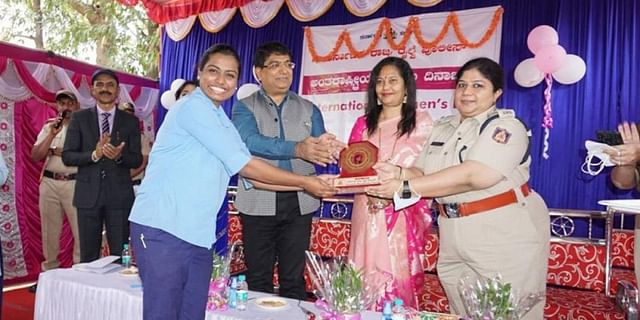
The Government Railway Police (GRP) on International Women’s Day honoured seven women serving as loco pilots and assistant loco pilots in trains operated by the South Western Railway.
One of the loco pilots being awarded by GRP in recognition of their exemplary services.
Bengaluru :
The Government Railway Police (GRP) on International Women’s Day honoured seven women serving as loco pilots and assistant loco pilots in trains operated by the South Western Railway. In recognition of their exemplary services to the Railways, S B Gayatri Krishna, V S Abhirami, C Minu Mubaraka, Nimi Chand, Rangoli Patel, Nimisha Kumari and P Noorul Meharna were honoured.
Additional Director General of Police, Railways, Bhaskar Rao and Superintendent, GRP, DR Siri Gowri were present at the event held at KSR Railway station. M P Omkareshwari, Road Transport Joint Commissioner (Bengaluru Rural), Psychologist Soujayna Vashista, and Senior Divisional Security Commissioner, RPF, Debashmita Chattopadhyay Banerjee, were also present on the occasion.
source: http://www.newindianexpress.com / The New Indian Express / Home> Cities> Bengaluru / by Express News Service / March 09th, 2022
As Urdu Day approaches, Hyderabad-based author Jeelani Bano speaks about her bond with the language.
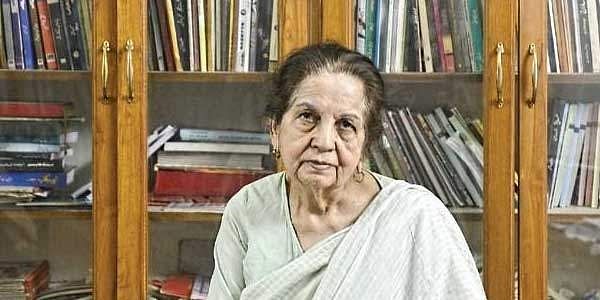
Jeelani Bano(Photo | R Satish Babu)
Jeelani Bano, 80, looks frail in her sea green sari with that mop of pepper-and-salt hair. Her demeanour is genteel, but only a talk about her stories on bonded labour, her aapa Ismat Chughtai and Progressive Writers’ Movement lights up her eyes. The decades pass on her soft wrinkled face as she turns pages of her autobiographical book Main Kaun Hoon and takes you back to an era gone by that’s still alive in her Banjara Hills house in Hyderabad, serenely tucked in another time-frame.
As Urdu Day approaches on November 9, she speaks about her association with the language. Many of her stories appear to be of our time. Jagirdari may have gone but capitalistic clutches don’t let go of the bonded slavery. Her story Paththaron ki Barish is heart-wrenching. Bano, who has authored 22 books, says, “A lot of writers of our time revolted against this inhuman system. Something also sparked in me and I wrote such stories. But today also, the situation of daily labourers is the same.”
Her book Aiwan-e-Ghazal, which tells the tales of feudal landlords in Hyderabad, has been translated into 14 languages. She then talks about her dear aapa—Ismat Chughtai—the firebrand writer.
“She was also from Badayun in Hyderabad, where I was born. She was friends with my mother and supported me a lot in writing,” says the 2016 NTR National Literary Award winner showing the letters Chughtai sent to her. Ismat wrote to her, “After marriage, respect your writing as much as you would respect your husband and in-laws.” In ’70s, when Jeelani Bano and her husband Anwar Moazzam, poet and writer, went to Pakistan, famous poets and scholars came to meet them at the border. She shares, “Nobody wants to understand what people of both the nations want. Sarhadein dilon ko nahin baant saktin (Borders can’t divide hearts).”
When once she went to the US, a scholar asked her, “You’re a Muslim woman. How did you get permission to write?” To this, she replied, “Nobody has stopped me from writing. Perhaps you haven’t been to India or else you wouldn’t have asked me this.”
Renowned poets and scholars such as Shakeel Badayuni, Makhdoom Mohiuddin, Jigar Muradabadi and Kaifi Azmi were hosted at her Mallepally home. But, she along with other children weren’t allowed to go to the baithaks. The young Bano would watch these poets, while playing in the courtyard.
source: http://www.newindianexpress.com / The New Indian Express / Home> Magazine / by Saima Afreen / November 05t, 2016
Hasna Iqbal (left) and Muhammed Nahid. Screenshots/ Manorama News
“They may shoot us,” said Hasna Iqbal, a Malayali student stranded in Kharkiv, the northeastern Ukrainian city that is under immense shelling from Russian forces on Wednesday.
Talking to Manorama News from the Vokzal metro station in Kharkiv at 3.45 pm (7.15 pm IST), the second-year medical student in Ukraine said they are unsure of what might happen next.
The student’s response comes hardly an hour after the Embassy of India in Kyiv issued a couple of advisories asking Indian citizens in Kharkiv to exit the city immediately.
The Embassy had reportedly acted in a haste based on Russian inputs. Vladimir Putin’s forces had been launching heavy attacks on the northeastern city the last two days.
“I don’t know what the Indian government wants us to do. Here there is a curfew from 4 pm to 6 am. If we are found outside during the curfew, they will shoot out,” Hasna said, braving tears. “There is heavy shelling and on top of it, we can hear gunfires.”
According to the Ministry of External Affairs, Kharkiv has, possibly, the biggest concentration of Indians in Ukraine. “At least 1,000 Indians are here,” Hasna said.
“Many have left by foot holding Indian flags. We don’t know what has happened to them. Things are getting worse here,” she said.
“Some of us reached the railway station at 6 am and three trains have left since. But not an Indian was allowed to board. They are giving preference to Ukrainians,” said Hasna.
“We’ll be here and hope to be safe, Insha Allah,” she added.
‘They aimed guns at us’
Another Malayali student Muhammed Nahid, who spoke to Manorama soon after, said they have not been contacted by the Embassy yet today.
“We reached the railway station at 5 am. They are boarding Ukrainians. They (Ukrainian forces) point guns at us and fired into the sky. We don’t know what to do,” said Nahid.
“We are still hanging around hoping we may be able to board a train somehow. We are running out of water and food,” he added.
source: http://www.onmanorama.com / OnManorama / Home> News> Kerala / by Onmanorama Staff / March 02nd, 2022
Muzaffar Alam’s ‘The Mughals and the Sufis’ is a remarkable and original work of scholarship.
Mughal emperor Jahangir chooses the Sufis. | Public Domain
The literature on the precepts of Sufism and the chronicles of its saints across various orders has a deep and prodigious lineage: from the great Kashf al-Mahjub of al-Hujwiri and the Risala of al-Qushayri, through Abdul Rahman Jaami’s Nufahat-ul-Uns, the wonderfully lucid Sakinat ul Auliya and Safinat ul Auliya, written by the 17th century Mughal Crown Prince Dara Shukoh, to the monumental compendium, A History of Sufism, by Saiyid Athar Abbas Rizvi, in our own times. The examination of the subtle and complicated interplay between religious doctrine, political influence, legitimacy and kingship throughout the Islamic period in India, though, is more recent.
Muzaffar Alam’s earlier book, The Languages of Political Islam in India c 1200-1800, published in 2004, was an important contribution to this discourse. It offered a fresh perspective by decoding the political vocabulary of those times to reveal the calibrations in theology, injunction and juridical practice, as Islam gradually became more “Indianised”.
In his new book, The Mughals and the Sufis – Islam and Political Imagination in India: 1500–1750, Alam once again breaks new ground, this time by harmonising two major domains of scholarship – Mughal History and Indian Islam – honed with painstaking care over a lifetime of study. What emerges is a highly nuanced and complex examination of the relationship between Mughal political culture and the two dominant strains of Islam’s Sufi traditions in South Asia: one centred around orthodoxy, the other focusing on a more inclusive and mystical spirituality.
The Sufi trajectory
The constituent chapters in the book, which can also be studied as stand-alone essays, chart the trajectory of the various Sufi silsilas and their principal actors, from the early, tenuous days of Babur and Humayun, through the 16th and 17th centuries, as the imperial position shifted from the more liberal outlook of Emperor Akbar (r 1556–1605) to the rigid attitudes of his great-grandson, Aurangzeb ’Alamgir (r 1658–1701).
Alam premises his critical study on a large number of contemporary Persian texts, court chronicles, epistolary collections, and biographies of Sufi mystics. Interestingly, the Maktubat-i Khwaja Muhammad Saif al-Din, compiled by Muhammad A’zam, Khwaja Muhammad Nasib Andalib’s Nala-i’ Andalib, and Muhammad Akram bin Shaikh Muhammad Ali’s Sawati‘al-Anwar are accorded no less importance than the staple Akbarnama or Badauni’s Muntakhab al-Tawarikh, known to every student of Mughal history.
This particular approach to Alam’s programme of study for his latest book serves two functions. First, his focus on relatively lesser-known figures and their writings, as well as many rare manuscripts, automatically inducts these long-underutilised texts into the bibliographical repertoire of mainstream historical research. Second, his own investigations enable Alam to challenge popular notions about the Sufis, upend unitonal hagiographic narratives of Sufi silsilas, and provide an alternate system of coordinates through which to view our cultural and religious history, in the process, reorienting our understanding of political Islam during the Mughal period.
A fundamental aspect of reappraisal is the relationship of a Sufi leader with the Mughal emperor. The usual perception is that the sole function of a Sufi saint was to be a spiritual pir (preceptor) for his murids (disciples), including those of royal blood. Alam cites numerous instances to the contrary, following a tradition that harked back to the Naqshbandi Sufis of Timurid times.
One of the key figures to emerge in this context is Khwaja ’Ubaid-Allah Ahrar, whose disciples included Timurid rulers and a number of their vassals throughout Central Asia. He and several of his descendants claimed they were not spiritual masters alone, but also the source of strength and assistance in the dispensation of politics as well as power struggles.
Although Khwaja Ahrar had died several years before Babur appeared at the threshold of Hindustan, the latter nevertheless ascribed many of his military achievements to the benediction of the pir. Most famously, at the Battle of Panipat against Ibrahim Lodhi in 1526, Babur, facing an enemy force that vastly outnumbered his own, is said to have meditated upon the image of the Khwaja, who then appeared as a horseman dressed in white, routing the Afghans.
Breaking myths
The Mughals and the Sufis also dispels some lingering stereotypes around the positions of the pirs in the Chishti and Naqshbandi orders. For instance, the Chishti pirs didn’t necessarily find ready disciples in the early Mughals and winning their allegiance was no trivial matter. A case in point is Shaikh ’Abd al-Quddus Gangohi, a member of the Sabiri branch of the Chishti order.
Khwaja Gangohi was a prominent preceptor of the Afghan elite at the Lodhi court, in fact, very nearly – the official royal pir. But as Babur established his supremacy in northern India through a series of brilliant, swift military campaigns, it took all of the Khwaja’s wisdom, tact and diplomacy, to reconcile himself to the rapidly changing realities. For his very vocal support of the Afghans, he had to suffer humiliation at the hands of the Mughals.
A similar stereotype concerns the perception of the non-inclusive, intransigent position of the Naqshandis throughout their history, as something of a monolith. Alam shows that the fervour of orthodoxy did sustain itself, from the pirs who were contemporaries of Amir Timur, to the Ahraris in the 15th and 16th centuries, through to the strident conservatism of Shaikh Ahmad Sirhindi and his followers in the 17th century. Aurangzeb’s unwavering support of the Naqshbandis ensured that the family of Shaikh Sirhindi enjoyed a favoured position at the imperial court.
Not only did this influence continue well after Alamgir’s reign, evidence is sighted of its influence outside the court in Delhi, for instance in literary circles, and beyond the capital, making inroads among sections of the civil society in Awadh, hitherto firmly entrenched in the Chishti-Sabiri tradition.
Through the following two centuries, however, Alam explains how a more muted and inclusive tenor of discourse developed within the Naqshbandi order, their change in position underscored by the triple forces of reformism, revivalism and modernism or Westernisation. Certainly, challenges from the West played a material role in changing the approach of modern Muslim intellectuals to Sufism.
Underlying many of the discussions are themes of influence, rivalry and conflict. Documentary evidence points to Sufis playing a role in informing and modulating imperial policy. Likewise, it is shown how the struggle for supremacy among rival princes (and princesses) was mirrored in the rise and fall of imperial allegiance to various silsilas.
Thus, when Akbar, at the peak of his religious innovations, is confronted by the outraged Naqshabandis, it is the latter who have to recant. And not long after Aurangzeb ascends the throne as the emperor Alamgir, Dara Shukoh’s Qadiri pir, Mullah Shah, is summoned to the imperial court and interrogated by the ’ulama. When it comes to a deeply critical and iconoclastic element of the Sufis, such as Sarmad Kashani, nothing less than execution would satisfy the emperor and conservative clergy. Viewed through this prism, the narrative of political Islam appears as a glazed mirror of the vicissitudes of princely wars of succession, and the leanings and idiosyncrasies of successive emperors.
What the women did
One of the criticisms that is often levelled against the academic patriarchy of medieval history is its scant attention to the women of the imperial household, their role and influence in contemporary politics and decisions that morphed and changed the empire. In this regard, the chapter-essay, “Piety, Poetry, and the Contested Loyalties of Mughal Princesses, c 1635-1700”, is a welcome inclusion in the present volume.
The legend of Jahanara, as the other-worldly princess who eschewed imperial titles in favour of the sobriquet of al Fakira, is well known. What is less well-known, though, are her allegiances to specific Sufi pirs and silsilas, and those of her sister, Roshanara, and her niece, Aurangzeb’s daughter, Zebunissa. This essay juxtaposes the contrasting religious beliefs and mystical leanings of these three ladies of the imperial household, despite their common upbringing.
Jahanara, even though she was initiated into the Qadiri sect, continued to retain a close spiritual affinity for the Chishti saints, in particular, Nizamuddin Auliya. Her choice is both a continuation of the pluralistic ethos instituted as imperial policy by Akbar, and a reflection of the deeply syncretic views of her favourite brother, Dara Shukoh – views that she wholeheartedly shared with him.
Roshanara played a far less public role than her sister, although she was a shrewd political observer, and increasingly, a key player in the filial strife that led to the War of Succession in 1657, ending with Aurangzeb’s ascendancy to the throne. Her close connection with the Naqshbandi-Mujaddidi order saw her acting as a mediator, during the attempts made by the sect to expand their influence over the entire imperial zenana.
Their sustained efforts to maintain dealings with the princess Zebunissa notwithstanding, the latter was far more inclined towards the practice and patronage of literary pursuits, than to the encouragement of the Mujaddidi brand of Islamic revival.
In a volume that offers much new perspective, the most insightful and striking essay is the penultimate chapter, “In Search of a Sacred King, Dara Shukoh and the Yogavsisthas of Mughal India”. In the author’s estimate, the Mughal Empire finds its intellectual and spiritual apotheosis not in the figure of Akbar, but Dara Shukoh, who, he boldly asserts, “is a step ahead of his great grandfather, Akbar”.
With this, Alam breaks with an unbroken line of rather uncritical adulation as regards Akbar that has stretched across generations of historians. For all his astute matrimonial alliances with Rajput chieftains, within the pecking order of the Hindu caste system, Akbar could only aspire to the status of a Kshatriya, Alam points out. Dara’s quest was far loftier – like Visvamitra, he sought to synthesise and embody the dual powers of the Kshatriya Raja and the Brahmin Rishi.
Akbar’s interest in Hindu scriptures, mythology and epics such as the Mahabharata reflect his curiosity about India’s political culture, but there was no great imperative for him to imbibe Indic norms of governance. In contrast, Dara’s project of translating the Yogavasistha goes well beyond intellectual curiosity or the inclination to recognise alternative formulations of spirituality. He becomes deeply immersed in the text, to the point of inhabiting it.
For Dara, the book is not only a philosophical treatise, worthy of study for a syncretic practicing Sufi – but a political manifesto – as the Crown Prince grapples with the eternal conflict between spiritual truth and temporal power. Rama Chandra is not the indigenous god from a hoary past but, in Dara’s dream, Lord Rama is a fellow-seeker of Truth, an elder brother.
In his quest for mystical and spiritual learning, Dara had perused the texts of several religious cultures, including his own. But it is only in the Yogavasistha, Alam proposes, that Dara finally found his model for the saint-king, one on which he wished to build the moral foundations of his own reign.
In a refracted light, The Mughals and the Sufis can perhaps be seen as an intellectual self-portrait, painted in the hues of scholarship, investigation and analysis. Now approaching his mid-70s, Alam remains as indefatigable as ever, poring over forgotten texts and rare manuscripts, to reveal the haqa’iq wa ma’arif (realities and truths) hidden within them.
The Mughals and the Sufis – Islam and Political Imagination in India: 1500-1750, Muzaffar Alam, Permanent Black.
source: http://www.scroll.in / Scroll.in / Home> Book Review / by Avik Chanda / April 28th, 2021
Rajia Begum and her son Nizamuddin. File | Photo Credit: Special Arrangement
Her son is stuck in Sumy bordering Russia
A school teacher in Nizamabad, who had travelled 1,400 km on a two-wheeler all by herself to bring back her son stranded in Nellore, Andhra Pradesh, following the sudden imposition of lockdown in March 2020, is in distress again.
Razia Begum’s 19-year-old Nizammudin Aman is stuck in Sumy, a city in north-eastern Ukraine, where he is pursuing MBBS first-year studies. He is among the 500-odd Indian students cooped up in hostel rooms or bunkers even as Russia has escalated the military offensive on the war-hit country. The students stuck there say Sumy, close to the Russia border, has been badly affected. The nearest metro station was blown up, and roadways are damaged too, they say. The distressed mother has written to Chief Minister K. Chandrasekhar Rao, Home Minister Mohammed Mahmood Ali, and senior State government officials on Wednesday requesting help in evacuating her son from Ukraine.
Back in March 2020, Nizam had gone to Nellore to drop off a friend. They were undergoing coaching for NEET-PG. As lockdown was suddenly announced, Ms Razia, who works as a teacher at Salampad Camp village at Bodhan in Nizamabad, set off on a solo journey to rescue her stranded son.
With just a pack of rotis, fruits, and a five-litre fuel can on April 6, 2020, Ms Razia embarked on a long, arduous journey on her two-wheeler. She drove alongside heavy vehicles on highways, even at night, and reached Nellore the next day. After picking up her son, they drove back to their home in Bodhan. Ms Razia lost her husband, also a school teacher, 14 years ago due to kidney failure. In the letter addressed to the government officials, she stated that the medical condition and helplessness made her son opt for the medical profession so that he could serve such patients in future.
Nizam is once again stranded, this time in a far-away country, amid a hostile situation, and Ms Razia cannot stop feeling anxious. “They are not able to get out of there since it is not safe to step out. I appeal to Prime Minister Narendra Modi to rescue my son along with other Indian students stuck there,” she appealed.
source: http://www.thehindu.com / The Hindu / Home> News> National> Telangana / by K Shiva Shanker / Hyderabad – March 07th, 2022
Safina Nabi has always felt like a storyteller and, as she put it, a “story listener.” As a child growing up in Kashmir, she would listen to radio programs with her grandfather, showing a natural curiosity about them. “I would have dozens of questions and he would explain [it to] me,” she said. “Growing up, I think journalism came naturally to me.”
Nabi started working in radio programming while studying for her master’s degree in journalism and mass communication at the University of Kashmir.
At one point, she hosted an hour-long live morning show. “I wasn’t interested in writing at all,” she said. “I loved to be in front of the camera, taking pictures or doing interviews.”
In 2014, Nabi was forced to move to Delhi due to flooding in Kashmir. While in Delhi, she began to take on writing jobs as a way to make some extra money. After several years of exploring different mediums and “trying everything,” she decided that writing was what she wanted to do.
Much of Nabi’s work explores issues of gender and how it intersects with health, conflict, social justice and human rights.
She has written for The Guardian, MIT Technology Review, Vice, Al Jazeera and more.
Her stories are built around strong female characters; she feels that people are the most important part of any piece.
Over the past couple of years, Nabi also started writing about her culture and community. She sees it as a way to preserve her heritage. “We [Kashmiris] are an ethnic group and we come from a minority background. We need to preserve our history, our language, and our cultural roots. I think one of the major and important ways to do that is to document them.”
Nabi has received two grants from the Pulitzer Center for her work, the first of which she found on IJNet. Initially, she wasn’t even sure she would apply because she was anxious about being rejected. “The tab remained [open] on my laptop for days and days,” said Nabi. Finally, she told herself she had to act. She applied and received a positive response within a week. “I was so excited about it,” she said. The project, Kashmir’s Tribal Women Fight the Stigma of Birth Control, focused on the lack of access to family planning resources for nomadic Kashmiri women. “I have received really great feedback. I really think [working independently] is something that has helped me grow, because I can tell the story the way that I want to,” Nabi said.
The ability to control the direction of her stories is incredibly important to Nabi. She spoke with frustration about the limitations of the journalism industry, and how difficult it was to get started as a young journalist with new ideas. “As a journalist who is juggling lots of other issues like internet gags and communication blockades, we don’t have the kind of time to actually research each and everything,” she said. Grants give her more freedom to control her stories, and resources like IJNet, she explained, help her find new opportunities.
Nabi’s most recent project is an in-depth piece funded by the Pulitzer Center. Titled, “How Kashmir’s half-widows are denied their basic property rights,” it highlights the struggles of Kashmiri women whose husbands have disappeared, but cannot be proven dead, leaving them in limbo.
Telling stories like this is what keeps Nabi going when facing situations like months-long internet and phone blackouts, government censorship and intimidation. “Who will tell the stories of these people who are suffering unnecessarily and [who] do not have avenues to reach out to people, to government, to authorities, and there is nobody to listen to them? I feel this is my obligation and this is my duty, to actually give voices to those people who cannot raise their voice, and I think that that’s something that keeps me pushing still,” she said.
It’s a very difficult phase of journalism in Asia right now, especially for women, Nabi explained. “In Kashmir, we don’t even have a women’s journalism association or a union. I think if we all come together collectively and take [up] that space, I’m sure the struggle is not going to end there, but at least we’ll have that kind of space where we will be able to share our vulnerabilities and our problems and discuss them, and be that support system for each other when in trouble.”
Nabi also noted the importance of media organizations and publications supporting and inspiring young women to become journalists. “I think it’s an obligation and duty of other [sites] like IJNet to give space and give more grants to journalists who come from these small backgrounds and give them chances, amplify their voices and their stories. That’s what will help more journalists to come out, especially women, and feel like, “Okay, there are some people who are making it big despite obstacles or struggles that they are facing.”
Photos courtesy of Safina Nabi.
source: http://www.ijnet.org / IJNET (Int’l Journalist Network) / Home> Newsletter > Journalist of the month / by Daniela Riddle / March 01st, 2022
Indian students, evacuated from Ukraine, on their arrival at Kochi International Airport in Kochi on March 5, 2022. | Photo Credit: PTI
‘We will soon be left with no option but to start walking to the nearest border ourselves’
Students in Sumy on Saturday said they were running out of hope after several days of promises on their evacuation through a “humanitarian corridor” and that continued bombardment in the city indicated there was no sign yet of a ceasefire for them.
The city also saw a blackout for most part of the day, leaving students without a means to cook.
“There is no water, no food, no electricity for the past two days and the bombings keep getting worse every passing day. Often bombs land a few hundred metres away from us,” said Zara Azan.
Another student, Hitesh Kumar Gujjar, said there were sirens at least thrice on Saturday forcing students to rush to their bunkers.
“Today is the 10th day. Every day we hear that we will be evacuated, but that is yet to happen. We will soon be left with no option but to start walking to the nearest border ourselves. We would prefer to die trying to escape rather than die of hunger and thirst ,” said Dushyant Siraw, who was echoing what a group of students said in a video threatening to walk to the Russian border armed with Indian flags amidst intense fighting in Sumy.
“The latest we have heard is that there will be an effort on Sunday to try and evacuate us. But this is not through official sources. If not tomorrow, we will lose all hope,” said Ms. Azan.
Mr. Gujjar said though there was a water tanker sent for the students, it was not enough.
“We got one litre of water. How can one tanker for 700 Indian students and hundreds from Uzbekistan, Kyrgyzstan and Nigeria be sufficient,” he said, adding that with no electricity, cooking on induction was not possible and students were making do with “biscuits and chips”.
Students say some of their friends are seeing their health deteriorate from exhaustion and scarcity of food.
“Several of my friends and I have fainted more than a few times. There is physical and mental breakdown. Many students are also experiencing asthma attacks, but inhalers and drugs or any medical assistance is just not available,” said Ms Azan.
source: http://www.thehindu.com / The Hindu / Home> News> National – Indians in Ukraine / by Jagruti Chandra / New Delhi – March 05th, 2022
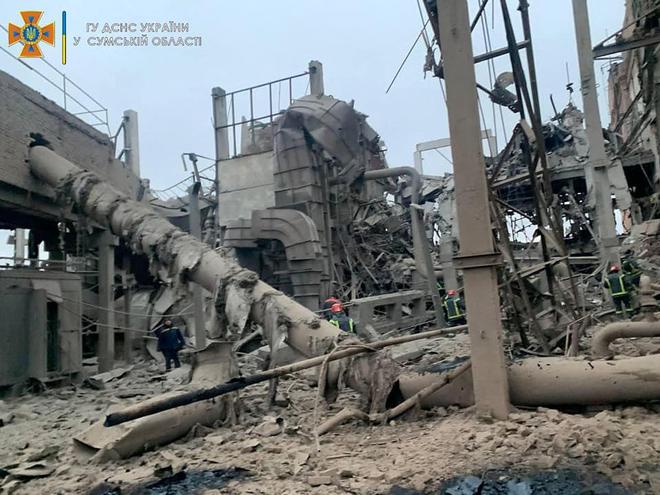
A view shows thermal power plant destroyed by shelling, amid the Russian invasion of Ukraine, in the town of Okhtyrka in the Sumy region, Ukraine, in this handout picture released on March 4, 2022. | Photo Credit: Reuters
Their fate hangs in the balance as there is no progress on ‘humanitarian corridor’ for evacuation
The fate of several hundreds of students at Sumy in eastern Ukraine hangs in the balance as there was little progress on a “humanitarian corridor” for evacuation of civilians on Friday, while students who were able to reach Pesochin from Kharkiv after an advisory continued to leave for the western border on privately arranged buses.
“There were air-strikes and bombings on Sumy yesterday, which led to power and water supply being cut-off. We spent the entire night without electricity, and we can’t cook without water. If we don’t get killed by bombs, we will definitely die of starvation and thirst,” says Shivangi Jaiswal, who shared videos of students collecting snow and water from roof channels.
She says that unlike Kharkiv, where there was some movement because of a train station, Sumy is cut off from all sides as roads and rail tracks have been damaged, entrapping students in their hostel bunkers.
“Only a government intervention can help us escape from here. But it seems no decisions are being taken for Sumy,” said Ms. Jaiswal
‘Buses not helpful’
On Thursday, Russia and Ukraine agreed to create humanitarian corridors for evacuation of civilians and there were reports that 130 buses were waiting on the Russian border for Indian students.
But Ministry of External Affairs spokesperson Arindam Bagchi said at a press interaction on Friday that there would be difficulties in evacuating students from an active conflict zone until there was a ceasefire and Russian buses were very far from Kharkiv and Sumy and were not proving to be helpful.
Reacting to these comments from Sumy, Zara Azan said, “the government says they are waiting for us at the borders. I want to ask them, if you can’t brave the shelling to reach us, then how do you expect young college students to make their way to the border without cabs, buses or trains. The least the embassy can do is arrange buses for us.”
“Yesterday we saw several fighter planes drop bombs just metres away from our hostel, and several girls fainted on seeing that. Increasingly, children are falling sick due to cold or complaining of low blood sugar levels or suffering panic attacks. We may even have to carry them while planning our escape as we can’t leave our friends behind,” said Zara.
She asked why did the embassy not forewarn its citizens about escalating tensions between Russia and Ukraine.
“In February, I had to travel from India to Ukraine and I called the Indian embassy to know if it was safe to travel as several other countries had started issuing advisories for their citizens and I was told that I could travel,” says Zara.
‘No info on exit plan’
In Pesochin, where nearly 1,200 students fled to from Kharkiv following a government advisory on Wednesday, students continued to leave for the western border on privately arranged buses for which they have paid from their own pocket. They were earlier expecting that they would be able to make their escape through the border with Russia on buses they believed the embassy would arrange for them.
“There is no information yet from the embassy on an exit plan for us through Russia. Our student coordinator has arranged a few buses and we are slowly leaving on them. Two buses with 60 students left yesterday and nearly six are leaving today. We have been told that all students will be able to leave Pesochin by Saturday,” said Mohamed Thaha Sheikh.
source: http://www.thehindu.com / The Hindu / Home> India> National / by Jagriti Chandra / New Delhi – March 04th, 2022