While Mughal rulers like Babar and Bahadur Shah Zafar have been buried on foreign soil, quite a few members of their clan rest at Humayun’s Tomb
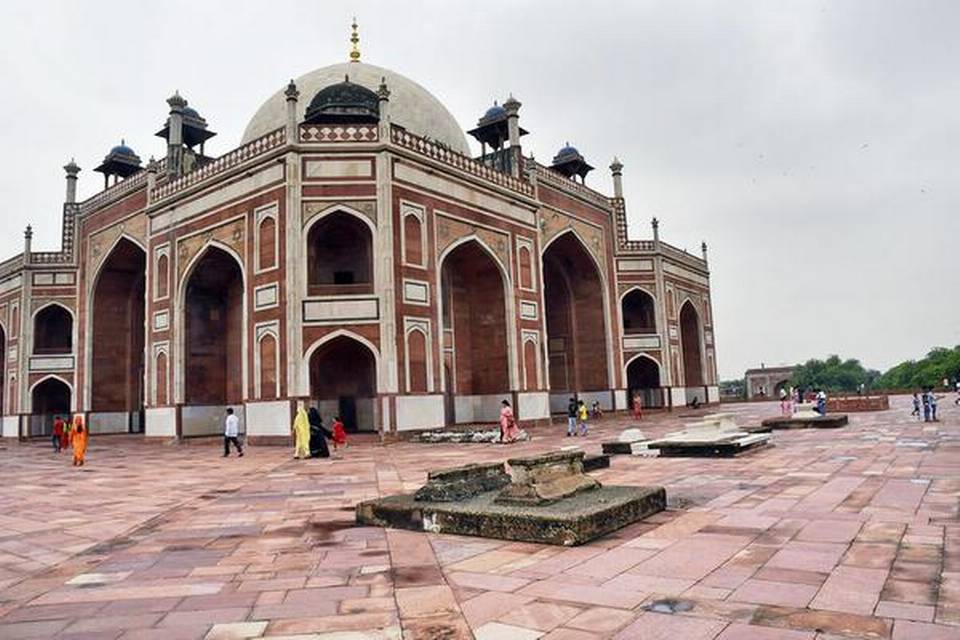
Where do most Mughal kings, princes, and princesses sleep in Delhi? The answer lies in the vaults of Humayun’s Tomb, built with much devotion, by the emperor’s first wife, Haji Begum. Among those buried here are Hamida Bano Begum, the mother of Akbar; Dara Shikoh, Shah Jahan’s heir apparent; Aurangzeb’s once beloved son, Azam Shah; the dandy Jahandar Shah, and his slayer Farrukhsiyar; Ahmed Shah and Alamgir-II.
There are many more, of lesser note, some without inscriptions, gathered within the folds of the mausoleum of their ancestor Humayun. It’s a strange feeling of beds spread out on a summer night with the kind emperor sleeping in glory among many of those who waded to the throne through the blood of their relatives. The last rites of murdered princes were generally adhered to and they were laid to rest in the family graveyard. But there were exceptions like Dara Shikoh, who was denied the ritual funeral bath by his austere brother Aurangzeb.
In Mehrauli, the precincts of the shrine of Hazrat Qutubuddin Bakhtiar Kaki also form the burial ground of many Mughal and other princes. In Agra, Akbar’s tomb at Sikandra is the repository of the remains of a host of princes and princesses. In Calcutta, several descendants of Wajid Ali Shah, the last King of Oudh, lie buried, and in Rangoon, the family of Bahadur Shah Zafar has found a burial place denied to it in the land of its birth.
Babar’s tomb should have been the last resting place of all those descendants whose graves are found in Humayun’s mausoleum. But Babar chose to be buried in Kabul which ceased to be a part of the Mughal empire by the time most of his successors died.
Isn’t it an irony of fate that the first and last emperors could not be buried in India? While Babar loved Kabul, Bahadur Shah Zafar had no choice as the British wanted to stamp out his very memory by burying him in a nondescript grave in Rangoon, which was rediscovered by chance and formed the rallying point for Netaji Subhas Chandra Bose’s INA during World War-II.
Bahadur Shah Zafar died on 7 November, 1862 and was hastily buried by lantern light, with the British officer deputed to escort him from India and look after his stay in Rangoon, supervising the funeral. Zinat Mahal and the other ladies of the harem who had accompanied the king did not attend the last rites, but his young son, Jawan Bakht was present. No tombstone was erected to perpetuate the memory of the star-crossed monarch, but fate willed it otherwise and Bahadur Shah Zafar seems to have had the last laugh as his name and fame survive despite his oppressors’ ill-intentions.
The king’s mazar (shrine) has now become a place of pilgrimage in Myanmar, where the last emperor is worshipped as a Pir. While on the walls are inscribed some of his heart-rending ghazals, like the one bemoaning the misfortune of his not having found even two yards of land in his country of birth “Kitna hai badnaseeb Zafar dafan ke liye / Do gaz zamin bhi na mili ku-e-yaar mein”. But he has acquired enough space in the hearts of his compatriots alright.
Babar’s mausoleum is a modest one, which lay neglected for many years. But it is heartening to note that lately it has been renovated, having somehow escaped destruction during the Soviet occupation of Afghanistan and then the turmoil of the Taliban period. Though demands have been made for bringing back Zafar’s remains to India, nobody has raised their voice for Babar’s reburial, not entirely because of the first Mughal emperor’s dying wish.
So Humayun’s Tomb remains the funeral parlour of the family of Babar. You go from vault to vault and nothing but inscribed stones confront you on which are enshrined a cloak-and-dagger mystery. Death, gruesome death, generally at the hands of an assassin hired by the next of kin, the ambitious prince determined to seize the throne.
Many were done to death by their brothers, uncles, nephews or treacherous wazirs. Some died of poison, administered through a favourite, but faithless, courtesan; others strangled in their sleep, yet others hacked with swords or stabbed through the heart or back. Children weren’t spared. You gaze at these tombstones with awe and pity. How many innocent lives destroyed for the sake of ambition! There is the silence of death all around, with the Grim Reaper gloating over his sickle of time with which he has laid low both those with name and those without fame. Only Clio, the muse of history, understands the secrets of these vaults and it is she who weeps in them through her tresses: Put on your shoes and tip-toe away.
The writer is a veteran chronicler of Delhi
source: http://www.thehindu.com / The Hindu / Home> Society> History & Culture> Down Memory Lane / by R.V. Smith / July 23rd, 2019
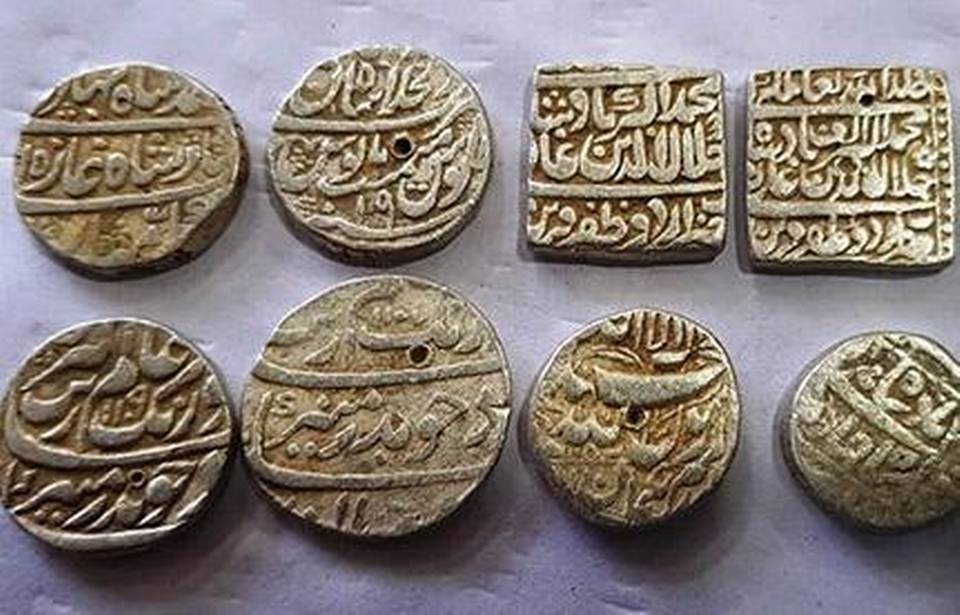
The Uttar Pradesh police on Friday said it had recovered a treasure trove of 698 “rare” Mughal-era silver coins dating back to the 16th and 17th century. A few of the coins are said to be from the eras of emperors Akbar and Aurangzeb.
The coins were found buried in a garden in Shimla, said a police officer from Moradabad district.
A DSP-rank officer from Moradabad Lallan Singh, the circle office of Highway area, said the coins were found by a Moradabad-based contractor named Ghulam Nabi while he was digging at a location in Shimla with three-four labourers.
The police came to know of the coins after Mr. Nabi and the labourers quarrelled among themselves over sharing the coins after they returned to the Mundhapandey area of Moradabad district, Mr. Singh said.
The coins weighed 7.9 kg, the officer said, adding that they had been sent to the Archaeological Survey of India.
“We struck silver!” U.P. police tweeted late on Friday as it released pictures of the recovery.
According to ASI, these are “rare 16th/17th century Mughal-era coins with legends in Persian and kalima in Arabic”, the police said.
The ASI is yet to issue a statement on the recovery or independently acknowledge their historical significance.
source: http://www.thehindu.com / The Hindu / Home> Society> History & Culture / by Omar Rashid / Lucknow – July 27th, 2019
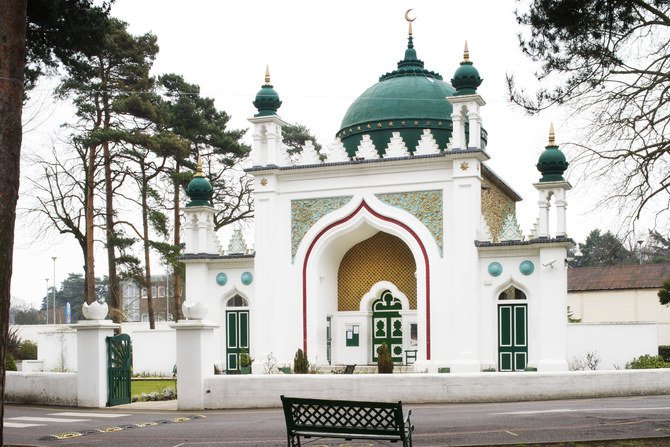
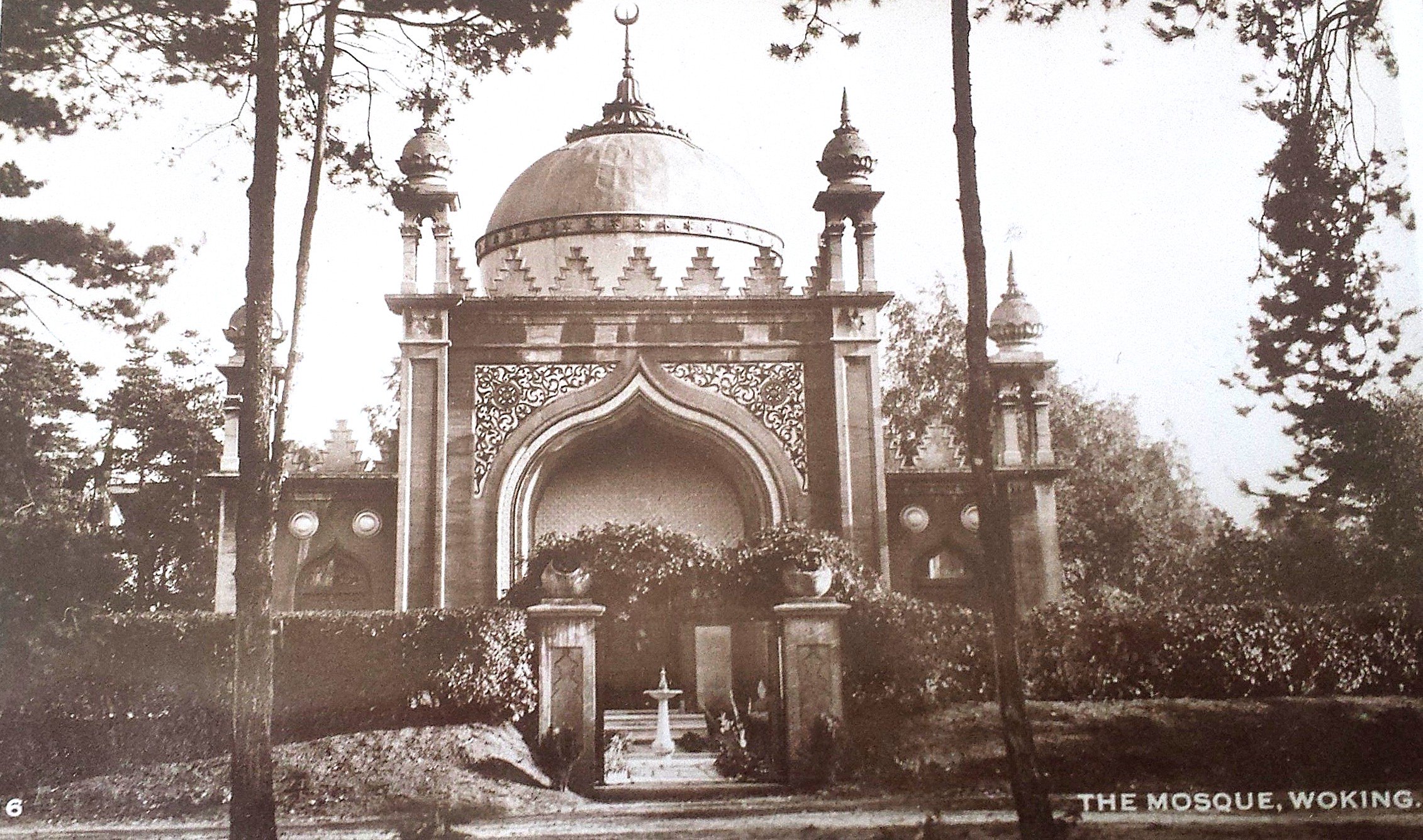
The mosque was built as part of a vision by Dr. Gottlieb Wilhelm Leitner, to include the main religions (Islam, Judaism, Christianity and Hinduism), but he passed away before he could fulfill his commitments. (Everyday Muslim/Tharik Hussain)
Everyday Muslim announced the discovery of a forgotten Arab/British princess directly descended from the Prophet Muhammad
Buried in a Muslim plot at the Brookwood Cemetery near Britain’s first Muslim Cemetery
London :
The grave of a British Muslim, believed to be a direct descendent of the Prophet Muhammad (peace be upon him), has been discovered in a suburban town about 50 kilometers (30 miles) southwest of London.
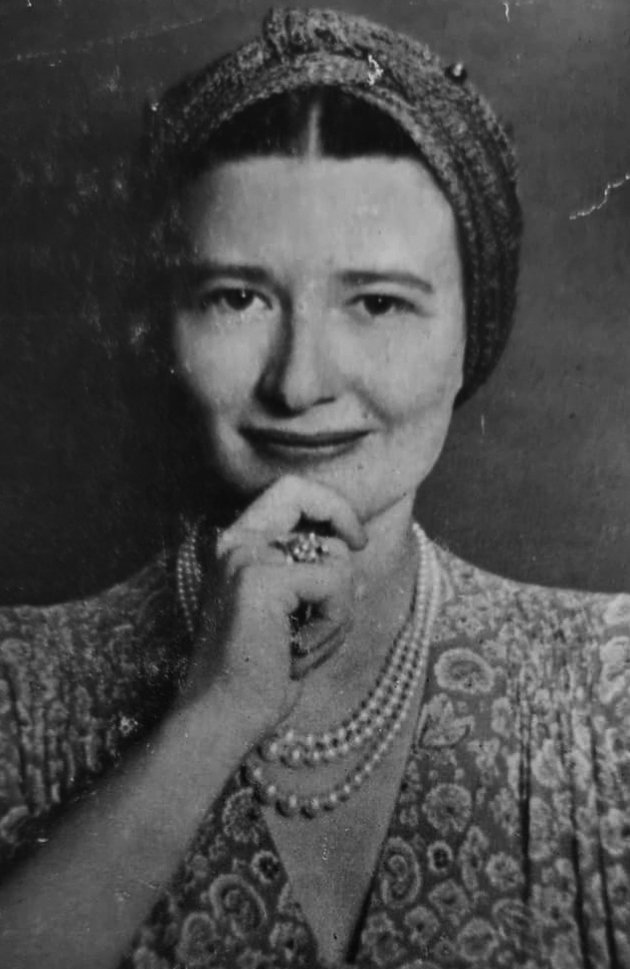
Nestled in the woodlands of Woking, Surrey, Princess Sharifa Musbah Haidar El-Hasimi (also known as Musbah Khanum and Musbah Haidar El-Ghalib) lies in one of Europe’s oldest Muslim cemeteries, surrounded by the graves of other notable Muslim Britons from the late Victorian period and beyond.
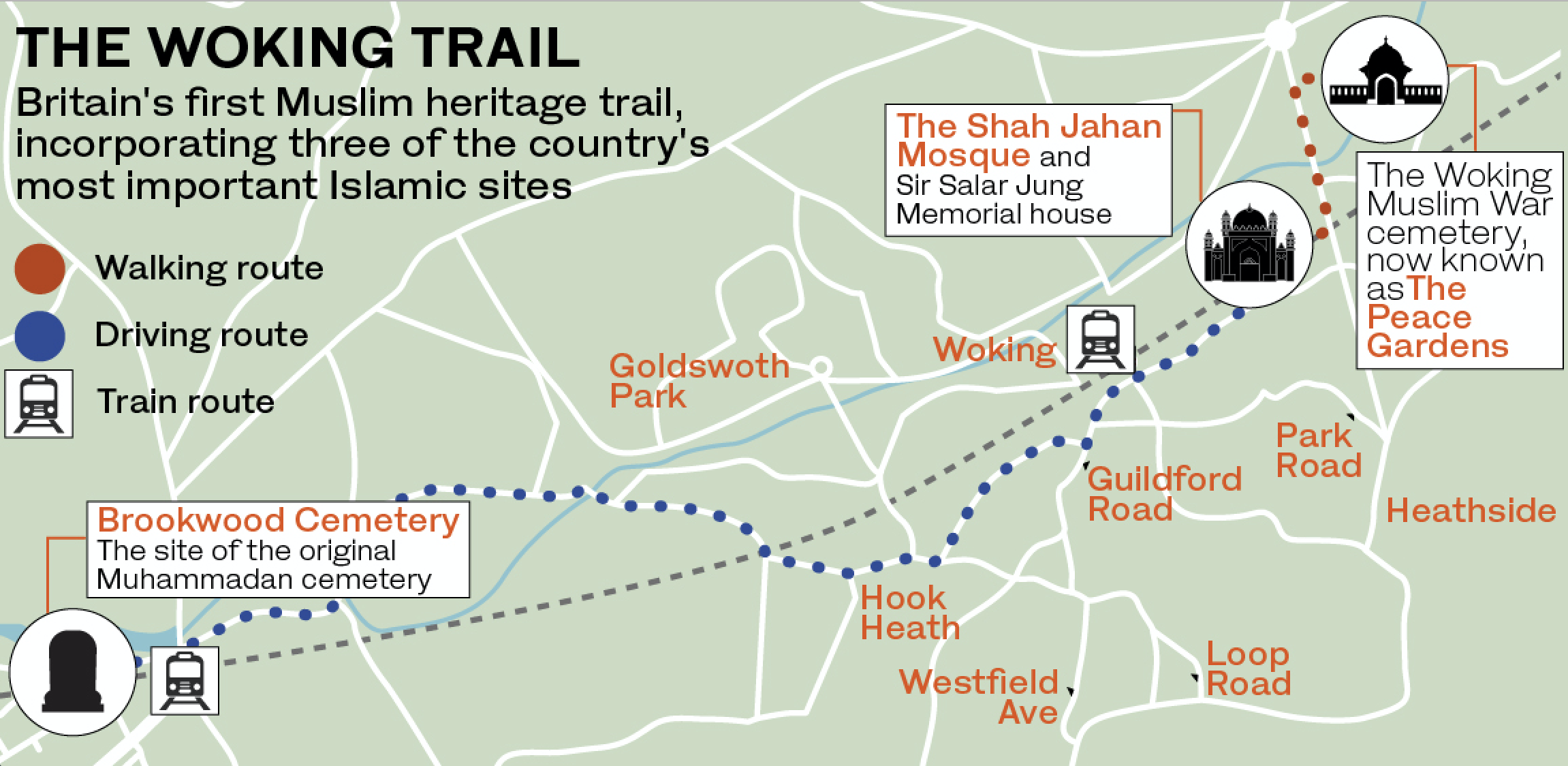
The burial ground, the first Muslim cemetery established in Britain, was unearthed as part of a trail led by Everyday Muslim, a non-profit organization dedicated to documenting Muslim heritage in the UK.
“Fascinating revelations on the history of this particular princess and her final resting place have been unearthed during a self-guided trail that takes visitors to three of Britain’s most important Islamic sites, offering an overview of each one,” said Tharik Hussain, the project’s manager.
It was Hussain who first discovered the story of the Princess when he stumbled across one of her books in a small bookshop in Brighton about six years ago. Captivated by this discovery, he began researching her background.
Princess Musbah Haidar, according to Everyday Muslim, was the second daughter of the Grand Sharif of Makkah, Amir Ali Haidar of the family of Devi Zeids, who claim to be direct descendants of the Prophet Muhammad.
Princess Musbah Haidar was the second daughter of the Grand Sharif of Makkah, Amir Ali Haidar of the family of Devi Zeids, who claim to be direct descendants of the Prophet Muhammad. (Supplied, no known copyright)
Princess Musbah’s mother was an Englishwoman of Irish descent called Isabel Dunn, who converted to Islam and became Amira Fatima, the second wife of Haidar. She was employed as an English teacher for the children from his first marriage.
Everyday Muslim reported that Princess Musbah was born at the family retreat, known as Chamlujah, in Istanbul on Nov. 25 1918, and had an older sister called Sfyne and a brother named Faisal.
She was initially brought up in the city, but following the dissolution of the Ottoman Empire, her family was forced to leave.
Later she moved to England, and married Maj. Francis Stewart Fripp, who later converted to Islam, taking the name Ghalib.
The princess’s ancestry is not well known as, at the time, the Ottomans had installed the other side of her family on the throne in Makkah. In 1916, with the encouragement and support of Britain, the then Sharif of Makkah, Hussein bin Ali, led a revolt against the Ottomans to create a united Arab state.
Everyday Muslim states: “Her great grandfather was the late Emir Abdul Muttalib, who was the grandson of Emir Musaad, who was directly descended from the patriarch of the House of Devi Zeid, Muhsin, whose brother Abdullah was the patriarch of the House of Devi-Aoun, which is the family tree of the current monarchs of Jordan and the historic monarchs of Iraq.
“Both houses stem from Emir Hassan, whose lineage is traced directly back eleven generations to Emir Katada of Makkah in 1174 AD. Emir Katada’s lineage traces back a further eight generations to Abdullah, the son of Mohammed Al-Alaoui, who is the grandson of Abdullah, the son of Hassan Al-Mussema.”
Al-Mussema was the son of Hassan, the brother of Hussein, whose father was the fourth caliph of Islam, Ali, the husband of Fatima, the daughter of the Prophet Muhammad.
In her lifetime, the princess authored two books; “Arabesque: an account of Harem Life,” detailing her life as a Makkan princess, and “Dawn Beyond the Tamarisks.” Her death was announced in The Times in January 1977.
According to Hussain, the two other Muslim sites in Woking the organization promotes have also been in the media recently: The Woking Muslim War Cemetery, which was renovated a few years ago and featured in the centenary celebrations of the Great War, and the Shah Jahan Mosque, which became the first in the country to be listed as a grade I historic monument as the first purpose-built mosque in northwest Europe.
The latter of these, named after Sultan Shah Jahan Begum, ruler of the British Raj tributary state of Bhopal, has a significant history.
The 130 year-old Shah Jahan mosque, in suburban Surrey, bears the name of its key donor, the Sultan Shah Jahan Begum, ruler of the British-Indian princely state of Bhopal. (Everyday Muslim/Tharik Hussain)
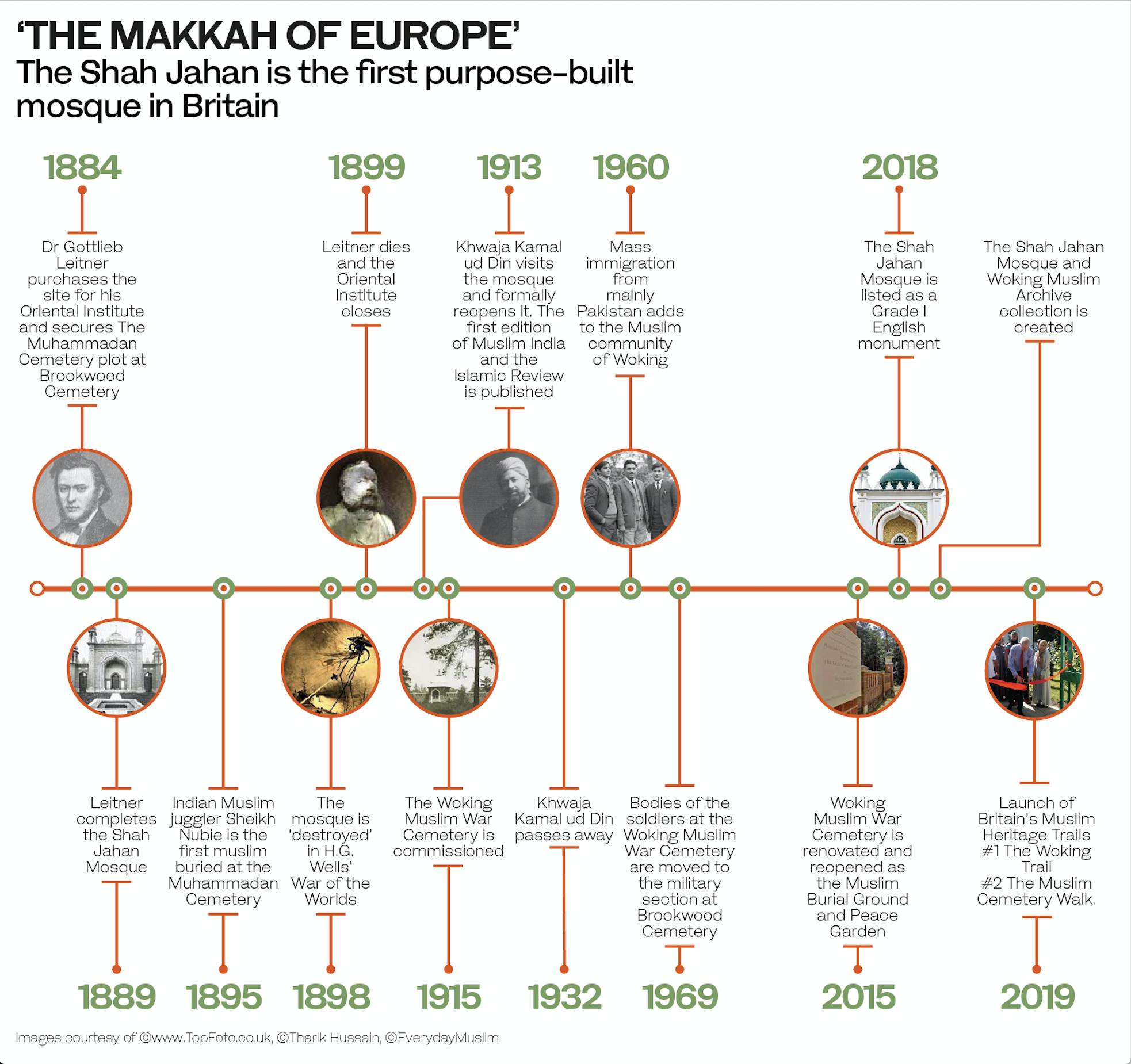
It was the vision of Dr. Gottlieb Wilhelm Leitner, an orientalist born of Jewish parents from Hungary. A remarkable individual, according to the mosque’s website, aged 17 he “took a degree at King’s College, London, by which time it is said he could speak 15 languages.” He later went on to found the forerunner to the School of Oriental and African Studies.
The mosque itself was designed by Anglo-Irish architect William Isaac Chambers in a style that mirrored Indian Mughal architecture from the 16th century.
FUNFACT
In popular culture, the Shah Jahan Mosque was destroyed in H.G. Wells’ novel “War of the Worlds,” which was set in the author’s hometown of Woking.
Why Woking of all places?
Lietner, a religious scholar who lived and worked for many years in India and abroad, wanted to set up a college that would allow people to study the religions of the East.
“He came up with a site just outside London, in Woking, where this beautiful gothic building, known at the time as the Royal Dramatic College, had fallen on hard times and was up for sale. So it was really about convenience. It came with lots of land and it meant he didn’t have to pay the high prices that he would have paid had he found somewhere in London,” Hussain told Arab News.
Lietner wanted to build free places of worship there as well, including a Hindu temple, an Eastern Christian church, a synagogue and a mosque. Because he anticipated people from all over the world would come, including Muslims, one of the first things he did in 1884 was secure a plot at the nearby cemetery (Brookwood) exclusively for the use of Muslim burials.
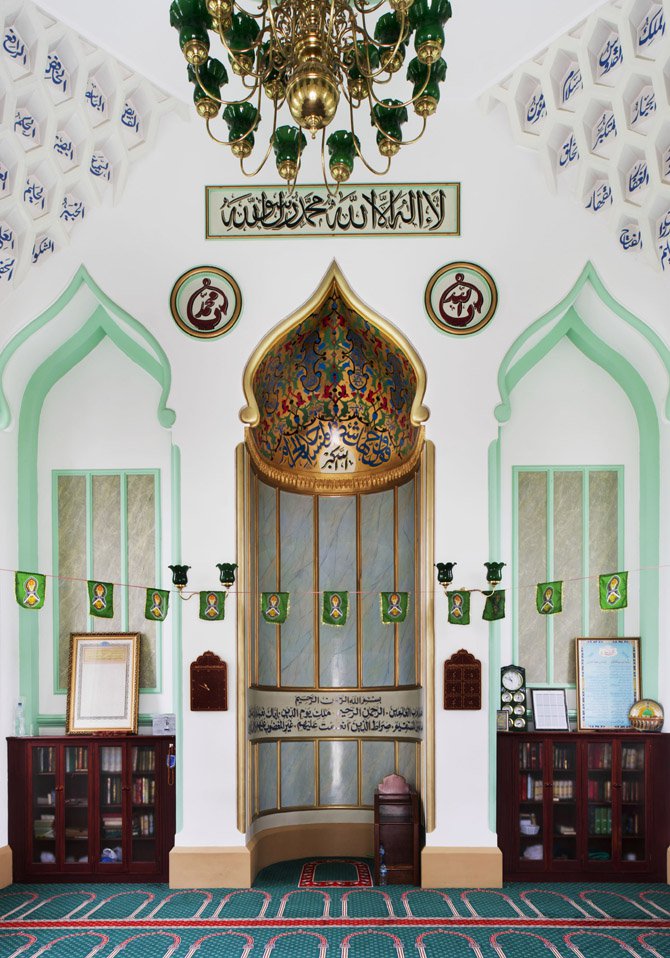
The mosque (interior pictured above with the direction of the qibla) was built initially, along with a Muslim cemetery, as Dr. Gottlieb Wilhelm Leitner understood that burial rites in Islam were a very important rite. (Everyday Muslim/Tharik Hussain)
A stone still stands to this day inscribed with specific instructions on how to bury Muslims, as very few people in Victorian Britain understood the specific procedures.
His institute flourished and after five years he began building the mosque, but passed away before he could fulfill his vision.
The Shah Jahan Mosque was completed in 1889, but according to its website: “Abdullah Quilliam’s Liverpool mosque, opened in 1889, pre-dates Woking by a few months, but the Shah Jahan has the honor of being the first purpose-built mosque in Europe outside of Muslim Spain.”
FASTFACT
The Shah Jahan Mosque in Woking is the oldest purpose-built mosque in northwestern Europe and was known as the “Makkah of Europe” during the early 20th century, when it became the center of Islam in the UK.
Hussain adds: “So this is why Woking, because it had Britain’s first purpose-built mosque and Britain’s first Muslim cemetery, so naturally Muslims were drawn to it.”
Unfortunately, the mosque was neglected after Leitner’s passing for over a decade, but was then restored by an Indian lawyer, Khwaja Kamal-ud-Din, who had befriended influential Victorians curious about Islam, including a Lord who later became a convert.
His name was Lord Headley, also known as Sheikh Rahmatullah Al-Farooq, an Irish peer, and one of the leading members of the Woking Muslim Mission who helped the center flourish, with the aim of bringing it back to life as a platform for promoting islam in Europe, even becoming home to one of the first Muslim publications in Europe, The Islamic Review.
That is why Woking has been dubbed the “Makkah of Europe” by the organizers of the trail.
The Muslim cemetries
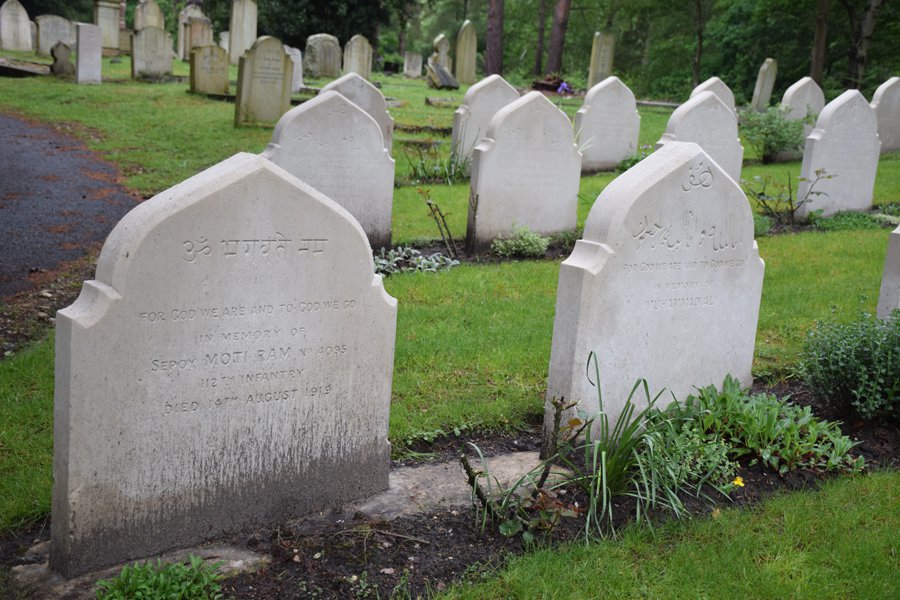
The Woking Muslim War Cemetery, now known as the Peace Gardens, played a prominent part in the remembrance of the centenary of the First World War, between 1914-18. It was the final resting place of 27 Muslim soldiers who fought for the British Empire and Free French Forces during the two great wars..
But it is the other cemetery that Everyday Muslim is keen to highlight, which you could say was the Westminster Abbey of Muslim cemeteries.
“This site is probably the least known and ironically is actually the oldest Muslim space we know of in Britain. It is a plot of land originally known as the ‘Muhammadan Cemetery,’ founded in 1884, within the nearby Brookwood cemetery, by Dr. Leitner,” Hussain told Arab News.
Princess Musbah resides here alongside Abdullah Quilliam (1856‑1932), founder of Britain’s first mosque and Muslim publication, Muhammad Marmaduke William Pickthall (1875‑1936), author of the first ‘native’ English translation of the Holy Qur’an, Naji Al‑Ali (1936‑1987), Palestinian political cartoonist and creator of “Handalah,” Sepoy Ahmad Khan (died 1914), the first British Muslim soldier buried on British soil, and many other famous Muslims, such as Victorians, princes and princesses, sultans and so on.
he cemetery in Woking is home to several important Muslim dignitaries. (Everyday Muslim/Tharik Hussain)
What is the aim?
Everyday Muslim wants to reach a point where sites such as these are not labelled as “British Muslim” heritage, but just “British” heritage.
Hussain, who also develops self-guided trails across the world for Lonely Planet guidebooks, said it should be recognized as a significant part of the island’s history
Sir Laurie Magnus, chairman of Historic England, which is responsible for protecting and championing the country’s heritage, said “Muslim heritage is very much a part of Britain’s heritage and I am delighted to launch this trail,” to celebrate these beautiful sites.
The initiative was aided by the National Lottery Heritage Fund, as part of a bigger project concerning the heritage and history of the mosque and the surrounding area.
Hussain said: “We wanted to put these trails out there so that Muslims and non-Muslims up and down the country could see the potential.”
He said they see this as a start, and hope to receive more funding to highlight Muslim heritage trails across the UK to make Muslim heritage in Britain more visible and a normalized part of the wider narrative.
“I think it’s really cool that in the process of trying to unearth British Muslim heritage, we are not only unearthing all these amazing stories of British people who were doing amazing things as Muslims and converts, but we find someone who has British blood and the Prophet’s blood. I think that’s just pretty fabulous, and something we should celebrate and embrace,” Hussain concluded.
source: http://www.arabnews.com / Arab News / Home> Latest News> Middle-East> Home / by Sarah Glubb / July 29th, 2019
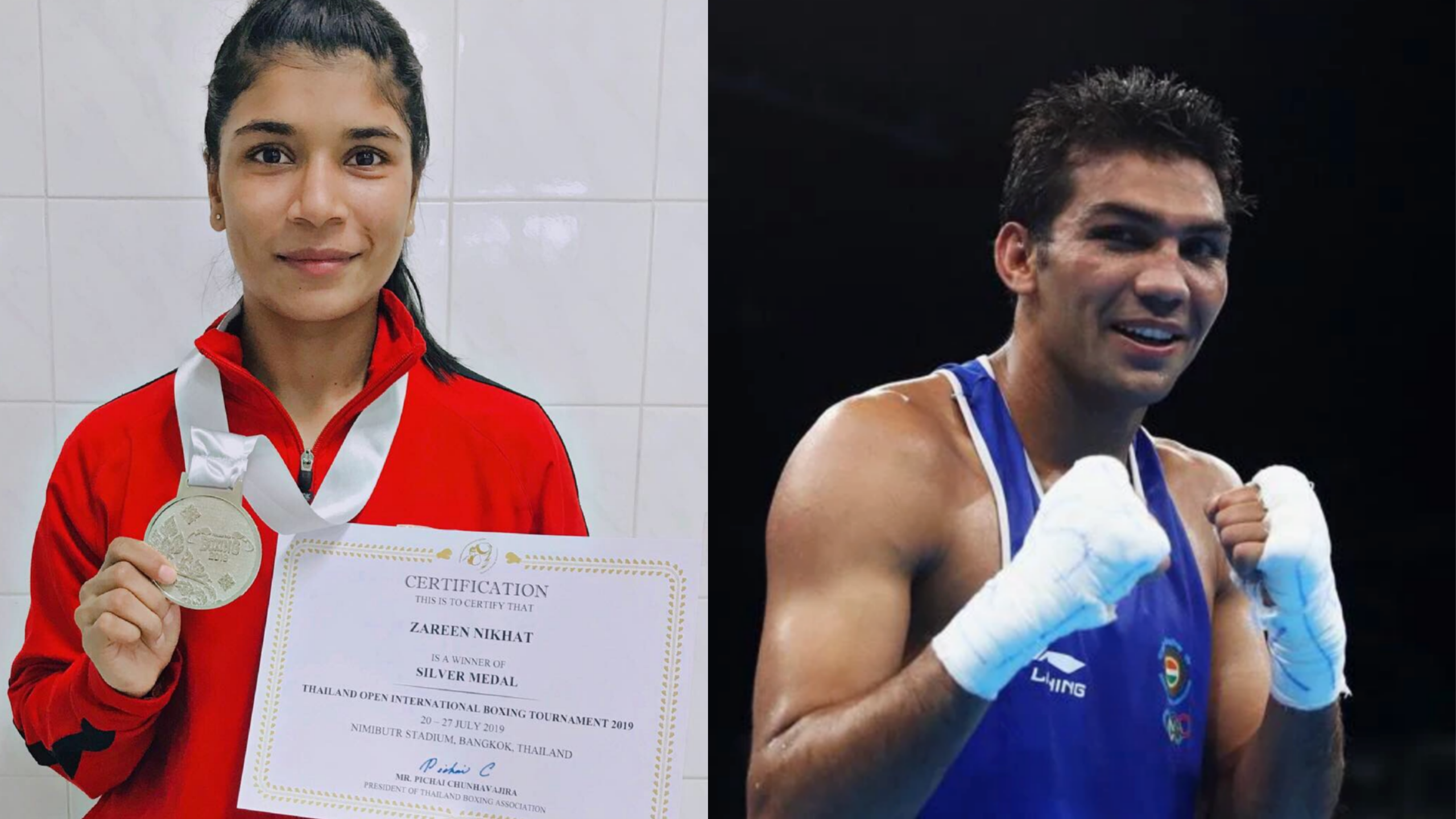
Former world junior champion Nikhat Zareen, and GeeBee Boxing silver-medallist Mohammed Hussamuddin, once again made the country proud by winning the silvermedal in the 51 kg category and 56 kg category respectively at the summit clash of the Thailand Open International Boxing Tournament on Saturday.
Nikhat, the Strandja Cup gold medallist and also the Asian Championships bronze-medallist, had to settle for silver as she lost to China’s Chang Yuan in the final.
The Chinese proved too tough for 23-year-old Nikhat and was handed a 5-0 blow. Although disappointed, the Hyderabad girl said she has learned many things which will be helpful in the world championship contest.
Nikhat took to Twitter to celebrate her commendable performance and said that she is only getting better. “Will come back fighting even stronger in the upcoming competitions. Thank you all for your continuous support! (sic),” she tweeted. Nikhat Zareen will compete with six-time world champion Mary Kom at the World Championships trials next week.
In 56kg, reigning India Open champion Chatchai Decha Butdee of Thailand continued his fine form to inflict a 5-0 defeat on Hussamuddin.
Overall, Indian boxers finished their campaign with a rich haul of eight medals at the championship.
source: http://www.thecognate.com / The Cognate / Home> News / by Shaik Zakeer Hussain / July 29th, 2019
Indian Music Experience (IME), a city-based museum that explores the evolution of Indian music with interactive, multi-sensory exhibits, is organising its grand launch on July 27.
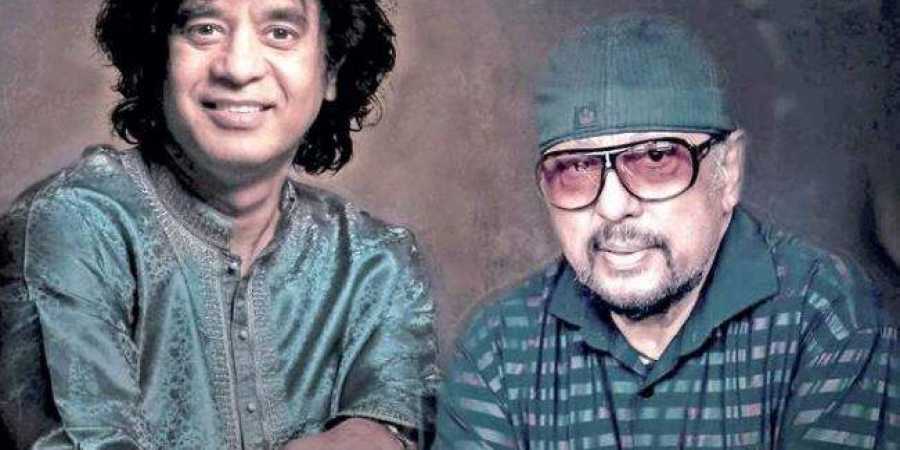
Ustad Zakkir Hussain and Louiz Banks
Bengaluru :
Indian Music Experience (IME), a city-based museum that explores the evolution of Indian music with interactive, multi-sensory exhibits, is organising its grand launch on July 27. Announcing this at a press conference, M R Jaishankar, chairman and managing director of Brigade Group and founder of IME, said, “The grand launch of the IME is a culmination of nearly a decade of effort to set up a truly world-class museum and arts centre in India. We are hopeful that the IME will grow to become a pre-eminent arts hub of the country and preserve and propagate India’s rich cultural heritage to the next generation.”
Many dignitaries, including Tejasvi Surya, member of Parliament, Bengaluru South and S M Krishna, former union minister for External Affairs, were present. On the occasion, there will be musical confluence by Ustad Zakkir Hussain and Louiz Banks at 7pm. Talking about IME, museum director and classical vocalist Manasi Prasad, shared, “The performing arts teach us to create, communicate and collaborate. India has the most diverse musical culture in the entire world and the museum celebrates this. Going forward, the IME aims to be a centre of music education and research, providing a platform for artistes and art lovers.”
The exhibit area of IME consists of eight thematic galleries showcasing various facets of Indian music, an instruments gallery with over 100 musical instruments, three mini theatres, and several computer-based interactive installations that allow visitors to experience the process of music-making. The exhibits feature memorabilia belonging to the Bharat Ratna musicians of the country— Bismillah Khan, Bhimsen Joshi and M S Subbulakshmi.
In addition, it will also feature a rare phonograph and gramophone, a selection of microphones, gramophone records and other artifacts.
The launch will be held at IME grounds in JP Nagar at 4.30pm.
source: http://www.newindianexpress.com / The New Indian Express / Home> Cities> Bengaluru / by Express News Service / July 27th, 2019
Parappa Village (Delampady Gram Panchayat) , KERALA :
Maharoof comes from a remote village called Parappa in Delampady grama panchayat on the Karnataka border. His father D P Mohammed works as a waiter at a hotel in Kozhikode.
Maharoof Mohammed
Kasargod :
Maharoof Mohammed, a 12-year-old boy from Kasaragod, is the toast of the footballing world. Last day, when schools were shut because of heavy rain, Mahroof and his friends hit the dirt to play football.
In a short video shot by his friends, Maharoof can be seen dribbling past five big boys and sending a prefect cross to his friend waiting at the goal mouth to find the back of the net. The friend takes off his T-shirt and Maharoof runs to hug him.
The 20-second video went viral on WhatsApp and one of his friends posted it on Instagram with the caption “Little Messi”.
On Instagram, Maharoof’s dribbling skills got the attention of footballers and fans. Kerala Blasters’ biggest fan club KBFC Manjappada shared it and footballers started taking notice. Iain Hume, the former ace player of Kerala Blasters, showered praise. He tagged the club’s manager Thomas Antony and wrote: “@thomantony Get this kid signed up NOW!!! #TheFuture”.The video posted by KBFC Manjappada touched 60k.
Hansito Jorge Mulder, who played for Delhi Dynamos and Chennaiyin, sought to know if the boy has an Instagram account.
Mulder, who now plays for Dutch club RKC Waalwijk, shared the video on his timeline saying: “Support my friend @mahruf_parappa. Showing some great footwork aka India Messi”.
Maharoof’s friends immediately started Instagram accounts for him. At the last count, the boy has eight Instagram accounts, including a fan page.
Maharoof comes from a remote village called Parappa in Delampady grama panchayat on the Karnataka border. His father D P Mohammed works as a waiter at a hotel in Kozhikode.
“He plays for local club Parappa Classic,” said Mohammed, who is happy about the attention his son is getting. His mother Misriya is a homemaker.
source: http://www.newindianexpress.com / The New Indian Express / Home> Good News / by Express News Service / July 25th, 2019
Nikhat Zareen, a former junior world champion, was the only woman boxer to reach the final of Thailand Open.
Nikhat Zareen Thailand’s Jutamas Jitpong in the semi-final. (Photo Credit: @BFI_Official)
Former junior world champion Nikhat Zareen (51kg) reached the final of International Tournament in Bangkok on Friday and was lone Indian woman to do so while Asian silver-medallist Deepak Singh (49kg) led four men into the summit clashes of the tournament.
Ashish Kumar (75kg), Commonwealth Games bronze-medallist Mohammed Husammuddin (56kg) and Brijesh Yadav (81kg) were the other three men to make the gold medal bouts.
Zareen was up against Thailand’s Jutamas Jitpong. The Hyderabadi impressed with the ferocity of her punches as she edged past the local favourite 4-1 and let out a scream to express her elation when her hand was raised by the referee.
Zareen later took to Twitter to dedicate her win to the Kargil War martyrs. 20 years ago, India decisively won the Kargil war and regained the territories that were briefly captured by Pakistan. The nation is celebrating the Army’s victory in the historic war.
__________________________________________
Nikhat Zareen ✔@nikhat_zareen
I dedicate my today’s Semi-Final victory at the Thailand Open to our brave soldiers of Kargil war who sacrificed their lives for our country#KargilVijayDiwas
Meanwhile, former Asian youth silver-medallist Ashish (69kg) lost his semi-final bout to sign off with a bronze medal. Ashish lost to Thailand’s Wuttichai Masuk in a split decision after an exhausting clash.
Among the women, Manju Rani (48kg) and Bhagyabati Kachari (81kg) ended with third-place finishes. Manju went down to Chuthamat Raksat of Thailand, while Bhagyabati lost to China’s Li Qian.
Earlier, Deepak hardly broke a sweat against Bhutan’s Tashi Wangdi. The Indian’s dominance was such that Wangdi faced two standing eight counts and was left with a gash above his right eye. The judges eventually ruled unanimously in the Indian’s favour.
Also advancing was Husammuddin (56kg). In a messy slugfest with Thailand’s Ammarit Yaodam, the Indian came out as the more aggressive and clean puncher to emerge triumphant in a 3-2 decision.
In the 75kg category, Ashish defeated Uzbekistan’s Fanat Kakhramnov to make the final.
Brijesh was up against local favourite in Saranon Klompian in the last bout of the day and produced a ferocious performance. A left hook just a minute into the second round sent his opponent crashing and the Thai could not regain his composure after that. Klompian faced three eight counts before the referee stopped the bout in Brijesh’s favour.
Sheikh Mohammad Munir Ansari conferred with the Star of Jerusalem medal.
Jerusalem (PTI) :
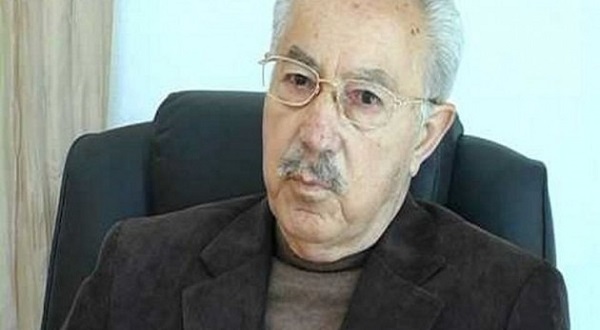
Palestinian President Mahmoud Abbas has conferred Indian-origin Sheikh Mohammad Munir Ansari with the Star of Jerusalem medal – one of the highest honours given to foreign nationals by the Palestinian Authority – for strengthening Indo-Palestine ties. At an event organised to honour 91-year-old Ansari Thursday evening, Abbas thanked him for serving Palestine and Jerusalem with distinction. Ansari, 91, is the Director of Indian Hospice, a unique and historic monument in the heart of Jerusalem, which has become a symbol of India’s heritage and presence in the third holiest city for Muslims going back to over 800 years.
Abbas said the Ansari family’s presence in the old city of Jerusalem reflects the strong traditional ties between Indian and Palestinian people. He called upon for strengthening people-to-people contact between the two sides.
Abbas plans to send Palestinian Prime Minister Mohammad Shtayyeh to India soon to boost tourist inflows from there which can contribute to strong bonding between the two people.
A representative of India, Sunil Kumar, who was present at the event, also appreciated the role played by the Ansari family in strengthening Indo-Palestine ties.
The Indian hospice has been under the direct supervision of a representative from India since 1924. Ansari’s father, Sheikh Nazir Hassan Ansari, was appointed the first Sheikh of the Hospice from whom the mantle passed on to the incumbent who was born in Jerusalem in 1928 and has spent his whole life here.
In 2011, India honoured Ansari with the Pravasi Divas Samman, the highest honour conferred on overseas Indians.
The history of the hospice goes back to about 12th century, when famous Sufi saint from Punjab Baba Fariduddin Ganj-i-Shakar (or Baba Farid, as he is better known) visited Jerusalem on pilgrimage and prayed in seclusion for 40 days at the site.
It later became a pilgrimage site for Indian pilgrims visiting Jerusalem and was dedicated as a charitable Waqf property in trust for a pious purpose.
The place where Baba Farid is said to have prayed has become a major attraction for Indian tourists visiting Jerusalem.
Almost every prominent Indian leader who has visited the region has paid a visit to the site and the hospice continues to host Indians visiting the Holy Land. The hospice also received a grant from the Ministry of External Affairs for its renovation.
source: http://www.caravandaily.com / Caravan / Home> Indian Muslims / by June 15th, 2019
Rahman founded Mina Jebel Ali Canteen and Catering Services, the flagship firm of the Parco group of companies – supplied photo
Rahman had been ill for nearly a year and he had flown to India for treatment.
Dubai-based businessman PA Rahman, chairman of Parco Group, died in his hometown in the south Indian state of Kerala on Sunday night. He was 72.
OK Ibrahim, KMCC senior vice-president, told Khaleej Times that Rahman had been ill for nearly a year and he had flown to India for further treatment.
“Relatives and friends who are close to Rahman travelled to India two weeks ago to pay their last respects, as his health continued to deteriorate,” Ibrahim said.
Rahman founded Mina Jebel Ali Canteen and Catering Services, the flagship firm of the Parco group of companies.
Over the last 39 years, he, along with his brothers, built diverse business units with interests in hospitality, retail, manufacturing, real estate, contracting, jewellery, healthcare, restaurants and education, among others.
“These companies are all supported by a large team of dedicated professionals who develop and manage the activities of the group,” said Ibrahim.
He was a successful entrepreneur but, on top of his achievements, people knew him as a community leader who was always willing to help those in need. He did a lot of social work and opened education centres.
He had served as a member of the state council of the Muslim League and a director of the Dubai Middle East Chandrika. He also founded NAM College, Kallikandy, a general degree college located in Kallikkandy, Kannur district, Kerala.
dhanusha@khaleejtime.com
source: http://www.khaleejtimes.com / Khaleej Times / Home> Nation> Dubai / by Staff Reporter, Dubai / July 10th, 2019
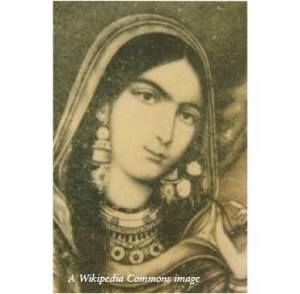
Begum Hazrat Mahal was the last of the official queens of the kingdom of Avadh, or “Oudh” as known to the British imperialists, a large province in northern India.
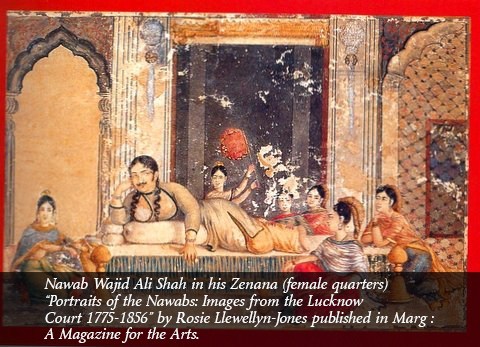
While the details of her birth and family are unclear, it is certain that Begum Hazrat Mahal was not of royal lineage. She is believed to have been a courtesan in the court of the last king of Avadh, Nawab Wajid Ali Shah, starting as a dancing girl named “Mahak-Pari” or fragrant fairy. The Nawab, besotted with the young girl, married her by means of the Shiite tradition of “mutah” marriage or “temporary marriage of pleasure.” It was a convenient method by which the Nawabs could add to their harems, and not technically stray from their marriages.
Mahak-Pari, as she was initially known, gave birth to a male child named Mirza Birgis Qadr Bahadur, and was elevated to the title of Hazrat Mahal Saheba, commonly known as Begum Hazrat Mahal. Transforming from a courtesan—a Pari (fairy)—to a Mahal (a royal queen) was rare, and the good fortune of bearing a male child combined with the right maneuvers in harem politics likely helped the young woman.
In 1856, the administrators of the East India Company annexed the kingdom of Avadh, by means of the infamous Doctrine of Lapse. The British coveted this territory as a great resource for cotton and indigo, and appalled by the debauchery of the Avadh court and its gross mismanagement of revenue, preferred to govern the region directly with a more “conventional” administration.
Nawab Wajid Ali Shah was exiled to Calcutta, and the unhappy king left with a few of his wives, and without most of his large harem, including his “secondary” wives. Begum Hazrat Mahal did not accompany the deposed king, continuing to reside in Lucknow with her young son.
When the Mutiny of 1857 broke out, Avadh was one of the major areas of rebellion as several recruits of the army were from Avadh. People were unhappy about the annexation, the deposition of their king, and the religious insensitivity of the British. The rebels needed a leader to further their cause.
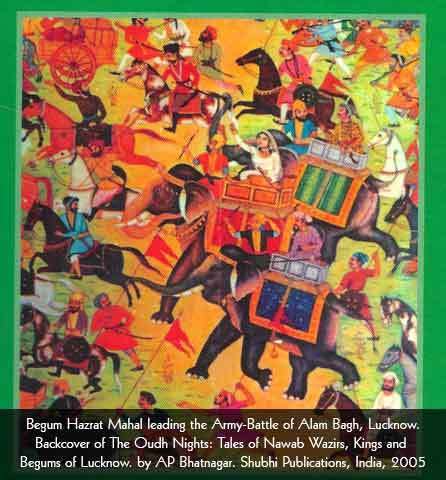
Begum Hazrat Mahal rose to the occasion to help the rebels defend Lucknow against the British troops. To the surprise of her adversaries, she reorganized the army with better co-ordination between the three units of the cavalry, artillery, and infantry. Many times, she rode at the head of the army on an elephant to encourage the soldiers against the advancing British troops.
As in other places, the Indian rebels could not hold out for long against the larger number of British troops, and the queen’s advisors asked the Begum to leave Lucknow in March 1858. She fled to the countryside, continuing her hostilities against the British by issuing orders while in hiding.
On November 1, 1858, Queen Victoria issued a proclamation whose intent was to end the Mutiny, pacify the religious sentiments of the Indians, and formally transfer control of the British territories in India from the East India Company to the British Crown. Begum Hazrat Mahal issued a counter-proclamation in which she argued against every claim of Queen Victoria.
The Begum reminded the Indians that several previous treaties had been violated, that princely heads had either been pensioned or killed, and property worth millions of rupees seized. If the British intent was honorable, why did the British Queen not “restore our country to us when our people wish it?” asked the bold and shrewd Begum. She questioned Queen Victoria’s claim to religious non-interference:
“…to destroy Hindoo and Mussulman temples on pretence of making roads to build churches—to send clergymen into streets and alleys to preach the Christian religion—to institute English schools, and to pay a monthly stipend for learning the English sciences, while the places of worship of Hindoos and Mussulmans are to this day entirely neglected; with all this how can the people believe that religion will not be interfered with?”
Begum Hazrat Mahal forewarned the Indians that their future prospects appeared limited under British rule. “It is worthy of a little reflection, that they have promised no better employment for Hindoostanees than making roads and digging canals.” The Begum’s words were rather prophetic. For decades after 1857, Indians pushed files under British bureaucracy and worked as laborers for the British government in India and overseas.
Begum Hazrat Mahal eventually sought asylum in the kingdom of Nepal, where she lived for the rest of her life. The British administration initially negotiated with her, assuring her a safe return and the possibility of a pension. The Begum, distrusting the British, refused—most likely because British retribution in the immediate aftermath of the rebellion was extremely harsh. While both Hindu and Muslim rebels were ruthlessly punished, there was fear that the Muslims would rise against the British (and Christian power) because it was a hitherto Muslim power that was being displaced, and the repercussions in former-Muslim strongholds such as Lucknow and Delhi were particularly extreme. After their initial negotiations failed, the British labeled the Begum as a woman of “savage disposition.”
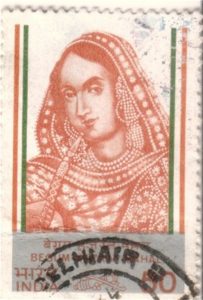
Begum Hazrat Mahal has remained a relatively minor figure in Indian history. Her legacy and her heirs were inadequately honored in the centenary celebrations of the Mutiny held at Lucknow post-Indian independence. Her great-grandsons protested against this oversight by the Indian government, which led Prime Minister Jawaharlal Nehru to order an inquiry into her place of burial. Her grave was discovered near Kathmandu, Nepal, in very poor condition. At this point, a park in Lucknow was named after her to commemorate her memory—this park has very recently been renamed—and later a postage stamp was issued in her honor.
Begum Hazrat Mahal’s legacy was diminished in the changed landscape of India post-1857. Her humble beginnings as a courtesan made her an inadequate role model.
The courtesans at the zenith of Lucknow’s court were no petty “nautch-girls” as described by the Victorian sensibilities of the colonists. They were sophisticated women, well versed in the arts of dance, music, and poetry. Their association with the courts made them extremely wealthy and nineteenth-century British records indicate that they were in the highest income-tax bracket before 1857. While the British derided the courtesans, and the culture they espoused, they did not hesitate to tax them on their “ill-earned” wealth. During the Mutiny, the courtesans monetarily supported the rebels, and their homes became rebel hideouts and secret meeting-venues.
Yet, this courtesan culture, the associated decadence and “debauchery” became a source of embarrassment for late-nineteenth-century Indian nationalists, social reformers, and the emerging middle-class English-educated “elite.” Indian nationalists believed that it was decadence and indolence that had helped the British uproot power in the princely states. A strong, respectable people hoping for self-rule needed to identify with respectable women and men, and a former courtesan-turned-warrior-queen did not fit this idealized image.
A strong and resolute woman, the Begum never gave in to the British, while her husband—a good man and an artist at heart, but weak in resolution—continued to live off the generous pension he received, always short of money, and therefore always acquiescing to the British.
Postage Samp of Hazrat Mahal. www.kamat.com
Several years after the Mutiny, a British painter visited Begum Hazrat Mahal, in Kathmandu, to paint a portrait of her son, Birgis Qadr. As he worked on his task, the painter ventured to ask her whether she would consider returning to Lucknow. Given the fact that much time had elapsed since 1857, the British regime was willing to forgive her and pay her a pension. Her residence in India would be proof of the British paternalistic spirit of forgiveness. Their condition, however, was that she would not be allowed a lavish lifestyle with a large retinue of servants. Perhaps, surprised by, or suspicious of the offer, but more likely annoyed at the continued interference in her life, the Begum refused the gesture, stating, with true Avadhi andaaz (style) “of what use will be the salary, if I am not to spend it upon the servants?”
Begum Hazrat Mahal was buried in a simple grave in the grounds of a mosque she built. Ironically she named it Hindustani Masjid, after the beloved homeland she had left behind, for whose sovereignty she had fought, and in which she has largely been forgotten.
Aarti Johri is a tech-professional turned history buff. This is an extract from her thesis for the Stanford MLA degree. Her articles have been published in the San Jose Mercury News, Stanford’s Tangents Magazine, and others. She serves on the board of SACHI (Society for the Art and Cultural Heritage of India).
source: http://www.indiacurrents.com / India Currents / Home> Features, General / by Aarti Johri / June 11th, 2016