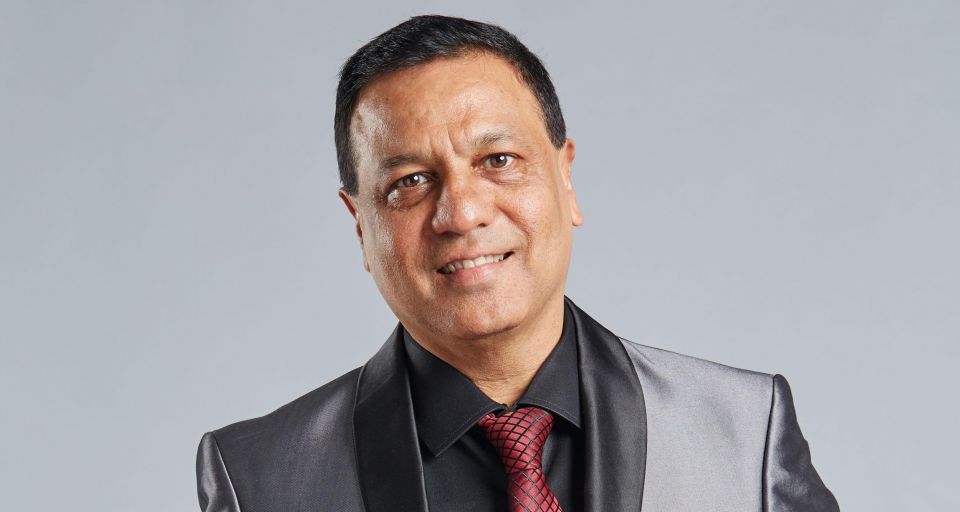
South African Indian cinema doyen Moosa Moosa has passed away. He was 75. Moosa succumbed to a heart attack on Sunday after undergoing surgery.
He was buried in Johannesburg on Monday according to Muslim rites.
Moosa had earned the title of being the longest-serving cinema group executive in the world, adding to the company’s reputation of having the longest relationship with Hollywood production house 20th Century Fox for almost eight decades now.
In 2007, Moosa received the South African Film and Television Industry Lifetime Achievement Award.
Tributes from all across the world continued to pour in for Moosa as the news of his demise spread.
Family and friends recalled how Moosa had taken over the family cinema business of the Avalon Group, started by his father 79 years ago as the first and still only Indian-owned cinema group in South Africa, after most of the 18 cinemas in the group were shut down by the draconian apartheid-era laws restricting property ownership in city centres to the minority white community.
Undeterred by this as the Avalon Group continued with just one cinema in an area designated for Indians in Durban, Moosa took on the seemingly impossible task of challenging the monopolies of white-owned major national cinema chains and won legal battles in the new democratic South Africa headed by President Nelson Mandela.
Moosa then started rebuilding the business as his son Aboobaker, popularly known as AB, also joined the business as the chief executive officer.
Currently they have cinemas in three major South African cities where new Bollywood releases play alongside Hollywood titles every week.
“My father showed tenacity and strength in keeping alive the Avalon dream through the tough times,” AB Moosa said in paying tribute to his father.
“When many had already begun to write the company’s obituary, my father’s resolve never wavered,” he added.
Many community leaders also paid tribute to Moosa for his support of community initiatives.
“He was always willing to support a variety of important social justice issues and always availed Avalon cinema venues for such events at no charge,” said Lubna Nadvi, from the University of KwaZulu Natal’s School of Social Science.
“Moosa will be justly remembered as a courageous and articulate businessman who was determined in his challenge of white monopolies in the 1980’s,” businessman Nirode Bramdaw recalled.
source: http://www.thehindu.com / The Hindu / Home> News> International / by PTI / June 26th, 2018
Do you know how it feels to stay cooped up inside your room for five months with shattered window panes reminding you of the constant presence of violence? Nousheen Baba, 21 Science student, Government College for Women, Nawakadal | Photo Credit: V. V. KRISHNAN
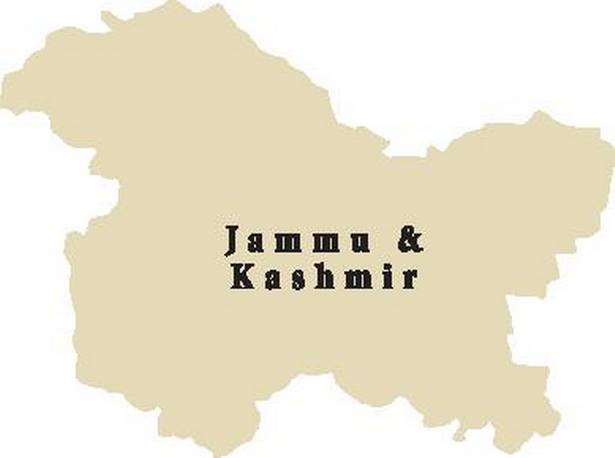
It is one step at a time for these Kashmiri women as they break away from traditional strangleholds and dare to dream differently, reports Peerzada Ashiq
Srinagar’s sprawling Eidgah ground is teeming with people. Despite the onset of Chillai Kalan, the harsh 40-day winter spell, there is a hubbub. Some are playing cricket, the rest looking on. Soldiers from the Central Reserve Police Force (CRPF) in mobile bunkers stand guard on the boundary wall; fingers locked on the trigger which, at the hint of any trouble, can spray pellets or tear gas. Three newly dug graves in the ‘Martyrs Graveyard’ bear testimony to the violent and troubled times of 2016.
Just metres away from the graveyard, Nousheen Baba and her sister Iqra Baba recall how they could not hold themselves back from watching the funeral procession of 12-year-old Junaid Ahmad on October 9. Security forces allegedly emptied an entire pellet cartridge from close range at Ahmad and the Valley exploded in anger and sadness at the loss of a young life. “Do you know how it feels to stay cooped up inside your room for five months with shattered window panes reminding you of the constant presence of violence,” asks Nousheen, a second-year science student of Government College for Women, Nawakadal and aspiring chartered accountant. The windows of the Baba household bore the brunt of the clashes which erupted between security forces and protesters.
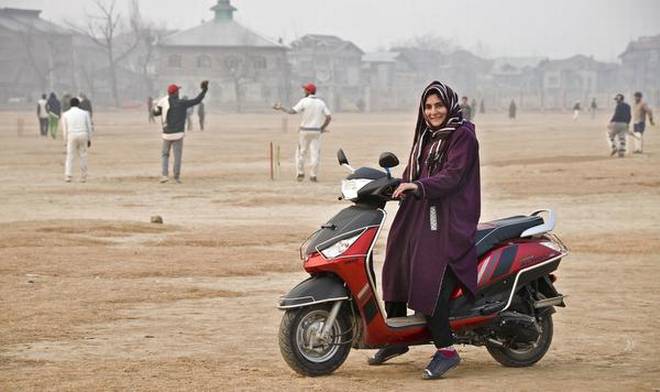
But Nousheen is eager to put the painful year behind her and even manages a shy smile. As a warren of houses in the highly congested Narwara locality in downtown Srinagar greets the eye, a tiny silhouette in a shiny grey cover makes its presence felt in the small courtyard of the Babas. Beneath the cover is the family’s first motor-driven two-wheeler. Courtesy Iqra, a Bachelor of Commerce student at the same college her elder sister goes to, who was rewarded by the State government for securing 85 per cent marks in her Class XII exam. “It’s our first scooter in the family. We are all learning to drive it,” says Iqra’s father Mushtaq Baba, a weaver. The Scooty is Nousheen’s constant companion too ever since Iqra brought it home nearly two months ago. From college to market, to visiting her friends, it is her lifeline to a future she dreams about.
Dreams on wheels
In the first phase of the two-wheeler scheme, Chief Minister Mehbooba Mufti handed over the keys to 450 scooters to graduation-level students of Government College for Women, Nawakadal and Government Women’s College, Baramulla on November 6. Only meritorious students whose family income is under Rs.4 lakh per annum are eligible for the scheme, which is being extended to all degree colleges of the State. In Jammu, 300 scooters were handed over to eligible students.
Mufti sees the Scooty as a game changer in improving the education of girl children who come from economically weaker sections. “I have lived a common man’s life and gone to college on a bus. I know the difficulties women face while using public transport. You feel it is safe sitting next to an old man, till he starts nudging you in the elbow; the unwelcome attention can be harrowing for any woman,” says Mufti, explaining the rationale behind her scheme. She recalls a young woman she spotted riding a scooter in Srinagar earlier this year while on her way to the State Assembly. “This girl was short and slim but it was her confidence that was striking. The idea took shape right there. We took the decision to bear 50 per cent of the cost of the bike,” she says.
The government has dovetailed many Central schemes meant for women empowerment to provide these scooters. “I wish I had one and could ride it freely. A girl who owns a Scooty now will never have to request her brother or father to go places. The two-wheelers give women a sense of control of things,” says the Chief Minister, adding, “Women are the first casualty of violence. Investments must be made to empower women.”
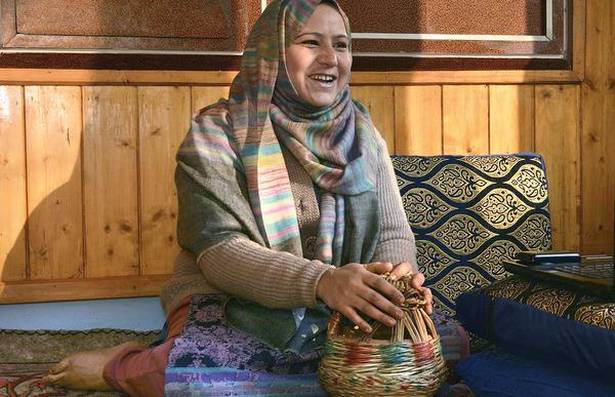
Iqra, for one, feels empowered, never mind the taunts of the local boys as she drives past: “The two-wheeler has earned me azadi (freedom) enough to go to tuitions late in the evening.” Five km away from the Baba household, Nargis Rasool, the eldest of four sisters and a brother, borrowed money to avail the Scooty scheme. “My father treats me like my brother’s equal now since I started driving the Scooty. It is like taking part in a revolution. Though many elders did object to my driving saying ‘how can a girl ride a Scooty on the street?’, my parents supported me,” says Nargis, a final-year Arts student of Government College for Women, Maulana Azad Road. Her 90-plus percentage in the Class XII exam helped this civil services aspirant to bring the first-ever vehicle to the Rasool household, a family of shawl weavers. Nargis has become an inspiration for the extended family, including six female cousins. “Their parents are now forcing them to study hard to secure a Scooty on merit,” she says.
I am rooted in Kashmiri art and culture. I want wages and artworks of women to shift to a competitive level. Arifa Jan, 31 Owner, carpet manufacturing unit | Photo Credit: V. V. KRISHNAN
Reviving an old craft
Namda, a carpet made through the process of felting by hand, needs both muscle and money. For Arifa Jan, 31, who completed in 2010 her Craft Management Entrepreneurs’ Leadership Programme from the Craft Development Institute, Srinagar, the challenge was to turn around the fortune of this dying craft at a time when exports of the once-world-famous Kashmiri carpet had plummeted. According to a government survey, the total production of handicrafts rose to Rs.1,614.59 crore by 2008 against Rs.200 crore in 1990-91 but Namda exports had gone down 97 per cent and amounted to less than Rs.40 lakh annually.
“The use of cancer-causing dyes and poor cotton mix pushed Namda to the verge of extinction,” says Arifa. She infused science and healthy processes back into the craft to make it market-friendly. In 2010, she had to brave prolonged curfew spells to reach her unit to weave the first-ever assignment of 300 Namdas, meant for an exhibition in New Delhi by Dastkar, an NGO working with craftspeople across India.
“Eight-five per cent of my Namdas were sold. I still remember the taunts of a German buyer who kept saying we were producing fake Namdas,” says Arifa, who credits an unknown buyer from Delhi for her first brush with success. The buyer later turned out to be Gulshan Nanda of the Crafts Council of India. Nanda reposed faith in Arifa and the money flowed. “Ms. Nanda would come to me and ask serious questions about the craft,” says Arifa.
In 2013, the Crafts Council of India selected Arifa for a trip to Kyrgyzstan to study their processes of carpet-making. Back home, she scouted for an Australian merino sheep hybrid that was introduced in the Valley in the 1960s. “Its wool is what goes into exquisite Namdas,” she says.
For the first time, Arifa introduced pre-processes to weed out hazardous particulates from the wool and ensured no cancer-causing dyes make their way into it. “Even artisans who’d make chain stitches on the carpet used to complain of chest pain earlier due to the use of synthetic ingredients,” she says.
The daughter of a retired State Road Transport Corporation employee, Arifa is now eyeing business opportunities in the U.S. even as her stable has expanded to 27 artisans, 17 of them women. “I am rooted in Kashmiri art and culture. I want wages and artworks of women to shift to a competitive level. Artisans have suffered a lot in Kashmir — we have to bring them on a par with sellers,” she says.
A girl from Kashmir, counting one lakh rupees and all the men around looking in awe at her… A strange feeling seeped in. Shaeena Akhtar, 31 Owner of a shawl loom | Photo Credit: V. V. KRISHNAN
Weaving a new formula
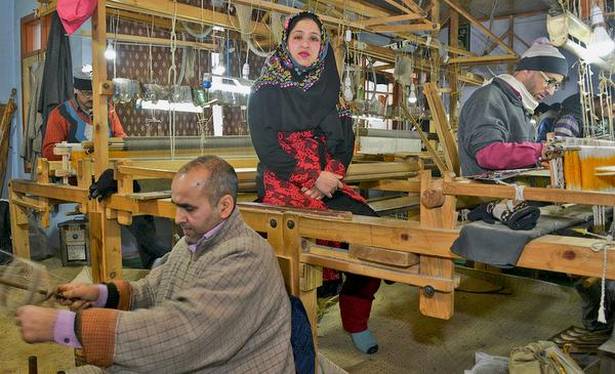
It’s 4.30 p.m. The rolling wooden bobbins with multi-coloured fine threads and the neatly thrown over-and-under shuttles meant for woofs and warps are showing no signs of the day’s tiredness. Bollywood music from the 1980s breaks the monotony of the shuttles at work. It’s the first loom in Kashmir where a woman is at the helm, and an attempt is underway to replicate the famous floating garden on Dal lake, Char Chinari, as a design relief from traditional motifs in Kani shawls, a fine handwoven mix of pashmina and shahtoosh wools. “We have developed a new formula for shawls. No one can steal it. It’s original and a major departure from the past. My work drives my clients to my loom — I have requests pending from many exporters,” says Shaheena Akhtar, 31. Like Arifa, Shaheena, a resident of Srinagar’s Nowshera area, too comes from a humble weavers’ family, but in just five years, she is being credited with giving a new identity to the Kani shawl, picking up the State’s Best Entrepreneur award along the way three years ago.
Shaheena’s journey to finding acceptability in markets in Italy, Germany and Dubai has been anything but easy. “Not everyone treats you as a daughter or a sister when you start something like a shawl business. My character was questioned because I used to meet officials. I struggled to have bank guarantors because my father was just a small-time weaver. It was not easy to raise money,” she recalls.
Following a training stint at the Entrepreneurship Development Institute, Pampore, in 2011, Shaheena was able to start with an initial investment of Rs.8 lakh. In a year she counted her first one lakh rupees in earnings. “My father had never counted Rs.1 lakh at a time. I am good at counting money. But that Rs.1 lakh was something I could not count for a while. A girl from Kashmir, counting money, and all the men around looking in awe. A strange feeling seeped in,” she recalls. As business grew, she enlisted her brothers’ help. “Of the 18 workers at the loom, 12 are relatives. I am proud that in such a short span I have a turnover of Rs.1 crore,” she says.
Roh-i-Kashmir (Soul of Kashmir), Shaheena’s company, has tie-ups with six major exporters for the 60-70 shawls her loom produces annually. “My thrust is quality. My shawl sells for Rs.4.5 lakh in the international market for its intricate and exquisite work. It takes more than nine months and two labourers to finish one intricately woven Kani shawl,” Shaheena adds.
Every time I watch a fisherwoman of Srinagar, I can see her making her own rules as she negotiates her space and life. Roohi Nazki, around 40 Owner, Chai Jai | Photo Credit: V. V. KRISHNAN
An English tea room in Srinagar
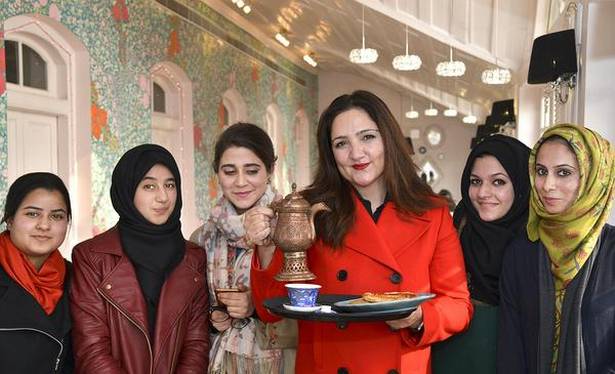
Historically, Kashmir has drawn its taste buds from Central Asia, including the famous kahwah (a traditional green tea preparation) and multi-cuisine wazwan. Roohi Nazki, a former employee with Tata Interactive Systems, is trying to get Kashmiris hooked on something very different: the tea room. It’s been worth the effort, if increasing footfalls at her small joint, Chai Jai — modelled after tea rooms in England — are anything to go by.
It was a solo holiday trip to England in 2013 that changed Roohi’s life and introduced her to the niceties of tea rooms. In the Cotswolds villages of south-central England she saw mirror images of the Kashmir Valley. Moving back to the Valley after living in Mumbai for 22 years, Roohi’s parents initially persuaded her to stay on in a corporate job, but she just knew what she wanted to do next.
As one walks down the British-era manicured embankment of the Jhelum river in Srinagar’s Polo View area, Roohi’s ‘little England’, complete with castle-room interiors and cobblestone floors, is hard to miss in the age-old Mahatta Building.
Launched in July this year, Roohi is reviving teas from bygone times like Daam Tyooth (a herbal tea), Bunafshan tea (flower tea), Qadri tea (a herbal tea with sugar mix), Nettle tea and Gulkand kahwah (mix of saffron and sun-dried rose petals). “I have 28 varieties as of now and I am working on a collection of 200 varieties,” she says.
Small steps to giant strides
While it is too early to see these women as enduring successes, having a woman Chief Minister at the helm seems to have given a fresh impetus to a more inclusive society in a State which has primarily been in the news this year for its mind-numbing violence. A slew of measures initiated by Chief Minister Mufti — including reservation of 10 per cent land in industrial estates for women entrepreneurs, the Ladli Beti scheme aimed at the economically poor, an all-woman entrepreneurs’ market, all-woman buses and all-woman police stations — are aimed at women.
The opposition National Conference spokesperson Sarah Hayat Shah acknowledges that every step towards empowerment of women is always appreciable, but simultaneously points out the troubled ground reality in Kashmir where even young girls have been killed or blinded in the wave of protests since July. “I am afraid the scooters may not be able to heal the wounds,” she says.
Ultimately, beyond the overhang of violence, a lot of the contestations with patriarchy are essentially atomic. “Every time I watch a fisherwoman of Srinagar, I can see her making her own rules as she negotiates her space and life,” says Roohi, now in her 40s.
Just like she fights her own little everyday battles, such as taking trolls — who were ‘outraged’ at her bringing a feel of Christmas to Chai Jai with cakes and candies from Mumbai — off her Twitter feed, one resolute click at a time.
source: http://www.thehindu.com / The Hindu / Home> News> National> Ground Zero / by Peerzada Ashiq / December 31st, 2016
Dr. Nusrat Parveen shares her journey in medicine in Canada by mentoring other immigrant doctors.
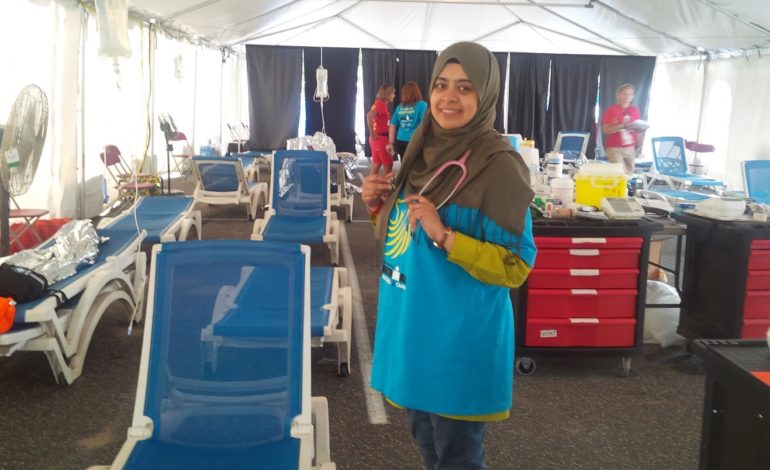
Dr. Nusrat Parveen was an established gynecologist in the Middle East. A medical graduate from Aligarh Muslim University in India, she acquired post-graduate qualifications including membership of the Royal College of Obstetricians and Gynaecologists in London, U.K., and a diploma in the same field from the University of Dublin in Ireland. But this long list of educational achievements was not enough to get Parveen a job in Canada.
The process to become a doctor in Canada takes time, and now Parveen shares her own journey to medical licensure with fellow international medical graduates (IMGs) who aspire to practise medicine in Canada. For her efforts as a mentor to IMGs, she was recently recognized by Ontario Premier Kathleen Wynne with the Volunteer of the Year Award for community services.
How did you come up with the idea of mentoring other IMGs?
My husband and I were volunteering with a food bank, when we came across an IMG who was lonely and felt lost as she did not have anybody to support or guide her. But she had the passion to practise medicine in Canada. Her situation had not dampened her spirit. It was her story that first inspired us.
How did you find other IMGs to mentor?
The spark to help fellow IMGs and knowing that many are not aware of the process and are struggling, made us start the IDEAS program at Thorncliffe Neighbourhood Office (TNO) where the relevant support and resources are provided to IMGs.
What has been your experience of supporting other IMGs?
Initially, it was scary. I had my commitments to my family and to bring up my two children. I was studying full time toward the physician’s assistant program at the University of Toronto, so my hands were full. But the fact that everything came together so nicely and the enthusiasm from the IMGs kept me going.
Where exactly are you in your own professional journey?
I have cleared MCCEE, MCCQE1, NAC OSCE, IELTS and workplace culture and OSLT courses. The physician’s assistant program has prepared me for the supervised clinical practice and gave me an opportunity to refresh my clinical skills. In short, it has prepared me to integrate well into supervised clinical practice while building connections and references.
You have not yet completed your own journey to practising medicine in Canada, so what gave you the confidence to mentor other IMGs?
I realized that there are many IMGs who need support, resources and peer mentoring. As I had prepared for my exams, I had a good idea of how things worked here and knew the process and where to look for resources. This knowledge of the system and process gave me courage and confidence to support fellow IMGs. I did have some doubts, which quickly vanished with my husband’s unflinching support.
Why are you so committed to helping others through this mentoring program?
I have given so much of my time and dedication to the medical profession, as it has given me opportunities to serve people. Mentoring IMGs is yet another way of giving back to the community.
What is your advice to your fellow IMGs looking to get accredited in Canada?
Perseverance and extensive networking to build connections and references is the key to success in Canada. Try studying a program like the PA program, which helps to refresh your skills and connect to a practice.
source: http://www.canadianimmigrant.ca / Canadian Immigrant / by Baisakhi Roy / November 20th, 2015
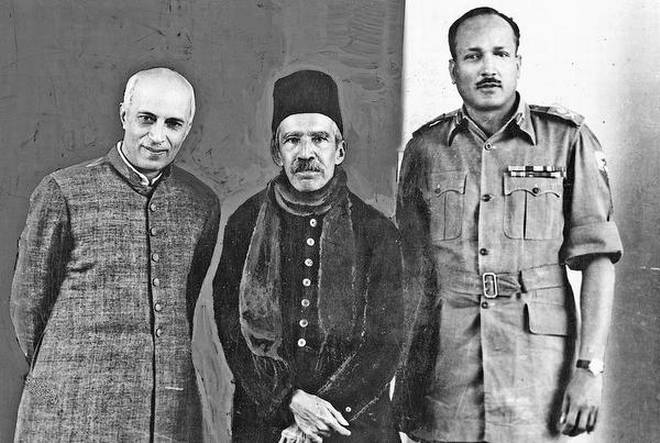
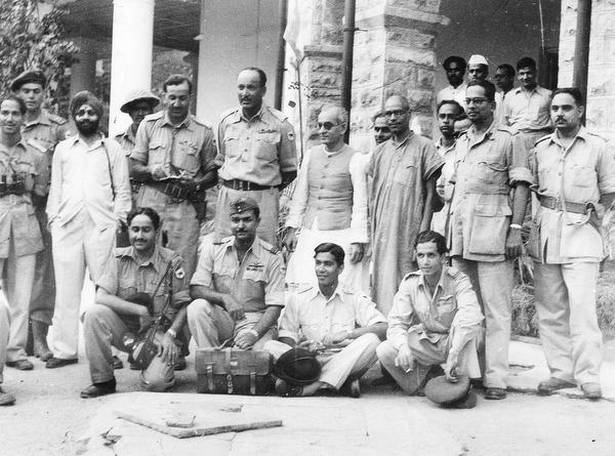
awaharlal Nehru with Nizam Mir Osman Ali Khan and Major General J. N. Chaudhuri after the police action | Photo Credit: THE HINDU
India’s diplomatic efforts succeeded in choking the supply of arms to Hyderabad, resulting in the September 17, 1948 surrender.
Seventy years ago, on September 17, 1948, at noon, Hyderabad ceased to exist as a princely state after a war that lasted all of 109 hours. It would have gone on for longer had India not been able to stymie the former kingdom’s attempts to procure weapons for a protracted conflict.
Hyderabad became part of India more than a year after the latter’s existence as an independent nation. Ruled by the hereditary ruler Nizam Mir Osman Ali Khan, the 212,000 sq km kingdom fancied its chance as an independent country.
Standstill Agreement
Unlike the Instrument of Accession with India signed by other princely states at the time of Independence, the Nizam nominated a three-member team to negotiate a Standstill Agreement. The Agreement signed on November 29, 1947 by Governor General Lord Mountbatten and Nizam Osman Ali Khan, specified that it would be valid for one year and that foreign affairs, defence and communications would be in India’s control while the Nizam had control over domestic affairs.
Declassified diplomatic cables between India War Office Staff, the Commonwealth Relations Office (CRO) and the UK Foreign Office, archived in the British Library, reveal that immediately after Independence, India played a high-stakes diplomatic game in London to staunch the flow of arms to Hyderabad in November 1947. This shortage of weapons ultimately forced the Hyderabad army to surrender within four days with limited Indian casualties.
The Nizam scouted for arms across the board — trying to buy them from France, tapping Pakistan for supplies and finally turning to gun runners — the role of Australia-born aviator Sidney Cotton’s role in the transport of weapons from Karachi to Hyderabad is the stuff of legends.
But the role of Indian diplomats in stalling the flow at the source is less known, carried out by hidden channels.
The British government played along with India by persuading France against selling German weapons to Pakistan, which in turn wanted to funnel them to Hyderabad.
The first of the series in the diplomatic cables sent to Donaldson at the CRO by R.H.S. Allen of the Foreign Office begins innocuously enough. “French Embassy informed Foreign Office on 1st November that Pakistan Trade Commissioner in London recently represented to French Authorities in Paris that his government urgently desired 600,000 rifles, same number of revolvers and 300,000 light and heavy machine guns from former German weapons in France. It added that, if France could not supply, his govt had other offers from Sweden, Belgium and the Netherlands,” says the cable marked Important/Top Secret by CRO.
These low bore, small arms on Pakistan’s shopping list were meant for Hyderabad. But India moved the diplomatic game a notch higher, with the persuasive but often abrasive V.K. Krishna Menon, Indian High Commissioner in London, swinging into action.
“As regards Hyderabad, it was decided that we should tell Mr. Krishna Menon, who has been bothering us (FO?) on the subject, that it is not our intention, as things stand at present, to supply arms on any abnormal scale to Hyderabad, but that Hyderabad is entitled to limited quantities of arms for the legitimate purposes of their state forces and police…” (says a cable sent again to Donaldson of CRO by FO on November 14, 1947)
An exchange of nine diplomatic cables in November 1947 and multiple jottings by officials on them, show how India managed to literally starve Hyderabad of weapons.
Another cable, sent to Gordon Walker, Under-Secretary of State (the initials are illegible) dated November 11, 1947 reads: “This shows that we must have a full and frank discussion with Mr. Krishna Menon and Rahimtoolah (Habib Imran Rahimtoolah, Pakistan’s High Commissioner) on the subject. Mr Menon constantly assumes that the UK should stop Pakistan from getting arms anywhere. ..But I confess that 600,000 rifles, 300,000 machines seems to be a lot…”
A group photograph of K. M. Munshi and Swami Ramand Tirth with Indian Union officers immediately after their arrival in Secunderabad on September 21, 1948. | Photo Credit: THE HINDU
Pakistan was not just shopping for arms — it was passing around the bowl. A rather large one at that. A cable from Washington to FO on November 26, 1947, reads: “Pakistan is now trying to get a loan of 2 billion dollars from the U.S.A. of which 200 million is for military supplies. This follows their attempt to get arms from France.” On the margin is the scribbled note: “USA have told us that they are cold-shouldering this.”
By the end of 1947 — the last cable in the series is dated December 4 — India had successfully closed the official arms pipeline for Hyderabad, hampering the Nizam’s efforts to stay independent for long.
Airborne supply
Then Sidney Cotton stepped in. He was the legendary flying ace who flew the last plane out of Berlin in 1939 and pioneered aerial reconnaissance by photographing German war efforts.
However, by the time, Cotton flew into the picture to help Hyderabad, it was too late. Hyderabad could not get any fresh weapons for 11 months from the time India and Pakistan came into existence. The armed forces of Hyderabad didn’t have arms nor ammunition for training.
Cotton flew to Hyderabad in the first quarter of 1948 to meet the Nizam and got a shopping list of weapons. He quoted an amount of £20 million in cash for running the weapons. Back in London, he hired a 24-member team and bought five used Avro Lancastrians for £5000 each. Cotton’s first run of arms began from Heathrow Airport on May 11, 1948, with the first Lancastrian that halted in Basle, Switzerland, to pick up an unspecified number of Oerlikon cannons. The first shipment of weapons landed on July 10, 1948 in Warangal.
In the course of the next two months, Hyderabad received about 25,000 mortars, 1,000 anti-tank mines, 1,200 sub-machine guns from Beretta, another 3,000 sub-machine guns, 10,000 rifles, one ack-ack and six low-calibre anti-tank guns and ammunition, delivered by Cotton.
Indian forces entered from the west in Sholapur and from the east near Suryapet. The war that began at 4 a.m. on September 13, 1948, lasted 109 hours and by September 17, 1948, Hyderabad surrendered. File | Photo Credit: P.V. SIVAKUMAR
The Nizam’s Commander-in-Chief at the time of Indian pincer movement on Hyderabad was Major General Syed Ahmed El-Edroos. He writes in his biography about the 20,000 .303 rifles and other small arms and ammunition brought in by Cotton and which had Rawalpindi Pakistan Arsenal markings on them.
But the Hyderabad army, which had a strength of 17,000 soldiers, 9,000 irregulars and 362 officers, didn’t get to train on the weapons or use them on the field. Indian forces entered from the west in Sholapur and from the east near Suryapet. The war that began at 4 a.m. on September 13, lasted 109 hours and by September 17, Hyderabad surrendered.
Cotton’s last flight out of Hyderabad’s Hakimpet airstrip was on September 16, at 3 a.m. — just hours before the surrender. This time the plane was loaded with cash of about £4 million in rupees.
Cotton was also supposed to have picked up the private militia leader Kasim Razvi. Razvi headed the Majlis-e-Ittehadul Muslimeen, and created the Razakars (volunteers) force to defend Hyderabad and the Nizam. This private militia created terror throughout the kingdom and triggered an exodus of Hindus from Hyderabad and other urban centres.
But Razvi’s escape ended in a theatrical fiasco due to a misunderstanding about the flight timing. As Cotton thundered away in his Lancastrian thinking Razvi had boarded, the militia leader desperately ran behind the plane, too late to flee. Razvi was placed under house arrest and tried for sedition. He was freed in 1957 and he emigrated to Pakistan where he died penniless in 1970.
The diplomatic heat was kept up even as Hyderabad surrendered. According to a report in The Hindu, R.K. Nehru, India’s diplomat in the U.S., in a radio broadcast on September 17 that was heard coast-to-coast said: “The British in similar circumstances would have marched in on the first outbreak of violence to restore order, put down the Razakars and bring the Nizam to his senses.” (This is significant because Pakistan and officials from Hyderabad were portraying India as an aggressor. And this Indian diplomat put things in perspective)
source: http://www.thehindu.com / The Hindu / Home> News> Cities> Hyderabad / by Serish Nanisetti / Hyderabad – September 15th, 2018
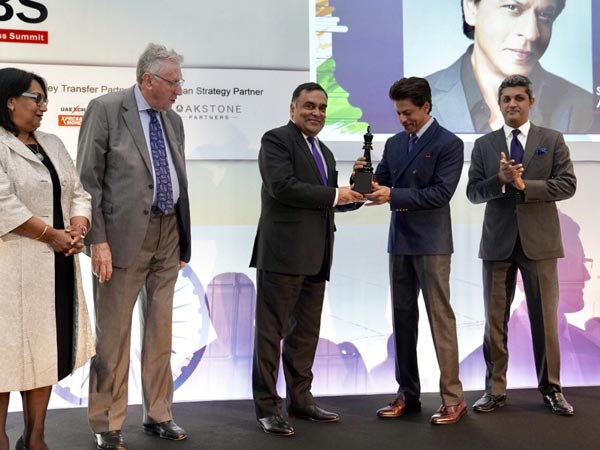
Here’s some good news for all Shahrukh Khan fans! The superstar was recently felicitated as a “Game Changer for his Unmatched Contribution to Globalizing Indian Cinema” at the business summit in London.
Time and again, King Khan has represented India at international events making the nation proud. The ET India – UK Strategic Conclave, a special business summit discussing the economic relations between India and UK was graced by the global icon in London.
Check out some of the pictures here-
SRK In Conversation
Representing the entertainment industry for a chat session on the ‘Growth of the business of entertainment across the globe and its impact on India”, Shah Rukh Khan said, “The growth for Indian films has been much smaller compared to the growth of television in India. The ratio of theatres to the audience area is still very small, we have very few theatres compared to the audience we can garner. In the Interiors of India, there are not many screens for people to go and I think there is a huge market here for entrepreneurs to get into making low-cost theatres.”
SRK Felicitated As The Game Changer
The actor, producer, activist was also felicitated with The Economic Times Game Changers of India” – Hall of Fame for “His Unmatched Contribution To Globalising Indian Cinema.”
The Superstar Also Unveiled A Coffee Table Book
A coffee table book titled ‘Game Changers of India’ was also unveiled at the summit which features Shahrukh Khan along with other accomplished leaders.
SRK’s Award Acceptance Speech
Accepting this honour, the superstar said, “I take this opportunity to thank a lot of people, actors, actress, and audiences, for allowing me to continue unencumbered with any idea that I had, they gave me the ability to just go ahead and give it a shot, try and go wrong if I may, and more often than not they allowed me to go wrong”.
He further added, “Business is become about millions, targets and projections, though I fully respect the managerial capacity of business, but I like to think of it as the people who work with me allowed me the imaginarily capacity, they allowed me to imagine and they managed that imagination. So, when you become a game changer you cannot take it upon yourself, there are loads of people involved and the audience as well around the world accepts you doing the stuff you do and think it’s entertaining”.
On the work front, Shahrukh Khan will be next seen in Aanand L.Rai’s Zero co-starring Anushka Sharma and Katrina Kaif.
Salman Khan host Shahrukh Khan on Dus Ka Dum – Dumdaar Weekend
source: http://www.filmibeat.com / FilmiBeat / Home> Bollywood> News / by Madhuri V / September 12th, 2018
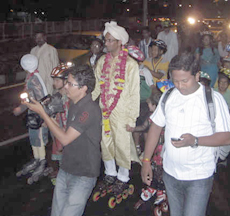
“Baaraat” of Sajid Khan, a national level skater and coach, skating its way to marriage venue in Bhopal on Sunday night.
Bhopal:
Bhopal, the capital of central Indian state of Madhya Pradesh, witnessed a unique wedding wherein “Baaraat” (the wedding procession of the bridegroom) on Sunday night skated its way to wedding venue on roller skates.
The “Baaraat”was that of Sajid Khan, a national level skater and roller skating coach in local Delhi Public School, who adopted this unique move to attract people’s attention towards skating and promote the game in the state and ensure recognition to it in international events.
The bridegroom and the “Baratis” all put on their skating shoes to roll on in the marriage procession from Gauhar Mahal to Bagh-o-Bahar, the wedding venue, as vehicular traffic on the VIP road nearly came to a screeching halt. Budding skaters, the disciples of groom Sajid, also danced to the beating of drums as the procession moved on with passersby halting down to have a clear glimpse of this unique “Baaraat”.
Sajid, who is also president of Speed Roller skating Association, Bhopal, skated to have a rendezvous with his bride Shaista Yasmeen, who also happens to be a skater and a roller skating coach. Several national and international junior skaters such as Huzaifa Zafar, Akshay Sharma, Syeda Masooma Fatima, Ahsas Shrivastava, Gautam Sharma, Shayali Kumbhare, Aamir, Nilesh, Sami Khan, Hrithik Khare and others also joined the “Baaraat” with their skates on.
Sajid revealed that it was their students who planned the one-of-its kind wedding and he was happy to accept the unique idea. The wedding shall be remembered for long, not for its grandeur, but for the mode of transport the groom and the members of the “Baaraat”chose to reach the marriage hall.
“It is a historic moment in my life as the people who witnessed the wedding procession shall be attracted towards the roller-skating sports. “We are advertising the skating game through the procession. I spend my whole time in skating and as such I and my students decided to take out wedding procession on skates which is something unique”, Sajid told media persons as he rolled on skates to meet his soul-mate and bring her home.
Meanwhile, Nikah was solemnized at the historical Taj-ul-Masajid, one of the biggest Masjid in Asia, between the Asr and Maghrib prayer timings on Sunday evening. Elite of the town along with large numbers of sportspersons attended the Nikah.
It may be pointed out here that a couple has also tied nuptial knot while rappelling at Kerwa Hills in the city in the past.
source: http://www.ummid.com / Ummid.com / Home> Life & Style / by Parvez Bari (pervezbari@eth.net) / September 19th, 2011
[SPONSORED CONTENT] Dr Shafi Ul Mulk had an idea that grew into a vision for change. Today, that vision is a reality, having grown his multiple dual concept diagnostic centres into a leading healthcare brand in the region
Through his healthcare services, Dr Mulk touches millions of people from around the world and has been celebrated on many prestigious forums. He has also added significant feathers to his illustrious cap, being honoured with Forbes magazine’s Top 100 Indian Entrepreneurs and Leaders in the Middle East two years in a row.
HUMBLE BEGINNINGS
The origins of Global Hawk were not unlike some world-renowned companies of today. Dr Mulk started with a personal staff of only two, working in Hamriya free zone, Sharjah. Dr Mulk created his company – the internationally acclaimed Global Hawk chain of diagnostic centres (that utilizes Global Hawk’s innovative technology in telemedicine and teleradiology).
THE START OF SUCCESS
The company grew quite rapidly, expanding across the globe and into a world-renowned healthcare empire worth more than US$200 million. The phenomenal success of the establishment can be directly attributed to the visionary leadership of Dr Mulk, who is widely considered the pioneer of teleradiology in the region.
His brainchild, Global Hawk Telemedicine/Teleradiology with IT solutions including RIS, Mulk Digitizers and Mulk Viewers products installed globally in major hospitals and medical centres have revolutionized the healthcare industry. In fact, the runaway success of Global Hawk Telemedicine encouraged him to start the chain of Global Hawk Imaging and diagnostic centres (GHID) which eventually led him to a number of accolades and international awards.
FAST RISE TO THE TOP
From a single branch in Deira, GHID has grown rapidly with many centres across multiple locations all with state of the art radiological technology, all the main imaging modalities – including open and closed MRI, CT scan, CBCT, 2D, 3D/4D Ultrasound, Digital Mammography, Bone Densitometer as well as top rated clinical laboratory diagnostic devices, all under one roof.
The centres are today considered as one of the best in terms of state-of-the-art, high-quality diagnostic imaging services and patient-centred care. With its goal of becoming a dedicated healthcare provider and imaging resource and research centre across the globe, GHID serves as a gateway to international expert standards diagnostic opinions – while also streamlining management and investigative recommendations. Today, this is a vital requisite in the current medical environment.
THE NEXT STEP: MORE GROWTH
Dr Mulk’s company has spearheaded an AED250 million expansion plan, which includes a chain of Global Hawk Diagnostic Centres with dedicated PET-CT / MRI and Cyclotron unites across the GCC, India and Eastern Europe, and a chain of Global Hawk multi-speciality Polyclinics and Medical Centres. The group is also looking to start a 50 bed Mulk oncology charity hospital in India, as well as Mulk speciality hospitals in the UAE.
BACKGROUND IN EDUCATION
Dr Mulk’s passion for innovation and medical technology can trace its roots from his impressive educational experience. A prominent neurovascular radiologist in the UAE, his formative medical education began at Kurnool Medical College, Andhra. He also has completeld fellowships at Michigan, USA and Multon Keynes, UK.
Being a passionate teacher, he freely shares his knowledge by teaching university students and mentoring junior radiologists. Dr Mulk has been consistently invited to speak at major international forums of radiology and imaging, as well as healthcare entrepreneur platforms. He was honoured as a guest speaker by the Arab Health Committee and International Health Organisations for his overall contribution to the Healthcare Sector, resulting from his wealth of experience in Radiology for two decades.
THE MAN BEHIND THE BUSINESS
Dr Mulk’s zeal and enthusiasm for success doesn’t limit itself to the professional fields, but also in his love for sports. A former national Bandminton player, he was named a ‘young Hopeful of India’ by a leading Indian Sportstar magazine at the age of 13. An ardent supporter of Badminton Associations of the region and sponsor of major Badminton tournaments, he is one of the top ranked players in the UAE, with winning accolades in the Masters Men event of the UAE Open Championship of 2016 and 2017.
But one of the most essential characteristics of his personality is his compassionate outlook towards the community. Dr Mulk is a well-respected member of various social and Islamic organizations in India and the UAE, and he actively engages in various charitable activities focusing on building a better tomorrow.
A true believer in strenghth of the family unit, Dr Mulk candidly acknowledges that the support he receives from his soulmate, Dr Yasmeen Ul Mulk, and their sons Zoheb Ul Mulk and Zain Ul Mulk is what most encourages him to follow his passion.
INTERNATIONAL RECOGNITION
Dr Mulk scored a double win at the Annual Health Awards in the UAE this year, winning the Distinguished Achiever award in Healthcare and Innovative Technology. These accolades add to his illustrious list of accolades and awards in 2017 alone; including being honoured with the World Healthcare Innovative Entrepreneuier of the year 2017, by the Global Association of Physicians of Indian Origin and the Indian Business Exceppent Awards – IBPC 2016 and 2017 – from H.H. Sheikh Nahyan Bin Mubarak Al Nahyan.
He has also received the Star Quality Award in Geneva 2014, The World Inspirational Company USA awards in 2015, as well as the International Medical Quality Award May 2016, which was held in Monte Carlo, Monaco.
Dr Mulk and his company have also been honoured and lauded with the ‘World’s Greatest Brands’ and ‘World’s Greatest Leader’ awards in 2017.
source: http://www.arabianbusiness.com / Arabian Business / Home> CEO> Business / by Global Hawk / July 23rd, 2017
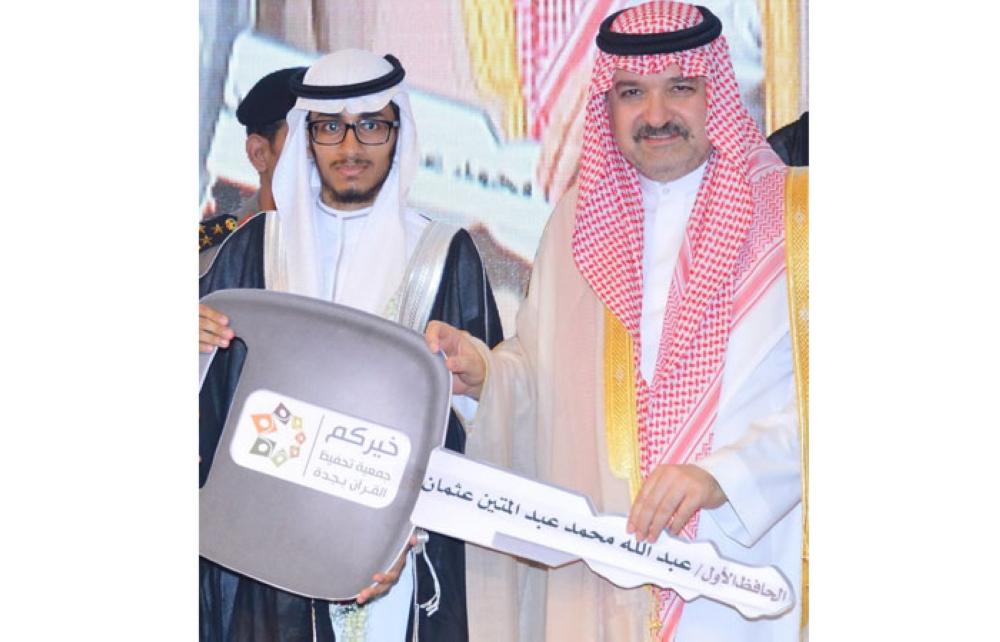
Prince Mishaal Bin Majed, governor of Jeddah, presents Abdullah Abdul Mateen Usmani the key of the car he won as first prize in the Quran memorization project
Jeddah :
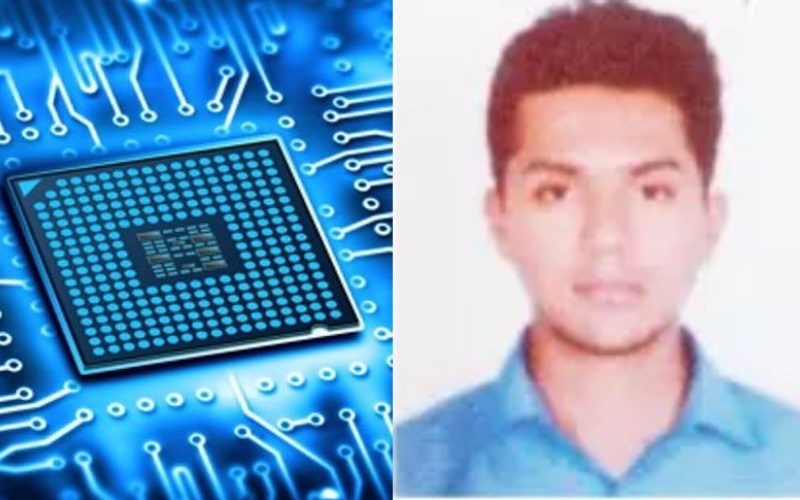
Abdullah Abdul Mateen Usmani, an Indian expatriate, has recently been declared winner of the annual Qur’an memorization contest organized by Jamia Tahfiz-ul-Quran Makkah region.
One thousand huffaz (memorizers of the Holy Qur’an) participated in the event with 13 of them scoring marks between 95 and 99. In the second competition that ensued Abdullah Abdul Mateen Usmani was declared the winner.
Prince Mishaal Bin Majed, governor of Jeddah, was the chief guest at the gala event with hundreds of senior officials, philanthropists and parents of the participants in attendance.
Prince Mishaal distributed prizes among the winners with first prize going to Hafiz Abdullah Abdul Mateen who was given a car.
Jamia Tahfiz-ul-Quran is an institution and center established for the students to memorize and recite Holy Qur’an.
The Jamia holds the competition every year to encourage students and other participants.
Hafiz Abdullah Abdul Mateen Usmani belongs to the southern Indian city of Hyderabad.
The award winner’s father, Mateen Usmani, thanked Almighty Allah for the honor bestowed on his son and lauded the efforts of Jamia Tahfiz-ul-Quran in memorization and recitation of the Holy Qur’an.
source: http://www.saudigazette.com.sa / Saudi Gazette / Home / by Syed Mussarat Khalil / September 08th, 2018
Explore a little-known facet of Goan history with our Quick Guide to the Safa Masjid
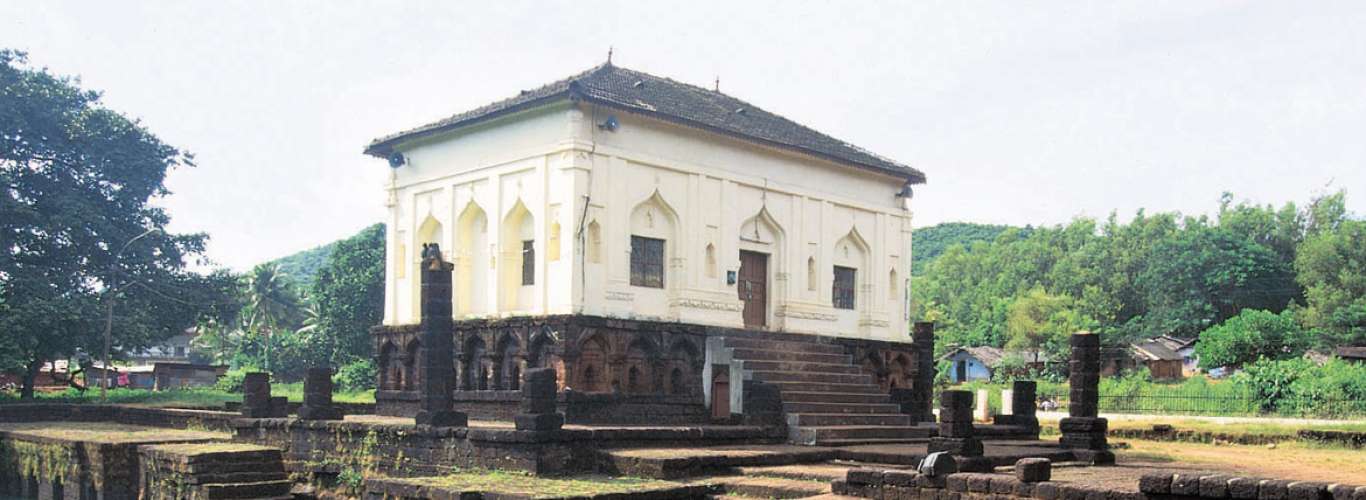
Set on the edge of a large tank just outside Ponda town, the Safa Masjid, built in 1560, is the only surviving mosque of the 27 shrines that Ibrahim Adil Shah of Bijapur constructed. Broken columns surround the mosque, which once graced a garden with laterite walkways. It’s among the few ancient Muslim monuments left in a state that has a long association with Islam and its solitude is evidence of the energy with which the Portuguese battled Muslim rulers.
Muslims – who now form just over five per cent of the state’s population – have lived in Goa since at least the 10th century CE, when the Kadamba rulers urged merchants from East Africa and Arabia to settle in the state.
But the kingdom’s affluence soon brought it to the attention of raiders. The raids, which started in the 10thcentury, reached a crescendo with strikes by Allauddin Khilji in 1294 and Muhammad Tughlaq in 1325. After briefly being held by the Vijayanagara Kingdom, Goa in 1358 came under the sway of Alla-ud-din Hasan Shah of the Bahmani family. When the Bijapur sultans took over from the Bahmanis in 1490, Yusuf Adil Shah started a construction campaign, building a mosque and a palace.
Ismail Adil Shah’s defeat in 1510, at the hands of the Portuguese Commander Alfonso de Albuquerque, had disastrous consequences for Goa’s Muslims. Angered that Muslims had helped Adil Shah’s defence, Albuquerque’s soldiers hunted them down viciously.
source: http://www.outlookindia.com / Outlook Traveller / Home> Explore> Story