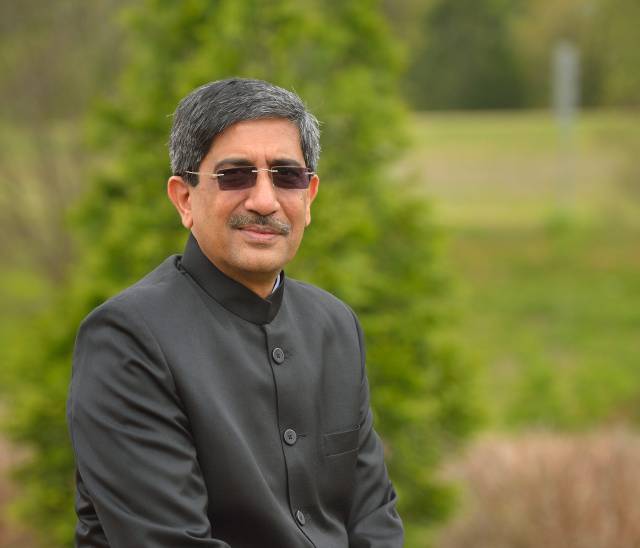
Ikhlas Khan. Photo courtesy of Ole Miss Communications
Ikhlas Khan, director of the National Center for Natural Products Research at the University of Mississippi School of Pharmacy, is the winner of AOAC International’s 2018 Harvey W. Wiley Award, which recognizes lifetime scientific achievement.
AOAC International develops global quality standards for microbiological and chemical materials, ranging from food to pharmaceuticals in an effort to ensure public health. Khan, who has been with the university since 1992 and directed the natural products center since 2017, has spent much of his career developing standards for dietary supplements.
“I’m very pleased to receive this award,” Khan said. “AOAC is the top organization for chemical standards, and I appreciate this recognition of my work in this area.”
As part of the honor, Khan will deliver the Wiley Award address and chair the Wiley Award Symposium at AOAC’s annual meeting in August in Toronto.
The Harvey W. Wiley Award has been given to one person a year since 1957, with past recipients including scientists from government, industry and academic institutions from around the world.
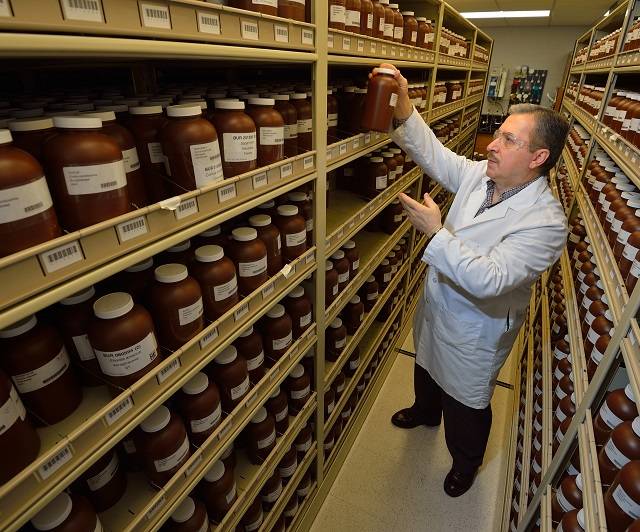
The National Center for Natural Products Research maintains a repository with more than 18,000 natural product specimens, derived extracts and pure compounds. Photo by Robert Jordan/Ole Miss Communications
Story by Sydney Slotkin Dupriest, courtesy of Ole Miss Communications
An on going art exhibition reveals the African legacy in India begins even before the Mughal period
Thriving in india — Politically, culturally and socially
Gujarat is not only home to the lost city of Dwarka, but also houses another secret heritage, of African kings in India. Till date, two dynasties of African kings live on in the former princely states of Sachin and Janjira.
The exhibition “Africans in India — A Rediscovery”, on view at the Southern Regional Centre of the Indira Gandhi National Centre for the Arts (IGNCA), remembers their forgotten legacy. The exhibition has been curated by Dr. Sylviane A. Diouf and Dr. Kenneth X. Robbins of the Schomburg Center for Research in Black Culture, part of the New York Public Library.
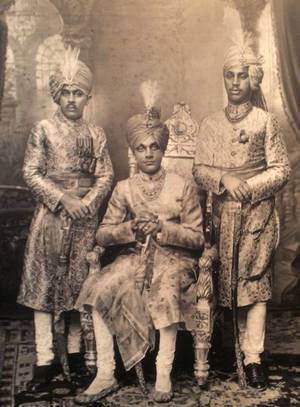
The exhibition reveals how the African legacy in India begins even before the Mughal period in the 1400s. Beginning as slaves migrating from East African regions around Ethiopia, Eritrea and Somalia, Africans rose up the social ladder to become generals, commanders, admirals, prime ministers, rulers and architects, largely known as Sidis or Habshis.
“The exhibition portrays how a community that travelled across the globe and came to India thrived here, politically, culturally and socially. Most of the immigrants came as slaves and some of them reached high offices in the army, some even became rulers,” says Dr. Mangalam Swaminathan, Programme Director, IGNCA, New Delhi.
According to Mangalam, this aspect of heritage isn’t widely known because of lack of information and research. “Even this exhibit, according to curator Sylvianne is only a fraction of the material lying scattered,” she adds. Through photographic reproductions of paintings from several collections across U.K. and U.S.A., the exhibition thematically displays several significant milestones of this heritage captured in diverse paintings spanning across eras. The exhibition showcases the role played by the Africans in four major kingdoms in the regions of Bengal, Deccan, Sachin and Janjira.
Some of the most famous African rulers were Prime Minister Ikhlas Khan who was Prime Minister and Commander-in-Chief for the Bijapur Sultanate, Malik Ambar, who was regent and Prime Minister in the Deccan and the Nawabs of Janjira and Sachin.
The forts, mosques, mausoleums and other physical testimonies to their skills as city planners, architects and rulers, can still be found in these regions. There were also some famous African queens, Mehr Lekha Begum Sahiba, Yasmin Mahal and Bamba Muller.
“The major aspect that one can take away India was a flourishing nation, where people came seeking employment, as far back as fourth century. Indian culture assimilated them into the society, as it had done with several other faiths, cultures and lifestyles. There was mutual give and take culturally, part of the broadminded tolerance of India. Africans in India are an indelible part of Indian history and heritage. We need to do more research and come up with exhibitions, research papers and publications,” says Mangala.
The exhibition was also taken to UNESCO in Paris, IGNCA New Delhi, National Science Center in Surat, M.S. University in Baroda and Gujarat National Law University in Ahmedabad. It was also shown at the India Africa Forum Summit in New Delhi.
The exhibition will be on view till December 26 at IGNCA-Southern Regional Centre (SRC), Kengute Circle, Magadi-Kengeri Ring Road, Near IIPM, Mallathalli, Jnanabharathi Post.
source: http://www.thehindu.com / The Hindu / Home> MetroPlus / by Harshini Vakkalanka / December 21st, 2015
UTTAR PRADESH / Mumbai, MAHARASHTRA / New York, USA :
Khan designed the dress for Houston Ballet Ball chair Hallie Vanderhider.
Hallie Vanderhider / Photo by Jenny Antill
Black Swan :
Guests at The Houston Ballet Ball were encouraged to don black, white or a mix of both as an ode to Tchaikovsky’s ballet “Swan Lake,” but Houston Ballet Ball chair Hallie Vanderhider took the concept further — much further, enlisting the design prowess of Naeem Khan to create her feather-laden gown.
Vanderhider and Tootsies creative director Fady Armanious flew to New York and met with Khan to discuss a gown that would capture the elegance and dark beauty that Vanderhider had envisioned for the ball. Within a few sketches, the trio had landed upon an all-black gown covered in 3,500 natural black coque feathers, weighing in at 7.25 pounds.
“It was a magical moment. Naeem totally captured the essence of Swan Lake,” Vanderhider said. “He is such an amazing talent and has a great sense of humor.
Khan encouraged Vanderhider to embrace the mysterious elements of the dress, reminding her, “This isn’t a mother-of-the-bride gown.” The gown’s sheer long sleeves and bodice were finished with intricate beading.
source: http://www.wwd.com / WWD / Home> Fashion> Fashion Scoops / by Heather Staible / February 22nd, 2018
Martial arts exponent Pathan Jameel Khan represents the other side of Indian sport?
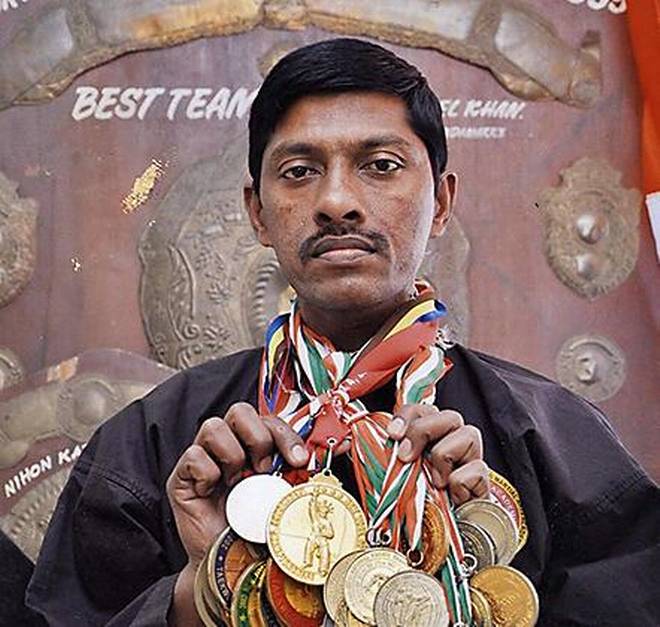
Well, yes, if his ordeal in getting even a decent job or sponsorship to take part in international sporting events is any hint. For this 40-year-old Jameel, winner of 15 gold, 13 silver and 17 bronze at the national and international events including two 2016 World Cup silver in the US is now struggling to meet both ends for want of financial support.
At a time, when cash incentives are being showered on truly deserving outstanding achievers, Jameel gently asks what is that he should do more to get the attention of the powers-that-be.
A native of Mandamarri village in Adilabad district, Jameel, whose father is a vegetable vendor, moved over to Hyderabad to pursue his passion in karate. His diligence and consistency at the highest level have won acclaim including an offer from a martial arts organisation to settle down in US with a chance to represent US. But for the love of the country, he spurned that and came back to India with hope of getting some help. But, as things stand, Jameel, a BA from Dr.Ambedkar Open University, is still staring at an uncertain future – even shunted out from one rented accommodation to the other for not being able to raise even the rental by the first week of the month. His lone source of income – training about 20 karate kids in Mehdipatnam – is always doubtful as it depends on the payment of fee by the students. Still, he has the grace to train about 500 girls of a Government-aided school free of cost to make them good in self-defence daily even now.
It may be recalled here that Telangana Government has been pretty generous in showering cash incentives on some of the deserving athletes in the recent past, running into lakhs but the fact that there are some big achievers like Jameel who are out of its radar is a sorry story of the powers-that-be not getting the right info. “May be, I am paying a price of not having the right connection or Godfathers to take up my cause,” moans a dejected Jameel even as he pursues the dream of representing India at this age in the 2020 Tokyo Olympics where karate is being introduced for the first time.
source: http://www.thehindu.com / The Hindu / Home> News> Cities> Hyderabad / by V.V. Subrahmanyam / Hyderabad – September 29th, 2016
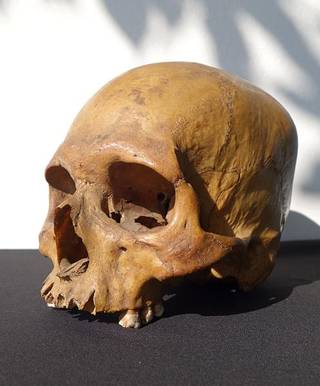
The resting place: The skull was found in a store room of The Lord Clyde pub in London. | Photo Credit: Special Arrangement
Skull of soldier, executed by the East India Company for rebellion in 1857, found its way to London pub; it’s now with historian Kim Wagner
Headhunting is usually associated with primitive tribes and contemporary terrorists, but the colonial rulers of India also collected heads of Indian soldiers as war trophies.
A 160-year-old skull of sepoy Alam Beg, now in the possession of a historian in London, is proof that colonial rulers who brought many modern practices to India were also at times inhuman.
In 1857, Alam Beg, also known as Alum Bheg, was a soldier with the 46th Bengal Native Infantry, an arm of the East India Company.
The Mutiny that year, after having covered the north Indian heartland, spread to Sialkot (now in Pakistan), where Alam Beg and his companions tried to follow their fellow soldiers and attacked the Europeans posted there. On July 9, 1857, they killed seven Europeans, including an entire Scottish family.
Alam Beg, along with his comrades, left Sialkot and trekked all the way to the Tibetan frontier only to be turned away by the guards on the Tibetan side. He was reportedly arrested from Madhopur, a scenic town on the northern part of the Indian Punjab and taken back to Sialkot. A year later, he was tried for the brutal killing of the Scottish family and blown up from the mouth of a cannon. The Mutiny ended soon after. Alam Beg’s tragic story surfaced more than a century later thanks to an Irish captain Arthur Robert George Costello, who was present at his execution.
The skull of Alam Beg. | Photo Credit: Special Arrangement
Present at execution
The Irishman was a captain in the 7th Dragoon Guards, dispatched to India after the Mutiny had shaken the bonds between the East India Company and the native soldiers. Costello had not seen any episodes of the Mutiny but was present at the execution, said historian Kim Wagner, who possesses the skull now.
Costello picked up the skull and returned to London with it. In 1963, the skull was discovered in a store room of The Lord Clyde pub of London, after it had changed hands. The new owners were less than happy to find this war ‘trophy’ from 1857, but treated it as a solemn object from a disturbing past of British history in the subcontinent. The owners of the pub learnt from a note left in an eye socket that it belonged to Alam Beg, who played a leading role in the mutiny of sepoys in Sialkot. They desired to repatriate the skull to the soldier’s family. For years, they tried but failed. It is not known how the skull of Alam Beg ended up in the Victorian-era pub. But it is possible that the Irish captain who witnessed the execution of the leader of the mutinous soldiers visited the pub or someone deposited it there, given the fact that it had links with the history of the Indian Mutiny. In fact the pub was named after Collin Thomson, also known as Lord Clyde, who was a military commander and played a role in crushing the mutiny in north and northwest India. So it is possible that soldiers after their Indian stint would visit the pub.
In 2014, the owners of the pub contacted Kim Wagner who has been writing about South Asian history for years. They urged him to take the skull and return it to the descendants of Alam Beg. Mr. Wagner brought it home and the skull finally added to his research on South Asia which was published late last year as “The Skull of Alum Bheg: The Life and Death of a Rebel of 1857.” The historian believed that only by making people aware of the skull that Alam Beg can be returned to his motherland.
His research showed that most of the soldiers of the 46th Bengal Native Infantry were from modern states of Uttar Pradesh and Bihar and Havildar Alam Beg most probably hailed from Uttar Pradesh. Though he wanted to return him to a dignified family grave yard of Beg’s family, it was not possible as the East India Company left no records of the soldiers of the 46th Bengal Native Infantry.
“There are no longer any records for sepoys of the Bengal Army – the best I could do was locate the area where the 46th regiment recruited from,” Mr. Wagner said.
The Mutiny of 1857 was crushed mercilessly and many gruesome incidents of that era find mention in official records. In 2014, around the time when Mr. Wagner began writing his book on Alam Beg, Ajnala in Punjab’s Amritsar hit the headlines when authorities discovered skeletons of 282 soldiers who were executed after the Mutiny. They apparently had surrendered hoping for a fair trial, but the Deputy Commissioner of the district Frederick Henry Cooper ordered execution of the rebels. They were buried with medals and even money of the East India Company that many of them had in their pockets. The grisly discovery is yet to receive a closure as the family members of those soldiers remain untraced.
Similar is the condition of Alam Beg as his journey back home remains incomplete but Mr. Wagner believed that his only physical remain should find a proper peaceful burial. Mr. Wagner is aware that the government of Prime Minister Narendra Modi has been vocal about honouring the fallen soldiers of India in various colonial era battles. He says that something similar can be done in case of Alam Beg as well.
“After all these years, it is high time for Alum Bheg to return home…he was probably born in what is today India, he was executed in what is now Pakistan,” Mr. Wagner wrote in his book proposing that a burial for Alam Beg near the India-Pakistan border would be the most suitable tribute to his sacrifice.
The historian said that in the absence of the descendants of such soldiers, it is the Indian government that should bring back Alam Beg to his motherland.
Headhunting by colonial rulers from Europe was a rampant practice in the 19th century and activists worldwide have been vocal in demanding human remains from Western museums and collectors should be returned to their countries of origin. Such a movement is yet to begin in India whose soldiers from the colonial past in many instances continue to remain anonymous and abroad.
source: http://www.thehindu.com / The Hindu / Home> News> National / by Kallol Bhattacharjee / New Delhi – February 04th, 2018
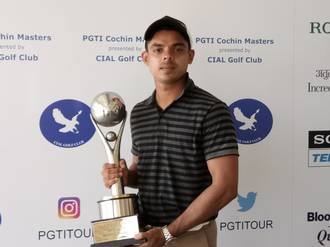
The 24-year-old golfer from Bengaluru had produced amazing play over the last two days, including a hole-in-one at Nedumbassery’s CIAL Golf Club, but suddenly everything appeared to be going up in smoke.
Bengaluru golfer Syed Saqib Ahmed with the PGTI Cochin Masters Trophy, his maiden pro title, on Saturday. – STAN RAYAN
For a brief moment, as he came up with successive bogeys on the 15th and 16th holes in the final round on Saturday, Syed Saqib Ahmedfelt his title chances slipping away in the PGTI Cochin Masters.
He then found out from his friends that Delhi’s Honey Baisoya, his nearest challenger who had started half hour earlier, had finished with a seven under and realised that he had to buck up. And Saqib found his touch just in time, produced birdies in the last two holes, and lifted his maiden professional title.
“I really felt the pressure after the bogeys on the 15th and 16th because both the par fives are actually easy holes,” said Saqib who finished with a three-shot lead (total 278) over the pre-tournament favourite Baisoya who came second.
“But I had a birdie on the 17th, which I think is one of the toughest holes. And the 18th went like a dream, I really didn’t think I could handle it so well. This is really a big burden off my head.”
The title ended three years of waiting for Saqib. “I dedicate this, my first pro title, to my parents and to my grandfather,” said the young man and then turned emotional.
Another Bengaluru player, M. Dharma, and Chandigarh’s Abhijit Singh Chadha finished joint third. V.J. Kurian, Managing Director, Cochin International Airport Limited, gave away the prizes. The Pro-Am event will be played on Sunday.
The final placings (par 288, four day total, top 10): 1. Syed Saqib Ahmed (278), 2. Honey Baisoya (281), 3. M. Dharma & Abhijit Singh Chadha (both 283), 5. Ankur Chadha (284), 6. Veer Ahlawat, Maniram, Gaurav Pratap Singh (all 285), 9. Arjun Prasad & Karandeep Kochhar (286).
source: http://www.sportstarlive.com / SportStar / Home> Golf / by Stan Ryan / Kochi – February 03rd, 2018
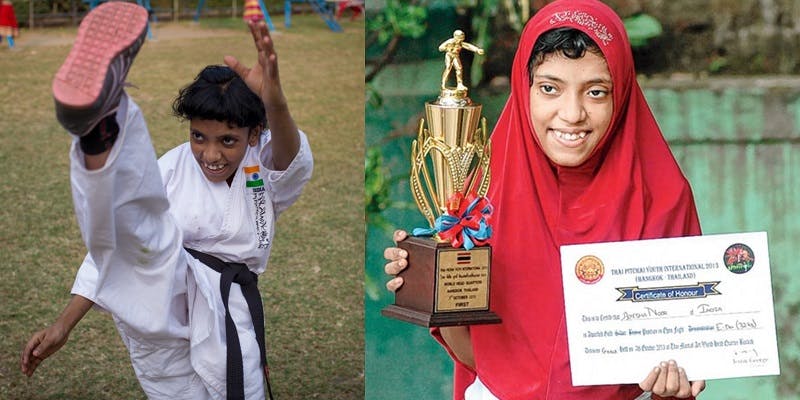
Ayesha Noor was born in a slum in Kolkata. Suffering from epileptic seizures, Ayesha was asked to leave school when she was just five. Only a year later, she decided to learn karate. Today, at the age of 19, Ayesha is an inspiration for many.
Images (L) Huffington Post (R) YourStory.com
Ayesha is the winner of two gold medals at the national level and has brought home three gold medals from international events. She also trains girls in Kolkata in self-defence. “I become a sherni (tigress) when I teach karate,” Ayesha told Huffington Post.
Ayesha’s journey hasn’t been an easy one. Her father passed away when she was just 13. Life has been difficult for the family of three that lives in a one-room house in a Kolkata slum. While her mother works as a tailor, her brother sells slippers to make a living.
Despite her inspirational triumphs in the international arena, Ayesha wants to teach karate to people across the world. Her coach and mentor MA Ali told Business Standard, “She is a completely different personality once she hits the ring and the fighter in her takes over.”
source: http://www.yourstory.com / YourStory.com / Home> HerStory> Think Change India / November 16th, 2016
Awadh, UTTAR PRADESH / London, U. K / Paris, FRANCE :
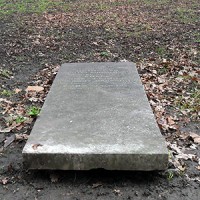
While walking around Paddington Old Cemetery during my lunch break earlier today, for some reason I felt compelled to read the faded stone slab that marked the resting spot of Princess Omdutel. Instantly my attention was grabbed, a Princess buried in Kilburn, North West London of all places, that sure wasn’t something I was expecting to find.
I have walked past the grave of Princess Omdutel, perhaps a 100 times or more since I moved to Kilburn and never paid it any attention. Now she had my full attention.
The badly worn and faded inscription on the stone slab was barely readable, but after a lot of scratching of my head, I finally managed to decipher the words: Sacred to the memory of Princess Omdutel Aurau Begum, daughter of the late General Mirza Sekunder Hishmut Bahadur, Brother to His Majesty King of Oude, who died 14th April 1858 aged 18 months.
With a little help from Google and www.findagrave.com, I managed to find the following information: Princess of Oude. Oude, or Awadh, which was the epicentre of the 1857 Indian Mutiny, when the sepoys rebelled against the British after baulking at orders to use cartridges greased in pig and beef fat. Members of the Awadh Royal Family arrived in London soon afterwards, lobbying unsuccessfully for the return of their lands. The princess’s father, Mirza Bahadur, died two months before her and is buried in Père Lachaise in Paris.
The British obviously offered the Awadh Royal Family a haven in London after they were ousted. I’m not sure how long the family had ruled for in Awadh, which is a region in India. But from what I can gather it seems likely that they were a puppets installed by the British Government.
Princess Omdutel Aurau Begum, her life had barely begun, when she died at only 18 months of age. I wonder if any of the family survived and if so what became of them. It is also intriguing that her father died two months before her in Paris. No mention of the mother, which is kinda sad if you ask me…
I find it strange that I have walked past the grave of Princess Omdutel numerous times over the past twenty months and never once read it, until today. Very strange. Maybe she was wanting a mention on London Is Cool…
source: http://www.londoniscool.com / London is Cool – a blog about Life in London / Home> Out and About in London / by William Wallace / February 21st, 2011
Awadh, UTTAR PRADESH / London, U. K / Paris, FRANCE :
The tragic story of Malika Kishwar, who rests in an unmarked grave in France’s most famous cemetery
The grave of Malika Kishwar at the Père Lachaise cemetery in Paris. Photo: Wikimedia Commons
She lies buried amidst sepulchres that house the remains of many who are still famous.
There is Jim Morrison on the premises, the American rock legend whom trains of tourists come to pay homage, like pilgrims bearing flowers. Edith Piaf, the waif who sang her way to greatness, finds her peace nearby, as does Frederic Chopin, the composer whose pickled heart is in Warsaw but whose body dissolves in the French capital. Benjamin Franklin’s grandson rests here, and in the vicinity there is a man believed to have been sired by Napoleon. Oscar Wilde’s sculpted grave competes with Marcel Proust’s neat bed of stone, and many more still are the artists, writers, and persons of esteem who crowd the hillside cemetery that is Père Lachaise in Paris.
And yet, between them all, under a platform of rugged rock, lies this tragic Indian woman. Her name and cause have been largely forgotten, but since 1858, she has been here, longer than many of her revered neighbours. Tourists walk by with cameras, oblivious to her unmarked square existence. But every now and then there is a stray visitor who arrives on a quest: to locate the final resting place of that remarkable woman, the last queen of Awadh.
I was that visitor a few days ago, when I trekked up Paris’ most famous graveyard to look for this forgotten tomb.
The lady appears in yellowed old books by several names. She was to some Malika Kishwar, while others knew her as Janab-i Aliyah, Her Sublime Excellency, mother to the ruler of “Oude”, Wajid Ali Shah.
In 1856, when the British deposed this nawab from his ancestral seat in Lucknow, his family departed for colonial Calcutta, with all the money they could gather and what dignity they had left. But while the son (a “crazy imbecile” in the eyes of his sneering oppressors) prepared to fade quietly into history, the mother was determined to win back that which was her family’s by right.
That very year, this woman who knew little beyond her sequestered palace, set foot on a ship, determined to sail to England so she might speak—woman to woman—to the English queen in person. After all, declared the middle-aged begum, Victoria was “also a mother”; she would recognize the despair her people had unleashed, and restore to the House of Awadh territory, titles, and its rightful honour. And so proceeded Malika Kishwar, her health already in decline, braving cold winds in a foreign land, to plead the cause of royal justice.
The mission was doomed from the start. Advisers were many and much was the money they sought for the privilege of their counsel. The results, meanwhile, were nowhere to be found.
As historian Rosie Llewellyn-Jones records, Kishwar discovered quickly enough that Queen Victoria, in her “circular dress”, had little power to bestow anything more than polite conversation on her and her Awadhi line—when an audience was granted, they spoke about boats and English mansions, not about imperial treacheries and the unjust business in Lucknow.
In the British parliament, things got worse. A prayer at long last prepared was dismissed on spurious bureaucratic grounds: the begum was to submit a “humble petition”, words that she failed to use in the document laid before the House. While her son accepted British imperium, the mother was obstinate in battle. So, when she wished to travel, they sought to dragoon her into acknowledging their suzerainty—if Malika Kishwar and her ménage wanted passports, she would have to declare herself a “British subject”.
The begum refused to do anything of the sort, prepared, at best, to be under “British protection”, but never anybody’s “subject”. And legal quibbles aside, the Great Rebellion of 1857 compounded matters—there was now no prospect of relinquishing even a fragment of British power when the hour called for a demonstration of obdurate strength alone. Awadh was lost forever.
The tide having turned, in 1858, the begum decided to return at last, defeated and unhappy in the extreme. But in Paris she fell ill and died on 24 January. The funeral was simple, but there was yet some dignity and state—representatives of the Turkish and Persian sultans gave this Indian queen the regard the British denied her and her line.
A cenotaph was constructed by the grave, but it has long since fallen to pieces—when decades later the authorities at Père Lachaise sought funds to repair the tomb, her exiled son decided from Calcutta that it was simply not worth his pension, while the colonial state was even less inclined to honour a difficult woman lying several feet underground in an alien European country. And so, since that time, in a graveyard full of magnificent memorials, the queen of Awadh has remained, a shell of broken stone sheltering her from the weeds and overgrowth that alone have made a claim upon her and the story that she tells.
Others of her suite also suffered. A younger son had come with her, Sikandar Hashmat by name. He died in England, and was carried to join his mother in her unmarked grave. A grandson’s infant child was also buried within, turning the tally in Paris to three.
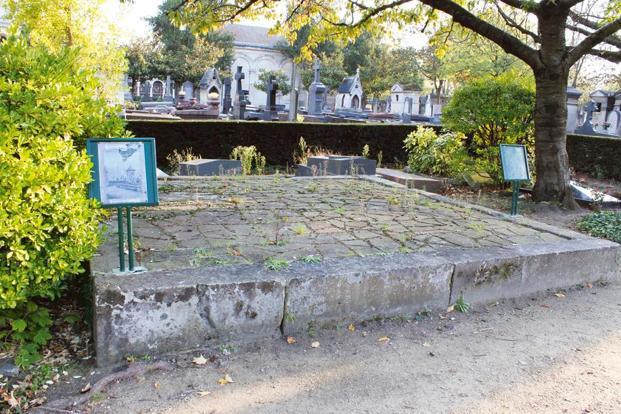
But it was in London that one more of the delegation fell, this one a baby princess, born to Sikandar Hashmat from his Rajput wife on British shores. I walked around a dull little place called Kilburn to look for this grave. And there, in a cemetery, after an hour between tombs set in the soggy English ground, I found a memorial to the child: Princess Omdutel Aurau Begum, “who died 14th April 1858”, months after her grandmother who was once a queen.
But Omdutel, all of 18 months, had a minor triumph where her royal grandmother had none—lying by a pathway in that cemetery in Kilburn, her grave at least bears her name.
The begum, on the other hand, has become to the passing tourist at Père Lachaise in Paris a plinth on which to rest, smoking a cigarette and looking on to a horizon full of the dead, till a stranger might appear to tell how they have under them.
Medium Rare is a column on society, politics and history. Manu S. Pillai is the author of The Ivory Throne: Chronicles Of The House Of Travancore.
He tweets at @UnamPillai
source: http://www.livemint.com / LiveMint / Home> Leisure> Medium Rare / by Manu S. Pillan / Friday – Jan 12th, 2018
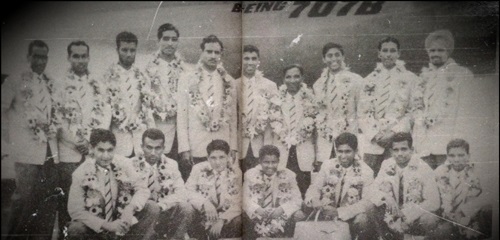
It was the year 1962, the year of the Asian Games in Indonesia.
The gold-winning football team of India was perhaps the best ever in its history.
India’s chef-de-mission to the 1962 Asian Games had criticised the hosts for excluding Israel and Taiwan from the Games for political reasons. Thus, right from the beginning, the crowds were hostile to India. Amidst such circumstances in Indonesia in front of the anti-India crowd, India came out on top beating a formidable Korea team 2-1 in the final, a team that India had lost 2-0 to in the opening match of the group stage.
These Indian footballers belonged to a tough breed of athletes. It was a matter of life and death for them. If one had to choose that one member who stood out in this team, it was none other than the midfield maestro Mohammed Yousuf Khan.
Born in Andhra Pradesh on 5th August, 1937, Yousuf Khan is considered one of the best all-round players in Indian football history. When he used to play, he used to gallop on the pitch like a horse, controlling the play in midfield, for which he was famously known as “the bearded horse.” He played a huge part in India’s triumph in the 1962 Asian Games, and was deservedly awarded the Arjuna Award in 1966.
Khan, who passed away in 2006, was a key member of the famous Hyderabad City police team in the late ’50s and the early ’60s. He was one of the only two Indians to be selected in the 1965 Asian All Stars XI. Such was his authority on the games that even the association acknowledged it.
However, life wasn’t all rosy – as it seldom is even now – for Indian athletes back then. Lack of proper infrastructure has been an obstacle since time immemorable. The determination and the will to do well for the country, to see the national flag fly high was what drove them to put their lives at stakes and achieve what they set on to.
Yousuf Khan was one of those athletes whose life faced an unfathombale and drastic turn of events so much so that one won’t get an answer to that even if one keeps wondering what and how something could go wrong.
Continuing to play in spite of the three head injuries during his playing days is a testimonial to the fact that football was much more than a game to him. When he was on the pitch, he had no second thoughts than to give it all for the team.
The 1960 Rome Olympian may have brought the best of defences to its knees on his day but, as he aged, he was waging a grim battle for survival, almost on his own with little support coming by.
This ageing footballer was clearly wondering whether players of his generation were right in sacrificing so much on the personal front, not even concerned about health, to earn name and fame for the country. But, why did such a thought even occur to him?
The head injuries were cited as the reason for the Parkinson’s Syndrome he would go on to suffer from 1994.The legs that created magic on the field by then, were swollen and unable to even support him. His struggle to walk even a few paces at home and feeling pain while getting up indicated that the champion player was going through a real torture. It was a sight that any sportsperson would not dare dream about in the worst of scenarios.
It is a tragedy that Yousuf Khan was being forced to live on the Rs. 3500 monthly pension which he got by virtue of retiring from the Police Department and the Central Government monthly grant of Rs. 2000. But, most of that was spent towards his medical expenses with little to cater to the needs of his family members — one son and five daughters.
Worse, even the Rs. 50,000, presented by Mr. H. J. Dora, former DGP and president of AP Olympic Association, was blocked in a private finance firm.
The time when he needed the utmost support from the country, the Indian Government took a backseat.
source: http://www.sportskeeda.com / Sports Keeda / Home> Feature> Football / by Ashish Shettyt / May 23rd, 2014