DELHI :
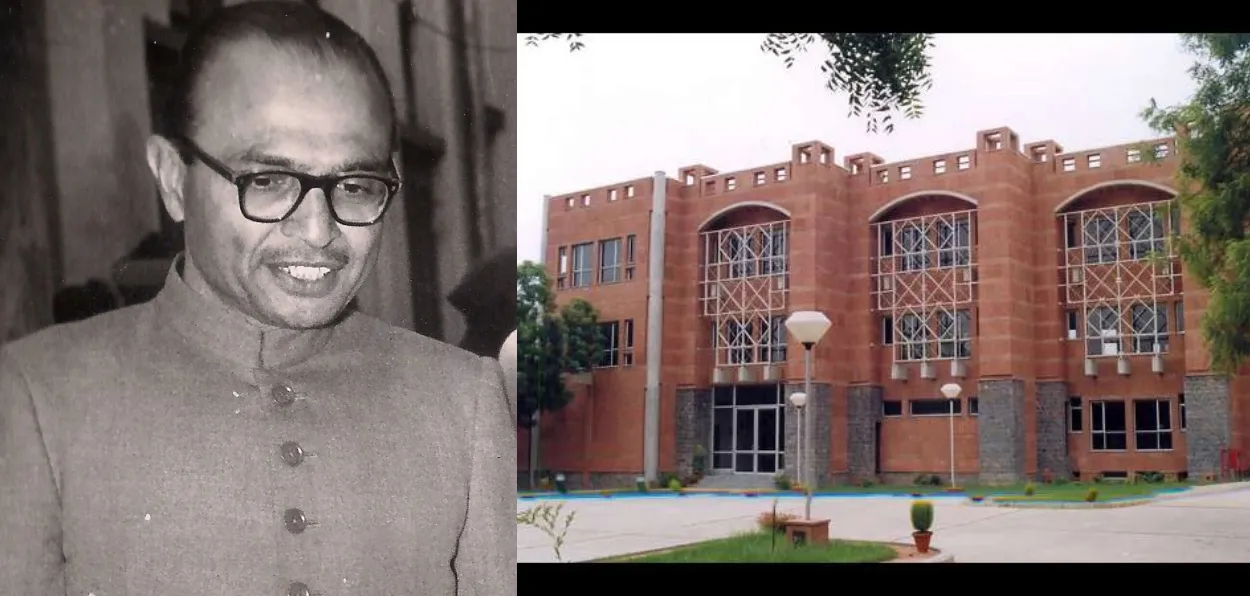
Hakim Abdul Hameed and campus of Jamia Hamdard
Life should be significant, not merely long. While some people make their lives significant by amassing wealth, others contribute to society and future generations. Hakim Abdul Hameed was one such rare individual. He is the founder of Jamia Hamdard, a deemed-to-be University located in South Delhi, which is celebrating its Foundation Day on September 14.
Abdul Hameed was born in Delhi on September 14, 1908. His life story is not merely that of a physician but of a man who transformed a family legacy of medicine into a vast movement encompassing education, research, healthcare, and public service.
His family was deeply involved in medicine and social service; his father, Hakim Hafiz Abdul Majeed, had established ‘Hamdard Dawakhana’ in 1906. ‘Hamdard’ in Urdu means one who empathises with others’ pain. This very sentiment became the guiding principle of Hakim Abdul Hameed’s entire life. He inherited not just a business from his father, but a responsibility. He strived to build Hamdard into an institution that would benefit every stratum of society.
Hakim Abdul Hameed was a practitioner of Unani medicine, yet his vision extended far beyond the treatment of the human body. He understood that for Unani medicine to be passed on to the coming generations, it required systematic teaching, rigorous research, and incorporating modern scientific methods.
He believed that tradition and modern science were not at odds; rather, by preserving the valuable aspects of ancient medical systems, they could be further fortified through scientific inquiry and research. This vision changed him into a pivotal pillar of Unani medicine.
The year 1947 was exceptionally difficult for the country. Partition had impacted millions and created an atmosphere rife with mistrust, violence, and uncertainty. Yet, even amidst such turmoil, Hakim Abdul Hameed was contemplating the establishment of institutions for the India of the future. It was during this period that he founded the Hamdard Charitable Trust and resolved to dedicate Hamdard’s earnings to the service of society. This decision speaks volumes about his character; he viewed wealth not as something to be hoarded for personal gain, but as a trust held for the benefit of society.
Subsequently, he established more institutions — the Hamdard Tibbi College and the Indian Institute of Islamic Studies in 1963; the Hamdard National Foundation in 1964, and the Hamdard College of Pharmacy in 1972.
Gradually, other institutions such as the Hamdard Education Society, Hamdard Public School, Ghalib Academy, and the Hamdard Institute of Historical Research were also added to this fold. He sought to create a comprehensive system where pharmacy, education, history, culture, and research could flourish alongside medical treatment.
The culmination of Hakim Abdul Hameed’s long-standing efforts came in 1989, when the institutions he had established were amalgamated into one to grant ‘Jamia Hamdard’ the status of a to-be Deemed University. This marked a significant achievement, realising a dream and the hard work of decades. He became its founding Chancellor. Hamdard’s own funds and his personal resources played a major role in establishing this university.
Today, it is important to remember that Jamia Hamdard was not backed by government machinery or a corporate conglomerate. Behind it lay the conviction of a single individual who believed that education could be the greatest service to society.
To remember Hakim Abdul Hameed merely as a builder of institutions would be to diminish his true stature. He was, first and foremost, a physician; understanding others’ pain was intrinsic to his nature. In his view, treating a sick person and providing a poor child with the opportunity to study were acts stemming from the same spirit of compassion, and he strove throughout his life to improve the human condition.
The body is healed through medicine, while the mind is nurtured through education. Hakim Sahib regarded both as integral parts of a singular mission of social service. Perhaps this is why the institutions he founded accorded equal importance to the humanities, history, and culture alongside hospitals and medical education.
Hakim Abdul Hameed’s contributions were recognised both within the country and across the globe. He was honoured with the Padma Shri in 1965 and the Padma Bhushan in 1992. In 1983, the then Soviet Union honoured him with the Avicenna Award. During the final years of his life, he also served as the Chancellor of Aligarh Muslim University.
However, considering his personality, it seems likely that he derived greater satisfaction from helping a needy person receive medical treatment or enabling a poor student’s education than from these accolades. For him, achievement was not merely about receiving awards but about making a difference in someone else’s life.
Hakim Abdul Hameed passed away in 1999, yet his work did not end with his departure. Even today, thousands of students study in the institutions he established, patients receive treatment in his hospitals, and the work of research and education continues to flourish.
The Jamia Hamdard campus is more than just a cluster of buildings; it stands as a testament to the idea that if an individual rises above personal interests to think about society, they can achieve a great deal for future generations. Hakim Sahib established these institutions much like a wise person plants a tree—knowing full well that while he might not live to sit in its shade, others certainly will. This was the most beautiful aspect of his life.
Today, the greatest challenge facing everyone associated with his institutions is ensuring that his legacy is not confined merely to names and monuments. The very meaning of ‘Hamdard’ is to understand the pain of others and strive to alleviate it. Hakim Abdul Hameed’s life teaches us that a person’s true legacy lies in the institutions and ideas that others carry forward long after they are gone. This is the legacy Hakim Abdul Hameed left behind. Carrying it forward is not just a matter of honour; it is our responsibility.
Author Prof. (Dr) M. Afshar Alam, is a Former Vice-Chancellor, Jamia Hamdard
source: http://www.awazthevoice.in / Awaz, The Voice / Home> Personality-News / by M Afshar Alam / September 13th, 2026