Category Archives: World Opinion

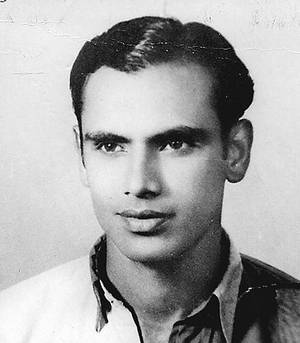
Air Marshal Jaffar Zaheer: Principled Indian Air Force officer

Lucknow, UTTAR PRADESH / NEW DELHI :

News, Obituaries 

Jaffar Zaheer’s impish irreverence hid a steeliness that emerged in the unusually principled stand he took against India’s omnipotent political establishment during the premiership of Indira Gandhi. As the first Indian Air Force (IAF) officer to head the country’s chaotic Directorate General of Civil Aviation, Zaheer refused, despite relentless political pressure, to withdraw the case against Gandhi’s unruly son, Sanjay, for flying a commercial airliner with passengers without a valid licence.

He also declined to apologise to Sanjay, an unforgiving thug who drew authority from being his mother’s political heir, for the “inconvenience” of charging him with the offence. The unrelenting Zaheer then further banned Sanjay Gandhi from flying a stunt plane and from executing dangerous aerobatics over the capital, Delhi, in violation of all safety norms. Sanjay ignored the veto and continued; Zaheer quietly resigned in June 1980.

On 23 June, Sanjay, unable to exit from a complex loop in his single-engine two-seater plane, crashed and died, changing the course of Indian politics. Zaheer was asked to withdraw his resignation, offered palliatives like ambassadorships and state governorships. But he declined, preferring instead the anonymity of running the small, private Khambatta airlines in the western port city of Bombay for the next five years.

But Zaheer’s impetuosity as a newly commissioned officer in the then Royal Indian Air Force (RIAF) in the early 1940s had almost ended his budding career after he poured a bottle of wine on his instructor whilst raising a toast during his “dining in” at an RAF mess in England. As the stunned senior officer glowered under the onslaught, Zaheer declared with aplomb to a speechless, but secretly pleased, audience of English fighter pilots that the drenched gentleman had needed a spring cleaning.

The only Indian cadet at the RAF base undergoing an aircraft conversion course, Zaheer had found the chief instructor’s behaviour racist, an assessment the commanding officer possibly shared, as he merely demanded to know whether the offending wine had been white or red. And, instead of the court martial that was under serious consideration, Zaheer’s eventual punishment was merely to reimburse the officer for the cost of dry-cleaning his uniform.

Zaheer was born in 1923 into an aristocratic Muslim family in Lucknow in northern India, the son of a renowned politician who after independence became a government minister and later a diplomat. Schooled locally, he joined the prestigious Allahabad University but left before graduating to join the RIAF in 1942. Soon after, along with other Indian cadets, he was dispatched to Canada to undergo flying training and was commissioned into service in September 1943 in the rank of Flying Officer.

The Second World War ended during Zaheer’s journey home by boat, but he did see some action strafing restive Pashtun tribesmen in the North West Frontier Province – now in Pakistan – in the region bordering Afghanistan that remains in ferment even today, having changed little in over a century.

Zaheer was one of a handful of IAF fighter pilots to graduate from the Institute of Armament Technology, a discipline that helped him formulate the Weapons Planning Directive of 1963 that remains the template for all such activity at Air Headquarters even today.

From 1964 until he retired 15 years later as IAF’s deputy chief in the rank of Air Marshal, Zaheer held various staff and operational appointments in which he oversaw the air force’s modernisation and streamlined its Byzantine financial procedures. During the 1971 war with Pakistan that led to the formation of Bangladesh, Zaheer commanded the critical Agra air force station near Delhi and was decorated for his services.

After retiring in 1979 he was appointed to head the Civil Aviation Directorate and almost immediately earned the ire of corrupt politicians by refusing to acquiesce to their demands to acquire a particular aircraft for which they were doubtlessly receiving backhanders. Zaheer’s scrapes with Sanjay Gandhi eventually led to his resigning in 1980, two years before his term expired.

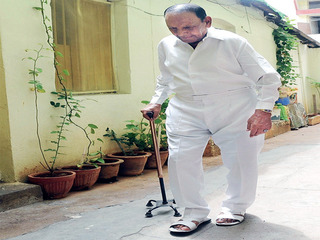
His droll sense of humour and self-deprecation never left him. When Zaheer was suffering from the early ravages of Alzheimer’s, a youngster once asked after his health. “Never felt better,” Zaheer quipped. “Don’t remember a thing.”

Kuldip Singh

Jafar Zaheer, air force officer: born Lucknow, India 14 June 1923; Director, Air Staff Requirements, Indian Air Force 1973-74; Director-General of Civil Aviation 1979-80; married (three sons); died New Delhi 23 January 2008.

source: http://www.independent.co.uk / Independent / Home> News > Obituaries / by Kuldip Singh / Tuesday – April 08th, 2017
Barefoot footballer Ahmed Khan no more

Bengaluru, KARNATAKA  / Kolkata, WEST BENGAL :

Ahmed Khan. | Photo Credit: Handout E Mail

Ahmed Khan, the last of India’s glorious generation of barefooted footballers who made a mark on the 1948 Olympic Games, passed away here on Sunday.

He was 90 and died due to age-related issues. Khan, who was also part of the Indian sides that won gold at the Asian Games of 1951 and went to the 1952 Olympics in Helsinki, will be remembered as a gifted inside-left who mesmerised spectators with his ball control.

He played for East Bengal for a decade, and formed part of a feared five-member forward-line — Sale, Dhanaraj, Appa Rao and Venkatesh the others — nicknamed the ‘pancha pandavas’.

“His close control was so good that they called him the snake-charmer, for he could make the ball do his bidding,” recalled I. Arumainayagam, who turned out for India at the 1962 Asian Games.

“We used to call him paambati. His death is a big loss to Indian football.”

Khan was born in 1926 into a family of footballers. His father, Baba Khan, was captain of local club Bangalore Crescent, while two of his uncles turned out for Mohammedan Sporting in Kolkata.

Ahmed’s three brothers — Amjad Khan, Sharmat Khan and Latif Khan — all played football at various levels.

As early as 1938, Ahmed joined Bangalore Crescent, where he played alongside his father.

He is best remembered, however, for his role in the 1948 Olympics in London, where India lost its first-round match in heartbreaking fashion to France but made a deep impression on the public.

In a report for The Hindu dated September 25, 1948, A. Ramaswamy Aiyar wrote: “Raman and Ahmed, the left-extreme and the left-inside, hail from Bangalore. They showed uncanny control over the ball and had perfect understanding.

“It was a treat to watch them move with the ball, interchange positions and run rings round the defence. They kept the audience spellbound and moved with such ease that they were described as a pair of wizards.”

“After winning the Rovers Cup with Bangalore Muslims, he joined East Bengal in 1949 and played for the club for the next 10 years.”

In a statement, East Bengal general secretary Kalyan Majumder hailed him as a “barefooted genius” and perhaps the greatest player the club had ever seen.

“With outstanding individual brilliance the barefooted Khan was capable of deciding the fate of any match all by himself. Even after boots were made mandatory I recall his outstanding performance in the 1958 IFA Shield final when he along with Balaram destroyed Mohun Bagan to win the Trophy,” he said.

“One also recalls the spectacular goal he scored against Yugoslavia playing barefooted in the 1952 Helsinki Olympics.”

Khan’s death was condoled by the Karnataka State Football Association. He is survived by his wife, Rabia Begum, and children Majid Khan and Parveen Begum.

source: http://www.thehindu.com / The Hindu / Home> Sport> Football / by Special Correspondent / Bengaluru – August 28th, 2017

Life at a funeral

Bengaluru, KARNATAKA / Kolkata, WEST BENGAL  :

AhmedKhanMPOs29aug2017

As Ahmed Khan is laid to rest, kin feel blessed to belong to the same family as the football great; contemporaries remember him as a humble man who loved the game

Amjad Khan sat quietly sipping chai, unmindful of the cacophony raised by a line of four-wheelers jostling for space on the narrow, single-laned Mackan Road. His brother Ahmed, arguably India’s greatest footballer who passed away on Sunday, had just been laid to rest and the mourning — for now — was over. The multitude, that had turned out to pay their respects and attend the funeral, had departed and house #75 — the house of ‘Ahmed, the Olympian’ — was slowly returning to ‘normal’.

A smile spread across Amjad’s face when he was asked about his brother. With every sip of chai that he took, Amjad’s eyes took on an even more vacant look as his mind went back in time. “What makes a man great? This is how I analyse it,” Amjad, also a former India international, said. “You could say Ahmed played up to 1958, right? Public memory is generally short. We watch a good movie and don’t remember it a month later. But if people remember this man, after 60 years of his playing career, then he must have done something extraordinary.”

There was pride in Amjad’s every breath. It was the predominant feeling shared by those in house #75. A feeling that stemmed from simply being associated with the bloodline of India’s greatest dribbler, fondly nicknamed ‘the Snake Charmer’ by the English media. Even Mannan, a grandson who was born decades after Ahmed hung up his boots, said he was “proud to just be born in the same family as Ahmed”.

Inside the house, Mannan proudly pointed to Ahmed’s trophies, a collection that was put on display just above the freezer box that contained Ahmed’s remains only hours ago. Numerous tributes by East Bengal, Ahmed’s club in Kolkata, were laid out. “The Padmashri has lost a bit of its sheen today because it was never awarded to Ahmed,” Amjad remarked on the conspicuous lapse of the Central government’s attention to a man who had bagged the gold in the 1951 Asian Games.

Among India’s greatest football heroes, Ahmed is right up there. As an inside-left (withdraw striker), Ahmed played in two Olympics (1948 and 1952) and won every domestic trophy that was up for grabs with East Bengal. “You know the thing about cotton? Whatever you throw on cotton, it never bounces back. That was Ahmed’s dribbling prowess,” Amjad said. “My father used to say that if Ahmed had not become a footballer, he would have become India’s best athlete. You know, when he was studying in the St Aloysius School in the city, he never used to carry books to the school. Instead, he used to take a small ball, a tennis ball, and practise dribbling on his way to school and back. That explains his gift.”

Ahmed was part of the deadly ‘Panchapandavas’ of EB, a forward line also comprising P Venkatesh and PB Saleh on the flanks, Apparao as the inside right and Dhanraj in the centre. When asked whether the gold medal was Ahmed’s top moment as a player, Amjad laughed. “That was just okay,” he said. “Have you heard of Sahu Mewalal, the guy who scored the winner at the 1951 Asian Games? Every year in Calcutta, where he used to play for Railways, he was the top-scorer of the league. Dhanraj wanted to overthrow Mewalal and asked Ahmed to do something for him. In one game, this gentleman (Ahmed) dribbled past everyone, even the goalkeeper, and called Dhanraj to the post to tap it in. That year, Dhanraj became the top-scorer. Scoring goals was Ahmed’s wish when he was playing.”

I Arumainayagam, the 1962 Asian Games gold medallist from the other time that India ruled globally, called Ahmed an inspiration. “We used to learn from watching him play,” he said. “We used to name ourselves ‘Ahmed’, ‘Dhanraj’, ‘Basheer’ and emulate their style. We, of course, couldn’t play as well as they did, but they influenced us greatly.”

More than anything, Ahmed was a fine human being. The 1952 Helsinki Olympics showed that. India were humiliated 1-10 by Yugoslavia and Ahmed repents that he was able to score only one goal in that game. Outside the Olympics, he often used to skip practice sessions while playing for East Bengal which made people wonder at his talent. He also preferred to play barefoot, shunning boots when the occasion afforded it. He was also fond of playing cards and often drew players from rival club Mohun Bagan into a round after a football game. During one such game, he was up against Sailen Manna, Bagan’s top defender of that era. “Manna was trying to convince Ahmed to play for Bagan,” SS Shreekumar, a former journalist and Ahmed’s friend, said. “This was in a room packed with footballers from Bagan and their supporters who were watching them. Eventuall, Ahmed agreed to play for Bagan. The entire room was stunned on hearing it. But Ahmed had one condition.

Manna asked him what it was. He told Manna that he will have to play for EB and the room burst into laughter.”

Shreekumar wonders what could have been had Ahmed accepted an offer to play for Swedish club IFK Göteborg. “He was named East Bengal’s best forward of the millennium,” Shreekumar said. “But when IFK Göteborg contacted Ahmed, his father asked him to consult his club, East Bengal. Jyotish Chandra Guha, a former secretary of EB who had scouted Ahmed, was worried about losing him. He downplayed Ahmed’s future in Sweden by suggesting it would be too cold and that the locals might put him down because he would be the only Indian there.”

While the tributes kept pouring in, Amjad’s tea was done. But the smile remained. “There are two things which makes football interesting – scoring goals and dribbling,” he added. “Ahmed found it interesting because of the second reason.”

Today, Ahmed Khan is no more. But ‘Ahmed Khan Olympian’ will live on forever.

source: http://www.bangaloremirror.indiatimes.com / Bangalore Mirror / Home> Sports> Football / by Aravind Suchindran, Bangalore MIrror Bureau / August 29th, 2017

AMU Alumni made to toppers in Boston University School of Dental Medicine

Aligarh, UTTAR PRADESH / Boston, USA :

Dr Mohammad Abbas Khan

Aligarh :

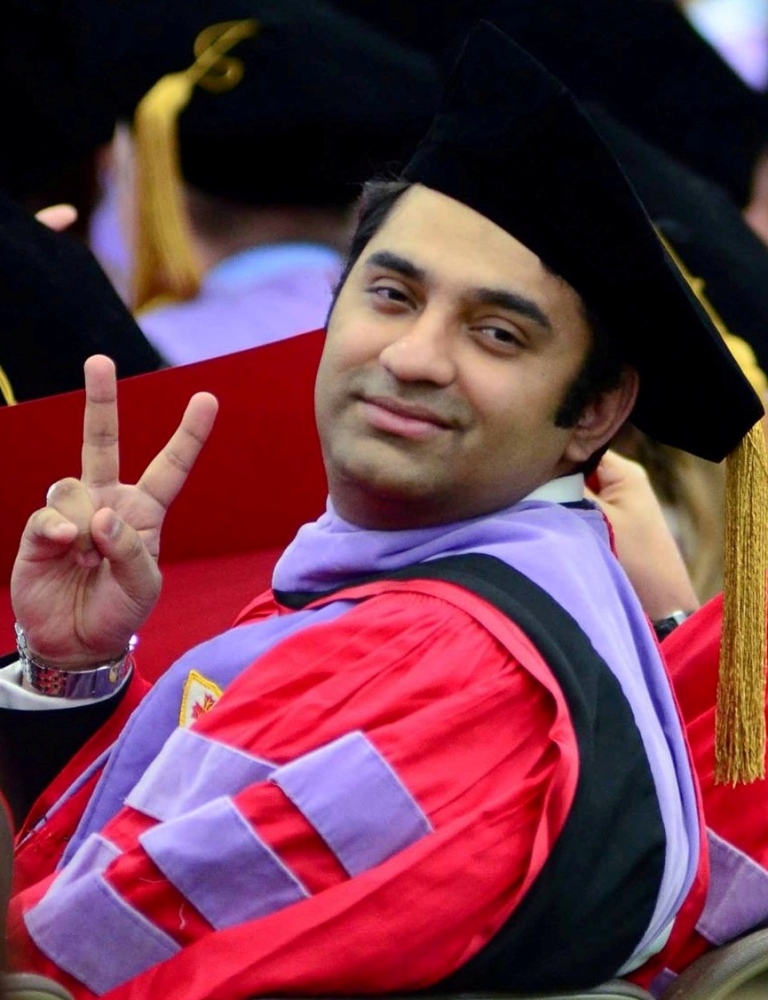
Aligarh Muslim University Alumnus, Dr Mohammad Abbas Khan has brought laurels to his Alma mater after graduating, among the top of his class at the Boston University School of Dental Medicine, USA for Doctor of Dental Medicine (DMD).

Khan has scored a 100 percent in Pharmacology besides scoring the highest marks in Oral and Maxillofacial Radiology in his exams at the Boston University School of Dental Medicine.  He has also been felicitated during the award ceremony of the Dental School. Meanwhile, he has also been awarded by the American Academy of Oral and Maxillofacial Radiology, USA for being among the top of the Dental School’s merit list.

Khan, who has been in the Boston University for over two years, has made remarkable contributions to the student bodies. As the elected President of American Association of Public Health Dentistry for the Boston University, he generated awareness about Public Health and spearheaded new initiatives. Due to his good academic record and passion to contribute to the students, he was appointed as the teaching assistant for the subjects of Pharmacology, Oral and Maxillofacial Radiology, Endodontics and Removable Prosthodontics.

Before beginning his journey at Boston University for his DMD, he did his MPH from Johns Hopkins Bloomberg School of Public Health (JHSPH) and graduated in 2015. Even at JHSPH, he was among toppers and contributed to the student community as the elected Vice-President for Johns Hopkins Student Assembly and Student representative for Committee on Academic Standards.

Khan’s mother, Dr Zebun Nisa Khan teaches at the Department of Education, AMU while his father Professor Huzoor H Khan teaches at the Department of Mathematics, AMU.

source: http://www.twocirlces.net / Two Circles.net / Home> Indian Muslims> Lead Story / TCN News / May 29th, 2017

Involvement by fans a big factor in my playing days – Muneer Sait

Chennai, TAMIL NADU :

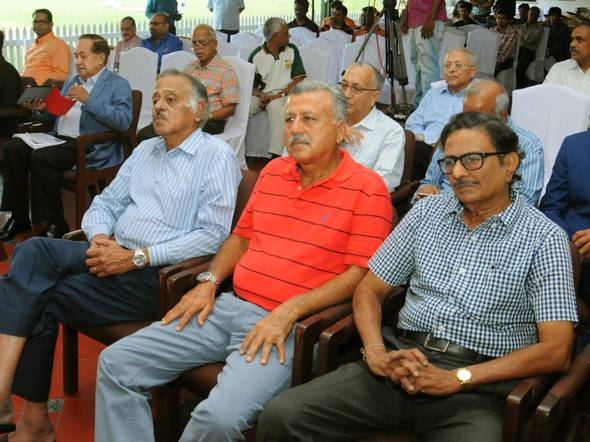
Sportstar caught up with distinguished former India hockey goalkeeper Muneer Sait, who was part of the Indian team that won the bronze in the 1968 Olympics in Mexico. He had arrived at the launch of Sportstarlive.

'During my time, when hockey was popular, we played in front of packed stadiums and having fans chant your name really gave me a kick', said Muneer Sait (seated centre). - R.RAGU
‘During my time, when hockey was popular, we played in front of packed stadiums and having fans chant your name really gave me a kick’, said Muneer Sait (seated centre). – R.RAGU

One of the outstanding hockey goalkeepers of his time, Muneer Sait was part of the Indian team that won the bronze in the 1968 Olympics in Mexico. For his work on field hockey, the International Hockey Federation awarded Sait the President’s Award in 2005. Hockey India inducted Sait as part of the five-member selection committee in 2009 and he is also associated with Squash Rackets Federation of Tamil Nadu. We caught up with the Olympian for an informal chat during the launch of Sportstarlive.

Edited excerpts:

What’s your impression of Sportstar? We are going live with our website…

The launch party was very well organised. It is nice to see a variety of sportspersons attending this event. Good representation from tennis, cricket, squash, snooker and also chess. I’ve been a regular reader of Sportstar and The Hindu. Actually, I’ve been recognised by The Hindu and have been getting complementary issues of the magazine.

What is the best part of being a sportsman in India?

I’ve loved sports every since my schooldays. We never had the distraction of the television, Twitter and Facebook so we had plenty of time to play. I have played hockey since my Loyola college days. During my time, when hockey was popular, we played in front of packed stadiums and having fans chant your name really gave me a kick. As a matter of fact, I played the 1966 national championships in Madurai in front of a full house. Everyday my photo would come in The Hindu as the outstanding goalkeeper. That boosted my image all over the country and got me selected for the Indian team.

What’s the flipside of being a sportsman?

The negative side, especially with respect to hockey, was the lack of money and encouragement from the associations. Those days we had to make our own arrangements for travel and accommodation for different national tournaments. I paid from my own pocket to go to Jalandhar via New Delhi for different competitions. It was a difficult time but we got through thanks to the love for the sport.

source: http://www.sportstarlive.com / SportsStar Live / Home> More  Sports> Hockey / by Amrit Ramakrishnan / Chennai – February 06th, 2017

Book on Ghadar hero Rehmat Ali Wajidke released in Surrey

Wajidke, Barnala : PUNJAB :

“Today when the Hindu nationalists are in power in India, we need to remind our younger generation that men like Wajidke and not the RSS played a significant role during the freedom movement. This has become important as the Hindutva forces continue to question the patriotism of Muslims,” he said.

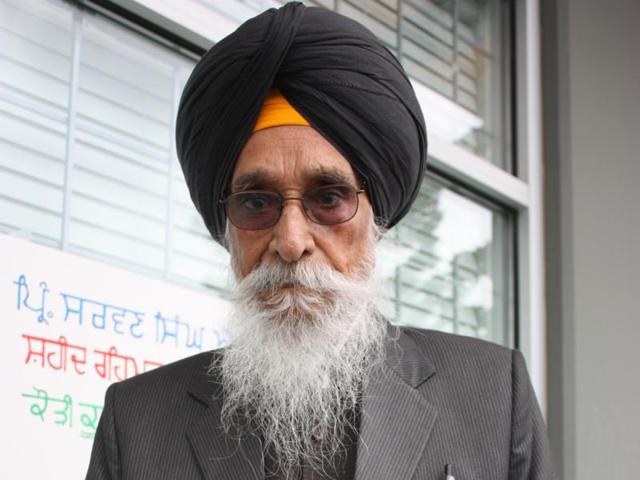
Sarwan Singh Aujla.
Sarwan Singh Aujla.

A Punjabi book on Rehmat Ali Wajidke, a Ghadar Party activist who was hanged in 1915, was released at a public event held in Surrey on Sunday.

Authored by Sarwan Singh Aujla, a retired school principal from Barnala, the book is written in the form of a long poetry and throws light on Wajidke and his struggle.

Wajidke was hanged for sedition by the British government in March 1915. He was among the Ghadar Party members who had returned from foreign countries to India to launch an armed rebellion against the British occupation. This year marks the centenary of Wajidke’s martyrdom.

Aujla, who is a freelance writer, has authored many books. He had served at the government public school in Wajidke, the native village of Rehmat Ali. He was instrumental in getting the school renamed after the Ghadar hero and had also traced his descendants in Pakistan and brought them to India where they were duly honoured by the Punjab government in 1970s. Wajidke’s relatives had migrated to Pakistan after the partition in 1947.

Aujla has been highlighting the story of Wajidke through his columns in the local newspapers as well. He told HT that his story needs to be amplified to challenge the communal forces which are inimical to peace and people’s unity.

“Today when the Hindu nationalists are in power in India, we need to remind our younger generation that men like Wajidke and not the RSS played a significant role during the freedom movement. This has become important as the Hindutva forces continue to question the patriotism of Muslims,” he said.

source: http://www.hindustantimes.com / Hindustan Times / Home> Punjab / by Gurpreet Singh, Hindustan Times / October 13th, 2015

Now Frontier Gandhi’s descendant to urge Modi to stand by Pakhtunistan

Kolkata, WEST BENGAL :

Yasmin Nigar Khan will organise a rally at Shahid Minar in the heart of Kolkata’s business district after Durga puja.

Yasmin Nigar Khan is the president of All India Pashtu-Jirga-e-Hind, an organisation that is spearheading the movement for secession of Pakhtunwa area of North West Frontier Province from Pakistan.(HT Photo)

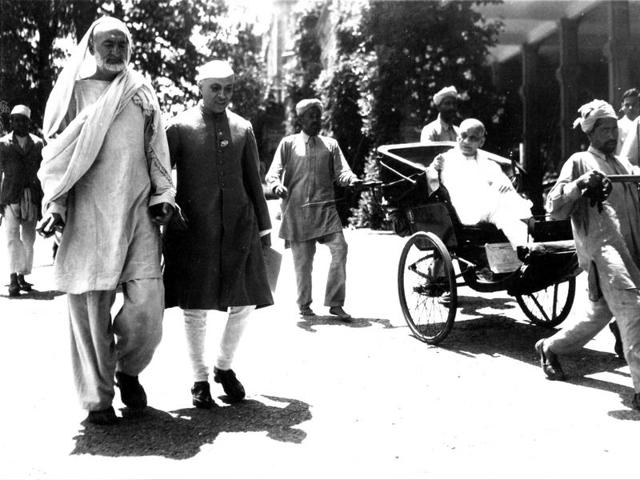
India-Pakistan relations may have more twists in store than meets the eye. Yasmin Nigar Khan, great granddaughter of Khan Abdul Gaffar Khan, better known as Frontier Gandhi, now plans to meet Indian Prime minister Narendra Modi to urge him to stand by the Pashtuns as he did in the case of Balochistan.

The Kolkata-based 45-year old leader of the Pashtuns living and working in India told HT that she also plans a rally in the city against atrocities of Pakistan on the people of North West Frontier Province (NWFP).

“We are happy that Prime Minister Narendra Modi raised the issue of Balochistan. Similar atrocities are regularly being committed by Pakistan on Pashtuns in NWFP. We want Modi to highlight the plight of Pashtuns and help in their struggle to get freedom from Pakistan. The Pashtun people are equally oppressed by Pakistan,” said Khan on Friday.

Yasmin Nigar Khan stays in Park Circus area in south Kolkata and runs a school. (HT Photo)

Yasmin Nigar Khan president of All India Pashtu-Jirga-e-Hind, an organisation based in Kolkata that has been spearheading a movement for secession of Pakhtunwa area in the North West Frontier Province (NWFP) of Pakistan and its merger with Afghanistan. The area is situated near the border of Afganistan and Pakistan.

She claimed there are about 10,000 Pashtuns living in Bengal, mostly in and around Kolkata.

“NWFP were given on lease to the British for 100 years. But more than 120 years have passed by,” she claimed, adding “NWFP has no business staying in Pakistan.”

“Our leaders are holding meetings in Kolkata to press our demand. We are planning to organise a rally against Pakistan in Kolkata after the Pujas at Shahid Minar. By the end of the year we will meet the Prime Minister,” said Khan.

The Pashtun community comprises basically the Pathans who are from Afghanistan and also from the Pakhtunwa area. In Kolkata, a section of them who have settled more than 100 years ago, are better known as Kabuliwalas (money lenders).

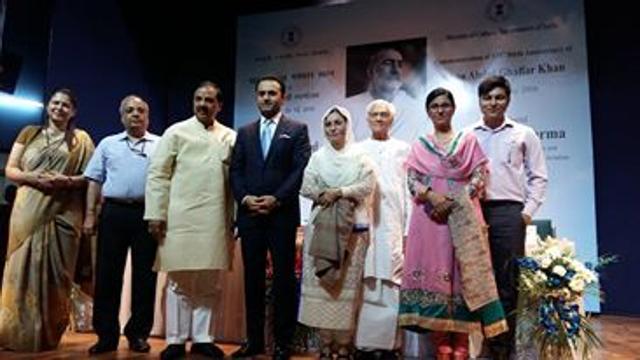
File photo of Khan (fifth from Left) attending a ministry of culture programme in Delhi to commemorate the 125th birth anniversary of Frontier Gandhi. She appealed for a university to be set up in Bengal in the name of her great grandfather. (Facebook)

Khan alleged that the condition of the Pashtuns living in NWFP is appalling and the Pakistan government is not keen on any development in the region.

“Like Balochistan, Pakhtunistan too is deliberately neglected. the Pakistan government is keeping the mass uneducated so that they do not demand their rights. The area is used for breeding terrorists Pakistan is using Taliban to spread terror in the region. We will soon hit streets over the issue,” added Khan.

Many of the Pashtuns living in Kolkata have relatives there and they worry about Taliban threats.

“We want to highlight Pakistan’s atrocities in NWFP and condemn attacks on India. Pakistan should be declared a terrorist state by the international community,” she added.

The Pashtun leader stated that during a programme at the union ministry of culture on May 20 this year (to commemorate the 125th birth anniversary of Frontier Gandhi), she appealed for a university to be set up in Bengal on the name of her great grandfather.

In 1996 after the death of her father Lala Jan Khan, Yasmin took over the mantle of the organisation that looks after the interests of Pashtuns.

source: http://www.hindustantimes.com / Hindustan Times / Home> Cities> Kolkata / by Ravik Bhattacharya, Hindustan Times / September 30th, 2016

This professor’s Unani medicine for diabetes is all set for clinical trials

Aligarh, UTTAR PRADESH :

Professor Naeem Ahmad Khan

Four years back, Naeem Ahmad Khan,  professor  at faculty of Unani Medicine, Ajmal Khan Tibbiya College, Aligarh Muslim University, set a goal for himself– he wanted to find a cure for diabetes.

It was possible only if he could regenerate the primary function of beta islet cells of the pancreas to store and release insulin.

Four years on, he claims to have succeeded in his mission. He has developed a medicine that, he says, will not only improve the function of pancreatic cells, but also protect them. Besides, it will regenerate beta islet cells and improve their health by giving them required nutrition.

“My medicine will regenerate the natural process of the pancreas. This medicine will help diabetic respond to fluctuations in blood glucose concentrations quickly by releasing stored insulin,” says Dr Khan.

He believes that the medicine, if clears clinical trials, will be a better alternative to the existing drugs. “Modern diabetic medicines stimulate beta cells to produce and release more insulin. If a person develops diabetes at a younger age, these medicines stop working after a few years. Then the alternative before the patient is to take insulin supplement, which is an expensive as well as painful treatment,” he says.

The clinical trial  of the medicine, he believes,  will help standardise traditional medicine system in India and bring it at par with modern medicine

“Apart from  restoring the normal functioning of beta cells, I believe that this medicine will also bring down the number of pancreatitis cases in diabetes,” he says.
Khan says that his medicine has already been tested on animals and has gone through the  necessary toxicological studies to rule out any heavy metal impurities and other toxic effects. It has been passed by the Government of India’s Institutional Ethical Committee, he adds.

The drug will soon be tested clinically before it is available in the market. “We will study it in a controlled environment where we will monitor its effect on diabetes in non- insulin dependent patients.  We will also compare it with other existing popular modern drugs,” says Khan.

The clinical trial  of the medicine, he believes,  will help standardise traditional medicine system in India and bring it at par with modern medicine. “Evidence-based traditional medicine is the need of the hour. We need to exploit their potential to help people deal with various lifestyle diseases,” he says.

Khan says that this medicine has been developed from eight different medicinal plants, some of which were used by ancient Unani practitioners. “These medicines are as scientific as allopathic drugs. We need to validate their worth and that’s what I have been trying to do all these years, ” he says.

source: http://www.healthpost.in / Healthpost.in / Home / by HP Correspondent / Saturday – January 28th, 2017

Prof. Mahdi Hasan – The Man who put Lucknow on Medicinal Map

Lucknow, UTTAR PRADESH :

ProfMahdiHassanMPOs26aug2017

Prof. Mahdi Hasan was born on March 21, 1936 in a village Gadayan, Akbarpur (then in Faizabad, now in Ambedkar Nagar), in UP.

His father, Jawad Husain, was Tehsildar, posted at that time at Tehsil Mohanlalganj of the District Lucknow, and his mother was Tayyabunnisa Begun. Hasan’s father died when Hasan was four years old, and his mother, being ill, was unable to care for him. His brothers late Bakhshish Husain, a police officer, and Syed Ghulam Husain, an IAS officer, subsequently raised him.

However, this did not deter him from pursuing his life with zeal and devotion to his studies and dedication for sports. He used to study at night in the light of a kerosene lamp and play during the day in the fields of the village. He excelled in studies and was appreciated for his sporting prowess. His father wanted him to be a doctor. He himself wanted to be a teacher. Finally he became both, and a sportsman too in the bargain.

In 1950, Hasan enrolled in the Christian College at Lucknow, where he did his Intermediate. Thereafter he did his B.Sc. I year from Lucknow University and in 1952 he was selected in M.B.B.S. at King George Medical College.

After graduation, he joined the Department of Anatomy as a Demonstrator in the year 1958 and worked till early 1963. He did his post graduation in Anatomy from KGMC. Thereafter, he moved to the J.N. Medical College, Aligarh Muslim University, Aligarh, where he would spend the bulk of his career.

It was in 1958 that he got married to Abida Kazim, who was an MA in Urdu, a rare achievement at that time for a woman from a Muslim family.

His persistent endeavour was to pursue basic medical research and his main thrust was to study problems of national relevance, such as environmental pollution, pesticide and metal neurotoxicity and brain aging. His commitment and dedication to acquire and disseminate knowledge can also be judged from the fact that during the last 6 months of his life, when he was very seriously ill, he worked earnestly to complete a book on Treacher Collins Syndrome.

He would sit for long hours with swollen legs kept on stool writing the book, which he completed in December 2012, a month before his death. Fortunately, the book was published a few days before his death when he was in the intensive care unit.

Dr. Hasan, all through his illustrious academic career spanning around 55 years (1958–2013), fought a relentless battle and succeeded in giving a completely new orientation to the teaching of anatomy.

He has to his credit about five books, seven book chapters, 125 research papers in indexed journals. His research work has earned him over 600 citations including those in the prestigious Nature, Gray’s Anatomy, and NIOSH and in 38 other reference works. He was indeed a man of parts, combines excellent teaching and research capabilities with societal concerns and social commitments.

Hasan spent many years trying to establish a Brain Research facility at Aligarh.

With assistance from the German government, he succeeded in 1980 with the establishment of the first Interdisciplinary Brain Research Centre.

He has been an internationally renowned anatomist, a pioneering brain researcher and a reputed national expert of medical education and have been rewarded with a no. of awards.

A few to name are Dr. S.S. Misra Medal of National Academy of Medical Sciences (India), Dr. Dharam Narayan Gold Medal of the Anatomical Society of India (1977), Ati Vishisht Chikitsa Medal of College of Chest Physicians of India (1995), Sushruta Award of World Academy of Integrated Medicine (WAIM) 2002, Dr. Bachawat Life-Time Achievement Award of Indian Academy of Neurosciences (2004) and Dr. Tirumurti Award of Indian National Science Academy (2010).

Professor Hasan was a person who had utmost devotion, dedication and determination in acquiring, creating and disseminating knowledge. Seldom does one find a nucleus around which an institution is build, but it goes to the credit of Professor Mahdi Hasan that at least three premier medical institutions of North India will always fondly cherish his memory.

KGMC will always remember him as its illustrious student and teacher; Jawaharlal Nehru Medical College, Aligarh will always remember him as an excellent, dedicated and devoted teacher; and Era’s Lucknow Medical College, Lucknow (a medical institution founded around him) will find it difficult to overlook its founder Director-Principal and Trustee. Alas!

This renowned medical teacher breathed his last on 12 January 2013 after fighting a relentless battle against cancer of the prostrate. He had been at Imambara Gufran Ma’ab sahib. His wife, Mrs Abida Mahdi died soon after on 24 February 2013.

Many Firsts In India To The Credit Of Mahdi Hasan

  1. First in India to have obtained M.S. with Honours in Anatomy.
  2. First Anatomist of the Country to be selected by Govt. of India for German Academic Exchange Fellowship (DAAD) in 1965.
  3. First Anatomist of India to have learnt electron microscopy and published a large number of research papers using this technique from 1966 onwards.
  4. First and only Indian Anatomist to be chosen a Fellow of Alexander von-Humboldt Foundation (Germany).
  5. First to publish a new “in vivo” method of staining zinc (Experientia Switzerland) 1977.
  6. First Indian Anatomist to have earned both Ph.D. and D.Sc.
  7. First and only Indian Anatomist to be conferred both the Hari Om Ashram Alembic Award (1978) and Dr. B.C. Roy National Award (1991-92).
  8. First to establish an Interdisciplinary Brain Research Centre in India (1977).
  9. First Indian Anatomist to be appointed an Adviser in Neurotoxicology by WHO (Geneva).
  10. First Indian Anatomist who presided over the First Afro- Asian Oceana Congress of Anatomists organized by AIIMS, in September 1988 at Hotel Ashok, New Delhi.
  11. First and only Indian Anatomist to be appointed a member of the Governing Body of ICMR.
  12. First and only Indian Anatomist to be appointed chairman of the Medical Committee of the Indian Red Cross.
  13. First Indian Anatomist to be elected a Fellow of the Indian National Science Academy (INSA) and also its Senior Scientist.
  14. First in India whose academic and social contributions comprise the main theme of a Malayalam Short Story “Jeevacchavangal” (Living Cadaver) by Punathil Kunjabdullah in 1972 (translated into Hindi, Urdu, English, French and Russian language) and won the gyanpeeth puraskar for the same.
  15. First Anatomist in recognition of whose meritorious contributions to clinical anatomy, a Gold Medal Award was instituted by the Anatomical Society of India in 1990 (continues till date).
  16. First and only Indian Anatomist to be awarded Padma Shri by Government of India.

Positions held :

  • Demonstrator in Anatomy, King George’s Medical College, Lucknow (06.11.1958 to 30.04.1963)
  • Lecturer in Anatomy, King George’s Medical College, (01.05.1963 to 17.10.1963)
  • Reader in Anatomy, Jawaharlal Nehru Medical College, AMU, Aligarh (18.10.1963 to 31.03.1972)
  • Professor of Anatomy, Jawaharlal Nehru Medical College, AMU, Aligarh (1972-1996)
  • Director, Interdisciplinary Brain Research Centre, JNMC, AMU, Aligarh (1980-1993)
  • Medical Superintendent JNMCH, AMU, Aligarh (1983- 1985)
  • Principal and Chief Medical Superintendent, JNMC, AMU, Aligarh (1984-1987)
  • Dean Students Welfare, AMU, Aligarh (1988-1989) Dean, Faculty of Medicine, JNMC, Aligarh (1991-1993)
  • Guest Faculty, Department of Anatomy, KG Medical College, Lucknow University (1997-1999)
  • Emeritus Medical Scientist ICMR, New Delhi INSA Senior Scientist (2003-2006)
    (1998-2001)
  • Member of NAAC (National and Accreditation Council of Govt. of India) Feb 2010
  • INSA Hon. Scientist, Dept. Of Anatomy, CSM Medical University,Lucknow (2006-2011)

President of :

  • Indian Academy of Neurosciences -1986
  • First Afro-Asian Oceana Congress of Anatomists held at Hotel Ashoka, organized by All India Institute of Medical Sciences, New Delhi -1988
  • Association of Gerontology-India -1992 -Anatomical Society of India.

Fellow of :

  • National Academy of Medical Science (India) [FAMS] -Indian National Science Academy [FNA]
  • National Academy of Sciences, India [FNAS]

Writer a is student, an aspiring painter & calligrapher

source: http://www.lucknowobserver.com / Lucknow Observer / Home> Others / by  Akansha / January 26th, 2015 – / The Lucknow Observer, Vol.1, Issue 10 / January 05th, 2015

Obituary – A Teacher of Teachers passes on

Gadayan, Akbarpur (earlier Faizabad (now) Ambedkar Nagar)  – Lucknow, UTTAR PRADESH :

Mahdi Hasan   (21 March 1936–12 January 2013)

Professor Mahdi Hasan (born in Gadayan village, Akbarpur, then in Faizabad, now Ambedkar Nagar, Uttar Pradesh) was Senior Honorary Scientist of the Indian National Science Academy; Honorary Professor, King George’s Medical University, Lucknow; and formerly Principal and Chief Medical Superintendent (1983– 87), Dean (1991–93) and Head of the Department of Anatomy, Jawaharlal Nehru Medical College, Aligarh. He was an internationally renowned anatomist, a pioneering brain researcher and a reputed national expert of medical education. He had many firsts to his credit: he was the first in India to have obtained an MS with honours in anatomy; the first anatomist to be selected by the Government of India for the German Academic Exchange Fellowship (DAAD) in 1965; the only Indian anatomist to be chosen Fellow of Alexander von-Humboldt Foundation (Germany); the first Indian anatomist to be elected Fellow of the Indian National Science Academy (FNA) and to be awarded the Padma Shri. Professor Hasan’s initial education was in Akbarpur (Faizabad). Life in Akbarpur was rather tough in those pre-Independence days as he had already lost his father when he was 4 years old and had been separated from his mother who was ill. However, this did not deter him from pursuing his life with zeal and devotion to his studies and dedication for sports. He used to study at night in the light of a kerosene lamp and play during the day in the fields of the village. He excelled in studies and was appreciated for his sporting prowess.

Professor Hasan did his Intermediate from Christian College, Lucknow and BSc I year from Lucknow University. In 1953, he was selected for MBBS at King George’s Medical College (KGMC), Lucknow. After graduation, Professor B.N. Sinha (then Head of Orthopaedics and also ex-president, Medical Council of India) persuaded him to join the Department of Orthopaedics. However, within a week of joining he went to Professor Sinha and told him that he wanted to teach and in this branch he would seldom get a chance to do so. Professor Sinha took him to his friend Professor Dharam Narain (Department of Anatomy). Dr Hasan joined the anatomy department as a demonstrator in 1958. The same year he got married to Abida Kazim, who was an MA in Urdu, a rare achievement at that time for a woman from a Muslim family. In 1962, he did his MS in anatomy with honours, and after briefly working as a lecturer at KGMC, Lucknow, in 1963 he moved to Aligarh as a Reader in anatomy. Continuing his pursuit of knowledge, he went to Germany in 1965. He not only learnt electron microscopy and worked on ageing with the renowned Professor (Dr) Paul Glees at the University of Gottingen, but also got an opportunity to learn German. Very few people know that he was an external examiner of the German language at Jawaharlal Nehru University, New Delhi and Aligarh Muslim University, Aligarh for almost 17 years. Although in 1972 he was offered the citizenship of Germany, he politely declined and came back to India and established India’s first Interdisciplinary Brain Research Centre (IBRC) at Aligarh in 1980.

His persistent endeavour was to pursue basic medical research and his main thrust was to study problems of national relevance, such as environmental pollution, pesticide and metal neurotoxicity and brain ageing. His commitment and dedication to acquire and disseminate knowledge can also be judged from the fact that during the last 6 months of his life, when he was very seriously ill, he worked earnestly to complete a book on Treacher Collins Syndrome. He would sit for long hours with swollen legs kept on a stool writing the book, which he completed in December 2012, a month before his death. Fortunately, the book was published a few days before his death when he was in the intensive care unit. Dr Hasan, all through his illustrious academic career spanning around 55 years (1958–2013), fought a relentless battle and succeeded in giving a completely new orientation to the teaching of anatomy. Thousands of his former students, practising modern medicine around the globe, not only adored him but also respected his genius. Hundreds of them are professors/consultants in various specialties of medicine and surgery in India and abroad. His passion for teaching did not dip even after retirement. He continued to teach and do research and write for grants. He could take classes anywhere—even in corridors. Once at Aligarh Muslim University, a student asked him for time to seek some clarifications. Then and there on the street, using a bicycle seat as support for pen and paper, he spent over two hours explaining the matter to the student under street light.

Professor Hasan was a person who had utmost devotion, dedication and determination in acquiring, creating and disseminating knowledge. Seldom does one find a nucleus around which an institution is build, but it goes to the credit of Professor Mahdi Hasan that at least three premier medical institutions of North India will always fondly cherish his memory. KGMC will always remember him as its illustrious student and teacher; Jawaharlal Nehru Medical College, Aligarh will always remember him as an excellent, dedicated and devoted teacher; and Era’s Lucknow Medical College, Lucknow (a medical institution founded around him) will find it difficult to overlook its founder Director-Principal and Trustee.

Alas! This renowned medical teacher breathed his last at 6 p.m. on 12 January 2013 after fighting a relentless battle against cancer of the prostrate. His wife, Mrs Abida Mahdi died soon after on 24 February 2013.

ABBAS ALI MAHDI*

Department of Biochemistry,  King George’s Medical University ,Lucknow, Uttar Pradesh abbasalimahdi@gmail.com

source: http://www.archive.nmji.in / Archives – The National Medical Journal of India / Vol. No.26, No.2, 2013 / by Abbas Ali Mahdi