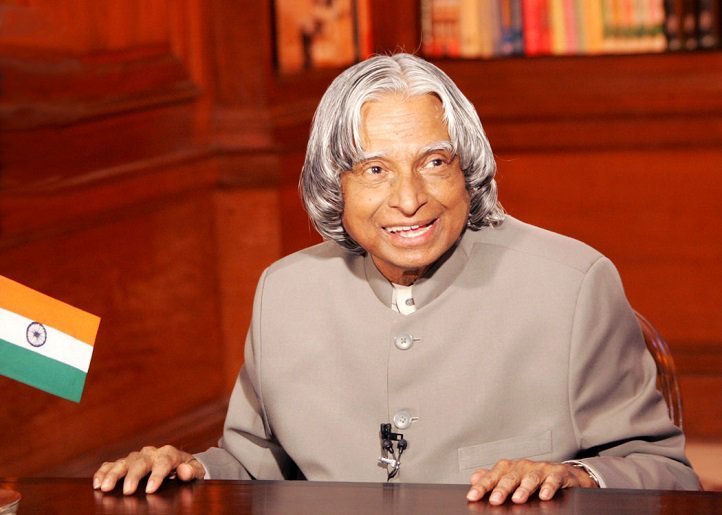
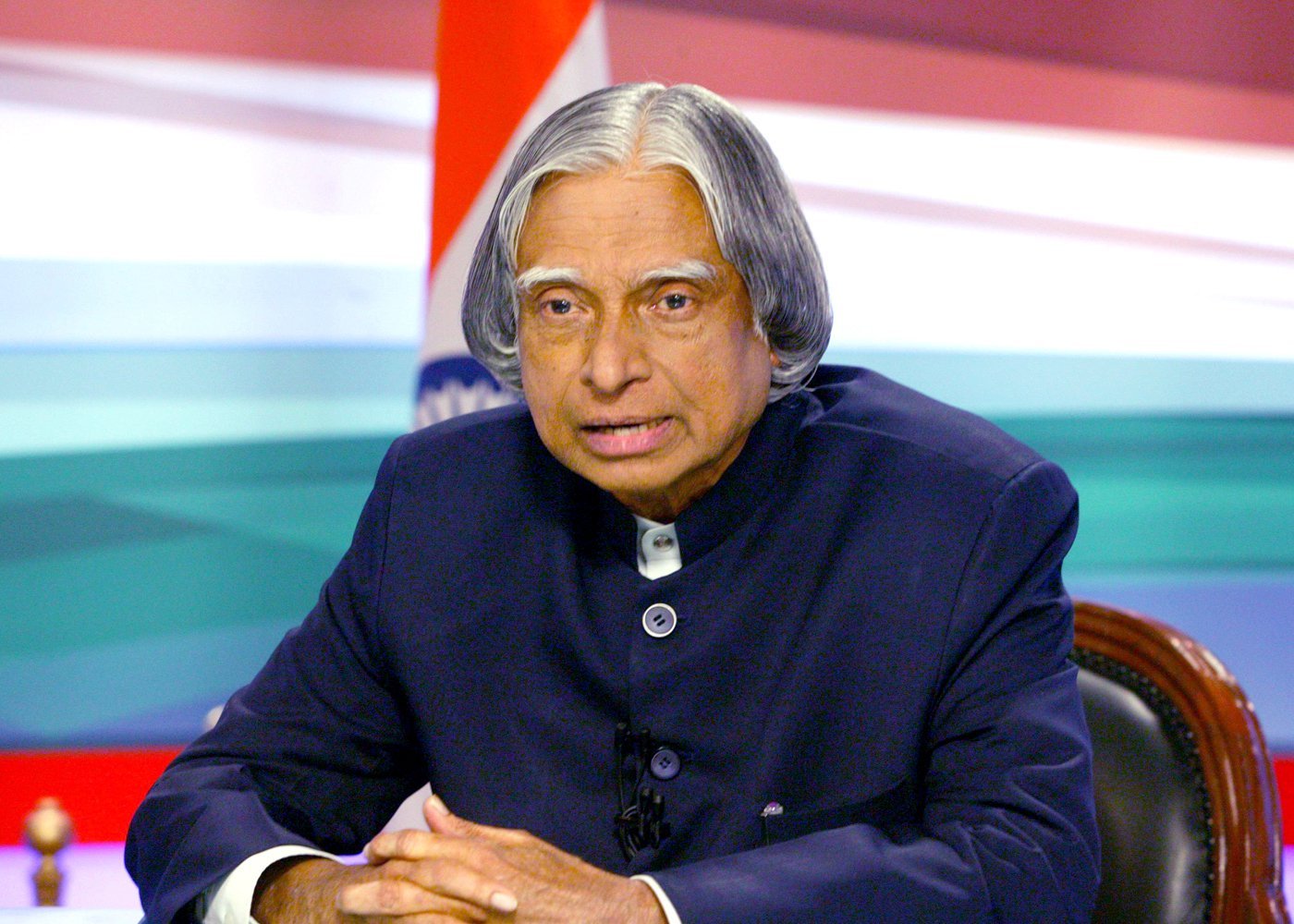
While India mulls over giving an appropriate tribute to the late former India President APJ Abdul Kalam and fights over his social media accounts, the UN has decided to name a satellite after the late scientist as a tribute to celebrate his vision.
Founded in 1999, CANEUS (CANada-Europe-US-ASia) serves to develop a common platform for space technology solutions for natural and man-made disaster management. The ‘GlobalSat for DRR’ is a UN-driven global initiative on sharing space technology for disaster risk reduction, Milind Pimprikar, chairman of CANEUS, told IANS.
The satellite will provide a common platform that will allow sharing of space and data segments, with an ability to serve individual nation’s disaster management and development needs, IANS reported.
Talking about the similarities between the satellite and Dr. Kalam, Pimprikar said, “In his ‘World Space Vision-2050’ Mr. Kalam had envisaged space faring nations joining hands to find solutions to mankind’s major problems such as natural disasters, energy and water scarcity, health-care education issues and weather prediction. Therefore we now plan to dedicate the UN GlobalSat initiative as a tribute to Late Dr. Abdul Kalam by renaming it ‘UN Kalam GlobalSat’.’
He hopes that the renaming will inspire new generations and scientists, and they’ll strive to work like Dr Kalam.
source: http://www.scoopwhoop.com / Scoop Whoop / Home / by Isha Jalan / August 08th, 2015
Emotions flooded former England skipper and commentator Nasser Hussain’s mind as he made his way to the pitch at the MA Chidambaram Stadium on Friday. Born in then-Madras in 1968, Hussain shares a special bond with the city – he spent the six years of his life in Chennai before moving to the UK.
Incredibly, in the mid-1980s, Hussain even scored a few hundreds at Chepauk as a TNCA league cricketer. “I’m very pleased to be back in the place of my birth. I think I was born in a hospital just over the other side of the stadium. Actually, I didn’t realise that. It was Ashwin who told me about that the other day when I saw him,” Hussain told TOI on Friday.
The 48-year-old was sad to see the devastating effects of Cyclone Vardah but lauded the people of Chennai for coming up with a “magnificent” rescue act.
“It’s obviously been difficult to see the devastating damage from the cyclone over the last couple of days. But the community spirit from the people of Chennai, the way they have been trying to clear up the trees on the road has been absolutely magnificent,” Hussain said.
An honourary member of the Madras Cricket Club (MCC), Hussain wants to soak in the atmosphere here over the next five days.
source: http://www.timesofindia.indiatimes.com / The Times of India / News> Sports News> Cricket News / by Bagwati Prasad / TNN / December 17th, 2016
It all started on the 2nd of October last year when I chanced upon an article on a sports news website. It told the story of India’s first Olympic swimmer, Shamsher Khan, who represented the country in the 1956 Melbourne Olympics. Prior to that, he had set national records in all four strokes, or categories, as well as in water polo and diving, making him the only Indian to do so!
One of his contemporaries happens to be Milkha Singh, whose victories are celebrated and remembered by the entire country. On the other hand, Mr. Khan languishes in anonymity. Nobody in the country knows his name or is even aware of his whereabouts. The article identifies his village as Islampur, situated in rural Andhra Pradesh.
After reading the article, I was determined to document his untold story on camera. I decided to visit his village along with four of my friends and attempted to make a documentary on the forgotten legend.
Over the next few weeks, we pieced together Shamsher, our tribute to India’s greatest swimmer. In a series of interviews, we conversed with his contemporaries, family members, well-wishers and finally, the man himself. We encountered an interesting variety of opinions not just about his life, but also about the lack of recognition sportspersons get in India. What started as a documentation of the life of one forgotten sportsman became the story of countless unknown athletes who struggle to get by on the back of their glorious achievements.
In the end, we were faced with difficult questions about the current condition of sports in the country, to which we found no easy answers. Our only hope is to spread more awareness about Shamsher Khan, and his services to a nation that refused to recognise him.
Shamsher: The Forgotten Legend | A documentary by Bharat Misra
Blue Pencil Entertainment
Published on Jan 22, 2016
He represented India at the Olympics for the first time in swimming. He was once the national record holder in all strokes.
He saw two wars during his service in the Indian army…and then, he disappeared from limelight.
Watch as we trace the life of the legendary Shamsher Khan, who lies forgotten in today’s India, like so many gifted sports personalities…
His arrival on the political scene as an articulate Muslim leader was no ordinary event in the journey of the Indian republic.
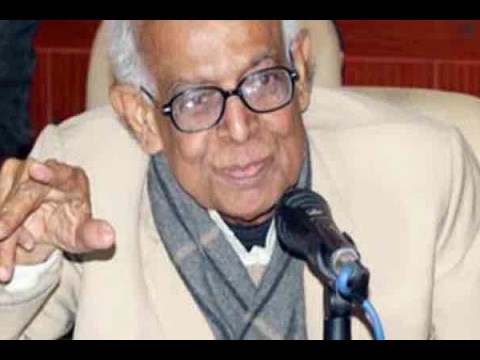
Syed Shahabuddin, 1935-2017. Credit: Youtube
Writing an obituary of the writer, diplomat and politician Syed Shahabuddin is actually an exercise in writing of the journey of Muslims in the Indian republic. The much maligned gentleman was somebody who could never be ignored. As a very bright student of physics in the academically brighter phase of Patna University in the first decade of India’s independence, he drew the attention of his teachers. The memoirs of his professors, Mohsin and Kalimuddin Ahmad, describe Shahabuddin’s promise in glowing terms. Soon thereafter, he became known for the leadership he provided to a student movement in 1955, including leading a 20,000-person march to wave black flags against Jawaharlal Nehru when he visited Patna – in protest against police firing on students.
He managed to get a job as a lecturer at the same time as qualifying for the civil services in 1957. He ranked second among all the aspirants, with a particularly high score in the interview section, and joined the Indian Foreign Service. Many delicious legends were fabricated around the kind of questions he was asked and his witty responses. His success not only inspired many students, but also helped overcome the trepidation among Muslims about their place in India after Partition.
While a section of Hindus looked upon Muslims as potential fifth columnists, a section of Muslims was also not very confident of the inclusionary-pluralist democracy that was being built up under Nehru. Notably, even as a student, Shahabuddin too was contributing towards this task of nation-building. With some ‘socialist’ leanings, though not formally with any party, his activism allowed certain critiques of the Nehruvian consensus to be heard.
He paid a price for this activism, though a minor one. Owing to Shahabuddin’s involvement in the student agitation of 1955, he had to wait for police/intelligence clearance and therefore could join the services a little later than his other batchmates. Legend has it that Nehru himself finally cleared the file.
In the late 1970s, the hegemony of the ruling Congress came be challenged by the socialists, Shahabuddin became restless within the confines of bureaucracy. He decided to quit government service and join politics.
Until then, Indian politics lacked a pan-Indian Muslim leader with well informed and articulate views. Although Maulana Azad had occupied an important position, he was part of the Nehruvian consensus and did not challenge it. Nor were academics looking at the worrying economic and educational locations of Muslim communities and their disproportionately inadequate share in the structures and processes of power. A few exceptions existed, such as the volume on castes among Muslims edited by Imtiaz Ahmad in the late 1960s and the works of Uma Kaura and Mushirul Hasan looking at the marginalisation of Muslims by the Congress under majoritarian pressures in 1970s, but these were rare.
None of the important dissenting voices in Indian democracy, whether Ram Manohar Lohia (1910-67), the defender of the lower castes, Jai Prakash Narayan (1902-79) nor the Left were paying attention to this issue.
Shahabuddin saw this vacuum in Indian politics and adventurously jumped in to fill it. His arrival on the scene as an articulate Muslim politician was no ordinary event in the journey of the Indian republic. As he stormed in, with his enviable articulation and abilities invoking constitutional values and spirit, he was almost matchless. He could not be dismissed, but he could be maligned as a sectarian, conservative and even communal reactionary. Often, he gave his critics grounds to do so. His stand on the gender issue in the Shah Bano case, where he stood on the side of the clerics, and on free speech, by asking for Salman Rushdie’s Satanic Verses to be banned are particularly problematic as the repercussions continue to play out today. On the issue of caste among India’s Muslims too, he was dismissive of pasmanda activists, although unlike many ‘reactionary’ Ashraaf, he never denied the reality of caste-based oppression and discrimination in Indian Islam.
His critics had little time for complexities and he was frequently clubbed with people like Maulana Bukhari, the Shahi Imam of Jama Masjid in Delhi, despite there being little to compare the two in either democratic legitimacy or point of view.
Throughout the 1980s and ’90s, Shahabuddin, through his English monthly, Muslim India, a journal of “Research, Reference and Documentation”, kept articulating and disseminating the concrete (as well as emotive) issues of concern to Indian Muslims, besides contributing extremely powerful, informed and passionate editorials. Putting together news reports and views from across periodicals, the magazine also carried parliamentary speeches, interventions, government reports, book reviews, personality profiles and statistical data demonstrating the under-representation of Muslims in various sectors of the economy and employment, and many other crucial areas. This was done with candid, coherent, persuasive prose, laced with facts and figures, and at times beautified with apt Urdu couplets.
The title of the monthly he had chosen turned out to be provocative, as this expression is said to have been used in certain documents of the Muslim League in late colonial India. But the sharp (and cunning, if I may say) mind of Shahabuddin had a very strong defence in the English grammar. He explained that in the expression ‘Muslim India’, the former is an adjective and the latter a noun. Thus, ‘Muslim India’ would grammatically put emphasis on the Indian identity of someone just happening to be Muslim. It was more patriotic than the expression ‘Indian Muslims’, wherein more emphasis was on Muslim (who happened to be Indian). Hence, he preferred ‘Muslim Indian’ to ‘Indian Muslim’.
Besides making interventions in a range of journalistic and academic periodicals, including even the ‘provocative’ English monthly, Debonair, Shahabuddin’s Muslim India carried very powerful editorials on almost every issue which touched the Muslim segment of Indian democracy. Nobody before and after him could muster that much of courage, conviction, energy and determination to do all these, that too all alone. Yet, he found enough time to reply to all the letters he received. He religiously wrote and dispatched letters.
The editorials that had particular impact are worth recalling. In July 1994, he wrote on Lalu Prasad Yadav’s brazen Yadavisation in Bihar at the expense of his core and unflinching support base – Muslims. The argument was well made, even by the standards of Shahabuddin’s characteristic articulation, with so much data damning the Lalu regime on almost every aspect of governance. Predictably, soon after, he left the Janata Dal. In July 2000, he published another editorial on the problems of governance at the Aligarh Muslim University (AMU) and their possible remedies. This was meant as advice from a senior IFS officer to a junior one, Hamid Ansari, who had joined as the vice chancellor of AMU. Yet another important editorial was on the 1988 Act making Jamia Millia Islamia (JMI) a central university. He called the Act a “swansong” for JMI. He later expanded this editorial and wrote a long essay, ‘How to revive the spirit of Jamia Millia ‘, in the Milli Gazette in 2010. Focussing on the AMU Act 1981, the lawyer in him kept arguing that the legislated Act did not provide AMU with minority status, though it did have minority character.
In the final years of his life, many of his projects remained unfinished. The tragic and mysterious murder of his only son Parwez (an IIT alumnus and a promising scientist) in the US in 2005 had perhaps broken him from within, even though he did carry on with his life as bravely as ever. He never got around to finishing it but the title he chose for his autobiography was Muslim Heart, Indian Mind. Perhaps that is the best way to remember him by.
Mohammad Sajjad is an associate professor at the Centre of Advanced Study in History at Aligarh Muslim University and the author of Muslim Politics in Bihar: Changing Contours.
Muslim women are flocking to a startup that promises them fashionable clothes that fit with their faith.
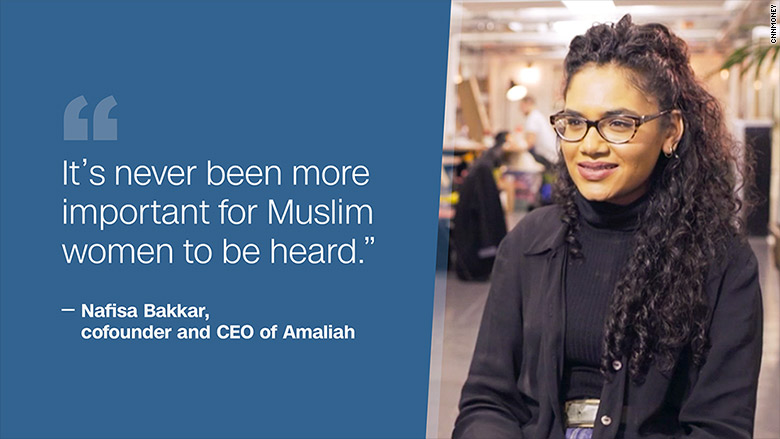
Nafisa Bakkar and her sister, Selina, launched Amaliah from their mother’s kitchen table in 2015 as an Instagram page to curate Muslim-friendly clothes from top brands.
Since then, that page has grown into an online community of more than 250,000 Muslim women.
The sisters grew up in the U.K., born to Indian immigrants from the eastern city of Kolkata.
Nafisa Bakkar told CNNMoney they grappled with multiple identities throughout their upbringing, but soon realized how big a role Islam played — and the challenges they faced as a result.
One of those was how to find clothes that were stylish but allowed them to adhere to their religion.
“Amaliah started as a personal frustration,” the 24-year-old said. “We realized that it was a big pain point for Muslim women to find clothes that were modest but also fashionable.”
That Instagram page has grown into a platform that allows Muslim women to share their perspectives, experiences and, of course, find the right clothes.The company’s website features a curated collection from leading stores such as H&M, ASOS and Zara, which customers can order directly online.
It also features blogs and articles with titles such as “My journey to being a part-time hijabi” and “Empowerment looks different to everyone.”
“I see Amaliah as a … tool for cultural change,” Nafisa Bakkar said. “I don’t really see us as just a clothing brand.”
The ultimate objective is gradually to change the perception of Islam in an increasingly polarized world.
“In today’s political turmoil… it’s never been more important for Muslim women to be heard,” the young CEO told CNNMoney. “What we’re seeing in the Islamic economy [is] a lot of start-ups rising out of frustrations, out of feeling that we’re not catered for.”
That market is growing, and big global brands are beginning to notice. Bakkar says fashion powerhouses such as Dolce & Gabbana and DKNY have started catering more to Muslim women over the past couple of years.
But there’s still a long way to go.
“In an ideal world, Amaliah wouldn’t exist,” Bakkar said. “It wouldn’t be difficult for a Muslim woman to find the right clothes that she doesn’t feel compromises her culture and values, it wouldn’t be difficult to hear the opinion of a Muslim woman in the mainstream news.”
CNNMoney (New Delhi)
source: http://www.money.cnn.com / CNN Tech / Home> India 20 under 40 / by Rishi Iyengar @Iyengarsh / CNNMoney (New Delhi) / March 17th, 2017
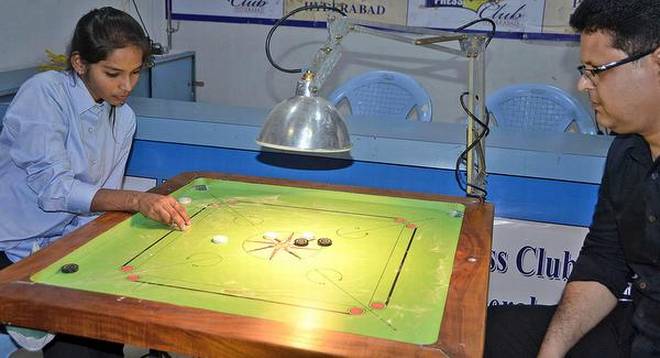
No stopping her Shaik Husna Sameera playing a friendly game with AICF president Neeraj Kumar Sampathy in Hyderabad on Saturday. | Photo Credit: V_V_SUBRAHMANYAM
Issues certificate to the carrom champ for setting a world record
For Shaik Husna Sameera, the agonising two-month wait has finally ended with the Guinness World Records (GWR) issuing the certificate recognising her feat of playing carrom for 34 hours and 45 minutes at DRRMC Indoor Stadium in Vijayawada in December last.
She broke the previous record of 32 hours and 45 seconds set by Narayan Paranjpe, Atul Kharecha, Prakash Kagal and Pramod Sen in the US in 2005.
Another record holder
With the GWR insisting that the world record be certified, she had to play with only one opponent, 22-year-old Allada Pavan, who is now employed in Bengaluru.
Interestingly, both are certified as world record holders for their feat.
“It’s a great moment. I have been waiting for this for long. Only I know what I had to go through in the last two months because of the suspense. But I must thank the AICF President Neeraj Kumar Sampathy for his support in helping me realise my dream,” said the Intermediate second year student of Sri Gayathri College at Chaitanyapuri in the city here.
“Yes, there were some doubts about the date mentioned in the proof that was submitted and there were quite a few queries too. But once they were satisfied, they declared that I did set a world record with a break of five minutes after every hour. This is a great moment for me,” said the 16-year-old Hyderabadi, who took to the sport as her mother was also a player and a qualified umpire too.
National titles
What next? “The focus is on winning the national titles. I am sure that given the kind of support from the AICF and Hyderabad Carrom Association with founder-president Haranath and S. Madan Raj going all out to help me, I hope to win the World Cup one day,” she said.
For his part, Dr. Neeraj said it was a great honour for the young champion as it’s not every day that such a record is attempted in any sport.
“And, I feel it is a huge fillip to the sport itself,” he added.
source: http://www.thehindu.com / The Hindu / Home> News> States> Telangana / by V.V. Subrahmanyam / Hyderabad – February 25t, 2017
Bengaluru had its first date with an air show 106 years ago
In 1911, Jules Wyck and Belgian adventurer Baron Pierre De Caters were the two pilots who brought their aircraft to Bengaluru
__________________________________
Bengaluru :
As the curtains were drawn on the 11th edition of Aero India on Saturday, thousands who thronged the Yelahanka Air Force Station need to know that they are not the first patrons of such a show. In fact, they are not even the first generation.
Bengaluru, India’s aviation capital, had its first date with an air show 106 years ago. February 3, 1911. Cricket hadn’t become the religion it is today in India. The Chinnaswamy Stadium was a barren land, and parts of Bengaluru were still a functional cantonment.
While people from districts neighbouring Bengaluru had made their way back then to catch what the organizers had called a “miracle in the skies,” Bengaluru’s quest for the flying machines remained intact in 2017 with at least three lakh people reported to have visited the aero show.
In 1911, Jules Wyck and Belgian adventurer Baron Pierre De Caters were the two pilots who brought their aircraft to Bengaluru, for a show that garnered a huge response. “But police had been prepared to handle the crowd here, after things had gotten slightly out of hand in Kolkata,” historian Vemagal Somashekar said.
If the elaborate preparations of the organizers a century ago are any indication then it only shows that a lacklustre event, like the 2017 edition of Aero India — just 53 aircraft on display and four aerobatic display teams — may fail to garner similar response in the coming years.
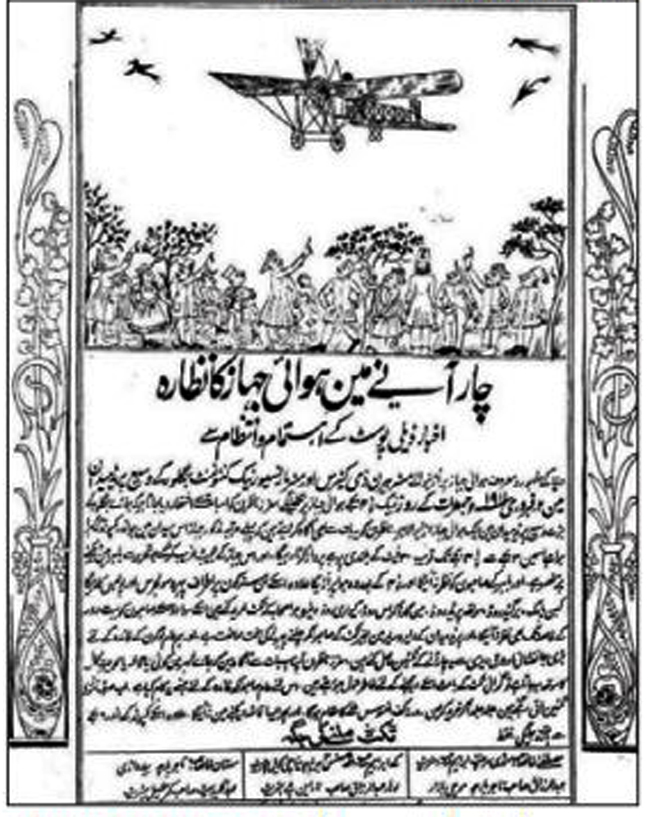
(The poster in Urdu, issued by merchants and businessmen from the Baidwadi (present day Shivajinagar) area. Photo Credit: fly.historicwings.com)
The fact that organizers did not reveal the right number of aircraft at Aero India 2017 is an indication that even they know it. When TOI enquired about the details of the show and the preparations in the run-up to the show, Mayaskar Deo Singh, director, Defence Exhibition Organisation, the nodal government agency organizing the show said: “An official release with final numbers on participation and other details will be issued so that there is no confusion.”
The official release days before the show had claimed that the number of aircraft participating would be 72, as many as the 2015 show, rated much better, had seen. Answering a specific question, defence minister Manohar Parrikar, however, had said on February 14: “There are 53 aircraft participating…”
Also, there are ways to watch the show for free, hundreds of citizens who stood with their cameras on terraces, the highway, some even got hospitality at villages around the air base.
But organizers in 1911 had figured out a plan for such free viewers. A poster in Urdu, issued by merchants and businessmen from the Baidwadi (present day Shivajinagar) area, reveals that the organizers, who had learnt that people would not buy tickets as they thought planes could be spotted even otherwise, had organized the show in such a way that only those with tickets (worth 25 paise each) had a one-hour exclusive.
“…Between 3.30pm and 4.30pm the planes will fly at a height of just 30 metre which only the ticket holders can see. For a few minutes after 4.30pm, the planes will fly a little higher,” reads a translation of the poster documented by the state archives department.
Mustafa Khan (mandi merchants, Ibrahim Sahib Street); Abdul Razak (businessman, Modi Road); Ibrahim Sahib (Meenakshi Kovil Street), Abdul Razak Sahib (steel merchant, Narayan Pillai Street) and Mastan Khan from Baidwadi (present day Shivajinagar) were the men who had signed off on the poster —they are an indication of how Bengaluru had a good trade set-up.
While TOI got a look at the poster, permission to take a photograph was denied. The poster, which has been sourced from fly.historicwings.com, further reveals as Somashekar had pointed out.
Police had been ordered to patrol major roads leading to the venue such as South Parade Road (now MG Road), Brigade Road and Church Street and even in Cubbon Park.
source: http://www.timesofindia.indiatimes.com / The Times of India / Home> News> City News> Bangalore News / Chethan Kumar, TNN / February 20th, 2017
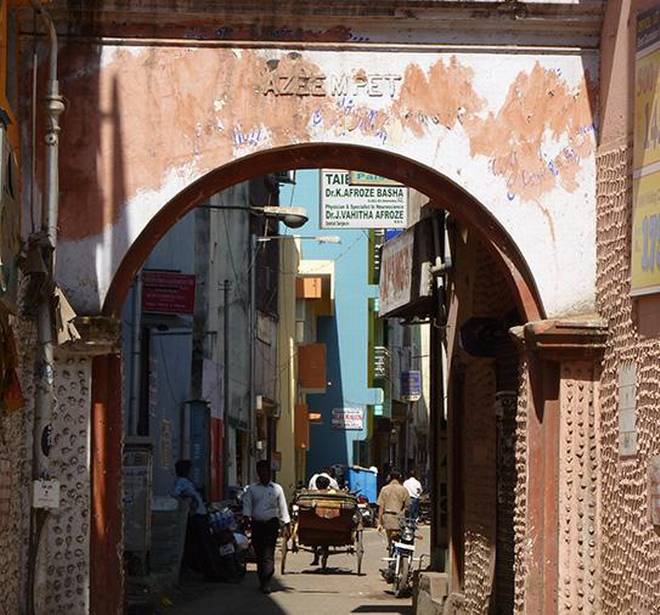
Kaman Darwaza in Chennai | Photo Credit: Kombai Anwar
Madras was in the eye of a power storm, 200 years ago
An ailing or aged ruler triggering a political crisis is not something new in Indian history, but what is interesting about the recent drama that unfolded in Chennai has its parallels to a power struggle that Madras was witness to a little more than 200 years ago. The drama then too had an ailing ruler, various aspirants including a ‘sister’ scheming to take over power upon his death, and a Governor keenly assessing the situation.
The only visible token of the dramatic events that unfolded in 1801 when Umdatu’l-Umara, the Nawab of Arcot, died, is a nondescript arch with the name ‘Azeempet’ chiselled on it, that still stands on Chennai’s Triplicane High Road, a few yards away from the Walajah Mosque. It is a reminder of sibling love that turned bitter and ultimately led to the dramatic fall of the House of Arcot, paving the way for the East India Company to establish itself firmly in the saddle and change the course of Indian history. Old timers remember this arch as the gateway, ‘Kaman-Darwaza,’ to the palace of Sultanu’n-nisa Begam, the daughter of Nawab Muhammad Ali Walajah and sister to Nawab Umdatu’l-Umara.
Nawab Umdatu’l-Umara, who succeeded Muhammad Ali Walajah upon the latter’s death in 1795, was very fond of his sisters, especially his senior sister (meaning the eldest of his younger sisters) Sultanun’n-nisa, also known as Buddi Begum. Sultanu’n-nisa was equally fond of her brother so much so that, out of concern for his safety, and to ward off evil, she used to send everyday a rupee coin to the Nawab, which he would dutifully tie it on his upper arm.The Nawab very often spent his evenings at the palace of his senior sister, listening to musicians, watching a dance recital or just having dinner. He had a room in her house, where the Nawab met with his officers and others. It was widely believed that Sultanu’n-nisa was the actual power behind the throne. Somewhere down the line, Sultanu’n-nisa had assumed that her son Raisul Umara would succeed her brother to the throne. But she was not the only one eyeing the throne, as the Nawab himself would lament – “I intend my son for the throne; Sayful Mulk (the Nawab’s younger brother) intends that the throne is for him; my senior sister has in mind that her son is meant for the throne after me; and the firangs (foreigners – the East India Company) are waiting for their opportunity. But it shall be as the Supreme Ruler wills.” The Nawab wrote a will on his deathbed, making his son Tajul Umara his successor, a move that enraged his sister, who felt betrayed. It was an opportunity too good to miss for the firangs, who were looking for an excuse to take over the Carnatic entirely.The English used the simmering anger of Sultanu’n-nisa and spread the rumour that a coup against the Nawab was in the offing. With the connivance of Nawab’s Diwan, Col. Barret, they surrounded the ailing Nawab with the Company’s troops.
When Nawab Umdatu’l-Umara died in 1801, a bitter Sultanu’n-nisa would not forgive her brother. She refused to let the coffin pass through the Kaman-Darwaza. It had to be left the whole night with guards in a hall opposite the arch. After failing to persuade his aunt to let the coffin through, Tajul Umara, son of the deceased Nawab, decided to break the wall behind Nusrat-mahall and send the coffin to Trichy, to be buried next to the tomb of his grandfather Nawab Walajah.
This power struggle enabled Governor Edward Clive to make a man of Company’s choice as the next Nawab, a man who was willing to sign away the Kingdom, which the young Tajul Umara, the rightful successor, refused to do. Umara’s cousin Azim-Ud-Daula was anointed as the next Nawab. Tajul Umara died within a few months. Sultanu’n-nisa and her son left for a Hajj pilgrimage and chose to settle down in the holy city of Karbala in Iraq, where she eventually died.
Two hundred years later, the arch still stands, a mute witness to the bitter power struggle that not just led to the tragic fall of the House of Arcot .
Kombai Anwar is a writer, photographer and film maker.
source: http://www.thehindu.com // Th Hindu / Home> Society> History & Culture / by Kombai S. Anwar / February 17th, 2017
Spears-Cabal win mixed doubles title with 6-2 6-4 victory
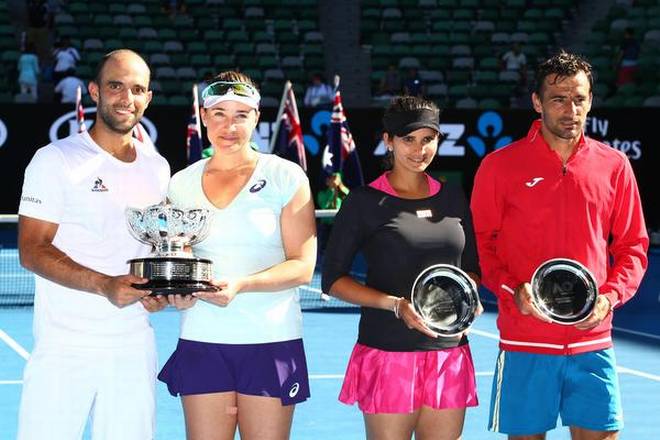
Sania Mirza will have to wait for her seventh Grand Slam trophy as the Indian and her Croatian partner Ivan Dodig lost the Australian Open mixed doubles final 2-6 4-6 to underdogs Abigail Spears and Juan Sebastian Cabal, here on Sunday.
The second-seeded Indo-Croatian pair paid the price for the free-flowing unforced errors from the racquet of Dodig, who struggled with his serve and ground strokes.
It is the second runners-up finish for Sania and Dodig together after losing the final of the 2016 French Open to Leander Paes and Martina Hingis.
Not his day
After losing the first two points, Dodig served a double fault at 30-30 and then sent a forehand long to concede a break in the very first game of the match.
Cabal and Spears though were in tremendous touch from the word go. Both were terrific from the back and at the net to comfortably pocket the first set.
Despite racing to a 3-0 lead in the second set, the Indo-Croat pair let their advantage slip and were locked in battle at 4-4. Dodig was never in his elements in the match and he served two double faults, the second one coming on a breakpoint, to allow Cabal to serve out the championship. PTI
source: http://www.thehindu.com / The Hindu / Home> Sport> Tennis / PTI / Melbourne, Australia – January 30th, 2017
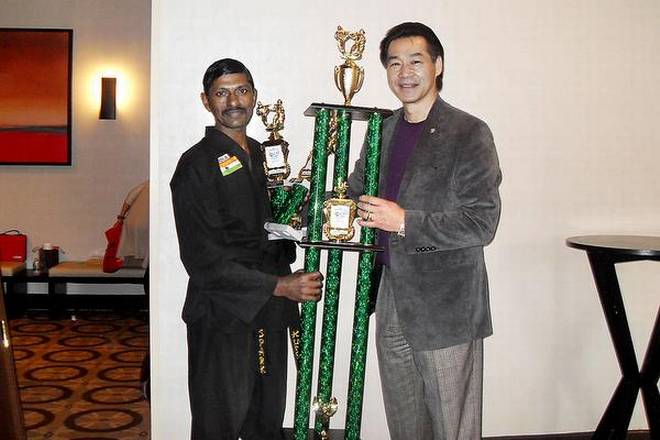
Proud moment: Pathan Jameel Khan winning gold in Virginia on Sunday is the second world championship gold this month, after he moved to the US.
Pathan Jameel Khan wins gold in the black belt division of World Championship in Virginia
This Hyderabadi has done it again! The 41-year-old Pathan Jameel Khan, the martial arts exponent, who moved to the US to take up karate training in an American school in New York a few months ago, made an emphatic statement again on Sunday winning the gold in the black belt division of the World Championship in Virginia.
This is incidentally the second world championship gold that Jameel has won, after moving to the US, this month.
Ironically, Jameel, winner of 15 gold, 13 silver and 17 bronze at the national and international events, including two 2016 World Cup silver in the US, has to look for greener pastures after his repeated pleas for financial assistance and a job did not evoke any positive response from the authorities concerned.
“It’s a pity that I had to move to the US to take up this training job which fetches me enough money to take care of my family of ageing mother, four brothers and a sister,” says Jameel, even while being subdued despite winning two world championship gold (conducted by two separate world federations).
But why? “My ultimate dream is to represent India in the 2020 Olympics when karate will be introduced. Since I realised that even winning at the highest level will not assure me the kind of exposure I need for the Olympics, I had no option but to move to the US,” counters Jameel.
This BA graduate from Dr. B.R. Ambedkar Open University, whose only livelihood when in Hyderabad was by training a handful of enthusiastic young talent, points out that the three-year contract with the American school should also ensure adequate exposure to the toughest competitors in the field. “Besides training, the stay in the US should also help in picking up a few new tricks too,” says Jameel, who also won two bronze in the men’s forms and weapons categories.
Will you come back after the contract period? “As things stand now, my contract will end in 2019, one year before the Olympics. By God’s grace if everything falls in place and I get the help from the Telangana government, I will train and put in the best efforts to realise my ultimate dream of playing in Olympics the next year,” Jameel concludes.
source: http://www.thehindu.com / The Hindu / Home> News> States> Telangana / by V.V. Subrahmanyam / Hyderabad – February 06th, 2017