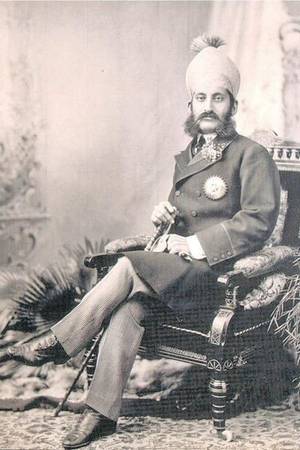
The sixth Nizam Mahboob Ali Pasha is remembered for combining tradition with modernity
Among the rulers of all the native states in British India, Mahboob Ali Pasha, the sixth Nizam of Hyderabad is reputed to have had the most lavish court. Born in August, 1866, Mahboob came to the throne at the age of three after the death of his father, Afzal ud Daulah. Mahboob Ali, thus knew no day when he was not the King.
A Regency under Sir Salar Jung I was set up for the young Nizam till he came of age. The Viceroy, Lord Ripon came to Hyderabad for the investiture ceremony held on February 5, 1884 and presented the Nizam a diamond-studded gold sword on the occasion.
Mahboob Ali was a perfect example of a Victorian Prince. He had a great taste for western culture and modern ways of life.
His English tutor, Major John Clark (who had earlier tutored the Duke of Edinburgh) had instilled in young Mahboob the customs and manners of high English society. As a result he imbibed great taste for all that was western. His western etiquette was so perfect that there was a rumour among the courtiers that the Nizam visited European countries incognito without the knowledge of any one!
His obsession for clothes and cars was legendary. His collection of garments was one of the most extensive in the world of his time.
The best English tailors were brought to Hyderabad to stitch the Royal robes combining tradition with modernity. There was a new dress for every day and he never wore the same dress for the second time.
It is no wonder that Mahboob Ali had a huge wardrobe in his palace that ran for more than hundred feet in length, considered to be the longest in the world. As his wardrobe was on the first floor of the palace, a lift was fitted for the Nizam to access his wardrobe every day with ease.
It is interesting to note that this hand-operated wooden lift at the Purani Haveli palace, in its shining best is still in perfect working condition.
His passion for cars was unparalleled and owned a good fleet of them. A Rolls Royce Silver Ghost that was made to order but delivered after he died in 1911, is now on display in the Chowmahalla palace fully restored, due to the efforts of Princess Esra Jah wife of the present Mukharam Jah.
The resources of the Nizam as well as the spirit of the times to which he belonged never discouraged lavish spending of money. Hyderabad came to be known for Mahboob Ali’s extravagant entertainments and lavish hunting expeditions.
Interest in medicine
It was under Mahboob Ali’s patronage, that Hyderabad Chloroform Commission was set up in 1889 and Chloroform as a safe anesthesia agent in surgeries was proved by Dr. Edward Lawrie, Principal of Hyderabad Medical School. The Nizam was personally interested in the work of the Commission. Two Hyderabadi doctors, Dr. M.G. Naidu (husband of Sarojini Naidu) and Dr. S. Mallanna (father of the future Gen. S.M. Srinagesh) were sent to England with funds provided by the Nizam to prove the efficacy of Chloroform in surgeries.
The British Medical Association journal, Lancet, hailed the work of this Commission. Mahaboob Ali, personally being interested in healing was famously known to administer a herb-based medicine to cure snake bite. During his reign, the first Hyderabad- Nagpur Railway line was laid in 1874. The advent of telegraph, telephone and electricity opened up Hyderabad towards economic growth.
Chirag Ali, a well known educationalist from Aligarh was invited by Mahboob Ali to spread English education in the Nizam’s dominions. Mahboob College in Secunderabad and Nizam College in Hyderabad stand testimony to the development of higher education initiated by Mahaboob Ali Khan. Aghornath Chattoadhyay, the father of Sarojini Naidu, the first Indian to have obtained Ph.D in Biology from Edinburgh University, was the first principal of the Nizam College.
Mahboob Ali Khan was a good polo player and an excellent marksman. He was probably the first Indian prince to have a court photographer, Deen Dayal. With his wonderful skills in photography, Deen Dayal, on whom the Nizam conferred the title, Raja, immortalised the Nizam and his times. Raja Deen Dayal employed in his studio an English lady to help him in taking the photos of the women members in the Nizam’s Palace.
Mahaboob Ali passed away on August 29, 1911 when he was hardly 45 years and was succeeded by his son, Mir Osman Ali Khan, regarded as the world’s richest man but the most frugal of all the Nizams, an antithesis to his flamboyant father.
Among the numerous expensive jewels that Mahboob possessed during his reign was the famous Jacob Diamond weighing 162 Carats, bought from the reputed London jeweller, Jacob.
Years later, Osman Ali Khan used this fabulous diamond, said to be next only to Kohinoor, as paper weight, the purpose for which Mahaboob Ali bought it.
Mahboob Ali also ever lives in the minds of the gastronomists, be the natives or visitors to this city for the aroma and the taste of the distinct Hyderabadi dhum biryani, the perfection for which the Nizam, Mahboob Ali Pasha justifiably took pride.
source: http://www.thehindu.com / The Hindu / Home> Society> History & Culture / by K.S.S.Seshan / February 02nd, 2017
Makki has rare collection of stones: Makki owns over 1,000 exhibits worth several crores
Huge claws of a T-Rex dinosaur that would take you to the world of Steven Spielberg’s Jurassic Park, massive amethyst crystals and a meteorite that fell in Siberia in Russia that remind of Carl Sagan’s Cosmos are part of his collection. Besides them, he owns hundreds of small precious stones, which would hold visitors in awe and expose them to a new world of stones.
Interestingly, all these are held by one man and he answers to the name of Makki. He is virtually a mobile museum. Whether it is something extra-terrestrial or buried in mounds or deep inside the earth, he has almost everything. He has ruby, agate, amethyst and many more.
“You need to touch them, feel them and experience them,” says 68-year-old Muhammad Fasihuddin Makki about his exhibits. He is not touchy about anyone touching specimens and insists that students need to be brought closer to them to change their perspective about stones.
Collecting and selling stones are his hobby as well as profession. “It’s my passion and I love it… my bread and butter are minerals,” he said. “I am taking stones to the doorstep of people for them to develop love for them,” said Makki, who has no formal training in geology. In fact, Makki is a Master’s in English and calls himself a “pujari of Laxmi and Saraswati”.
The Pune-based Makki is the founder of Matrix India and also runs a touring museum. His personal collection is displayed in exhibitions across India. He has participated in several exhibitions, conferences and auctions abroad. He has been supplying rocks and minerals to schools and colleges. He also runs one of the biggest agencies in the world involved in exporting and importing rocks and minerals.
“We offer a variety of minerals from spectacular specimens for collectors to large stock of supplies to wholesale buyers. We have a ready stock of different rough materials from India and we regularly add to our inventory freshly mined new specimens from the Deccan Traps,” said Makki. They also supply boulders and large colourful rocks for landscaping and interior decoration.
Makki is a member of various associations, including Minerological Society of India, Minerological Society of America, Collectors Society of India, Volcanological Society of India, Euromineral France and Mineralientage Germany.
The family of Makki hails from Karnataka and his father was into collecting minerals. “I picked it up from him,” he said. It has been close to five decades into this profession and hobby. “I love this and it keeps me going,” he said. He takes over 1,000 specimens for exhibitions and their value will be several crores.
“I do not charge any money or take remuneration.The institutions where I arrange these mineral and fossil exhibitions arrange for my accommodation and for my two or three assistants. The organisers bear the cost of transporting exhibits like stones from Pune. Some of the exhibits are quite heavy and many of them weigh more than 100 kg,” he said.
His son Sami has started helping him in the business and in arranging these educational earth science exhibitions.
The most precious among the specimens in his collection is a meteorite. It looks small but it is over 8 kg, he smiles. “It fell in 1947 in Sikhote-Alin in Siberia. In 1994, I visited an exhibition in the United States, where this was auctioned…. I did not hesitate, bid for it and bought it… it was quite a sum, but it is a rare collection,” he says.
He recently held “Exhibition of Rocks, Minerals & Archaeological Antiques” and it was hosted by the Centre for Extra-Mural Studies (CEMS) of the University of Mumbai in collaboration with the INSTUCEN (India Study Centre) Trust, and the Deccan College of Pune. “I want people to touch them, photograph them… it is a kind of a bond…it is a rock. Minerals do not have life, but once you touch and feel it, you are in a totally different world,” he says passionately.
He said, “The trilobites are over 400 million years old. These are the oldest fossils with me. Dinosaurs became extinct 60 million years ago. I have dinosaur fossils with me and in fact children love to see them. They often want to touch and see and I do not object. Today one can see dinosaurs in films or on television. When children see a live claw or egg or remains they get excited,” points out Makki.
Explaining how he goes about his collection, he said: “I do mining and collection from all parts of India. I have set aside a lot of large exotic colourful mineral specimens as my personal collection and in addition to that I also acquire many different kinds of colourful and interesting mineral specimens found in other countries. I buy from other dealers or exchange with my specimens and in this way over the years I have accumulated a huge collection of colourful crystalline mineral specimens from all over the world.”
India, he says, is a treasure house of minerals and the Geological Society of India and Geological Survey of India have been doing a great job. “Collection and exhibition of rocks and minerals offer good careers,” he claims.
source: http://www.deccanherald.com / Deccan Herald / Home> Special Features / by Mrityunjay Bose in Mumbai / DHNS – January 29th, 2017
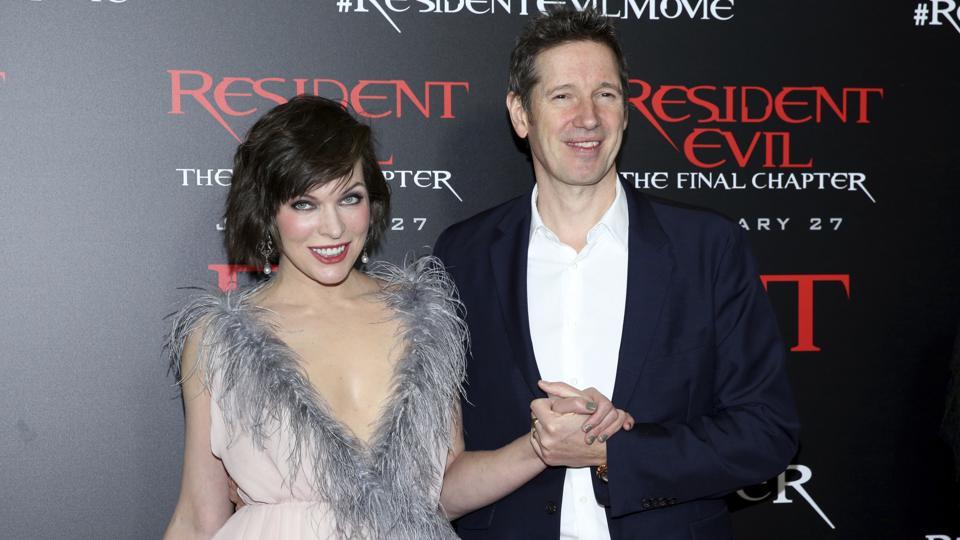
Actor Milla Jovovich and her husband, filmmaker Paul W.S Anderson say Salman Khan has more fans in Germany than them.(Rich Fury/Invision/AP)
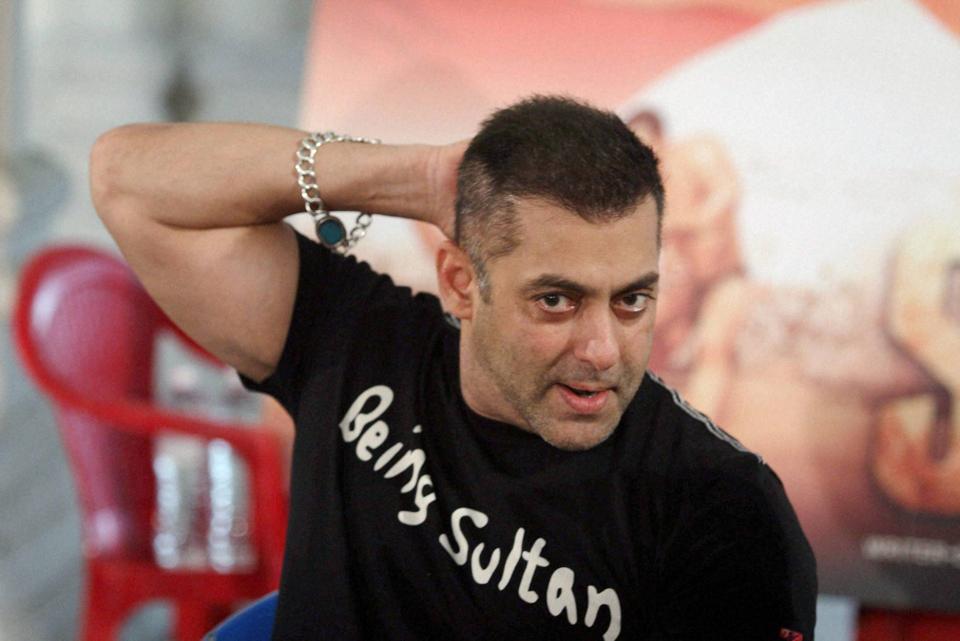
A Bollywood A-lister’s stardom can leave even Hollywood celebrities behind. That’s exactly what filmmaker Paul WS Anderson and his wife, actor Milla Jovovich witnessed when they ran into Salman Khan in Germany in 2011.
“We were staying at the same hotel and I was shocked because there was this huge crowd of fans inside the hotel. First immediately I thought they were my fans and I walked out all ah… No one is paying attention to me at all and what’s going on,” says Milla who will soon be seen in the sixth instalment of the Resident Evil film franchise.
She adds, “Suddenly this guy (Salman Khan) walks by and everyone is like Oh My God!! I see all of this happen and ask myself ‘Jesus Christ who is this guy?’ And then we get to know he’s the biggest Indian Bollywood star and he’s a huge deal.”
The 41-year-old actor says she was quite embarrassed with the incident. “That incident was quite interesting yet humiliating. We were all prepared to sign autographs and no one was interested and it was funny. We would turn up, pull-up at the hotel and literally more than 100 fans gathered outside the hotel. When we pulled up and got out of the car, no one was interested in us and it was so funny,” she adds.
Her husband, Paul Anderson feels Indian films are big in other countries. “Bollywood movies aren’t considered harmful in anyway. They are not pushing any western values. So Indian stars are huge in Germany,” says Anderson.
Actor Salman Khan’s stardom in Germany floored actor Milla Jovovich and her husband, filmmaker Paul W.S Anderson. (PTI)
Following the incident, Milla now wants to work with Salman and says, “I would love that. I don’t know about the singing and the dancing bit. Though I’d have to …it will be my next training.”
source: http://www.hindustantimes.com / Hindustan Times / Home> Bollywood / by Samarth Goyal, HT / January 26th, 2017
V Shoba follows the footsteps of a warrior king and listens to the voices of admiration and anger that echo his still volatile legacy
————————————————————–
In the green, hilly tracts of Kodagu, a small district in Karnataka bordering Kerala, the past is urgent, pressing. A king’s ghost has been summoned again, so his story can be rewritten to suit the age. Tipu Sultan. Perhaps no other Indian king has been mummified by as much subjective judgement. Invariably, he is either a justified villain or an unjustified hero, a tele-serial star or a wanton killer of Hindus. In Kodagu, where Tipu is believed to have put thousands to the sword, a destabilising interrogation of his legacy recently claimed two more lives, over 200 years after the king perished in the British siege of Srirangapatna in 1799. Even as the Karnataka government’s plans to celebrate Tipu Jayanti on Deepavali day—10 days ahead of his date of birth, 20 November—predictably met with opposition from Hindu organisations, the Muslims of Kodagu, many of them descendants of migrants from Kerala, appropriated him as their hero overnight.
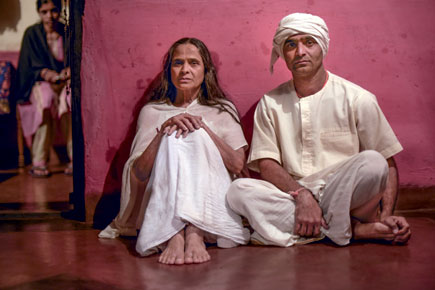
DS Kuttappa’s widow Chinnamma and son Dani
On the appointed day, the communities clashed violently in the tourist town of Madikeri, the headquarters of the district, resulting in two unfortunate deaths: 65-year-old DS Kuttappa, the district organising secretary of the Vishva Hindu Parishad, was killed when he fell or was pushed from, depending on who you believe, a height during the riot; and 22-year-old Shahul Hamid from Siddapur was shot while returning in a truck from Madikeri. Observers blame the deaths on police and administrative negligence, but the reality of the unrest in Kodagu runs deeper.
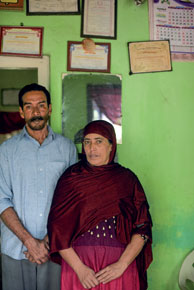
Naseer and Kulusu, Shahul Hamid’s bereaved parents
From his perch in Srirangapatna near Mysore, Tipu Sultan—and before him, his father Haider Ali—had repeatedly attacked Kodagu in the 1780s in order to secure free passage to Malabar. His incursions into Coorg, replete with the plunder and destruction of temples—a common practice in medieval times even among Hindu rulers—were time and again thwarted by native Kodava warriors, but the region eventually succumbed to the assaults. According to historical accounts, Tipu then ordered ‘both the slain and the prisoners, with the women and children, to be made Musalmans.’ “Kodavas were deeply scarred by Tipu’s excesses but they did not give up. They had their tiri-toks—country guns—and they were skilled at guerrilla warfare. For Tipu’s army, the leeches alone proved a deterrent,” says Addanda C Cariappa, a writer, actor, theatre person and former president of the Karnataka Kodava Sahitya Academy, who is working on a book in Kannada on Tipu Sultan. His pride in the community’s martial heritage and its achievements in the military soon dissolve into alarmism as he talks about the shrinking Kodava population. “We are a dwindling race with a population of just 1.25 lakh. Soon, we will be the Kashmiri Pandits of south India. The religious turbulence of Tipu’s reign is partly to blame,” Cariappa says.
There is no love lost between Kodavas and the erstwhile ruler of Mysore: they will tell you that Tipu was no son of the soil; that he preferred Persian to Kannada and wanted to propagate Islam across south India; and that his epitaph in Srirangapatna and the inscription on his sword commemorate him as a sultan who lived and died for the faith. This, then, was the majoritarian cultural sentiment that formed the backdrop of the Tipu Jayanti celebrations in Kodagu. The Siddaramaiah government has been accused of inciting riots for political gain in a district where all the legislators—two MLAs, KG Bopaiah and Appachu Ranjan, and Prathap Simha, the lone MP from Kodagu—belong to the BJP. Conspiracy theorists go to the extent of alleging that a law-and-order crisis was precipitated by the Siddaramaiah camp to show the new home minister of the state, G Parameshwara, in poor light. Whatever the provocation, the celebrations marked a dark day for communal harmony in the state.
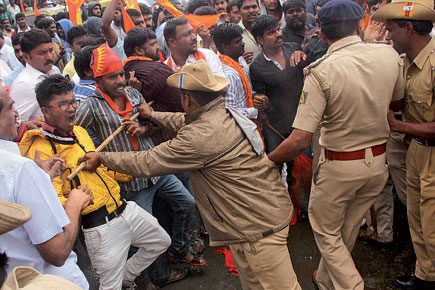
A scuffle breaks out during the Tipu Jayanti celebrations in Madikeri (Photo: KPN)
It is dark when we halt at Kuttappa’s house near Madhapur, about 20 km north-east of Madikeri, at the end of a long, snaking drive through banana and paddy fields. The sitting room is bustling with local reporters, Sangh Parivar activists and Kuttappa’s scampering grandchildren. His son Dani wears a dhoti and an unreadable expression. His mother sits unmoving in a corner, her long hair undone,face buried between her knees. “Father knew his life was in danger. But anything could have happened in Madikeri that day and he could not stay away,” says Dani, who works at a factory in Madikeri and is an RSS activist. “They beat him and stoned him, then pushed him to his death. There are eyewitnesses who saw what happened near General Thimmaiah Circle.” The police are awaiting the autopsy report that may throw light on the cause of his death.
On that Tuesday morning, a few thousand people carrying Tipu flags marched towards Town Hall, where his birthday was to be celebrated. The 2,000 policemen who were later deployed to keep vigil over the small district—4,100 sq km of it—had not yet been called in; the district administration was wholly unprepared for trouble. As supporters of the Social Democratic Party of India (SDPI) and Sangh Parivar activists hurled stones at one another, the situation quickly spiralled out of control and the police resorted to a lathi charge. “The Muslims came armed with stones and swords,” alleges Dani. Soon, he is no longer talking about the death of his father, but building a case against “radical Muslims” who, he alleges, have destroyed the peace of the region.
Kodagu is a peaceable place where enmities that lay buried in the dim mists of the past are not easily kindled. Before the flare-up around Tipu Jayanti, the Sultan’s exploits here were largely forgotten—although, if you visit enough Kodava homes, you will have occasion to pet dogs named Tipu. The last time there was a Hindu- Muslim clash in Kogadu was in December 2001, when miscreants vandalised the Harishchandra temple at Palur, about 20 km from Madikeri. Angry Hindu mobs gathered in town, blocking roads and attacking Muslim worshippers; Section 144 was eventually imposed. Like most riots, the 2001 incident reeked of political opportunism and widened the space between Kodagu’s communities. This is happening again now, thanks to a king who has captured the fancy of a nation in search of heroes. Tipu introduced land reforms and modern banking. He abolished alcohol and donated to temples. He was the last Indian ruler to consistently rebel against the British. Yet, large sections of Kodavas do not hesitate to judge an 18th-century ruler by 21st-century morals. “He killed Hindus and converted them. These people who want to celebrate him—what are they celebrating exactly?” Dani asks.
“The problem is that people think in terms of religion in this country,” says actor and playwright Girish Karnad, who received a death threat on social media after remarking that Bengaluru International Airport would have been named after Tipu Sultan, and not after city founder Kempegowda, had the king been Hindu. “It is not as though our politics has changed in 200 years. We still see leaders using atrocities to build their careers. At least Tipu Sultan did not commit these atrocities against his people. I can’t see how what he did was more condemnable. The people of Mysore were happy with him,” he says.
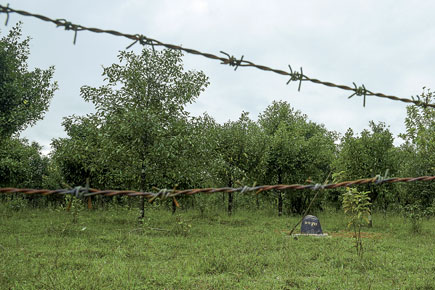
A memorial at Ayyankeri, a Karnataka village 6 km from the temple town of Bhagamandala, marks the location of Tipu Sultan’s alleged massacre of Kodavas (PHOTOS: DIPTI DESAI)
On the banks of the Cauvery at Ayyankeri, a village 6 km from the temple town of Bhagamandala on the road to Madikeri, is a patch of flat forest land planted with kodampuli (Malabar tamarind) trees. A barbed wire fence separates it from private land where rising water levels have made cultivation difficult; consequently, a lush pastoral meadow stretches all the way down to the river, its waters screened from sight by a thin line of trees. Inside the fence stands a small, rounded black stone with the date ‘13.12.1785’ painted on it, next to the words ‘Holocaust of the Humans’. Visiting what is described to me as the Auschwitz and Jallianwala Bagh of Kodagu, I am struck by the absence of history around it. No one in the neighbourhood has heard of Devattiparambu, the grounds where Tipu Sultan is said to have massacred over 30,000 Kodavas on a single day after inviting them to a feast. Yet, Kodavas like Addanda Cariappa are convinced that this is where the king all but wiped out a thriving, fearless people. Cariappa’s book is to be released on 13 December to commemorate the incident. “We used to call this area periya parambu (big ground). The NCC camped here in the 1950s to build a bridge,” says Abdul Rahman, a villager who owns some land next to the river, speaking in Malayalam. “A couple of months ago, some people from the Codava National Council [which has been campaigning for ethno-linguistic tribal minority status for Kodavas] came and looked around for a place to install the memorial. Since this is forest land, they thought it would be safe here,” he says. Rahman and his neighbours attended the Tipu Jayanti celebrations in Madikeri because they were puzzled at the calumny suddenly hurled at their village. Tipu allegedly converted thousands of Kodavas, whose descendants are now known as Kodava Mappilas. Muslims living in Ayyankeri, however, say their ancestors migrated from Kerala. “We have a mosque here that is said to date back 300 years and there are no records of conversion by Tipu Sultan in these parts,” says Rahman. “Nor is there any proof that this was Tipu’s killing field.”
Was Tipu really a monster of ego and a jihadist? Or could he have liberated India from the imperialists? “How does it matter? Lives have been lost,” says Abdul Naseer, the father of Shahul Hamid. “We have lost our only son.” In a small house with green walls, Naseer and his wife Kulusu contemplate their misfortune. “Shahul worked at a Toyota showroom in Bengaluru. He had come to Siddapur to apply for a BPL card so that we could get a discount on his sister’s kidney stone surgery in Mangalore,” says Kulusu. “He did not know a thing about Tipu. He just hitched a ride back home from Madikeri.” About 300 Muslim youth from Siddapur, Kodagu, attended the event, and most of them have since fled the area fearing arrest. “There are no youth in town today. There is fear. The police keep coming back with inquiries,” says Naseer. Police have made over 60 arrests so far and filed 35 cases. A magisterial probe has been ordered. “The people who killed my son go scot free even now,” Naseer says. He flew in from Dubai, where he works as a driver, when he heard his son had been shot. “I remember thinking, ‘It is a bullet to the head, he won’t make it’,” says Naseer, who has no plans to return to the Middle East. “There is no one to earn for,” he says.
While the Madikeri incident may have been precipitated by an unmindful government decision, there is a discernible trend of Muslim radicalisation in Kodagu, says KB Ganapathy, editor-in-chief of Star of Mysore, a widely- read evening newspaper. “I grew up in Kodagu. Muslim women never wore burkhas until a few years ago. Just two years ago, a women’s college in Virajpet took issue with students suddenly appearing in burkhas. The women in turn asserted their fundamental right to wear them, and eventually the parties came to the compromise that they could wear the burkha till the college gate but no further,” he says. “In this situation, the Congress may well be trying to capture the Muslim vote.”
In Srirangapatna, the anniversary of Tipu Sultan’s death is celebrated with much gusto. Followers waving banners with his emblem—a blazing sun amidst tiger stripes— participate in a procession from his mosque to his grave, where they smear sandal paste on the tomb. “I have attended many of these processions—called urs—and they have been peaceful. It is when you politicise the celebration that problems occur,” Ganapathy says. He has argued against idolising Tipu over other kings who fought the British. “Why doesn’t Mamata Banerjee celebrate the birthday of Siraj-ud-Daulah, the last independent Nawab of Bengal? He lived before Tipu’s time,” the editor says.
Tipu was a multicultural icon, a proto-nationalist who understood the future and respected other religions, says leftist historian KN Panikkar, who wants the country to remember him “not as a Muslim ruler but as a ruler of Mysore who gave us an anti-imperialist legacy”. Must we celebrate kings in democratic India? A king is not a perfection of noble qualities. He may fight an intercontinental cast of foes, but he is first and foremost fighting for his territory. “Freedom as we know it today was not part of Tipu Sultan’s imagination,” says Addanda Cariappa. “Just as it was not part of the imagination of the Peshwas or the Rani of Jhansi. They all fought for themselves.”
‘Happy is the country that needs no heroes,’ wrote Bertolt Brecht. Let us live up to the perils of the era and not drag a long-dead ruler to court with us.
source: http://www.openthemagazine.com / OPEN / Home> Cover Story / by V. Shoba / November 27, 2015
Educational Excellence Celebrated at AFMI’s Silver Jubilee Convention in Delhi
American Federation of Muslims of Indian Origin’s Silver Jubilee convention held at the Kedar Nath Sahani Auditorium in New Delhi Dec.31-Jan.1st celebrated the accomplishments and marked a milestone in the organization’s history. The convention was held in co-ordination with the Delhi Youth Welfare Association.
More than 120 Muslim students from across India were awarded with gold, silver, and bronze for attaining meritorious distinction in the board exams. In addition, the prestigious Sir Syed Ahmed Khan Award conferred about leading Mumbai philanthropist Dr. Abdul Kader Fazlani Sopariwala. The Mir Taqi Mir Award was given to Mr. Sanjiv Saraf, founder of the popular web portal www.rekhta.org, for his contributions in promoting the Urdu language. The website now features more than 22,000 titles of Urdu books. Excellence Awards were given to former Chief Electoral Commissioner S.Y.Quraishi and the historic Anglo Arabic Senior Secondary School.
Sanjiv Saraf accepting his award from Justice Sachar
In a first for AFMI convention all the medallists were interviewed by Dr. Fazlani’s philanthropic organization and scholarships worth Rs.4 crore were pledged.
Awards to top students were given at the hands of Delhi Deputy Chief Minister Manish Sisodia. He praised the work of AFMI and that more such efforts need to be undertaken to uplift the society. He mentioned that education remains the top priority of the Delhi government with as much as 25% of the state government’s budget dedicated to it.
AFMI’s flagship awards program has been instrumental in spreading awareness about educational excellence and empowerment across the country. Dr.A.R. Nakadar, AFMI’s founding trustee, said that the fruits sown by AFMI at its inception are now bearing fruit. He said that due to such efforts there has been a remarkable improvement in the educational scenario of Indian Muslims. Citing the latest census reports, published in Indian Express, he stated that there has been a 98.8% increase in the number of Muslim graduates between 2001 and 2011. During the same period the Indian Muslim literacy rate has increased from 59.1% to 68.5%. He said that the day is not too far when, through the collective efforts of all, AFMI’s dream of 100% literacy will be realized.
Dr. Nakadar urged the students to not to rest on the laurels but to use the award as a motivational tool to attain even grater heights of educational excellence. He also asked them to not to forget those who have been left behind and to spread the message of educational empowerment everywhere.
AFMI’s incoming president Dr. Khutb Uddin, a practicing psychiatrist from Indiana, in his remarks applauded the students for their hard work. He urged them to not to be distracted by negative thoughts and to focus on their education. He also pointed out that everyone from the individual to the government should be involved in raising the quality of education in the country and that it should be everyone’s top most priority.
The inaugural session of the convention was addressed by Justice Rajinder Sachar, Mr. Anil Swarup, Secretary Education & Literacy (Government of India), Mr. Naseem Ahmad, Chairman of National Commission for Minorities, and convention chairman Mr. Mohammad Naeem, president of Delhi Youth Welfare Association. The session was ably moderated by AFMI Trustee and leading scholar Dr. Aslam Abdullah.
The convention was also addressed by Prof. Akhtarul Wasey (Vice Chancellor of Maulana Azad University, Jodhpur); Mr.Siraj Hussain, IAS, former VC Jamia Hamdard, Dr. S.Y.Qureshi (former Chief Election Commissioner), Justice Fakhruddin, Mr. Ali Quraishi (New Mexico), Mr. Tayeb Poonawala (New York), Mr. Siraj Thakore (Canada), Mr. Farhad Rahmani, Mr. Ayub Khan, Prof. Janaki Rajan, Dr. Shabistan Gaffar, Mr. Mohsin Siddiqui, Mr. Suhel Tirmizi (Editor, Gujarat Today), Dr. Husain Nagamia (Florida), Mr. Shafi Lokhandwala (Detroit), Mr. Khalil Ahmad, etc.
The convention also featured an AFMI Alumni session in which previous year’s medalists spoke on their experiences after winning the award. They also offered their guidance for the students in choosing their career pathways. Among those who addressed this session include Dr Nurul Islam (pediatric cardiologist), Mrs. Darakshan Khan (IT consultant), Dr. Suhail Qureshi (oncologist), Dr. Naseem Ahmed (Orthopaedic surgeon), Dr. Nabeel A.K., Ms. Samreen Siddiqui, Mr. Uzair Khan, among others.
In his closing remarks Dr. Nakadar thanked all the organizers and volunteers of Delhi Youth Welfare Association, under the leadership of Mr. Mohammad Naeem, for organizing a very memorable convention.
A seventeen member delegation of the American Federation of Muslims of Indian Origin, led by Dr. A.R.Nakadar, met the Vice President of India Mr. Hamid Ansari on January 2, 2017 and appraised him of AFMI’s activities. Mr. Ansari appreciated the efforts of AFMI and the concerns and care of NRIs for improving the quality of education in India.
An AFMI delegation met the Deputy Chief Minister of Delhi Mr. Manish Sisodia on January 3rd and discussed the current situation of education in Old Delhi.
AFMI’s Regional Awards Program in Mewat
AFMI held its regional awards program in Nuh, Mewat in coordination with the Human Welfare Foundation. One of the key organizers of the program is Uzair Khan, a former AFMI medalist, who is now carrying its message to the interiors of Mewat region. He is presently pursuing MBA from Jamia Millia Islamia.
Reviving Delhi’s Educational Institutions
AFMI’s NRI delegates visited a number of educational institutions in Old Delhi which have held aloft the banner of education among trying circumstances. The schools visited include Anglo Arabic Senior Secondary School, Mazhar ul Islam School, and the Fatehpuri School. AFMI’s governing board will soon formulate a a plan for help in the revival of these historic institutions.
source: http://www.milligazette.com / The Milli Gazette / Home> Online News> Education and Careers / January 23rd, 2017
Indian tennis ace Sania Mirza picked up her first title of the season, combining with American Bethanie Mattek-Sands to lift the Brisbane International women’s doubles title, but ended up losing the World No.1 crown to her partner.
The top-seeded Indo-American duo triumphed 6-2, 6-3 against the second-seeded Russian team of Ekaterina Makarova and Elena Vesnina in the final here.
The trophy, however, ended Sania’s 91-week reign as the world No.1 doubles player in the WTA rankings. That position was taken over by Bethanie.
“I feel like I’m handing over Miss World No.1 crown,” Sania said in her post-match speech.
The Indian had come into the tournament as a defending champion, having won it with Swiss ace martina Hingis last year.
“We always have good matches (against Vesnina/Makarova). It’s great to come back as defending champion. Thank you to my partner and best friend. We go a long way, we play once a year, the last time we played, we won in Sydney,” Sania said.
“I think we should play a lot more. Thanks for playing with me. I was No.1 in the world but congratulations to her for becoming No.1 now. If not me, than her, she has had an amazing year,” she added.
Sania will go back to pairing with Czech Republic’s Barbora Strycova in Sydney next week and the Australian Open, which starts on January 16.
source: http://www.timesofindia.indiatimes.com / The Times of India / News> Sports> Tennis > Top Stories / PTI / January 07th, 2017
The City Civil Court has granted injunction order stopping the telecast of the documentary film, `Living Moghals,’ produced by the Public Service Broadcasting Trust.
The documentary, which has been screened on various TV channels, has attracted flak from the descendants of the last Mughal emperor, Bahadur Shah Zafar, for projecting Princess Laila Umahani and her two sons as the only surviving heirs. Taking objection to the `misleading’ documentary, Prince Yakub Habibuddin Tucy, great grandson of Bahadur Shah, and 34 other members of the family approached the court and obtained the injunction order, pending disposal of the suit.
Prince Habibuddin told presspersons here on Sunday that both print and electronic media were giving a wrong picture showing Princess Umahani and her sons — Ziauddin Tucy and Masihuddin Tucy — as the surviving heirs. The fact was that Umahani’s elder sister, 88-year-old Princess Hussan Jahan Ara Begum, her children and grandchildren were also present. There were at least 55 Mughal descendants living in the city alone.
“All this is being done with an ulterior motive,” Prince Habibuddin said. He said all the descendants of the Mughal family wherever they might be living should come under the banner of Mughal Emperors Family Society so as to preserve their identity.
source: http://www.thehindu.com / The Hindu / Home> Southern States> Andhra Pradesh – Hyderabad / by The Hindu Staff Reporter / Monday – December 09th, 2002
Calicut, KERALA / KINGDOM OF SAUDI ARABIA / KYRGYZSTAN :
Shaik Rafik Mohammed, Chairman of Gammon Group / image credit: Twitter
The Saudi-based entrepreneur of Indian origin, was invited by the Kyrgystan Government to take up the prestigious military position in view of his earlier contribution to the country.
From among more than two million Keralite expatriates present across the world, a notable name is Shaikh Rafik Mohammed, who has now assumed a top position in the defense department of Kyrgyzstan, a Central Asian state of the former Soviet Union.
Shaikh Rafik Mohammed, Chairman, Gammon Group (UAE and Saudi Arabia), has been appointed Major General by Ali Mirza, Defence Minister of Kyrgyzstan, at an official ceremony held in the Central Asian country, Omar Abu Baker, media advisor of Rafik, told Khaleej Times.
It is a rare military position occupied by an overseas Keralite, he said on behalf of Rafik, adding that the Keralite holds Kyrgyzstan nationality conferred by its former President, Kurmanbek Saliyevich Bakiyev, whom he casually met in his 20s while working in Iran. He was conferred the military leadership at a function held in the Kyrgyzstan military head office, his representative told Khaleej Times.
The Saudi-based entrepreneur of Indian origin, whose family resides in Dubai, was invited by the Kyrgystan Government to take up the prestigious military position in view of his earlier contribution to the country.
The inspiring story of the Keralite expatriate who migrated from Calicut Kerala before completing his fifth-grade schooling culminated in his recent appointment as Major General of Kyrgyzstan. While there are scores of successful of business tycoons in the region, this could well be the first time a Malayali has occupying top military leadership of a foreign country.
Mohammed Rafik earlier worked as an advisor to the former Kyrgyzstan President Kurmanbek Saliyevich Bakiyev (2005-1010) whom he met in Iran where the young Indian entrepreneur was developing a major steel plant.
After selling the successful project to the Iranian Government, Rafik went to Kyrgystan and presented a similar project to Kurmanbek, then a governor who was preparing to contest presidential elections.
Kurmanbek promised to green-light the project if he won the election. After he got elected, the new president appointed young Rafik as his chief advisor – a milestone in his career in his mid-twenties. He remained president for two terms and Rafik developed wide network of friends in the Central Asian republic, which has witnessed a rapid flow of foreign investment and reversal of socialist mode of development to a capitalist mode of production.
As an economic diplomat, Rafik could play a key role in attracting foreign investment from many countries to the young nation by suggesting easy tax regimes that kept away foreign investors till then. From there, he was invited by Saudi Arabia to develop some projects on the free zone model of Dubai. Kyrgyzstan in the Central Asian region maintains close economic, political and strategic relationship with the Gulf region, especially Saudi Arabia. Kyrgyzstan is also a member of the Jeddah-based Organisation of Islamic Countries (OIC).
Gammon Group has a strong presence in emerging markets such as Asia, Middle East, Europe and North Africa. The diversified group is present in several areas, including infrastructure management and petrochemicals. According to the group’s website, it employs 200,000 employees in 28 countries.
“Rafik had left Kerala at a young age and he could complete only his primary school education. He went to Mumbai where the young man learnt all the tricks of business and from there to the Middle East. He has worked in the UAE, Iran, Saudi Arabia and Kyrgyzstan,” his media advisor added.
source: http://www.khaleejtimes.com / Khaleej Times / Home> News> General / by VM Satheesh, Dubai / December 31st, 2016
Drawn into the struggle and trauma of families in conflict-torn Sri Lanka and Kashmir, filmmaker Iffat Fatima says she became a part of it through a process of osmosis
Iffat Fatima an independent filmmaker from Delhi, went to Sri Lanka in 2000 to research a fellowship project on Education and Identity. In the years that followed, she worked at a television channel, Young Asian Television. In 2005, Iffat made a documentary film on conflict in Sri Lanka and what it had done to the lives of people – The Other Side of War and Peace. When she met Parveena Ahanger, the chairperson of the Association of the Parents of Disappeared Persons (APDP) in 2006, the urge to make a film on Kashmir’s disappeared was strong. After nine years of travel and research, Iffat made Khoon Diy Bharav, which has moved viewers in all its screenings.
A guest at The Hindu’s festival of literature, Lit for Life, in Chennai in January 2017, Iffat answers a few questions:
Can you please tell us about the Association of Parents of Disappeared Persons (APDP)?
In 1994, with the support of legal professionals and human rights activists, the families of the victims of Enforced Involuntary Disappearances (EID) in Jammu and Kashmir organised themselves into a collective: The Association of Parents of Disappeared Persons (APDP). Over the years APDP has become a movement – an important space for a continuous engagement on issues of justice and accountability. Drawing attention to the trauma of the families engaged in a gruelling struggle against the Indian security establishment, APDP has succeeded not only in breaking the silence over the issue of enforced disappearances in Kashmir, but has also sustained and kept alive a public discourse on resistance and what it means to resist against all odds. APDP, in the very act of its being, poses a challenge to the official discourse of erasure that is being systematically imposed in the public domain in Kashmir.
Your film Khoon Diy Bharav was made over a period of nine years? Can you speak about the work that went into the film? It must have been extremely traumatic for you — living the horrific stories all over again. How did you manage to sail through it? Can you narrate some of these incidents?
I was, in a sense, introduced to the trauma and the grief of the families of the disappeared through the making of my film, Lanka – the other Side of War and Peace. In 2006, almost a year after I finished the film I began working on the issue of enforced disappearances in Kashmir. I had been in touch with Parveena Ahangar whose son became a victim of enforced disappearance in 1990. Parveena had been largely instrumental in bringing the families together under the banner of APDP. She became my constant companion and I travelled all over the valley with her, meeting the families. I was drawn into the struggle, the continuous trauma, the continuous torture the families were going through. Through a process of osmosis, I internalised their struggle and became part of it. I cried and laughed with them, carrying a camera and recording their struggle became an organic process. I was not thinking of the end product.
Through these many years, 2006 to 2010, the movement for azaadi in Kashmir was also going through a tumultuous period. People were coming out into the streets in thousands, young boys were being killed. Resistance was acquiring a new form and people were expressing their agency, reclaiming the movement, so to say ‘snatching it away from the gun’. The affected families kept using the term “Khoon Diy Baarav” which eventually became the title of the film. What they were implying is that blood has flown, it has congealed and sedimented into memory and transformed into resistance. So resistance is a form of justice, while there is no hope of justice from the Indian state. After 2010, I felt I had to come to grips with my material and give it a tangible form. I had more than a 100 hours of material. The editing process was long and agonizing, I made several cuts. Friends were very supportive and their suggestions and feedback was very valuable in shaping the final film.
Army, in Kashmir, is above law so to say. How did they react to your film? I have read of the demonstrations held in certain campuses during the screening of your film.
“If there is a rule of law, why are the armed forces exempt from it?” is a question that Parveena poses in the film several times. This is a challenge that many people find difficult to confront, especially in the current atmosphere of hyper-nationalism in India. They would rather not see it. But I must say that I have extensively screened the film in India and most audiences have been moved by the film and have responded in a very humane way. I get a sense that it reaches out to people rather than raising their hackles.
You have been arrested several times. Can you speak about it?
I haven’t been seriously arrested but have been apprehended several times. Majority of people in Kashmir have experienced that and most certainly anybody roaming around the streets with a camera has to be prepared for it. It is very disconcerting and rather scary, I must admit. But maybe part of being a filmmaker or a journalist is to learn to negotiate and work around these difficult situations. As a director there is also the added responsibility of the crew and the expensive equipment. I think being a woman might have some advantages as you are seen to be less of a threat. It is important to be cautious and to create a certain safety network.
Over 8000 men have disappeared in Kashmir. How are the women coping? Have they reshaped their lives?
The disappeared are all men and the women are left behind to cope. They don’t have a choice, many of them have children, they have to survive and carry on with their lives and are doing that very courageously. They have brought up their children, done their best for them. The women and the families are supportive of each other and APDP is there for them. However, it has taken a big toll, most of them have health problems — physical as well as psychological. There are some women who have remarried and moved on with their lives, but those with children largely have chosen to stay single. Keeping alive the memory of the disappeared is very important, in fact it keeps them going.
Your film about Sri Lanka also explores memory and violence. Do these two experiences – Sri Lanka and Kashmir — have any similarity?
In both cases- Sri Lanka and Kashmir- the conflict has been protracted and the state has used brute military power to repress people’s aspirations and political demands leading to a cycle of violence.
It is inevitable; brute military power can only lead to a shattered social fabric with deep wounds and scars. The state seems to be impervious to that. It doesn’t care.
source: http://www.thehindu.com / The Hindu / Home> Entertainment> Movies / by Deepa Ganesh / December 29th, 2016
Researchers hope the government will act to protect the cannon at Gulbarga Fort
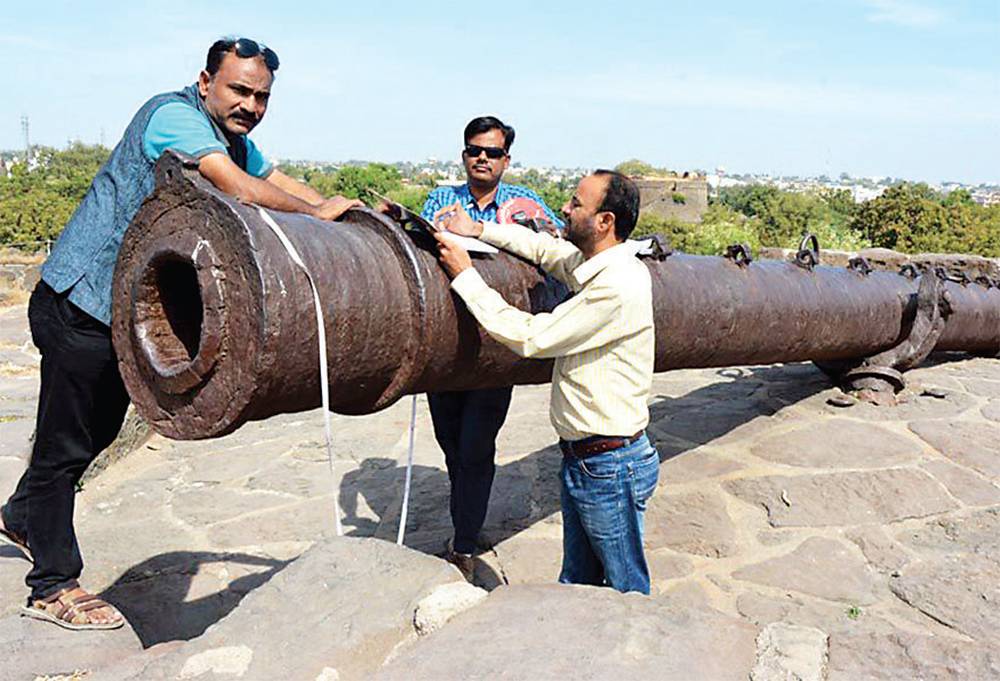
Mohammed Ayazuddin Patel, Dr Rehaman Patel and Mohammed Ismail measuring the Bara Gazi Toph
The three researchers, Mohammed Ayazuddin Patel, the national award winner, artist and photographer, Dr Rehaman Patel, artist and researcher at Indo-Islamic Art, Kalaburagi, and Mohammed Ismail, Bahmani researcher and coin collector who recently discovered a cannon in a fort in Kalaburagi, which they say is the longest in the world, are worried over its preservation.
It was their visit to Gulbarga Fort in search of the name of the first Bahmani sultan, Alauddin Hasan Bahaman Shah among the Persian inscriptions on the Jama Masjid that led to its discovery. Speaking of the cannon to Bangalore Mirror, Mohammed Ayazuddin Patel said, “Since 2010, I have been researching on the subject. The existing world record is in the name of Tsar Cannon that is 17.5 feet long and was built in the 15th century in Russia. The cannon has been named in Guinness Book of World Records, when the fact remains that the top three longest cannons exist in India. It is a matter of pride for the people of Kalaburagi and the Hyderabad-Karnataka region that the longest cannon in the world is located in Bahmani Fort and was manufactured during the reign of Bahmani Empire in the 14th century. It is made of the alloy Panch dhatu.”
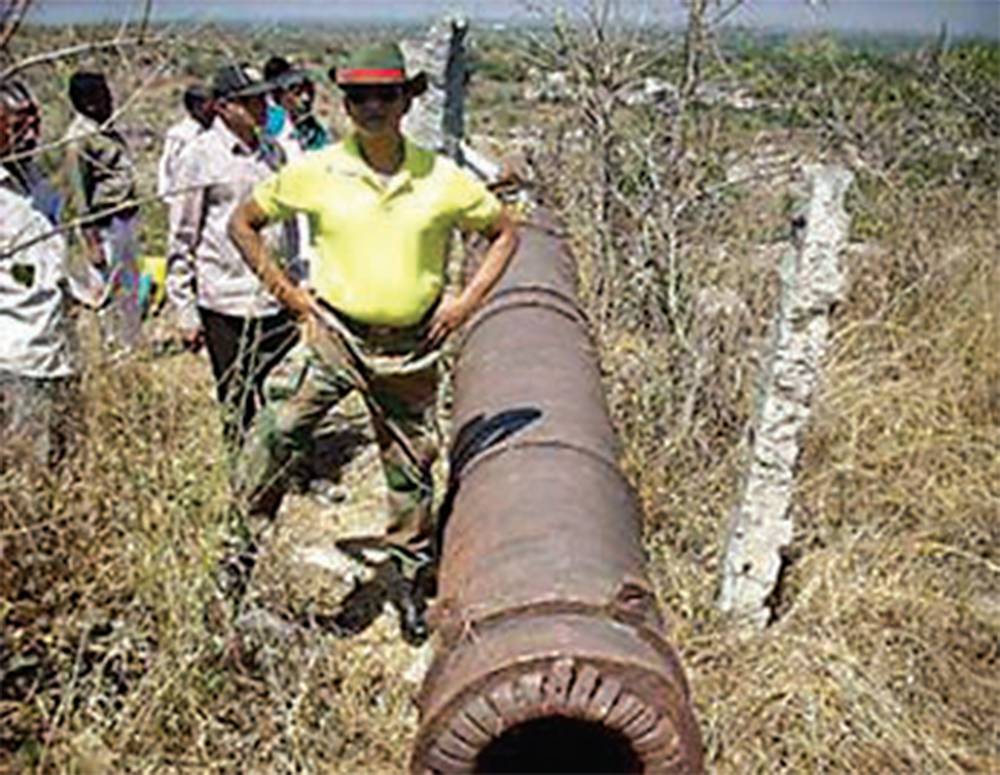
The cannon is known as Bara Gazi Toph and measures about 29 feet in length. Its circumference is 7.6 feet and diameter 2 feet. The barrel is 7-inch thick. In India, the largest recorded cannon is about 23 feet long and is located in Koulas Fort in Nizamabad district of Andhra Pradesh. Asaf Jah-1 (first Nizam) granted the Koulas Fort to the Rajput king Raja Kunwar Gopal Singh Gaur in 1724 AD for his bravery in the battle of Balapur and Shakkar Keda. The biggest cannon on wheels, built by Raja Mansingh, is in Jaipur and measures 20.6 feet in length.
“The Jaipur cannon weighs about 50 tonnes. We assume that the weight of the Kalaburagi cannon could be around 70-75 tonnes. While, the firing range of the Jaipur cannon is about 35 kilometres, that of Bara Gazi Toph could be 50-55 kilometres,” Ayazuddin Patel said.
The Bahmani monarchs, who ruled from the present Kalaburagi (Ahasnabad), stand out among other rulers for their contribution to the city. The founder Alauddin Hasan Bahaman Shah (1347-1422) made Gulbarga the capital and before his death he became the master of a vast empire. Even as they extended their territory, the rulers made significant contribution to the fields of art, architecture and literature.
The Bahmani sultanate was the first independent Islamic state of the Deccan in South India and one of the larger medieval Indian kingdoms. They ruled for 191 years (1347-1538 AD). Their other capital was Bidar.
The Gulbarga Fort was significantly expanded in 1347 by Alauddin Hasan Bahmani after he cut off ties with the Delhi sultanate. Islamic monuments such as mosques,
palaces, tombs, and other structures were also built later within the refurbished fort. The Jama Masjid built within the fort in 1367, is a unique structure of Persian architectural. It is fully enclosed, and has elegant domes and arched columns, which is unlike any other mosque in India.
The biggest challenge about historic monuments in the state is their protection, a fact not going to be any easy with the region being a backward area. “The Archaeologi-cal Survey of India and state archaeology department should take steps to protect the cannon at the Bahmani Fort and it should be included in the world record list. It should be fenced. The cannon is filled with sand and pebbles, so should be properly cleaned. Also, a signboard stating its details as the longest cannon in the world is a must. The fort and Jama Masjid must be declared heritage centres,” added Ayazuddin.
The team submitted a memorandum with their pleas to the district in-charge minister Sharan-prakash Patil, the deputy commissioner, regional commissioner, as well as the departments concerned.
GIGANTIC CANNONS OF THE WORLD
Jagadamba Bhavani Tope: Located at the historic Koulas Fort in Andhra Pradesh is believed to be the largest cannon in the world. The cannon (left), which is 23 feet in length and weighs 70 tonnes, is predominantly made of iron. It has a 16-inch calibre with an explosive head of 150 kg.
Jaivana: Recorded as the world’s largest cannon on wheels, Jaivana was manufactured during the reign of Maharaja Sawai Jai Singh II (1699–1743) at a foundry in Jaipur, Rajasthan. Jaivana’s barrel measures 20.19 feet in length and 11 inches in diameter. The 50-tonne cannon is mounted on four wheels. The rear wheels are mounted on roller pin bearings, to turn it 360° and fire in any direction. It was designed to fire a 50 kg cannon ball to a distance of 35 km. This cannon was never used in any battle as the Rajput rulers of Amber had friendly relations with the Mughals.
source: http://www.bangaloremirror.indiatimes.com / Bangalore Mirror / Home> News> State / by Deepthi Sanjiv, Bangalore Mirror Bureau / December 28th, 2016