Rummana Hussain, a painter and conceptual artist who was also active in Indian politics, died on July 5 at her home in Bombay. She was 47.
The cause was cancer, said the photographer Ram Rahman, a friend.
Ms. Hussain, who came from a prominent Muslim family in Bombay, was for much of her career a painter of allegorical figurative subjects. But political events in India, particularly the destruction of a mosque by Hindu militants in the city of Ayodhya in 1992 and the subsequent attacks on Muslims, spurred her into political action and changed the direction of her work.
She participated in demonstrations protesting both the Ayodhya incident and growing religious nationalism in India. She developed a photo-based feminist art that brought images of ruined architecture, land and the female body together in pointed combinations.
As an artist in residence at Art in General, an alternative space in Manhattan, she created a video-based installation last fall. Titled ”In Between,” the video combined images of Bombay with others of South Asian immigrant life in New York and alternated shots of the artist under treatment in a Manhattan hospital with others of her walking across the Queensboro Bridge wearing the tinkling ankle bells of an Indian classical dancer.
Ms. Hussain showed widely in India and in Europe
She is survived by her husband, Ishaat, and a daughter, Shazmin.
source: http://www.nytimes.com / The New York Times / Home> N.Y./ Region / by Holland Cotter / July 18th, 1999
Kurnool, ANDHRA PRADESH / Dubai, UNITED ARAB EMIRATES :
Besides the groom dressed as a prince in a royal entourage, flanked by a column of soldiers and a set designed as a castle, the wedding will bring together celebrities from the UAE, Turkey, Sri Lanka and Pakistan.
Some Indian ministers are also expected to attend this wedding of the daughter of Nawab Shahtaj Shaji Ul Mulk, founder and chairman of Sharjah-based Mulk Holdings.
A hall at the famous Atlantis hotel is being recreated into a mini palace for the main wedding event which is scheduled for January 4.
The groom, Bilal Muahid Khan, who has a degree in infrastructure engineering is settled in the US. He recently won an award for his design proposal of infrastructure study and solutions for the city of Charlotte. His father, Masood Nawaz Khan, is a cardiologist based in Charlotte.
The Khans also belong to a royal family and are distant relatives of Nawab Shaji Ul Mulk.
Royal entertainment such as dance shows, poetry recitation and fire throwing will be part of the show.
An Indian singer has reportedly been roped in for an unplugged show.
Indian Mela (carnival) will be the theme for the Mehndi ceremony, which is scheduled for January 3.
Performers like magicians, stilt walkers and rice carvers have been roped in for this event.
source: http://www.business-standard.com / Business Standard / Home> PTI Stories> International News /by Press Trust of India / Dubai / August 03rd, 2010
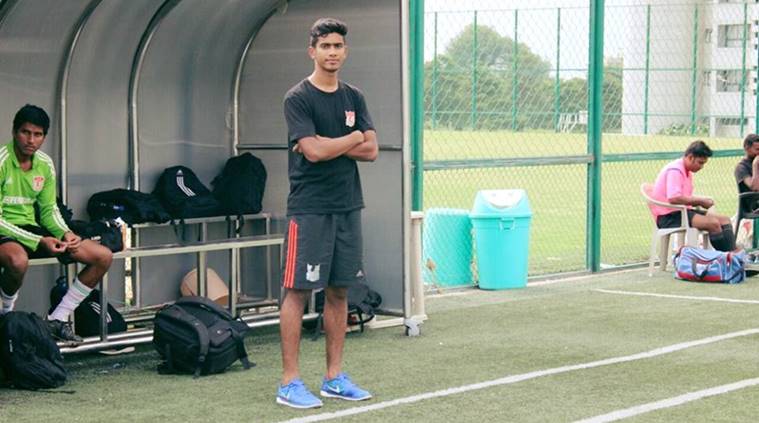
Ashique Kuruniyan said he was keen to make a mark in Spain and come back a better player and play for India and FC Pune City both.
Ashique Kuruniyan has represented India Under-19 team for the AFC U-19 Championships in Palestine. (Source: Facebook)
Indian Super League franchise FC Pune City today got a big boost to its academy plans as is product Md. Ashique Kuruniyan will head to La Liga club Villarreal to play for its third team on loan.
This is the first time a home grown Indian academy player has been selected by a top Spanish club to ply his trade in Europe.
Excited at the development, FC Pune City CEO Gaurav Modwel said, “This is a testimony of the fact that India is brimming with talent and the right talent needs the right guidance to make the right moves. Ashique has the correct attitude and an appetite for goals.
“He will only get better with his stint in Spain and I won’t be surprised if he goes on to have a longer spell in Spain beyond the one year loan that we have agreed with Villarreal CF. I would like to thank Villarreal for taking this step and I hope this turns out to be first of many such initiatives that we will take together for the growth of Indian football.”
The Kerala-born youngster has already made the right noises when he was picked for the India Under-19 team for the AFC U-19 Championships in Palestine. Prior to that, Ashique represented India for the Under-18 side in the FAM-Frenz Asia Champions Trophy where he scored a wonderful solo goal for India that brought him under the spotlight. Primarily a winger, Ashique can play across the forward line.
Ashique said he was keen to make a mark in Spain and come back a better player and play for India and FC Pune City both.
“This is a dream come true. All these years, we would admire these top clubs and their players from afar, but thanks to FC Pune City and Villarreal, I will get a chance to play at one of the most respected clubs in Spain,” said Ashique.
Villarreal CF’s President Fernando Roig said this is just the beginning of identifying good talent from India and giving them a chance to play against in our youth team.
“Villarreal CF was more than happy to absorb Md. Ashique Kuruniyan in their side because we saw the spark in him. Our coaches will work on him and we will aim to realise his true potential. His development as a player is given and this will only bode well for football in India in general. We thank FC Pune City for facilitating this move and hope this inspires a lot more young talent to make it big in Europe.”
La Liga President Javier Tebas said this is just the beginning of identifying good talent from India and giving them a chance to play against the best in the business.
“We thank FC Pune City and Villarreal CF for creating a competitive pathway for young talented players. Through ISL, we have already seen a lot of Spanish coaches and players come to India in the last three years. For us at La Liga, it’s heartening to see Indian players making a move to Spain as well. We hope that this inspires many more young talented Indian players to get opportunities in Spain.”
source: http://www.indianexpress.com / The Indian Express / Express Sports / Home> Sports> Football / by PTI / Pune / October 26th, 2016
A woman from Dakshina Kannada district got an international certificate in transactional analysis psychotherapy. She is reportedly the third Muslim woman in the world to achieve this feat.
Forty-two-year-old Haseena Abdulla, daughter of K Abdulla Parkala of Manipal , received the certificate by the International Transactional Analysis Assoication at the conference hosted by SAATA – a South Asian Association in September. Transactional analysts from many countries witnessed the event and examiners were from Germany, UK, Japan, South Africa, US, and India. This award is an appreciation for her eight years of effort in exploring the world of psychotherapy.
P K Saru, the former president of SAATA and founder director, ASHA Counselling and Training Centre, Coimbatore and Fuson, provisional teaching supervising transactional analyst from Turkey are the only two Muslim women, to have got this certificate before Haseena Abdulla.
Haseena said she is very passionate in discovering the frames of relationship and initiating empowerment efforts for many. “As an ardent learner of human behaviour, my journey of seeking knowledge led me into the world of transactional analysis.
It was a road less travelled for Muslim women, and I am the third Muslim woman transactional analyst in the world, and second in the country to earn this certificate,” she said proudly.
Haseena, who was trained under P K Saru, is a post graduate in psychology and sociology. She has also been trained in hypnotherapy, gestalt therapy and psychodrama. She is a master practitioner in NLP trained by Dr. Richard Mc Hugh, USA. Currently she is a practising psychotherapist and has a clinic in Manipal. She is also a visiting practitioner at Calicut, Kerala.
“Transactional analysis is a most advanced discipline in psychotherapy arena, which empowers the patients with awareness and the power to heal. It has a strong evidence based, effective diagnosis and participatory treatment plan for patients with psychiatric problems. Consulting a psychologist is still a stigma in the community and labelling the client as psychotic, sometimes even by the practitioners caused this unfortunate situation. Discovering the unknown part of the self is essential in completion of a healing process. Transactional analysis psychotherapist helps the client to achieve this by not being labelled,” Haseena said.
“The concepts in transactional analysis could be readily applied in our lives from the moment we are exposed to them. It believes that the power to cure and heal is in the patient. Therapist is just a facilitator to the patient to think and decide. Application of TA has also been instrumental in organizational success and educational excellence,” she added.
source: http://www.timesofindia.indiatimes.com / The Times of India / News Home> City News> Mangalore / Vinobha KT / TNN / October 05th, 2016
Abortive takeover bids did not prevent the Muslim influences from impacting the Kashmir society. Long before Kashmir’s transition to Islam, the new faith existed and thrived even during the Hindu rule, says Sara Wani
(Manuscripts of the Holy Qur’an calligraphed in 1237 AD on a 25 feet long and 2.5 inch wide scroll paper. Belived to be gifted by Shiekh Hamza Makhdoom (RA) to Khawaja Miram Bazaz, great grand father of Majid and Ashraf Quazi, who displayed it in an exhibition in Srinagar.)
Mohammed bin Qasim packed home never to return and Ghaznavids’ left, as if vowing never to set foot on mountains guarding Kashmir like a wall. Kashmir kingdom was apparently insulated against the changes that swept proper India. Delhi Muslim kings and Turkish Sultans remained too preoccupied with power consolidation to make any advance toward Kashmir.
But for the ideas and influences, high Himalayas were no impregnable. Then, political boundaries did not stop trade, refugees and even fortune hunters. Kashmir knew of Islam much earlier than the two failed conquests.
In his Shah Hamdan of Kashmir, Kashmir’s former Director of Archives, Archeology, Research and Museums, Prof Fida Mohammad Khan Husnain has referred to a legend that then Kashmir ruler Veenditya’s emissaries had trekked through Bahrain and met the prophet of Islam. “This information is further collaborated in a Persian manuscript entitled Anwar-i-Kashmir, where it is informed that the Holy Prophet did depute Abu Hazifa Yamani in about 8 AH (after Hijra) with letters to the Chinese emperor but the above emissary got held up in Kashmir due to a heavy snowfall,” Husnain wrote. “Veenditya, the Raja of Kashmir treated them well.”
While the author offers no detail about the veracity of the manuscript and its writer, he claims that Caliph Umar ibn Khitab had deputed a delegation of five persons to Kashmir in about 21 AH. He offers no reference to substantiate the claim. Extensive research failed to trace the king in Rajatarangini. At that point of time when Islam was getting established in the deserts of Arabia, Kashmir was witnessing transfer of power from Baladitya, the last Gonanda king, to Karkotas whoso rule begun with Durlabhavardhana (627-649). Even the Thang dynasty records in China suggest that the first Muslim delegation comprising 15 Arabs was led by Said Ibn Abi Waqqas. Thabit ibn Qays accompanied him. Dispatched by Caliph Usman, it met Chinese Emperor Yung-Wei in 651.
But the existence of Muslims in Kashmir is well documented after the fall of Sindh. Chachnama author Alafi bin Hamıd al-Kufı, states that Muhammad Alaf, an Arab mercenary who had served Sindh ruler Dahır (712 A D), sought refuge in Kashmir. The then Kashmir ruler Candrapıda, received him well and bestowed on him the territory of Shakalbar. G M Sufi, the author of Kashir: Being A History of Kashmir has quoted Sir Alexander Cunningham locating Shakalbar somewhere around the slat range saying the territory was then under the control of Kashmir king.
After Alafı’s death, his estate was inherited by one Jahm, who, according to al-Kufı, “built many mosques there”.
Writing in the UNESCO publication History of Civilizations of Central Asia (IV), N A Baloch has quoted al-Bırunı recording that Muhammad bin al-Qasim bin Munabbih who took Multan “belonged to the house of Jahm bin Sama al-Shami, who had allegedly settled in Kashmir as far back as 712–14 and whose descendants had reportedly continued to flourish there.”
Baloch says though Kashmir was ruled, from the eighth century onwards, by the local, independent, originally non-Muslim dynasties, the region had “increasing political contacts with the Muslim rulers of Sind and Khurasan.” Kashmir and Kashgar, then, would be the two main trading states through Gilgit.
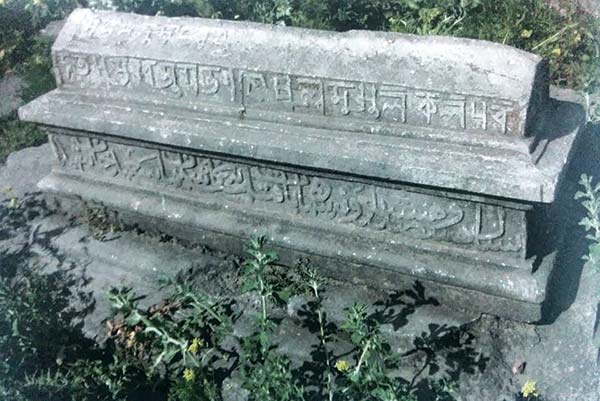
(Arabic and Sharda inscription on the grave of Seda Khan, next to Ziarat of Bahauddin Sahib, who died in a battle in the reign of Mummad Shah (1484-1537).)
Gaznavids’ returned home from Rajouri as winters set in and failed to wrest Kashmir from Sangramaraja in 1021. “It is, however, possible that some of Mahmud’s soldiers, finding it difficult to cross the mountains towards the plains of India, stayed behind and settled in Kashmir,” historian Abdul Qayoom Rafiqui writes in the UNESCO publication. “It is after these Turkish invasions that Kalhana refers, for the first time, to the presence of Turuskas (Muslim) in Kashmir when describing the reign of Harsa (1089–1111).”
Venetian adventurer Marco Polo is still a widely reliable traveler of that era. He visited Kashmir in 1260. His description of an “idolatrous” Kashmir, then ruled by Laksmanadeva (1273-86) – an “incompetent” ruler “consistently harassed by the Turks and his turbulent nobles”, is brief but interesting.
“They have an astonishing acquaintance with the devilries of enchantment; insomuch that they make their idols to speak,” Polo records in his Travels of Marco Polo. “They can also by their sorceries bring on changes of weather and produce darkness, and do a number of things so extraordinary that no one without seeing them would believe them.”
While terming Kashmir as the “very original source from which Idolatry has spread abroad”, Polo has made the predominant faith clear. But he has made two other observations.
“There are in this country Eremites (after the fashion of those parts), who dwell in seclusion and practise great abstinence in eating and drinking. They observe strict chastity, and keep from all sins forbidden in their law, so that they are regarded by their own folk as very holy persons. They live to a very great age,” goes the first one.
“The people of the province do not kill animals nor spill blood; so if they want to eat meat they get the Saracens who dwell among them to play the butcher,” is the other observation. Saracen is a generic term for Muslims that Christian writers widely used in Europe.
Evidences suggesting Muslim presence in thirteenth century were further corroborated in August 2012 by Qazi brothers – Ashraf and Majid, originally from Khawaja Bazaar. At an exhibition, they displayed full text of the Qur’an calligraphed in 1237 AD on a 25 ft x 2.5 inch scroll paper. “It is part of our heirloom and we had forgotten it on our attic in our old house under the shingled rooftop and nobody touched the two boxes for nearly 150 years,” Ashraf said. “Once we discovered and opened the box, we discovered the treasure.” The rare manuscript, calligraphed by Fatahullah Kashmiri was gifted by Sheikh Hamzah Makhdoom to Khawaja Miram Bazaz, the great grandfather of the Qazis. It carries a certificate of authenticity and transfer with 35 Ulema as witness. Historians did not expect Muslims to be living in Kashmir, then.
Focusing on the ‘court’, Rajatarangini, Kashmir’s oldest historical chronicle skips mentioning social changes in detail. But the first major mention of a social change is during the reign of Lohara dynasty king Harsa (1089-1101). The king says Kalhana, “introduced into the country more elaborate fashions in dress and ornaments and made his courtiers imitate his own taste for extravagance in personal attire.” The ‘new dress code’, an apparent ‘Western Disturbance’ was explained by M A Stein as the “Mohammedan influence”.
This observation is indicative of a social impact though not a religious transformation. But the Kashmir court was never immune to foreign influence. Even Lalitaditya’s had a Turk minister Cankuna. Stein says he was from Badakhshan or its immediately adjoining tracts on the upper Oxus. Besides, Lalitaditya, “as overlord of India”, according to Maharajas’ of India, by Annmorrow Shrishti was “already recruiting regiments from Central Asia.”
Vajraditiya-Bappiyaka, Lalitaditya’s son who ruled Kashmir for seven years, says Kalhana “sold many men to and introduced in the country many Mleccha practice”.
Apparently, Mlecchs were to Hindu scholarship what Saracens were to European writers. A Sanskrit word, Mleccha means “alien in language and manners, uncouth, inferior”. Their presence was felt throughout the reign of Korkotas’, the dynasty that reigned Kashmir between 663 – 855 AD, coinciding with the period when Arab armies were being dispatched to the length and breadth of the world. Even the Bhavaishya Purana, one of the 18 Puranas of ancient Vedic literature dealing with the future, anticipates the rise of prophet of Islam as “the Acharay of Mlecchas”, a desert resident who would be the embodiment of divine qualities. Some Kashmir historians see Ali Kadal as the Mleccha Mar that Rajatarangini refers to.
Husnain is correct in saying that Islam was brought to Kashmir by non-Muslim Rajas. While Karkota king Vajraditya (761– 767) introduced Mleccha practices, Lohara dynasty king Harsa not only employed Turuska commanders but made temple spoliation a state policy. He confiscated idols possessing the valuable metals, they were made of.
A Hindu iconoclast, Harsa was an interesting character. Initially prudent, courageous and lover of art and music, Sufi feels “his mind was rather demented”. Kalhana see him as “a jumble of contraries”, who was bankrupted by extravagances. To manage his kitty, Kalhana says he would loot the temple treasures, especially the metallic idols. An exploitative taxman, he would even levy night soil! Even though famines, bandits and plagues attacked Kashmir, Harsa never exempted his subjects from taxes. Eventually, his nephews led a rebellion, putting his palace afire, roasting his queens alive and slaying his successors. He was perhaps the only Kashmir king who head was sliced after being hunted down and left to be cremated by a wood-dealer “as a naked pauper”.
Stein has explained Harsa differently. “As Kalhana is particular to specify the new metal statues of gods throughout Kashmir which escaped Harsa’s clutches, we cannot doubt the extent and thoroughness of Harsa’s iconoclasm,” Stein writes. “Can the latter have been instigated or encouraged somehow by the steady advance of Mohammadanism in the territories? Kalhana when relating to these shameful confiscations, gives to Harsa the epithet Turuska i.e; Mohammadan, and later makes reference to Turuska captains being employed in his army and enjoying his favor”.
Having little faith in his people and his soldiery, Harsa had raised a new model for his army. Comprising mostly Ekangas, the royal bodyguards and the Tantrins, the reformed trouble-makers, each group of hundred soldiers was placed under a Muslim commander, thus making it impossible for soldiers to run away or hatch plots. This was the beginning of Muslim influence in Kashmiri politics. After Harsa, Bhiksacara (1120-21) is understood to have raised a Muslim cavalry for his personal guard, a task they eventually failed in.
Harsa, however, was one of the series of puppet kings who misruled Kashmir for nearly 500 years after Lalitaditya (724-60) when court rivalry would change kings in Kashmir like turbans. In between came Avantivarman (855-883) who tried to put the house in order. Putting foreign conquests at halt, he devoted his attention to his state focusing on development, welfare, and delivery of services. As his son succeeded him, things were back to square one with class-wars and internecine battles triggering the political instability and reducing the kingdom to its old territorial confines.
By the time Jayasimha (1128-1155) took over, Muslim mercenaries had gained so much popularity that the king and his army chief, according to Kalhana, would go “into the camp with Yavanas (Muslims).”
The gradual decay of the state and the society had led to such deterioration, according to Rajatarangini that when Sahadeva (1300-1 to 1319-20 AD) took over, Kashmir had reduced to a kingdom of “drunkards, gamblers and profligate women”. So when Mongol king Karmasena’s commander Dulcha (Zulchu) invaded Kashmir in 1320, the king fled to Kishtwar. Nobody resisted 70,000-strong invaders, who devastated Kashmir for eight months, selling men to Tartar traders, setting afire dwellings and standing crops. But the entire army perished over Devsar Mountains in south Kashmir while fleeing Kashmir winters with thousands of men and women slaves.
Dulcha destruction literally marked the end of a long chaotic Hindu rule. That changed Kashmir forever.
(This is the second in a four part series on advent of Islam in Kashmir. Read the first partIslam’s Kashmir Story.)
source: http://www.kashmirlife.net / Kashmir Life / Home> Faith History / Tuesday – February 16th, 2016
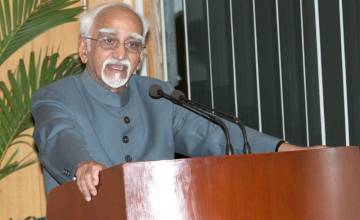
Vice President Mohammad Hamid Ansari on Thursday said a shared struggle against colonial rule provides the foundations of India-Africa partnership and “mutually beneficial engagement” will take the relationship to a “strategic level”.
Addressing students and faculty members of the University of Lagos here, Ansari said India, the largest democracy in the world, rejoices at the gains made by Nigerian democracy, the largest democracy in Africa, in the past 18 years.
“Our shared struggle against the colonial rule provides the foundations of India-Africa partnership. This mutually beneficial engagement continues to inspire and strengthen as we embark on elevating this partnership to a strategic level for the benefit the peoples of Africa and India,” he said.
Saying that each country and people shape their destiny in their own unique way, informed by their own historical experience and their own genius, the Vice President said independent India is a faithful reflection of the legacy of its national movement.
“The image of the modern Indian nation and the values that shape and continue inform it today, were cast in the crucible of our struggle for independence from colonial rule or what we now call the Indian National Movement. Much of the gain from the movement is enshrined in our Constitution and continues to enlighten the political and judicial discourse in India,” he said.
Elaborating how Indian national movement was more than a struggle for independence, the Indian leader said that it was an exercise in building a nation.
“It was not just a movement to replace a colonial regime and deliver political power to Indians but was aimed at using that power to secure social and economic justice, and dignity, for every Indian,” he said.
He said the Indian national movement is also an example of how the constitutional space offered by the existing structure could be used without getting co-opted by it. It did not completely reject this space – but entered and used it effectively in combination with political mobilization to overthrow the existing structure.
“The movement is perhaps one of the best examples of the creation of an extremely wide movement with a common aim in which diverse political and ideological currents could co-exist and work, and simultaneously continue to contend for overall ideological and political hegemony over it,” he added.
source http://www.thestatesman.com/ The Statesman / Home> India / IANS / Lagos, Nigeria / September 30th, 2016
Earlier, Shaik edged Joshua Chow of HongKong in the first all-lefty semi-final, 231-218 to advance to the finals.
Debutant Shaik Abdul Hameed became India’s first-ever title winner at the Asian-level as he captured the Asian Bowling Federation’s Thailand tour event. Shaik defeated Mahmood Al Attar of UAE 242-183 in the final
Both the men’s title contenders had an opened frame each in frame two, but Shaik rolled three consecutive strikes to take a slender lead of 9 pins when Mahmood came back in the fifth and sixth frames. The Indian, however, rolled another three consecutive strikes from frame seven onwards while Mahmood’s form tapered off. Shaik went on to strike out for a comfortable victory over Mahmood. Earlier, Shaik edged Joshua Chow of HongKong in the first all-lefty semi-final, 231-218 to advance to the finals.
Shaik won India’s first-ever medal in the sport during the Commonwealth Tenpin Bowling Championship 2002 in which he won gold medals in Singles and Masters and a silver medal in All Events. (Express News Service)
source: http://www.indianexpress.com / Indian Express / Home> ieSports> Sports Others / by Express News Service / New Delhi / April 20th, 2014
M Rafeeque Ahmed, chairman of Farida Group, a manufacturer of leather goods, has been elected the chairman of the Council for Leather Exports (CLE) at its annual general meeting in Chennai on Thursday.
Ahmed will be joined by Subash Kapoor as vice-chairman of the CLE. They will hold office in the respective positions for two years.
PR Aqeel Ahmed will be the regional chairman for south, Puran Dawar for north, Ramesh Kumar Juneja for east, Naresh S Bhasin for west and Mohamed Iftekhar for Central, a statement from CLE said.
The entire election process to the regional committees was initiated and monitored by the Joint Director General of Foreign Trade, Chennai, which had been notified as election authority for this purpose by the Union ministry of commerce and industry, the statement said.
source: http://www.timesofindia.indiatimes.com / The Times of India / News Home> Business > India Business / Sushma U N / January 23rd, 2015
Sheikh Ashiq, Director M/s Ferozson Exports Pvt Ltd, (a unit of Alkhuddam Group) Srinagar has bagged award for “meritorious performance in the export of Natural Silk Carpets.” It is the prestigious award in the silk industry.
Ashiq received the award on Monday at a function at Vigyan Bhawan, New Delhi. The function was organized by Indian Silk Export Promotion Council set up by Ministry of Textiles, government of India.
Acknowledging the award, Ashiq said the credit goes to the founder and chairman of the Alkhuddam Group Sheikh Feroz “who made the foundation of the company very strong.”
“Credit also goes to the suppliers of the company who have always shown trust in it,” he said.
Ashiq also thanked the organizers of the event.
source: http://www.greaterkashmir.com / Greater Kashmir / Home> Business / GK News Network / December 10th, 2014
“For a girl to pick up a tennis racquet and to want to be a professional—it was unheard of,” Sania Mirza says. “People thought it was a joke.” PHOTOGRAPH BY GREG WOOD / AFP / Getty
On the last day of August, Sania Mirza, currently the No. 1 women’s doubles player in the world, was on one of the smaller side courts at the U.S. Open grounds, in Flushing Meadows, about to play her first match in this year’s tournament. She and her partner, Barbora Strýcová, of the Czech Republic, were squaring off against the Americans Jada Myii Hart and Ena Shibahara. The sun had begun to sneak behind the bleachers, where a few dozen fans had settled in. Occasionally, a roar from Arthur Ashe Stadium or the grandstands could be heard over their polite clapping. Mirza’s black hair was tied back in its usual businesslike bun, her dark eyes focussed beneath a neon-pink headband. Mirza’s gruelling summer had included her third Olympics, which had ended just a couple of weeks before, with a fourth-place finish in mixed doubles. Her longtime partnership with the tennis icon Martina Hingis was also coming to an end. Now she was gearing up again, knowing that millions were paying attention in her native India, even if only a handful were watching in New York.
Mirza, who will be thirty in November, is wildly famous in one hemisphere and virtually unknown in the other. She has nearly twelve million Facebook fans – more than double the number that Serena Williams has—plus four million followers on Twitter, and two million more on Instagram. She is, without hyperbole, one of the most popular athletes on Earth. She has, to date, earned $ 6.3 million in career prize money, a fraction of what Williams has made, but more than a thousand times the annual per-capita income in her home country.
She is also Muslim, and has sparked the ire of clerics for competing in tennis clothes that leave her arms and legs exposed. Though roughly one in twelve people on the planet is a woman from India, few Indian women have succeeded in professional sports, for reasons that are not hard to pinpoint. Last year, in the World Economic Forum’s Global Gender Gap Report, India ranked No.108, out of a hundred and forty-five countries listed. For years, women in India were largely discouraged from participating in high-level sports—and, unless the women were wealthy, good facilities were hard to come by, anyway.
Mirza is helping to change this. She’s an advocate for women’s rights, and has spoken up about ending the practice of female feticide in India. She has criticized government policies on domestic violence and sexual assault, as well as lopsided pay schemes, including in sports. She was the first South Asian woman to be appointed as a Goodwill Ambassador for the United Nations, and she often calls out reporters for asking her, and not her male counterparts, about her “family plans.” She told me that, after she and Hingis won Wimbledon last year, she was asked by a reporter when she’d be having a child. “I was, like, ‘I won Wimbledon two days ago!’ ”
Though Mirza makes light of her reputation, in India, for what some there see as arrogance, the truth is that her outspokenness has only made her more popular back home. Her stardom is an unlikely outcome, considering where she started. “For a girl to pick up a tennis racquet and to want to be a professional—it was unheard of,” she told me. “People thought it was a joke.”
Mirza grew up in Hyderabad, a city of nearly seven million. It was only half that size when she was a child, and, back then, sanitation, let alone access to a tennis court, was not a given—only a handful of courts existed, and many that did were riddled with potholes or made with cow dung (a surface that was thought to offer a middle ground between clay and hard courts). Today, as Mirza is well aware, the city center of Old Hyderabad is a hub for human trafficking, and domestic violence is an urgent problem. Though technically illegal, child marriage persists. Local police blotters in and around Hyderabad regularly carry gruesome stories: a woman who hanged herself by her sari when a dowry went sour, a husband setting his wife on fire. Just a few weeks after last year’s U.S. Open came news, from south of Hyderabad, in Bengaluru, that a woman had been raped by two security guards outside of tennis courts in Cubbon Parks. It was the third such attack in the city in a month. According to local reports, the victim later told police, “I want to be like Sania Mirza.”
The Mirzas moved to Hyderabad, from Mumbai, when Sania was an infant, one of many families drawn to the burgeoning technology mecca. Mirza’s father, Imran, held a number of jobs, working mostly as a printer and, later, in construction. Mirza’s mother, Naseema, also had a mind for business, and she and her husband often worked together. They were ambitious, and forward-thinking in their attitude toward girls; still, they tried to avoid placing too much stress on their daughters. (Sania’s sister Anam is seven years younger.) It was on a whim that Imran signed up Sania, then six years old, for tennis lessons, at Hyderabad’s Nizam Club. There were cricketers in the Mirza family, but women’s cricket had not yet taken off in India. Tennis seemed like something she might enjoy.
A couple of months later, Sania’s coach suggested that Imran come to watch his daughter play. He put it off. When he finally saw her on the court, he immediately realized that she was a standout talent. Soon, the sport became as much a part of her childhood routine as brushing her teeth or doing her homework. Sania attended the Nasr School, a progressive all-girls private school, which adapted her academic schedule to accommodate her tennis travels. “Always in tracksuits, coming directly from practice straight to school!” Nirmal Gandhi, a teacher at Nasr who had Mirza as a student, said. “I don’t think I ever saw her serious. She was always laughing with her friends.” At the time, the Indian system for youth tennis was, Imran said, “nonexistent.” It’s not unheard of for the parents of tennis players to spend fifty thousand to a hundred thousand dollars, or more, annually on coaching, travel, and equipment, an expense that was far beyond the Mirza household budget at the time. So Imran began to coach his daughter, and set about researching local tournaments, learning what he could through word of mouth and follow-up phone calls. Sania’s mother stayed at home “to hold down the ranch,” tending to Mirza’s little sister and various pieces of family business, a pattern that would continue for twenty years—Sania’s tennis career becoming another joint family venture.
Mirza eventually won a berth in the 2003 Wimbledon junior girls’ competition, as a doubles player with Russia’s Alisa Kleybanova. They won the tournament. When Mirza stepped off the plane back in India, a mob of people greeted her and her family at the airport, fanfare that surprised them. Government dignitaries took photos with her and bestowed her with awards. The Indian press began to cover her every move, and it hasn’t stopped since. “At fifteen or sixteen, you’re still trying to get in touch with yourself as a person, as a teenager,” Sania Mirza said. “You have pimples. You have baby fat, in front of millions of people. You have to kind of grow up in front of the media, and you’re growing older and the following is getting larger and larger. You’re still getting in touch with who you are.”
“The Indian media, too, was just growing up,” Imran said. “They grew up along with Sania. They were really not geared or didn’t know how to handle a female sporting icon. They might have handled a film star, but here was the first sporting woman from India. It wasn’t easy for her, but it probably wasn’t easy for the media to deal with, either.” In 2005, as she was competing on the international circuit, a group of clerics issued a fatwa against Mirza, calling her skirts and T-shirts “un-Islamic” and “corrupting.” The cleric Haseeb-ul-hasan Siddiqui told the Guardian that the clothing she wore on court “ leaves nothing to the imagination .”
“You get hate mail,” Mirza told me. “You get love mail, but hate is a lot harder to digest than love. That’s the way it is.” She continued to wear Western-style pants and heels, and slogan-bearing T-shirts, including a popular one that declared, “Well-behaved women rarely make history.” The increased attention, and Mirza’s handling of it, gained her even more Muslim fans, a broad demographic that had largely been overlooked by the tennis-marketing establishment. And she excelled on the court. As a professional singles player, she reached a ranking of twenty-seven, the highest spot achieved by an Indian woman.
Privately, though, Mirza was battling a series of injuries. The hypermobile joints that helped give her flexibility on the court also led to extreme pain, which she often hid. She underwent operations on both knees and a wrist. Upon examining her body and her demanding competition schedule in 2010, doctors gave her the devastating news: she was done playing singles.
Mirza had been engaged to a longtime family friend, but in January of that year it was reported that she had called off the engagement. Then, in April, she became engaged to the Pakistani cricketer Shoaib Malik, whom she had met through mutual friends and had seen occasionally thereafter on various sports-related travels. The new wedding plans were a major story in India: Malik had served for two years as a captain of the Pakistani national cricket team, and cricket is something of a religion in that part of the world. Ordinarily, this would have made Mirza and Malik the Beyoncé and Jay Z of South Asian sports—but marriage to a Pakistani, even one who is an élite athlete in a treasured national pastime, is still “a huge taboo” in India, according to Bappa Majumdar, the Hyderabad bureau chief for the Times of India, who has covered Mirza. “It showed huge guts on her part,” Majumdar said.
The couple had planned an Islamic wedding ceremony in Hyderabad, with another ceremony to follow in Pakistan, adhering to that country’s customs. Within hours of the announcement, dozens of journalists had camped out in front of the Mirza home, to cover the tale of the star-crossed lover-athletes. The story then took an additional soap-opera turn: a woman from Mirza’s home town went to the press, saying that she was already married to Malik, and had been since 2002. He initially disputed this; they had merely met online and exchanged photographs—though, he said, the pictures she sent him were of someone else. But he ultimately admitted to the marriage and got a quick divorce, according to local news reports, days before his wedding to Mirza.
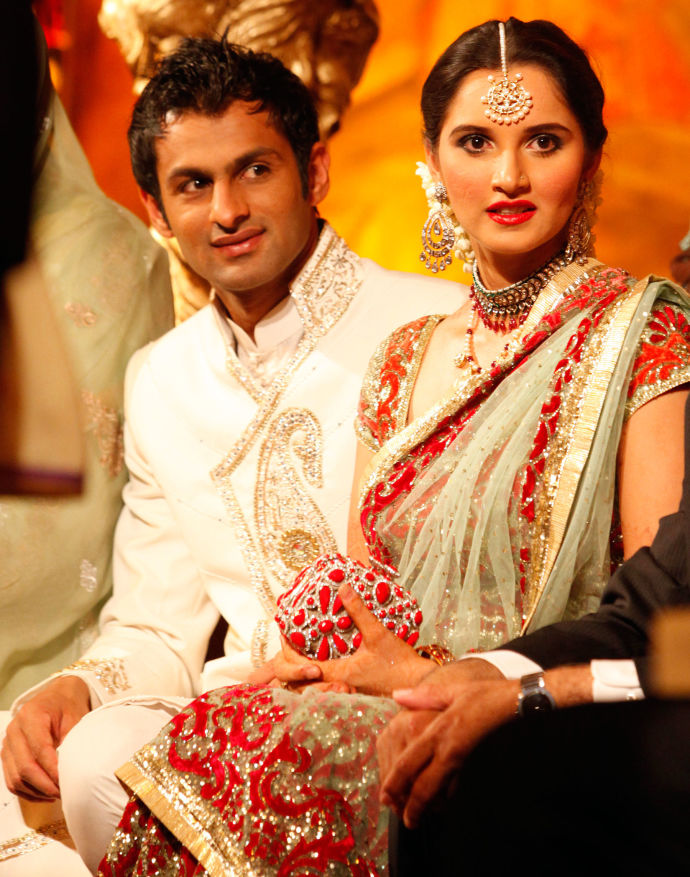
Mirza at her second wedding to the Pakistani cricket star Shoaib Malik, in his home country. His nationality drew criticisim of Mirza in India./ PHOTOGRAPH BY FAISAL MAHMOOD / REUTERS
On account of her marriage, some of Mirza’s critics in India have called her the “daughter-in-law of Pakistan.” In an interview with a New Delhi television station, in 2014, she burst into tears, saying she was exhausted by the need to “keep asserting my Indianness.” “I have no problem if they attack me about my tennis or they attack me about what I’m doing,” Mirza told me, adding, “I come from a country of 1.2 billion people, and I’ve accepted the fact that I’m not going to be liked by all of them.” Her family, in any case, approved of the union, Imran said. “She wasn’t getting married to a country but a person.”
Mirza and her father spend much of the year on the road, but when they’re not travelling they can often be found at the Sania Mirza Tennis Academy, a set of nine hard courts nestled among farmland and jungle, with a sweeping view of Hyderabad. The family bought the plot of land four years ago, with the goal of making it a hub for tennis in India. Some hundred children are now enrolled in the academy, almost all of them having heard about it by word of mouth. Some are the children of Hyderabad’s rising middle and upper-middle classes, but others have never seen a tennis court prior to joining, and rely on scholarships, which are offered according to financial need. Backing from sponsors was not forthcoming when the academy opened, in March of 2013, so the program was jump-started with funding from the Mirza Family Trust.
Here Mirza can practice in relative seclusion. She and her father also talk to parents about the nuances of a good backhand, what competition is like internationally, and the grit required to make it as a professional. Some aspiring players have shown up at the academy’s gates on rickshaw, their parents willing to relocate some or all of the family to Hyderabad or nearby villages solely in pursuit of tennis. “They thought Sania was an overnight success, and they want results in six months,” Imran told me when I visited the academy last year. “And I keep telling them it takes ten years to find out whether they even have a chance. It cannot be done for the money or the fame. It has to be done for the passion.”
When I spoke with Mirza in Flushing, a year later, she said it had been two months since she’d been home to India. She and Strýcová won their first match at the U.S. Open, convincingly, 6–3, 6–2, and she noted afterward that the dynamic she shares with Strýcová on the court is not dissimilar from her partnership with Hingis: Mirza is strong and powerful, sweeping the back of the court, while Strýcová is nimble and poppy at the net. The two have known each other since they were teen-agers on the junior circuit, which has helped with the transition. But earlier this week they were knocked out of the Open by Caroline Garcia and Kristina Mladenovic, the tournament’s top seeds. (Garcia is ranked No. 3 in the world in women’s doubles, and Mladenovic is No. 4. Hingis is No. 2.)
Mirza published an autobiography in India this summer. She said she doesn’t know how long she’ll play, or what the future holds for Indian women, but she pointed to India’s victories at the Rio Games as a sign of progress. The Indian Olympic Committee, which had been banned, was reinstated in 2014, and the country sent its largest-ever delegation, a hundred and seventeen athletes. They won two medals: a silver in badminton, for Pusarla Venkata Sindhu, and a bronze in wrestling, for Sakshi Malik. “It was amazing,” Mirza said. “And it was the women who won!”
Mary Pilon is the author of “ The Monopolists,” a book about the board game Monopoly. She previously worked as a staff reporter at the Times and the Wall Street Journal, where she wrote about sports and business.
source: http://www.newyorker.com / The New Yorker / Home> Sections> The Sporting Scene / by Mary Pilon / September 10th, 2016