Sangam city is famous not only for its brilliant academicians and towering political personalities, but also because of its sportspersons who have made it big on the national and international stage in various disciplines. Cricketers, gymnasts, hockey players or shuttlers, Allahabad lads have always made their presence felt whenever they have got an opportunity.
Heading the list is Mohammad Kaif who made it to the national squad and soon found a place in the record books with his match-winning knock at NatWest trophy in 2002 where he scored an unbeaten 87 in partnership with another cricket hero, Yuvraj Singh, to clinch the trophy for India at Lord’s cricket ground.
Kaif was the most successful captain of UP in the Ranji Trophy, as under his leadership the home team won their maiden Ranji Trophy title, beating Bengal in a thriller played at Lucknow in 2006. Kaif has played 13 Tests, 125 one-day internationals and 177 first class matches. However, donning a new role Kaif will now lead his new state, Chattisgarh, which will make its debut in Ranji Trophy in the 2016-17 domestic season.
Another cherished moment for Allahabad was when five of its cricketers including Ashish Winston Zaidi, Obaid Kamal, Jyoti Yadav, Mohd Saif and Mohd Kaif represented UP in the 1998 Ranji Trophy final against Karnataka.
The history of gymnastics in Allahabad dates back to 1989 when the National Sports Academy (NSA), headed by its chief patron Dr UK Mishra, made a beginning in the sport with a handful of boys. His efforts bore fruits when the 2010 Commonwealth Games made gymnast Ashish Kumar an instant star, as he created history and became the first Indian to win medals in gymnastics for the country.
In badminton, the city has produced number of outstanding players like Suresh Goel, Damayanti Tambe, TN Seth, Abhinn Shyam Gupta, Sushant Saxena and few others. Goel was the men’s national singles champion on five occasions from 1962 to 1970 and he also won national titles in men’s doubles and mixed doubles.
The story of local sporting heroes’ march to glory would be incomplete without the mention of Danish Mujtaba who became the captain of Indian team at the young age of 23 and produced some memorable performances at international level. He was the only player from the city who participated in the Rio Olympics, 2016.
source: http://www.timesofindia.indiatimes.com / The Times of India / News Home> City> Allahabad / TNN / August 29th, 2016
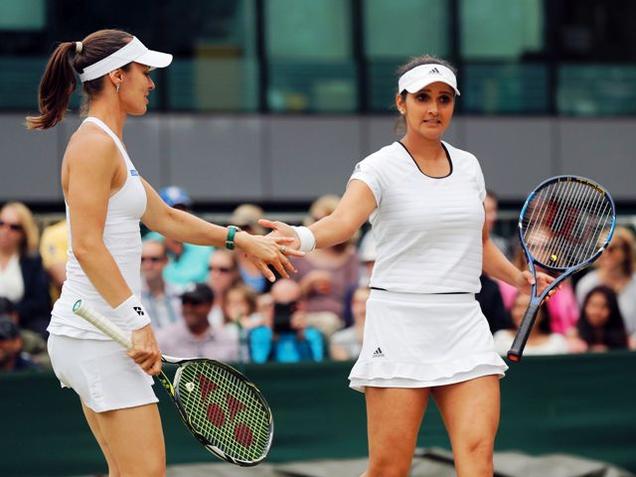
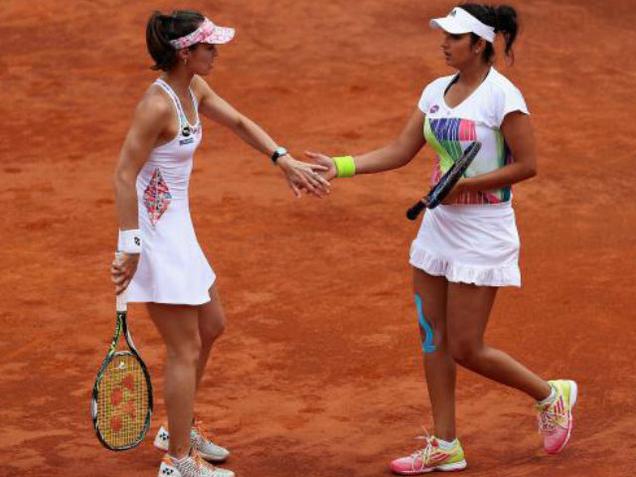
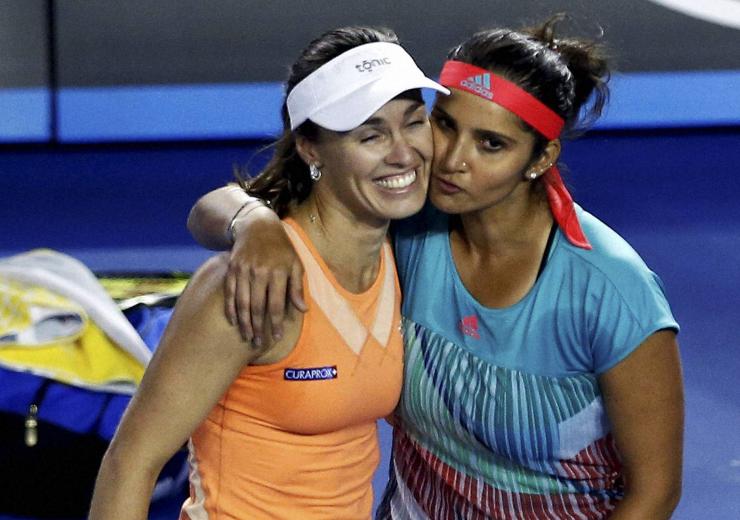
It is official. India’s six-time Grand Slam winner Sania Mirza has decided to part ways with Swiss great Martina Hingis. The World No. 1 duo has won 3 Grand Slams and 14 WTA titles together since they paired up in 2015.
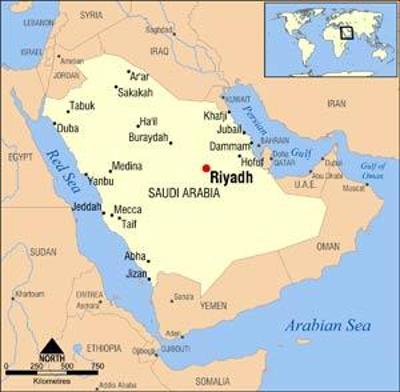
The Union government is leaving no stone unturned to ensure the safe return of Indian expatriates in Saudi Arabia, said Mohammed Irfan Ahmed, member of Central Haj Committee of India..
Irfan said as many 8,000 labourers are stranded in Saudi Arabia. Majority of them are from Kerala and Karnataka. “We are working on their return as well demanding that they are paid their dues,” he said.
source: http://www.timesofindia.indiatimes.com / The Times of India / News Home> City> Mangalore / TNN / August 09th, 2016
Mufti Mohammad Akhtar Raza Khan Qadiri aka Azhari Miyan, chief cleric of the influential Dargah Aala Hazart here, has occupied 25th place in the annual list of 500 ‘most powerful and influential Muslims’ across the world.
The list was prepared by the Jordanian thinktank Royal Islamic Strategic Study Centre (RISSC), affiliated with the Royal Aal al-Bayt Institute for Islamic Thought in Amman.
Azhari, 72, who has around five crore disciples in 55 countries all over the globe, has regularly featured in this list. He was ranked 22nd in 2013, 2014 and 2015. Considered as the ‘grand’ mufti in India, Azhari has written more than 5,000 fatwas, the most famous being one that was passed in 1975 against sterilisation.
“The then Prime Minister Indira Gandhi had made sterilization compulsory in the country. Even Darool Uloom Deoband had passed a fatwa, claiming the process is valid in Islam. But Azhari Miyan stood by his decision, saying the medical process was against sharia,” said Maulana Shahbudeen Razvi, Azhari’s secretary.
Azhari is the great grandson and successor of one of the most distinguished sub-continental Islamic scholars in history, Ahmad Raza Khan. Khan had founded the Barelvi movement in South Asia.
“Azhari Miyan shot into prominence after he refused to offer namaz at the Imam-e-Haram at Mecca in 1986 since a Wahabbi cleric was leading the prayers. Following this, he was arrested by the Saudi Arabian government. But largescale protests throughout the world forced the Saudi Arabian government to release him,” added Razvi.
Azhari has also authored more than 50 books on Islamic theology and thought in Urdu and Arabic. After receiving his basic education at the Manzar-e-Islam madrassa of the Dargah Aala Hazrat and Islamia Inter College, Bareilly, he pursued higher studies at the Al-Azhar University, Egypt. He was honoured with the prestigious ‘Fakhre Azhar’ (pride of Azhar) award by the Al-Azhar University. “It is considered as one the biggest awards in the Islamic world,” said Razvi.
Azhari’s son Maulana Asjad Raza Khan, who is also the Bareilly city Qazi, said, “My father has always given messages of love, peace and prosperity. He says that terrorism has no link with Islam and people should not keep any connection with it.”
Apart from Azhari, another Indian to feature among the top 50 in the list is Maulana Mahmood Madani, leader and executive member of Jamiat Ulema-e-Hind. Madani was ranked 43rd in the list. The RISSC publication highlights people who have influenced and benefitted others within the Muslim community through their practice of Islam.
The top ten personalities in the list this year included names of King Abdullah II ibn Al-Hussein, king of Jordan, professor Sheikh Ahmad Muhammad Al-Tayyeb, the grand sheikh of Al-Azhar University, King Salman bin Abdul-Aziz Al-Saud, king of Saudi Arabia, Grand Ayatollah Sayyid Ali Khamenei, supreme leader of Iran, Amir al-Mu’minin King Mohammed VI, king of Morocco, Sultan Qaboos bin Sa’id Al-Sa’id, sultan of Oman, General Sheikh Mohammed bin Zayed Al-Nahyan, crown prince of Abu Dhabi, President Recep Tayyip Erdogan, president of Turkey, Grand Ayatollah Sayyid Ali Hussein Sistani, marja of the hawza, Iraq and Hajji Muhammad Abdul-Wahhab, Amir of Tablighi Jamaat, Pakistan.
source: http://www.timesofindia.indiatimes.com / The Times of India / News Home> City> Bareilly / by Priyangi Agarwal / TNN / August 08th, 2016
No more the hassles of carrying multiple ATM cards, an innovator in Kerala has developed a ‘Prime Card’ that helps customers merge savings accounts of different banks in a single card. He affirms that it can replace the US-based VISA and Master card available in India and emerge an alternative to existing Indian domestic card ‘RuPay’ with high-end security features. He has applied for an Indian patent for his innovation.
The 43-year-old innovator K Ummer Thalhath, a native of Malappuram opted out of his final year graduation in science at Farook College in Kozhikode. He went on to pursue an electronics course for three years and left that on an innovation spree.
Thalhath claims that the card has high-end security features and hence none would be able to duplicate or hack it. It will help the bank account holder draw money from any ATM. If the Prime Card is lost or stolen, the one who gets hold of it may not know which bank accounts are merged in the card and it has two pin numbers which cannot be easily cracked.
He is keen to develop it further with the support of industries here, who are willing to develop a domestic high-end electronic payment facility.
VISA and Mastercard are US-based global payments technology companies, while RuPay is an Indian domestic card scheme. He believes that his idea of ‘Prime Card’ payment technology if realized in association with Indian banks or domestic card company, will help India take a lead in floating a high-end secure card. He has held initial discussion with major banks including State Bank of India (SBI), Industrial Development Bank of India (IDBI) and Federal Bank.
The account holder can merge existing accounts or new account to the Prime Card with different personal identification numbers (pin) for different bank accounts. On high-end security feature of the card, he said Prime Card has two pin numbers, the customer should provide one pin when the card is inserted in ATM machine and another when selecting the bank for transaction. Other security modes are Matching Number System and Number looping system. Hence the security is much higher than ordinary cards, he said.
Responding to that, Federal Bank – Digital Banking assistant general manager Sunny KP told TOI that “the idea is good as it is handled by a single payment application software, yet there are practical difficulties in its implementation. It requires infrastructure, intermediary standing between banks to merge accounts and permit from Reserve Bank of India (RBI).”
National Payments Corporation of India (NPCI) chief manager Dheeraj Bharadwaj said over 50 crore cards are already in the market and to replace that with one card for various bank accounts would be tedious as it requires the consent of many banks. It was NCPI that launched RuPay to fulfil RBI’s desire to have a domestic and multilateral payment system in the country.
Centre for Science and Technology Entrepreneurship Development (C-STED) director Ajith Prabhu assured all possible support to take it forward in terms of exploring the commercial possibilities.
While, the innovator swears by his innovation that it can end the headache of banks over issues involving current ATM transactions. However, an electronic payment company or a financial institution with RBI permit should come forward to take it up, he said.
source: http://www.timesofindia.indiatimes.com / The Times of India / News Home> City> Thirvananthapuram / by Laxmi Ajai Prasanna / TNN / August 08th, 2016
Tanveer Sait to inaugurate Haj Camp-2016 on Aug. 1
Mysuru :
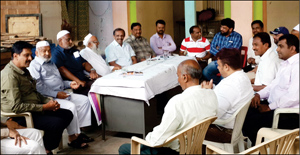
The District Haj Committee held its preliminary meeting under the Chairmanship of Abdul Azeez Chand at Muslim Girls Orphanage in city recently. The meeting elected Abdul Azeez Chand as Convener and Arif Ahmed Mekhri as Joint Convener for the orientation and inoculation for pilgrims of Haj-2016 from Mysuru, Mandya and Chamarajanagar.
The Haj Camp-2016 will be held on Aug. 1 at RK Palace in Udayagiri. Minister for Primary and Secondary Education, Minority Welfare and Wakf Tanveer Sait will be the chief guest.
Co-ordinator Mohammed Mumtaz Ahmed, Anwar Pasha, Syed Younus, Rafeeq Ahmed Khan, Rehman Khan, Irfan Silverline, Sohail Baig, Yusuf Jidda, Shabnam Sayeed, Akbar Aleem of Nanjangud, Mohiuddin of Mandya, Qurath Bhai and Khaleel, District Wakf Advisory Board Officers, were present.
For details, contact the Cordinator on Mob:97417-89000.
source: http://www.starofmysore.com / Star of Mysore / Home> General News / July 23rd, 2016
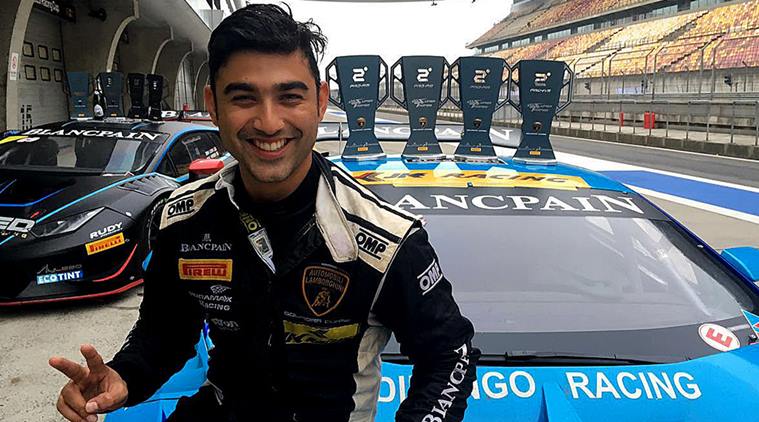
Armaan Ebrahim was off a fine start and went into the lead exiting Turn-1 and maintained the one-second advantage till he pitted for Dilantha to take over. (Source: IndiainF1)
Thailand :
In the double header, Armaan Ebrahim and Dilantha Malagamuwa, driving team Dilantha Racing, finished third in the first race on Saturday.
Indian racer Armaan Ebrahim, along with Sri Lankan Dilantha Malagamuwa, notched a fine double in the Lamborghini Blancpain Super Trofeo Asia series here this weekend.
In the double header, Armaan and Malagamuwa, driving team Dilantha Racing, finished third in the first race on Saturday and went one better today with a second place finish.
Armaan had qualified second for the first race, just a 10th off the pole position while Dilantha, suffering from an indisposition, was placed sixth for the second outing.
Armaan was off a fine start and went into the lead exiting Turn-1 and maintained the one-second advantage till he pitted for Dilantha to take over.
Dilantha, however, lost one spot and eventually finished third which was creditable considering that the Sri Lankan was on drips going into the weekend due to food poisoning.
In the second race, Dilantha, feeling much better, jumped two spots to move into fourth and gained another place when the car in front ran wide. After the mandatory pit-stop, Armaan took over and put in some blistering laps to move into second spot, but could not make any progress as he had too much a gap to make up.
Reflecting on his weekend, Armaan said: “We were a bit unfortunate in the first race after I came in when in the lead as Dilantha had not fully recovered from food poisoning that had him on the drips. Considering this, we were happy to finish second.
“In race two, Dilantha had to start since he qualified and luckily was feeling better. He got a good start and moved into fourth and after a couple of laps of applying pressure. The car in front of him ran wide allowing him to get through.
“Dilantha held third for the rest of his stint, but the gap to the leaders was considerably huge. Once I got in, I had to drive like a quali and managed to catch the car in P2 and pass him. I started making time on the leader, but the gap was too big and we ran out of time which meant we finished a strong second.”
source: http://www.indianexpress.com / Indian Express / Home> Express Sports> Sports> Motor Sports / by PTI , Buriram / July 24th, 2016
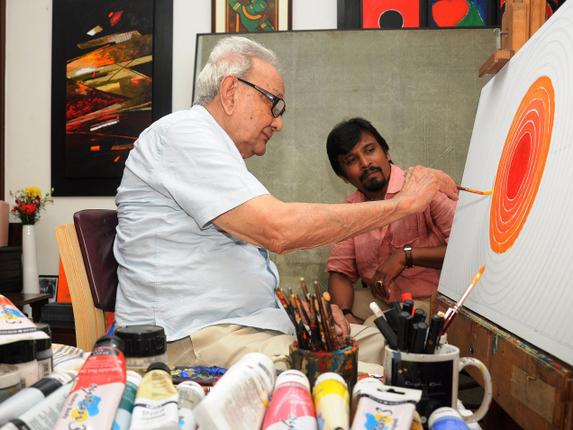
In this September 12, 2013 photo, S.H. Raza works on a “bindu” as his disciple Manish Pushkale looks on at the former’s studio in New Delhi. / The Hindu
“Bindu is a source of energy, source of life. Life begins here, attains infinity here”.
A few years ago, aged 89, S.H. Raza was game to talk to children almost like one, maybe just a couple of years older. Then, at the Jaipur Literature Festival he allowed the youngsters, who had surrounded him, a little peek into his life. Back in India after spending 60 years in France, his life seemed to have come a full circle. Not ready to confer retrospective dignity to his early years, Raza candidly admitted: “I was not fond of school. I was a bad student scoring low marks. Arithmetic did not interest me. My interest lay in drawing and painting. Fortunately, I found the right gurus. It is imperative parents as well as teachers understand a child’s qualities.” Raza himself was lucky. A restless soul that he was, his primary schoolteacher once asked him to continuously look at a dot on the wall inside the classroom to calm his mind. It was a little exercise that was to change the meaning of life for Raza, who turned the simplebindu into a work of art before raising it to the status of life itself.
Incidentally, Raza often judged as a France-based artist, grew up in a Madhya Pradesh village and went on to study at the Sir JJ School of Art. Around the time that the nation was hoisting the tricolour for the first time as an independent country in 1947, he founded the Bombay Progressive Artists’ Group. The group challenged the existing art establishment and Raza’s image as a rebel was probably etched with it.
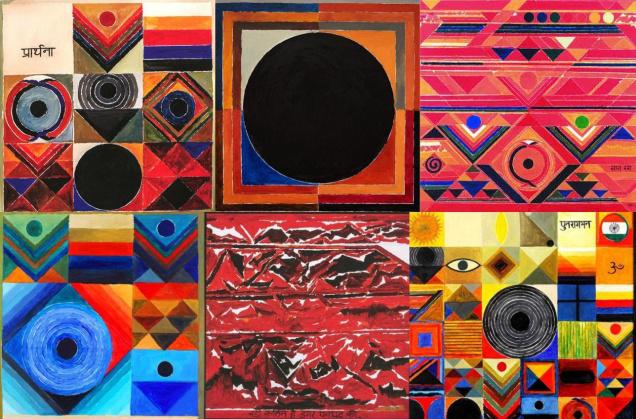
His long journey in the world of arts started thus. Raza started as a landscape painter, a colourist. Soon the bindu occupied his mind and he turned to metaphysical ideas. This relentless search for the infinite got him plenty of laurels and lots of money. Though he refused to quantify art in terms of money, none could deny the steep price tags that accompanied many of his works. For instance, Saurashtra went for Rs. 15.9 crore. His La Terre attracted a whopping Rs. 18.8 crores.
(A combination of S.H. Raza’s works. “Bindu is a source of energy, source of life. Life begins here, attains infinity here,” he had said)
After linking all the dots in the universe of art, Raza, aged 94, passed away quietly in an intensive care unit of a hospital in New Delhi.
There was not a note that was not dignified, not a colour in the palette that was left unexplored. Often short of breath, hard of hearing with fading vision, Raza with his frail frame looked very much his age to a layman. To a lover of art, he remained a genius, transcending the inevitable frailties of age with determination. Where his eyes failed him, his fingers did not. He continued to whip up magic till the end. Even when the man who was a master at giving a new meaning to colours needed the help of an assistant to mix his colours, his magic did not elude him. Fittingly, one of his last exhibitions was titledNirantar (Relentless). With that single term he lived up to the words of noted Hindi author Ashok Vajpeyi who often said that Raza did not paint to live, he lived to paint. The exhibition itself contained some of the works he had done after coming back to India, between 2011 and 2016.
If in that interaction with youngsters in Jaipur, Raza stated that “Bindu is a source of energy, source of life. Life begins here, attains infinity here”, a few years later in New Delhi he showed other shades to his personality as he talked gently, if, one may say so, almost relentlessly, of Modernism. Yet he did not fail to talk of specifics, happy once again to talk of the bindu, how it provides focus in life, indeed, life itself. Happy he was to talk of early red, the later blues and yellows. And equally at ease talking of the marriage of art and artist, how initially man creates art, how then art forms him. Little wonder, the distinction between Raza and his art gradually disappeared over the years. His art could never conceal the artist, in the final years, it spoke on behalf of the artist. Little wonder, fellow artist Krishen Khanna once said that his friend lived his art! And Raza found profound meaning into something as innocuous as juxtaposing two colours. According to him, the two colours could be in conciliation and harmony or conflict and unending struggle, almost like a man-woman relationship. Raza brought to his canvas the quintessential Indian spirituality and tradition by concentrating his energies on colours, purush-prakriti and nari in his trademark geometric abstract works. And to think, he introduced the French to our artworld and set up studios there!
A contemporary of M.F. Husain, F.N. Souza, Khanna and Tyeb Mehta, Raza carved out his own niche on his own terms. He played with colours like none else and was wise enough to understand that art lovers abroad loved Indian art not jut for its spirituality but its constant soaking in of colours. Of course, like the longest of journeys begins with a single step, for Raza any art too began with a dot. An art work was never the sum of its parts, rather each part, each stage was art itself. Slowly, this centreing of the universe around the dot consumed the mind, and life, itself of Raza. What it gave him in return was priceless art that seeks to confer immortality on the artist.
As he celebrated the bindu in conversations, he occasionally recalled the primary school teacher too. As the Padma Vibhushan awardee fought one last battle one cannot help recall Ashok Vajpeyi’s words that Raza lived to paint. And when he could no longer paint, life lost its meaning… Life indeed had come a full circle. Yes, the bindu is the most important thing of all.
source: http://www.thehindu.com / The Hindu / Home> Features> Friday Review> Art / by Ziya Us Salam / July 23rd, 2016
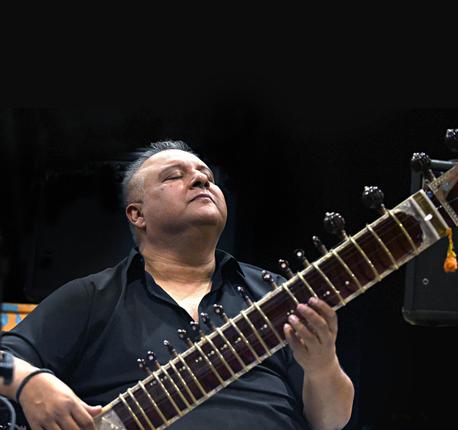
Shujaat Husain Khan. Photo: Shaju John / The Hindu
Chennai:
The sitar exponent gave lessons on music and life at a students’ workshop recently.
It is a long winding road from Chennai to Cheyyur. Suddenly in the middle of wilderness you spot a well-designed concrete patch — the Swarnabhoomi Academy of Music. As you drive past the main gate to reach the campus, shaped like a grand piano, bright morning rays light up the clear, vast skyline.
Walking past two huge murals at the entrance, you enter a darkened hall with the spotlight on Shujaat Khan, his fingers gliding over the gleaming sitar strings. Gentle notes, rich with classicism, cut through the silence. The young audience sits enthralled. After a brief sketch of a raag, the Grammy-nominated sitarist talks endearingly, in flawless English, about his experience, experiments and the trials and triumphs of being a musician.
The session, part of a two-day camp on Indian music is no sombre class. Shujaat, son of maestro Ustad Vilayat Khan, is at his wittiest best interacting with the youngsters. He encourages them to ask questions, express their opinion and even invites two of them to join him on stage.
“I was born into a family of musicians. If I didn’t do this there wouldn’t have been any option because I was bad at everything else. I loved driving but I thought I couldn’t make a living out of it. The only thing I was slightly good at was music,” he says sipping coffee. “But it’s not easy to make a career in music since there are few people who can judge between ordinary and outstanding.”
Like most celebrity children, who struggle to forge an identity of their own, it was an emotional quest for Shujaat to reach out to his famous father and try to live up to the Imdadkhani gharana legacy. “Even today it is difficult to step out of the shadow of greatness. Being the son of a legend is more pain than pleasure. The pleasure part is only music. People are not ready to forget whose son you are. The comparisons are heart-breaking. I did not come into music because I was Ustad Vilayat Khan’s son. It was because I enjoyed it. Today I have nothing to complain about though. The world has given me everything, more than what I deserve,” he says recalling the rocky road to acceptance.
Does he emulate the way his father traversed the depths of a raag, a student is keen to know. “I have no illusions of being a genius like him. But the purpose of pursuing music is the same — to feel the intensity. You should allow the different emotions to come through the swars. Every journey is difficult. I am not the kind of person who likes to focus only on the unhappy moments. It wasn’t easy to get a nod of approval from my father yet I mustered the courage to go my way.”
“Your father was a purist but at the same time rebellious. Do you see those traits in yourself,” is the next query. “The apple doesn’t fall far,” laughs Shujaat. “In fact most of you are rebels. Your parents might have wished that you become engineers, doctors or chartered accountants. But you have decided to follow your heart. If that is being a rebel, so be it. I have always let my son and daughter make their decision and take responsibility for it. If I had become a clone of Vilayat Khan nobody would have respected me. I have the genes, but I also have my own musicality.”
He says he is unaffected when people misunderstand his idiosyncrasies and outspokenness. “For instance, I am not ready to treat artists as gods. I do not want the next generation to think of me as more than human. I am not. I want them to know they too can achieve what I have. If you take away the sitar from me, I am nobody,” he smiles and then looking at the photographer clicking away, says, “Listen bhaisaab, I am not Madhuri Dixit…” Continuing the conversation, he says, “You know some musicians keep complaining about the reign of Bollywood music. Classical music is not for the mass. It is chamber music. You cannot expect every youngster to listen to it. Let us encourage those who show interest. There is nothing to be pessimistic about the future of classical arts. It will continue to thrive the way it has for centuries.”
A participant then asks him, how should one collaborate without diluting musical values? “Diluting is not the right word,” he points out. “What you need to do is to step out of your comfort zone and find a meeting point.”
Introducing the students to raag Khem, the honeyed tone of Shujaat’s sitar brings out the inherent flavours of Hamsadhwani and Yaman in it. “Never rush through a performance. Very often you hear musicians trying to create excitement right at the beginning by indulging in something dramatic. Build up the tempo slowly,” he advises.
When he is not performing, Shujaat takes off to the mountains. He loves to observe the changing hues of Nature. “My tryst with taal and raag is at a very personal level. Beyond that nothing else matters. Not even awards or titles. Love of the audience is enough. ‘Jo tammanna bur na aaye umra bhar, umra bhar uski tammanna kijiye’ (you spend the life chasing that one desire that is not fulfilled).”
source: http://www.thehindu.com / The Hindu / Home> Features> Friday Review > Music / by Chitra Swaminathan / July 14th, 2016
The most significant of Tipu’s memories lie at the Scottish National War Museum in the Edinburgh Castle.
Tipu Sultan, the Tiger of Mysore, whose birth anniversary celebrations became a contentious issue recently, is avidly remembered, ironically, through his countless artefacts and personal effects displayed in museums and art galleries in England and Scotland. The soldiers and commanders too fought valiantly for this great warrior king, the only monarch to have died on the battlefield fighting the British.
After Tipu was killed on May 4, 1799, Arthur Wellesley, the future Duke of Wellington, gave a free hand to the victorious army to pillage Tipu’s palace and arsenals in Srirangapatnam. The excited British soldiers indulged in such acts of loot and confiscation that there was no one in the army who did not carry multiple artefacts as souvenirs and war spoils.Most valuable ones like the swords, ivory goods, pistols, cannons and jewellery were to the turn of the high ranking officers. The remnants of war rockets, Tipu used to the bewilderment of the British, numbering 700, were shipped to England where they were subjected to reverse engineering to unravel the process of making them.The iconic 42 inch sword that Tipu held on the fateful day of his death and presented to General David Baird as war trophy, was bought by the now beleaguered liquor baron Vijay Mallya in 2003 at a Sotheby auction for Rs 1.57 crore. It is reported that Mallya also bought several other war items like carved quires, flint lock pistols, cannon and other personal items of Tipu.A finger ring with the word Ram engraved in Devanagari script, recovered from Tipu’s body, was exhibited in the British museum. It is said that the ring was later presented by Wellesley to his niece, Lady Fitzroy Somerset. The gorgeous Tipu’s throne with a gold canopy was ripped out and all its eight large diamond studded tiger heads that formed the front of the throne were shared among the generals.
One of them was presented to Edward Clive (son of Robert Clive), then governor of Madras, is now exhibited in Clive Museum at Powis Castle in Wales. A pair of Tipu’s golden slippers, his glittering tent, a camp cot, swords, walking stick with tiger head etc, are also seen here.
Of all the curious objects of Tipu, the “toy tiger” displayed in the Victoria & Albert Museum, London, is the most important. It is an awesome life-size wooden toy seen in a military uniform. This impressive toy has in its body a mechanical pipe organ hidden and by turning a handle, creates wailing shrieks and a loud roar while the victim’s hand moves up and down in despair.
The design of this toy tiger is said to have been inspired by the death of the son of the Scottish General Sir Hector Munro, a bête noire of Tipu. There are also several items of jewellery taken from Tipu’s palace which are on display in this museum.
In 1999, Edinburgh’s National Museum of Scotland, as a part of the bi-centennial celebrations of Tipu’s death, held a special exhibition in which a replica of Tipu’s toy tiger was made for the occasion. It continues to be in the museum now.
A significant legacy of Tipu was the proliferation of paintings and sketches the contemporary artists produced. Due to these paintings, the image of Tipu was entrenched in the collective memory of the British so well that in 1831 when Ram Mohan Roy visited England, he was embarrassed to face hostile booing crowds at many places. As Ram Mohan Roy’s headgear resembled Tipu’s turban, he was mistaken to be a descendant of Tipu Sultan.
Castle’s war museum
The most significant of Tipu’s memories lie at the Scottish National War Museum in the historic Edinburgh Castle. Here are preserved swords, daggers, war medals and other articles taken from the arsenals at Srirangapatnam. There are numerous ornamental swords belonging to several prominent Scottish army generals who saw action in the Mysore wars.
Swords presented to the generals as souvenirs are also on display. The names, Carnatic, Mysore and Srirangapatnam carved on stones, indicate the importance the Scots bestowed on their combats against Tipu. An armlet of Tipu, found on his body that was presented to David Baird, is also preserved here.
At the concluding ceremony of Edinburgh International Festival (EIF) held annually, a spectacular display of fireworks takes place outside of the castle in commemoration of the Mysore wars. The exquisite Amaravathi sculptures excavated from near Guntur in 1845 by Sir Walter Elliot, now exhibited at the British Museum, and the enigmatic Kohinoor diamond taken away in 1850 after the Second Sikh war and presented to Queen Victoria, form part of the crown jewels displayed now in the Tower of London. They attract millions of tourists from all over the world annually.
The indiscriminately looted Tipu’s Srirangapatna treasures, now as global exhibits, stand as quintessential reminders of the nature of the British colonial aggrandisement in India.
(The writer is retired professor of History, University of Hyderabad)
source: http://www.deccanherald.com / Deccan Herald / Home> In Perspective / by K S S Seshan / July 12th, 2016