The 31-year-old Arif, who hails from Tangmarg of Baramulla district (Jammu & Kashmir), achieved the qualification in the final FIS Qualification being held in Dubai.
Alpine skier Arif Mohammad Khan
Chennai :
Arif Mohammad Khan on Saturday became the first alpine skier from the country to win a quota for the Winter Olympics by accumulating requisite FIS (International Ski Federation) points.
The 31-year-old Arif, who hails from Tangmarg of Baramulla district (Jammu & Kashmir), achieved the qualification in the final FIS Qualification being held in Dubai. The 2022 Games is scheduled to be held in Beijing in February.
Father Mohammad Yasin Khan was Arif’s first coach. Yasin used to guide mountain tracking expeditions and teach the basics of skiing in Gulmarg. “Arif took up skiing at the age of three and quickly learnt the basics. It’s good that the efforts he had put in in all these years have eventually paid dividends,” said an elated father.
As per the FIS, a skier has to accumulate minimum qualifying points to confirm the Winter Games spot. According to www.olympics.com, in order to qualify for the Beijing 2022 Winter Olympics in the slalom, the average of five best results in the event between the period of July 1, 2019, to January 16, 2022, is considered. For alpine skiers who have competed in less than five events during this period, an extra 20 per cent of average points are added to the International FIS points list.
The four slalom races in Dubai over the past week were the only events Arif has taken part in during the qualifying period.
“It’s a proud moment as earlier the Winter Games Federation of India used to organise trials to pick the teams including the skiers. Arif has become the first alpine skier from the country to secure qualification by earning FIS points,” Rauf Tramboo, member of Winter Games Association of Jammu & Kashmir, told this daily.
Alpine skiing comprises events like downhill, super G, slalom, giant slalom and combined.
Arif will now head to Italy from Dubai to compete in an international event. “Some international event is there. It will be great preparation for him ahead of the Games. He is unlikely to return to the country before the Games,” signed off Rauf.
source: http://www.newindianexpress.com / The New Indian Express / Home> Sport> Others / by Firoz Mirza, Express News Service / November 20th, 2021
Mehreen Mushtaq Shamim, a teacher from Bengaluru’s Delhi Public School has bagged an award in Artificial Intelligence (AI) at the Intel AI Global Impact Festival.
She was selected as one of the four winners of ‘AI impact shapers: Teachers with innovative AI teaching learning practices’. Mehreen has been teaching AI in DPS East for nine years now. The CBSE curriculum had introduced AI as a subject for classes 9-12 in 2019.
Mehreen is credited with empowering 1,218 students with practical knowledge of AI and training over 250 teachers in AI-related multi-disciplinary pedagogies.
“I introduced students to Bootcamps that give them advanced lessons in AI. I could mentor students and inspire them into creating projects, three of which are now pending patents. Our students are interested in technology and can think out of the box very well. If guided in the right direction, they can do wonders,” TOI quoted Mehreen as saying.
Mehreen, who has a masters in computer applications, said the more she learnt about AI, the more passionate she got about the subject. “Knowing the power of AI, I now want to encourage children of other streams — not just science — to take up the subject and upskill themselves,” she added.
The first Intel AI Global Impact Festival was launched on October 15, 2021. It saw the participation of 20 countries from around the globe and the display of more than 200 AI-led social impact innovations. The other winners from the AI Impact Shapers category were from Singapore, South Korea and Poland.
source: http://www.thecongnate.com / The Cognate / Home> Inspiring / by Rushda Fatima Khan / October 30th, 2021
The task at hand is to spot the Unicorns or billion-dollar valuation startups from Kerala.
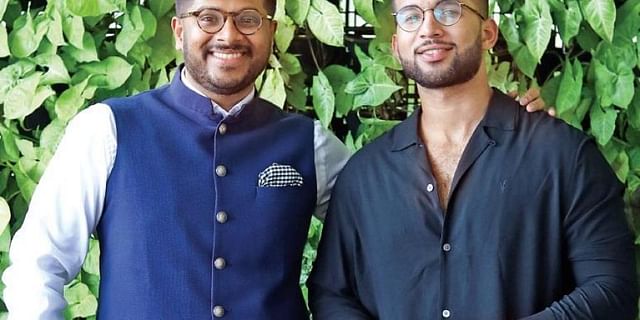
Azhan Musthafa Backer and Zahan Musthafa Backer.
Kochi :
Though there are many successful Malayali-founded startups including the likes of Byjus, Fresh-to-Home and ID Fresh Food, there are hardly any startups that have attained that level of success from Kerala. Now, two Ivy League-graduated Dubai-based siblings with roots in Thalassery, are on a mission to identify and guide high-potential Kerala-based startups to navigate through regulatory blindspots, and handhold them from seed capital level to accessing the public markets through an IPO. The task at hand is to spot the Unicorns or billion-dollar valuation startups from Kerala.
Meet Azhan Musthafa Backer and his younger sibling Zahan Musthafa Backer, founders of Backer Ventures, a firm that not only helps founders access seed funding but also assists them to wade through the regulatory and legal maze so that the founders can stay focused on the core business. To begin with, Backer Ventures will start a liaison office in Kochi to assist the startups based out of Kerala.
“The entrepreneur eco-system here is ‘let’s startup here and scale-up somewhere else’. The good thing that Covid has brought about is, it allowed people to work, network and access funds over Zoom,” says Azhan, co-founder of Backer Ventures. The post-Covid changes that allowed people to work and access markets sitting anywhere in the world will help the Kerala startup ecosystem immensely, believes Azhan, who did his undergrad from Warwick University, UK and LLM from Cornell University, New York.
Zahan, the co-founder of Backer Ventures, who accompanied his elder brother Azhan on a four-day trip to Kerala, says they have met with some ‘interesting startups’ in Kerala in the fintech, healthcare and AI (artificial intelligence) space during the trip. While Azhan is CEO & Director (Projects & Deals) at Musthafa & Almana, a Dubai-headquartered international law firm, Zahan is director, technology and innovation at the law firm. The law firm is founded by Kerala couple Musthafa Zafeer OV and Almana Zafeeer.
Backer Ventures will help provide $150,000 to $300,000 to early-stage founders, who are going to be trailblazers in the emerging markets. “Operating at the intersection of law, tech and entrepreneurship, we are long-term allies that provide startups with the necessary tools to breakthrough in emerging venture markets,” explains Zahan, who also did his undergrad from Warwick University and LLM from Cornell University.
“Globally speaking, the money is easily available. Startups coming out with a half-decent idea and half-decent founders can easily attract funds now. Investors like us as competing. We are telling founders to allow us into your cap table, please allow us to invest in your company,” says Azhan.
Backer Ventures, he says, provide a “differentiated venture platform that demystifies a niche corner for founders that partner with us”.
Will the young Turks succeed? “We are pretty confident. And hopefully, we will have some figures to back it in the next 12-18 months”, says Azhan.
source: http://www.newindianexpress.com / The New Indian Express / Home> Cities> Kochi / by Rajesh Abraham, Express News Service / November 17th, 2021
Nawazduddin Siddiqui was also nominated with David Tenant and Roy Nik in the Best Performance as an Actor (Male) category.
Nawazuddin Siddiqui.
Mumbai :
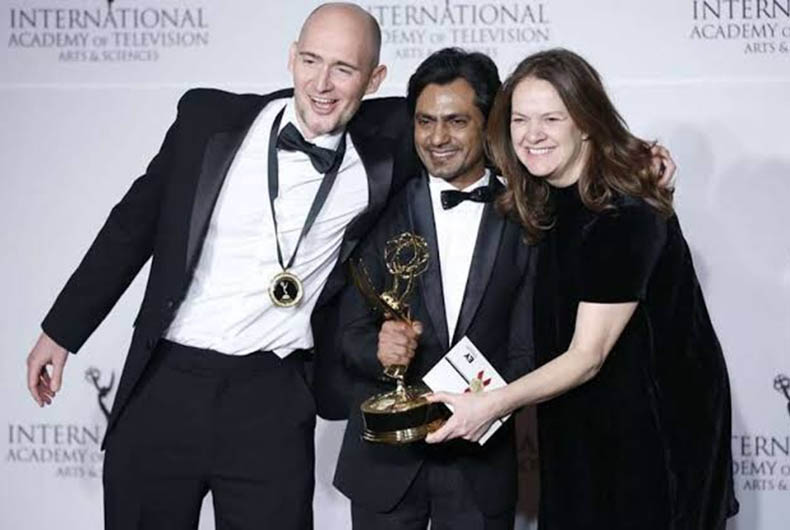
Bollywood actor Nawazuddin Siddiqui had a moment of pride as his British show ‘McMafia’ won Best Drama Series at the 47th International Emmy Awards, and he accepted the award for the entire team on the stage.
The actor was also nominated with David Tenant and Roy Nik in the Best Performance as an Actor (Male) category.
Nawazuddin said:
“For me getting recognised and nominated on such a huge level is something I had never dreamt of in my wildest dreams. David Tenant who is nominated with me in the same category makes me feel extremely special.”
“I have watched Des, Hamlet and many other films. He is a performer to watch for and he portrays every scene and character to its perfection and getting nominated alongside such a talented man means a lot.”
The actor will be seen in the upcoming film ‘Jogira Sa Ra Ra’, ‘Heropanti 2’ and ‘Adbhut’. His film ‘No Land’s Man’ was premiered at the Busan International Film Festival and Cairo International Film Festival.
source: http://www.ummid.com / Ummid.com / Home> Life & Style / IANS / November 15th, 2021
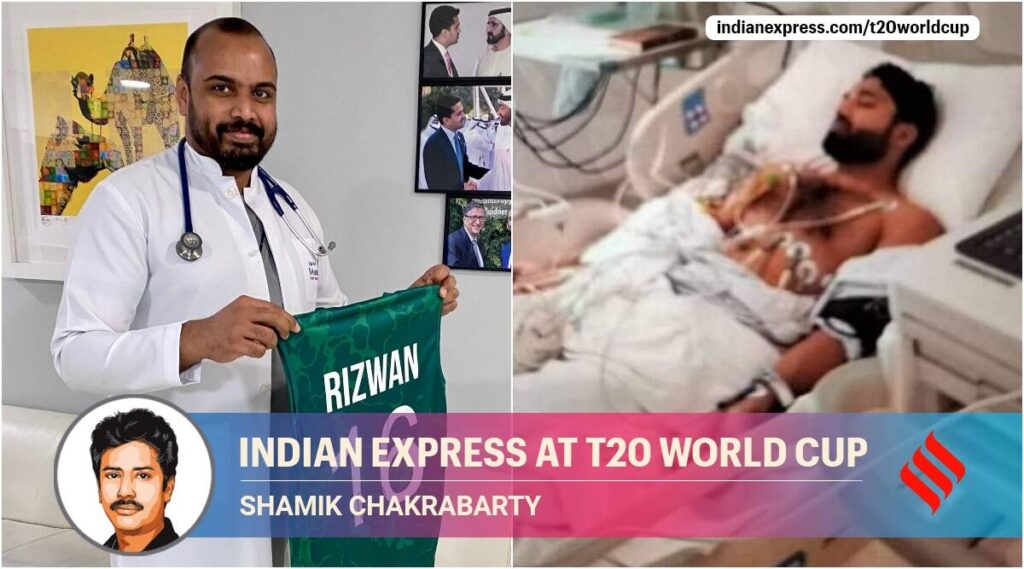
Dr Saheer Sainalabdeen posing with Mohammad Rizwan’s jersey. (Special Arrangement, Twitter/ShoaibAkhtar)
The attending pulmonologist, Dr Saheer Sainalabdeen, originally from Thiruvananthapuram, said Mohammad Rizwan was critical at the time he was admitted in Dubai’s Medeor Hospital.
It was a race against time. Two days before his team’s T20 World Cup semifinal against Australia, Pakistan’s wicket-keeper opener Mohammad Rizwan, after complaining of severe chest pain, was in the ICU unit of Medeor Hospital near Burjuman in Dubai.
The attending pulmonologist, Dr Saheer Sainalabdeen, originally from Thiruvananthapuram, says Rizwan was critical at the time he was admitted. Under the Indian doctor’s care, Pakistan’s key player recovered in time for the game.
He didn’t just make it to the playing XI, he also made a gritty 67, helping his team post a formidable score in the match that Australia narrowly won. Despite the heartbreaking loss, Rizwan, 29, remembered to acknowledge the efforts put in by the good doctor. As a token of gratitude, he sent across a team shirt, autographed by the Pakistan players.
Speaking to The Sunday Express at his chambers, Dr Saheer credited the quick recovery to Rizwan’s “willpower”.
In ICU for 35 hours
“He was in the ICU for 35 hours. He had a fever for three-four days, but he was Covid negative. Then (two days before the match), he had severe chest pain, enough to make him gasp,” Dr Saheer said.
The 40-year-old doctor said he initially suspected a heart problem, but tests ruled that out. “Actually, due to infection, spasms had blocked Rizwan’s esophagus (food pipe) and trachea (windpipe), resulting in chest pain. His condition was critical.”
Going into the match, Rizwan was not 100%, but managed to score 67 in 52 balls, getting out only in the 18th over of the Pakistan innings. He returned to keep the wickets and took a sharp catch of the in-form Australian opener David Warner, who seemed to be running away with the game.
During a break in the game, Pakistan’s batting coach, former Aussie batsman Mathew Hayden, had revealed to the host broadcaster that Rizwan had been in hospital a day earlier.
“I am a big fan of this batting line-up, they have performed superbly right through with the bat all along, and tonight is no exception. Rizwan was in hospital a night ago, suffering from a bronchitis condition, but this is a warrior… He has great courage, so has Babar (Azam), fantastic to see them combine so well,” Hayden said.
Among those who applauded Rizwan’s drive and commitment was Indian off-spinner Ravichandran Ashwin . “Can you imagine this guy played for his country today & gave his best. He was in the hospital last two days. Massive respect @iMRizwanPak. Hero,” posted Pakistan great Shoaib Akhtar.
Dr Saheer recalled Rizwan was desperate to play. “Whenever we spoke, he told me, ‘Play I must, I have to be with the team’. He was given an injection before leaving the hospital (a day before the game) and then, two hours before the start of the match, he took medicines. I allowed him to play only because he was medically fit to play,” the doctor said.
Dr Saheer said, Rizwan and his Pakistani teammates wanted to visit him personally to thank him, but biosecurity protocol didn’t allow them to do so. “He said, ‘Ek shirt bhej rahe hain aapko (Sending you an autographed team shirt)’.”
While happy at the gift, Dr Saheer said he was happier at Rizwan’s recovery. “It was down to his willpower. I have never seen a person with such strong willpower. He was weak but his willpower trumped the illness.”
Recalling the challenge, he added: “An illness that usually takes about a week to heal was taken care of inside two days… He had a big game coming up, so it was my duty to walk the extra mile, leave no stone unturned and then see how it goes. When he was admitted to the ICU, I never thought it would be possible. But he responded very well to the treatment, followed our advice in toto and pulled off something unreal.”
source: http://www.indianexpress.com / The Indian Express / Home> Sports> Cricket / by Shamik Chakrabarty, Dubai / November 14th, 2021
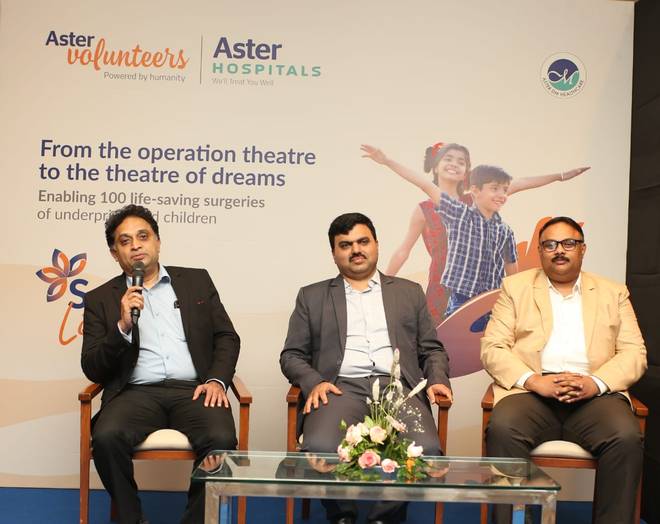
The ‘Second Life – Because Little Lives Matter’ initiative was launched in Bengaluru on November 15 by Dr. Nitish Shetty, Regional Director, Karnataka and Maharashtra Cluster; Farhan Yasin, Regional Director, Kerala and Oman Cluster; and Devanand K.T., Regional CEO, Telangana and Andhra Pradesh Cluster
A 24X7 multi-lingual helpline has been set up to manage enquiries
To mark Children’s Day, Aster Hospitals in India launched the ‘Second Life – Because Little Lives Matter’ initiative.
The year-long initiative is aimed at supporting the medical treatment of disadvantaged children. The aim is to facilitate free paediatric surgery for at least 100 children below the age of 12 years.
Throught this initiative of Aster Volunteers Global CSR, the company wants to extend help to deserving children who are being treated across Aster Hospitals based in five States in India. This includes common childhood illnesses, such as appendicitis, intussusception, empyema and paediatric urology surgery, as well as complex clinical surgeries, including bone marrow transplant, liver transplant and heart surgery.
The initiative was launched in Bengaluru on November 15 by Dr. Nitish Shetty, Regional Director, Karnataka and Maharashtra Cluster; Farhan Yasin, Regional Director, Kerala and Oman Cluster; and Devanand K.T., Regional CEO, Telangana and Andhra Pradesh Cluster.
The treatment will be funded either by Aster DM Foundation, philanthropists or NGOs.
The foundation has established the criteria to identify eligible cases for the program. Applications will be assessed on the socio-economic status, BPL category, medical outcome of the child prior to commencement of selection and subsequent treatment.
A 24X7 multi-lingual helpline (+91 9633620660) has been set up in Kozhikode in Kerala to manage enquiries.
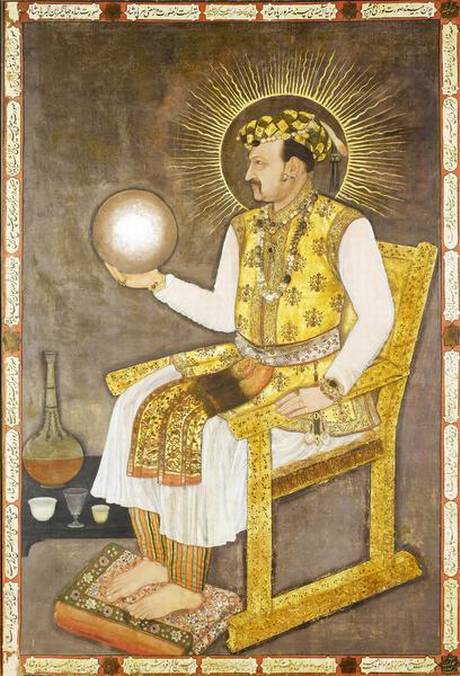
Emperor Jahangir’s inquisitive mind is revealed in his conversations with Mutribi al-Asamm Samarqandi
The 18 decades of the Great Mughals (1526-1707) produced some first-rate literature.
Many fine books came from the rulers themselves, steeped in a tradition of high culture that required them to be literate. The Baburnama, the first memoir/ autobiography of the subcontinent, is as readable today and as modestly written as Julius Caesar’s books (Cicero said of Caesar’s prose that it is unadorned, like a classical statue). The Tuzuk of Jahangir is filled with bombast, vanity and anger, but it is so honest and has so much detail, particularly on the side of his interests as a naturalist, that it is a work of the highest order.
And then there are the works that are smaller but sparkling, like little jewels. One such is the life of Humayun by his sister, Babur’s daughter and Akbar’s aunt, Gulbadan Begum. Written in Persian, as opposed to the Chagatai Turk that Babur wrote in, it is clear and direct, and as thorough a portrayal of Babur and Humayun as what they produced themselves. The story we know of Babur circumambulating the bed of a very ill Humayun and asking, in pagan fashion, to be taken instead of him, is from her book.
Courtly manners
The work we are looking at this time is from a lesser noble, a traveller from Samarqand called Mutribi al-Asamm, who spent time in Jahangir’s court. It is available in translation as Conversations with Emperor Jahangir. The Mughals loved having people over from their ancestral lands, which they would never see again, and lavished them with gifts and honours. Mutribi came to India (Jahangir was based in Lahore) roughly 400 years ago in 1627, when he was 70 and the emperor 58, only a few months away from his death.
Mutribi’s writing reveals a lot about the flowery manner of the court. He visits Jahangir a month after arriving in India and the emperor asks why he has waited this long. Mutribi refers to himself in the text as the “incompetent narrator” and Jahangir as possessing “a tongue of pearls”. At that first meeting, Jahangir gives him a thousand rupees and Noor Jahan (“may her chastity be preserved”) another five hundred, possibly the equivalent of crores in our time.
At their next meeting, Jahangir inquires about the hue of the black stone from which his ancestor Timur’s sepulchre is made in Samarqand. The emperor produces stones which Mutribi compares unfavourably to the original (“it is so bright you can see your face in it”).
Lord bountiful
The transactional manner of the exchanges is apparent from another meeting in which Jahangir asks Mutribi which of the Iraqi thoroughbred horses on display he would like to be given. Mutribi says, “whichever is more expensive,” possibly to make the emperor feel that he is being generous rather than his supplicant greedy. Again, when Jahangir offers him a choice of saddle — velvet or broadcloth — the answer is velvet, because it is more expensive. Jahangir says velvet gets wet easily, to which Mutribi says that the monsoon is far off. The two meet 24 times in two months before Mutribi returns. Towards the end, the following conversation is held:
“The pleasantness of Samarqand was being discussed. The Emperor asked me, ‘Is Samarqand spelled with a ‘q’ or with a ‘k’?’
‘Either way is correct,’ I replied. ‘In Tabari’s history and several other books it is referred to as Samarkand, but in popular usage it has become known as Samarqand. Some say that the name comes from Samar and Qamar, two slaves of Alexander the Great who built the city which was then named for them. Their graves are situated in the main market square of Samarqand.”’
Then Jahangir inquires about an ancestral tomb, asking how much it requires to be maintained. ‘“If you want to do it properly, 10,000 rupees,’ I [Mutribi] said, ‘otherwise 5,000 rupees just to keep it going.’
‘If 10,000 rupees will maintain it,’ he said, ‘then we have decided that in accordance with your information we will send 10,000 rupees, in order that that blessed station be maintained.’
I said, ‘O God, as long as the Sun and the Moon shall be, may Jahangir son of Akbar remain King.’”
Aakar Patel is a columnist and translator of Urdu and Gujarati non-fiction works.
source: http://www.thehindu.com / The Hindu / Home> Books / by Aakar Patel / November 13th, 2021
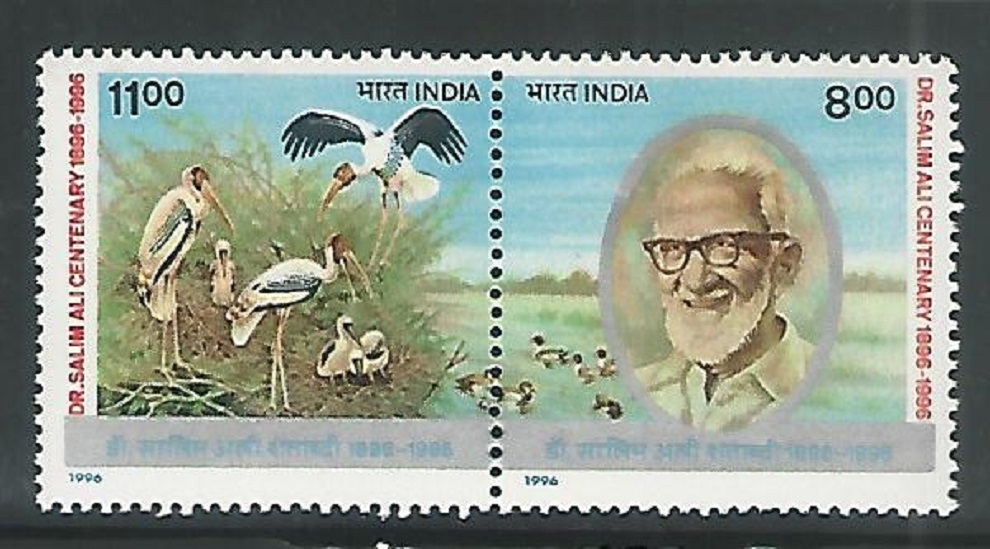
Ornithologist Dr. Salim Ali’s forgotten radio-casts now come ‘alive’ in a book. / In memory of Ornithologist Dr Salim Moizuddin Ali.
Dr Salim Moizuddin A. Ali (November 12, 1896-June 20, 1987) was the first Indian to conduct systematic bird surveys across undivided India and even later, and then penned several bird books which popularised ornithology in the sub-continent.
Mumbai :
In a unique initiative, the forgotten radio broadcasts of legendary ornithologist, the late Dr Salim Ali have been compiled and brought ‘alive’ in a book form, which will be released on November 12, marking the 125th birth anniversary of the ‘Birdman of India’.
Dr Salim Moizuddin A. Ali (November 12, 1896-June 20, 1987) was the first Indian to conduct systematic bird surveys across undivided India and even later, and then penned several bird books which popularised ornithology in the sub-continent.
The book — “Words For Birds” — edited by renowned author Tara Gandhi, comprises all the 35 broadcasts of Dr Ali on All India Radio (AIR) — from British India to Independent 1980s — probably unheard of by most people in the current century.
“I had worked with Dr Salim Ali for long… I have even worked on his other papers and documents and I came across these broadcasts that are well-preserved by BNHS,” the book editor Gandhi told IANS briefly, as the book awaits official release.
It will be unveiled as part of the ongoing 125th birth anniversary celebrations of the great ornithologist conferred with the Padma Vibhushan (1976), at the Bombay Natural History Society (BNHS, founded 1883), said Education Officer Raju Kasambe.
The 35 talks that comprise “Words For Birds” were broadcast over 45 years, between 1941-1985, revealing Dr Ali’s exceptional skills both as an oral communicator and a passionate bird propagandist.
“The object of these talks is really to interest listeners, in the first instance for the healthy pleasure and satisfaction bird watching affords rather than for its intrinsic scientific possibilities,” the ornithologist had said of his radio transmissions.
The enthralling radiocasts, in a story-telling style, cover a wide range — bird habits and habitats, risks they face, the crucial role of avian in nature’s cyclic processes, how they benefit agriculture, unseen or little understood contributions to the economy, etc.
On his passion, Dr Ali said how 50 years ago bird watching in India was nowhere as popular, or indeed respectable, as it has become now, and in his younger days he would time and again fall in with persons who left him with a feeling, as they withdrew, that they were inwardly tapping a pitying finger on their foreheads.
“Their first glimpse of me very often was, it is true, of a distinctly shabby khaki-clad individual of the garage mechanic type, wandering leisurely and rather aimlessly about the countryside and surreptitiously peeping into bushes, and holes in tree-trunks and earth banks…” said the legend modestly.
Though he had focussed mainly on birds in his radio talks, it is evident that he was interested in all forms of wildlife and contemporary conservation issues, too, with each talk reading like a short essay, and the reader can even glance randomly through it to be immensely educated and entertained.
Dr Ali’s best-sellers from his massive collection include “Book Of Indian Birds” and the monumental 10-volume “Handbook of the Birds of India and Pakistan” (co-authored with S. Dillon Ripley), “The Birds of Kutch”, “Indian Hill Birds”, “Birds of Kerala”, “The Birds of Sikkim”, and his autobiography, “The Fall of a Sparrow”.
The book editor Gandhi was guided by Dr Ali for MSc (Field Ornithology), and she works for biodiversity conservation, conducts surveys to document birds and other wildlife in India.
Besides scientific and popular articles on nature and ecology, she has penned several books like “Birds, Wild Animals and Agriculture: Conflict and Coexistence in India” and edited the two-volume “A Bird’s Eye View: The Collected Essays and Shorter Writings of Salim Ali”.
Published by Black Kite and Hachette, “Words For Birds” (256 pg/Rs.599) will soon be available from BNHS and Amazon platforms. — IANS
source: http://www.clarionindia.net / Clarion India / Home> India> Life> Books / November 05th, 2021
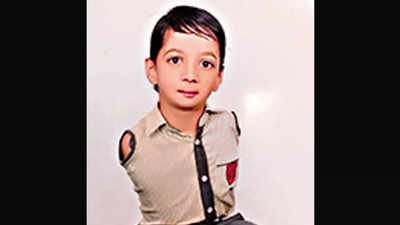
Muhammad Aasim , a 15-year-old disabled boy who had been waging a battle to get his village school at Velimanna upgraded to a high school, has been shortlisted as one of the three finalists for this year’s International Children’s Peace Prize awarded by Kids-Rights Foundation, an international children’s right organisation based in Amsterdam.
The other two finalists are teen brothers from Delhi Vihaan and Nav Agarwal who had been working towards tackling the waste menace in the national capital through their NGO One Step Greener and Christina Adane, an 18-year-old girl born in the Netherlands and now living in the UK, who had led a campaign for free school meal provision to be extended through the holidays.
The finalists were announced by Archbishop Desmond Tutu, who is a patron of the prize. In his message, Tutu said the finalists show, through their values and determination, just what children can achieve in campaigning to improve the rights of others worldwide.
The International Children’s Peace Prize is annually awarded to a child who has made a special effort to promote children’s rights and better the situation of vulnerable children.
The three finalists were selected from 169 nominations received from 39 countries.
Aasim was born without both hands
Nobel Peace Prize laureate Kailash Satyarthi will award the prize to this year’s winner on November 13 during a hybrid ceremony to be held at The Hague.
Aasim, who was born without both hands and has 90% disability, has been spearheading the campaign to upgrade the Government Mappila UP School at Velimanna to a high school.
Acting on a letter written by Aasim, then chief minister Oommen Chandy had issued an order to upgrade his school to a UP school in 2014.
But after he reached seventh standard in 2018, wheelchairbound Aasim took up the fight to upgrade the school, which is just 250 metres away from his house, to a high school as it was difficult for him to travel to faraway schools. After his repeated pleas and even protests failed to evoke a positive response, Aasim filed a petition in the Kerala high court which directed the education department to upgrade the UP school to a high school.
But the state government challenged the order and now his petition is before the consideration of the Supreme Court.
“Aasim has been continuing his studies privately at home for the last two years and has not enrolled in any other school. He hopes that his fight to uphold the basic right of education will succeed and will help and inspire all other children,” his father Mohammed Saeed said.
Aasim, who writes with his leg, is a recipient of the Ujjwala Balvam award initiated by the state women and child development department.
source: http://www.timesofindia.indiatimes.com / The Times of India / Home> News> City News> Kozhikode News / TNN / November 06th, 2021
Peshawar / Calcutta (now Kolkata), BRITISH INDIA :
The Telegraph tells the story of another Pathan from Peshawar who galloped his way into Indian cinema, and then galloped away much too soon.
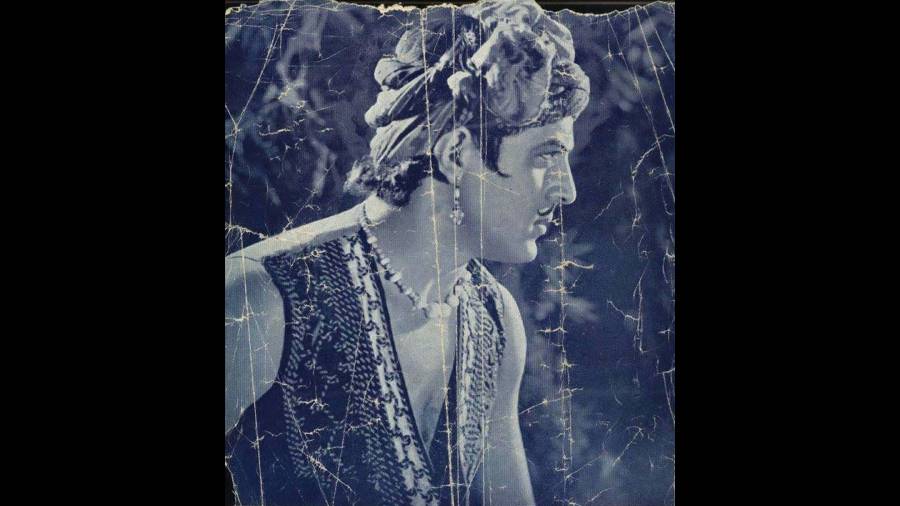
Gul Hamid / Courtesy, Film Heritage Foundation
Let’s start from the very beginning, a time when celluloid was just opening up to the light of day. And in those first few pages of the history of Indian cinema, one place finds mention again and again — Peshawar.
The city, some say, derives its name from the Sanskrit Purushapura, meaning the City of Men. Perhaps by divine direction, it truly went on to gain a reputation as the city of stars. Prithviraj Kapoor, Raj Kapoor, Dilip Kumar, Vinod Khanna… were all born in Peshawar or nearabouts. Shah Rukh Khan’s clan too belongs there. It was also home to Gul Hamid, a Pathan who shone bright on the silver screen like few stars did.
Born in 1905 in Pirpai village, Hamid was known for his handsome looks. Nasir Shah, whose great grandmother was the actor’s sibling, reveals how a young Hamid galloped into the movies, quite literally. “He was a constable with the British police in Peshawar and was sent to Lahore as part of a contingent to manage a political event — a public address by Gandhiji. This was around 1928-29,” Shah tells The Telegraph over phone from Australia, where he works as an engineer.
A member of the mounted police, Hamid was ambling on horseback after work when he came upon a film shoot. The director of the unit was the famous A.R. Kardar, and the scene that of an abduction — of the heroine by the villain, also on horseback. Seeing a helpless woman being chased, Hamid — unaware of what shooting really meant — rode his horse straight into it and brought the villain down. “Kardar was struck by the handsome Pathan and talked him into working in his film,” Shah says.
That’s how he debuted in Sarfarosh, a silent film made in 1930. Hamid was also part of the first Punjabi feature film, Heer Ranjha (1932). After working in several films in Lahore, he followed Kardar to Calcutta, which was then one of cinema’s biggest laboratories. He acted in Debaki Bose’s Bengali film Seeta (1934), which became the first Indian talkie to receive international recognition, at the Venice Film Festival. He was also part of Yahudi ki Ladki (1933), directed by Premankur Atorthy. And then, Hamid made his way to Bombay, to another budding industry for some more action.
“I would call him the first real stud of Indian cinema; his appearance was just so perfect,” says Shivendra Singh Dungarpur, filmmaker, archivist and restorer, “…the kind of star, say, John Wayne was in the Westerns of Hollywood.” Dungarpur shares an anecdote from those times. “When Bose saw the astonishingly good-looking man from Peshawar, he wondered what kind of a role would suit him… and thus Hamid got to play the character of a god, as if to justify his looks.”
The film also featured Prithviraj Kapoor as Rama and Durga Khote as Sita.
In fact, the entire story of Hamid’s career — and untimely death — is in many ways quite incredible. The actor died when he was all of 31, after battling Hodgkin’s disease for a few months. But by then he had acted in 14 films, earning for himself the title of Sitar-e-Hind or Star of Hindustan.
Hamid fell in love with and married the Calcutta-born Patience Cooper, his co-star in many films. But he had to keep it a secret from his family back in Peshawar for obvious reasons.
“He was even engaged to a simple, traditional girl of his mother’s choice,” says Shah. His family came to know about the marriage only after Hamid’s death, when his brothers broke open a chest full of letters shared between the two. It was almost like he was living a double life, feels Shah, “His family clearly had no idea of his stature or the big picture.”
The film world in those days was ruled by the trinity of Prithviraj Kapoor, K.L. Saigal and Hamid. “The scenario would be much altered if Hamid hadn’t died so young,” says Dungarpur. And although very little documentation survives, Hamid — given his pairing up with Cooper — was quite the star people were talking about. “I recall seeing magazines from the era with photographs of couples such as them, and Devika Rani and Himangshu Rai,” says he.
Perhaps the most significant of all of Hamid’s films was Khyber Pass (1936), which he also scripted and directed. “It was made in Peshawar; it was his effort to showcase Pashtun culture,” says Shah.
In an interview reminiscing those days — it is available on YouTube — Prithviraj Kapoor talks about Hamid, “Badi khoobiyat thhi usme, bahut pyara admi thha… Woh mujhey bade bhaiyya pukarte thhe (Hamid was a talented man and lovable man, he would address me as big brother).”
As a very sick Hamid lay on his deathbed, Kapoor went to visit his friend one last time. Shah’s grandfather, who was then a little boy, witnessed a conversation between the two that could very well have been lifted straight out of a script.
Kapoor asked, “Gul Hamid, kaiseho… how are you?”
And Hamid answered, “Andar se aag ki tarah garam aur bahar se barf ki tarah thanda (Burning like fire itself from within and as cold as ice on the outside).”
It is said that cinema never again saw an actor with Gul Hamid’s looks.
source: http://www.telegraphindia.com / The Telegraph Online / Home> Culture / by Paromita Kar / October 31st, 2021