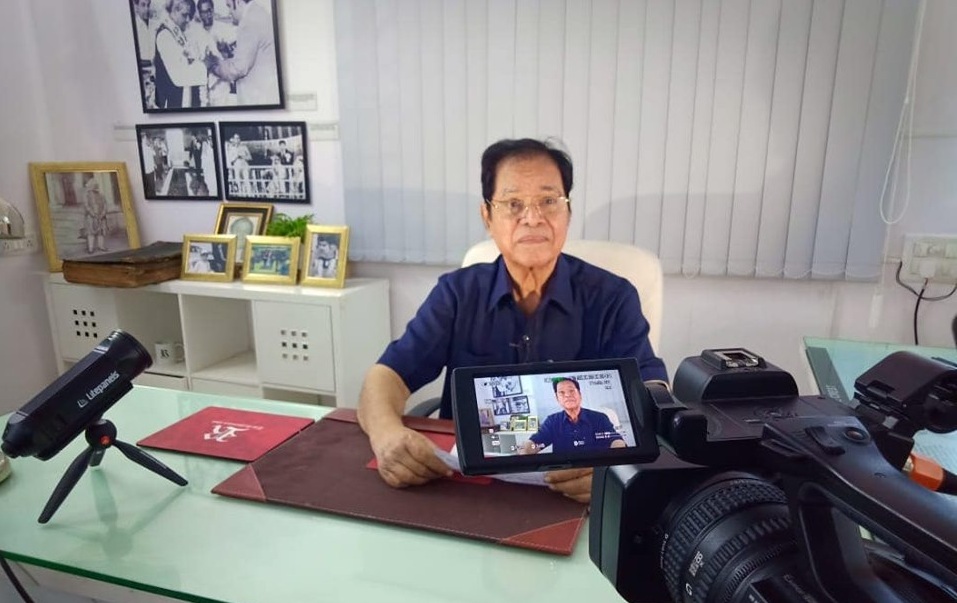
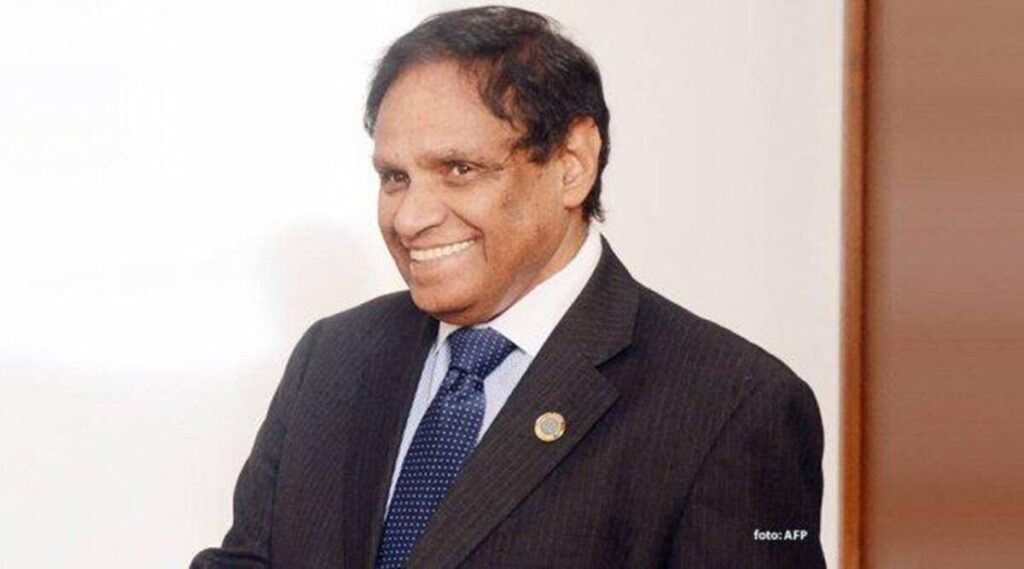
He was the Chairman of Indo Arab League and tirelessly worked for the Palestinian cause
pix: therahnuma.com
Hyderabad:
The Editor of Urdu Daily Rahnuma-e-Deccan Syed Viqar Uddin Qadri passed away on Thursday night after a prolonged illness. He was 82 years old.
For a few months, Qadri was under treatment in a private hospital. Yesterday, after Maghrib he suffered a massive cardiac arrest and passed away at 11:30 p.m.
Qadri was the Chairman of the Indo-Arab League and tirelessly worked for the Palestinian cause. He was a reputed journalist with integrity and was very popular among his friends, peers, and relatives.
He had close personal relations with the former Iraq President Saddam Hussein, the ex Palestinian Authority President Yasser Arafat, and the current Palestinian Authority President Mohammad Abbas.
He organized many meetings under the banner of Indo Arab League which were attended by the Palestinian President Yasser Arafat and Indian Prime Minister Indira Gandhi and other prominent world personalities.
Qadri was awarded the “Star of Jerusalem” the highest Palestinian civil award. He was the first and only Indian to receive this award.
He was also awarded the highest civilian award “Sahibul Jllallah” by Morocco King Mohammed IV. His older brother Syed Lateefuddin played a key role in uniting different Muslim groups in Hyderabad. Lateefuddin had passed away in the 1970s.
Qadri was also close to the ex AP Chief Minister N T Rama Rao and has served as Chairman of the Minority Financial Corporation. He is survived by his two sisters.
His funeral prayer will be held in Mecca Masjid after the Friday prayer. His body will be put to rest in his ancestral graveyard at Hazrat Musa Qadri Dargah at Purana pul.
source: http://www.siasat.com / The Siasat Daily / Home> News> Hyderabad / by Mohammed Hussain Ahmed / December 10th, 2021
Barely two weeks before his death, Maulana Azhari went to Kasganj to meet the family members of Altaf, who was found dead in police custody
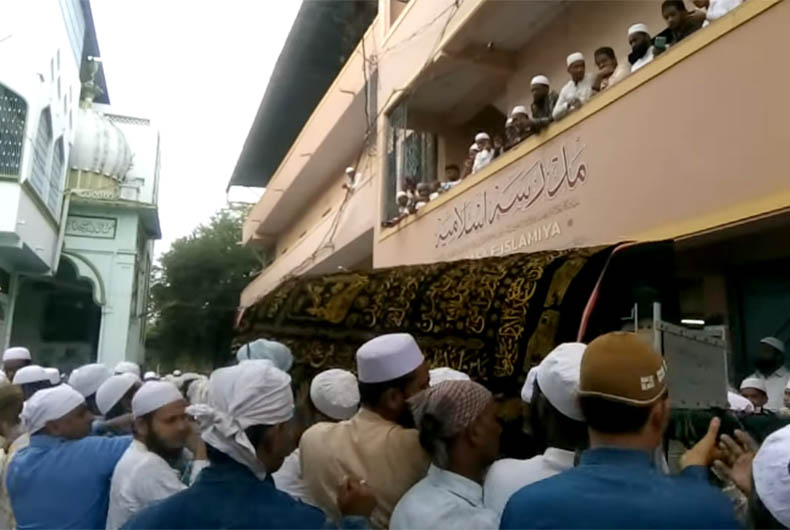
Maulana Abdul Hameed Azahri Funeral / Maulana Abdul Hameed Azhari’s Janaza taken to Bada Qabristan in Malegaon for the funeral and last rites. (ummid.com photo)
September 16, 2006, exactly a week and a day later, we were in a meeting with then Chief Minister of Maharashtra Vilasrao Deshmukh in Matralaya, Mumbai. The meeting was called at the behest of Abu Asim Azmi, then Rajya Sabha MP of Samajwadi Party (SP). Azmi had gathered about 25 Muslim MPs, including Maulana Mehmood Madani, Asaduddin Owaisi and others, along with the relatives and close family members of those arrested after the July 2006 Mumbai train blasts.
Abu Asim Azmi had sought from the Chief Minister a hearing to lodge complaint against the indiscriminate arrests of Muslim youth following July 2006 Mumbai train blasts. The case of September 08, 2006 Malegaon serial blasts at Bada Qabristan and Mushawerat Chowk was added in the agenda in the last minute.
Top police officials including Director General (DG) Police Maharashtra P.S. Pasricha, Mumbai Police Commissioner A.N. Roy and then ATS Chief K.P. Raghuvanshi were also there in attendance.
Family members of those thrown in jail following the Mumbai train blasts were sharing the heart wrenching stories of how their close kin were framed in the case and made accused for something they were not responsible of. It was then that a man in his sixties wearing white kurta and sporting Jinnah cap stood up.
“You have framed innocent Muslims in false cases. Now you want to repeat the same to cover up the Malegaon blasts case”, he said, his fingers pointing at the police officials.
He then turned towards Chief Minister Deshmukh and said, “We don’t trust your police. We have lost our near and dear ones in Malegaon blasts. Any attempt to cover up the case will be dealt with strongly.”
The Chief Minister, not accustomed to such plain speaking, watched in dismay.
The man who had upset the highest chair in the state was Maulana Abdul Hameed Azhari. Besides Maulana Azhari, I had seen only Maulana Mohammad Wali Rahmani (Sample here) talking to ministers and top officials in such a blunt, unapologetic and uncompromising tone.
My very first meeting with Maulana Hameed Azhari was when I went to Riyadh in 1994 to work as an Engineer at Saudi Carpet Factory. Maulana Hameed Azhari was in the Saudi capital since 1978. He served there at Information Centre of Saudi Ministry of Defence till his retirement in 2002 as Supervisor of the Centre.
“We used to work on monochrome computers provided on rent by IBM. Multi-tasking operating systems with GUI support were not yet available for the users. It was literally tiring to work on computers those days. No wonder if we were left completely exhausted after office hours.
“The Maulana however was a workaholic, and despite his hectic and tiring duty hours, would regularly engage with fellow Indians, especially those from Malegaon, listening their issues if any and helping them out in whatever way he could”, Sheikh Ahmed, who worked with him at the same centre in Riyadh, told ummid.com.
“His home in Riyadh was a centre for the expatriates to share their grievances, especially on Fridays when he used to serve lunch to the visitors. His wife was a good cook, and for the expatriates having home-made food in Riyadh was no less than a delight”, he said.
“Maulana Azhari was respected also by his seniors for his devotion to work. This is why he was honoured and conferred upon an award of appreciation and acknowledgement at the time of retirement”, Sheikh Ahmed recalled.
The post Maulana Azhari held was probably the highest by any Malegaonian abroad. Things have changed now a bit. But, getting rewarded for work in Saudi Arabia was rare during those days.
“Early days and Education”
Maulana Azhari was born in 1944. He was among the founding batch students of Madrasa Millat, established by Maulana Abdul Hameed Nomani – his mentor, guide and inspiration. After graduating from Madrasa Millat, Maulana Azhari went to Darul Uloom Deoband for further studies.
Later, he went to Al Azhar in Cairo, Egypt for higher studies. Maulana Hameed Azhari was one among the 05 students of Maharashtra who went to Al Azhar for higher education. Besides him, others were Maulana Nazir Azhari, Maulana Abdul Ahad Azhari and Maulana Mukhtar Azhari –a all from Malegaon. The 5th one was from Sholapur.
Back home from Al Azhar, Maulana Hameed Azhari joined Madrasa Millat, his alma mater, as a teacher. He spent few years here and then went to work at Saudi Embassy in New Delhi. It was because of this assignment that he got the posting at the Information Centre of Saudi Ministry of Defence in Riyadh where he worked till retirement.
During the same period, Maulana Azhari, with the help of some of his friends, worked towards establishing Kulliyah at Taherat – a madrasa for education of girl-students. The madrasa was administered by his younger sister, Gulshan Aapa, till her death.
“A Crusader”
Maulana Azhari was a great admirer of Maulana Abul Kalam Azad – one of the front leaders of India’s freedom movement and the country’s first Education Minister. Post retirement, Maulana Azahri established in his name “Maulana Abul Kalam Azad Research Centre” and devoted him for promotion of research and knowledge. He also undertook Arabic teaching classes and Duroos – sessions to study Quran at Rahmani Masjid, Nayapura on regular basis.
The Malegaon serial blasts on September 08, 2006 however “rekindled the activist” in him, and he led from the front the campaign for the acquittal of local Muslim youths who were wrongly framed in the case.
[Watch in this video Maulana Abdul Hameed Azhari criticising the functioning of ATS, Malegaon blasts, and also referring to his September 16, 2006 meeting with then Chief Minister Vilasrao Deshmukh in Mumbai.]
It was the time when no one, except the close kin of the accused, would dare to speak anything in favour of them. Maulana Azhari however started the campaign – initially with few of his close aides, later expanding it through the Kul Jamaati Tanzeem – an organisation represented by leaders of all Muslim sects.
The formation of Kul Jamaati Tanzeem was a big blow to the investigating agencies that were of the view that the bomb blasts in Malegaon were the result of sectarian differences between various Muslim groups.
During the course of about five-year long campaign, Maulana Azhari met everyone – right from UPA Chairperson Sonia Gandhi, Prime Minister Dr Manmohan Singh, Union Home Minister P Chidamabarm to CPI-M General Secretary Prakash Karat, Mulayam Singh Yadav, Lalu Prasad Yadav and others. This is besides frequently leading representations on a number of occasions to Maharashtra state leadership including Chief Minister Vilasrao Deshmukh and his successor Prithviraj Chavan. In all these meetings, the Maulana had only one point to raise. Local Muslim youths are innocent and there is a need for a thorough investigation into the 2006 Malegaon terrorist attack.
Slain ATS Chief Hemant Karkare had later confessed that it was because of this strong conviction that he decided to explore all possible angles while investigating the another terrorist attack that rocked Malegaon this time on September 29, 2008 at Bhikku Chowk. It is now a history how the motorcycle on which the bombs were planted led to the expose of the Hindutva terrorists who were involved in the terrorist attack not only in Malegaon but also in other places of the country.
The efforts taken by Maulana Azhari-led Kul Jamaati Tanzeem and others bore fruit when the Muslim accused were first granted bail in November 2011 and later discharged from the 2006 Malegaon blast case in April 2016.
“War against Coronavirus”
After the acquittal of Muslim youths in the 2006 Malegaon blasts case, Maulana Azhari kept alive the Kul Jamaati Tanzeem even though some people felt that the organisation was no more needed.
After the outbreak of the Covid-19 when unfortunately Malegaon became a victim at the initial stages of the Pandemic’s first wave and when whole of the city was turned into a prison, Maulana Azhari again rose to the occasion. Taking members of the Kul Jamaati Tanzeem along he met the Health Minister, District Collector and other officials of the civic body and health department to demand adequate facilities for those who were advised quarantine.
Maulana Azhari personally visited with few of his close aides the temporary quarantine centres and met the Covid-19 victims to solace them in the time of distress. This is perhaps why he too became infected with the deadly virus. Lucky as he always was, he won the battle against the Covid-19 but was forced to suspend his regular activities because of weakness and post-Covid complications.
Maulana Azhari resumed regular activities – this time at national level, after the first wave of Covid-19 ceded and his health condition improved. Expanding his activities, Maulana Azhari joined hands with Waman Meshram of BAMCEF and Maulana Khalilur Rahman Sajjad Nomani of All India Muslim Personal Law Board (AIMPLB).
While working with BAMCEF, Maulana was also nominated as the National President of Rashtriya Muslim Morcha. Through this platform Maulana Azhari travelled to far-away places of India and met Dalit and Muslim victims wherever they lived.
Barely two weeks before his death, Maulana Azhari went to Kasganj to meet the family members of Altaf, who was found dead in police custody. During the same period, Maulana Azhari visited a number of districts of Uttar Pradesh before attending the 27th session of the All India Muslim Personal Law Board (AIMPLB) held in Kanpur on November 20 and 21, 2021.
After his return from Uttar Pradesh tour, Maulana Azhari lost no time in meeting with the top police officials in the wake of indiscriminate arrests after November 12 Malegaon bandh and shutdown called to protest against the anti-Muslim carnage in Tripura .
“There should be a distinction between those involved in violence and the organisers who had called for the shutdown. Your tirade against the organisers is arbitrary and unconstitutional. It should be stopped”, he told Additional Superintendent of Police (ASP) Malegaon Chandrakant Khandvi in his signature blunt tone that had dismayed the Chief Minister Vilasrao Deshmukh back in 2006.
Two days later on December 04, 2021, Maulana Abdul Hameed Azhari, whose crusade and statesmanship helped in exposing the people involved in the war against Muslims in the name of fighting terrorism, left for his heavenly abode .
[The writer is Founder Editor of ummid.com and is privileged to work with Maulana Hameed Azhari.]
source: http://www.ummid.com / Ummid.com / Home> Obituary / by Aleem Faizee, ummid.com / December 07th, 2021
Amina had taken a loan from the Keechery Service Co-Operative Bank for the wedding of their daughter by mortgaging their land and house.
The bank will return the documents for the land after changing it to Amina’s name at the earliest, officials said. (Photo| EPS)
Kochi :
Amina’s family will sleep peacefully at their home in Kanjiramattom, a suburb in Kochi, free from the fear of bank attachment, thanks to the large-heartedness of NRI businessman MA Yusuf Ali.
She had been spending sleepless nights and had forgotten what it felt like to have a normal day due to a bank loan, which the family struggled to repay.
Amina had taken a loan from the Keechery Service Co-Operative Bank for the wedding of their daughter by mortgaging their land and house. The land and house were under bank attachment due to the default in repayment. Her savings were used for the treatment of her husband, and there is no money left to pay the recovery amount.
On Sunday, Amina rushed to Panangad to meet Yusuf Ali, who had come to the village to visit Rajesh and his family, who rescued the Lulu group chairman after his helicopter crash-landed early this year. As soon as Yusuf Ali heard about Amina’s distress, he instructed his coworkers to deposit the money and pay off her loan amount at the earliest.
Amina never thought that her problems would be solved quickly when she expressed her grief over the threat of losing her home to the bank to Yusuf Ali. Amina’s husband Syed Mohammad is suffering from cancer.
On Monday, Amina and her husband were informed that someone had come to visit them. Both of them rushed to the place and were clueless about the visitors. They asked the visitors who they were and the purpose of their visit.
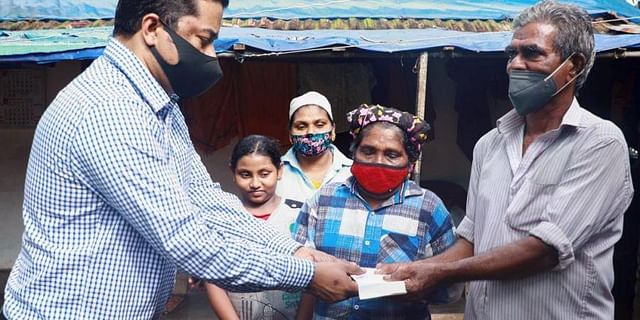
The visitors were the employees of Lulu Group. Though Amina didn’t understand who they were initially, the employees of Lulu told them that they had paid off the loan amount of Rs 3,81,160 that the couple owed to the bank. Amina and her husband were beyond belief when the media coordinator of Lulu Group NB Swaraj, handed over the receipt of the repayment of loan and interest to Amina. He also handed over a sum of Rs 50,000, including medical expenses, to the couple for treatment expenses on Yusuf Ali’s instructions.
The loan amount of Rs 2,14,242, and a total of Rs 3,81,160 including interest and penalty interest, was deposited by Yusuf Ali in the bank. The bank will return the documents for the land after changing it to Amina’s name at the earliest, officials said.
source: http://www.newindianexpress.com / The New Indian Express / Home> Good News / by Express News Service / December 07th, 2021
From being in the company of snake charmers at Kotla in 1999 to capturing history once again at Wankhede Stadium.
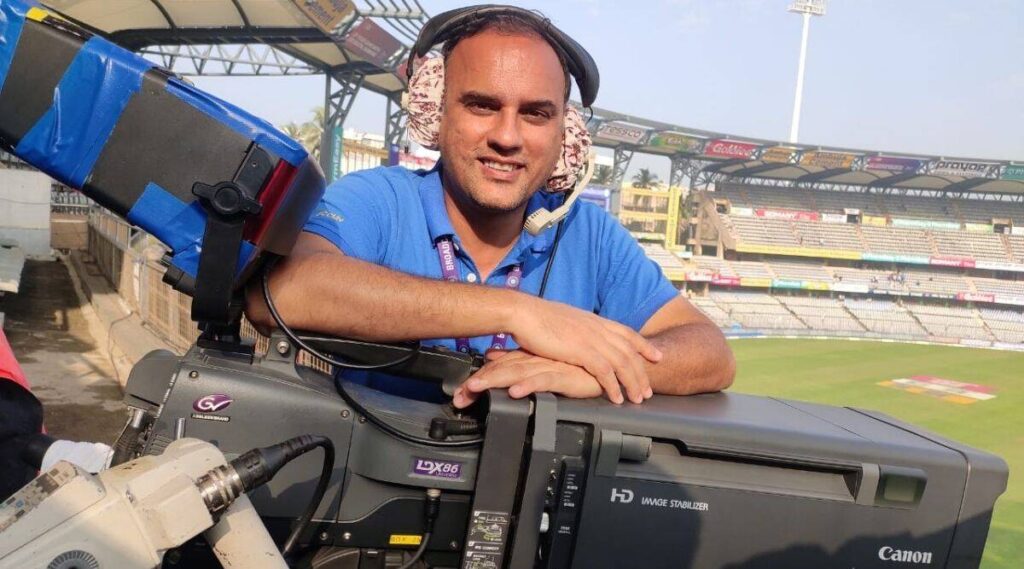
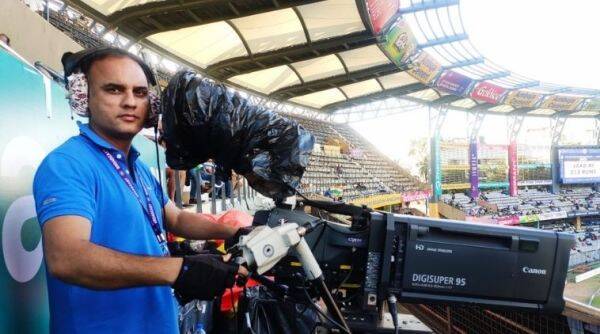
Taqi Raza has the unique distinction of being the camera person for Anil Kumble’s 10-for, as well as Ajaz Patel’s at Wankhede (Express Photo)
When Ajaz Patel twirled around in nervous excitement as the ball started to descend towards Rachin Ravindra, Taqi Raza cleansed himself of emotions and watched from the Grand stand at Wankhede stadium. He would give millions watching the game on television a peep into the mysterious art of a spinner with his spin-cam, the mechanical eye that reveals the ripping release and the revolutions of the ball across the 22 yards in slow-motion.
Now he held his breath and waited. Ravindra, who would later say how his peripheral vision had made him nervous as it had revealed his team-mates were already celebrating the historical moment, managed to safely pouch it. The crowd erupted, the commentators lost their heads, living rooms in New Zealand and even in India filled with joy but Raza struggled hard to check his emotions spinning out of control.
“Sadly I can’t show my emotions because if I express then I can’t concentrate and the world cannot see what is happening inside the stadium,” Raza told The Indian Express . The eye of the world can’t go blind in joy even on a moment that has only occurred thrice in the 144 years of cricket history. A tiny shake of a camera would deprive the viewers. Raza is a ‘slip’ cameraperson, beaming home the fingers of the bowler on the ball at release.
As rare as the epochal moment was, Raza has been there, done that. He had captured the incredible ten-for twice. He was there at Feroz Shah Kotla in 1999 when Anil Kumble snared 10 Pakistani batsmen.
In the company of a snake charmer. But we are getting ahead of the story. Here and now to Ajaz’s and his own tryst with destiny.
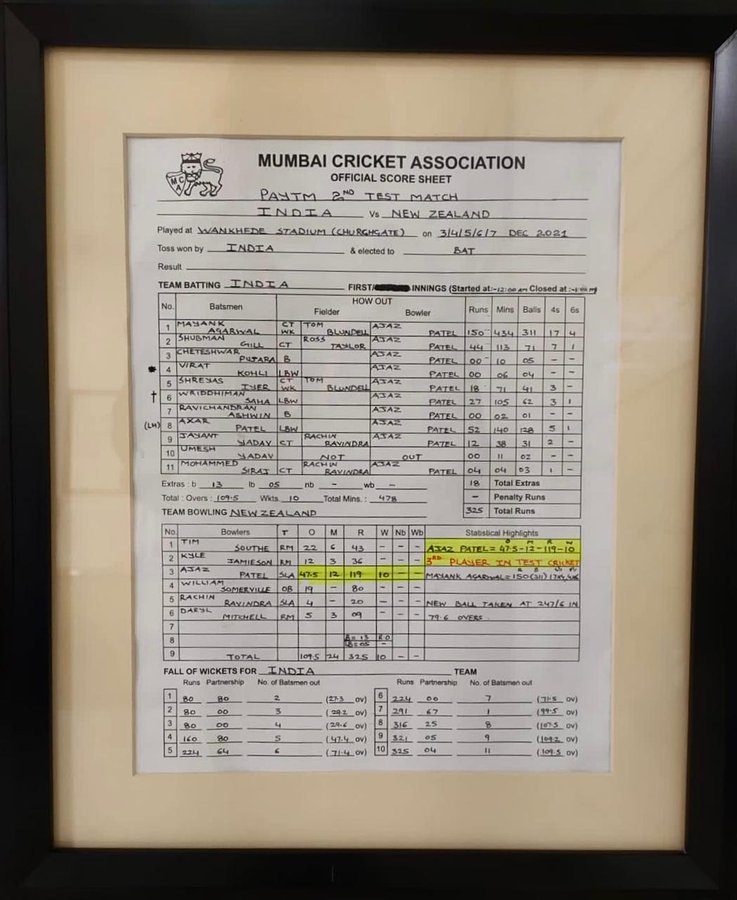
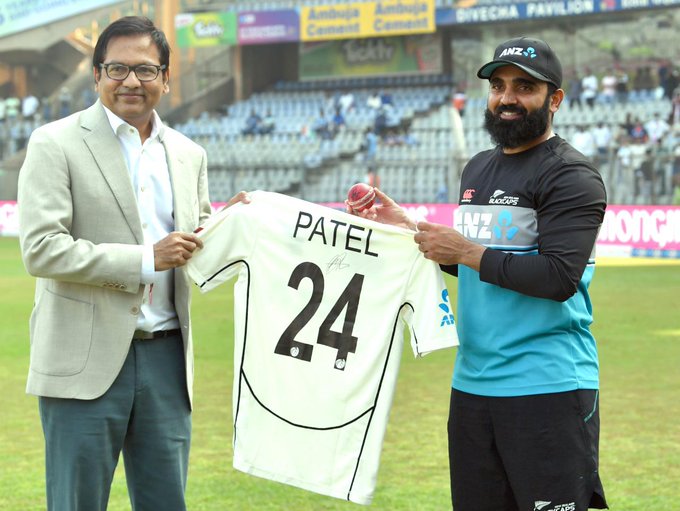
MCA President Dr Vijay Patil felicitated Ajaz Patel with #INDvNZ score sheet and momento. Ajaz handed over the ball and tshirt for the upcoming MCA museum
Ajaz Patel bagged 14 of the 17 Indian wickets to fall in the Mumbai Test He had picked up all 10 wickets in the 1st innings of the 2nd #INDvNZ Test
___________________
7, 8, 9, 10 countdown
Well before the historic moment, Raza had begun the countdown in his mind. 7 down, 8 down, hoping for a historical reprise. “When eight wickets fell down, I asked myself will I have a chance to see history again? I’m the only one in the camera crew who has recorded this achievement before while everyone has retired,” he says. “As a cameraman we don’t have liberty to talk to anyone. Our job demands lots of concentration.” So the internal monologue continued. “When Ajaz took ten wickets, I was overjoyed.”
22 years back, he had witnessed another ball travelling across 22 yards towards history. That memory rebooted now. It was a turbulent time. The political party Shiv Sena had warned of dire consequences if Pakistan were allowed to play at home in India. Uncertainty, tension, fear was in the Delhi air. Raza recalls how the Delhi police had locked all the gates of the stadium to prevent the protestors.
However, the Delhi police also feared the humans might outsource the vandalism to reptiles.
“There was fear that protesters could send snakes inside the ground, so I remember the authorities had kept a snake charmer near the boundary line, incase snake entered the playing area, they could catch it.”
In the end, the only spitting venom that stung the Pakistanis in Delhi winter was released by Kumble. Ajaz’s date with history was captured by 35 cameras. Kumble had got eight. One of which was in the hands of Raza. “Just 8. Now we have around 75 units compared to 30 earlier. There was no technology earlier,” Raza says.
Five years before Kumble had Wasim Akram poking to VVS Laxman for his glorious moment under the smoggy sun, Raza began his job as a technician. He has travelled the world since then, covered all cricket World Cups, including India’s triumph in 2011, trained his camera at Tiger Woods at golf courses, spent time capturing blurs at Formula 1 races, beamed Pro-Kabbadi to homes, and spent his life in various sporting arenas.
He has evolved; so has the broadcasting technology. “In 1999 there was no DRS and Ultra Edge, too much relied on human judgement but now with these tools, bowlers have more chances which wasn’t the case earlier.”
It’s a no-brainer choosing between Kumble and Ajaz’s achievements but the question is asked nevertheless. The answer comes quicker. “For me Kumble’s performance will always be on a higher plane. First it came against Pakistan and the team won because of him. Kumble was under more pressure because he was playing at home. I’m not taking away credit from Ajaz but Kumble was more special for me,” Raza says.
Anil Kumble 10 wickets record against Pakistan
Tough job
The job of the human behind the camera is one of the most difficult ones in the circuit. The pre-game rigging and testing of equipment and the match-day fatigue. Nature might yell, leave alone call, but they can’t abandon their post.
Raza chuckles at a memory from the 2019 World Cup in England. The body screamed for a release at the toilet, but he had to resist. “I somehow controlled and waited.”
Good he did as he could catch priceless moments of the World Cup . “I saw how Virat Kohli was consistently looking to his left side. First I felt there might be some family members seated there but between breaks, Kohli ran towards the stands and told the crowd not to boo Steve Smith, who had come after being banned by Cricket Australia after the ball tampering saga.” Eagle eyed, as ever, Raza didn’t miss the moment.
“I was the only cameraman who got that shot, it showed the other side of Kohli,” he says.
Taqi Raza (Express Photo)
More often than not, it’s a lonely job in some ways though in some stadiums, they aren’t left on their own. “In Multan stadium in Pakistan, Virender Sehwag used to come to our area, which was near the dressing room, and chat up,” Raza says. The new stadiums with segregated spaces don’t allow for that coziness. They are isolated in their corners. They do what the producer tells them to do. They stand for hours under baking sun or chilly winter to get us as close to the action. They stand there, in a cocoon, trying to drag us into the heat of the battle.
Jim Laker, 1956. Anil Kumble, 1999. Ajaz Patel, 2021. And one man with an umbilical cord to two of them – Taqi Raza. Remember the name.
source: http://www.indianexpress.com / The Indian Express / Home> Sports> Cricket / by Devendra Pandey, Mumbai / December 07th, 2021
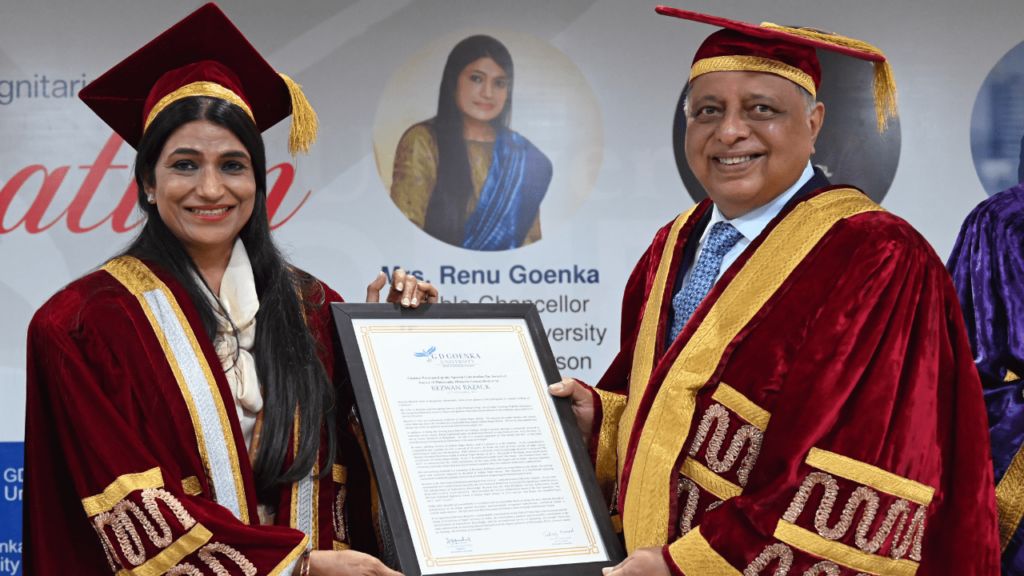
Numismatists and real estate mogul Rezwan Razack was conferred an honorary doctorate on Tuesday by GD Goenka University.
The honorary doctorate was conferred on him during a special convocation attended by Chancellor of the GD Goenka University Renu Goenka, Pro-Chancellor Nipun Goenka, Vice-Chancellor Prof. Dr Tabrez Ahmad, Chairman of M3M group Basant Bansal, and Registrar of the university Dr Dhirendra Singh Parihar. Prof. Dr Tabrez Ahmad, Vice-Chancellor of the GD Goenka University, praised Razack for his contribution to numismatic studies and research.
Rezwan Razack is Co-Founder and Joint MD of Bangalore-based Prestige Group and is hailed as the largest collector of Indian currency. He is also the founder of South India’s first currency museum in Bengaluru, one of the largest and most authentic collections of Indian paper money and coins. He is co-author of the Revised Standard Reference Guide to Indian Paper Money.
After receiving the honorary doctorate from the GD Goenka University Razack said it was an honour for him. A graduate of prestigious St. Joseph College Razack is also the current chairman of the International Bank Notes Society-India Banknote Collectors’ Chapter.
source: http://www.thecognate.com / The Cognate / Home> Business / by The Cognate News Desk / November 25th, 2021
Ebrahim served time on Robben Island as a political prisoner alongside Mandela, Kathrada and others.
Ebrahim Ismail Ebrahim (Twitter Yeni Ozgur Politika)
Ebrahim Ismail Ebrahim, an Indian-origin anti-apartheid icon who spent years imprisoned on Robben Island alongside Nelson Mandela and Ahmed Kathrada, has died. He was 84, South Africa’s ruling party African National Congress (ANC) has announced.
Ebrahim died after a long illness at his home here on Monday, the party said in a statement on Monday.
“The ANC learnt with deep sadness of the passing of Ebrahim Ismail Ebrahim. We offer our heartfelt condolences to his wife and children, as well as their extended family, friends and comrades,” it said in the statement shared on Twitter.
“Comrade Ebi, as he was affectionately known, was a longstanding member of the ANC, a patriot who served his country in different capacities with humility, dedication and distinction,” the party said.
Ebrahim served time on Robben Island as a political prisoner alongside Mandela, Kathrada and others. After his father was arrested twice for defying laws that restricted the movement of Indians in South Africa, he joined the liberation struggle at the age of 13.
He often stated how he had been inspired by the Satyagraha style of Mahatma Gandhi, which he used in his passionate representation of the ANC in global conflict situations in Sri Lanka, Palestine, Rwanda, Kosovo, Bolivia and Nepal.
Ebrahim was arrested in 1963 and imprisoned on Robben Island, where he shared a cell with former president Jacob Zuma, whose role in state capture and corruption he later decried.
After his release, Ebrahim went into exile to continue his work with the ANC, but was abducted by apartheid-era security police from neighbouring Swaziland, tortured and sentenced to a second term on Robben Island.
He obtained two university degrees while on Robben Island.
After the release of all political prisoners and the election of Mandela as South Africa’s first democratic president, Ebrahim served in various capacities, including as Deputy Minister of Foreign Affairs and Parliamentary Counsellor to Mandela.
Sharing their condolences, the human rights organisation #Africa4Palestine acknowledged the role Ebrahim played in the ANC resolution for the immediate and unconditional downgrade of the South African Embassy in Israel to a Liaison Office in 2017.
The Congress of Business and Economics, an offshoot of the erstwhile Transvaal Indian Congress, honoured Ebrahim with a Lifetime Achievement Award in 2018.
“Comrade Ebie, as he was fondly known, recalled at the time how he had spent half of his adult life in prison but that he would do it all over again if he had to because of his firm belief in struggling for peace, justice and the end of the scourge of apartheid and racism across the world,” said CBE Executive Director Yusuf Moosajee.
“In all my interactions with Ebie, both locally and abroad, he was always passionate about South Africa and its role in world politics,” said internationally-renowned filmmaker Anant Singh in a tribute.
source: http://www.indianexpress.com / The Indian Express / Home> World / by PTI, Johannesburg / December 07th, 2021
The Mumbai-born Ajaz took all 10 wickets in India’s first innings and returned with an impressive return of 10-119.
New Zealand’s Ajaz Patel celebrates the dismissal of India’s Mohammed Siraj during the day two of their second test cricket match with India in Mumbai (AP)
Ajaz Patel becomes just the third bowler in the history of men’s Test cricket to take all 10 wickets in an innings (Jim Laker in 1956 and Anil Kumble in 1999).
Resuming on 221 for four, the hosts were bowled out for 325 runs. The Mumbai-born Ajaz took all the wickets and returned with an impressive return of 10-119.
In his first over of the day the 33-year-old Patel, whose family immigrated to New Zealand in 1996, dismissed Wriddhiman Saha leg before wicket for 27 to complete his third five-wicket haul in an innings in tests.
Incredible achievement as Ajaz Patel picks up all 10 wickets in the 1st innings of the 2nd Test.
Ravichandran Ashwin was out bowled on the next delivery to hand the left-arm spinner his best bowling figures in the format as India were reduced to 224-6.
Axar denied Ajaz the hat-trick and then combined in an unbroken 61-run stand for the seventh wicket with Agarwal to keep India on course for a big total on a track offering assistance to the spinners.
Agarwal has hit 16 fours and four sixes in his knock and looked assured at the crease with Ajaz, who didn’t find much support from the other New Zealand bowlers.
The opening test in Kanpur ended in a thrilling draw, with New Zealand’s last batting pair hanging on in the final session to deny India victory.
source: http://www.indianexpress.com / The Indian Express / Home> Sports> Cricket / by Sports Desk, New Delhi / December 03rd, 2021
Two women, one war. What sets them apart? Professor Lakshmi Subramanian explores Rudrangshu Mukherjee’s ‘A Begum and A Rani’.
The focus of this work, as evident in the title, is two women who fought the same war in 1857 but who never met, whose lives were strangely similar and yet were recalled very differently. Why this was so, what made for a particular telling of their afterlives and how in course of the retrospective retelling, one became a legend and the other a mere trace, forms the core of Rudrangshu Mukherjee’s narrative.
It departs from his earlier work on the Revolt of 1857, where he placed emphasis initially on the diverse structural elements that made up the popular uprising in Awadh and subsequently on explaining the violence that characterised the actions of both the insurgents and their suppressors. Here, in contrast, Mukherjee prefers to focus on the individual as the actor of history and on the politics that animated the reconstruction of individual lives. He does so with elegance, ever attentive to the dictates of Clio, in unravelling the complexity of the context in which the two protagonists found themselves as they were sucked into the vortex of real politics and popular expectations.
(A Begum and A Rani was published by Penguin Allen Lane in July 2021. Buy it here.)
The first two chapters of the book give the reader a taste of the Revolt in its early stages, when a series of military mutinies collapsed into agrarian rebellion, bringing myriad elements into the fray, ranging from the aggrieved taluqdar to the oppressed peasant, from the disenfranchised ruler to the urban dweller. Amidst the clamour of the rebels for a return to Mughal rule and for an end to the unholy power of the hated firang, emerged a slow political front to embark on campaigns against the British forces and coordinate military activity.
Two parallel centres of authority
In Lucknow, the discarded wife of Wajid Ali Shah found herself at the epicentre of protest, whereas in Jhansi, Lakshmibai was urged by the rebels to take up their cause. While the latter was found in active combat, Hazrat seems to have attended to the day-to-day requirements of the troops, making sure that they were provisioned and supported. Hazrat seems to have also been pitted against one of the most charismatic leaders, Maulvi Amir Ali, who insisted on Hazrat becoming his disciple — which Hazrat herself resisted.
That these two individuals represented two parallel centres of authority is clear but what this implied in terms of differing conceptions of freedom is not readily apparent. However, in the analysis of the ishtahars or proclamations that were issued, Mukherjee makes the important point that religion was the integral and unifying idiom in the Mutiny.
The Afterlife
It is in the chapter titled Afterlife that the book really comes into its own. Here, Mukherjee tracks the moments in the emergence of a nationalist historical consciousness in Maharashtra, Bengal, and subsequently in North India, in which the status of the martyr queen gained traction. Analysing poetry, local memories, eulogies and early historical work on the Rani of Jhansi, Mukherjee tracks the making of a very particular historical memory and its amnesiac other, thereby engaging with the complex relationship between myth and history.
He suggests that these categories were not necessarily oppositional. Rather, both were exercises in remembering and forgetting and reconstructing. It is to his credit as a practitioner of history that he reconstructs as well as he does the lives of two women — one of whom was subsequently pushed on to the centre-stage while the other was relegated to the margins.
Lakshmi Subramanian is professor of History in BITS Pilani, Goa. She is the author of several works on music and nationalism as well as on India’s maritime history. Her latest book is Singing Gandhi’s India: Music and Sonic Nationalism. When she is not steeped in teaching and research, she likes to travel to the hills.
source: http://www.telegraphindia.com / The Telegraph, Online / Home> My Kolkata / by Lakshmi Subramanian / December 03rd, 2021
Five students from University of Kashmir have invented an automatic rice cooker. Apart from working automatically, the rice cooker also sucks out starch from the rice.
The group of inventors said, “Rice cookers accessible these days are giving us undesirable food. They prepare food without expelling the destructive material like starch which can cause medical issues among some people.”
The main goal of this invention is to suck out the starch from the rice which is unhealthy for the diabetic patients.
Earlier, the people who used to cook rice in cooking pots, used to drain out starch from the rice manually which avoided health problems like diabetes, obesity etc. It was researched by innovators that diabetic patients were advised by doctors not to consume rice made in rice cookers as it doesn’t drain out starch.
“The cooker is designed as such that it prompts the user whether to suck out the starch from rice or not because healthy people need starch for their body,” said Jehangir Hameed, a member of the group, who is currently pursuing M. Tech.
The rice cooker will cook food with a single text message sent by a user through the mobile phone. It will monitor the starch status of the rice being cooked. It will consistently screen the starch status and will expel when it is being discharged out of the rice.
Working of the project
It has inbuilt rice bowl and water tank which are controlled utilizing controllers and hence no physical intervention is required while cooking or keeping the prepared food warm.
The device is fully automatic as it is controlled by GSM and IoT based technology. The rice cooker is programmed and configured to receive a command from a mobile phone to cook rice for people ranging from 1 to 12.
With predetermined chambers for water and rice, it will automatically put the rice and water for cooking. At every stage of cooking, the device will send an alert to the user about the number of people for whom rice is cooked. When the food is cooked, it will again send a message to the user that the food is ready.
Jehangir said, “It’s good for everyone. People who work outside, or a student who lives in a hostel, people coming from outings and sports activities after being exhausted, have no capacity to prepare food. With a single text from a mobile phone or other source, it will accomplish the cooking work itself.”
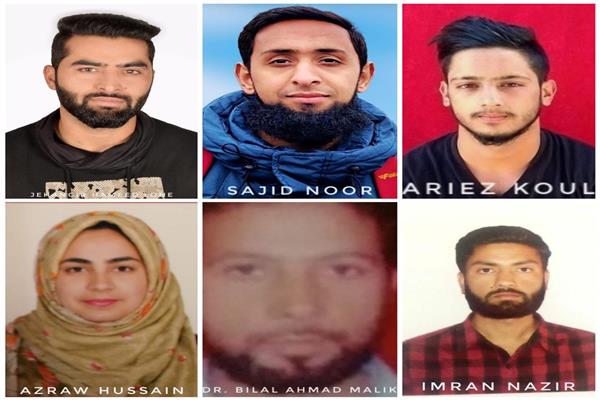
Apart from Jehangir, Azraw Hussain, Sajid Noor, Ariez Koul and Imran Nazir are part of the project along with Dr. Bilal Ahmad Malik, the Scientific Officer from University of Kashmir.
The patent authority of India has accepted and published the details of their patent on the invention.
The innovators want support from government or private companies in order to convert their prototype into a marketable product.
source: http://www.risingkashmir.com / Rising Kashmir / Home / by Insha Latief Khan / November 03rd, 2021
Although the award will technically go to AR Rahman for being the music director and the producer of the video, it is clear that Rahman considers the video to be the work of his daughter Khatija.
Chennai :
Noted music director AR Rahman’s daughter Khatija Rahman seems to be doing her dad proud. The gifted singer’s music video – ‘Farishton’ – has won the award for the Best Animation Music Video at the International Sound Future Awards.
Although the award will technically go to AR Rahman for being the music director and the producer of the video, it is clear that Rahman considers the video to be the work of his daughter Khatija.
He tweeted the news of the musical video having won the awards. “‘Farishton’ wins one more award. @Rahmankhatija EPI.”
This is not the first award for ‘Farishton’ as just a couple of days ago, the music video won an Award of Merit at the Global Shorts.net, an international short film competition.
The video has also received a special mention award at the Los Angeles Film Awards.
‘Farishton’ is significant as Khatija Rahman considers it to be the beginning of her musical journey.
In a post describing her video on YouTube, Khatija says, “I was born in Chennai in a multicultural family with different genres of music and with friends from diverse backgrounds. I’ve always been fascinated with the wonders of life. As Mawlana Rumi says – ‘There are a thousand ways to kneel and kiss the ground; there are a thousand ways to go home again’. The video’s main character Amal was created with such experiences of mine and the longing to explore the unknown. I hope all of you find your own journey of the unknown.”
source: http://www.newindianexpress.com / The New Indian Express / Home> States> Tamilnadu / by IANS / November 09th, 2021