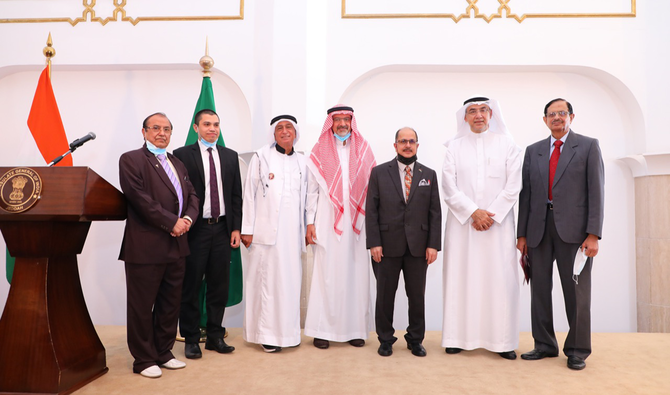
Indian Ambassador Dr. Ausaf Sayeed, third right; Dr. Ashraf A. Amir, second right; Acting Consul General Y. Sabir, second left; Dr. M.S. Karimuddin, right; and others.
The Jeddah chapter of the Indo-Saudi Medical Forum (ISMF) was launched at the InterContinental Jeddah on Friday by Indian Ambassador Dr. Ausaf Sayeed. The event took place in the presence of prominent Saudi and Indian healthcare professionals in the western region.
Dr. Sayeed thanked Dr. Ashraf A. Amir, chief medical officer (CMO) at Jeddah’s high-profile International Medical Center (IMC), for agreeing to become the forum’s president. He also thanked veteran and popular Indian pediatrician, Dr. M.S. Karimuddin, for becoming the forum’s vice president.
The ambassador highlighted the great strides that have taken place in recent times in relations between Saudi Arabia and India. Dr. Sayeed said the visit of Prime Minister Narendra Modi to Saudi Arabia in October last year plus the signing of a series of important agreements in different fields, including healthcare, have provided new momentum to the two countries’ relationship.
The ambassador highlighted the immense opportunities that “are waiting to be tapped in the healthcare industry.” He said the new forum, led by an energetic and experienced team, would be a good platform for complementing the steps and initiatives being taken by both governments — in Riyadh and New Delhi — to increase cooperation in the field of healthcare. He pointed out that India had become the “pharmacy of the world” during the coronavirus (COVID-19) pandemic. “India stands ready to play its part in alleviating the difficulties of the global community during times of global health crises.”
Dr. Ashraf Amir promised to take all steps to achieve the stated objectives of the Indo-Saudi Medical Forum. He said the advancement of the Indian healthcare sector had been phenomenal and that Saudi Arabia had won international praise for its exceptional handling of the coronavirus crisis.
Acting Consul General Y. Sabir welcomed the guests. He noted that the Indo-Saudi Medical Forum aimed to serve as a key platform point for high-level informal interactions between the medical fraternities of both India and Saudi Arabia.
Dr. Karimuddin highlighted the many activities that the forum plans to undertake in the coming days and months. Among other things, he said: “An effort will be made to bring together corporations working in the healthcare sector, including hospitals, pharma and surgical equipment firms, in order to collaborate with a view to providing excellent healthcare for Saudi citizens and expats.”
Dr. Karimuddin said the Indo-Saudi Medical Forum was a nonprofit body under the patronage of the Embassy of India. The forum, made up of Indian and Saudi doctors and experts in the field of healthcare and wellness, will play a supporting role in strengthening India-Saudi Arabian cooperation related to healthcare. ISMF will have three chapters in Jeddah, Riyadh and Dammam.
Nouf Marwaai, award-winning yoga instructor, spoke about how India’s expertise and facilities in the field of wellness and holistic healthcare was relevant to the Saudi healthcare system.
She said the momentum for the present Saudi-Indian relationship began during Modi’s visit to the Kingdom in April 2016 when King Salman presented him with the Kingdom’s highest civilian decoration, the Sash of King Abdul Aziz. “This recognition is an indication of the importance the Kingdom attaches to its relations with India,” she said.
Dr. Iqbal Musani, general secretary of the forum, highlighted with a PowerPoint presentation the giant strides that India and Indian doctors have made in the field of medicine.
Prominent among those who were present at the event included Hamna Maryam, consul (commerce) at the Indian Consulate in Jeddah; Mohammed Alungal, chairman of Abeer Medical Group; V.P. Mohammed Ali, chairman and managing director of Jeddah National Hospital; Dr. Kavitha Marusamy of Ibn Sina National College; Dr. Ataat Khan and Dr. A.H. Maniyar.
A large number of Indian and Saudi doctors also attended the launch virtually in view of COVID-19-related restrictions.
source: http://www.arabnews.com / Arab News / Home> Business>Corporate News> Latest News / December 26th, 2020
The University has a campus spread over 467.6 hectares of land in the city of Aligarh, Uttar Pradesh. It also has three off-campus centres in Malappuram (Kerala), Murshidabad-Jangipur (West Bengal) and Kishanganj (Bihar).
pix: ani
New Delhi:
Prime Minister Narendra Modi released a postal stamp as part of centenary celebrations of Aligarh Muslim University (AMU).
Chancellor of the University Syedna Mufaddal Saifuddin and Union Education Minister Ramesh Pokhriyal Nishank were also present on the occasion.
This is the first time PM Modi is participating in a programme of the Aligarh Muslim University, being held via video conferencing.
Speaking to ANI, AMU Public Relations Officer (PRO) Omar Saleem Peerzada had said, “A centenary celebration is a landmark event in the history of any university. We are celebrating this event following all protocols of the COVID-19 pandemic. There are webinars, seminars and symposiums going on.”
AMU became a University in 1920, through an Act of Indian Legislative Council by elevating the Mohammedan Anglo Oriental (MAO) College to the status of a Central University. MAO College was set up in 1877 by Sir Syed Ahmad Khan, the PMO release stated.
The University has a campus spread over 467.6 hectares of land in the city of Aligarh, Uttar Pradesh. It also has three off-campus centres in Malappuram (Kerala), Murshidabad-Jangipur (West Bengal) and Kishanganj (Bihar).
source: http://www.newsroompost.com / Newsroom Post / Home> Education / by Newsroom staff / December 22nd, 2020
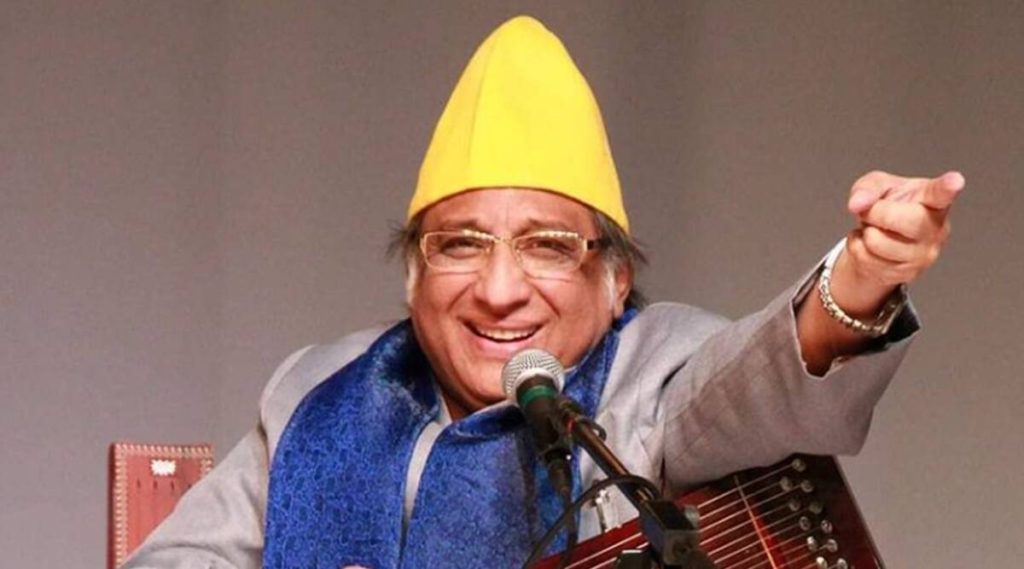
Ustad Iqbal Ahmed Khan was a renowned vocalist. (Source: Instagram)
Since 1981, Ustad Iqbal Ahmed Khan was serving as the custodian or Khalifa of Dilli Gharana.
Hindustani classical music maestro Ustad Iqbal Ahmed Khan passed away at the age of 66 on Thursday, December 17, 2020. His demise left many people shocked who took to social media to express their condolences. The vocalist, who belonged to Dilli Gharana, was a recipient of the Sangeet Natak Akademi Award for his contribution to classical music.
After receiving his initial training in music from Ustad Chand Khan and later under the guidance of Ustad Hilal Ahmed Khan and Ustad Naseer Ahmed Khan, Ustad Iqbal went on to “teach Indian Classical Music and style of Dilli Gharana Gayaki”, as per his official LinkedIn profile.
A well-known name in Delhi’s cultural scene, owing to his immense contribution to the field, he was serving as the custodian/Khalifa of Dilli Gharana since 1981. He took over the reins after the demise of Ustad Chand Khan Sahib in 1980 and other senior members (rather in quick succession), as per the official website dilligharana.in.
The Gharana’s Sursagar Society was founded in 1940 by the late Ustad Chand Khan Sahab/Saheb (Sangeet Martand) in the memory of his father, Shams-e-Mousiqui Ustad Mamman Khan. The society aims to conserve and promote an awareness of both the rich and heterogeneous cultural tapestry through a focus on the classical arts, with their attendant legends, rituals, mythology and philosophy and the deeper and subtler values of these arts, as per dilligharana.in.
Here are some musical soirees the society used to organise at distant places in Delhi, courtesy Sursagar Society of Delhi Gharana page on Facebook.sources
His style of classical singing and his renderings of Thumri, Dadra, Tappa, Bhajans and Ghazals won him great acclaims.
He was actively involved with classical music through various mediums that included performing, teaching, research, recording and archiving, and curating productions and events that aimed towards preserving and promoting the classical repertoire, both in India and abroad.
source: http://www.indianexpress.com / The Indian Express / Home> Lifestyle> Art &Culture / by Lifestlye Desk / New Delhi – December 17th, 2020
Colonial historians and scholars often claim that the Indian Freedom Movement was a disjointed movement with no nationalistic feeling among the people participating in it. This belief, that Indians fought against the British for local communal reasons without any coherence, has been further propagated by the Indian historians as well, after the independence. Often, we are made to believe that Muslims fought to secure their religion or Caliphate while Hindus to protect regressive social institutions. Similarly, urban elite, peasantry, tribal, and others have their own narrow interests in fighting against the British.The idea may be true and open to debate, but the fact that there was a coherence among different groups within India while fighting against the British is an undeniable fact.
During the early 19th century, the British decided to partition Bengal. Hindus and Muslims, together, rose up against the decision which based itself upon religious segregation. India in general, and Bengal in particular, adopted the Swadeshi campaign to oppose this decision. In 1905 Bengal got divided, agitating the youth. It must be noted that the present Bihar was part of Bengal at the time. The youth, led by people like Barin Ghosh, started adopting militant methods to oppose the British.
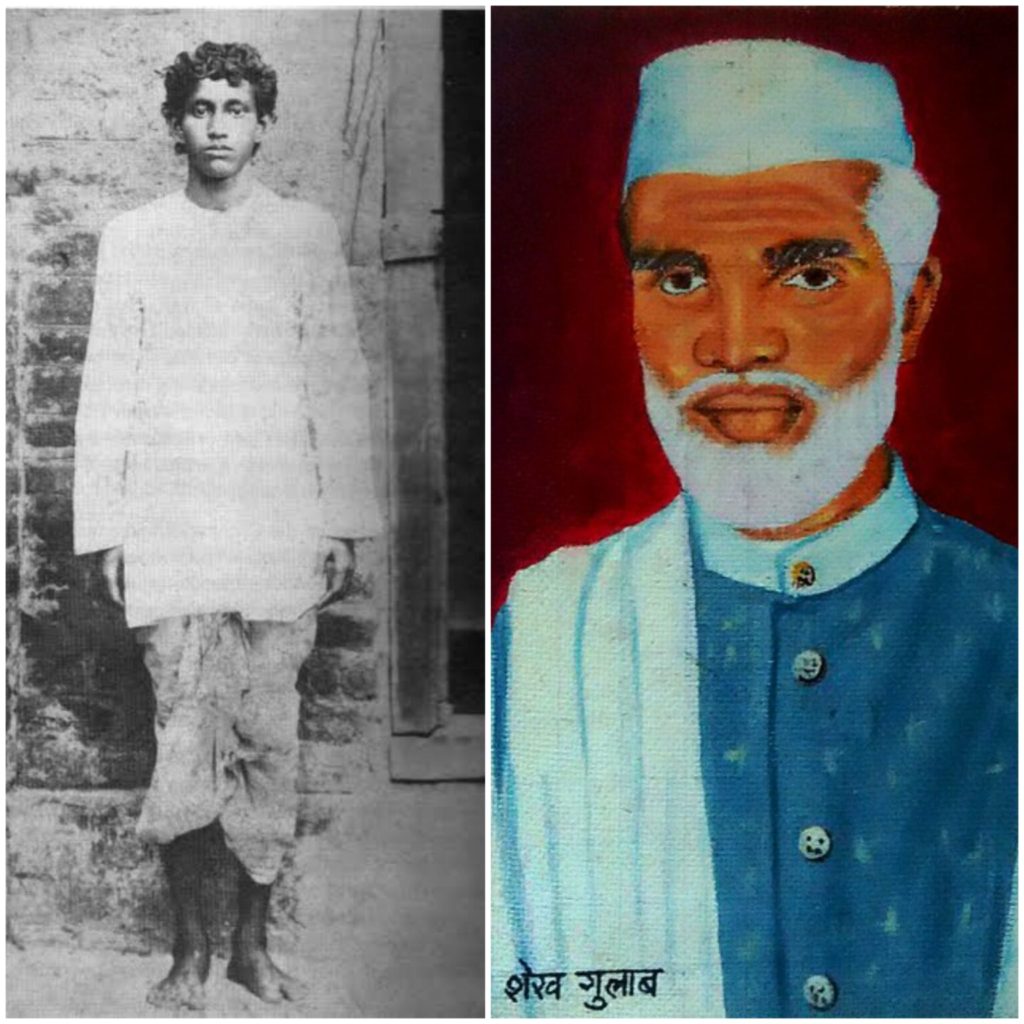
At the same time, in Champaran of Bengal (now, in Bihar) indigo planters led by Sheikh Gulab started a non-cooperation agitation against the British indigo planters. Gulab defied the tinkathia system, where indigo had to be planted on the best portions of land, on his 60 bigha land which was near Sathi factory in Champaran. It was 1907 & Champaran was part of Muzaffarpur commissionerate.
More and more peasants joined Gulab in his movement and another Sital Ray rose as another prominent leader. Planter’s Association had their own army called Bihar Light Horse, famous for its cruelties over peasants. In 1907, the government passed an order appointing Gulab and his comrades as the special constables in police. Gulab defied this appointment and did not join. Police arrested him under the Special Police Act, 1861.
Sentence of Gulab was reversed later by Kolkata Court in March, 1908.
Next month, in Muzaffarpur a judge, Kingsford, was transferred from Kolkata. Champaran lied under his jurisdiction. Indians were already angry with the judge for his anti Indian attitude and there was this apprehension that he had been brought to crush the anti British peasant movement. British reports were already pointing towards a collaboration between Kolkata based Bengali revolutionaries and the peasant movement of Champaran.
The arrest of Sheikh Gulab had stirred the local emotions and this transfer of Kingsford acted as a catalyst.
Within a few days, Khudiram Bose, a young boy of 17, and Prafulla Chaki, both of them Bengali tried to assassinate Kingsford with a bomb. Accidentally, they killed two English women.
Khudiram Bose was hanged till death in August, 1908.
Khudiram’s martyrdom instilled a new spirit in Sheikh Gulab. In September, 1908, he organized more peasants at Vijayadashami Mela in Bettiah, Champaran. Now, peasants were openly defying the planters and attacking them. On 16 October, 1908, peasants attacked the Parsa Indigo factory. Government reacted brutally. Sital Ray was arrested along with more than two hundred peasants.
In the Legislative Assembly of Calcutta, it was argued that Bengali and Bihari have worked in unison against the British in Champaran during 1907 – 1908. Further reports that a Burkha clad Muslim woman provided shelter and help to Khudiram Bose during his attempt on Kingsford’s life also point towards an association between Sheikh Gulab’s movement and Bengal revolutionaries. P.C Roy, implicitly, contends that the arrest and case against Sheikh Gulab may be one of the reasons that Khudiram Bose attacked Kingsford in Muzaffarpur.
(Writer is a well known historian)
source: http://www.heritagetimes.in / Heritage Times / Home> Bihar> Freedom Fighters / by Saquib Salim / July 17th, 2020
The award has been conferred upon noted Indian scientists including APJ Abdul Kalam, MS Swaminathan and KG Menon earlier, and Prof Asad is the first recipient as AMU faculty member.
Prof Asad Ullah Khan, Coordinator, Interdisciplinary Biotechnology Unit, Aligarh Muslim University
Aligarh:
Noted biotechnologist and scholar, Prof Asad Ullah Khan (Coordinator, Interdisciplinary Biotechnology Unit, Aligarh Muslim University ) has been decorated with Sri Om Prakash Bhasin Award-2019 for his trail-blazing research in Biotechnology.
The award, held in high esteem across the country and is given to eminent scientists in the field of Agricultural Sciences, Biotechnology, Electronics, Engineering and Medical Sciences, carries a cash prize of Rupees one lakh with a citation and plaque.
The award has been conferred upon noted Indian scientists including APJ Abdul Kalam, MS Swaminathan and KG Menon earlier, and Prof Asad is the first recipient as AMU faculty member.
Prof Obaid Siddiqui, an alumnus of AMU, received this honour in 1993.
The Vice-Chancellor Prof Tariq Mansoor has congratulated Prof Khan on this awe-inspiring academic honour and said ‘it is given on his seminal contribution to study of Antimicrobial resistance and infection biology of bacteria’.
The award will be given during the first week of November 2020, said a statement from AMU.
source: http://www.ndtv.com / NDTV / Home> NDTV Education / by Shihabudeen Kunju C / April 12th, 2020
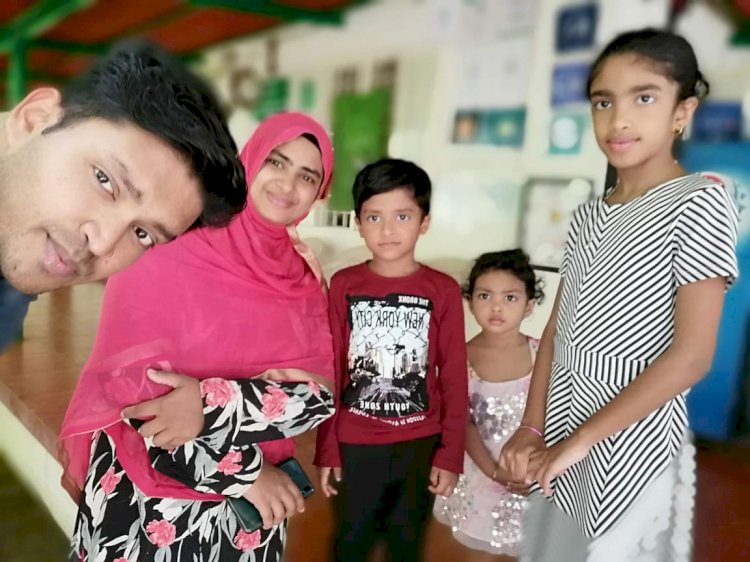
At a time when the world has turned online for education, work, shopping, business and whatnot, here is a couple from Malappuram district in Kerala who has brought out a new online method of learning, integrating computer coding with school subjects for kids. Let’s meet Aisha Sameeha and Shahid Jabbar from Nilambur.
Hailing from the village of Melattur, Aisha Sameeha was just one among the many girls in Malappuram – who studied well, graduated in BTech, got married and settled with her husband in his workplace Dubai.
Soon, they got their first child and Sameeha got busy with her daughter Eshal.
However, sitting idle or being content with the homely chores alone was not her cup of tea. Sameeha tried her hand at different trades such as content writing for technical websites, cooking and baking, stitching and embroidery etc. She also attended and won a few cooking competitions held in Kerala and Dubai.
Into the field of education
Having born and brought up in Kerala and abroad, Sameeha had got familiarized with different methods of education. And that encouraged her interest in learning and teaching. “Teaching has always been my passion, even when doing BTech. And that is also a reason I didn’t take up the job offers that came my way after the completion of my studies,” said Sameeha. She especially mentioned the methods followed in the PeeVeeS Public School, Nilambur, where she studied from class 1 to 6 and the MES Engineering College. The two institutions taught her the importance of encouragement by teachers and the effectiveness of grouping and sharing to learn better.
Once her daughter began to attend school, it opened her to another world in the field of education. The kindergarten that Eshal attended in Dubai followed the Reggio Emilia approach, which gave high importance to interaction between parents, teachers and students. Parents were encouraged to come to the school and be a part of various activities. Each class had a library and several other items that caught children’s attention and interest, where they could gain knowledge. “I had thought that I couldn’t manage small kids, but it was proved wrong when I began to go there,” confessed Sameeha. “I used to observe how they were doing things, dealing with the children, the method of teaching etc. That was a sort of experimental and experiential learning. Eshal liked it a lot there.”
source: http://www.thesite.in / The Site / Home> Empowerment / by Najiya O / December 07th, 2020
Noted NASA scientist Dr Hashima Hasan, who is the Program Scientist for NuSTAR, has thanked the Aligarh Muslim University (AMU) helping her materialise her dream. According to an official AMU press statement, she thanked the university during the interview to NASA STEM Stars.
“The student life at AMU from 1968 to 1973 and the academic credentials gained there helped me attain a prestigious scholarship to further pursue higher studies in Nuclear Science at the University of Oxford,” Hashima said.
“I worked hard and gave this land all I had, and this great nation paid me back in spades, but it all started at AMU,” she added.
“I was a little girl back then, but the spectacular satellite launch made me eager to follow every success and failure in the newspaper. I clearly remember the day man landed on the moon,” she said. The work at NASA is dynamic, challenging and energizing and my journey to become a space scientist began after a post-graduate degree in Nuclear Physics at the Aligarh Muslim University, reminisced Dr Hashima.
She attended Tata Institute of Fundamental Research, Mumbai for a postdoc and worked at the Bhabha Atomic Research Centre in Mumbai before reaching the United States on a US Council Fellowship.
“Later in life, I worked at the Space Telescope Science Institute, Baltimore, writing the simulation software for the optics of the Hubble Space Telescope and its science instruments, using it to analyse the optical error of Hubble after launch,” she shared in the interview.
Dr Hashima recalled that as the Optical Telescope Assembly Scientist, it was her job to keep the telescope in the best focus until a fix could be installed.
“Then I was ready to achieve my dream of working directly for NASA. An opportunity arose in 1994 when a job for a Visiting Senior Scientist was advertised. Although it was a two-year job, I found working at NASA Headquarters so exhilarating and rewarding that I stayed on,” she said adding that NASA’s space science program gives her the opportunity to lead cutting edge science, work with world-class scientists and write research papers on astronomy.
source: http://www.thesite.in / The Site / Home> Inspiration / by The Site Reporter / December 12th, 2020
Currently, Lulu imports apples and saffron from Kashmir and imports will significantly increase in the coming years.
Image used for representatio
The UAE-based Lulu Group International has announced a plan to set up a food processing centre in Srinagar for sourcing a wide range of agri products from Jammu and Kashmir.
The announcement was made by Lulu group chairman Yusuffali MA on Thursday during a meeting with a delegation from Jammu and Kashmir headed by its Principal Secretary (Agriculture Production and Horticulture) Navin Kumar Choudhary on the sidelines of the UAE India Food Security Summit 2020.
“As per the commitment made during the visit of Prime Minister Narendra Modi to UAE in 2019, Lulu Group is fully focused on sourcing a wide range of agri products from J&K,” Yusuffali, who is from Kerala, said.
“Setting up of a new food processing and logistics centre will further boost the export of Kashmiri products,” he said.
Currently, Lulu imports apples and saffron from Kashmir and imports will significantly increase in the coming years.
The group imported more than 400 tons of Kashmiri apples till date, despite several challenges in the recent past due to the coronavirus pandemic, according to an official statement.
Yusuffali said Lulu group is one of the leading importers of food and non-food products from India and setting up of a new food processing and logistics centre will further boost export of Kashmiri products to the Gulf Cooperation Council (GCC) and other countries.
GCC is a political and economic union of six Arab states bordering the Gulf.
Its members are the United Arab Emirates, Saudi Arabia, Qatar, Oman, Kuwait and Bahrain.
Describing the meeting as “very productive”, J&K Principal Secretary Choudhary said a large number of decisions were taken to promote the export of agriculture and horticulture products from the union territory to the entire Gulf region using stores of Lulu group.
He assured all help to Lulu group for setting up logistic facilities and offices at identified facilities in J&K.
Choudhary also welcomed the initiative of Lulu group to host a “J&K special” fortnight at all super markets at its group across the Gulf region on the occasion of Republic Day-2021 as part of Incredible India.
This fortnight celebration will begin on January 24 next year and will showcase J&K’s famous products like cuisine and cultural heritage, the statement said.
The discussions also focused on exploring the possibility of direct passenger as well as regular cargo flights between Srinagar and Dubai.
An MoU was also signed between Lulu group and Fruit Master Agro Fresh J&K for the supply of apple and other fruits for the super markets of Lulu group across the Gulf countries, the statement said.
Indian Consul General Aman Puri congratulated Lulu group for announcing a host of initiatives and the long-standing commitment and partnership in achieving the target of doubling J&K’s exports and expressed his gratitude to the company chairman for his initiatives in the union territory which would generate employment opportunities for local youths and contribute to the economic development of the region.
source: http://www.newindianexpress.com / The New Indian Express / Home> Business / by PTI / December 11th, 2020
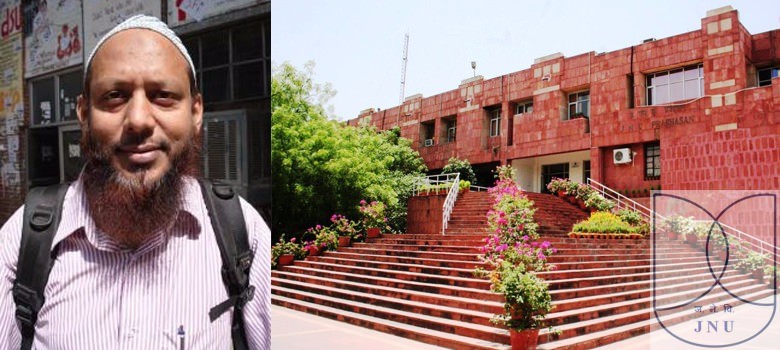
According to Dr Khurshid Imam, understanding Judaism is essential to fully comprehend the Quran.
Navras Jaat Aafreedi/jnu.ac.in
The only Hebrew language teacher who holds a position in Indian academia is Dr Khurshid Imam, Assistant Professor at the School of Language, Literature and Culture Studies in Jawaharlal Nehru University. In this conversation with Dr Navras Jaat Aafreedi, he reveals the secret of a Ben Gurion “mosque” and tells us about a hadīth in which Prophet Muhammad encouraged Muslims to learn Hebrew.
Please correct me if I am wrong in understanding that you are the only person teaching Hebrew at any Indian university?
Not only am I the only person teaching Hebrew at any Indian university, but I was also instrumental in getting Hebrew introduced at the Jawaharlal Nehru University. Although officially speaking it was introduced at the university only as a result of a bilateral agreement between India and Israel, yet had I not made efforts for it, I doubt if this would have happened when it happened. (This interview was conducted in 2011. Since then, Dr Imam has been joined by Achia Anzi in teaching Hebrew at JNU, but Anzi teaches on a contractual basis. Hence, Imam still remains the only Hebrew teacher to hold a tenure track position in Indian academia.)
There are two divisions in any religious community, one of the observant followers and the other of the non-observant ones. You clearly belong to the observant section of Muslims. Considering this and given the tensions between Jews and Muslims today, it is surprising to come across you, an observant Muslim, as the only Hebrew teacher in India. Although Islam does not forbid learning any language, it is hard to find somebody like you.
It is only because of the stereotyping of Muslims that people are surprised when they find me teaching Hebrew. Stereotyping can have very dangerous ramifications as witnessed in the post-9/11 fatal attacks on Sikhs in the US when they were mistaken for Muslims because of their beards and turbans. Also, generally Muslims know their religion not as a result of self-study but as a consequence of how it is interpreted to them by the clerics, which shapes their understanding of how a Muslim should conduct himself. Hence, they are often suspicious of those among them who study the Torah or have Jewish friends.
Similarly, instead of appreciating a Muslim studying the Hebrew language in which one of the most important sacred texts, the Torah, was received, it is seen with suspicion and even condemned. There was a time when the Indian Muslims had a similar attitude towards English, then seen by them as a language of the imperialists and enemies of Islam which would distance the Muslims from their religion, Islam. But today not only is English taught even in the Islamic seminaries, its importance is realised by one and all across the Indian Muslim community.
My family, friends and wider community were all surprised when I decided to learn Hebrew. Even in Israel, everybody seemed to be surprised to find a visibly observant Muslim like me with a beard and Islamic skull cap desirous of learning Hebrew. For the Israelis, it was their first ever interaction with a non-Arab Muslim, and that too an observant one and on top of that interested in learning their language, which took them by surprise. So, among both, Muslims as well as Jews, there were people who felt I had gone crazy. And I was met with this response only because of the stereotype of a Muslim that these people had. As for me, my interest in Hebrew was driven by my desire to learn about the Jewish version of the Middle East conflict, as my Jewish brethren expressed it in their language Hebrew. I could already access the Arab version in their language because of my knowledge of Arabic. I did not want to know about the conflict between the Jew and the Muslim through a third person.
During the time you spent in Israel for your studies, the consciousness that the people there would form their perception of Indian Muslims on the basis of their impression of you must have put some pressure on you?
It was after my MPhil at the Jawaharlal Nehru University that I went to the Hebrew University of Jerusalem for some time for specialising in the Modern Middle East. Initially I went to Israel on a Government of Israel Scholarship, but after that I was supported by Golda Meir scholarship to continue my studies there. The various courses that I took under these two scholarships were cumulatively considered at par with MA.
Although lessons in Hebrew language are not a part of MA in Middle Eastern Studies, yet knowledge of Hebrew is considered mandatory for it. Hence, I learnt Hebrew along with my MA and attained knowledge equivalent to seven levels. I was in Israel from 1998 to 2000. I registered for PhD in 2002 and was awarded the degree of PhD in 2009. I was the first non-Arab Muslim that the Israelis had any interaction with. And they started trusting me so much that some of my Jewish friends even visited the Palestinian Authority-administered Bethlehem with me for the first time in spite of all apprehensions. I got invited to their homes on Jewish festivals just as I was invited by my Palestinian friends on Muslim festivals. My having relations with both parties sometimes made people suspicious of me. Palestinians would think of me as a Yemenite Jew while the Ashkenazim would consider me an Arab. Hence, I was under threat from both sides. In this respect, mere glares would say a lot to me even if the people did not utter a word.
When I tread on areas beyond the university neighbourhood, people would look at me with suspicion. Muslims would look at me in the same manner if I visited a mosque not accompanied by any local Arab Muslim friend. The very atmosphere is such that people get easily suspicious of strangers and fear them to be suicide bombers or fanatic attackers. Later, I started empathising with them. I used to offer namāz (Islamic prayers) in the balcony of my flat in Israel. The door to the balcony had a picture of [Israel’s first prime minister] Davd Ben Gurion. I never thought of removing the picture, and as a result my flatmates started calling it Ben Gurion mosque.
Without exaggeration, at least 20-25 Jews wept when I left Israel. Relations are still such that whenever anybody from this university goes to Israel, he is asked about my well-being. I see it as an achievement that I left behind weeping Jewish friends when I returned to India, given the fact that I had gone to Israel all alone, despite discouragement from family and friends and their warnings that according to them, I, a devout Muslim, was risking my safety by heading to an enemy country. Later, Israeli TV channel, Channel 8 Avutz Shimoni, invited me to Israel for two weeks for an interview for a six or seven episode documentary series on identity.
How and when did you develop an interest in the Hebrew language?
Conscious as I was that there was more to the animosity and the tensions between Jews and Muslims than just the Arab-Israel conflict, I decided to interact with Jews in their own language to get to the very root of the problem. It was an attempt on my part to understand their outlook, their point of view, right from the horse’s mouth, instead of being informed through the press, predominantly by the third party, which is neither Jewish nor Muslim.
Secondly,there is a hadith according to which Prophet Muhammad asked his followers to learn Hebrew. It is said that two of the sahābā attained command of Hebrew, one in thirteen days and the other in fifteen days. Hebrew of those times was very close to Arabic. By learning Hebrew, I also followed a sunnat, according to which one should learn as much as possible. My knowledge of Hebrew has also enabled me to bridge the communication gap between me as a Muslim and Jews. I also felt that with the increasing strengthening of relations between India and Israel, knowledge of Hebrew would brighten my career prospects. The first organisation to employ me upon my return to India was the Indian Defence School where I taught Hebrew. Even today, when I do not teach there any more I am still requested to come from time to time whenever there is anything involving the Indo-Israel defence deals. Hence, I have served my religion as well as my country by learning the Hebrew language.
What did you propose to study when you applied for the Government of Israel Scholarship?
I proposed to research the Role of Extremist Writers in the Peace Process.
After your return from Israel on the completion of your studies, did you face any opposition or resistance to your academic endeavours in India?
I am often called a Mossad agent who has been planted among Indian Muslims. Jawaharlal Nehru University is politically a very sensitive place given the dominance of the Left at the campus. It is the Left which is considered secular and it is anti-Israel. Hence, I could not expect any support from them. And as far as the Right is considered, even if they were sympathetic towards the cause of Hebrew, they were suspicious of me because of my religious Islamic demeanour. Therefore, of the two main political factions active at the university campus, I could not get support from either.
In this situation, it was not easy to introduce and promote Hebrew in the university and all I could do was to keep a low profile. Conscious of the fact that Muslims and Jews are seen as political adversaries, I urged the people to see my attempt to introduce Hebrew as a purely academic act, rather than driven by any political agenda. JNU is particularly known for the study of modern foreign languages. I tried to draw attention to the need for the introduction of classical languages and projected Hebrew as one. Introducing Hebrew in the garb of a classical language was the only strategy I could think of for countering the forces resisting it.
What I teach today is actually Modern Hebrew. I neither find myself qualified to teach the classical form nor is there any demand for it as the students are largely market-oriented and not research oriented. It is the knowledge of Modern Hebrew which would serve them better.
Could you, please, narrate a few interesting anecdotes or experiences of Israel.
When I got off the taxi at the Hebrew University in Jerusalem after my arrival in Israel, a heavy suitcase of mine, which did not even have wheels, was lifted for me for a long distance, until I reached my destination, by a stranger. It is interesting to note here that I had been cautioned against going to Israel by friends and family, and now my very first experience there was so pleasant.
Once a bomb explosion took place in the university library and the old librarian got injured. I also happened to be there. The librarian was so impressed with my gesture of immediately getting him water to drink and also with my washing his wounds, that after that incident he always introduced me to the people as the gentleman who came to his rescue immediately after the explosion. As a result of this and many other incidents, I got the happy feeling that I was positively contributing to Jewish-Muslim relations by leaving behind a positive image of Muslims, unlike the one the Jews had before. There were even articles on me in the Israeli press after this incident.
Before I went to Israel, I did not use to allow anyone to take pictures of me, but in Israel I was photographed so much that I stopped resisting.
One day, I was on my way to see a filmmaker who had interviewed me for a documentary he was making on Jihad. I had with me a book for him, titled Killing in the Name of God. Just when the bus arrived at the stop a police car stopped right in front of it after overtaking it and the policemen signalled to the driver not to open the door. With the pistols pointed at me, I was asked to raise my hands. After which I was asked to lift my shirt and then to open the bag. Upon my opening the bag came out that book, which made them all the more suspicious. However, I was let off when I showed them my University Identity Card. They explained that they did so because they had some input about a suicide bomber.
I would admit that I did have the same perception of Jews as common among the common Muslims, that they are a people guilty of the falsification of religious texts. It was after going there that I realised that the Jews were not any different and were regular, ordinary people like us, with good as well as bad among them. The Indian Muslims do not seem to be prepared as yet for greater interaction with Jews, for many among them have cancelled their visits to Israel out of fear of being ostracised by their community or instead of going there directly have gone there secretly via some other country.
The Urdu press does play a negative role in shaping the Muslim perceptions of Jews and Israel. I do not know where this misconception came from that the Muslims are not free to pray in the Al Aqsa mosque, but it is very widespread among them. It is silly of the Muslim countries to not grant visas to those who have been to Israel. Just as we Muslims resent being stereotyped, the same way, we Muslims too, should not stereotype the other communities.The Hebrew University of Jerusalem has a Department devoted to Islamic Studies. When the Jews can study about Islam and its history why cannot the Muslims study about Jewish theology and history and culture. It is necessary to understand the Jews in order to understand the Quran, which is full of references to Abraham, Moses, David and Solomon.
Dr Navras Jaat Aafreedi is an Indo-Judaic studies scholar and a Muslim-Jewish relations activist, employed as Assistant Professor in the Department of History & Civilization, School of Humanities & Social Sciences, Gautam Buddha University, Greater Noida.
The World’s First Halal Angels Network was launched to promote innovation, entrepreneurship, and startups to tap $5 trillion, Halal consumer market, and would grow to USD 9.71 trillion by 2025. It was launched during the COVID-19 pandemic to help investors, businesses, entrepreneurs & startups overcome these challenging times.
It is founded by Indian American Dr. Tausif Malik , who is a serial entrepreneur based out of Pune, India, and Chicago, USA. India is the biggest manufacturer of Halal consumer goods and has huge market opportunities in the Middle East, North Africa, and Southeast Asia.
Halal Angels Network would be the 1st Angels Network backed by Blockchain technology. The areas of interest for investments would be future technologies (Blockchain, Fintech AI, etc), Modest Fashion & Cosmetics, Retail, Pharmaceuticals, Food Cafe & Restaurants, Processed Food & Tourism.
According to Dr. Malik to it is an extension of his earlier initiative of All India Muslim Business Startup Network (AIMBSN), India’s only (AIMBSN) is a very unique business ecosystem and the objective of the All India Muslim Business Startup Network (AIMBSN) is to create an entrepreneurial spirit and participation amongst the Indian Muslim community, so they can participate and contribute back to the economic activity of their motherland INDIA.
Halal Angels Network would be based on the traditional format of Angels Network where membership would be offered to Angel investors, Investment corporations, organizations, and, startup and they could network with each other for investments and business.
Halal Angels Network is also setting up offices in GCC, Europe, and South East Asia. Halal Angels Network would be hosting Halal Angels & Venture Capital Two Day Summit 2021, for Networking, Startup Showcase & Strategic Partnership.
Dr.Malik concluded by saying that ” When discussed this idea with the investment and startup community; they all got excited about the Halal Angels Network platform and the consensus was this would be win-win situation for everyone to overcome the COVID-19 pandemic”.
source: http://www.maktoobmedia.com / Maktoob / Home> Business / by Maktoob Staff / May 11th, 2020