Syed Fâzil Pasha: A Legacy Across Continents

KERALA / TURKEY :

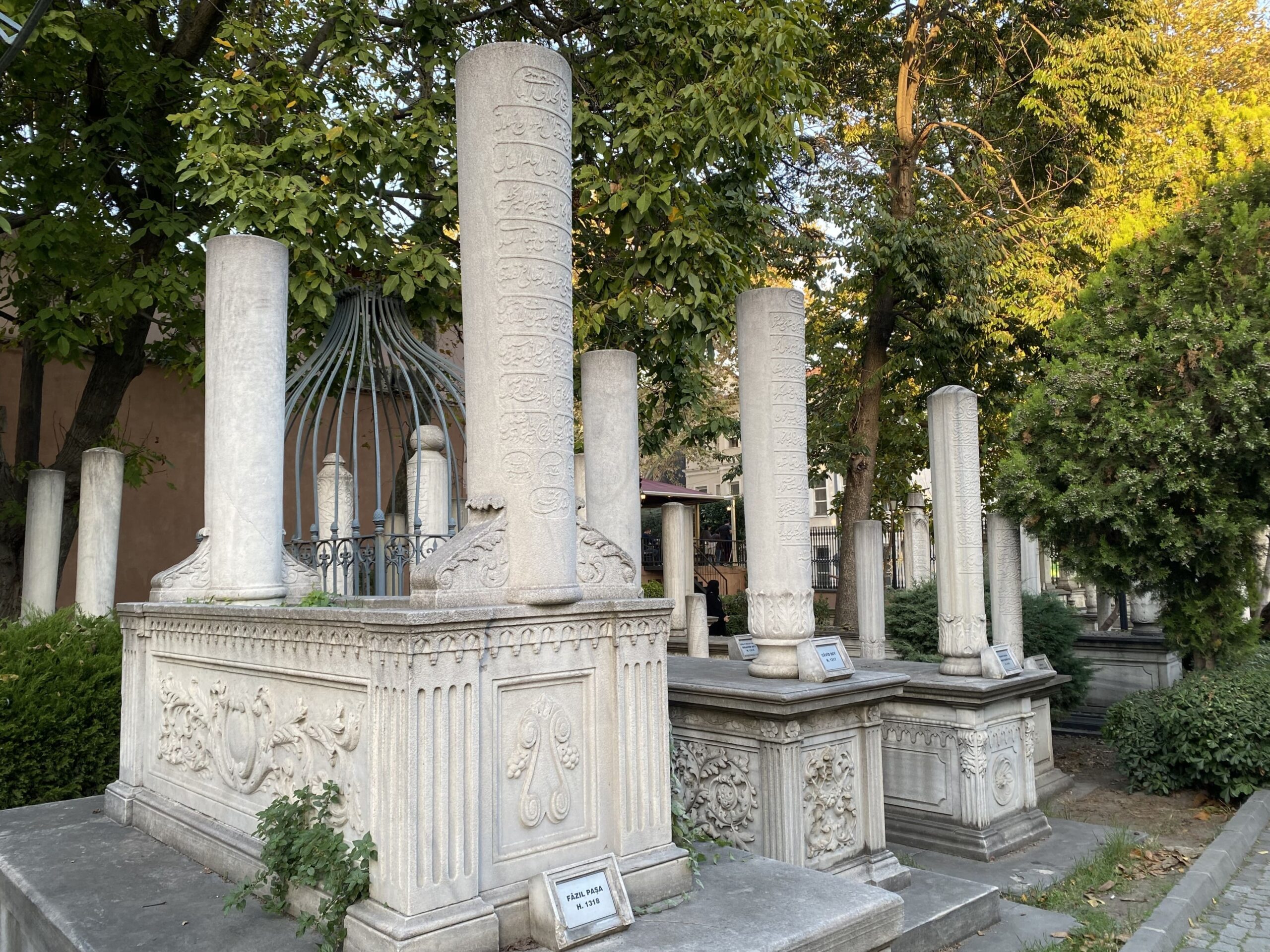
If we take a 400 metre walk from the bustling Sultan Ahmed tram station – the gateway to the two great historical and widely-visited tourist attractions, Aya Sophia and the Blue Mosque – we encounter a small but serene mausoleum complex on the left– Sultan Mahmud Han Turbesi. Unless visitors pass this royal cemetery to get to the cafe on the other side, it is a calm and quiet neighbourhood corner. Nestled in this tranquil corner of the mausoleum lies a grave with a headstone inscribed with the name Fâzil Pasha (1318), a testament to transoceanic Sufi sagas and the magnificent history of the Ottomans. 

Fâzil Pasha’s headstone

Why is this ordinary-looking grave even noteworthy in an area already replete with so much history? The story that answers this question begins in Malabār, my homeland, a coastal region in south India’s Kerala state. 

In the year 1824 AD, Fâzil Pasha was born in the remote yet historically significant  village of Mamburam in Malabār. He was the only son of the great Sūfi scholar who made substantial contributions to the shaping and nurturing of south Indian Islam– Syed ‘Alawy al Mauladdawīla of Mamburam. As an integral part of the everyday lives of the people of Malabār, he was fondly referred to as Mambuaram Thangal.1 He was also respectfully titled Qutub al-Zamān – Pole Saint of the Time.2  Mamburam Thangal was also a shaykh (spiritual mentor) to many of the ‘Ulemā and Sūfis of the time. Following the footsteps of his Bā ‘alawy3 forefathers, he built masjids, invited people to Islam, fought colonisers, wrote many scholarly treatises and poems, and propagated the tariqa (Sufi order) on the coast. He lived a fruitful life, and his teachings still endure in the hearts of south Indian Muslims.

Fâzil Pasha

Educated by his Sūfi father in the foundational Islamic sciences and the ways of the Qadiriyya tariqa, Fâzil Pasha embarked on a quest for knowledge in Yemen and Mecca. It has been said that he set out to these lands at the age of 20 after his father’s death. He had also gained ilm (knowledge) and tarbiyah (spiritual nurturing) from several local and global ulama including Parappanangadi Avukkoya Musliyar (d.1292 AH),4 Shaykh Abdullah Bin Omer (d.1265 AH),5 and Shaykh Abdellah bin Husain Bin Tahir (d.1282 AH)6 of Yemen. Life in Mecca offered more than knowledge to Syed Fazl Pasha; he married one of Shaykh Shafi’i al Habashi’s daughters and started a family there.7 He also had the good fortune to be a disciple of Shaykh Ahmed Zaini Dahlān, one of the great Sunni scholars of the late modern period who wrote over a hundred books, including his magnum opus Al Fitnat al Wahhābiyya– the book that traced the historical and political routes of the Wahhābi movement. 

In 1848, Fâzil Pasha returned to Malabār to continue the legacy of his Sufi father. The people of Malabār accepted and revered him in the same way they did Mamburam Thangal. Fâzil Pasha soon attained the religious, spiritual, and political leadership of not only the Muslims, but a vast populace that included Hindus and others. He disputed the caste practices and advised working-class people (Kudiyāns) to pay no respect to the landlords (Janmis)8 and not to eat their leftovers.9 Fâzil Pasha showed no hesitation in inviting them into his own home for a meal. His work and teachings led to the conversion of many Hindus to Islam, and he soon earned the ire of British officials and Janmis. Concurrently, he spearheaded religious and spiritual endeavours such as constructing masjids, establishing Sufi hadras (religious gatherings), disseminating ideals of the Qādiriyya tarīqa, and writing books in various Islamic sciences.

The shrine of Mamburam Syed Alawy Thangal

Just as his father’s presence in Malabār had “stirred the problem”,10 so too did Fâzil Pasha‘s – as was observed by British officials. Anti-colonial resistance seemed often to begin with a visit or ziyarat to Mamburam Thanga‘s grave, and his son did not shy away from speaking out against the cruelties inflicted on the local populace by colonial officers.

Records found in British Indian archives document several attempts by the colonial British authorities to exile or arrest Fâzil Pasha, but his wide popularity prevented the government from doing so. Fâzil Pasha’s influence prompted greater fear and anxiety in British officials than even his father, due to his stronger connections with the Muslim world and its leaders outside India. Britain made several unsuccessful attempts to persuade Fâzil Pasha to leave Malabār and settle in Arabia to ease the civil unrest they were facing. By now, thousands of anti-colonial freedom fighters had been killed in the protests, and after thorough consideration, Fâzil Pasha decided to heed the calls of the authorities and leave for Arabia. This exile in 1852 was a turning point in Fâzil Pasha’s life, marking his transition from a regional leader to one with global impact.

The cover page of Correspondence of Moplah Outrages in Malabar

In Arabia, his influence continued to burgeon. After spending some months in Mecca, he travelled to Egypt where he was welcomed by Hidive Abbās Pasha, the Ottoman official in command of the region at the time. He stayed in Cairo for some time and published Uddat al umarāi wal hukkām (Equipping the Leaders and Rulers) before departing for Istanbul, despite Hidive’s insistence for him to stay in Egypt.  

In Istanbul, Fâzil Pasha met Sultan Abdul Mecid (d.1861), with whom he discussed the existing challenges and threats faced by the Muslim world.11 After returning to Mecca, several years later, Fâzil Pasha visited Istanbul again, during the reign of Sultan Abdul Aziz Han (d.1876), informing the new sultan of developments in the Hejaz. The renowned author and Ottoman governor of Lebanon, Emir Shakib Arslan, also mentioned his meeting with Fâzil Pasha in his magnum opus Hadiru al ‘alam al Islami. 

Fâzil Pasha in Ottoman uniform

In 1876, in the era of Sultan Murad Effendi, the Ottoman government assigned Fâzil Pasha as the governor of the Dhofar region in Oman, where many Ba ‘alawi ancestors were buried. Fâzil Pasha was distressed by some of the un-Islamic practices he saw there, and raised his concerns to the Ottoman sultan. He focused on restoring Islamic tradition in the region, and the implementation of Zakat. He also prohibited sihr (black magic) and detained those who practiced it.

Fâzil Pasha also worked hard to improve Dhofar’s economy by importing and exporting goods throughout the Indian Ocean. He even attempted to negotiate trade with the British in colonial India;12 though unsuccessful in this, his endeavours managed to improve the economic situation in the region.

It is noteworthy that the revival of Dhofar, a land that had once flourished with the presence of the Bā ‘Alawis, was entrusted to another from among their lineage, though from a different land, centuries later.

Fâzil Pasha’s seal

After years of successful rule, Fâzil Pasha was finally forced to leave Dhofar due to political conflict. In 1880, he returned once again to Istanbul, where he was warmly welcomed by Sultan Abdul Hamid II. The sultan appointed him to his cabinet, and Syed Fâzil officially became a pasha, entrusted the duties of the finance department and becoming the first Indian assigned as a pasha in the Ottoman caliphate.13 Sultan Abdul Hamid made good use of Fâzil Pasha’s knowledge of southern Arabia, and the Pasha helped him accomplish a great deal, playing a vital role in the Sultan’s master project, the Hamidiye Hejaz Railway. Fâzil Pasha and his wife were among its first passengers14. 

Five of  Fâzil Pasha’s nineteen works were published during his time in Istanbul.15 Ottoman historian Tufan Buzpinar states that a copy of all of his works were preserved at the Yildiz Palace and later moved to Istanbul University.  

Fâzil Pasha continued in his role as pasha until his death in 1900. His death was marked as a huge loss by Turkish newspapers16 and his funeral was attended by many high-ranking Ottoman officials and ministers with Sultan Abdul Hamid Han. The names of these dignitaries have been listed in many works, including Misbāh-ul Fuād by Kānjirāla Kunjirāyin Kutty, one of Malabār’s most famous poets and scholars. 

Fâzil Pasha’s journey unfolds like a tapestry woven across continents. He was an anti-colonial freedom fighter and social reformer, as well as a seeker and provider of sacred knowledge for 19th-century scholars and students of Mecca. Earning many different titles throughout his life, he was also recognised as an emir who restored Dhofar to its historical legacy. Additionally, he held the esteemed position as a minister for Sultan Abdul Hamid II, earning a title by which he is remembered to this very day.

Fâzil Pasha was laid to rest at the Sultan Mahmud mausoleum compound, after an incredible life journey that took him from the shores of Malabār all the way to Istanbul’s imperial chambers. His tombstone serves as a source of reflection and contemplation for people around the world, but especially for Malabāris such as myself.

Edited by Leila Khansa

Footnotes

  1. Thangal is a term of respect used for the Syeds, individuals with prophetic lineage, in Malayalam language. ↩︎
  2. There is a belief among traditional Muslims that Allah will choose one of His Awliyā (saints) as a leader for the saints of the era. This revered figure is known as the Qutb. ↩︎
  3. Ba Alawiyyah is a Sufi Tariqa founded by Shaykh Faqih al Muqaddam(d.1255) in early 13th century in Tarim, Yemen. Shaykh al Muqaddam was a student of Shaykh Abu Madyan Ghawth al Tunisi(d.1198) who was a direct disciple of the famous Sufi Shaykh Abdel Qader al Jilani(d.1166) Hence, the Ba Alawiyyah tariqa is also regarded as a sub-branch of Qadiriyya tariqa. ↩︎
  4.  Avukkoya Musliyar aka Abu Bakr Koya Musliyar is a Malabari scholar who travelled across Muslim lands and made connections with many of the ulema of the time including, Ibrahim al Bajuri, Abdul Hamid al Sharwani, Rahmatullah Qiranwi, and others. It was his habit to write poems on scholars he met and some of them are preserved in Malabar. He also authored a number of books in Arabic. ↩︎
  5.  Shaykh Abdullah was a famous Yemeni scholar who also served as the mufti of Yemen. He visited Kerala in the era of Mamburam Thangal. While there, he taught Imam Ibn al Hajr al Haytami’s (d.1566) Tuhfat al Muhtaj bi Sharh al Minhaj to Keralite scholars including Fâzil Pasha. ↩︎
  6. Shaykh bin Husain bin Tahir was a Yemeni scholar who wrote extensively on both fiqh and tasawuf. ↩︎
  7. Shaykh al Habashi was a scholar who lived in Mecca where he taught classical Islamic texts. ↩︎
  8.  Janmi is the term referred to the landlords who belonged to elite castes such as Brahimns and Nairs. They owned the land as a birth right where people from backward castes had to work for little or no wage. Workers from lower castes were called ‘Kudiyan.’ ↩︎
  9. In the caste system, the Kudiyans could only eat the left overs of the upper castes. ↩︎
  10. A term used in British archives in reference to Fâzil  Pasha and his father Mamburam Thangal. ↩︎
  11. Maluavi, Ahmed & Abdulkareem CK, Mahathaya Mappila Sahitya Parambaryam. Calicut: Azad Bookstall, 1978. ↩︎
  12. Alawy, Seema, Muslim Cosmopolitanism in the Age of Empire. Harvard: Harvard University Press, 2015. ↩︎
  13. Jackob, Wilson Chacko, ”Of Angels and Men: Syed Fazl and Two Moments of Sovereignty”, The Arab Studies Journal 20/1, 2012. ↩︎
  14. Musafir, “Hejaz railwaykku pachakkodi kaattiya Mamburam Thangal”. ↩︎
  15. Buzpinar, Tufan, “Abdul Hamid II and Syed Fadl Pasha of Hadarmaut: An Arab Dignitary’s Ambitions 1876-1900”. The Journal of Ottoman Studies, 1993. ↩︎
  16. Maluavi, Ahmed & Abdulkareem CK, 1978. ↩︎

______________________________________________________________

Muhammad A Twahir

Muhammed A. Twahir is from Kerala, South India and is a graduate of Jamia Markaz in Calicut. He authored a biography of Syed Fazl Pasha in Malayalam as a part of ‘Makers of Islam in Malabar’ book series published by Malaibar Press, India. He is currently pursuing his masters in Sociology at Ibn Haldun University, Istanbul. He can be reached at @el.malaybari on Instagram.

___________________________________________________________

source: http://www.sacredfootsteps.com / SacredFootsteps.com / Home>History / by Muhammad H Twahir / edited by Leila Khansa
Bengal to Barbados: Sabir Nakhuda’s quest to unveil the untold story of Indian migration on the Caribbean island nation

INDIA / BARBADOS :

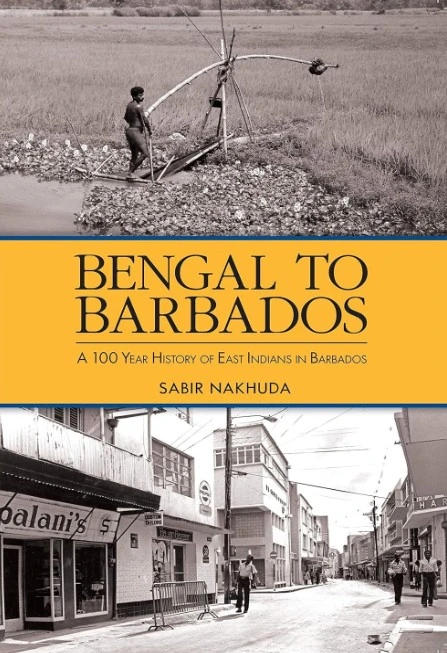
Nestled in the southeastern Caribbean Sea, Barbados is an island country in the Lesser Antilles of the West Indies, next to North America. It’s one of the more populous and prosperous Caribbean islands. The story of Indian migration to Barbados began around 1910 with Bashart Ali Dewan from West Bengal, the first documented migrant from India to the island. Intrigued by this historical narrative, Indian-origin Sabir Nakhuda, a former journalist and author who grew up in Barbados, dedicated 15 years to researching and crafting his book – Bengal to Barbados: A 100 Year History of East Indians in Barbados. “It is a labour of love and a crucial mission to preserve the history of a community whose story needed to be told,” he remarks while connecting with Global Indian.

This year Sabir Nakhuda co-founded the Bengal to Barbados Foundation Inc. and Bengal to Barbados Digital Project with his friend Suleiman Bulbulia to highlight the distinctness and impact of East Indian-Bajan identity. The digital project, which is being co-curated by the Barbados Museum and Historical Society, weaves together migration stories from Bengal, Gujarat, Sindh, and South India with themes of cultural integration, heritage, and intergenerational experiences.

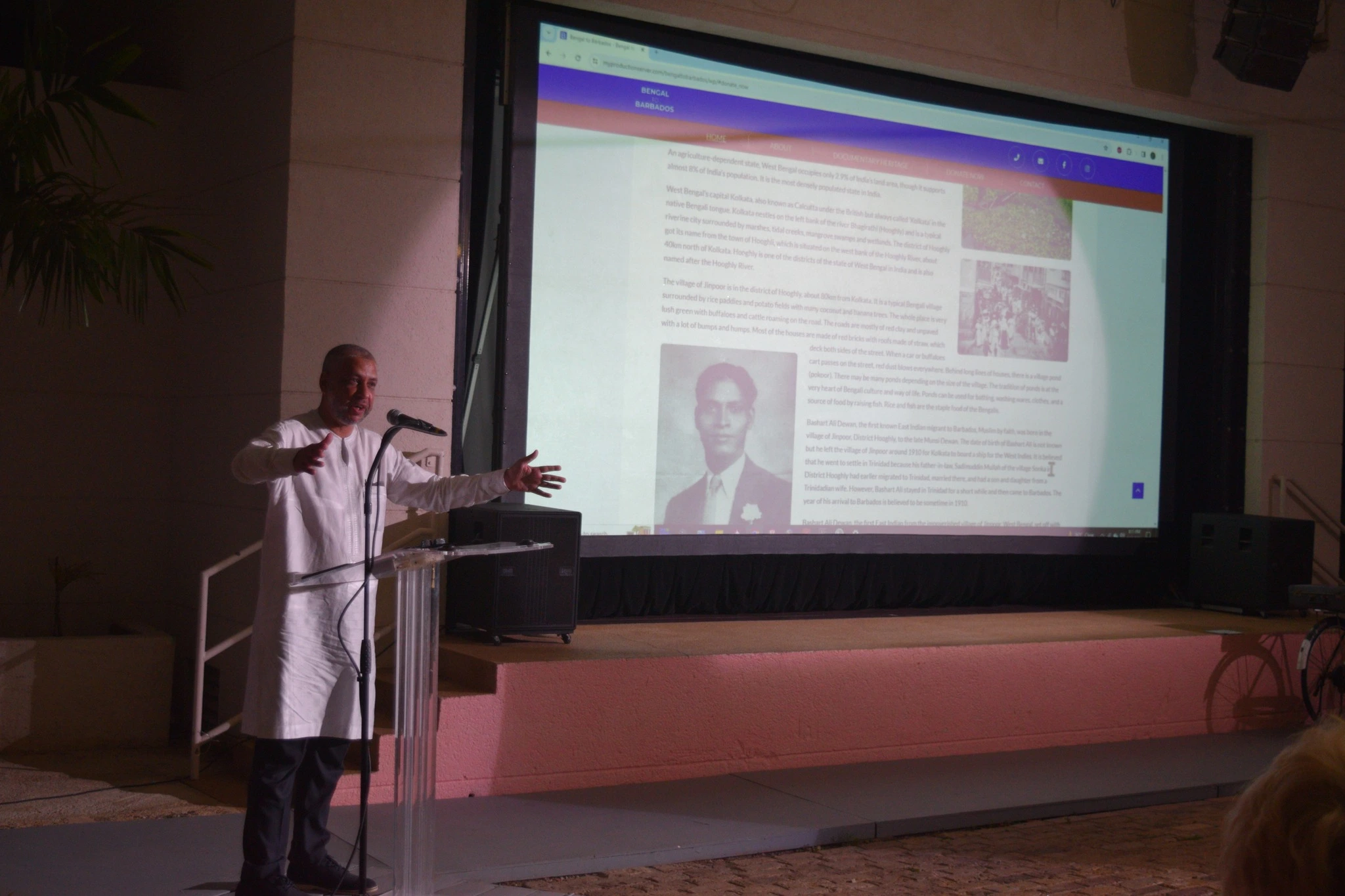
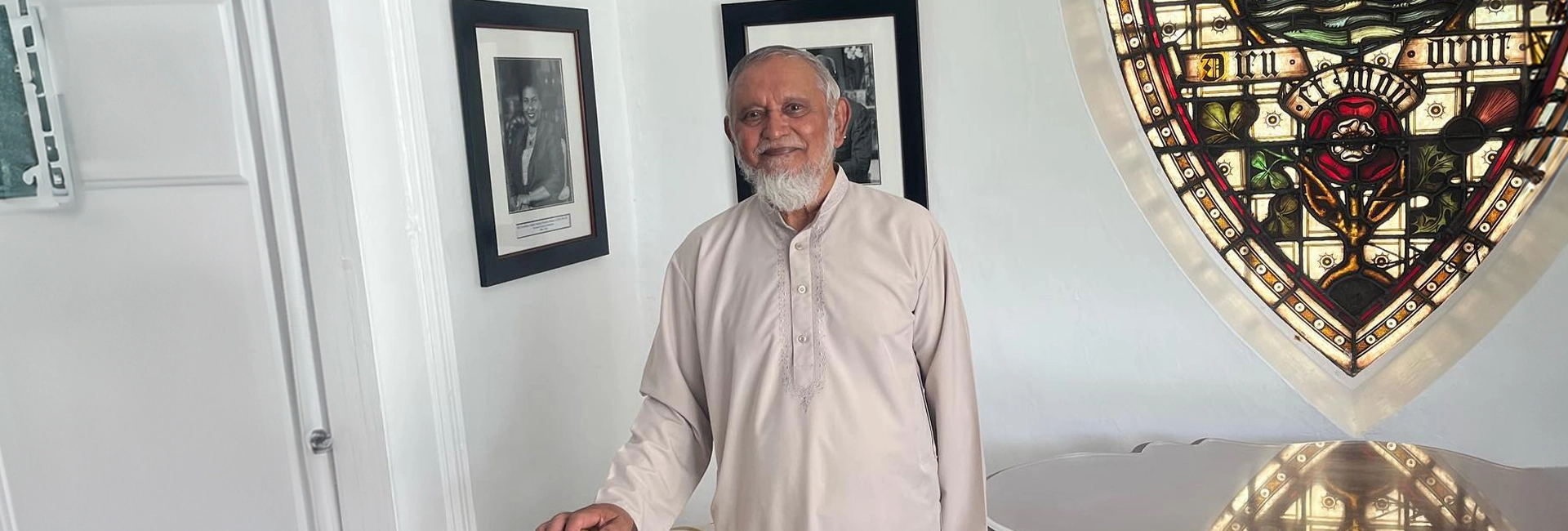
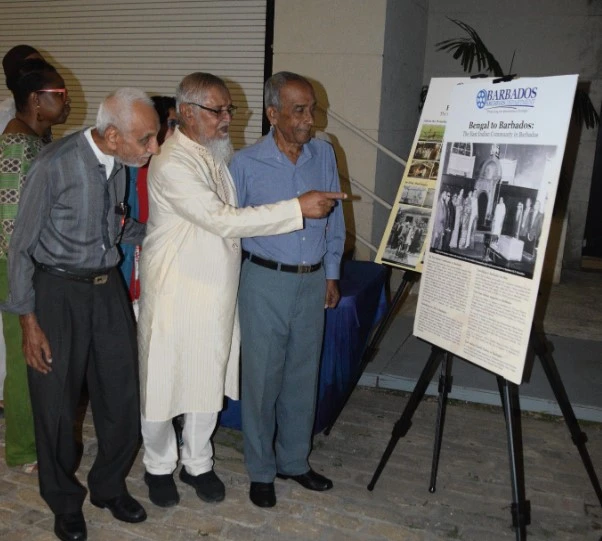
Sabir Nakhuda (centre) with Indian-origin people during the launch of Bengal to Barbados Foundation and digital project

Quest to revive Indian legacy in Barbados

In 1953 author Sabir Nakhuda’s father travelled from the village of Tadkeshwar in the Surat district of Gujarat to the distant Caribbean Island of Barbados for work. He was one of those Indian migrants from the region who were seeking better opportunities far from home. Five years later, in 1958, when Sabir was just ten years old, his father sent for him to join him in this new land. His mother and younger brother followed them in 1960, and the place became their new home.

“Growing up in Barbados, I navigated a unique cultural landscape, balancing my Indian roots with my new life in the Caribbean. I completed my primary and secondary education on the island, and later, pursued higher education in Canada. Fluent in Gujarati, Hindi, and Urdu, I always maintained a strong connection with my heritage, even as I adapted to my new environment,” Sabir tells.

It wasn’t until he began working at The Barbados Advocate, one of the oldest newspapers on the island, that he realised how little was known about the East Indian community in Barbados. He came across a few interviews from the 1950s with two elders from their community, which touched on their arrival in Barbados. But it quickly became apparent that there was so much more to uncover. “There were no documented records or any other accounts of our community’s history on the island. This realisation sparked a determination in me to dig deeper and document our story,” he remarks.

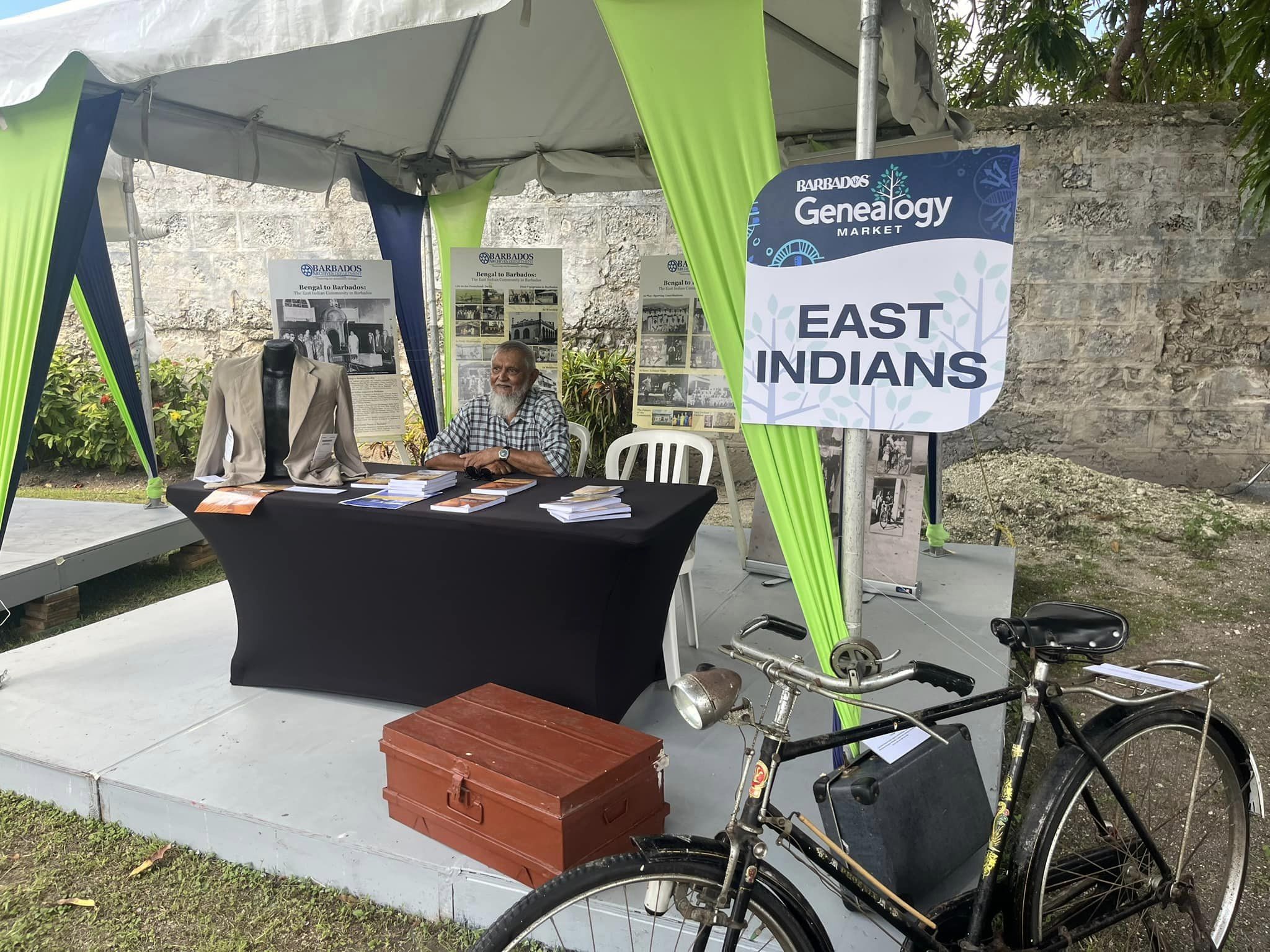
Sabir Nakhuda at the 2024 Genealogy Market, Barbados

With no written records to rely on, Sabir turned to oral history, visiting and interviewing various members of both the Barbadian and East Indian communities. He collected documents, photographs, and artefacts, piecing together the fragmented history of this often-overlooked group.

During my research, a particularly significant moment came when a family of early Bengali migrants shared an airmail letter with me. The sender’s address on the back of that letter led me to India, where I was determined to trace the roots of the first migrant who came to Barbados.

Sabir Nakhuda shares

In 1999, Sabir took a trip to India with a purpose – to find the first migrant from India who landed in Barbados. It was a journey that took him to the village of Jinpoor, where he found the descendants of the first migrant – Bashart Ali Dewan. It took him about two weeks to find the village of the first migrant.

“I interviewed his sons, other family members, and villagers, documenting their stories through pictures, videos, and recorded interviews. Often, my Bengali friends helped translate, ensuring that the rich history of these families was accurately captured. These recordings, now preserved in my hard drive, form a crucial part of the historical record I have worked to create,” he says. 

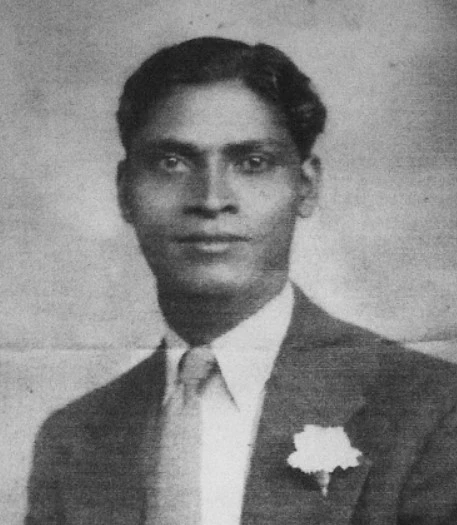
Bashart Ali Dewan – first Indian migrant to Barbados | Photo Courtesy : Bengal to Barbados Foundation Inc

Keeping heritage and connections alive

Along with his research, Sabir Nakhuda has also collected various Indian artefacts, including old bicycles, jackets, relics, and photographs. These items, along with the history of the East Indian community, have been displayed in genealogy and archive exhibitions in collaboration with the Barbados Archives Department, where Sabir has been a contributor for many years.

“I also give lectures on the arrival of East Indians and their contributions to nation-building in Barbados, ensuring that our story is told and remembered,” tells Sabir who is enjoying an active retired life.

Due to his research that lasted 15 years, the author and former journalist has developed strong connections with the families of other Bengali migrants across various villages in West Bengal. “Although I am a Gujarati and not related to Bashart Ali and his family, I visit them and family members of other migrants spread across various villages in Bengal, whenever I travel to India.” he mentions.

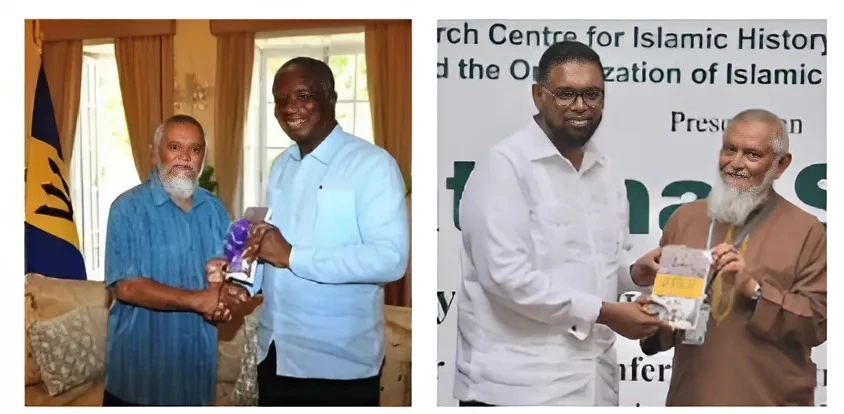
Sabir Nakhuda presented his book to Barbados PM Freundel Stuart in 2013 and President of Guyana, Mohammed Irfan Ali in 2023

Sabir Nakhuda has been to many parts of India dozens of times, and makes a point to visit his own uncles, aunts and extended family members in India, whenever possible.

One of my most cherished experiences was being invited to speak at the Visva-Bharati University at Shantiniketan in West Bengal in 2019, where I discussed the Indian diaspora in the Caribbean. I was elated to visit the place built by Rabindranath Tagore, as he is one of my favourite poets.

Sabir Nakhuda shares

In addition to his historical work, Sabir Nakhuda also writes poetry in English, Gujarati, and Urdu, and has continued his oral research, currently focusing on a book on the migration of Muslims from India to Barbados. “This upcoming work will detail the names of the villages from which Muslims have migrated, the history and pictures of these villages, and a chronology of every individual who came to Barbados from 1910 to 2023,” he says.

Creating legacy for future generations 

The year 2016 was eventful both for Barbados as a nation and for Sabir Nakhuda as an author. It was the year when the nation celebrated 50 years of its independence. The same year, while attending the Commonwealth Prime Ministers meeting, Barbados’s PM Freundel Stuart presented Nakhuda’s book Bengal to Barbados to India’s PM, Modi. “PM Stuart later told me that he discussed the context of my book with PM Modi and highlighted the contributions East Indians have made in various fields of nation-building,” the author recalls. The foreword of the book was written by none other than PM Stuart himself.

During Barbados’s 50th anniversary of independence, the author was selected to serve on the committee organizing the celebrations. A time capsule was placed at the historic site of Independence Square in Bridgetown, the capital, where the Independence flag was first raised. Among the artifacts, two books were included: the autobiography of Sir Garfield Sobers, a former Barbadian cricketer who is considered Barbados’s national hero and the greatest all-rounder in the world, and Bengal to Barbados.

The time capsule is set to be opened on Barbados’s 100th anniversary in 2066. While I may not be around, my future generations will be, and most importantly, the legacy of the East Indian presence and our stories will resurface.

Nakhuda says with pride

Cover Image of Sabir Nakhuda’s book

Connecting the dots

Sabir Nakhuda’s friend Suleiman Bulbulia’s interest in co-founding the Bengal to Barbados Foundation Inc. with him stems from the same deep commitment to preserve and promote the history and culture of the East Indian community in the Caribbean island nation. He even has a distant connection with the first documented Indian migrant to the country. “My paternal grandfather’s second wife was related to Bashart Ali Dewan, the first documented East Indian migrant to Barbados,” he says.

Born and raised in Barbados, Suleiman’s paternal and maternal grandfathers migrated from Kaphleta, Gujarat in the 1930s. With the Bengal to Barbados Foundation Inc. the retail senior manager by profession seeks to bridge cultural understanding and acceptance of Indian-origin people in the island nation.

Suleiman Bulbulia during the launch of Bengal to Barbados Foundation and digital project

Both Sabir Nakhuda and Suleiman Bulbulia are dedicated to documenting the stories, history, and legacy of East Indians in Barbados. Their goal is to collect tangible, historic items from the Indian community to create a permanent display of these artefacts. Additionally, they aim to share the collected information through their website and social media platforms.

“Our efforts have centred around providing accurate historical information about the Indian community in Barbados while promoting their culture, knowledge, and heritage. These efforts have led to an understanding and acceptance of the Indian community among both the government and the general public in Barbados. Additionally, our work has strengthened the bonds of friendship between India and Barbados,” Suleiman signs off.

source: http://www.globalindian.com / Global Indian / Home> Story> Global Indian Exclusive> Indian Art & Culture / by Amrita Priya / September 05th, 2024

Ace IAS Academy launches UPSC/KPSC batch 2024-25 with inaugural ceremony

Mangaluru, KARNATAKA :

Mangaluru:

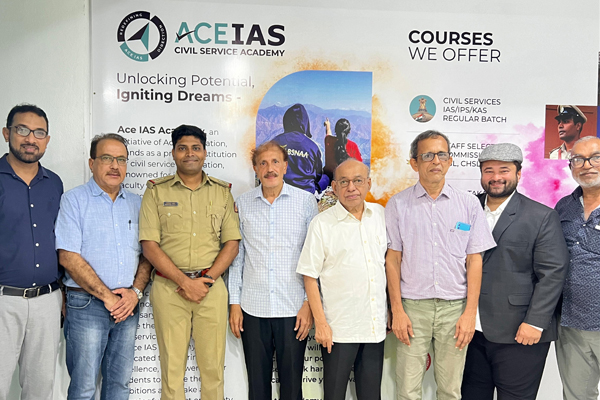
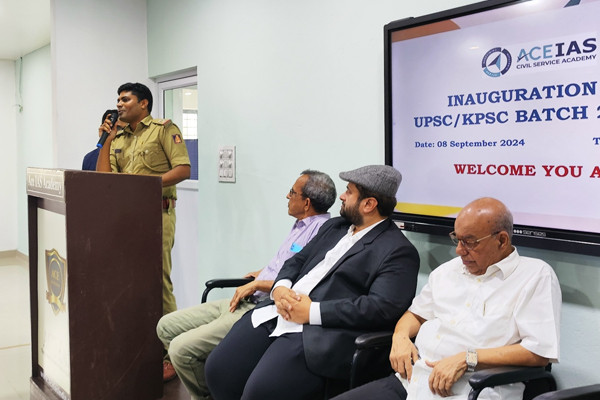
Ace IAS Academy inaugurated its UPSC/KPSC Batch 2024-25, with Police Sub-Inspector Mushahid Ahmed, an alumnus from the academy’s first batch, officially launching the program.

The event also saw the relaunch of the academy’s website by the Founder President of Ace Foundation, Saduddin Salihi. The occasion was graced by Abdul Salaam, retired General Manager of KIOCL, as the Guest of Honour.

Following the inauguration, a workshop on “Effective Communication” was conducted by motivational speaker and life coach, Saif Sulthan Syed.

The event was attended by the trustees of Ace Foundation, B.S. Muhammad Basheer, Siraj Ahmed, and Shahul Hameed. Nazeer Ahmed, Director of Ace IAS Academy, welcomed the dignitaries and students, while Academic Coordinator Hilaal Raafi hosted the event.

source: http://www.english.varthabharati.in / Vartha Bharati / Home> Karavali / by Vartha Bharati / September 10th, 2024

Veteran Ramgarh MLA Zuber Khan Passes Away at 61

Ramgarh, RAJASTHAN :

Alwar:

Zuber Khan, the four-time MLA from Ramgarh Assembly constituency in Rajasthan, passed away at 5:50 am on Saturday. The news of his demise was shared by his wife, former MLA Safia Zuber Khan, via social media. “It is with deep sorrow that I inform you all that respected Zuber Khan ji has passed away. Zuber ji breathed his last today (14 September 2024) at 5:50 am,” Safia Zuber wrote.

Khan, who had recently returned home after treatment at Medanta Hospital, had fallen ill on Thursday. His close friend, Anoop Sharma, revealed that Zuber Khan had undergone a liver transplant one and a half years ago, and doctors had advised him to rest. However, he remained active during the first phase of elections and in the assembly session, which led to deterioration in his health. He was admitted to Medanta Hospital a few days ago before being transferred to Jaipur.

On Tuesday night, after his health showed signs of improvement, Khan returned to his residence in Alwar. However, his condition worsened again on Thursday, and he passed away early on Saturday at his farm house in Dhai Pedi, near Alwar. Over the last three days, well-wishers had been visiting him to check on his health. According to close sources, doctors had indicated about 15 days ago that his health was critical.

Born on 1 August 1963, Zuber Khan’s final rites will take place today at 5 pm after Asr prayers, with his burial near the Gas Godown in Ramgarh, Alwar.

Zuber Khan had an illustrious political career, winning the Ramgarh Assembly seat four times. He was elected in 1990, 1993, 2003, and 2023 on a Congress ticket. He also served as chairman of Mewat Development Board in the previous Gehlot government. Despite contesting elections in 1998, 2008, and 2013, Khan faced defeats at the hands of BJP’s Gyandev Ahuja. In 2018, his wife Safia Zuber Khan contested and won, defeating BJP candidate Sukhwant Singh by over 12,000 votes.

Between 2003 and 2008, Zuber Khan also held the role of chief whip of the Congress Legislative Party in Rajasthan Assembly. His political journey began during his student days at Jamia Millia Islamia, New Delhi, where he was elected president of the students union twice under the banner of NSUI.

Hailing from a traditional farmer family in Machri Umrain, a rural area in Alwar, Zuber Khan’s political legacy was rooted in his father’s role as sarpanch for 38 years. After receiving his early education in a government primary school, he continued his studies at JMI, where his political career took off.

In the 2023 elections, Congress replaced Safia Zuber’s ticket with that of Zuber Khan, who went on to secure victory by defeating BJP candidate Jai Ahuja by 19,696 votes, securing 93,765 votes in total, compared to Ahuja’s 74,069.

source: http://www.radiancenews.com / Radiance News / Home> Latest News> Report / by Radiance News Bureau / September 14th, 2024

Bengaluru hosts workshop on Islamic Psychotherapy for health professionals

Bengaluru, KARNATAKA :

Muslim health professionals in India’s Bengaluru in the last week had a thrilling experience when they were introduced to Traditional Islamically Integrated Psychotherapy (TIIP) by renowned Islamic psychologist Yaqeen Sikander.

Bengaluru (India): 

Muslim health professionals in India’s Bengaluru in the last week had a thrilling experience when they were introduced to Traditional Islamically Integrated Psychotherapy (TIIP) by renowned Islamic psychologist Yaqeen Sikander.

Yaqeen Sikander was invited for a 5-day workshop jointly organised by Mind and Brain Hospital and Khalil Centre.

The workshop held from August 31 to September 04, 2024 in partnership with the Centre for Study and Research (CSR India) and International Students of Islamic Psychology (ISIP) aimed at introducing the innovative therapeutic framework of TIIP to Indian mental health professionals.

About Traditional Islamically Integrated Psychotherapy

Traditional Islamically Integrated Psychotherapy (TIIP) is developed by Khalil Centre’s interdisciplinary team of Islamic scholars and psychologists.

The programme integrates contemporary behavioural science within an Islamic epistemological framework.

Originally conceptualised by Dr. Hooman Keshavarzi and Dr. Amber Haque in 2013, the model has been further developed by Khalil Centre’s team, including Dr. Fahad Khan and Dr. Khalid Elzamzamy.

The programme approved by American Psychological Association (APA) is an evidence-based approach tailored to meet the needs of Muslim patients. It has been continuously refined through ongoing research.

About Yaqeen Sikander

Yaqeen Sikander is a clinical psychologist and certified TIIP practitioner based in Istanbul, Turkey.

Sikander, who led the sessions at the workshop, is currently pursuing a doctorate in Clinical Psychology at Ibn Haldun University in Istanbul, simultaneously receiving specialised TIIP training from Dr. Keshavarzi.

Yaqeen Sikander’s sessions in Bengaluru offered valuable insights into merging spirituality with modern clinical practice, a core aspect of TIIP.

TIIP Workshop Bengaluru

The TIIP Workshop Bengaluru commenced with a Meet and Greet session at Shifaa Hospital, Bengaluru, where Yaqeen Sikander shared his journey through global education and his career in psychology.

This session also featured presentations from Dr. Asfiya Khaleel, Psychiatrist and Director of Ummeed Deaddiction and Rehab Centre, Bengaluru, and Dr. Fiaz Ahmed Sattar, one of the leading psychiatrists in Bengaluru.

Both the speakers provided their insights from years of experience, enriching the discussion on integrating holistic approaches in clinical practice.

Zulekha Shakoor Rajani, Co-Head of the Islamic Psychology Department at Mind and Brain Hospital, shared a presentation on the evolution of Islamic psychology globally and in India exploring its development and future prospects.

Zulekha Shakoor Rajani along with Shujauddin Fahad Inamdar had in June 2024 travelled to Istanbul, Turkey, to undergo TIIP training organised by Khalil Centre where she completed her TIIP Level 2 training while Shujauddin completed his TIIP Level 1 training. While addressing the workshop, Zulekha also shared with the audience her TIIP training experience.

“Attending the TIIP training in Istanbul was a transformative experience that deepened my understanding of the vital connection between Islamic principles and modern psychological practices,” she said.

“It became clear to me that Muslim mental health professionals in India needed access to this invaluable approach. By bringing TIIP to Bengaluru, we aimed to introduce Islamic psychology to a broader community of psychologists, therapists, and counsellors, helping them integrate spirituality with their clinical practice”, she added.

After the introductory Meet and Greet session at Shifaa Hospital, the attendees participated in the workshop at Mind and Brain Hospital, focusing on Mastering Therapeutic Excellence. This session covered holistic case conceptualisation, integrative therapeutic interventions, and fostering self-efficacy to enhance client outcomes.

The 4th day of the workshop was held at Ummeed Deaddiction and Rehab Centre, Bengaluru, where Yaqeen Sikander provided introduction to Islamic psychology, discussing its core principles and the role of the practitioner in integrating spirituality into therapy.

The event concluded with a Tafakkur session — a short spiritual retreat emphasising psycho-spiritual contemplation. This session, led by Yaqeen Sikander and Shujauddin Fahad Inamdar, offered the participants a unique experience of Islamic meditation and holistic healing.

‘Just a beginning’

The workshop was a huge success, offering participants practical tools and insights that will enhance their ability to provide holistic, culturally relevant care.

“I am confident this is just the beginning of a much-needed shift in the way mental health is approached in our community.

“The success of this TIIP workshop has exceeded our expectations”, said Dr. Safiya MS, Psychiatrist and Director of Mind and Brain Hospital, the organiser of the event.

“The response from mental health professionals across the country has been overwhelmingly positive, reflecting a clear demand for approaches that integrate Islamic principles with psychiatric and psychological care.

“We believe this workshop will serve as a catalyst for the wider acceptance and practice of Islamic psychology in India. It is our hope that this initiative will inspire more professionals to explore and implement holistic, faith-based mental health practices, ultimately benefiting both practitioners and patients alike”, she said.

Mind and Brain Hospital, which hosted the workshop, is a leading neuropsychiatric treatment facility in Bengaluru. The hospital had established India’s first Islamic Psychology Department, co-headed by Zulekha Shakoor Rajani and Shujauddin Fahad Inamdar in 2023.

The department is dedicated to advancing mental health treatments that integrate modern psychological practices with Islamic principles.

source: http://www.ummid.com / Ummid.com / Home> Health / by Ummid.com News Network / September 11th, 2024

Women power in full force at Riyadh’s Indian International School

Riyadh, SAUDI ARABIA :

The new management committee for the school was announced on Tuesday and will be headed by Shahnas Abdul Jaleel as chairperson.

The other members were Sajida Husna, Sumaiya Sangreskop, Shahzeen Eram, Pashim Ali and Syed Zafer Ali.

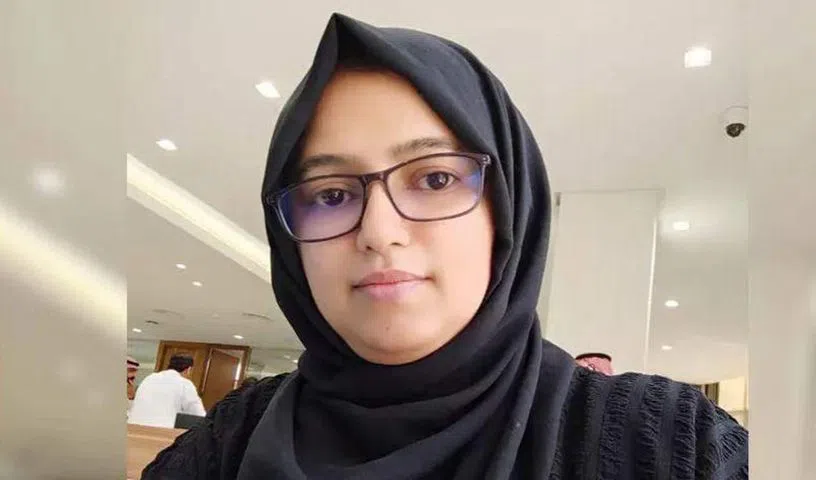
Photo of Shahnas Abdul Jaleel

Jeddah:

In a significant development, the governing body of the Indian International School, Riyadh (IISR) is now led by women, with four of the six members being women.

The new management committee for the school was announced on Tuesday and will be headed by Shahnas Abdul Jaleel as chairperson. The other members were Sajida Husna, Sumaiya Sangreskop, Shahzeen Eram, Pashim Ali and Syed Zafer Ali.

The four women in the management committee are in addition to principal Meera Rahman. Previously all management committees had seven members, however, this time only six members were named. Shahnas is a software engineer working in Saudi Arabia and is a native of Ernakulam in Kerala and is a mother of two. Her husband also works as a software engineer.

The women in leadership roles in the school is expected to change the dynamics, especially in matters of the academic affairs of the students. The community-run schools under the patronage of the Indian Embassy play a pivotal role in Indian community affairs in the Kingdom. It is noteworthy to mention that earlier, Dr. Hemalatha Mahalingam was nominated as chairperson of Jeddah’s Indian International School.

Interestingly, social reforms unleashed by Saudi Arabia’s Crown Prince Mohammed Bin Salman have brought sweeping changes in the Kingdom wherein women benefitted the most. The country, where women for decades had a restricted role in public, is now embracing their potential.

source: http://www.telanganatoday.com / Telangana Today / Home> India / by Irfan Mohammed / September 06th, 2024

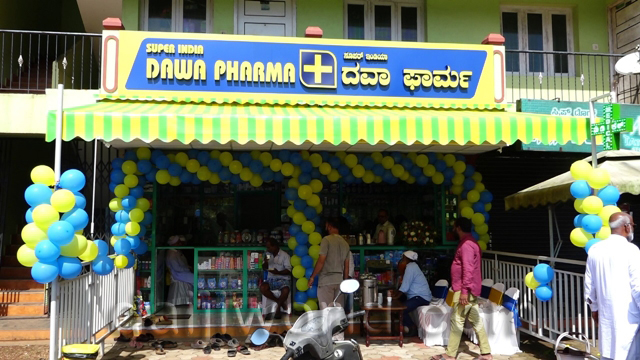
Super India’s Dawa Pharma opens new branch on Pilikula road

Mangaluru, KARNATAKA :

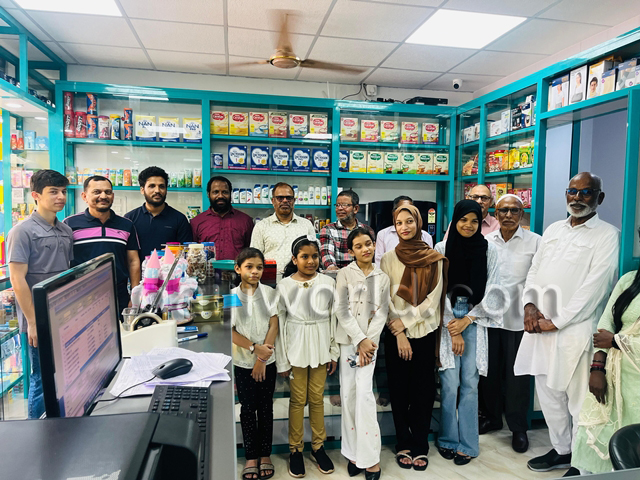
Super India, dedicated to serving India’s rural population, has opened its new, well-equipped Dawa Pharma branch at Sana Complex on the Vamanjoor-Pilikula connecting road, on the outskirts of the city.

The branch was inaugurated by Abdul Khader Ahmed Vamanjoor, owner of Super India Dawa Farma, along with Sheikh Hasan Abbas Vamanjoor, Fakir Hussain Ullal, and other prominent personalities by cutting the ribbon. Speaking at the event, Abdul Khader Ahmed Vamanjoor said, “Super India Dawa Pharma is always ready to serve the rural population and has a system in place to deliver quality medicines to consumers’ doorsteps. We request consumers to continue supporting the organization.”

He further added that the Dawa Farma branch is well-equipped with a wide range of medicines and medical kits for local residents. Additionally, the service includes free home delivery of medical supplies without any extra charges.

Sheikh Hasan Abbas Vamanjoor highlighted, “Instead of traveling to the city to purchase medicines, customers can now visit Super India Dawa Pharma and receive quality medicines at affordable prices.”

source: http://www.daijiworld.com / Daijiworld.com / Home> Karnataka / by Daijiworld Media Network – Mangaluru (MS) / September 12th, 2024

Who is Muhammed Ajmal Variyathodi? Member of India’s men 4x400m relay team

Palakkad, KERALA :

Following a remarkable performance of 2 minutes and 59.05 seconds at the World Athletics Championships in Budapest on Saturday night,…

Following a remarkable performance of 2 minutes and 59.05 seconds at the World Athletics Championships in Budapest on Saturday night, the Indian 4×400 meter relay team consisting of Muhammed Anas, Amoj Jacob, Muhammed Ajmal Variyathodi, and Rajesh Ramesh gained widespread recognition.

This lesser-known relay group not only shattered the Asian record but also accomplished a historic feat by becoming the first Indian team to qualify for a World Championship final.

Muhammed Ajmal, a 24-year-old Indian track and field athlete, specializes in 400m sprints. His motto is straightforward: “Hear the bang and just run.” Gradually making his mark in the national scene, he aspires to progress further and achieve significant success in the international arena.

More about Muhammed Ajmal Variyathodi:

Born on June 1, 1998, in Palakkad, Kerala, Muhammed Ajmal initially embarked on his sports journey as a soccer player while growing up in Palakkad. He participated at the U-19 state level in football until his coach, Nandakumar sir, recommended that he shift his focus to running. This marked the beginning of Ajmal’s transition from a 100m sprinter to his current role as a 400m sprinter.

Indian athlete Muhammed Ajmal originally started as a 100m sprinter but eventually transitioned to the 400m category under the guidance of his coaches. In his very first 400m race, he achieved an impressive time of 46.91 seconds, securing the gold medal at the National Services Championships held in Bhubaneswar.

Muhammed Ajmal discussed his transition in an interview, saying, “In India, there’s a higher chance of competing in international events in the 400m. Otherwise, you need to be exceptional as a sprinter to make it in the 100m.”

His goal is to surpass the national record set by another athlete from Kerala, Mohammed Anas, who achieved a time of 45.21 seconds.

At the 7th International Sprint & Relay Cup held at Atatürk University Stadium in Turkey, Ajmal secured the third position with a timing of 46.04 seconds. In 2021, he clinched the gold medal at the Inter-Services Championship with a time of 46.91 seconds. He had a strong start in 2022 by winning gold at the Indian Grand Prix, finishing in 46.78 seconds.

He followed up his success by earning a silver medal at the National Inter State Senior Athletics Championship. There he improved his timing to 46.48 seconds. Ajmal is now dedicated to performing well at the upcoming Commonwealth and Asian Games later this year.

Muhammed Ajmal’s Athletic Accomplishments:

Muhammed Ajmal has emerged victorious at the National Athletics Championship on two occasions.

He secured a gold medal at the Indian Grand Prix in the year 2022.

In 2021, he earned a gold medal at the National Federation Cup.

Interesting Tidbits about Muhammed Ajmal:

His initial aspiration was to become a soccer player.

He shares a strong friendship with the national record holder, Mohammad Anas Yahiya.

Major Achievements:

1x In the Top 8 at World Championships

1x Asian Championships Silver medallist

Alongside, 1x In Top 8 at Commonwealth Games

1x In the Top 8 at Asian Championships

2 x National Champion

1 x Current Asian Record holder – 4x400m

source: http://www.thestatesman.com / The Statesman / Home> Who Is / by Statesman Web / August 28th, 2023

Merging passion with powerful storytelling

Mysuru, KARNATAKA :

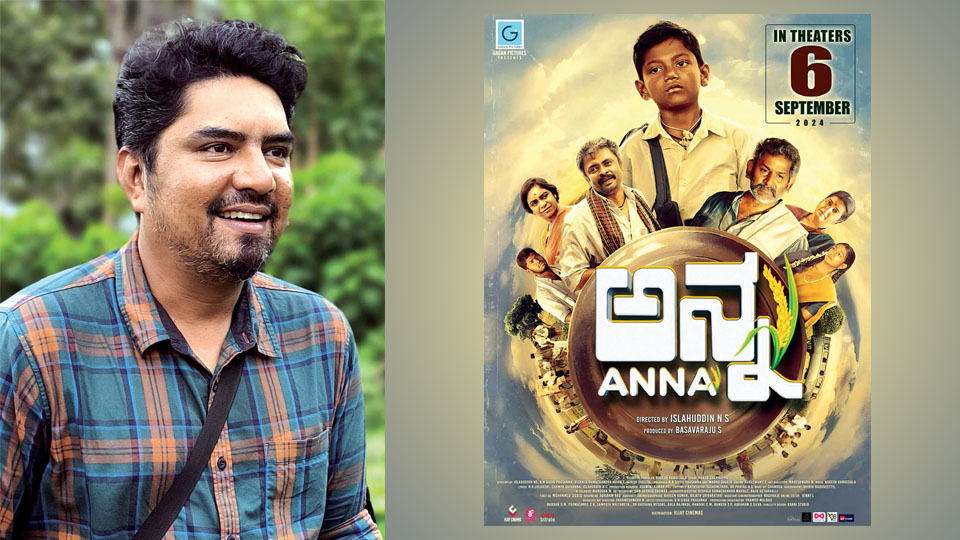
Mysuru-based Director Islahuddin believes in movie-making beyond the ordinary

The Kannada film industry, popularly known as Sandalwood, has recently witnessed a surge in films across diverse genres, breaking away from the conventional commercial ‘masala’ formula. Films like Achar & Co, Daredevil Mustafa, Hostel Hudugaru Bekagiddare, Tagaru Palya and Orchestra Mysuru have been warmly embraced by audiences, proving that the industry is in safe hands with the new generation of filmmakers stepping up to the challenge.

Joining this fresh wave of talent is N.S. Islahuddin from Mysuru, the director of the Kannada film Anna. Despite hardships, Islahuddin successfully directed a few films, including Nodi Swamy Ivanu Irode Heege, starring Rishi.

Known for inspiring many aspiring actors and technicians, Islahuddin is now back with his latest venture Anna, which tells the story of eight-year-old Mahadeva. Set in the 1980s, the film portrays the struggles of a poor family that cannot afford even rice (Anna in Kannada).

Islahuddin also pioneered Kannada’s first-ever crowd-funded film, Jaagadoreyuthade (Spaces for Rent), an adaptation of Maxim Gorky’s play The Lower Depths.

Star of Mysore caught up with the talented moviemaker Islahuddin during his recent visit to Mysuru for a brief chat.    Excerpts…

Star of Mysore (SOM): How do you feel about ‘Anna,’ a non-commercial movie, being accepted by all sections of the audience?

Islahuddin: I am elated. Being embraced by all sections of society feels like a blessing. Our movie doesn’t take sides — except for the side of the hungry. ‘Anna’ is merely a metaphor. While rice, as a staple food for billions, holds deep significance, our story is set in the 1980s when rice was a luxury beyond the reach of the common man. Today, ‘Anna’ could symbolise any unfulfilled desire of the underprivileged.

SOM: What inspired you to choose a subject like ‘Anna?’

Islahuddin: The story found me. It is based on a Kannada Sahitya Akademi award-winning short story by Hanur Chennappa, who had previously served as Assistant Director, Department of Kannada and Culture in Mysuru. The team was already in place, and I joined towards the end. I am deeply grateful to the entire ‘Anna’ team for making this an unforgettable experience.

SOM: For a film like ‘Anna,’ it’s often difficult to secure producers and theatres for release. How did you manage both?

Islahuddin: ‘Anna’ symbolises desire. It highlights the gap between ragi and rice and the divide between the haves and have-nots. Basavaraju, our film’s producer,  who faced hardships in his youth, was approached by our music director and executive producer Nagesh Kandegala and he instantly agreed to produce the film. The film has turned out exceptionally well and the overwhelming response during screenings gave us the confidence that we have a winner. Even though Basavaraju is a first-time producer, we chose to take this leap of faith on our own.

SOM: With four gold medals in journalism and mass communication, a master’s from the University of Sunderland and having cleared the National Eligibility Test (NET) from the University Grants Commission (UGC), you could have easily settled as a Professor in a reputed university. Why did you choose theatre and films?

Islahuddin: I’ve always liked theatre and cinema and so did my friends. I’ve always valued my friendships and most of my friends are here in my city Mysuru.  We are a close-knit group here in Mysuru, bonded by our shared passion for the arts. Our journey began in theatre, but we quickly set our sights on filmmaking.

I took the next step by pursuing my master’s in filmmaking in the UK, then returned to Mysuru to reconnect with my friends. Our primary goal has always been to build a thriving ecosystem for filmmakers right here in our city.

SOM: What are your upcoming projects?

Islahuddin: I’ve been in talks with a few actors, who also happen to be good friends, about directing some scripts I’ve written. Additionally, there are exciting offers from producers interested in bringing my stories to life with me as the director. There’s also an international project in the works, but I’ll reveal more when the time is right. Only time will tell. — VNS

Excelled academically

A graduate in Business Management from  D. Banumaiah College, Islahuddin went on to pursue a Post Graduate degree in Mass Communication and Journalism at Manasagangothri, where he excelled academically, bagging four gold medals, including the prestigious Star of Mysore Silver Jubilee Endowment Gold Medal in 2006.

His passion for filmmaking led him to secure a scholarship at the University of Sunderland, where he earned a Master’s in Media Production in 2008. Upon returning to Mysuru, Islahuddin embarked on a challenging 15-year journey to fulfil his dream of directing films.

source: http://www.starofmysore.com / Star of Mysore / Home> Feature Articles / September 12th, 2024

Ayodhya Ram Mandir: Muslim artisans of Pilibhit made the world’s longest flute for Ram Lalla, know its speciality

Philbit, UTTAR PRADESH :

On the day of Pran Pratishtha in Ayodhya, the flute of Pilibhit will also spread its charm in Ramnagari. Muslim artisans of Pilibhit, famous for flutes, have prepared the world’s largest flute

The Pran Pratishtha ceremony is to be held in Ayodhya on January 22. The atmosphere of the whole country is filled with Ram regarding this. Preparations are going on in full swing. In such a situation, how could Pilibhit district of UP, famous as the city of flutes, remain untouched. Muslim artisans of Pilibhit, famous for flutes, have prepared the world’s largest flute. On the day of Pran Pratishtha, the flute of Pilibhit will also spread its charm in Ayodhya. On Friday, after worshipping this flute, it was sent to Ayodhya. Hina Parveen, who made it, said that it is a matter of pride for us that our flute is going to the temple which is being discussed all over the world. In the city, the members of Vishwa Hindu Parishad worshipped the 21 feet 6 inches flute in the presence of the DM. Along with this, everyone expressed happiness by chanting Jai Shri Ram.

Ram Ji and Kanha Ji are the same incarnation – Hina Parveen

Hina Parveen, a resident of the city, has made this flute with the help of her son and brother-in-law. She has claimed it to be the longest flute in the world. Along with this, the people of the district are also seen agreeing to this. She told that ever since we came to know that Ram temple is being established, we wanted to make this flute. This flute is 21 feet 6 inches. Earlier in Pilibhit, the record of a flute of 16 feet was there. Now it is the world’s largest flute. Now we have sent it to VHP to send it to Ayodhya. Today the flute is being worshipped. After this, this flute will be toured in Pilibhit, then this flute will go to Shri Ram temple. Hina Parveen further told that Lord Shri Krishna has a special relationship with the flute. Everyone knows. Our flutes have been going to Mathura. We have a very old relationship with Kanha ji. This musical instrument starts with Kanha ji, our business is with him. That is why we have a very old relationship with him. Ram Ji and Kanha Ji are the same incarnation. All things are going to Ram Ji’s court, so our flute should also be there. This is the reason why we have made this flute for Shri Ram Mandir.

This flute is made from 20 years old bamboo from Assam – Hina Parveen

Hina Parveen says that this is our ancestral work. 20 years ago my husband brought a special kind of bamboo from Assam. After this I made this flute for my Ram ji from the same bamboo. I called my brother-in-law Shamshad, the most skilled artisan of the flute city. He has put a tune in this flute. Vishwa Hindu Parishad helped us completely. There was enthusiasm in our hearts, now this enthusiasm has doubled. I am blessed. My husband is not in this world right now. Hina Parveen’s brother-in-law Shamshad works to put tune in the flute. He has put the tune in the flute. On this Shamshad said that the tune of this flute is absolutely fine. Be it the rhythm of harmonium or any musical instrument, this flute can match the tune of all. Hina Parveen told that we needed a big and thick bamboo. It is a coincidence that the bamboo that our husband Nawab Ahmed had brought was found. It was surprising when this bamboo, which was so many years old, was neither infested by termites nor damaged anywhere. Perhaps it was the grace of Lord Ram. This bamboo is still not available in Assam. I can say with confidence that it is not possible to find the bamboo for this flute now. It is all a matter of coincidence, I don’t know why my late husband brought this bamboo and it was never used, perhaps it came for Lord Ram only. DM Praveen Kumar said that Guinness World of Records has been contacted for this flute. It was worshipped on Friday. Now it is being sent to Ayodhya. Now soon there will be an effort to register it as the world’s largest flute.

source: youtube.com / www.prabhatkhabar.com

source: http://www.prabhatkhabar.com / Prabhat Khabar / Home> Big News / by Sandeep Kumar / January 20th, 2024