Learn photography online in nine Indian languages

Lovedale, Nilgiris (Ooty) , TAMIL NADU :

IqbalMohamed01MPOs07jan2018

Language is no barrier to learning the nuances of photography at the Light and Life Academy

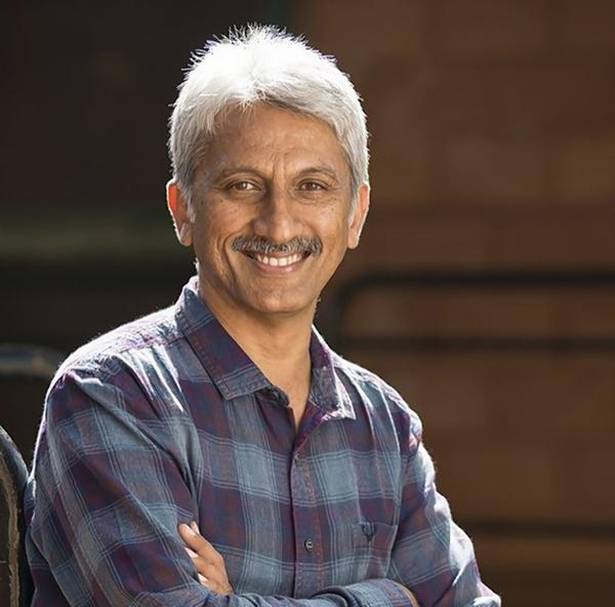
It is 6 am, and I watch Iqbal Mohamed quietly set up his camera in front of the big glass windows in his living room and wait for the sun to rise. We are at the Light and Life Academy (LLA) in Lovedale in the Nilgiris, and I learn that he does this every morning. “No two sunrise is the same,” he offers by way of explanation. Mohamed doesn’t say very much. He prefers to let his photographs do the talking, laughs his more vocal wife Anuradha.

The photographer founded LLA in 2001 as a full-facility photography institute. The inspiration was his alma mater, the Brooks Institute California. He worked in Hollywood with some of the biggest names in photography, and in India, winning considerable acclaim, before setting up his school. LLA, which maintains high standards of professionalism and excellence, has added immensely to the pool of talented photographers in the country. And the alumni have now helped him realise another dream — to set up an online course called ‘Get Creative with Photography’.

Seamless lessons
IqbalMohamed02MPOs07jan2018

They want to reach out to more people who take pictures as a serious hobby, says Anuradha. “But we did not want it to become just another random photography course. Mohamed’s book, Portrait & Function Photography, in eight Indian languages, was enthusiastically received, and that made us think of an online programme that was serious, structured and professional,” she adds. LLA online was born after three long years of hard work. The programme is available in English and nine Indian languages (Tamil, Telugu, Malayalam, Kannada, Hindi, Marathi, Gujarati, Oriya and Bengali). “Prahlad Kakar advised us on how to create the video tutorials, all shot in campus, and make them not just informative, but also entertaining,” she says.

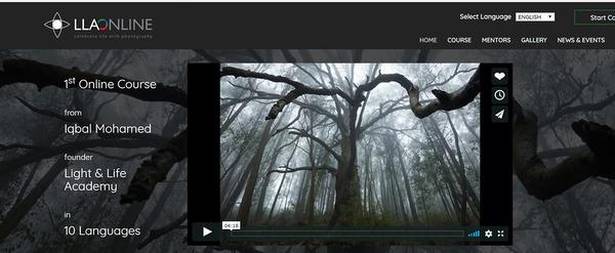
I click on the online programme to see how it looks, and the screen fills up with a haunting photograph of trees. Even to my unprofessional eye it is a stunning image. It is one of Mohamed’s photographs.

Nattily dressed LLA alumni present the lessons. Each one is an acclaimed photographer, says Anuradha, with considerable pride. “Without them, this course would not have been possible.” These include Shaheen Thaha (celebrity, fashion and architecture), Mihir Hardikar (food and beverages), Ajit SN (automobile and underwater), Punya Arora (editorial and underwater fashion), Satish Kumar (automobile) and Ankit Gupta (architecture and travel).

Getting into the details
IqbalMohamed03MPOs07jan2018

The online tutorial begins with clear, concise and simply-worded instructions. Then comes the fun part. I ask Anuradha if can see/hear the lesson in Bengali. I follow it up with a class in Tamil, Hindi and Kannada! The dubbing is perfect and as someone who has only taken pictures on her mobile phone, even I can understand everything. ‘Getting Ready & Exposure’ is the first lesson, followed by ‘Shutter’, and two sessions each on ‘Lenses and Apertures’, four sessions on ‘Light’, a lesson on ‘Colour’, and finally one on ‘Composition’.

Each of the modules explains the concepts and is supported by images. At the end of each class, an assignment is given that the students have to complete and upload in a week. Their homework is critiqued by mentors and peers, and only then can they proceed to the next class. If required, they are allowed to re-shoot. “This way they share ideas and learn from each others’ mistakes,” explains Anuradha, who emphasises that a strict protocol and system is followed and those signing up for the course have to be committed. There is no skipping lessons.

Offline vs online
IqbalMohamed04MPOs07jan2018

Online students have access to more than 500 stunning photographs by over 90 LLA alumni to give them an idea of what they can do with their cameras. Mohamed oversees their work and comments when necessary. The first set of students have already completed two assignments and the results have been promising, says Anuradha. Once they get feedback, they will launch other programmes, she adds.

Prahalad Muralidharan, CEO of LLA Online, explains that it was challenging to replicate the successful methods of their full-time courses on to the online platform. “After brainstorming and countless revisions, we finally found a way to do it. With peer-group interaction, an online forum and professional feedback, LLA Online is as close as it gets to LLA in terms of learning on an online platform!” he says.

The course includes 10 sessions over 10 weeks. The fee is ₹10,000. The full time courses at LLA can go up to ₹6,65,000. Details: llaonline.in or call: 97511-51999

source: http://www.thehindu.com / The Hindu / Home> Life & Style / by Pankiaja Srinivasan / January 05th, 2018
Four students of MANUU UGC training centre clears NET

Hyderabad,  TELANGANA :

Hyderabad  :

Four students from Maulana Azad National Urdu University’s UGC Net Coaching Centre have cleared National Eligibility Test conducted by Central Board of Secondary Education , New Delhi in November 2017.  One of these students has also cleared JRF.

The results were declared on January 3.

The successful MANUU students are Md Mustaquim Raza (Urdu-NET & JRF), Nafia Zainab Iftikhar (Arabic-NET), Mohammad Mushtaq Khan( Management-NET) and Qhudsia Wajid (English-NET).

Maulana Azad National Urdu University is a central University , providing higher education through Urdu medium. The UGC NET Coaching Centre has been established under the Equal Opportunity Cell of the University. It is providing free coaching to students from minorities and other scheduled communities.

UGC funded NET Coaching Centre has provided coaching to about 50 students for about two months. Students from the University and outside were admitted through entrance test.

Dr. Mohammad Aslam Parvaiz, Vice Chancellor, MANUU, while congratulating the successful students said that the University proposes to provide long term coaching to the students next year to ensure higher results.

source: http://www.thehansindia.com / The Hans India / Home> Telangana / January 05th, 2018

‘Baghi Banjara’ traces life, works of Barkatullah Bhopali

Bhopal, MADHYA PRADESH :

Bhopal :

Centered on the life of freedom fighter Maulana Barkatullah Bhopali, a play ‘Baghi Banjara’ was staged at Shaheed Bhawan on Friday. Scripted and directed by Waseem Khan, the play was staged for the first time in the country.

Abdul Hafiz Mohamed Barakatullah, known with his honorific Maulana Barkatullah (7 July, 1854-20 September 1927), was an anti-British Indian revolutionary with sympathy for the Pan-Islamic movement.

The whole journey from birth to death of the great freedom fighter was beautifully shown in the one-hour-twenty-minute-long play.   Barkatullah was born on 7 July 1854 at Itwara in Bhopal.

He fought from outside India, with fiery speeches and revolutionary writings in leading newspapers, for the independence of India. In 1988, Bhopal University was renamed Barkatullah University in his honour. He was educated from primary to college level at Bhopal.

Later he went to Bombay and London for his higher education.  He was a meritorious scholar and mastered seven languages: Arabic, Persian, Urdu, Turkish, English, German, and Japanese. Despite a poor background he topped the list of successful candidates in most of the examinations for which he appeared, both in India and England. He became the Quondam Professor of Urdu at the Tokyo University Japan.

He was one of the founders of the “Ghadar” (Rebellion) Party in 1913 at San Francisco. Later he became the prime minister of the Provisional Government of India established on 1 December 1915 in Kabul with Raja Mahendra Pratap as its president.  He died in 1927 at San Francisco.

The play was presented by mainly young cast of Swabhiman Shikshan Samiti. Suggestive sets, costumes and lights were used.

A patriotic song ‘rang de basanti chola…,’ of movie ‘Shaheed’ (1965) was used in the play. Gaurav Jaat as Maulana Barkatullah, Badra Wasti as Tarik Nigar, Shakeel Chand as Kadar and others  were in lead role.

“For the first time, the play centered on the great freedom fighter is being staged for the first time in India. I don’t know why no play was staged on the tenacious fighter. I wrote the play at the instance of Shriram Tiwari, former director of culture. The writing took one year and the rehearsals lasted for one-and-a-half- months,” said Waseem Khan.

source: http://www.freepressjournal.in / The Free Press Journal / Home> Bhopal / by A Staff Reporter / January 28th, 2017

Singapore Mutiny of 1915: A standalone episode not linked to freedom struggle

SINGAPORE :

On August 4, 1914, the British Empire declared war on Germany, making WWI a truly global war. As Britain observes the centenary of the war on Monday, TOI takes a look at one episode of 1915 that rattled Britain and her empire.

On February 15, 1915, the 5th Light Infantry Regiment of the Indian Army was getting ready to embark on a voyage to Hong Kong from Singapore. A little after 3pm, one sepoy Ismail Khan of C company fired at an ammunition lorry from the quarter guard near Alexandra Barracks. Soon, sepoys and VCOs (viceroy’s commissioned officers) of four predominantly Muslim Rajput companies (there were some Jats and Lohias too from Haryana and Punjab) of the eight-company strong regiment mutinied, starting a week of chaos and bloodshed that has come to be known in history as the Singapore Mutiny.

A lot has been written about the mutiny ever since, but very few have been works of scholarship. Fewer still are the official histories of the event. But in India, there’s a great deal of mystique surrounding this episode, which nationalists, historians and others, have linked to the freedom movement. They see some commonality between the 1857 Uprising and this one, and glorify this mutiny, without, of course, considering what the main actors of the event, the rebel sepoys, said in their testimonies to the courts of inquiry.

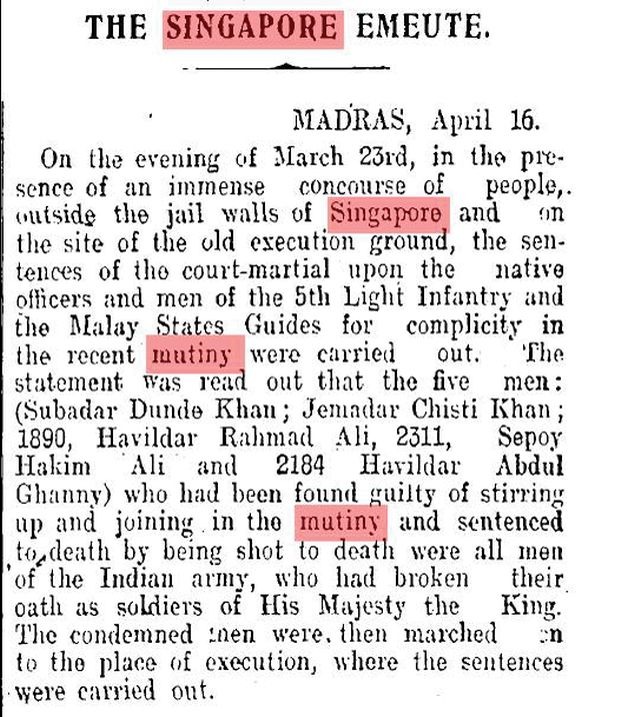
 Snapshot of a TOI article from 1915 on the Singapore Mutiny

Snapshot of a TOI article from 1915 on the Singapore Mutiny

They gave ambivalent statements, turned coats, played victims, and testified against men already dead in the mutiny or executed by firing squads. They did all this to exonerate themselves and men of their own caste/village from swift colonial justice. Even those sepoys who were identified as mutineers by others spun convincing tales to fool the court.

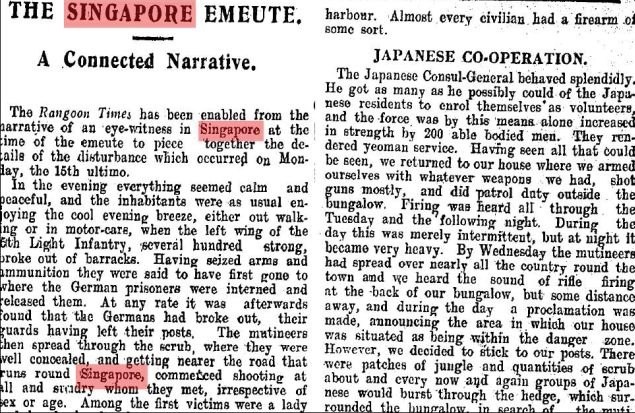
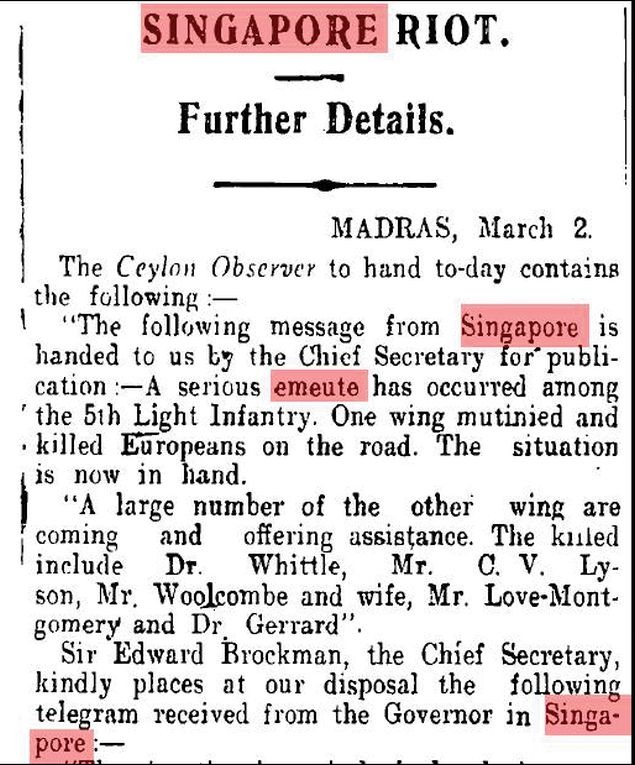
The Times of India had extensively reported the mutiny in 1915, calling it the Singapore Emeute. On March 2 that year, when the mutiny had already been put down and the inquiry was on, the first news of the mutiny had reached India. This paper had reported then: “A serious emeute has occurred among the 5th Light Infantry. One wing mutinied and killed Europeans on the road. The situation is now in hand. A large number of the other wing are coming and offering assistance.”

The mutineers belonged to the right wing of the regiment. The left was primarily composed of Pathans (the sepoys, though, called themselves Hindustani Pathans) who also came from the same regions as the Muslim Rajputs—Punjab and Haryana, including areas that form part of Delhi NCR today. These men didn’t join the mutineers, but ran helter-skelter in the melee and shut themselves in bathrooms/toilets and shops, with many escaping to the forest.

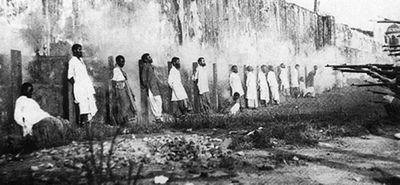
Mutineers being executed by firing squad. It shows some sepoys still standing and some down, as the European militia executioners missed their targets several times.

It was a deja vu moment for the regiment, which, in its previous avatar as the 42nd Bengal Native Infantry regiment, had seen exactly four companies rebel during the 1857 Uprising and the rest staying loyal. That was the reason why the regiment wasn’t disbanded after the Uprising was quelled. In 1915, too, the regiment would escape disbandment because of this reason, and would “honourably discharge its duty and salvage its lost reputation” in East Africa where they would fight the Germans.

But in the week that the mutiny lasted, the rebels killed 12 British officers and 14 European civilians, liberated German prisoners held in a jail (of whom 17 joined them and the rest stayed neutral), and got on board by persuasion or intimidation some men of the Malay States Guides.

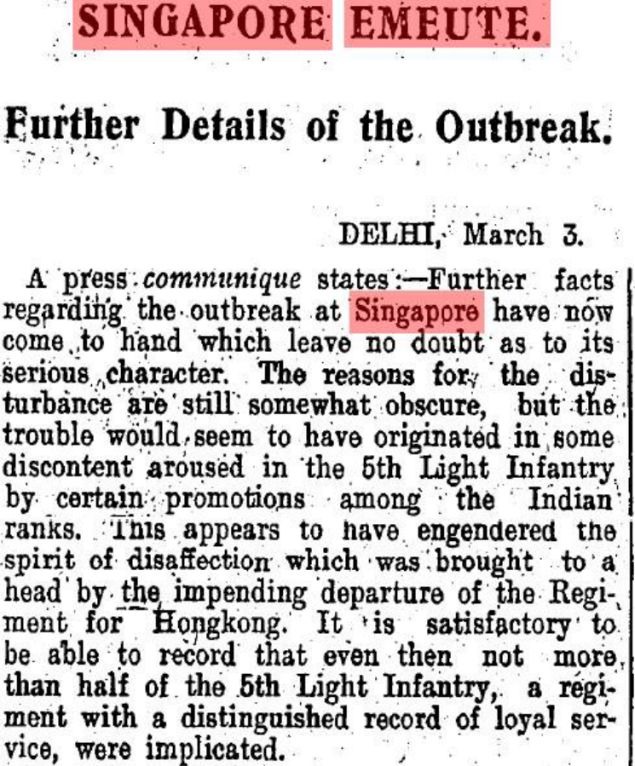
On March 3, 1915, The Times of India had a clearer picture of the mutiny. “Further facts regarding the outbreak at Singapore have now come to hand which leave no doubt as to its serious character. The reasons for the disturbance are still somewhat obscure, but the trouble would seem to have originated in some discontent aroused in the 5th Light Infantry by certain promotions among the Indian ranks. This appears to have engendered the spirit of disaffection which was brought to a head by the impending departure of the regiment for Hong Kong. It is satisfactory to be able to record that even not more than half of the 5th Light Infantry, a regiment with a distinguished record of loyal service, were implicated,” TOI had reported.

Snapshot of a TOI article from 1915 on the Singapore Mutiny.

That obscurity, as stated in the TOI report, has remained till date. The mutiny was quelled by the British by February 22 with Franco-Russo-Japanese help. After that, it was the time for conspiracy theories. Though there was little evidence on ground, the mutiny was linked to the Ghadar Conspiracy—efforts by the Ghadar Party to foment rebellion among Indian troops stationed abroad. The Ghadarites themselves took credit for it, though they got news of the mutiny only on March 2—the same day TOI carried the report—after the mutiny was suppressed. And they thought until April that Singapore was under rebel control.

Then there was the German conspiracy theory. At least one German prisoner took credit for inciting the Indian soldiers to mutiny. Plus the sepoys are believed to have received letters from their comrades fighting in Europe that the German king had converted to Islam and that it was not right to fight the forces of a Muslim king.

Then there was the more convincing theory of the sepoys rebelling due to their unwillingness to fight the forces of the Ottoman Sultan, the caliph of Islam.

Snapshot of a TOI article from 1915 on the Singapore Mutiny

But the real factor may have been a combination of terrible lapse in communication and leadership on the part of the British (the CO of the regiment was particularly unpopular among the troops and officers, both Indian and British. After the mutiny, he was dismissed from his post and retired from the Army) and a greater desire among the Indian troops to escape the horrors of European war—the latter observation also made by Japanese historian Sho Kuwajima.

On July 5, 1915, TOI carried the government’s explanation: “In view of the misrepresentations that have been made regarding the mutiny, we are authorized by the governor to state that no report whatever had reached His Excellency or the general officer commanding prior to the mutiny regarding any seditious tendencies in the 5th Native Light Infantry … No charge of disloyalty had ever been made to the government against the 5th Light Infantry … on the other hand, Government had received most positive assurances as to the loyalty of the regiment.”

Yet the sepoys were only loyal to one another in their regiments, battalions and companies as in the case of the Singapore mutineers. They gave no call for freedom or anything of that nature.

 Snapshot of a TOI article from 1915 on the Singapore Mutiny

Snapshot of a TOI article from 1915 on the Singapore Mutiny

Nevertheless, in the immediate aftermath, there was disturbing talk about the loyalty of Indian troops, and the wisdom of trusting the security of big colonial possessions like Singapore to Indians was questioned too. But in a strange coincidence, exactly 27 years after the Singapore Mutiny, on February 15, 1942, 80,000 British-led Allied troops surrendered at Singapore to the Japanese of whom 40,000 were men of the Indian Army. Nearly 30,000 of them would eventually join (either voluntarily or under duress) the Indian National Army.

Buried in history

· 47 sepoys, NCOs and VCOs were executed after a general court martial
· The ringleaders were identified as Subedar Dunde Khan, Jemadar Chisti Khan, Havildar Rahmat Ali, Sepoy Hakim Ali and Havildar Abdul Ghani; Dunde Khan and Chisti Khan were shot first on February 21
· 64 others were sentenced to transportation for life or ‘sazaa-e-kalapani’

· No memorial or plaque whatsoever to the mutineers exist anywhere

· Mutineers till today are unfairly vilified in Western accounts

· Since most sepoys on trial and during court of inquiry clammed up, the full truth about the causes of the mutiny are not known till today

(Write to the author at manimugdha.sharma@timesgroup.com)

source: http://www.timesofindia.inditimes.com / The Times of India / News Home> India / by Manimugdha S. Sharma / TNN / August 03rd, 2014

Save a knight’s remains – Kin of Sir Ali Imam renew demand for heritage tag for neglected 1932 mausoleum

Dipatoli (Ranchi), JHARKHAND :

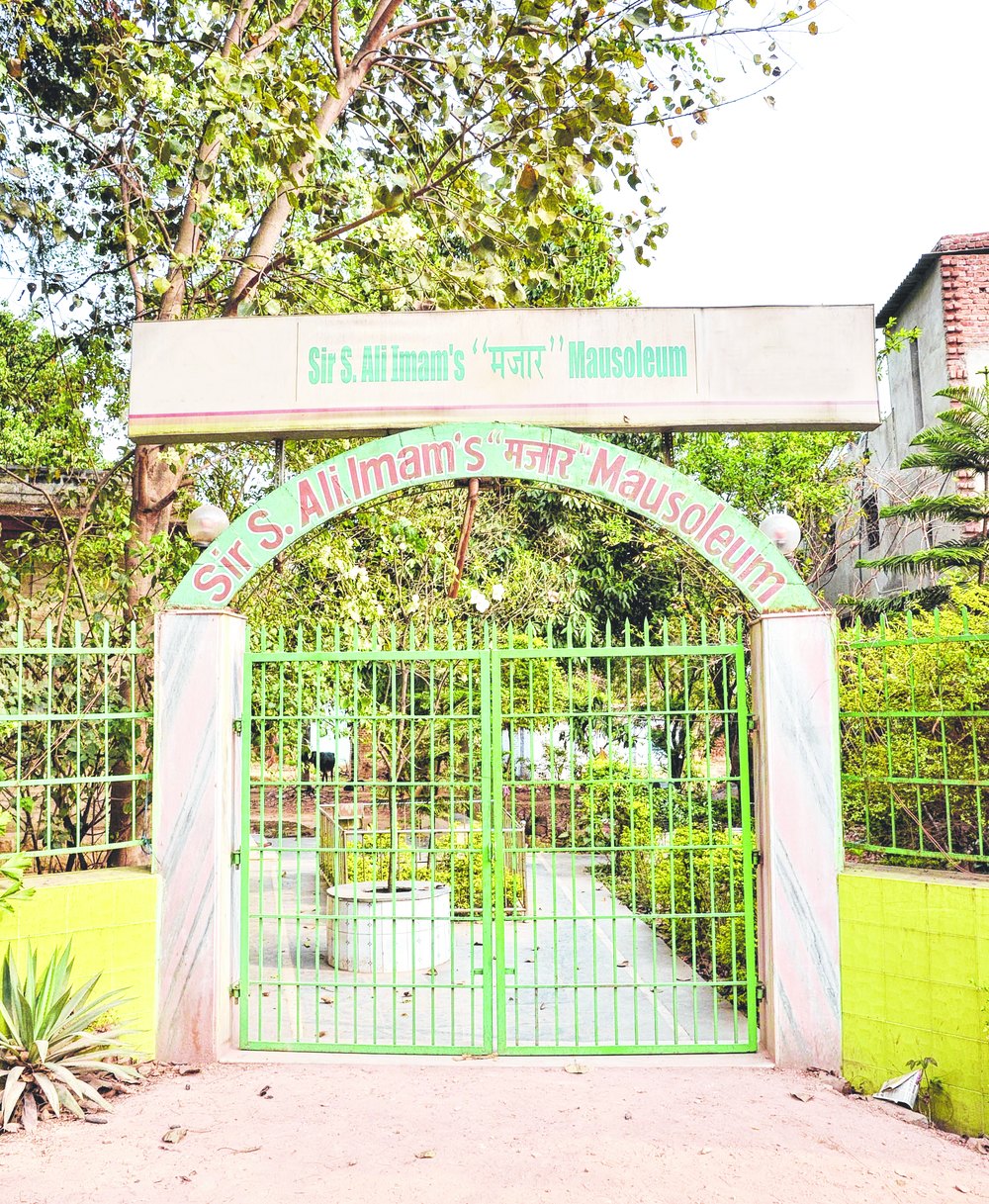
The mausoleum of Bihar's architect Sir Ali Imam on NH-33 near Dipatoli in Ranchi. (Prashant Mitra)
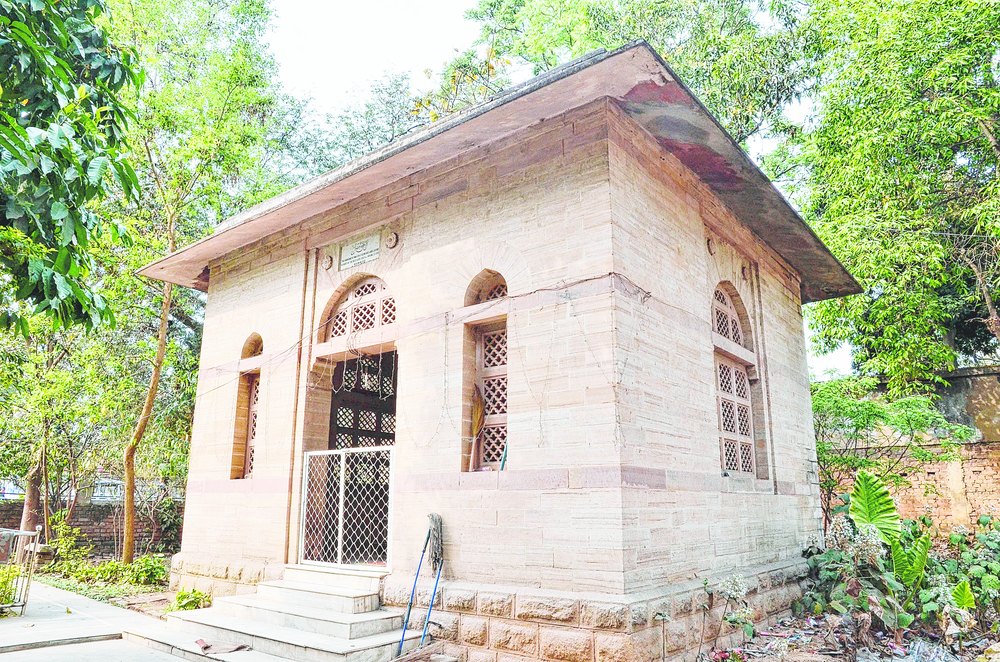
The mausoleum of Bihar’s architect Sir Ali Imam on NH-33 near Dipatoli in Ranchi. (Prashant Mitra)

Jharkhand’s “stepmotherly attitude” towards the mausoleum of Sir Ali Imam, one of Bihar’s prime architects, has prompted the knight’s grandson to resurrect his decade-old heritage status demand for the site that rightly deserves conservation.

In 2005, a memorandum had been signed between the Indian National Trust for Art and Cultural Heritage (Intach) and Birla Institute of Technology (BIT), Mesra, to develop the mausoleum on NH-33 near Dipatoli, Ranchi, into an art and culture centre. But, like most other projects in the state, it sank into oblivion.

In 2012-13, the Archaeological Survey of India (ASI) listed some monuments for protection, including the Jami Masjid and Baradwari Masjid in Rajmahal, Khekparta temple in Lohardaga and Buddhist ruins in Benisagar, West Singhbhum, but the mausoleum was again given the pass.

Such “monumental neglect” has now prompted Askari Imam, the grandson of Sir Ali Imam, and other members of the Sir Ali Imam Trust like grandnephew Bullu Imam to request the Raghubar Das government for a heritage tag.

Justin Imam, the great grandson of the knight, said they were pursuing the matter with the department of art and culture (archaeology) so that a pending report advocating conservation rights for the mausoleum was given active consideration. “A year ago, we had submitted the report to the department. It is obvious no one took interest. We will push the matter again tomorrow (Tuesday),” Justin said.

Former state convener of Intach Shree Deo Singh conceded that Askari Imam had approached him with a conservation request five years ago. “The Trust was then formed for its maintenance. However, after my term as convener ended, the tomb was subjected to utter neglect,” Singh said.

Bullu Imam pointed out that the monument existed in a capital city and yet most people of Jharkhand were unaware of it. “This is so unfortunate,” he said.

MausoleumMPOs06jan2018

“Once the mausoleum is declared a protected site, it will attract tourists from the state and outside,” added voluntary caretaker Chetan who also runs a shop nearby.

State art and culture secretary Vandana Dadel said members of Sir Ali Imam Trust had met her last week and she had assured them that she would look into the matter. “I will send a team to the site so that we can initiate talks with the ASI,” she promised.

Ali Imam, a judge at Patna High Court in 1917, was a law member of the British Imperial Council and was conferred knighthood by the British government. Sir Ali Imam, who played an important part in the constitution of Bihar, died in 1932 after which the mausoleum was built.

_____________________________________________

Correction:

I would like you to make amendment in one of the paragraph. Where you mentioned that Justin Imam the great grandson to Sir Syed Ali Imam. In fact Justin Imam is the great grandson to Sir Hasan Imam who was the younger brother to Sir Syed Ali Imam Saheb.
Sir Ali Imam Saheb great grandchildren are from Late Justice Jafer Imam, Reza Imam and Naqi. Kindly amend the paragraph in your article.

Many thanks
Amina Imam Ahmad / 05th April 2018

__________________________________________

source: http://www.telegraphindia.com / The Telegraph,  Calcutta,India / Front Page> Jharkhand> Story / by Arti  S. Sahuliyar / March 10th, 2015

Eighty years after death, nobody cares for ‘architect of Bihar’

BIHAR :

Unsung hero

Known as one half of India’s legendary barrister brother duo, he has been hailed as the co-architect of modern Bihar.

However, on his 80th death anniversary on Friday, the legacy of Syed Hasan Imam, a nationalist leader, patriot and a freedom fighter, remains forgotten.

Born in 1871 in Neora village near Patna, Imam died on April 19, 1933 and lies interred on the banks of river Sone in Japla, a small village in the border of Bihar and Jharkhand.

After suffering years of neglect and facing encroachment around his tomb, his grandson, Bulu Imam, now living in Hazaribagh, is striving to restore the lost honour.

“Today, on the occasion of his 80th death anniversary, I feel heartbroken to remember the legacy of my grandfather who, instead of being remembered, let alone celebrated for his immense contribution to the cause of Bihar and India at large, has been consigned to oblivion,” said Bulu Imam.

‘Some honour restored’

“We went to his tomb in Japla and cleaned it up on the anniversary and also put a chhadar on it, trying to restore some honour to his forgotten legacy. There were encroachments around the tomb and Hasan Imam’s house,”“ he said.

“I have evicted all the encroachers and now I am trying to preserve the place as his lasting memorial,” said Bulu Imam over phone from Hazaribagh, Jharkhand.

Syed Hasan was educated in Patna and in the UK, and was called to the Bar in Middle Temple in 1892. When he returned to India, he practiced in Calcutta High Court, where he became a judge in 1912.

After the establishment of the separate province of Bihar with Patna as its capital in 1912, and with the Patna High Court opened in 1916, Imam resigned from the judgeship of Calcutta High Court to practice in Patna, according to The India Gazette’s Who’s Who in India, 1927 edition.

He was elected president, special session of the Indian National Congress, in September, 1918. He was also elected as a delegate to the London Conference on the Turkish Peace Treaty in 1921.

He and Sir Al Imam along with barrister Sachchidananda Sinha and Mahesh Narayan were instrumental in getting the British empire grant a separate province of Bihar out of Bengal in 1911, as announced by King George V at the historic Delhi Durbar that year.

Despite his exemplary contributions to Bihar and to India, Hasan Imam remains a forgotten hero, much like his elder brother Sir Ali Imam.

The two brothers or ‘Imam Brothers’ as they were popularly known, will possibly go down in history as ‘faded icons’, much like their fabulous house, all but gone now.

source: http://www.deccanherald.com / Deccan Herald / Home> Metro / New Delhi – April 20th, 2013

Telangana’s Sara clinches gold junior Taekwondo Nationals

Hyderabad, TELANGANA :

The Telangana taekwondo who won laurels in the national meet with SATS chairman A Venkateshwar Reddy and others.

Meanwhile, in the 63rd National School Games Taekwondo championship, held in Nalgonda, the State won three silver and five bronze medals.

Hyderabad: 

Telangana State’s Maseera Sara Khan clinched a gold medal in the 63 to 68 kg weight category in the recently concluded 37th National Junior Taekwondo championship at Chhattisgarh. This is the first gold medal for Telangana after the formation of the State.

Meanwhile, in the 63rd National School Games Taekwondo championship, held in Nalgonda, the State won three silver and five bronze medals.

List of winners:

1.Nandishwar (silver in 21 to 23 Kg), Hanshika Singh (silver in 24 to 26 kg), Himanshu Pilli (silver in Above 50 Kg), Shiv Kiran (bronze in 25 to 27 kg), Naina Bai (bronze in 18 to 20 kg), Ramya.S (bronze in 22 to 24 kg), Trilok (bronze in 32 to 25 kg), Akshita (bronze in above 38 kg) and Santosh (bronze in Under-18 Kgs).

source: http://www.telanganatoday.com / Telangana Today / Home> Sports> Other Sports / by Sports Bureau, Telangana Today / January 04th, 2017

Cricket is my bread and butter: Jaffer

Mumbai, MAHARASHTRA :

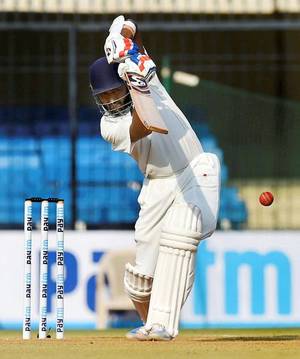
Guiding light: The seasoned Wasim Jaffer, who notched up valuable runs for the new Ranji champion, wants to continue contributing to the fortunes of Vidarbha. | Photo Credit: PTI

Veteran run-machine is convinced Vidarbha has the talent to go places after this momentous triumph

Wasim Jaffer has not lost his appetite to score runs in the Ranji Trophy.

A joy to watch because of the elegant stroke-play he brings to his batting, Jaffer has stacked up impressive numbers. After playing 22 seasons — 19 for Mumbai — Jaffer is on the top of the pile with 10738 runs and some of those helped the team he represented this season to win the Ranji Trophy. And he is ready for another stint.

Injury prevented him from turning out for Vidarbha last season, but he regained fitness and returned to nurture the talented cricketers of the Central India team. He played in nine matches, scored 595 runs, with one century (158 not out against Goa) and three half centuries for an average of 54.09. Two years ago, he played nine matches and scored only 382 runs at 27.42.

The sheer love for the game, which he calls “bread and butter of his life”, enabled him to stretch his First Class career once he was through with his long association with Mumbai with which he won eight Ranji Trophy titles.

After going through the grind of a home First Class season the last two decades, Jaffer kept himself occupied in the Yorkshire, Birmingham and Liverpool leagues for almost 20 years and this season he will be playing in the Lancashire league.

The 39-year-old believes that he took the right decision by opting to play for Vidarbha. “Playing for India is not the be all and end all….I had been there and done it. I just wanted to continue playing. I wanted to stay fit, face fresh challenges and do my bit for other teams. It also helped me to make some money. I don’t do anything other than play cricket.  That’s why I go to UK every year with my family,” said Jaffer.

After being raised in a city rich in cricket culture, Jaffer found the cricketing environment in Vidarbha different.

“There was no quantity, only quality; players were equipped with good skills. There were only 25-30 probables who played across all formats.

“They were happy winning at home and fine with it. When they lost ‘away’ matches, I don’t think they were hurt. It’s here that Chandu (Pandit) played the decisive role. He took them out of the comfort zone and pushed them hard. He did not praise them enough, but criticised them. Two years ago, I found out that when the match was in a 50-50 situation, they did not really go for it and show the killer-instinct. Chandu changed their attitude completely. Vidarbha needed someone like Chandu.”

Jaffer said when Mumbai won the Ranji Trophy in 2003 and 2004, Pandit did not form any committees within the team. “But here we had committees for entertainment, travel, food etc. This helped in team bonding. Chandu also changed room partners to prevent players forming groups. This was one way he took them out of the comfort zone and pushed them really hard.”

The two ex-Mumbai players also impressed upon opener Sanjay Ramaswamy to change his attitude, from being an introvert and not listening to others, to take good suggestions and implement them.

“I also impressed upon Chandu to give opportunities to Aditya Sarwate and what a partnership developed between him and Akshay Wadkar against Delhi. Vidarbha has good players in Lalit Yadav, Rajneesh Gurbani and Akshay Wakhare. Faiz Fazal has years of experience. Someone like Karn Sharma had to sit out.”

Jaffer says that Vidarbha, “having tasted success”, will look for more at all levels. “They have the confidence now. Chandu has instilled that attitude in the team.”

source: http://www.thehindu.com  / The Hindu / Home> Sport> Cricket / by G. Vishwanath / Mumbai – January 03rd, 2018

Akbaruddin lends a helping hand to special children in Hyderabad

Hyderabad, TELANGANA :

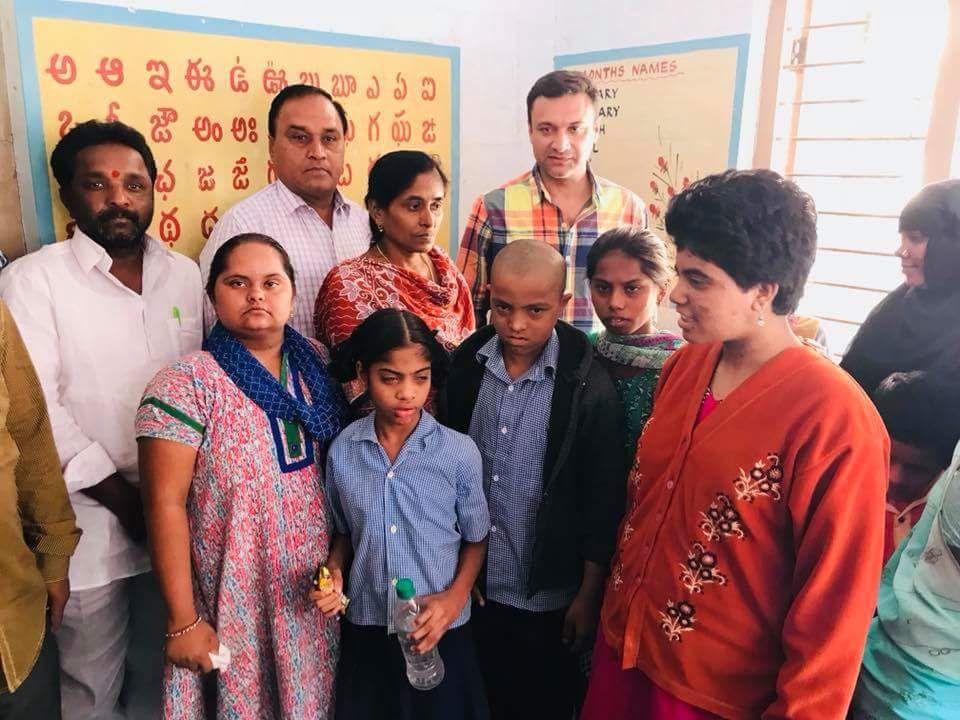
MIM leader Akbaruddin Owaisi along with the children of Bhavita.

Managed under Sarva Siksha Abhiyan (SSA), the resource centre provides facilities to 30 children with various kinds of disabilities.  During a recent visit to Bhavita, Akbaruddin was informed that the children had only one teacher and did not have access to playing and learning equipment .

Hyderabad:

As a noble gesture, MIM senior leader and MLA from Chandrayangutta, Akbaruddin Owaisi has adopted Bhavita, a resource centre for children with special needs located in Jangammet Falaknuma Government Junior College premises.

Managed under Sarva Siksha Abhiyan (SSA), the resource centre provides facilities to 30 children with various kinds of disabilities. During a recent visit to Bhavita, Akbaruddin was informed that the children had only one teacher and did not have access to playing and learning equipment.

On his direction, the Deccan College of Physiotherapy has taken Bhavita under its management and has provided learning and playing equipment worth Rs 5 lakh.

A physiotherapist and an instructor have been roped-in for the children, who will visit the centre on a daily basis, said Dr Aditya, Principal Deccan College of Physiotherapy, which is run under Owaisi Group of Hospitals.

The MIM leader has provided sports equipment and provisions for occupational therapy including an ultra sound, stimulator, bolsters, walking aids, elbow crutches, wobble board, skill games for kids and wedges which could help teachers and instructors to train the children.

Majority of the children at Bhavita suffer from cerebral palsy, muscular dystrophy, congenital deformities and intellectual disabilities. According to Dr Aditya, such children need proper care and treatment that would create an enabling atmosphere for them to grow like normal children.

Akbaruddin said he wanted the Centre to be strengthened and children to utilise the new facilities that had been made available to them.

“Whatever they need I am ready to provide from my side. I will also take up the issue of Bhavita Centre with the District Collector to provide more space for these children in the Falaknuma Campus,” he said.

Akbaruddin Owaisi has also donated Rs 50 lakh for improvement of infrastructure, establishment of labs, libraries and restoration of buildings in Falaknuma and Golconda Government Junior and Degree Colleges.

source: http://www.telanganatoday.com / Telangana Today / Home> Hyderabad / by Naseer Giyas / January 02nd, 2018

The jungle man of Coimbatore

Coimbatore, TAMIL NADU :

Jalaluddin01MPOs04jan2018

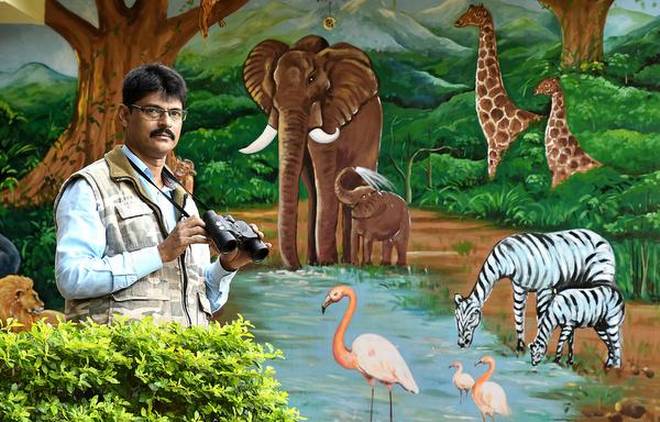
Wild life lover N.I. Jalaluddin is convinced that the way forward in conservation is through young people and he works tirelessly to sensitise them about forests, animals and birds

“My love for Nature started with birds, by observing the kaaka and kuruvi,” laughs N.I. Jalaluddin. As a school boy he was in Kollegal where his father was working. And, as he stared up at the sky, he was often beset by questions about the birds he saw flying. He wondered: ‘How do the migratory birds fly across continents and sometimes over 16,000 kms without any GPS, fuel, or driver?’.

That enthusiasm and curiosity combined with a trek to Mudumalai as a part of WWF camp fuelled his interest further. “I was a regular at BNHS Nature camps in Bandipur, Nagarhole and Masinagudi. And, I decided to talk about Nature and Wildlife among school students from then on.”

Jalaluddin02MPOs04jan2018

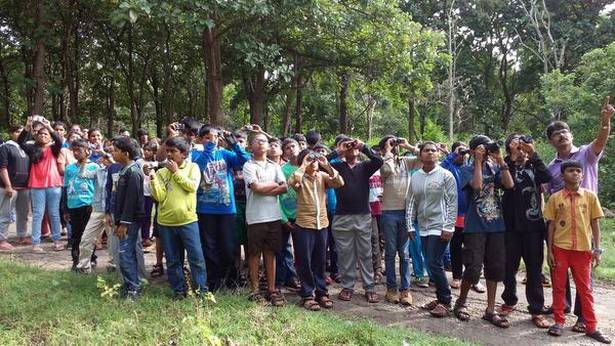
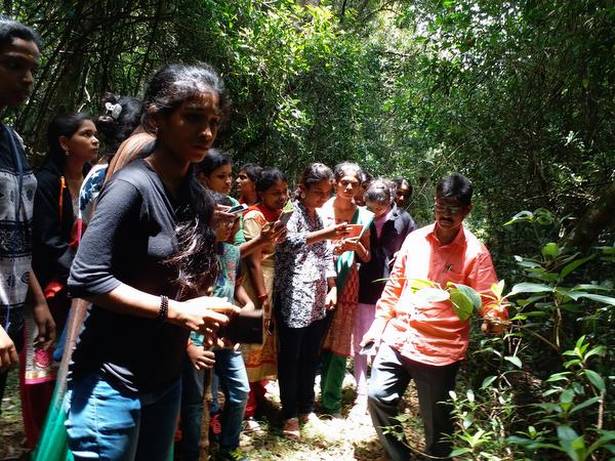
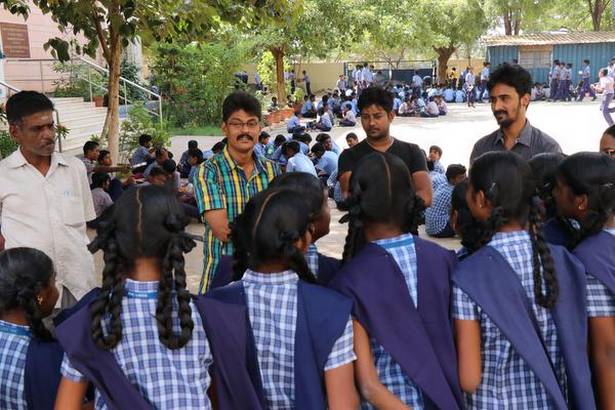
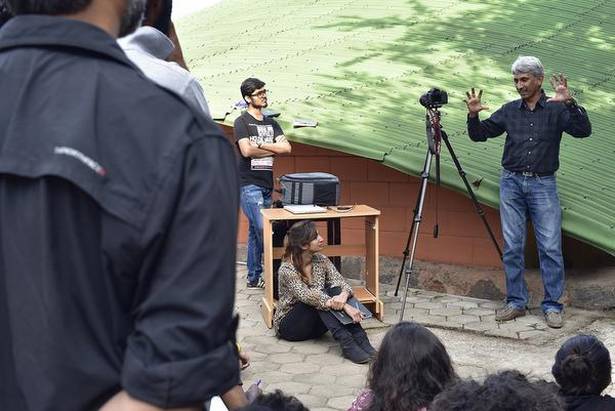
Today, his Nature Conservation Society that spreads awareness among students and the public has completed thousands of Nature camps and reached out to millions of students. Several awards have come his way with the latest one being the Best Service Award by the District Collector. “I work with eco-club students and take them on Nature walks in the Western Ghats,” he says. He educates them about the forests and the rich biodiversity it supports. Then, there is bird watching, and learning about mammals too. “I tell them how to identify pug marks, foot prints, and spoor of animals, and the importance of animal census.”

Jalaluddin talks excitedly about Project Kaliru, an initiative by Tamil Nadu Forest Department to save elephants. As a part of the project, he will cover 46 institutions, schools and colleges, and talk to them about elephants and wildlife. “The elephants lead the forests and set the terrain route for other animals. One of the prime objectives of Project Kaliru is to ensure that there is nil human -animal conflict. Did you know that the elephants as they migrate also bring a variety of plants from another region? The elephant dung has about 40 per cent of undigested food that includes seeds of a variety of fruits and vegetables.”

Awareness is the key, he stresses. “Tribals and animals have co-existed for generations. The conflict arises only in urban zones. In one year, there are over 15,000 deaths by road accidents while the death by human-animal conflict is about 30, which can be easily mitigated.” He is also making a documentary on elephant-human conflict called Wild Witness. “ It’s a dream project for me. One of my students, actor Aravind, who has attended my camps, is helping us out with the camera equipment. DFO Satish and Conservator of Forest S. Ramasubramaniam have been very helpful.” Jalaluddin is a regular at surveys of wildlife population with the forest department. He has rescued many species like snakes, birds, and animals used in illegal trade and handed them over to the forest department for release and rehabilitation. He has spoken out vociferously to save the wetlands. “When I raised my voice against cutting of trees for highway expansion, the authorities threatened to file a criminal case against me. But the Bar Association backed me and we fought it out .” He has intervened and stopped cutting of thousands of trees in the city by litigation, court stay orders, and through dialogues with higher officials. “Youngsters are the change makers, our hope. We have to start with them to care for Nature. Even awareness on banning plastics works better when you take it through them.”

Recently, Jalaluddin took a group of 150 students from Shree Sakthi College of Engineering on a trek to Valparai. “I told them to observe the scratching of animals on trees. It is one of the ways to understand that we are in tiger territory. Engineering colleges should also inculcate nature awareness. A watch tower or a check dam involves engineering skills.”

Jalaluddin03MPOs04jan2018

He recounts some thrilling experiences. “Once, we spotted a leopard in Mudumalai. Another time, we saw a herd of 13 elephants at a very close distance while on a trek at Theppakaadu. Luckily, there was a trench in between, much to the relief of the students,” he laughs. Along with students from Chandra Matriculation School, and Ramakrishna College for Women, he has spotted tigers in Bandipur, Thengumarhada…. “It’s a pity that some schools ignore this aspect of education. We live in the Western Ghats, the hotspot of bio-diversity. When I ask the students about our State animal (Nilgiri Tahr), bird ( Emerald Dove) flower ( Senkaanthal), or tree (palm tree), most them don’t know. A lot of animals, for example wild dogs or dhols have become a rare species now. I have spotted the Emerald Dove or Panchavarna pura so many times at Siruvani foothills. That is also very rare. In Tamil Nadu, we have four Project Tiger programmes in Anaimalai, Mudumalai, Satyamangalam and Kalakkad-Mundanthurai. We have Project Elephant too in Anaimalai and Mudumalai to care for and conserve the elephants.”

People fondly call him Kaatuvaasi or man of the jungle. He brushes it off with a smile, and says, “ I keep doing my work. We have to leave something for the future generation. I feel happy even if one student out of every 10 I talk to, plants a tree. He will in turn talk to another 10 people. Then, there is no stopping. That, is an achievement.”

Jalaluddin04MPOs04jan2018

Awareness programmes

Banning plastic bags, film shooting in reserve forests

Conducting awareness drives through rallies, photo exhibitions and workshops in schools

Supporting the forest department in mitigating human-animal conflict by dialogues with affected villagers

Awarding schools and individuals who contribute to a healthy eco-system

source: http://www.thehindu.com / The Hindu / Home> Sci-Tech> Environment / by K. Jeshi / January 01st, 2018