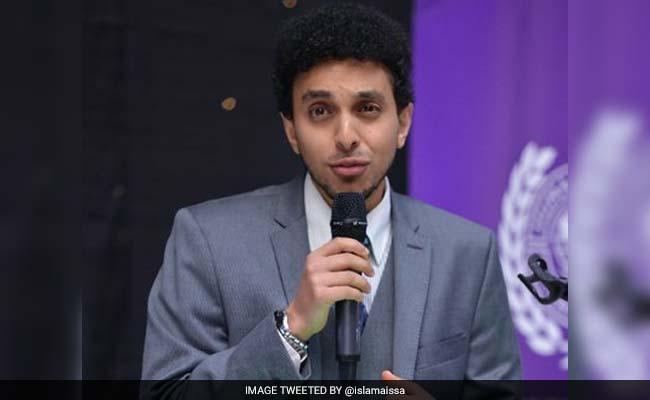
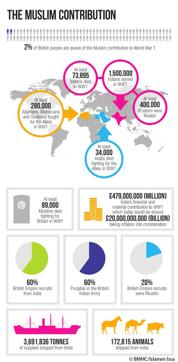
Islam Issa found that at least 885,000 Muslims were recruited by Allied forces
London :
Personal letters written by Indian Muslim soldiers who fought in World War I sharing their impression of England 100 years ago in comparison to their home country were on Friday released by a literature expert in London.
Islam Issa from Birmingham City University earlier this year found that at least 885,000 Muslims were recruited by the Allied forces in the war between 1914 and 1918. He released the letters to mark Armistice Day, or the end of the war.
The over 100-year-old letters highlight the experiences of Indian soldiers as they share their impressions of England in comparison to their home country, Heritage Daily reported.
Mr Issa has been researching individual stories from the war for an exhibition commissioned by and held at the British Muslim Heritage Centre in Manchester, called Stories of Sacrifice.
During his research, he found that 1.5 million Indians and 280,000 Algerians, Moroccans and Tunisians fought for the Allies during World War I, many of them Muslims.
“When I decided to look at soldiers’ letters, I expected a very bleak outlook on the war. Of course, sometimes, that’s exactly what I found. But quite often, the letters were about individual experiences and very normal, human things,” said Mr Issa.
“These anecdotes certainly helped shape my narrative for the Stories of Sacrifice exhibition. While there’s an important narrative about the war as a whole, the personal and human narrative was probably more striking. Whatever your ideology or stance, you end up realising that these Muslim soldiers were individual humans and as a result, they were making sacrifices at that individual, human level,” he said.
Complete with a virtual library, lesson plans and a toolkit for schools, the British Muslim Heritage Centre’s exhibition is the first long-term exhibition of its kind, devoted solely to exemplifying the Muslim community’s contribution and sacrifices during World War One.
On his trip to a London department store in 1915, soldier A.
Ali writes: “We visited a shop where 2000 men and women were working and everything can be bought. There is no need of asking as the price is written on everything.”
In the same letter, he shares his experience of the London Underground: “Then we went in the train that goes under the earth, it was for us a strange and wonderful experience – they call it the underground train.”
In another 1915 letter by Abdul Said, more opinions on shopping and butchers are shared.
“Every shop in this country is so arranged that one is delighted to look at them. Whether you buy much or little it is properly wrapped up, and if you tell the shop man to send it to your house you have only to give him your address and he delivers it.
“The butcher’s shops in Hindustan are very dirty, but here they are so clean and tidy that there is absolutely no smell.”
source: http://www.ndtv.com / NDTV / Home> Section> Indians Abroad / by Press Trust of India / November 12th, 2016
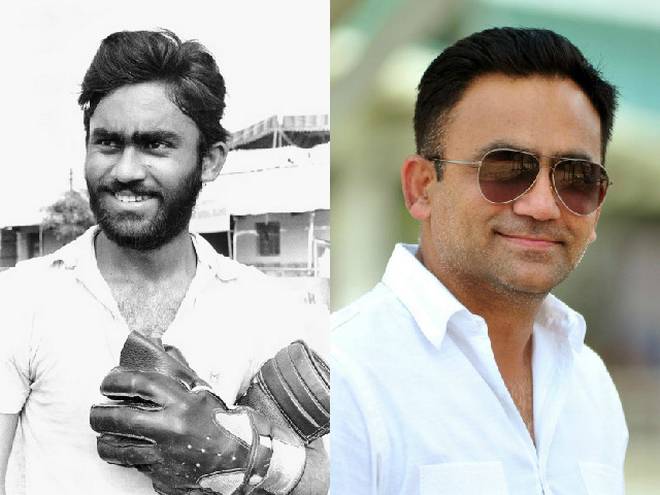
Saba Karim was one of the unsung heroes of Indian cricket team. A freak eye injury meant his first Test was also his last.
His first-class debut came at 15, against Assam. His farewell game happened against the same opponent 18 seasons later. He went on his first tour with India in 1989 to the West Indies but waited eight more years before playing his first ODI. And then three more years to earn a Test cap. Within months of playing a Test, at 33, Saba Karim bowed out of the game, an injury to his right eye cutting short his career.
The eye injury was a freak incident at Dhaka during the Asia Cup in 2000. It was India’s first match of the tournament and Karim was keeping to Anil Kumble, an exercise he was not familiar with. Kumble was giving a tough time to the batsmen, bowling quicker, and this particular delivery kissed the flap of the batsman’s pad and Karim had no time to avoid the path of the ball. “It slammed into the socket of my right eye,” recalled Karim.
His world seemed to have crashed in that heart-breaking moment “My vision was blurred and I thought I had lost my vision. It was indeed a hard time,” said Karim. He received treatment at the Sankara Nethralaya in Chennai and recovered to get back to the Indian team for the one-off Test against Bangladesh. The team captain, Sourav Ganguly, was willing to back him. So were the National selectors.
Karim prepared for the Test by playing some club matches in Mumbai. “My vision had improved and I thought I was ready,” he remembered. But obviously he was not. “When the game started I realised I couldn’t cope with the speed of the delivery. And then I was having problems with the sweat coming into my eyes.” He played the Test but not in ideal conditions even though India beat Bangladesh in the latter’s debut as a Test nation.
He developed a love for cricket when studying at St. Xavier’s and later at St. Michael’s in Patna. The facilities were hardly encouraging but Karim made steady progress, taking to wicket-keeping on the advice of Sudhir Das, a former state and zone medium-pacer. He went on his first international tour as part of the Indian Schools squad to the West Indies in 1982. The same year he was included in the East Zone team for the Deodhar Trophy before making it to the Bihar squad for the Ranji Trophy.
Within a season of making his mark at the first-class level, Karim shot into national reckoning as a wicketkeeper-batsman of quality. He was still playing school cricket when the zonal selectors picked him for the tour match against Clive Lloyd’s West Indians at Cuttack in 1983. Two catches and a stumping in the only innings that West Indies batted was a “huge inspiration” for Karim, who now nurtured dreams of making it big.
The tour to the West Indies in 1989 paved the way for Karim to showcase his talent but the opportunities were sparse. “The tour was an eye-opener. I knew little about international cricket and I tried to absorb as much as possible. It was a huge experience,” Karim noted. All he played were three side games. On return, he did not get a look in. “The selectors had forgotten me,” he smiled. And then churning started and in his words his career stood “rejuvenated.”
Help for Karim came from seniors like Hari Gidwani and Arun Lal. “I gained in values and improved my temperament.” Seven years of toil helped Karim stage a comeback when he was picked to go to South Africa in 1996-97. He had shifted to Bengal from Bihar in 1994-95. “I made the move at the right stage. I was not getting opportunities beyond my zone. When Tata Steel transferred me to Calcutta I made my shift too. It is true that your performances don’t get to be noticed when you play for emerging teams.”
In Bengal, Karim made rapid progress. “The facilities were amazing. Lots of clubs matches and the league for well organised too. The practice facilities for the Ranji team were excellent. Most important was that I was never made to feel like an outsider.”
Karim was making waves. He figured in two tour matches against visiting Australian and South African teams in 1996-97. Interestingly, his debut came at Bloemfontein in early 1997. “Nayan (Mongia) injured his finger and indicated to me. (Coach) Madan Lal told me I was in the playing XI and that was one of my most unforgettable days.” Karim played six ODIs in that tri-series and figured in 19 more ODIs before the year ended. Only one ODI each in 1998 and 1999 and another seven in 2000 was all that Karim could add to his career.
Among his memorable moments on the cricket field was pulling off a sensational victory against Pakistan at Karachi in 1997. He contributed a priceless 26 before Rajesh Chauhan sealed it with a six off Saqlain Mushtaq. “I can never forget the stone pelting from the crowd,’ he recalled. A commerce graduate from Hindu College, Karim, like Sunil Gavaskar, is a voracious reader with “Love In The Times Of Cholera” by Gabriel Garcia Marquez his favourite book. The 47-year-old Karim, who played two first-class matches following his Test debut before calling it a day, is currently a National selector and lives in Noida with (wife) Rashmi and (son) Fidel, an avid footballer.
(Saba Karim played 1 Test (15 runs); 34 ODIs (362 runs, 1 fifty, 27 catches, 3 stumpings); 120 first Class Matches (7310 runs, 22 centuries, 33 fifties); Career span: 1982-83 to 2000-01.
source: http://www.thehindu.com / The Hindu / Home> Metroplus / by Vijay Lokapally / April 19th, 2015
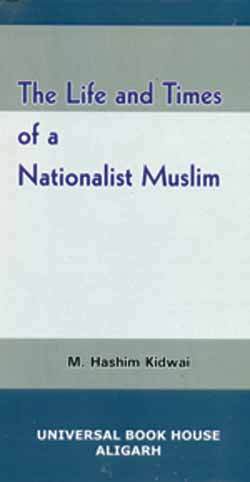
M. Hashim Kidwai’s memoir recollects the student movements at Lucknow University, the role of Muslims in resisting Partition, and their participation in politics and academics after Independence.
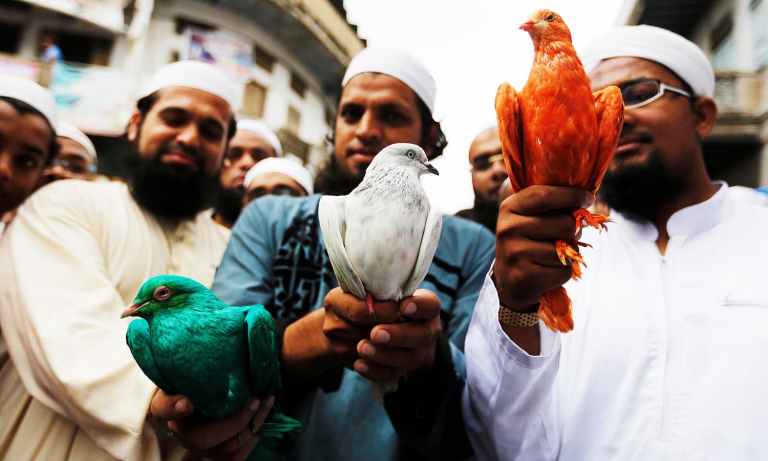
Muslims hold pigeons during a march to celebrate India’s Independence Day in Ahmedabad, India, August 15, 2016. REUTERS/Amit Dave
There is a remarkable similarity in the rise and ascension of religious reactionaries between the majority and minority communities in the decade before Independence. During the period of 1938-47, the Muslim League’s communal separatism was in fierce contest with the majoritarian assertion of the Hindu Mahasabha and the RSS, while at the same time it also benefitted from the extremism of the other party. The colonial state abetted such reactionary forces.
Other than the presence of the colonial state during that era, the Congress was the most powerful political force in the country, and was led by the likes of Mahatma Gandhi, Jawaharlal Nehru and Maulana Azad, even though the ideologies of many members of the provincial and district Congress leadership overlapped considerably with the Hindu Mahasabha.
Another reassuring difference is that today we do not have a Muslim political force comparable with Jinnah’s Muslim League, even though we do have the likes of Asaduddin Owaisi, Azam Khan and the sympathisers of the illiberal, non-plural, exclusionary traditions among Muslims and Hindus. If one may add, at the global scale as well, such forces seem to be on the rise today.
Born in 1921, Muhammad Hashim Kidwai saw all of this from close proximity. In his diary, he recollects the days of the late colonial India while living in today’s era. The title of the book itself is interesting. He describes himself as a ‘nationalist Muslim’.
In the late colonial period, the likes of Maulana Azad and Rafi Kidwai were banking upon the nationalist Muslims against the onslaught of the Muslim nationalists (or the votaries of the separate nationhood), just as the likes of Gandhi and Nehru were fighting with the Hindu nationalists, the rabid majoritarian reactionaries.
One should read the first volume of Kidwai’s reminiscence in the backdrop of these events. His account is rich in details pertaining to politics up to the Nehru era. His presence in Lucknow as a student till his late 20s and then his role as a teacher of political science at the Aligarh Muslim University (AMU) immediately after Independence and Partition enabled him to articulate significant narratives.
The fact that he was also an activist – both as a student and as a teacher – adds to the sharpness of his observations and insights. His long chapter on the student movement in Lucknow University provides vivid details of various little and big political organisations and fronts, literary associations and journalistic initiatives. The details captured in that chapter provide a valuable account of the political evolution of the Lucknow youth in the popular phase of the national movement.
In terms of academic explorations in India, we have an inadequate understanding of student movements as well the role of Muslims in resisting partition. This chapter invites us to make attempts towards filling the gap. The subsequent brief chapter on the consequences of Partition reflects on how Muslims adjusted thereafter.
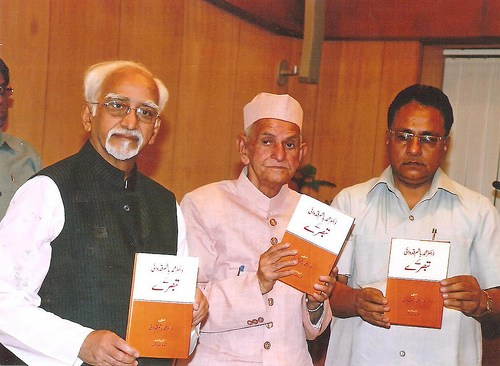
Vice President Muhammad Hamid Ansari with Hashim Kidwai (C) at the launch of his book Life and Times of a Nationalist Muslim. Credit: Aligarh Movement
It also hints at the relatively greater communalisation of the regional politics of Uttar Pradesh, which pushed Rafi Kidwai out of UP politics and then led to Nehru accommodating him in national politics.
There are a number of Urdu memoirs about the socio-political life on the huge AMU campus, but rather than offering informed criticism and reflections, most are essentially exaggerated eulogies. Kidwai’s memoir is not very critical either, but it does stand out for being able to relate campus life to the world outside. To him, the AMU campus was neither politically insulated nor did it suffer from an ‘isolation syndrome.’
Life and Times of a Nationalist Muslim M. Hashim Kidwai Universal Book House Aligarh, 2015
Being a quintessential Congressman, his narrative about the stealth placing of an idol in the Babri Masjid in December 1949 is focussed more against socialists like Ram Manohar Lohia and Acharya Narendra Dev, who according to him, remained silent to this injustice. Kidwai, however, does show his reservations against G.B. Pant, the then chief minister of UP. He complains, “Both Pandit Nehru and Sardar Patel urged Pandit Pant, the UP premier, to take strong action… But for reasons best known to him, Pantji did not take any action… Pantji’s policy of leaving everything to the district authorities was very much condemned and resented by a large number of Congressmen.”
Progressing strictly in chronological sequence and living up to its name as a diary, almost half of the memoir is devoted to AMU. Kidwai served there not only as a teacher but also as a writer of textbooks, a teacher activist and also contributed in academic governance.
In a huge residential university like AMU, which houses more than 30,000 students, “policing” students is a challenging task. Kidwai describes his roles as that of a provost of a residential hall as well as a proctor. While describing the role of the various vice chancellors, he, unfortunately, neglects their impact on establishing or encouraging academic rigour.
Kidwai is almost solely concerned with the socio-political life on the campus and the narrative gives the impression that the Youth Congress dominated the campus. Other accounts of post-Independence AMU inform us that Left activism had gained a significant presence at the university in the 1960s. Kidwai’s account ignores this and also does not dwell on the composition of the student body, that is, the regions the students came from or their socio-economic status.
The volume concludes with the death of Nehru in 1964.
A close reading of India’s comparative history that draws few parallels between the elections of 1946 and of 2014, and the consequences thereof, is still awaited. One hopes that the sequel volume of Kidwai’s memoir will delve deeper into such issues.
By his own admission in the preface, Kidwai, as a parliamentarian, stood behind the clergy, jarringly conservative on gender issues. He was also one of those that ill-advisedly encouraged Rajiv Gandhi to legislate against the Supreme Court verdict on the Shah Bano issue. Therefore, this first volume really sets up expectations for the next and about how he will recollect the days of 1985-86, especially at a time when the same gender issues have once again acquired significant political saliency. Equally important will be to read his views on the decline of the Congress post-1980s.
This is an important book, one which will become a resource for scholars interested in the participation of Muslims in both politics and in academics after Independence.
source: http://www.thewire.in / The Wire / Home> Books / by Mohammad Sajjad / November 04th, 2016
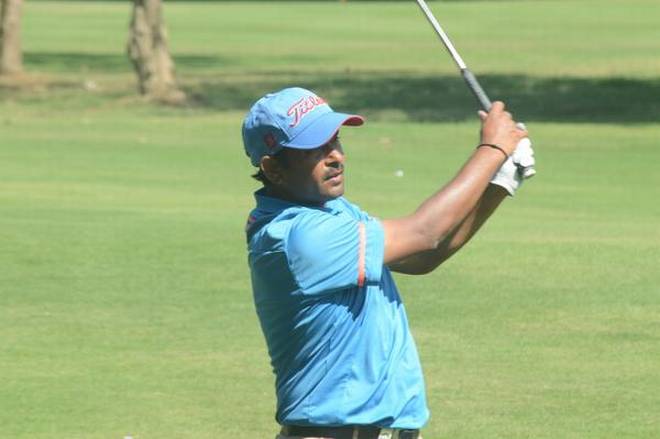
SURPRISE WINNER: Shamim Khan sank a 35-foot putt for a birdie to finish with an unblemished eight-under-62 and an overall 19-under-261.
Mumbai:
Delhi’s Shamim Khan upset all calculations to win the ₹1 crore CG Open at the Bombay Presidency Golf Club (BPGC) on Saturday. The 38-year-old professional of 21 years sank a 35-foot putt for a birdie to finish the tournament deciding day with an unblemished eight-under-62 and an overall 19-under-261, the lowest score for a four-round competition at this course.
The previous best was Jyoti Randhawa’s 18-under-261 in 2011. Khan has also taken the lead in the Rolex Ranking.
Bengaluru’s Khalin Joshi with a final-round card of 65 ended the tournament with an overall 18-under-262 to finish runner-up. Khan won ₹15 lakhs and Joshi ₹10 lakhs.
Khan, trailing by two points at the conclusion of the third round, struck putting form in the second and fourth holes and again in the 10th, 11th and 12th on the back nine to become joint leader with Joshi and Kapil Kumar.
A jubilant Khan said: “It’s been an incredible week. I dropped just three bogeys in the whole tournament. I had lost my touch with the long range putts in the last few months, but it came back at the CG Open. I made three 15-footers today and two putts from 30 to 35 feet. That made all the difference.
“I knew I was in the race once I made three consecutive birdies on the 10th, 11th and 12th. But I decided not to check the leader-board till the 17th. That worked for me.
“Once I saw I was two ahead after the 17th, I went for the birdie on the 18th. It’s great to win after so long. I owe a lot to my caddie ‘Gullu’ for this win. He was a great support. My ball-striking was also terrific through the week. I’m now looking to winning my second Rolex Player of the year title after 2012.”
Finally Zaheer Khan, the spearhead of the Indian Bowling attack got the reward for his contribution in international Cricket. The selection panel has decided to give Arjuna Award to Zaheer Khan. He will be the fifth Muslim Cricketer to receive the Arjuna Award. The Prestigious Arjuna award was instituted in 1961 by the Indian government to recognize outstanding achievement in the national sport. In total till now 30 Muslim players of different sports have been awarded the Arjuna. The list of Arjuna Awardees Muslim Cricketers includes Salim Durrani, Mansoor Ali Khan Pataudi, Syed Mustafa Hussain Kirmani, Mohammad Azharuddin and Zaheer Khan.
Born on 7 October 1978, in Ahmednagar district of Maharashtra, Zaheer is a member of Indian cricket team since 2000. He is known for his ability to swing the ball both ways. After doing well with the bat he is now considered as an all rounder. He holds the world record for the highest Test score by a number 11 batsman when he scored 75 against Bangladesh in 2004. At the time he was batting with the star cricketer Sachin Tendulkar; the pair amassed 133 runs and set a new record of partnership for India’s tenth-wicket. Zaheer made his Test debut in 2000 against Bangladesh at Dhaka and one day international debut against Kenya at Nairobi during the ICC KnockOut Trophy the very same year. Despite many injuries on different occasions now Zaheer Khan is the key player of Indian Cricket team. As a test player he played 78 tests and has taken 271 wickets with an average of 31.94. As a batsman he scored 1045 runs with 75 as his highest score. In one day international he played 191 matches claimed 273 wickets and as a batsman scored 781 runs. Cricket experts say that if Zaheer keeps injuries at bay, he will be India’s greatest fast bowler of all time. Now after getting the Arjuna award hope he will get more energy and will do better than before.
Salim Durrani was the first Muslim Cricketer who was given this prestigious award. He got the Arjuna Award in 1961. He was famous for hitting sixes on public demand. An aggressive batsman who was also a fine spinner, he was born in Kabul on 11 December 1934. He made his debut in 1959 against Australia. He played 29 tests in all, scored 1202 runs including a hundred (104) against West Indies at Port of Spain. He also captured 75 wickets including three hauls of 5 or more wickets in an inning.
The second Muslim who was given the Arjuna Award was Mansoor Ali Khan Pataudi. He got this award in 1964. Nawab Pataudi, who is commonly known as Junior Pataudi, holds the record of the youngest captain of the world. He played 46 tests for India and scored 2793 runs including a 203 (not out) as his highest score. He made his debut against England in 1961. He suffered a car accident in which he lost an eye and stopped playing cricket. In 1974 he returned to cricket and led the team. Under his captaincy India won 9 tests.
Syed Mustafa Hussain Kirmani was the third Muslim Cricketer who got the Arjuna Award. He was given this award in 1980-81. He is still the best wicket-keeper of India. MS Dhoni is very close to his record. He was also a good batsman. Born on 29 December 1949, he holds the record for highest dismissals by an Indian wicket-keeper and also for having played highest number of tests for India as a wicket-keeper. He made his debut in 1975 against the West Indies. In all he played 88 tests for India, scored 2759 runs with two centuries and 12 half-centuries. He dismissed 198 batsmen behind the wickets. He also played in 49 one-day matches, scored 373 runs and dismissed 36 players as a wicket-keeper. He was in the world cup win of 1983.
Mohammed Azharuddin(now the Congress member of Parliament from Moradabad) is the most successful Muslim cricketer of India. He was the fourth Muslim who got Arjuna Award. He got this award in 1986. Born on 8 Feb, 1963 in Hyderabad, Azhar made his test debut against England at Kolkata in 1984-85 series and hit 110 runs and became only the eighth Indian to do so. This inning was followed by 105 at Madras and 122 at Kanpur. He is the only player in the history of test cricket to score centuries in three consecutive tests. He is the only Indian to score a century in one session of a day’s play, he moved from 59 to 162 between lunch and tea on the third day of the second test against England in 1990. His highest test score is 199 which he scored against Srilanka at Kanpur in 1986-87. He is among the successful Indian Captains. Under his captaincy, India won many series. He played 99 tests for India and scored 6206 runs.
List of Muslim Arjuna Awardees:
1961 : Saleem Durrani (Cricket)
1964 : Mansur Ali Khan Pataudi (Cricket)
1966 : Yusuf Khan (Football)
1969 : Mir Kasim Ali (Table Tennis)
1970 : Abbas Moontasir (Basketball)
1970 : S. Naeemuddin (Football)
1973 : A. Kareem (Ball Badminton)
1973 : Afsar Hussain (Yachting)
1973 : Dafadar Khan M. Khan (Equestrian)
1975 : L.A. Iqbal (Ball Badminton)
1980-81: Mohammed Habib (Football)
1980-81: Mohd. Shahid (Hockey)
1980-81: Syed Modi (Badminton)
1980-81: Syed M.H. Kirmani (Cricket)
1981 : Sabir Ali (Atheletics)
1982 : Farokh Tarapore (Yachting)
1983 : Zafar Iqbal (Hockey)
1984 : Capt. G. Mohd. Khan (Equestrian)
1986 : M. Azharuddin (Cricket)
1989 : Abdul Basith (Volleyball)
1996 : Moraad A. Khan (Shooting)
1997 : Asif Ismail (Tennis)
1998 : Mohd. Riyaz (Hockey)
2000 : Akhtar Ali (Tennis)
2000 : Jalaluddin Rizvi (Hockey)
2002 : Anwer Sultan (Shooting)
2002 : Md. Ali Qamar (Boxing)
2003 : Akram Shah (Judo)
2004 : Sania Mirza (Tennis)
2010: Zaheer Khan (Cricket)
This article appeared in The Milli Gazette print issue of 1-15 October 2011 on page no. 16
source: http://www.milligazette.com / The Milli Gazette / Home> Online News> Community News / by A N Shibli / Published online October 01st, 2011 / Print Issue 01-05 October 2011
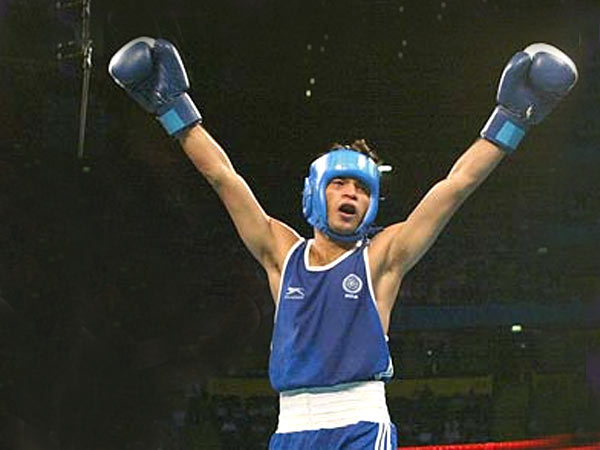
Mohammed Ali Qamar helped India win it’s first gold medal in boxing at the Manchester Commonwealth Games in 2002. It was far from an easy journey for the talented boxer from Kidderpore in Kolkata. Qamar’s father enrolled him into boxing at a very young age at Kidderpore School of Physical Education. He was trained by Cheena Bhai in his early years.
Qamar started showing signs of improvement at the junior level by winning important matches that would go on to shape his career. His first big win came in 1991 when we was crowned the Inter-district champion in West Bengal. He extended his winning run to the national sub-junior levels as he was undefeated for four straight years 1992-1996. The Indian showed immense resolve before losing to Ron Siler in the quarterfinals of the 1999 World Amateur boxing championships in Houston.
Qamar took on home favorite Darren Langley in the finals in the Light Flyweight category at the Commonwealth Games. Langley was leading for most part of the summit clash, but the Indian did not give up as he outscored his British opponent 10-3 in the latter stages of the match. He also survived a standing count before he outmanoeuvred the Brit 27-25 to clinch the gold.
He lost in the quarterfinals of the 2002 Busan Asian Games.
A career that promised so much was cut short by injuries. Qamar, who shares his name with the legendary boxer Muhammad Ali slipped into oblivion after his historic win in Manchester.
Kidderpore is now the hub of women’s boxing in India. Boxers who train at the place consider Qamar as their inspiration. Indian fans can only hope that these women can go on to win medals for India.
source: http://www.sportskeeda.com / SportsKeeda / Homepage> Boxing / by Jaiprakash @jaiprakashmr / December 27th, 2014
Well-known Sunni scholar, Qazi of several Mohallas, Sayyid Mohammed Umarul Faruk Al Bukhari, popularly known as Posot Tangal, passed away in the early hours of Saturday, September 26.
The-53-year-old Thangal was admitted in a private hospital in Kozhikode where he breathed his last.
He was born as the eldest son of Sayyid Ahmed Bhukhari at Kadalundi in Kozhikode (Calicut) in 1961.
After studying religion at a young age, he was under the tutelage of Sufi Beeran Koya Musliyar. After securing Bakhavi degree from Bakhiyatuswalihath, he started teaching near Akkod in a Madrasa near his home town.
He later arrived as Mudarris at Posot in Kasargod district as per suggestion from Tajul Ulama Sayyid Abdurrahman. He involved himself in community education till his death.
He had decorated the positions of Qazi in several Mohallas in Kasargod and Dakshina Kannada districts. He was also a member of Kerala Jamiyyathul Ulama Mushavara, Kerala SYS state treasurer, and founder of Manjeshwar Malhar Institute.
His mortal remains were brought to Kasargod after funeral prayers at his home own Kadalundi and buried in the premises of Malhar Institute.
Karnataka Sunni Ulama Okkoota state president Qazi P M Ibrahim Musliyar Bekal, Darul Irshad Sarathi Abbas Musliyar, Ullal Qazi Sayyid Fazal Koyamma Al Bukhari Tangal Koora, SJM state president Atooru Sayyid Musliyar, SMA president B M Mumtaz Ali, KCF International president S P Hamza Sakhafi Bantwala, chief secretary Haji Shaikh Bava, SYS state president K C Road Hussain Saadi, chief secretary G M Kamil Sakhafi, SSF state president, Karnataka state Wakf board member N K Mohammed Shafi Sa’adi Bengaluru, KMJC Dakshina Kannada president Haider Parthipadi, Dakshina Kannada Wakf board president Haji S M Rashid, SSF national leader MSM Abdurrashid Zaini Al Kamil, Ishara editor Abdul Hamid Bajpe, Karnataka state Wakf board Ulama council member K H Ismail Saadi Kinya and others have expressed condolences on the demise of Posot Tangal.
source: http://www.daijiworld.com / DaijiWorld.com / Home> Top Stories / Media Release / Saturday – September 26th, 2015
Manchester, Birmingham City University – UNITED KINGDOM :
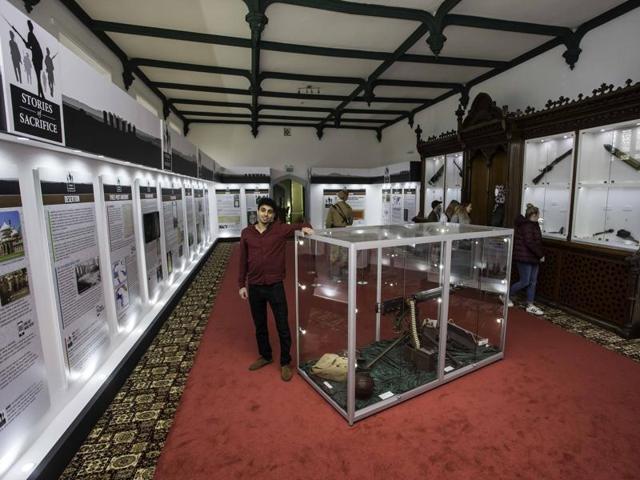
Islam Issa, lecturer in English literature, at the “Stories of Sacrifice” exhibition at The British Muslim Heritage Centre in Manchester. (Birmingham City University)
Previously unreported letters from the early 1900s by some of India’s Muslim soldiers who fought in World War 1 have been disclosed by a literature expert at Birmingham City University.
Islam Issa, lecturer in English literature, previously found that at least 885,000 Muslims were recruited by the Allies, having trawled through thousands of personal letters, historic archives, regimental diaries and census reports.
New personal letters discovered by Issa from more than 100 years ago highlight the experiences of Indian soldiers as they shared their impressions of England in comparison to their home country, a university statement said.
Commenting on the police in a letter dated October 1915, A Ali wrote: “The police indeed deserve praise. If one policeman raises his hand every single person in that direction, rich and poor alike, stands still where he is as long as his hand is raised.”
On his trip to a London department store, Ali said: “We visited a shop where 2000 men and women were working and everything can be bought. There is no need of asking as the price is written on everything.”
In the same letter, he shared his experience of the London Underground. “Then we went in the train that goes under the earth, it was for us a strange and wonderful experience – they call it the underground train,” he said.
Issa has been researching individual stories from the Great War for an exhibition commissioned by and held at the British Muslim Heritage Centre in Manchester, called “Stories of Sacrifice”.
In another 1915 letter by Abdul Said, more opinions on shopping and butchers are shared. “Every shop in this country is so arranged that one is delighted to look at them. Whether you buy much or little it is properly wrapped up, and if you tell the shop man to send it to your house. You have only to give him your address and he delivers it.
“The butcher’s shops in Hindustan are very dirty, but here they are so clean and tidy that there is absolutely no smell.”
During his research, Issa found that 1.5 million Indians, 280,000 Algerians, Moroccans and Tunisians and soldiers recruited from other parts of Africa fought for the Allies during World War 1.
The contribution of Muslims to the Allied forces during World War 1. (Islam Issa)
“When I decided to look at soldiers’ letters, I expected a very bleak outlook on the war. Of course, sometimes, that’s exactly what I found. But quite often, the letters were about individual experiences and very normal, human things,” said Issa.
“These anecdotes certainly helped shape my narrative for the ‘Stories of Sacrifice’ exhibition. While there’s an important narrative about the war as a whole, the personal and human narrative was probably more striking. Whatever your ideology or stance, you end up realising that these Muslim soldiers were individual humans and as a result, they were making sacrifices at that individual, human level.”
Complete with a virtual library, lesson plans and a toolkit for schools, the British Muslim Heritage Centre’s exhibition is the first long-term event of its kind, devoted solely to exemplifying the Muslim community’s contribution and sacrifices during World War 1, the statement added.
The exhibition was part of Sadiq Khan’s first visit outside London as mayor, and was also recently visited by the head of the British Army, Gen Sir Nick Carter.
source: http://www.hindustantimes.com / Hindustan Times / Home> epaper> World / by Prasun Sonwalkar, Hindustan Times / November 12th, 2016
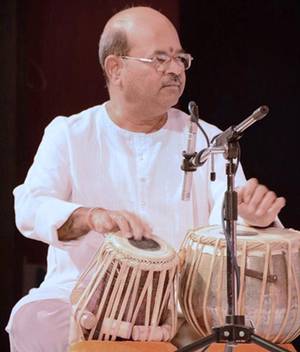
Tabla player Pandit Ravindra Yavagal has been chosen for the first ever Sitar Nawaz Ustad Balekhan Memorial Accompanist Award, instituted by Sitar Nawaz Ustad Balekhan Memorial Foundation Trust, Bengaluru.
The foundation has instituted the award in a bid to accord accord recognition to accompanying artistes, who always remain in the background.
In a release issued on behalf of the trust, chairman Ustad Hafiz Balekhan has said: “Team spirit and regard for the main artiste is of utmost importance during accompaniment. A tabla player can be termed as an able accompanist only if he or she is capable of anticipating the effect that the main artiste wishes to create and accompanies in a manner that enhances the intended effect. Pt. Yavagal is a perfect example of an able accompanying table artiste”.
The award will be conferred on Pt. Yavagal during the ninth death anniversary of Ustad Balekhan on Sunday at ‘Srijana’, Dr Annaji Rao, Sirur auditorium on the campus of Karnatak College in Dharwad at 6.15 p.m.
The former MLA Chandrakanth Bellad will confer the award.
A native of Hubballi, Pt. Yavagal had his initial training under his father Ramachandra Yavagal and subsequently under Veeranna Kamkar and Pt. Sheshagiri Hangal.
He also studied under Pandit Lalji Gokhale, guru of Pandit Hangal and student of Ustad Ahmed Jan Thirakwa.
Pt. Yavagal has also accompanied many master musicians globally. He is a grade one staff tabla artiste of All India Radio, Bengaluru.
A Hindustani classical jugalbandhi by Kolkata artistes Pandit Debashish Bhattacharya (slide guitar) and Pandit Sugato Nag (Sitar) will follow the award ceremony. Pt. Yavagal will accompany them on the tabla.
source: http://www.thehindu.com / The Hindu / Home> News> States> Karnataka / by Special Correspondent / Dharwad – November 27th, 2016
Director of Glendale Academy, Anjum Babukhan, said there was a severe shortage of good teachers and pointed out that while in the real world, life could get difficult and stressful for aspiring teachers, it would, in the end, be a most intrinsically rewarding profession.
Teachers, who are in a profession that creates a lasting impact in shaping future citizens and one that empowers them to make a difference at home and school, should maintain work-life balance. Teachers need to imbibe intelligence, emotional and social quotients, she said.
She was addressing the gathering at the third convocation of the Integrated Pre-School Teachers’ Training Academy (IPTTA) here on Saturday, when 36 teachers passed out.
Others who were present and also spoke included former principal of Meridian School, Pratima Sinha and academic coordinator of Eurokids, Sultana Shahin Moidu, an expert in the field of early childhood education.
Toppers Afsha and Padmaja were felicitated and a digital video disc of the training workshop was released by Ms. Sultana. IPPTA President V. Ravi said their mission was to develop teachers who were passionate, had active and creative minds, and with the courage to act on their beliefs.
“We wish to create a generation of pre-school teachers, who would guide the nation’s future,” he said.
source: http://www.thehindu.com / The Hindu / Home> News> Cities> Hyderabad / by Special Correspondent / Hyderabad – November 20th, 2016