APs Kashmir Lenseman Bags Prestigious Award

JAMMU  & KASHMIR  :

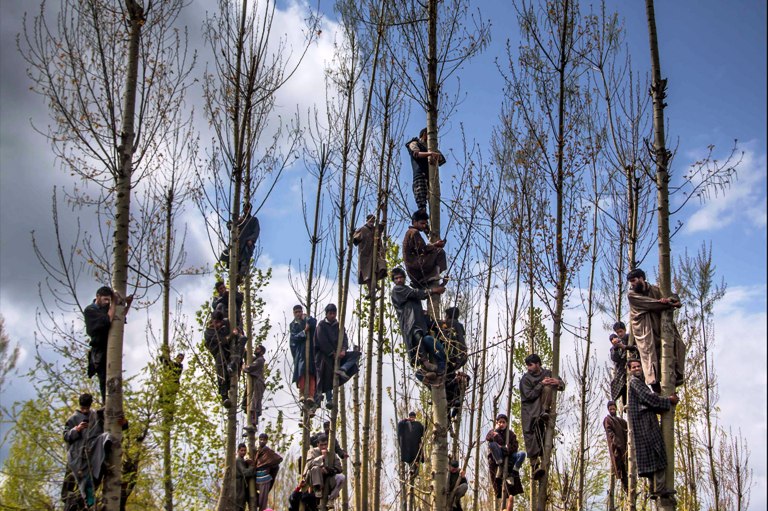
Dar Yasin’s April 7, 2016 photograph of a militan’s funeral bagged it second position in Atlanta Photojournalism Seminar

KL NEWS NETWORK

Srinagar :

Photojournalist Dar Yasin, working for American news agency, Associated Press (AP), has bagged the prestigious Atlanta Photojournalism Seminar award.

Dar Yasin (AP)
Dar Yasin (AP)

His photograph was adjudged as the second best in the general news category.

The click that bagged the award is a photograph showing Kashmiri Muslims climbed on trees to watch the funeral procession of Waseem Malla, a suspected militant of Hizb ul Mujahideen, in Pehlipora. Clicked on Thursday, April 7, 2016 photo, the village where the funeral took place is more than 65 kms south of Srinagar.

Dar is a decorated photo-journalist whose clicks earlier have also brought him many laurels. He has been covering Kashmir for the AP for more than a decade now.

The Atlanta Photojournalism Seminar, America’s longest continuously operating photojournalism conference, started in 1973.  Its 2016 edition took place on November 11-12, 2016 at the Hilton Atlanta Northeast.

source: http://www.kashmirlife.net / Kashmir Life / Home> Latest News /  KL News Network / Sunday – November 13th, 2016

Role of Muslim Women In Freedom Movement

(Muslim Womens participation in the upraising against English Colonialization efforts in India before 1947)

DR. DARAKHSHAN ANJUM opens a window to the invaluable contribution the Muslim ladies made to the freedom struggle.We always talk about the role of men in the war of independence, but have we ever thought about the great role played and responsibility shouldered by women? Were Muslim women, who used to stay within the four walls and behind the veils and observe strict purdah, so powerful and energetic to help liberate the country?

When Shah Abdul Aziz Dehlvi proclaimed jihad against the British and in response to this call ulema and other people from all over the country joined him and obstructed the smooth sailing of the British, ladies were also not far behind. The teaching of Jihad took a concrete shape in 1857 and continued till India achieved freedom in 1947. Not only Muslim men but Muslim women also stood up against the British. The list of Muslim women who participated in the freedom struggle is impressive and not restricted to one type of activity. They encouraged their husbands, fathers and sons at home and themselves took all the household responsibilities on their shoulders in the absence of their men folk. They came out of their four walls and travelled from place to place to encourage people to strive for independence. They joined non-violent as well as violent movement against the foreign rule. These women were not only from educated and enlightened families but also from illiterate and rural areas.


Begum Hazrat Mahal, the wife of Nawab Wajid Ali Shah, took charge of the affairs of the state, after her husband was exiled to Calcutta. She worked in close association with other leaders of India’s first war of independence. She besieged Sir Henry Lawrence and other officials in the residency. She shot dead Sir Henry Lawrence. Although General Havelock came to help the English troops, yet he failed in the mission. After some time Sir Campbell became successful in recapturing Lucknow. The Begum was forced to retreat. She turned down all offers of amnesty and was prepared to escape rather than being caught by the British troops.


Bi Amma (Abadi Begum), the mother of Shoukat Ali and Mohammad Ali also played a vital role in the independence struggle. When, in December 1921, Mohammad Ali and Shaukat Ali were arrested by British troops, she received this news very patiently. And when the rumour spread that Mohammad Ali would be released from jail after amnesty, she said with utmost confidence in her tone, “Mohammad Ali is a son of Islam and he can’t even think about begging forgiveness from the British. If he does so then my old hands have enough strength to strangle him.”

Ghandhiji said that she was an old lady but had the energy of a youth. She was restless to see the country free from the foreign yoke. She herself used to spin cloth for her own use and convinced people to use Khadi. She tried hard for Hindu-Muslim unity and that to her was almost a part of Iman.


Mrs. Zubaida Daoodi, wife of Maulana Shafi Daoodi fought gallantly against the British and joined non-cooperation movement. She collected the clothes of her husband, relatives and others and burnt them at the Congress office. She became the leader of the people who collected foreign clothes from door to door. She participated in all public gatherings and organised meetings to inspire women to participate in freedom struggle. When the students left government schools and colleges to support non-cooperation movement, Maulana Shafi Daoodi started a school for such students and Begum Shafi Daoodi looked after food and other facilities provided for these students.


Azizan, another freedom fighter, was born in Lucknow in 1832. It is said that she lived with Umrav Jan in Sarangi Mahal. On June 4, 1857 when Nana Sahib called Hindus and Muslims to get united for the cause of freedom and join him, she left home and joined the freedom movement. She organised a battalion of women. She was skilled in the art of war and taught other women how to use arms. She collected information about the British and passed it on to the freedom fighters. She was caught and brought in front of General Havelock who offered to forgive her if she confessed all her faults but she rejected the proposal and preferred martyrdom.


Amjadi Begum (wife of Maulana Mohammad Ali Johar) belonged to a renowned family of Rampur. She followed Maulana Johar’s philosophical and political principles. She accompanied the Maulana in every journey, meeting and other activities. She collected money for Satyagarah and Khilafat fund and bore all expenses of Mahatma Gandhi’s travel to introduce him to public.


Sadat Bano Kichlew was the wife of Dr. Saifuddin Kichlew. She was well versed in Urdu and Persian and compiled many patriotic poems and articles to encourage people. That was the period when it was rather difficult for the Muslim woman to express her thoughts and views in writing. When Dr. Kichlew was arrested in 1920, she said, “I feel proud that he got prison for his service to nation. To give one’s life for this cause is as if one has gained thousand lives.” She also participated in civil disobedience movement and served ‘Swaraj Ashram’ founded by Dr. Kichlew as its chairperson.


Zulekha Begum (wife of Maulana Abul Kalam Azad) was a very courageous woman. She faced financial problems many times because of the Maulana’s participation in the freedom struggle but did not disturb him at all.

When, in 1942, the Maulana got one year’s imprisonment, she wrote to Gandhiji, “My husband has got one year imprisonment. That is less than our expectation because if it is the result of his devotion to the nation then he did not get justice; it is less for his eligibility. From today, I will look after the whole work of Bengal Khilafat Committee.” What a courageous person! Although she was not quite healthy at that time yet she not only bore the news of her husband’s imprisonment with utmost patience but decided to join the freedom movement actively.


Nishat un Nisa Begum (Begum Hasrat Mohani) was also an active participant of this movement. She came into the political and public arena after April 13, 1916, when Maulana Hasrat Mohani was taken into custody for the second time. She was public relations officer of her husband and looked after all the cases of the Maulana in the British courts. She was not only a devoted wife but also a patriotic woman. She took part in all meetings with Maulana Mohani. Although she was financially weak but not ready to accept monetary help from others. She managed all expenses of household and travelling with the income incurred from the sale of books and magazines. She represented Congress Subject Committee in 1921 with Begum Khursheed Khwaja (wife of Abdul Hamid Khwaja). They joined Swadeshi movement and helped Maulana Mohani to establish Khilafat Store in Aligarh. Begum Khursheed started editing a monthly magazine Hind when Khwaja Hamid was sent to jail. She also took charge of Jamia Millia Islamia in the absence of Khwaja. She established Hamidiya Girls Secondary School in Allahabad in 1930 (presently this institution is a degree college).


Razia Khatoon (daughter of Nasiruddin) was the first Muslim lady of Bengal who stood up against the British. She was arrested and sent to Kalapani where she took her last breath. Akbari Begum was the mother of Barrister Asif Ali. She inspired Muslim women through her speeches to join the non-cooperation movement. In May 1920 she delivered a historic speech in which she said, “We should hold our religion firm and socially boycott the people who oppose it.”


The history of Freedom Movement would be incomplete without mentioning the contribution of Asghari Begum (mother of Qazi Abdur-Rahim), of Thana Bhawan, Muzaffarnagar, who fought the British valiantly and was burnt alive when defeated. Similarly, Habiba and Rahimi (who also belonged to district Muzaffarnagar) obstructed the advance of English forces, were caught and hanged. Zehida Khatoon Sherwani (daughter of Muzzamil Khan Sherwani) wrote patriotic poems to encourage freedom fighters. Khadija Begum joined the non-cooperation movement and went from home to home to inspire women to wear Khadi, Muneera Begum (wife of Maulana Mazharul Haq), Amina Qureshi, Fatima Qureshi, Amina Tyabji (wife of Abbas Tyabji), Rehana Tyabji (daughter of Abbas Tyabji), Hamida Tyabji (granddaughter of Shamsuddin Taybji), Begum Sakina Luqmani (daughter of Badruddin Taybji), Fatima Taib Ali, Shafaat un-Nisa Bibi (wife of Maulana Habibur Rehman of Ludhiana), Safia Saad, Begum Kulsoom Siyani, Asmat Ara Khatoon, Sughra Khatoon, Bibi Amatul Islam, Fatima Ismail, Sultana Hayat Ansari, Hazra Begum, Zuhra Ansari also participated in the freedom struggle and made rich contribution in various ways. Some of them were imprisoned, fined and suffered for freedom movement and their contribution cannot be denied. It is estimated that about 225 Muslim women committed their lives to the Revolt but their role in the freedom movement has not been properly acknowledged by the historians. The great contribution of these ladies should be brought to the knowledge of the present generation and this would be the best way to pay homage to them.

source: https://www.facebook.com/notes/wake-up-women/role-of-muslim-women-in-freedom-movement/164987506883565/
Bi – Amma Hostel

Rampur / UTTAR PRADESH / NEW DELHI  :

The name Bi Amma is given to new hostel on the name of Abadi Bano Begum who was born in 1850 in Rampur, (U.P.) in 1857.

Abadi Bano Begum , popularly known as Bi Amma was an ardent nationalist whose family members had suffered the trauma of 1857 revolt and she had a strong desire to see the country free from British rule.

Despite having no formal education, Bi Amma was an exceptionally devout, courageous and intelligent lady.

Widowed at young age, she shouldered her responsibility of raising her sons with utmost sincerity and dignity. She sold off her property and jewelry to educate her sons at Aligarh and Oxford.

Her sons Shaukat Ali and Muhammad Ali popularly known as Ali brothers joined Khilafat and Non-Cooperation Movement. After the arrest of nationalist leaders,  including Ali brothers, Bi Amma threw off her veil to play frontal part during the freedom struggle.

She collected funds, organized meetings and asked the Indian women to use khadi and boycott foreign goods. She addressed huge gathering and inspired women to play to greater participatory role in the freedom movement. She was a protagonist of Hindu-Muslim unity and campaigned hard for communal harmony and unity, which were imperative to win freedom.

She passed away on 13th November 1924.

The Foundation stone of the Bi Amma Girls hostel was laid on 18th February 2010 by late Mrs. Uma Khanna wife of Shri Tejender Khanna Honourable’ Lieutenant General of India. It took almost two years to complete.

It was inaugurated on 28 September 2012 by a woman of great eminence and protagonist of women’s education lok sabha speaker Mira Kumar on 28th September 2012. In her inaugural addresse and interaction with the hostel residents she has emphasized on women education.

source: http://www.jmi.ac.in / Jamia Millia Islamia Hostel Manual 2013-14 / Girls’ Residence, New Delhi


Kuchipudi dancer Haleem hopes to make it big in films

Ongole, ANDHRA PRADESH / Hyderabad , TELANGANA :

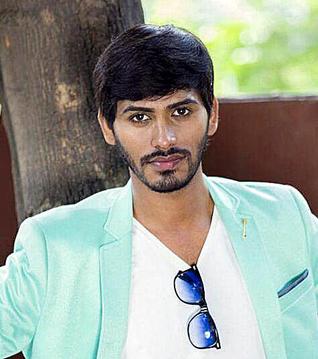
Haleem Khan, Kuchipudi dancer-turned actor .

More than 800 dance performances earned him a place in tinsel world

Haleem Khan hailing from a traditional Muslim family developed fascination for Kuchipudi classical dance form with Krishna-oriented Vaishnavite tradition.

Changing his stage name to Hari, he learnt the Hindu traditional peforming art under Natyacharya Kaja Venkata Subrahmanyam without the knowledge of his family and went on to carve a niche for himself in the traditional dance ballet by specialising in the Rupanurupam tradition (woman impersonation) by playing the role of Satya Bhama, consort of Lord Krishna. Brahmin women from Kuchipudi village in the past had shied away from giving stage performances.

“This helped me foray into the Telugu tinsel world with Usha Kiron Movies spotting my talents and giving me a gay role of Shailu in the 2011 romantic film Nuvvila ,” recalls the dancer-turned-actor in a conversation with The Hinduhere.

New film

Haleem Khan, who has given over 800 Kuchipudi dance performances within the country and abroad, was here to promote his new film Ame Atadaite set for release on November 12.

One among the thespians who can don the female role with ease, Haleem, with screen name Haneesh, performs the lead role opposite Kannada actress Chira Shree in the film. Chevalier awardee Kamal Haasan is my inspiration as also Bhanupriya, who has made a mark as a dancer. He was floored by Kamal Haasan’s performance in Bhamane Sathya Bhamane .

Chitram Bhalare Vichitram and Madam were also his reference points, he adds showering praises on Naresh and Rajendra Prasad who sent the audience to peals of laughter by impersonating as women. “Presently, I am acting in a Telugu film as villan,” he adds.

Les Johnson from Germany has written a book on him, capturing the trials and tribulations he underwent before maturing into a Kuchipudi dancer and then an actor. “Efforts are on to make it into a movie,” he adds.

The actor-cum-dancer has come out with an instructional DVD to kindle interest among the members of GenX in Kuchipudi.

source: http://www.thehindu.com / The Hindu / Home> National> Andhra Pradesh / S. Murali / Ongole – November 11th, 2016

Tree Facts : Floral Splendour

Mysuru, KARNATAKA :

treefactsbf12nov2016

Ornamental garden is the dream of plant-loving urban dwellers. Plants, foliage and flowering of different hues in various combination can express the beauty of nature around the living area. It is not the size that matters as one can landscape even a small home ground in the same way as done for larger estates or public parks. When done in the best form it is the pride of the house.

An ‘ornamental garden’ developed by a woman falls into this category. The owner, gardener and executor is none other than the winner of the first prize in the Annual Dasara Flower Show under ornamental garden category: Ms. Hashmath Fathima. It is an artistic outdoor garden developed around her little dwelling place in a plot of land in Kalyanagiri, all on her own. The garden has all the ingredients of a modern ornamental garden with display of choicest flowering and foliage plants in the form of annuals and perennials (herbs, shrubs, climbers, trees, ornamental grasses, bulbs etc.) embellished with various design elements.

The special feature is most part of the garden is developed using containers of various size, shape and hues. The entrance gate opens up into a path leading to the garage, beautifully paved with lawn grass in the crevices which makes up for the absence of a lawn (due to lack of space). On entry into the garden you can notice the potted plants stacked up in multiple rows in various colour combination of foliage and flowers & height along side the wooden wall. The half wall of the verandah has been decked up with colourful overhanging Lantanas, besides the hanging pots at the entrance of the house.

For embellishment valuable objects of artefacts in the form of figurines of various objects, birds nests etc., are placed at vantage points. The northern wall of the house is fully green, a breathing wall completely covered with creeping fig (Ficus repens). The perennial climbers (Allamanda, Quisqualis, Bougainvillea etc.) with their foothold on the northern edge ramble on the wooden barricade. The garlic vine (Mansoa alliacea) overarching the garage makes spectacular display with purple coloured blooms and attracts the onlookers. A small pond is also designed in the backyard with water lily (Nymphae sps) in it. In addition to being pleasant to look at, this ornamental garden is also enjoyable to use with a recreation area to sit and enjoy reading etc., in the form of a bench decorated with an arch covered with a climber in the front yard and an aviary with plenty of beautiful birds in the backyard.

Another eye-catching addition is the bottle garden (hanging) created using soft drink bottles planted with variegated Alternantheras. This impressed me a lot. In general the display of plants is such that as soon as one enters one can experience the burst of flowers of all hues amidst the colourful foliage. Above all, with innumerable flowering and foliage plants (Acalypha, Althea rosea, Asparagus, Aglonema, Alternanthera, Anthuriums, Asters, Coleus, Catharanthus, Chrysanthemums, Cocks comb, Begonias, Cosmos, Calendulas, Chlorophytum, Duranta, Euphorbia milii, Gamphrena, Gazania, Gerberas, Day lily, Ferns, Marigolds, Pentas, Petunias, Zinnias etc., etc.) this little paradise looked like a “mini flower show.”

Ms. Hashmath is into gardening for more than a decade and has won several first prizes in the past too. I understand that she herself carries out most of her gardening work and uses only organic manure. Most of her earnings are spent on maintaining the garden. A dress designer by profession, she has put her heart and soul in designing the beautiful and attractive garden as well! Furthermore, she has shown the ability and imagination of the gardener in her in the best form besides the woman power.

Text & photographs by Dr. Mahadeswara Swamy, Scientist, Mob: 97429-91057, e-mail: swamy_clri@hotmail.com

source: http://www.starofmysore.com / Star of Mysore / Home> Feature Articles / November 06th, 2016

Eight-year-old Kashmiri girl wins gold in kickboxing

Bandipura District, JAMMU & KASHMIR :

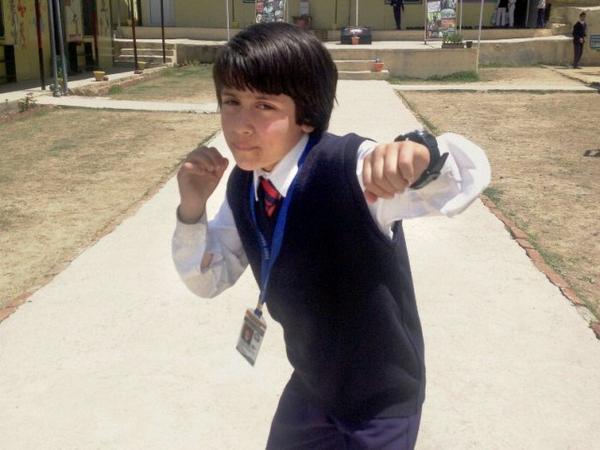
Tajamul Islam. / PTI


A resident of Tarkpora village in Bandipora district, Islam is a student of the Army Goodwill School.

Eight-year-old Kashmiri girl on Friday created history by winning the gold medal for India in the world Kick Boxing Championship of under-eight players in Italy’s Andria.

“In five days, Tajamul Islam won six games,” said her coach Master Fasil Ali.

She defeated her rival from the U.S. to become the world champion in the kick boxing championship. She is first such player to achieve the feat from the volatile Kashmir Valley.

A Class 2 student, Islam represented India in Italy where the World Kick Boxing Championship, in which 90 countries participated, was underway.

“She (Islam) has created history by winning a gold medal in the game at the age of eight,” said PDP leader Waheed Parra, who is also J&K State Sports Council secretary.

In 2015, Islam won the national recognition after bagging the gold medal in sub-junior category National Kickboxing Championship in New Delhi.

A resident of Tarkpora village in Bandipora district, 65 km from Srinagar, Islam is a student of the Army Goodwill School.

Ms. Islam’s brother and two sisters also practice kickboxing.

Appreciating the talent, State Education Minister Nayeem Akhtar said, “It’s a proud moment”.

source: http://www.thehindu.com / The Hindu / Home> Sport> Other Sports / by Peerzada Ashiq / Srinagar – November 11th, 2016

Meet England’s newest recruit Haseeb Hameed, or the Bolton Boycott

Lancashire, UNITED KINGDOM :

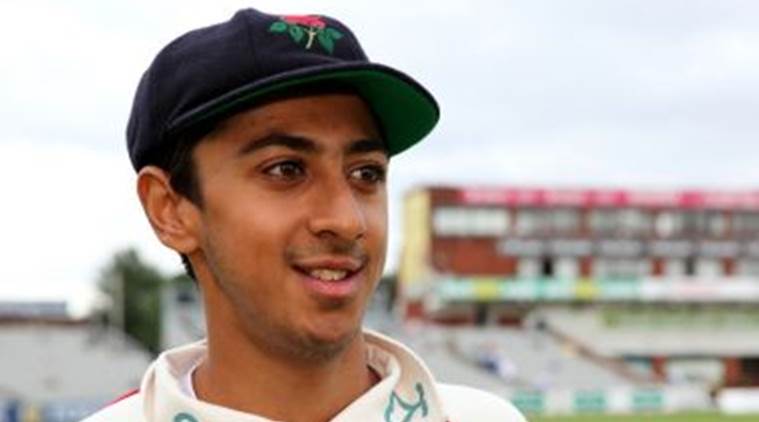
Haseeb Hameed, cricket of Indian origin, made his debut for England against India at the age of 19.

Touted as the most promising batsman teenager around, Haseeb Hameed made his U-19 debut at the age of 17.

Ismail Hameed had an unusual hero, while growing up as a cricket-obsessed youngster in Gujarat in the mid 70s. It was the usual Kapil Dev or Sunil Gavaskar. Or Kris Srikkanth or Dilip Vengsarkar. It was that stodgy English technician, Geoffrey Boycott, who by then was treading the sunset of his career.

In the late 80s, he shifted to Bolton for a better livelihood. He might have been busy yarning a better livelihood in a textile factory, though he still squeezed in time to represent semi-professional leagues in his locality. And when he expanded his household, he dusted up that old fixation for Boycott.

He bought old video tapes of Boycott and religiously showed them to his three sons, Safwaan, Numan and Haseeb. He would then make them “bat like Boycott” for hours on end in the neighbouring park. Soon, Ismail gave up his job in the factory and became a driving instructor so that he could spend more time drilling the technique of Boycott into his sons. The third son, though, showed more inclination to bowling and he would join his brothers and father in the park after school.

To his credit, Ismail straightaway made them bat and bowl with the leather ball. So the boys shed the fear of the leather ball at a young age. The older boys were in the Lancashire U-15 team as pure batsmen. But Haseeb’s first love was always leg-spin bowling, and it was as a leggie who could bat that he was picked for the Lancashire U-15 team, when he was just eight.

Maybe Haseeb was such a naturally talented batsman that his batting potential couldn’t be obscured for long. During a club game, he made an unbeaten 19 for his club Tong CC, which wowed the coach and senior players in the side. In a couple of seasons, he showed such precocious potential that he was opening the innings for his club and Lanchasire. His narrative was just beginning to unfold.

Hours of watching Boycott’s footages and twice as many hours of technical finetuning under his father’s gaze—his father is still his coach and mentor—helped him evolve into a fine batsman with a composure and belief that belied his age. The conditions back home too helped develop a compact technique. “The nature of the pitches, typical league cricket up north where it rains a lot; it’s slow and low, helped me. You’ve got to be careful driving on the up and the like. I had to wait for the ball and not leave my bubble, be patient. It’s always been that way for me,” he told The Guardian in an interview early this year.

Touted as the most promising batsman teenager around, he made his U-19 debut at the age of 17, and soon he was touring Australia for an U-19 Test series. In the first innings in Perth, he made a duck, but in the second he epitomised all the virtues his father’s idol had embodied in his career. Trailing by 300-odd runs, he engineered a resillient reardguard operation, soaking up 256 balls for an unbeaten, eventually match-saving 91.The effort earned him the moniker “Lancashire Wall”. That was only a preface.

Soon, he was blooded into the Lancashire first team. Last August, he was handed out his debut, against Glamorgan. He composed 28 off 119 balls in difficult conditions. However, for all his crease-occupation, a century eluded him, until his 11th match, against Warwickshire when he scored a crabby 103 off 295 balls, spending six-and-a-half hours at the crease against a rounded attack comprising former England bowler Samit Patel and Boyd Rankin.

More centuries flowed from his bat. He then became the first Lancashire batsman to score back-to-back hundreds against Yorkshire, showing again his fondness for occupying the crease. He batted for five hours for 114 in the first innings before reeling off, to show his other side of batsmanship, with a brisk 100 off 124 balls, against a bowling firm that featured Tim Bresnan, Ryan Sidebottom and Adil Rashid.

The knock fetched him instant applause from present and former players was a match-saving 122, occupying the crease for more than six hours, in the second dig against Nottinghamshire, whose bowling unit featured Stuart Broad and Imran Tahir. Thus in 31 innings, he racked up 1411 runs at an average of 50.39. And per innings, he consumes an average of 117 balls.

Among those wowed by his batting is former English skipper and opener Mike Atherton, who has dubbed his batting “Atherton-like”. Former Lancashire colleague and South Africa batsman Ashwell Prince says “he’s born to bat”. In the county circuit, he is called “Bolton Blocker” and “Bolton Boycott”.

If he makes his England debut against Bangladesh or later against India, he will be the youngest English debutant since Ben Hollioke and only the second teenager to play for England in the last 67 years.

While his father wants his son to keep producing Boycott-like knocks, Haseeb has bigger ambitions. “I want to emulate guys Kohli, Root, Williamson, players who play very organised cricket across the three formats extremely well. If you’ve got the basics and you’re strong in your basics, then you can develop your game very quickly. You just need to watch Kohli, the way he manipulates gaps so well and times the ball. I’m confident that down the line I’ll be able to do that as well.”

source:  http://www.indianexpress.com / Indian Express / Home> Express Sports / by Sandeep G / November 09th, 2016

Kerala History Congress set to begin tomorrow

Mallapuram, KERALA :

VC to open meet on Calicut University campus

The fourth International Kerala History Congress will begin at Calicut University on Friday. Calicut University Vice Chancellor K. Mohammed Basheer will inaugurate the meet. Jean-Baptiste Prashant More, a Tamil-born French historian, will deliver the keynote address.

M.G.S. Narayanan, chairman of the Kerala History Conference, will preside over the inaugural function. Prof. Narayanan, M.R. Raghava Varier, and Kesavan Veluthat will make presentations under the ‘doyens of Kerala historiography lecture’ series.

Exhibition of archives

An exhibition of archives and historical documents began on Wednesday as part of the History Congress. Syndicate member K. Fatimat Zuhra inaugurated the exhibition. Syndicate member and head of the Department of History P. Sivadasan presided. The exhibition will be free for the public until Sunday.

The exhibition is arranged jointly by the State Archives Department, the Calicut University Department of History, and Zamorin’s Guruvayurappan College, Kozhikode. The exhibition has a large number of historical documents from different periods, including stone age and middle ages.

source: http://www.thehindu.com / The Hindu / Home> National> Kerala / by Staff Reporter / Malappuram – November 10th, 2016

“ Throw open Mosques for Social and Educational causes ”

Mysuru, KARNATAKA :

Dr. Mohammed Haziq Nadvi, Director of Darul Umoor and Research Centre, Srirangapatna, offers to donate blood to needy

Sitting from left: Abdul Khader Sait, President, MESCO & Managing Director, AANCO Industries; Khaleel Ur Rahman Waseem, Jamath-e-Islami Hind; Dr. B. Sheik Ali, former Vice- Chancellor, Mangalore and Goa Universities; Dr. Mohammed Haziq Nadvi, Director of Darul Umoor and Research Centre, Srirangapatna and Prof. Noor Ahmed Khan of Universal Guidance Centre for Education, seen during the Lecture Series at MESCO Education Complex in N.R.Mohalla on Friday last.

Mysuru :

(Afsar Pasha)- Dr. Mohammed Haziq Nadvi, Director of Darul Umoor and Research Centre, Srirangapatna, has called upon managements of Mosques to throw open their doors for social and educational causes including starting of blood banks and study centres.

Speaking at the inaugural function of the Lecture Series on “Islamic history, thoughts and its impact on the world” organised by Universal Guidance Centre for Education and MESCO, Mysuru, on Friday last at MESCO Education Complex in Subashnagar, N.R.Mohalla, Dr. Nadvi said Mosques, which are generally restricted to Muslims offering prayers, can endear themselves to the general public in a pluralistic society by taking up social and educational causes.

He even declared his blood group and offered to be available for donating blood to the needy.

Similarly, he said Mosques should promote education by offering free coaching classes to the needy students without religious discrimination. These efforts will go a long way in promoting amity among different communities in a climate of hostility.

Dr. Nadvi regretted that Islamic history had been distorted and Islamic culture had been misinterpreted, leading to a wrong impression of Islam in the eyes of the world.

With passage of time, Muslims have moved away from the basic Islamic doctrines that had won the world’s adulation centuries ago. There is a dire need for Muslims to correct their course by pursuing the way of life as shown by Islam and undo the harm that time has inflicted upon it.

He emphasised the need for fresh efforts in the direction like the Lecture Series so that the coming generations abandon the false legacy and pursue Islam in the true sense.

Noted historian and former Vice-Chancellor of Goa and Mangalore Universities Prof. B. Sheikh Ali focussed on the Almighty’s creations and the path upon which the humanity should follow.

Secretary of the Universal Guidance Centre for Education Prof. Noor Ahmed Khan said the Centre took the initiative to hold such Lecture Series as it felt necessary to guide the youth and connect them to their roots so that they can take the right course.

Former Vice-Chancellor of Yenepoya University Prof. Syed Akheel Ahmed, who was also present on the occasion, welcomed the initiative to hold the lectures.

The Universal Guidance Centre for Education will hold lectures on “Islamic history, thoughts and its impact” by Dr. Nadvi on the first and third Friday of every month at the Lecture Hall at MESCO Mosque.

source: http://www.starofmysore.com / Star of Mysore / Home> General News / November 04th, 2016

Cyrus Mistry replaced by Ishaat Hussain as TCS chairman: Tata Sons

 NEW DELHI / Mumbai, MAHARASHTRA  :

ishaathussain02mpos10nov2016

In a statement, the software giant said a letter from Tata Sons named Hussain as the new chair while the company looks for another replacement.

The Tata Sons today named Ishaat Hussain as the chairman of the Tata Consultancy Services (TCS) in place of Cyrus Mistry with immediate effect.

In a statement, the software giant said a letter from Tata Sons named Hussain as the new chair while the company looks for another replacement.

“The company (TCS) has received a letter dated November 9, 2016 from Tata Sons Ltd nominating Ishaat Hussain as the Chairman of the Board of Directors of the company in place of Cyrus P Mistry with immediate effect. In view of this, Mistry has ceased to be the Chairman of the Board of Directors of the Company and Hussain is the new Chairman of the company,” TCS said in a regulatory filing.

TCS said Hussain shall hold office as the Chairman of the company until a new Chairman is appointed in his place.

“Tata Sons has issued a special notice under Section 169 read with Section 115 of the Companies Act, 2013 and a requisition for convening an extraordinary general meeting of shareholders of the company under Section 100(2) of the Companies Act, 2013 to consider a resolution for the removal of Cyrus P Mistry as Director of the Company,” it added.

Last month, in a sensational coup, Mistry was sacked as Tata Sons chairman and replaced by Ratan N Tata as the interim chairman.

source: http://www.indiatoday.intoday.in / Indiatoday.in / Home> News> India / by Nivedita Dash / New Delhi – November 10th, 2016