Former president A.P.J. Abdul Kalam was laid to rest on Thursday here with full military honours in the presence of Prime Minister Narendra Modi and several other leaders.
The People’s President’s body, draped in the Indian tricolour was brought to the burial site at Pei Karumbu in a flower-bedecked gun carriage, escorted by columns of the three armed services.
A gun salute was accorded to the former supreme commander of the armed forces and a military band played the haunting Last Post.
Modi, who arrived here on Thursday morning, paid his last respects to the country’s youth icon and most popular president by laying a wreath.
Tamil Nadu Governor K. Rosaiah, union Ministers M. Venkaiah Naidu, Manohar Parrikar and Pon Radhakrishnan, Tamil Nadu ministers like O.Panneerselvam, Natham R. Viswanathan and others also paid their last respects to Kalam.
Kerala Governor P. Sathasivam, Kerala Chief Minister Oommen Chandy were also present, as was Andhra Pradesh Chief Minister N. Chandrababu Naidu.
Congress vice president Rahul Gandhi and other party leaders also paid their last respects to Kalam – also known as India’s Missile Man.
Earlier the mortal remains of Kalam were taken to the family mosque for prayers.
His family members also reached here.
“All our relatives have also arrived to attend the last rites,” A.P.J.M.K. Sheik Saleem, the former president’s brother’s grandson, told IANS.
The Tamil Nadu government declared a public holiday on Thursday under the Negotiable Instruments Act. Banks, insurance companies, schools and colleges are closed throughout the state.
The government has also ordered closure of liquor shops and bars throughout the state.
Around 30,000 jewellery shops would also remain closed, while petrol bunks stopped sales for an hour between 10-11 a.m. as a mark of respect for Kalam.
Movie-theatre owners too have decided to shut down for the day while fishermen have decided not to venture into the sea.
Political parties like the DMK and the AIADMK have cancelled their functions.
Interestingly, the decision of private sector organisations to voluntarily shut shows that Kalam was truly a People’s President.
Born in Rameswaram on October 15, 1931, Kalam, as a boy, hawked newspapers to supplement his family’s income. His father owned a boat and his mother constantly struggled to keep the family sufficiently fed and clothed.
His sister pawned jewellery with a moneylender so that the studious Kalam could carry Rs.600 when he left Rameswaram to join the Madras Institute of Technology.
source: http://www.newindianexpress.com / The New Indian Express / Home> States> Tamil Nadu / by IANS / July 30th, 2015
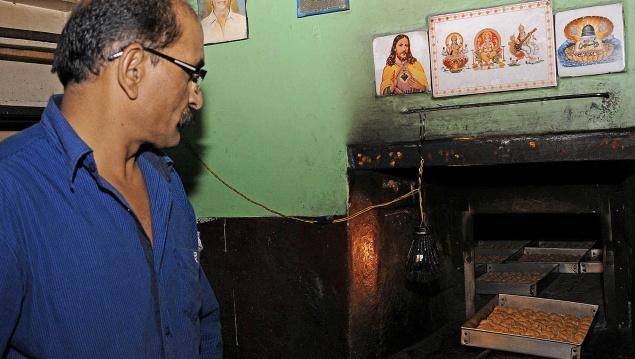
Wheat varkey being prepared in a bakery in Udhagamandalam.- Photo: M. Sathyamoorthy
Rajkumar starts work at 3 a.m. every day at his baking station, preparing and baking the “Ooty Varkey” for nearly six hours daily. Their family has been making varkey in Ooty for more than seven decades now and they have customers coming in from different parts of the State and also from Bangalore and Puducherry. They make about 100 kg of Varkey a day and have added more varieties to cater to the demands of the customers.
This is one of the popular products that tourists to the Nilgiris want to take home. There are nearly 150 bakers in Ooty who make Varkey and they plan to submit details soon to get the Geographical Indication certificate for “Ooty Varkey”. Some of them, such as Rajkumar, follow the recipe that the family has used for several years now.
K. Mohammed Farook, President of Ooty Bakery Owners Association, told The Hindu that there were many in the plains who sell the product as “Ooty Varkey”. Getting the certificate will benefit the bakers in Ooty. The bakers in the Nilgiris procure the raw materials locally.
The quality of water and the weather in the Nilgiris give a special taste to the Varkey, he says. “We have collected the details and will submit the final copy to the officials soon for the GI certificate,” he said.
source: http://www.thehindu.com / The Hindu / Home> News> Cities> Coimbatore / by M. Soundariya Preetha / Coimbatore – July 27th, 2015
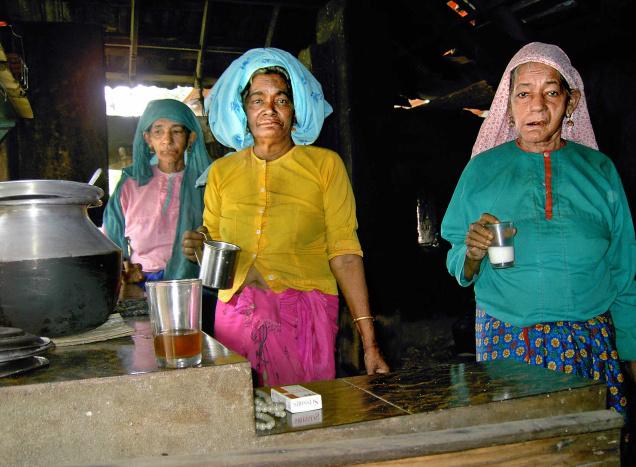
Rabia (middle) at her Makani at Panangangara along with her sisters.
The rustic hands which served thousands of people with tasty ethnic tea at a village makani at Panangangara near Perinthalmanna have stopped moving. Rabia, 70, will not serve any moretea either for the local people or the passersby.
Rabia passed away on Saturday, leaving behind a legacy of serving people with tea for over half a century. In fact, she served tea for generations.
The tea shop she managed on the veranda of her house on the Palakkad-Kozhikode highway at Panangangara had long become a talk of the village largely because of the unique taste of the tea she mixedand her simple behaviour. She was helped by her sisters Fatimakutty and Sulaikha.
Many a traveller, including foreigners, has had the taste of Rabia’s tea. Started 60 years ago by her late father T.K. Saithali, Rabia and her sisters insisted on carrying forward the Makani tradition that existed in Malabar. Although Makani does not mean anything more than a shop, the very mention of it in the villages of Malappuram brings memories of ethnic culture, language and food.
source: http://www.thehindu.com / The Hindu / Home> National> Kerala / by Abdul Latheef Naha / Malappuram – July 26th, 2015
The Rampur Raza Library is renowned globally for its collection of ancient manuscripts from South Asia. The library has now organised an exhibition of Qurans, inviting scholars to view ancient manuscripts of the holy Quran in the month of Ramzan.
Some of the manuscripts on display are among the oldest pieces of Arabic calligraphy. A 7th century Quran written on parchment in the early Kufic script, attributed to Hazrat Ali (d. AD 661) is on display. Viewers are lining up to see this rare manuscript.
An 8th century manuscript of the Quran is attributed to Imam Jafar Sadiq, whose unique penmanship is widely appreciated.
A 9th century script is attributed to Imam Abul Hasan Musa, who served as prime minister to three caliphs of Baghdad. He died on July 20, 941 AD. His Quran is in the early Naskh style, popular in the 10th century. This form of calligraphy continues to be in vogue, with some changes.
Maulana Mohammad Irshad Nadvi, who is coordinating the exhibition, said, “The library also has a copy of a Quran written by master calligrapher of the 13th century Baghdad, Yaqut-al Musta Simi. It is decorated in gold and precious lapis lazuli.”
Nadvi said another masterpiece of Arabic manuscript by this calligrapher, titled Diwan-al-Hadira and dating to 1221 AD is part of the royal library of Sultan Ibrahim Adil Shah of Bijapur.
The exhibition also displays calligraphy in Arabic that created its own pseudo-geography, with exquisite and richly illustrated figures of human beings, animals and birds. Some of this came from the pen of 13th century calligrapher Zakaria bin Mahmud al-Qazvini.
Among the assets of the library on display is the Arabic manuscript Sharhal-Kafia of Razi. It bears marginal notes by Nawab Sadullah Khan, prime minister of Mughal emperor Shah Jahan. Among the many seals on this manuscript is one of emperor Aurangzeb.
Jacob Thorek Jensen, who is visiting the exhibition from Denmark and serves as advisor to a Danish culture agency, said, “This is a brilliant show of the elaborate calligraphy of writers of the Quran.”
Library spokesman Himanshu Singh said visitors to the library and the exhibition come from different faiths.
source: http://www.timesofindia.indiatimes.com / The Times of India / Home> City> Bareilly / by Nazar Abbas, TNN / July 16th, 2015
Khwaja Moinuddin Chisti Urdu, Arabi-Farsi University in Lucknow has approved the recognition to degrees offered by Manzar-E-Islam Madrassa of Dargah Ala Hazrat. With this affiliation, children studying at the Dargah Ala Hazrat madrassa in Bareilly can go on to study at a university.
As madrassa marksheets are not accepted as valid at universities, students of the madrassa seldom make the transition to modern universities. Officials of Dargah Ala Hazrat are seeking similar affiliation from Jamia Millia Islamia University, Mahatma Jyotiba Phule (MJP) Rohilkhand University and Aligarh Muslim University (AMU). This madrassa is already affiliated to Jamia Hamdard University, Delhi.
“Khwaja Moinuddin Chisti Urdu, Arabi-Farsi University has now given affiliation to our madrassa. As the focus of the madrassa is more on religious teachings, the students do not get proper modern education, including lessons on English, Mathematics, Science, Computer Applications and other subjects,” said Mufti Mohammed Salim Noori of Manzar-E-Islam madrassa.
He added that at this madrassa, students get “alim” (considered to be of intermediate level) degree to students who pass out from here. However, as it is not accepted in most of the varsities, the children of the madrassa are seldom able to take admission in universities for modern education. For moving to modern universities, these students are required to take enrolment in a proper school and have to clear an intermediate exam. “Appearing for intermediate exams from school is a long and tedious process. However, as we have entered into tie-up with this varsity, the students holding alim degree of our madrassa will directly get admission and they need not to again give intermediate exams from a school,” said Maulana Subhan Raza Khan alias Subhani Miyan, chairperson of Dargah Ala Hazrat.
For seeking admission in varied courses of Khwaja Moinuddin Chisti Urdu, Arabi-Farsi University and Jamia Hamdard University, the madrassa students will have to either come in the merit list or clear the entrance exams.
The officials of the shrine added that after Ramzan, they will also approach authorities at Jamia Millia Islamia University, MJP Rohilkhand University and AMU for similar affiliation for the betterment of students studying in madrassa. The affiliation has made the madrassa students happy. “I am excited to study in a university as I will get an opportunity to become part of nation’s mainstream. We will be in a better position to take on the world,” said Mohd Khalid, a student.
source: http://www.timesofindia.indiatimes.com / The Times of India / Home> City> Bareilly / by Priyangi Agarwal, TNN / June 28th, 2015
City budding Tennis player Mustafa M. Raja won U-9 Tennis Tournament for Boys organised by Archana Tennis Academy, Sarjapur Road branch, Bengaluru, yesterday.
Mustafa registered wins in six rounds and emerged as the winner among 64 players. In the finals he defeated Jason.
He is a student of Excel Public School and trains at the Nagaraja Tennis academy at SJCE campus.
Mustafa Raja is son of Murtuza Raja and Farida Raja.
source: http://www.starofmysore.com / Star of Mysore / Home> Sports News / Monday – July 20th, 2015
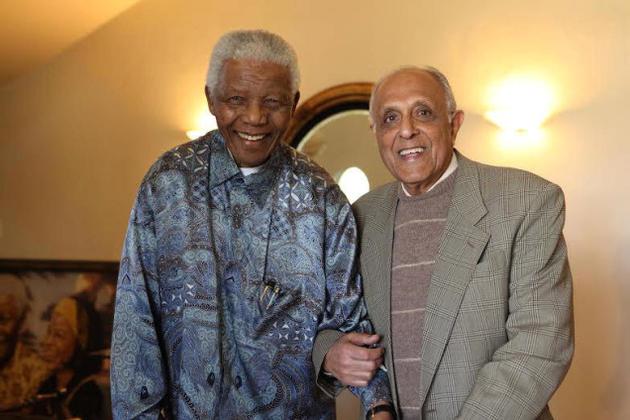
Special Camaraderie: “Throughout, Mandela retained hope, confident that sooner or later, the battle for equality would will be won.” Picture shows Nelson Mandela and Ahmed Kathrada. / by Special Arrangement / The Hindu
Ahmed Kathrada, who was on Robben Island with Nelson Mandela, recalls his famous co-prisoner’s eternal optimism.
As the world celebrated Nelson Mandela International Day on July 18 — Mandela’s birth anniversary — the air of mystery surrounding his long years of imprisonment is slowly being lifted. Mandela once called his time in prison “a long holiday”, a picture belying a life of denial and discrimination. For 10 years, Mandela was denied bread, his food was rationed, and he had to wear a humiliating uniform. Yet, according to new accounts of his time at Robben Island, where he spent 18 years in detention, Mandela was a picture of positivity.
Ahmed Kathrada was his fellow prisoner for 26 years. Prisoners with brown skin, many of whom were of Indian descent, were given preferential treatment over black prisoners. For instance, they wore trousers, while Mandela was only permitted to wear shorts. Yet, there was a sense of common cause and camaraderie. Mr. Kathrada and other prisoners would happily share their bread with Mandela and rejoiced when, three years into detention, Mandela was allowed to wear trousers. Throughout, Mandela retained hope, confident that sooner or later the battle for equality would be won.
These and other moments of joy and companionship were shared by Mr. Kathrada in a telephonic conversation with The Hindu. Mr. Kathrada also spoke of his latest book Triumph of the Human Spirit, in which he has written about his 300 visits to Robben Island as a tour guide since his release in 1990.
He is also updating his book No Bread for Nelson Mandela. “I am writing about our prison days. I was there for 26 years, Mandela for 27. I know him from 1962,” he says.
Mr. Kathrada, whose ancestors hailed from Surat, says Mandela’s personality came to the fore when hostilities were at their peak. “Mandela remained optimistic all along. When the Defiance Campaign and other movements of boycott were launched, it was with the sense that they would be successful. One does not expect immediate results. Success takes time. As an Indian you would know freedom cannot be attained in a matter of a year or two. We took heart and inspiration from the Indian struggle,” he says. “We understood that the protest had to be continuous. In South Africa, the Defiance Campaign helped in rousing public opinion. For instance, before the campaign, African National Congress had 5,000 members but following the campaign the numbers rose to over 1,00,000 members.”
Mr. Kathrada and others were arrested in July 1963 in Rivonia, Johannesburg, after which the famous Rivonia Trial began in October that year. The accused were charged with sabotage and attempts to overthrow the government by violent means. The trial ended a year later, after which Mr. Kathrada was sentenced to life imprisonment along with Mandela, Walter Sisulu, Govan Mbeki, Andrew Mlangeni, Billy Nair and others.
“For 26 years, eight of us of were together. We were sentenced to life imprisonment. When we reached the prison, Mandela was already there. As we interacted, I realised that he was a natural leader of leaders. He had already emerged as a force to reckon with in the early 60s,” he says. In the Defiance Campaign, whose aim was to get rid of six unjust laws, Mandela was the chief leader, Mr. Kathrada explains. “Thousands of volunteers were taken prisoners. It made no difference to the Apartheid government. In a prison trial, most were found not guilty. The case went to the Supreme Court. Mandela went underground and continued his political work. He was arrested in 1962 on a tour of African countries and England for mobilising support for our struggle. He continued his work underground for a year, got solidarity and financial support in England.”
Mr. Kathrada reveals that when all the important leaders were in jail in South Africa, the African National Congress policy was to continue the struggle with the support of the world, especially India and other countries. “The aim was to force the government to come to the negotiating table. Mandela started talking to the government from prison. One of his demands was to release all political prisoners, legalise the urban spots, and allow exiles to come back. The government acceded to all the requests. The ANC was allowed to function. It was in the 60s and was a big moment for us back then.”
Looking to India
Mandela and other leaders drew inspiration from India’s non-violent path to freedom, he says. “The enemy does not concede anything in a hurry. Our struggle took a long time. Contrary to what many people believed, we had a peaceful transition from apartheid to democracy.”
Mr. Kathrada left school when he was 17 to join the Transvaal Passive Resistance Council to work against the Asiatic Land Tenure and Indian Representation Act, which was popularly called the Ghetto Act. The Act, like many piecemeal concessions given by the British to Indians during the freedom movement, sought to give Indians limited political representation and defined the areas where Indians could live, trade, and own land. It was during the phase of increasing association between the African Congress and the Indian Congress that Mandela became close to Indian leaders.
Mr. Kathrada is hopeful that the path shown by Mandela is the one that South Africa will follow in the years to come. “We are only 20 years old as a democracy, but we have made considerable progress. Most of the children are now in schools; clinics and hospitals have been established. Electricity and sanitation have reached a majority of the population. Yes, challenges remain: we have hunger and poverty. But at the level of ideology, yes, it has percolated down to everybody.”
ziya.salam@thehindu.co.in
source: http://www.thehindu.com / The Hindu / Home> Opinion> Comment / by Zia Us Salam / July 21st, 2015
The President of All India Milli Council Mysuru, Hazarath Moulana Mohammed Zakaulla Siddiqi has urged the Muslim brethren to celebrate Ramzan peacefully.
Hazarath Moulana Mohammed Zakaulla Siddiqi speaking to SOM said that during the holy month, Muslim brethren fast and offer prayers for peace and well being of everyone and added that donation of 2.5 percent of the total earnings in a year is given to the poor and urged the Muslim brethren to donate 2 kg wheat or its cost to the poor before offering prayers at the Eidgha Maidan on the day of Ramzan.
In his message, Hazarath Moulana Mohammed Zakaulla Siddiqi urged the Muslim brethren to live as per the Shariath of the Prophet, live peacefully, spread the message of peace and harmony and walk in the way which the Holy Quran has showed.
Moon Committee to meet today : Meanwhile, a meeting of the Mysore District Hilal (Moon) Committee, has been convened at the office of the District Waqf Advisory Committee, Muslim Boys’ Orphanage Campus, New Sayyaji Rao Road, Mysuru, today, after Namaz-E-Maghrib at 7pm to sight the Eidul Fitar (Ramzan Festival) Moon and to declare the celebration of Eid. The Public is requested to contact the Hilal Committee personally or the telephone numbers mentioned below to inform the sighting of moon to the Committee with sufficient witnesses or to get the information regarding sighting of Moon according to the press release from Ariff A. Mehkri, Chairman, Mysore District Wakf Advisory Committee who is also the Convenor of the Mysore District Hilal (Moon) Committee.
For details contact Ph: 0821-2423520, Mob: 94498-18786, 98869-69882.
source: http://www.starofmysore.com / Star of Mysore / Home> General News / Friday – July 17th, 2015
This is not the first appearance for Nihar Ameen and his swimmers at the Rashtrapati Bhawan for the Arjuna Award ceremony. But, this year is a bit more special for the 49-year-old coach who has been guiding Indian hopefuls for over a decade as two of his wards -Virdhawal Khande and Prasanta Karmakar – will be honoured on Monday at the Arjuna ceremony.
Ameen, who will be present for the felicitation, is delighted but says it’s a work in progress. “It’s an amazing feeling to be there and meet the President. Last time it was Abdul Kalam. The moment validates all the struggle and hard work we’ve done over the years,” Ameen told TOI on Sunday. “It especially means a lot as medals are won against all odds,” he added.
Khade ended a 24-year-old draught by winning a bronze at the Guangzhou Asian Games, while Karmakar created history with his bronze medals at 2010 Commonwealth Games and the Asiad in the disabled category.
Ameen, one of India’s best-known swimming guru, works like a one-man army. Besides being a coach, he also acts as manager and dietician to his pupils. He plans training sessions and arranges physiotherapy support for the swimmers. His passion for the job has seen him spend almost three decades as a coach.
Sandeep Sejwal and Khade, the first Indian swimmers to break into the top-100 of world rankings, have both had stints under him.However, Ameen’s foray into coaching was more due to a sudden family need than any planning. He had to turn coach when younger sister, Shanaz Shacoor, needed one after the 1982 Asian games. “I was just 20 and it was a panic situation for me. I was not sure if I could deliver,” he recalled. “Shanaz was the big talent in the family. I had to take over her coaching after the Asian Games. It was very difficult as I was not a trained coach,” he added.
But since then, there has been no looking back for the Ameen who has a Level 5 certification in coaching from the American Swim Coaches Association, a peak of sorts for swimming coaches. But Ameen recalled the struggle he had to wage in the early days. He was helped along by the workout diary maintained by Shanaz and some coaching tips from the German coach Bernd Johnke, who was assisting the Indian team ahead of the 1982 Asiad. “I used to observe Johnke and picked some tips from him that helped. And we started training at a public pool with no lanes,” he said.
Ameen runs his Dolphin Swim Team in a school at the outskirts of Bangalore. His wards won 46 medals at the recent junior Nationals in Bhopal , the latest affirmation of his worth.
India has never won a medal at the Olympics and there is no silver lining in the cloud either. However, Ameen wants to stay positive, saying Indian swimmers have the talent and can produce better results at the international level if the government provides adequate facilities. “Appropriate budget and proper support staff can take things to a different level,” he asserts.
source: http://www.timesofindia.indiatimes.com / The Times of India / Home> Sports> More Sports> Others / by Ritu Sejwal, TNN / August 29th, 2011
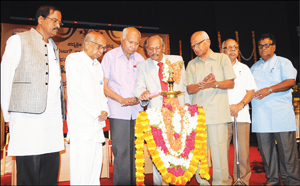
Noted writer Dr. K.S. Nisar Ahmed is seen lighting the lamp to inaugurate the Seminar on ‘Nadoja Dejagow – Baduku mattu Baraha’ at Kalamandira this morning as (from left) retired VC of Sanskrit University Prof. Mallepuram G. Venkatesh; Senior researcher Dr. Chidananda Murthy; littérateur Dr. C.P. Krishnakumar; Retired Director, Kuvempu Institute for Studies (KIKS) in Kannada Dr. D.K. Rajendra; Legal expert Dr. C.K.N. Raja and Kadamba Rangavedike president Rajashekar Kadamba look on.
Mysuru :
Kalamandira on Hunsur Road in city, which was the venue for conduct of a seminar on ‘Nadoja Dejagow – Baduku mattu Baraha’ this morning, turned into a venue for hundreds of littérateurs from across the State to fall to the feet of former Vice-Chancellor of University of Mysore Nadoja Prof. Dejagow, who is on the threshold of turning a centenarian, to seek his blessings.
Inaugurating the seminar, noted writer Nadoja Dr. K.S. Nisar Ahmed described Prof. Dejagow as the best of those who studied under Kuvempu and lauded Dejagow for the simplicity in his language in his works which amount to nearly 290 and over 40 on Kuvempu alone.
Stating that Prof. Dejagow was one of the few, who fought relentlessly for Kannada even after retirement, Dr. Nisar Ahmed added that Dejagow was a fighter to the core when it came to struggle for Kannada.
Describing Prof. Dejagow, who mastered the art of writing quality works, as an encyclopedia on Kuvempu, Dr. Nisar Ahmed stressed on the need for functioning of the Centre of Excellence for Study in Classical Kannada at Manasagangotri.
Retired Director, Kuvempu Institute for Studies (KIKS) in Kannada Dr. D.K. Rajendra, presided.
Senior researcher Dr. Chidananda Murthy spoke on ‘Kannada Horatagararagi Dejagow,’ retired VC of Sanskrit University Prof. Mallepuram G. Venkatesh spoke on ‘Sahitiyagi Dejagow,’ Legal expert Dr. C.K.N. Raja spoke on ‘Shikshana Tagnaragi Dejagow’ and littérateur Dr. C.P. Krishnakumar (CPK) spoke on ‘Adalithagararagi Dejagow.’
MLAs Vasu and G.T. Devegowda, former KEA Chairman R. Raghu and hundreds of littérateurs including admirers of Prof. Dejagow were among those present.
source: http://www.starofmysore.com / Star of Mysore / Home> General News / Sunday – July 12th, 2015