Indian athletes at Universiade: an interview with S.N. Mohammed Salauddin

We interview S.N. Mohammed Salahuddin, a young Triple Jump athlete from Tamil Nadu. He is the son of Mr. K.S. Mohammed Nizamuddin (1991 Colombo South Asian Games Triple Jump Gold medalist), and recently represented India at the Gwangju World University Games:-
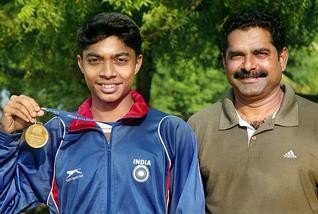
Triple jumper S.N. Mohammed Salahuddin with his father and coach K.S. Mohammed Nizamuddin

 1. Congratulations for your performance at the Universiade (World University Games), held at Gwangju, South Korea. How special is your feeling? How was your experience there, during the games?

A:  I feel very happy about getting the chance to participate in the World University Games, which is one of the most important world-level tournaments. I feel I’ve started touching my achievements list, by this. And I acquired very good experience there, as I watched how the champions get trained over for the events and I’ve got an idea about what I must have to go through, to do something big next time.
2. Why did you choose athletics as your aim in life?
Ans:- My first active participation in the sports was at my school Sports Day, and I bagged some prizes initially. Once during the 8th standard, I was chosen for a meet, but was removed from it on the final day and told that I should improve my performance.

My parents, who were present there to watch me run were disappointed, came up to me and asked what had taken place. My father reassured me and suggested that I should start specialized training from the next day. So that was my start as a determined athlete.
3. Your father, Mr. K.S. Mohammed Nizamuddin, won the gold medal at the 1991 Colombo SAF Games for the nation.  Did you want to become an athlete yourself or were you inspired by him?

Ans:- It’s not really like that, it all started after that mentioned incident took place, I took athletics seriously and achieved more and more. It’s good to be an achiever, and I went to achieve a lot, and that’s what made me into the game. Athletics is a game which requires only my effort –  it’s not a team game, like cricket or football. So, I like it to win with the help of my own effort. Apart from my dad, Jonathan David Edwards, the triple jump World record holder, from Great Britain, inspired me a lot. He is awesome!

4. How old were you when you first developed an interest in athletics? How has your journey been till now?
Ans:- I started developing an interest in this sport at the age of 14. The journey till now is going quite good, but it has been hard in parts. The life of an athlete is very hard. There are some injuries, pains and similar sort of things, but an achievement can fade these instantly as well. I hope it gets better by the Olympic Games.
5. How did you feel when you realised you had broken your father’s record of 14.89 m (which he set in 1987) at the Nehru Stadium, in 2011?
Ans:- Ah, it’s a good question (smiles). Actually, during 2010, I read about my father’s record in a book, and imagined I would break it. I was confident that I’d make it by next year. I kept telling my dad to watch for my name to replace his. After I broke the record in 2011, I was very excited and proud, because the record stood for 24 years – a long time. He was extremely proud to know it was I who had broken his record. I also wanted to make him happy, and I was successful in doing so.
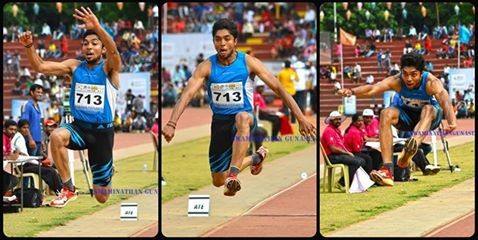
Salahuddin doing the triple jump

 6. In a country obsessed very much with cricket and football, how difficult it is to claim a name in athletics?

A:- In India, people give too much importance to cricket, and the authorities spend a lot of money on it, but they don’t do the same for the sake of athletics. Just twenty countries in the world take part in cricket, but more than 200 countries participate in athletics, so it’s one of toughest sports in the world. If people show some interest and provide encouragement in the field of athletics, India can bag many gold medals in the coming Olympics.
7. So how do you manage both academics and athletics together?

A:- Academics are not at all a problem for me. Both my school teachers and college teachers support me a lot, and I always manage to get more than 60% marks in the exams, so it’s not difficult for me to handle both at the same time.
8. How does your educational institutes help you building you as a sportsman?
Ans:- My educational institutes are easy with me, and they support me a lot. They provide me enough time to train hard for the sports, and so balancing between studies and games is not hard for me.
9. Are you preparing hard for the 2016 Olympic Games?
Ans:- I’m currently not aiming for the 2016 Olympics in Rio, but I’m training hard with the aim of representing India in the 2020 Olympics as well as in the 2024 Olympics from now on.
10. Apart from athletics, which other sports do you like to play and watch? Who is your favourite in that sport?
Ans:- I’m mad about football. Cristiano Ronaldo and Frank Lampard are my favourite footballers.
11. What is your message for the young athletes of India who are hesitating to pursue sport as a career?

A:- Believe in hard work. Hard work can gift you achievements a bit late, but it can take you to new heights. Always be disciplined. And those who hesitate, should have an intense interest in the sport. Guys who have no interest in a particular sport, yet they are playing it, will not achieve success in it. Love for the sport helps a sportsman achieve a lot.
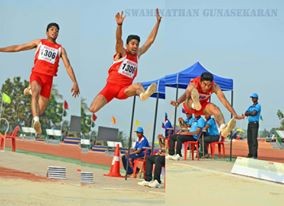
Salahuddin3MPOs16jul2015

We also had Mr. K.S. Mohammed Nizamuddin (1991 Colombo SAF Games Triple Jump Gold medalist), say a few words about his son, Salahuddin:-

“It’s great to see that Salahuddin was selected to represent India in the World University Games, where he’d definitely gain a great experience. This is the fourth international competition he participated in, till date. His performance was quite satisfying in it, but still he would have done better as per my coaching view. He will certainly become an outstanding Triple jumper in the international field in coming years.”

Thank you Mr. Salahuddin, for giving his precious time for the interview session. We hope he wins many medals for India in future and make our country proud. We would like to see more Salahuddins emerging and making our country proud in Athletics. All the best for his future.

source: http://www.sportskeeda.com / SportsKeeda.com /  Home> SK Athletics> World University Games> Interview / by Resham Das / July 14th, 2015
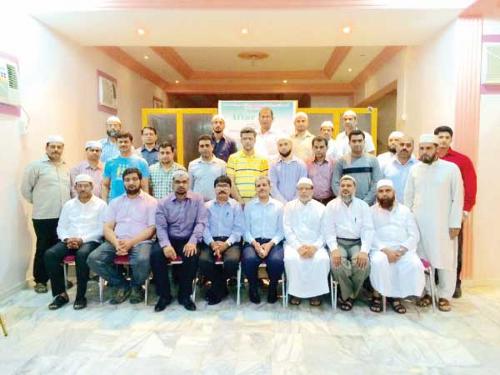
Gulbarga’s KBN Engineering College Alumni hosts Iftar program

GulbargaMPOs16jul2015

Jeddah :

KBN Engineering College Gulbarga Alumni hosted an iftar program at a local restaurant here.

Syed Mohiuddin, general secretary of the alumni, welcomed all the members and guests and also highlighted the aims and objectives of the alumni.

President of Alumni Syed Nasir Khursheed while addressing the audience explained the system of functioning of the alumni and the achievements of the group. He mentioned the course conducted by alumni, Primavera P6 and lecture on QA/ QC which was very useful for members.

Treasurer of the forum, Saleh Bin Ali appealed to the members to come forward and strengthen the alumni as this is a platform of technocrats who have the opportunity to help other fellow engineers for upgradation and getting jobs.

Ahmed Ali Soofi, senior member of the alumni, appreciated the tasks carried out by the executive committee and advised other members to help the executive committee in working more effectively.

PR coordinator of the alumni Ismail Zubair said it is the responsibility of all the members to be connected with the alumni and play a vital role by providing services in line with their capabilities.

Joint coordinator Imdad Ali introduced the new members, while the vote of thanks wa delivered by chief coordinator Mohammed Yahiya. — SG

source: http://www.saudigazette.com.sa / Saudi Gazette / Home> Kingdom / Jeddah – Wednesday – July 15th, 2015

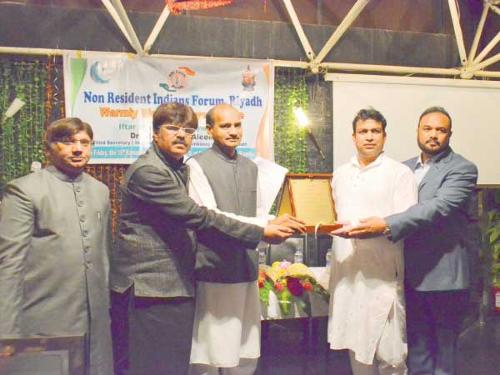
NRIF Riyadh bids farewell to Dr. Aleem

DrAleemMPos16jul2015

Riyadh :

Dr. Mohammed Aleem, third Secretary, Information and Labor, Embassy of India here said that many Indian expatriates still needs to correct their legal status in the Kingdom and many of them are seeking the help of embassy to correct their status.

Officials are trying to solve these new cases visiting the embassy almost every day for rectification. He appealed the Indian expatriates to help the fellow countrymen by properly guiding them.

Dr. Aleem who completed his tenure in Riyadh has been transferred to Qatar and will be leaving soon. Non-resident Indians Forum, Riyadh (NRIF) organized an Iftar in his honor at a local restaurant here.

Aleem thanked the NRIF members for organizing the impressive farewell function. Dr. Hifzur Rahman, second secretary at the Embassy here, was the chief guest.

The NRIF, formed recently, organized its first function inviting more than 150 Indians for Iftar. NRIF President Syed Akram Mohiuddin said in his welcome address that there are many issues which are not being dealt by other associations and we will try our best to sort out these issues pertaining fellow Indians.

Akram appreciated Dr. Aleem for is relentless efforts and services for the Indian community in Saudi Arabia.

Dr. Sayeed Mohiuddin, vice president education,  highlighted the aims and objectives of the organization and said this organization will work in a true democratic way and the office bearers will be elected every year. Sayeed outlined the coming events of NRIF, which includes a cricket match between Riyadh and Jeddah, The Third Youm Al Watani Cup Cricket Tournament, and many other events.

The event started by the recitation from the verses of Holy Qur’an by Hafiz Zakir Hussain.

The following team has been elected: Syed Akram Mohiuddin – president; Syed Aftab Ali Nizami – vice president (cultural affairs); Dr. Sayeed Mohiuddin – vice president (education); Dr. Abdul Sattar Gayas – vice president (health and sports) and Abdus Subhan – vice president (administration), Javed Ali – general secretary; Abdul Majeed – joint secretary and Mohammed Kaleem – treasurer.

Its core committee members include Dr. Anwar Khursheed, Ghulam Mohammed Jaweed, Mohammed Salahuddin, Shakeel Mah, Nooruddin Jahangeer, Mir Hussain Ali Khan and Taquiuddin Mir. Javed Ali, general secretary, conducted the proceedings and Taqiuddin Mir proposed vote of thanks.

source: http://www.saudigazette.com.sa / Saudi Gazette / Home> Kingdom / by Mir Mohsin Ali / Tuesday – July 14th, 2015

Fake or real? A royal riddle

A mighty fracas is raging between the descendants of Nawab Wajid Ali Shah in Calcutta and an Iranian woman who claims to be married to a scion of the Awadhi family. Hemchhaya De investigates the rumpus

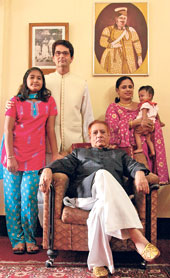
REGAL ROOTS: Shahebzade Wasif Mirza and his family pose before the portrait of Nawab Wajid Ali Shah;

A king-size portrait of Nawab Wajid Ali Shah will catch your eye the moment you step into the grand, old living room of Wasif Manzil on Talbagan Lane in Calcutta. “That’s my ancestor,” says Shahebzade Wasif Mirza, a dignified septuagenarian, pointing at the portrait — the pièce de resistance in a room bristling with Awadhi heirlooms.

“Satyajit Ray once asked me, ‘Why did the Nawab choose to move to Bengal after his kingdom was annexed?’ At that time, he had just made a film calledShatranj Ke Khiladi,” recalls the patriarch, a registered descendant of Wajid Ali Shah (1822-1887). “I told Ray that perhaps the Nawab felt he would get the respect he deserved only in Bengal.”

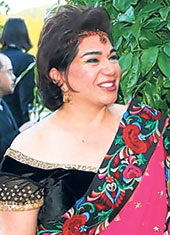
For Shahebzade Mirza, it’s a matter of family honour that he takes on what he calls “pretenders” to the Awadh legacy. In recent months, he has been fighting a fierce battle against Fay Ary, an Iranian woman who divides her time between Monaco, Paris and Dubai, and claims to have married a direct descendant of Nawab Wajid Ali Shah and his second wife Ronakara Begum.

Fay Ary
Fay Ary

But she refuses to disclose her late husband’s name for “fear of being drawn into family feuds.” Ary also wishes to do something for the underprivileged in India through her charity organisation, Royal Awadh Cultural and Heritage Foundation (RACH).

“All this sounds very nice. But she calls herself Her Royal Highness Princess Jehan Ara Fay Ary. I have the complete family tree and she figures nowhere. I’d like to know where her imaginary kingdom is located,” says Mirza. In a recent letter to the French ambassador to India, Jerome Bonnafont, he complained against Ary and RACH. “Our objection is to the use of our family’s name …for large monetary gains,” wrote Mirza.

Fay held a charity auction in Paris this May where her “personal collection of jewellery” went under the hammer. “We don’t know what she auctioned as her Awadhi legacy. And we don’t know where the proceeds are going,” says Ibrahim Ali Khan, a descendant of a 19th century Awadhi vizier, who heads the Royal Family of Awadh Foundation in Lucknow.

It all began a couple of years ago when Nawab Jafar Mir Abdullah — who reportedly claimed to be the Awadh rulers’ “direct descendant” — came under media glare. Abdullah, who’s on the RACH advisory committee, was accused of faking his nawabiheritage and arranging Awadhi banquets for foreign tourists in collusion with “unscrupulous” travel operators in Lucknow. It was also alleged that he charged tourists hundreds of dollars for banquets and mujras (dances) at his Lucknow home. His partner in this enterprise is said to be Prateek Hira, who heads a tour operating agency called Tornos India and is also associated with RACH.

Hira maintains that Khan and others have launched a malicious campaign to defame Ary, Abdullah and his agency. “Abdullah is well respected in Lucknow,” says Hira.

_________________________________________________________________

Dramatis personae
■ Shahebzade Wasif Mirza, descendant of Nawab Wajid Ali Shah (1822-1887) of Awadh (Oudh).

■ Fay Ary, an Iranian who claims to have married a direct descendant of Wajid Ali Shah and his second wife Ronakara Begum. Ary runs a charity, Royal Awadh Cultural and Heritage Foundation (RACH).

■ Ibrahim Ali Khan, a descendant of a 19th century Awadhi vizier, who heads the Awadh Royal Family Foundation in Lucknow. Does not support Ary.

■ Jafar Mir Abdullah, who is described as Wajid Ali Shah’s direct descendant and is on the RACH advisory committee.

■ Prateek Hira, who heads a tour operating agency called Tornos India and is associated with RACH.

____________________________________________________________

Fay Ary gained some publicity in Lucknow around this time after announcing her charity projects. “She wants to do something for the poor — like arranging cleanliness drives in various Indian cities and providing slum dwellers with clean drinking water. She sought my help to implement the projects,” says Hira.

Ibrahim Ali Khan and others tried to blow the lid off what they called a “nexus” between Abdullah, Hira and Ary last year. “The issue was almost dying down when a freelance journalist from Delhi wrote to Hira and threatened action against his activities. He wrote to me as well,” says Khan.

Fay didn’t take it lying down. In an email dated June 29 this year, she wrote to her friends in Lucknow, Dubai and Paris, “A very nasty activity is being undertaken …(by a journalist)… for want of some money to sustain himself …ignore this man who keeps changing his name to fool people.”

Speaking from Paris, Ary expresses her “anguish and disappointment” over the “concerted efforts to pull down RACH.” “I claim nothing from the Indian government or from the Awadh families. I auctioned my own jewellery in Paris. I am hankering after no title. All I wanted to say to these people was that I had the resources to do some good work in India,” says Ary.

She wants to start her “slum cleanliness drive projects” in early October. She will also host a gala event in Dubai this November to seek support for her charity work. “People who claim to be true nawabs in India should stop bickering and do something for their country.

There seems to be another point of clash between Ary and Shahebzade Mirza. Ary told the media last year that she would renovate Nawab Wajid Ali Shah’s mother’s grave in the Père Lachaise cemetery in Paris. The Nawab’s mother, Aliya Begum, went to England to plead with Queen Victoria for returning Awadh to her son. On her way back, she fell ill and died in Paris in 1856 and was buried in Père Lachaise. Ary wants to project her grave as a site of historical significance.

The Shahebzade Mirza family, on the other hand, wants to rectify an inscription near the grave which says that her son Wajid Ali Shah was killed by British forces in 1856. “The Nawab died of natural causes in 1887. We have written to the French consulate in Calcutta to do something about it,” says Mirza. A spokesperson from the French consulate, who prefers not to be identified, confirmed receiving the letter.

“I accompanied Fay to the Paris cemetery this year. She is planning a renovation,” says Abdullah, the controversial ‘nawab’ who refutes all allegations against himself. “She doesn’t lay any claim to the Awadh royalty. She is herself related to Farah Diba Pahalvi, the queen of the last Shah of Iran who ruled till 1979.”

Abdullah also goes on to say that he will go on hosting banquets for tourists in order to interact with people and entertain them. “I tour the world and get invited by top officials. I will also continue to be part of RACH and the commendable work it does,” says Abdullah. “I never claimed to be a descendant of Wajid Ali.”

Agrees Rosie Llewellyn-Jones, a British scholar who’s writing a biography of Wajid Ali Shah. “Abdullah does not really claim descent from Wajid Ali Shah, but from Nawab Mohammed Ali Shah, who ruled Awadh from 1837 to 1842,” she says. She adds that it’s important to remember that “Wajid Ali Shah’s descendants are not the only descendants of the royal family of Awadh.”

“Each Nawab, from the time of Asaf-ud-daula (1775 to 1797), had a number of wives, and inevitably, a large number of children and grandchildren. These people are also descendants of the Awadh royal family. On Wajid Ali Shah’s death he left about 45 sons, and a larger number of daughters, and the descendants of these sons and daughters can obviously claim direct descent from him.” On Ary, she says that unless she is prepared to reveal her husband’s name “we can’t really check out her claim.”

Indian historian Ravi Bhatt, who penned a book called The Life and Times of the Nawabs of Lucknow, begs to differ. “Just as Nagpur is famous for oranges and Benaras for silk, Lucknow is known for its nawabs,” says Bhatt. “Every Tom, Dick or Harry calls himself a nawab these days. But let me tell you there is no descendant of the Awadh royal family in Lucknow now,” says Bhatt.

Meanwhile, Shahebzade Mirza is gearing up for the next round of battle. “We hope the French government will act on our complaint against Ary. The war is far from over.”

source: http://www.telegraphindia.com / The Telegraph, Calcutta,India / Front Page> 7 Days> Story / Sunday – August 23rd, 2009

Pranab, Modi congratulate Sania on Wimbledon win

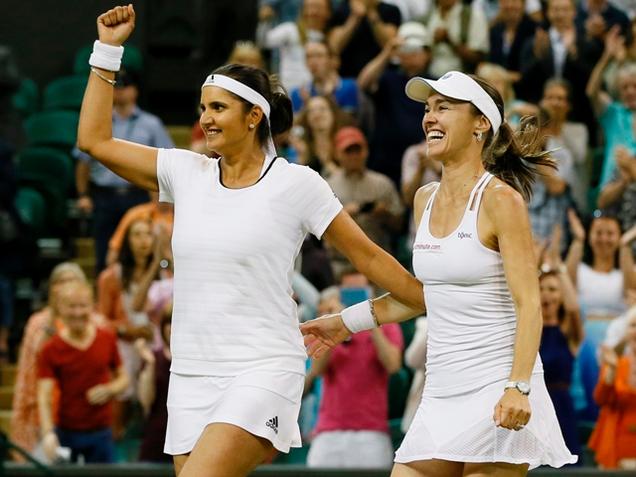
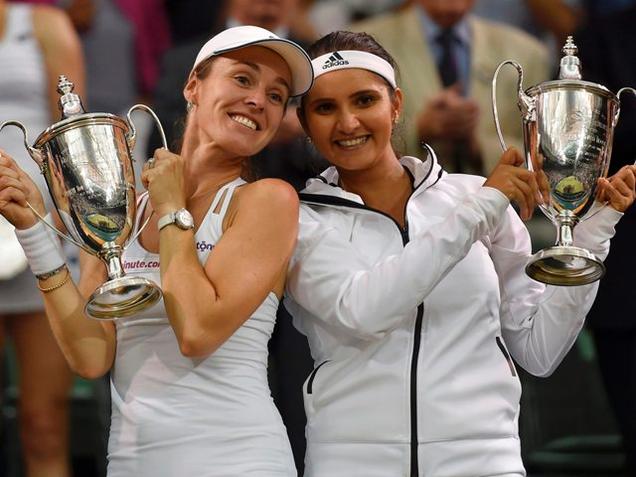
Martina Hingis (R) and Sania Mirza celebrate winning the Wimbledon women's doubles final, in London on Saturday.
Martina Hingis (R) and Sania Mirza celebrate winning the Wimbledon women’s doubles final, in London on Saturday.

President Pranab Mukherjee and Prime Minister Narendra Modi on Sunday congratulated Sania Mirza for becoming the first Indian to win the Wimbledon women’s doubles title with her Swiss partner Martina Hingis.

“Well played Martina Hingis and Sania Mirza. You played wonderful tennis and registered a fantastic win at Wimbledon. We are proud and very happy,” Mr. Modi said in a statement.

“Hearty congratulations @MirzaSania @mhingis on winning women’s doubles in Wimbledon, @MirzaSania’s achievement will inspire youth of India,” Mr. Mukherjee tweeted.

“Many congratulations to @MirzaSania for winning the @Wimbledon doubles title. An incredibly well played match,” Sports Minister Sarbananda Sonowal tweeted.

source:  http://www.thehindu.com / The Hindu / Home> National / by PTI / New Delhi – July 12th, 2015

Sania seals historic Wimbledon crown with Hingis

Martina Hingis and Sania Mirza pose with their trophies after winning their Women’s Doubles Final match / Reuters

Sania had come close to winning a women’s doubles Major in 2011 when she reached the French Open final with Elena Vesnina but ended up runners-up.

India’s tennis queen Sania Mirza today created history by becoming the first female player from the country to win a women’s doubles Grand Slam trophy as she clinched the Wimbledon title with Swiss partner Martina Hingis.

More than a decade after turning Pro, 28-year-old Sania laid hands on her first women’s doubles Major title when she and Hingis battled past second seed Russian team of Ekaterina Makarova and Elena Vesnina 5-7 7-6(4) 7-5 in a thrilling final.

In an interesting coincidence it was at these very historic courts that Sania had won women’s doubles junior Wimbledon championship with Russian partner Alisa Kleybanova in 2003.

Sania had come close to winning a women’s doubles Major in 2011 when she reached the French Open final with Elena Vesnina but ended up runners-up.

Already having a long list of firsts, Sania had become India’s first woman player to win a Grand Slam when she won the Australian Open with compatriot Mahesh Bhupathi in 2009.

She later added French Open (2012 with Bhupathi) and US Open (2014 with Bruno Soares) to her mixed doubles collection.

It was a remarkable turn around for the top seeds as they were trailing 2-5 in the deciding set but made a stunning comeback to reel off five straight games to clinch the issue.

Vesnina was all fired up and her smashing volleys at the net put Sania and Hingis in a lot of trouble. The Russian was left distraught as she played out of her skin.

It was third time in recent times that Sania and Hingis played the two Russians in finals — Indian Wells and Miami — and asserted their supremacy again.

Sania was broken in the very first game of the match when Vesnina hit a volley winner from the net but the top seeds immediately broke Vesnina to avoid falling behind. It was a remarkable lob from Hingis that gave them two break chances and they converted the second.

Sania and Hingis put tremendous pressure on the their rivals but the two Russians responded well and it was 5-5.

Hingis was broken in the 11th game at love after a terrific rally of powerful ground strokes from left-handed Makarova. Vesnina pounced on one return from the Swiss and hammered the volley winner close to the body of Sania.

Makarova served for the set and it was Vesnina’s smart play at the net that sealed them the opening set.

It was the first set that Sania and Hingis had dropped in this tournament.

source: http://www.thehindu.com / The Hindu / Home> Sport / by PTI / London – July 12th, 2015

Joy of Anas’ Family Knows No Bounds

Kozhikode : 

Back home at Kondotty, Sulaikha M P could hardly contain her happiness as husband Anas Edathodika ended up on Delhi Dynamo’s roaster for `41 lakh at the 2015 Indian Super League (ISL) players auction in Mumbai on Friday. “I am really happy for my husband. It is truly a wonderful moment for the entire family. We have not celebrated the news, but there is immense joy and happiness in family. Anas’ parents are equally happy,” Sulaikha told Express.

Not a big fan of football, Sulaikha, who married the Dynamo’s midfielder four years ago, could not really comprehend the magnitude of his feat, but believes Anas has done something that makes the entire state proud.

“I don’t watch much of football. Neither do my parents. But we all are just happy for him. We know he loves football more than anything else. No one in the family has believed he would reach this far,” she says.

Meanwhile, his father Muhammed Kutty says his son loved football so much that he worked so hard to become a footballer. “His life was just dedicated to football. He is reaping the result of his efforts,” says his father.

“I haven’t seen him play much. But I never missed a chance when I get one. There were times I even cautioned him against playing for fear of getting injured. I have seen him injured many a time. That is the only time we have had anything against him playing,” says Muhammed. His mother Khadeeja does not know football, but is glad that something good has happened to her son. “This will give him a lot of money, a security in life. Any mother seeing her child growing in career will be happy. So am I,” says Khadeeja.

source: http://www.newindianexpress.com / The New Indian Express / Home> States> Kerala / July 11th, 2015

HISTORY OF FOOD – Arab flavours from 7th century still sparkle in the Muslim cuisine in Malabar

In the northern districts of Kerala, the menu still carries legacies of the merchant traders who visited the region centuries ago.

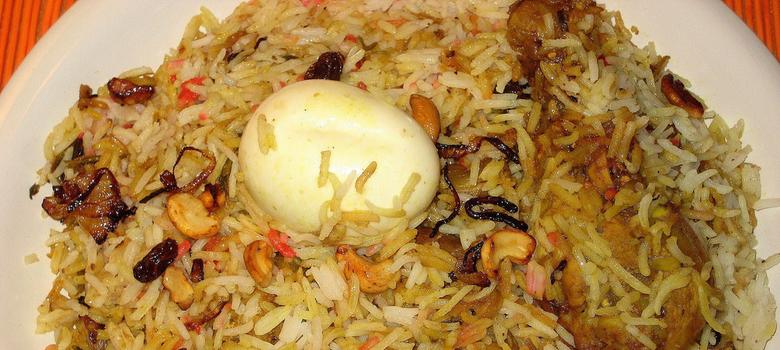
BiriyaniMPOs11jul2015

As lakhs of Muslims break their Ramzan fast with iftaar meals across India, there’s one region where the menu is strikingly distinct from that in the rest of the country. The Muslim community in Malabar, in the northern districts of Kerala, boasts of a unique cuisine that even today shows telltale signs of Arab influence carried across time.

Ask for a Sulaymani in any tea shop in Malabar, stretching from Kozhikode to Kasargod, and you’ll get sweet black tea with lemon. The name is believed to have been lent to this simple drink by the Sulaymani Bohras (Sulaymanis), a Musta’lī Ismaili community from Saudi Arabia and Yemen.

Step into the dining room of any traditional Mappilla (Muslim) home in Malabar at meal times and chances are that you’ll be enticed by the rich and inviting aroma of mandi, a distant cousin of the biryani. Said to be the traditional dish of Hadhramaut and Sana’a areas in Yemen, the mandi among the relatively unknown delicacies found on Malabar dining tables.

A mixture of rice, spices and chicken or lamb, the mandi is made in an oven in the ground tiled with clay bricks. The rice, spices and water are cooked in this oven, while wood coals are placed on top to make sure that steam doesn’t escape. The coal is also used to add the extra smokey flavour to the meat which too is cooked in this oven. Care is taken to use the meat of a young goat, which is tenderer than regular mutton.

“This dish is little known outside Kerala but it is an extraordinarily popular item in Malabar,” said Muhammed Seedi, managing director of the Whitehouse group of restaurants, which has the dish on its menu. “It has to be cooked for at least two and a half hours for the flavours to seep in.”

Mandi is said to be a corruption of the Arabic word “nada”, which means “dew”. The name is an allusion to the tenderness of the meat.

Adapted with local ingredients

“The influence is not just limited to Yemen,” said Ammini Ramachandran, Texas-based author and food writer. “Alissa, a wheat, meat and cinnamon porridge, is similar to harisa, a recipe preserved over centuries by the people of the Middle East. Recipes for this dish are found in 10th century Baghdadi cookbooks Annals of the Caliph’s Kitchen, Sufi Cuisine as well as in the Iraqi cookbookDelights from the Garden of Eden. In medieval Baghdad, it was called ‘hareesi’. Even today, the dish is served in Turkey, [where] it goes by the name ‘herise’, while in Lebanon it’s called ‘ hreessey’.”

She added: “The cuisine was adapted with local ingredients. Take for example ‘ari pathiri’, a thin chapati made out of rice flour. Rice being the staple grain in the region, breads and rotis were alien to the local food habits. The women innovated what they had in hand and made bread with rice powder for their Arabian paramours, who were used to a bread-based diet.”

Even the Malabar biryani, one of the key stars of any iftaar table, has a distinct Arabian touch. The rice and the meat are cooked separately and then layered and cooked. “Biriyani ustads”, who specialise in making this dish, are hired to cook it for weddings, special occasions and iftaars. Other dishes, meanwhile, are rustled up by the “pandaaris”, who hold the position of executive chefs.

“The Mappilas were extremely hospitable people, and would share their food with everyone in the neighbourhood,” said Sumesh Govind, managing director of Kozhikode-based Paragon Group of Hotels. “Subsequently, Malabar biryani became a staple in Hindu Thiyya homes as well, especially in the Thalasserry area. So much so that it’s also called Thalasserry biriyani.”

Malabar or Thalasserry biriyani is served with date pickle, raita and coconut chammanthi (chutney), again a fusion of West Asia and Kerala.

Influenced over the ages

Local produce such as mussels have also found their way onto iftaar tables. Ari kadukka, or rice-coated mussels, are among the favourites.

Another iftaar speciality said to have roots in West Asia is the dessert – muttamala or necklace of eggs. Thin filaments of egg yolk are cooked in sweet sugar syrup served over Pinnanathappam, steam-cooked cardamom-scented egg white pudding.

The influence of the Arabs lingers on in this and many other Malabar Mappila dishes.

Muslims or Mappilas tended to congregate more in the Malabar region because of the patronage from the local leaders. Subsequently, Malabar Mappila culture and cuisine came to have an identity of its own.

“The area we know as Kerala today was trading with merchants from West Asia from pre- Mohammedian times,” noted Dr K Gopalankutty, retired head of the history department at the University of Calicut. “After the Roman Empire collapsed, traders from Assyria, Babylon and Egypt as well as the Phoenicians and Arabs dominated this market, some even eventually mingling and marrying into the local population.”

By the 7th century, Muslim traders visited the southern coast of Malabar and shared their culture as they sold their wares.

Well before Abu Fazl wrote about how dozens of master cooks whipped up delicacies for the imperial Mughal kitchens of Akbar in his Ain-i-Akbari, the south western coast of India was already breaking fasts with culinary delights based on recipes brought across the seas from West Asia.

Over 2,000 years after they sailed to southern India, the legacy of these peaceful traders of West Asia continues to live on in the cuisine of Malabar.

We welcome your comments at letters@scroll.in
source: http://www.scroll.in / Scroll.in / Home> History of Food / by Supriya Unni Nair / Friday – July 10th, 2015

Chhota Imambada conservation work not as per norms: ASI

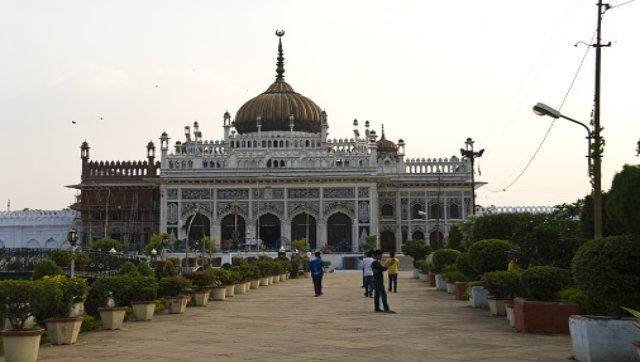
The Archaeological Survey of India (ASI) on Thursday raised a question mark on the authenticity of the ongoing preservation work being carried out by Hussainabad Allied Trust (HAT) at Chhota Imambada and demanded an immediate halt. (Getty image)

The Archaeological Survey of India (ASI) on Thursday raised a question mark on the authenticity of the ongoing preservation work being carried out by Hussainabad Allied Trust (HAT) at Chhota Imambada and demanded an immediate halt.

The ASI has also objected to the ongoing construction work at the Picture Gallery and has approached its headquarters to intervene. It said construction at the Picture Gallery was sheer violation of the Ancient Monument and Archaeological Sites and Remains (Amendment and Validation) Act 2010 that prohibited any construction within and near the protected monument.

The ASI’s move came after a short survey that it carried out a couple of weeks back to check the authenticity of the ongoing construction work at Chhota Imambada, and architectural marvel built by Nawab Mohammad Ali Shah in 1838.

“The officers were aghast at the way preservation work was being carried out at Chhota Imambada, as it was totally against the norms,” an ASI officer said.

Instead of using mortar, lime and surkhi, the ideal material for preservation work, the officer said the labourers were found using cement. “In those days mortar, lime and surkhi were generally used as binding material for the monuments. But using cement in place amounts to a crime and it will ruin the monument,” the officer who inspected the Imambada said.

He said technically, the same material (as used earlier in the monument) should be used for preservation work. Use of cement would ruin the entire edifice.

The style of preservation was another thing that the officers found highly objectionable and said it was totally against the preservation norms. “Old monuments like Imambada only need to be conserved. But in this case, the labourers were found breaking the plaster and applying a fresh one, using cement,” the officer said.

One had no right to spoil the originality of the structure, the officer said. Be it on the left side of Chhota Imambada or the right side of the main entrance gate, at all the places, the labourers were breaking the original plaster that bore the Quranic verses, calligraphy and aesthetic artwork, he said.  They were re-plastering with the same kind of designs. “This way there will be nothing original left. Besides, they are also minimising the scope for any future restoration work that is not at all possible after using cement,” he added.

The ASI also raised an objection over the illegal construction of toilets at the ASI-protected Picture Gallery. “It was found that the toilets were being constructed at the Picture Gallery. It is a protected monument and any construction is illegal,” said NK Pathak, superintending archaeologist, ASI.

Pathak said in this context, a letter had been written to the district magistrate and also to the ASI headquarters.

source: http://www.hindustantimes.com / Hindustan Times / Home> Cities / by Oliver Fredrick, Hindustan Times, Lucknow / June 13th, 2015

Sania Mirza enters maiden Wimbledon final

SaniaMPOs10jul2015

Indian tennis ace Sania Mirza entered her maiden final at the prestigious Wimbledon with Swiss partner Martina Hingis by earning a straight sets victory in the women’s doubles semifinals at the All England Club here on Friday.
The top seeds needed only 56 minutes to overcome American fifth seeds Raquel Kops-Jones and Abigail Spears 6-1, 6-2 in their semifinal match on No.1 Court to enter the summit clash.
This is Sania’s first final here across all formats in seniors though she had won the girls’ doubles title here 12 years ago with Russian Alisa Kleybanova. Martina, on the other hand, has two doubles (1996, 1998) and one singles title (1997) to her credit that she won at the lone grass court Major.

Though the World No.1 Indian has three mixed doubles Grand Slam titles, she is yet to win the top prize in women’s doubles. The only time she reached a Major final in the category was at the 2011 French Open.

The top seeds totally dominated both the sets.
In the first one, they broke their opponents twice out of four opportunities which was more than enough to seal the set in their favour. Though they gave three breakpoint chances to Raquel and Abigail, they managed to save all three. Also, they dominated by taking 30 of the 46 points played in the set.

The fifth seeds were already rattled by now which led to double fault thrice at crucial moments in the second set. Sania and Martina got two chances to break Raquel and Abigail and utilised both perfectly to clinch the set and match. They were so clinical that they did not even give a breakpoint opportunity to their opponents.

The world’s two highest ranked players will next take on the winners of the match between Russian second seeds Ekaterina Makarova and Elena Vesnina and Hungarian-French fourth seeds Timea Babos and Kristina Mladenovic.

Earlier in the day, another Indian Sumit Nagal, partnering Vietnam’s Nam Hoang Ly, earned a straight sets victory to enter the boys’s doubles semifinals.

The eighth seeds needed only 53 minutes to defeat Japanese combination of Yusuke Takahashi and Jumpei Yamasaki 6-2, 6-3 on Court 6. Nagal and Ly will next take on Serbian-Norwegian pair of Miomir Kecmanovic and Casper Ruud for a place in the final.

source: http://www.deccanherald.com / Deccan Herald / Home> Sports / IANS – Wimbledon,  July 10th, 2015