Tag Archives: A U Asif

Dr. Mohammad Manzoor Alam: The Visionary Behind IOS and the Unfulfilled Dream of Empowering India’s Marginalized

Ranipur (Madhubani District), UTTAR PRADESH / DELHI :
SONY DSC

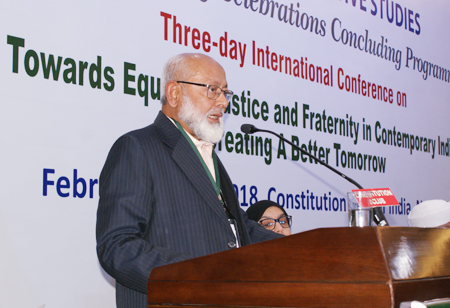
Dr. Mohammad Manzoor Alam, the founder of the Institute of Objective Studies (IOS), stands as one of the most prominent leaders of the Indian Muslim community. Recently, his biography “Dr. Manzoor Alam: Empowering the Marginalized” written by senior multilingual journalist A. U. Asif, was released at the Constitution Club of India in New Delhi. The event was attended by several distinguished personalities from politics, academia, the judiciary, and the media.

The biography reveals many unknown aspects of Dr. Manzoor Alam’s life, his contributions, and his wide national and international connections — from Dr. Manmohan Singh to Ahmed Patel, from cabinet ministers to chief ministers and governors. His close friendships extended to Malaysian Prime Minister Anwar Ibrahim and several prominent personalities across the Gulf Cooperation Council (GCC), including ministers and academicians. Among his international associates were Prof. Omar Hasan Kasule, Secretary General of the International Institute of Islamic Thought (IIIT), USA; Dr. Ahmad Muhammad Ali, the first President of the Islamic Development Bank (IDB); Dr. Ahmed Tutunji, General Secretary of the International Islamic Federation of Student Organizations (IIFSO); and Professor Ismail Raji al-Faruqi, co-founder of IIIT, Dr. Abdullah Al-Maatouq, Chairman of the International Islamic Charity Organization (IICO) Kuwait etc.

The Institute of Objective Studies: A Pioneering Muslim Think Tank

Undoubtedly, the IOS — the first Muslim-run think tank in India — has played an unparalleled role in academic and intellectual engagement. Over the past four decades, it has organized more than 1,230 conferences, seminars, symposia, and workshops on diverse issues affecting Muslims and Indian society at large. It has completed over 410 research projects and produced around 405 publications focusing on socio-economic, educational, and cultural challenges.

Through its data-based research, collection, and presentation, IOS provided valuable insights into the conditions of marginalized communities. The institution succeeded in building a network of more than 500 research scholars, social scientists, academicians, judges, lawyers, and politicians. Its studies and deliberations form a crucial body of work on the socio-economic conditions of Indian Muslims.

However, despite its achievements, the IOS has failed to evolve a sustainable mechanism for implementing the findings of its research. After nearly four decades of existence, the impact of its ideas on the ground remains negligible. The think tank, while rich in intellect and intent, fell short of translating its research into practical policies for the empowerment of marginalized communities. When one examines the ground realities, the absence of tangible transformation makes this collective effort appear more like an academic exercise than a movement for social change.

The Promise and the Reality

The Institute of Objective Studies was established in 1986 with the vision of empowering the 200 million-strong Indian Muslim community — a group that, even today, lags behind many other marginalized sections, including Dalits, on multiple socio-economic parameters. While IOS produced a wealth of research and data, it failed to create models of empowerment or tangible change on the ground.

It would be unfair to assume that Dr. Manzoor Alam’s vision was limited to research and conferences alone. He unsuccessfully attempted to extend his work into education, media, and healthcare. Unfortunately, many of those initiatives remained unrealized.

Dr. Alam had conceived numerous projects, including a dream university and  television channels Al-Hind and  Falak TV — both designed to serve as platforms for education and social awareness. He presented these projects at several events in India and abroad, yet they never materialized beyond the planning stage. Why these ideas remained confined to files is a question that only Dr. Alam himself can answer.

Dr. Manzoor Alam’s Tryst with Education and Development

In the 1990s, Dr. Alam invited Mohammad Yunus Saleem, then Governor of Bihar, to lay the foundation stone of an educational institution in his native village, Ranipur, in Madhubani district. Decades later, that very school continues to function from a thatched hut.

Similarly, he invited another Governor, Akhlaqur Rahman Kidwai, to lay the foundation of a hospital in the same village. However, there is no trace of that foundation today, and the land has reverted to agriculture. It is said that even a few delegations of Arab dignitaries visited the site to explore funding possibilities for these projects. Yet, despite such visits and promises, Ranipur remains a mirror reflecting the unfulfilled dreams of Dr. Alam’s vision for grassroots empowerment.

Akhlaq Ur Rehman Kidwai, then Governor of Bihar, during his visit to Ranipur — the native village of Dr. Manzoor Alam — for the foundation stone-laying ceremony of a school.

The Unfulfilled Dream of an Islamic University in India

Following the model of the International Islamic University Malaysia (IIUM), the International Islamic University Islamabad, and the International Islamic University Dhaka, it is said that funds were once earmarked for a similar university in India. The responsibility for establishing it reportedly rested with Dr. Manzoor Alam. A 25 acres  of land were even purchased in Palwal district, Haryana, under the Taawun Trust which was formed in 1980s for the same purpose. However, the project never moved forward, and its current status remains unknown.

Under the same trust, a clinic in Zakir Nagar, New Delhi, was inaugurated by the then Chief Minister, Sheila Dikshit. But today, little remains of that initiative — its fate is known only to its former manager, Mohammad Alam, son of Dr Manzoor Alam. Likewise, a valuable piece of land (D-16 worth over 10 crores) in Abul Fazal Enclave, earmarked for the Taawun Trust office, was later developed into a five-storey building. The ownership and purpose of this property are known only to Dr. Alam and other trustees.

Other Institutions and Initiatives

Along with the late Qazi Mujahidul Islam Qasmi, Dr. Manzoor Alam co-founded several organizations, including the All India Milli Council, Islamic Fiqh Academy (IFA), Qazi Publications, Universal Peace Foundation (UPF), Featured and News Analysis (FANA), United Mass Media Association (UMMA), Indo-Arab Economic Cooperation Forum, and the Taawun Trust. Except for IOS and IFA, most of these institutions are now nearly defunct.

In earlier years, FANA and UMMA operated from 166 Zakir Bagh but were later shifted to the IFA premises at Zakir Nagar. The present status of the Zakir Bagh flat remains unclear. Similarly, behind the IOS office once stood the premises of the Universal Peace Foundation (UPF), which was closed many years ago.

A Malaysian organization once sponsored Bharat Offset Press, located at 2035 Mumtaz Building, Gali Kasim Jan, Ballimaran, Delhi. The press was set up under Dr. Manzoor Alam’s patronage to provide financial support to widows and orphans. One can only hope it continues to serve that noble purpose today.

Interestingly, most of the important publications of the Institute of Objective Studies are now being published and marketed by Genuine Publications and Media Pvt. Ltd., where Dr. Alam’s younger son, Ibrahim Alam, serves as the Executive Director.

Now, his elder son Mohammad Alam has taken over as the General Secretary of the IOS. It is hoped that the unfulfilled dreams of Dr. Manzoor Alam will be realized and a university will be established on the proposed land in Palwal

The Unasked Questions

A serious question arises: Why has no one from among Dr. Manzoor Alam’s large circle of associates — including intellectuals, professors, writers, and bureaucrats — ever raised concerns or sought accountability? Why has there been such silence around the unrealized projects and abandoned initiatives?

Dr. Alam is a man of extraordinary connections and resources, with access to national and international leaders, institutions, and philanthropists. Yet, despite such privilege and goodwill, he could not establish even a modest school or clinic in his own native village — a village that once saw two governors visit to inaugurate his projects.

Dr. Manzoor Alam’s journey represents a paradox: a leader of vision and intellect who created one of India’s most influential Muslim think tanks, yet whose dreams for practical empowerment of the marginalized remain largely unrealized. His ideas, no doubt, inspired a generation of scholars and activists. But without concrete implementation, the towering edifice of research and conferences risks standing as a monument to missed opportunities.

source: http://www.muslimmirror.com / Muslim Mirror / Home> Exclusive Reports / by Syed Zubair Ahmad / October 30th, 2025
PCI announces Moulvi Muhammad Baqir Award to honour journalists for exemplary work

NEW DELHI :

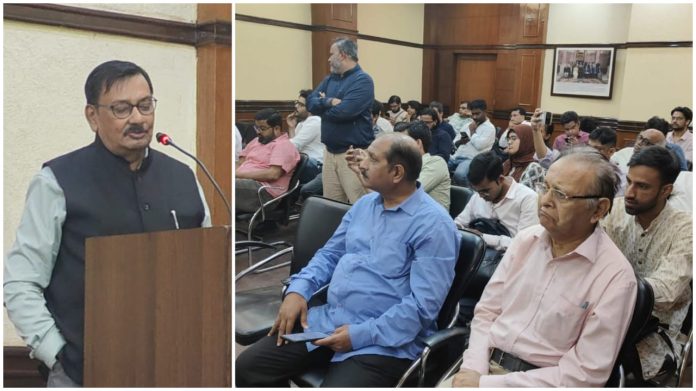
PCI President Gautam Lahiri addressing the gathering

In a significant move, the Press Council of India (PCI) has announced the institution of the Molvi Baqar Award to recognize and honour three outstanding journalists from the Urdu, Hindi, and English media every year.

PCI President Gautam Lahiri revealed this during an event commemorating the life and contributions of Molvi Muhammad Baqar, a pioneering figure in Indian journalism and the first journalist to be martyred during the 1857 Indian Rebellion.

“The criteria for this award will be to encourage journalists to follow in the footsteps of Molvi Baqar, who made the ultimate sacrifice while covering the events related to the 1857 ‘Mutiny’ through his newspaper, Delhi Urdu Akhbar,” said Lahiri in his presidential address. He added that PCI would soon finalize the modalities and constitute a jury to select the awardees.

The event, which focused on “The Life and Times of Moulvi Muhammad Baqir ,” highlighted his role as a patriotic journalist who played a key part in preparing the ground for India’s freedom. Historian and author Dr. Swapna Liddle, the Chief Guest at the event, praised Baqar’s commitment to the nation’s cause, despite the controversies surrounding his role.

“Some confusion exists due to the views of his son, Mohammad Hussain Azad, a renowned Urdu literary figure, who appeared to have taken a contrary position to his father. However, this must be understood in the context of the reign of terror during that time,” said Dr. Liddle, clarifying that Azad’s actions were likely influenced by the pressures of British rule.

Shoib Raza Fatmi, Editor of Hamara Samaj, reinforced this perspective by noting that Azad’s name frequently appeared in Delhi Urdu Akhbar as Editor, Printer, and Publisher, indicating his involvement in his father’s journalistic mission despite the difficult circumstances.

The program also featured a panel discussion moderated by Mahtab Alam, where young Urdu journalists discussed the relevance of Molvi Baqar’s journalism in today’s media landscape. Munazah Shah of News 18 pointed out the striking similarities between the challenges faced by Baqar in his time and those confronting the Urdu media today, particularly financial pressures and the need to foster communal harmony.

“The challenges faced by Molvi Baqar and today’s Urdu media are not very different. We should look to him as a role model for overcoming these obstacles,” said Sohail Akhtar Qasmi of Al Jazeera Arabic.

Tasleem Raja, a journalist with Siyasi Taqdeer and Qaumi Awaaz, echoed this sentiment, emphasizing how much contemporary media could learn from Baqar’s work in covering sensitive and complex issues.

A.U. Asif, a senior PCI member who was instrumental in connecting the Urdu media with PCI initiatives, lauded Molvi Baqar’s pioneering work in investigative journalism. “Molvi Baqar was one of the first to practice on-the-spot reporting and investigative journalism between 1837 and 1857 through his newspaper Delhi Urdu Akhbar, a practice that is now common in today’s media,” said Asif. He congratulated the PCI for unveiling Molvi Baqar’s portrait in its central conference hall, a tribute to his lasting legacy.

The event, organized to mark the martyrdom of Molvi Baqar on September 16, was held a day earlier this year due to the coinciding celebration of the Prophet’s birth anniversary. A large number of journalists attended, and the program concluded with a question-and-answer session.

The institution of the Molvi Baqar Award is seen as a step toward encouraging journalists to adhere to principles of courage and integrity in their work, much like the pioneering figure it honors.

source: http://www.muslimmirror.com / Muslim Mirror / Home> Indian Muslim> Media> Positive Story / by Muslim Mirror Desk / September 16th, 2024

Shams Tabrez Qasmi is Felicitated with Amar Shaheed Molvi Baqar Award 2021

NEW DELHI :

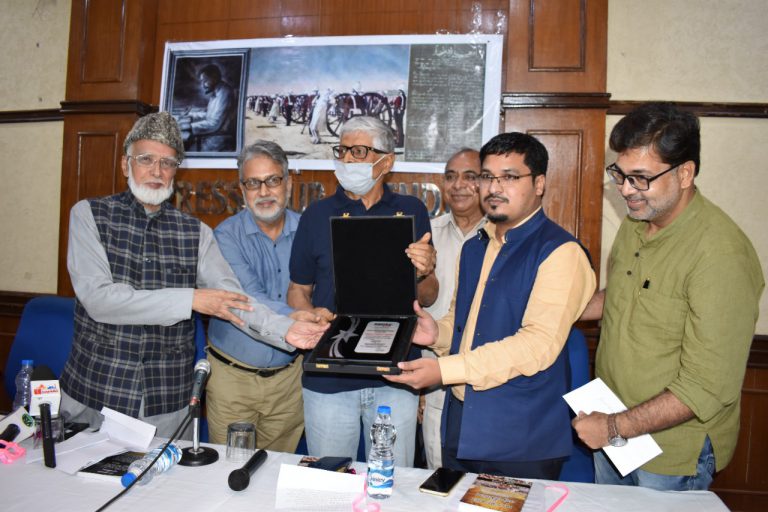
Shams Tabrez Qasmi, the CEO and the chief editor of Millattimes, has been honoured with “Amar Shaheed Molvi Baqar Award 2021”.

The award is in the memory of the martyr and celebrated Urdu journalist Molvi Muhammad Baqar (1780-1857). The award was conferred upon him on 16th September 2021 in a programme held at the premises of the Press Club of India (PCI), 1 Raisina Road, Near Kirshi Bhawan, New Delhi-1 in the presence of the office bearers of the PCI and a good number of the journalists.

The award was presented to Mr. Qasmi in the recognition and appreciation of his commitment, dedication and continuous efforts in the field of journalism.

Millattimes, from its day one, had been covering the issues ignored by the mainstream media, specially the issues of the minority communities and the other weaker sections of the society.

The Award was sponsored by Media 24×7 and Abdul Sattar Memorial Educational Society.

The programme, wherein the award was presented, was held from the Press Club of India (PCI) to commemorate the 164th death anniversary of the Martyr of the first War of Independence 1857 and the famous Urdu journalist Maulvi Muhammad Baqar.

It was addressed by a galaxy of journalists like Mr. Jai Shankar Gupta, Member of Press Club of India, Satish Jacob, former BBC journalist, Meem Afzal, ex-MP, Ismail Zafar Khan, SK Pande, Arvind Kumar Singh, Qurban Ali, Maroof Raza, Masoom Moradabadi and others, besides chief guest Prof. Azra Mosavi, a direct descendant of Maulvi Muhammad Baqar’s grand family from AMU, Aligarh.

The Press Club of India resolved in its meeting held on 6th September 2021, in the presence of its President, Mr. Umakant Lakhera, Secretary General Mr. Vinay Kumar and other members, like Mr. A. U. Asif, Press Club of India’s executive member, to commemorate the death anniversary of the Martyr of the first War of Independence 1857 and the famous Urdu journalist Maulvi Muhammad Baqar.

It was also decided that an award after his name will be presented to two journalists every year along with an amount of 21,000-00 Indian Rupees.

According to the resolution, this programme was held on 16th September 2021 and two dynamic, youth, budding and promising journalists: Maulvi Shams Tabrez Qasmi, a Darul Uloom Deoband Alumnus and the Chief Editor of Millattimes and Swati Mathur, a JNU Alumnus and a reporter with The Times of India were felicitated with the award named after him.

The Press Club of India (PCI), as stated at its website, is basically a meeting point for the journalists. The idea to set up the Press Club of India was first conceived by eminent journalist and editor Mr Durga Das in the early 1930s. When he had visited London as the editor of the Associated Press of India, he had chance to visit the London Press Club as well. It became a motivator for him to replicate the model in Delhi.

Eventually the Press Club of India was founded on December 20, 1957 and incorporated as a company on March 10, 1958. Mr Durga  Dass, the then Editor of The Hindustan Times was elected its first president and Mr D R Mankekar, a veteran journalist, became the first secretary general of the Club.

Now, it is an important and oldest body of the Indian journalists which is run by the elected President, Secretary general and members.

Moulvi Muhammad Baqar, a scholar, a journalist and an Indian independence activist, was born in 1780 in Delhi. He received his basic education from his father. For further studies, he got admission in Delhi College. Following his graduation, he was appointed as a teacher in Delhi College in 1828. He served as a teacher for six years.

Along with being one of the best editors, he was a successful reporter as well.

He launched a weekly newspaper namely “Dehli Urdu Akhbar” in 1835. It survived for almost 21 years and proved to be a milestone in the field of the Urdu Journalism. With the help of this weekly, he played a significant role in social issues. The weekly brought political awakening in masses and united them against the tyrant British rulers.

It is a fact that Maulavi Muhammad Baqar always advocated for the unity among the Muslims and Hindus as he thought that it is necessary to get rid of British rule.

He was arrested on 14th September 1857 for revolt. On 16th September 1857, he was tied to the mouth of a cannon. Then he was fired mercilessly by Major William SR Hudson.

Thus he became the first journalist to be executed following rebellion in 1857 by the then tyrant British government ruling over India.

Mr. Qasmi, who was felicitated with Amar Shaheed Molvi Baqar Award, is fond of learning, reading and writing from his early age. He has penned more than one thousand articles and essays on religious, social and political issues. He is one amongst the few journalist of the new generation taken seriously in India. He is known as a courageous, bold and fearless journalist.

Being a student in the DUD, he wrote columns for Weekly “Aalmi Sahara” and Daily “Azizul Hind”. It was an honour for him that on 6th December 2014, Dr. Aziz Burney published his article on Babri Masjid in his daily newspaper Azizul Hind as editorial.

When he reached capital city Delhi, he started his career as the editor of known New Agency: “INS”. In 2015, he was offered to write a column for the daily newspaper “Khabren”, New Delhi.

Mr. Qasmi launched a News Portal namely “Millattimes.com” in January 2016.

Officially it was inaugurated by Maulana Sayyid Muhammad Rabey Hasani Nadavi, President: All India Muslim Personal Law Board in Mumbai. Currently it is most read and visited Urdu news portal from India. Along with Urdu language, Millat Times is also providing its services in English and Hindi languages. Its YouTube Channel is also available, where the ignored issues by mainstream media are discussed.

He has interviewed several towering personalities like Mr. Iqbal Ahmad Ansari, ex-Chief Justice of Patna High Court and General Zamiruddin Shah, ex-VC of Aligarh Muslim University to let the viewers know their lives, services and views on several topics.

The area of his main interest is issues of Indian Muslims, current affairs of the Muslim World and the Middle East.

On this auspicious occasion, I congratulate Mr. Qasmi from the bottom of my heart! Congratulations! I hope Millattimes, as a media house, will continue offering its services and covering the issues, under Mr. Qasmi’s able leadership, which are commonly ignored by the mainstream media houses. ****

Email: qasmikhursheed@yahoo.co.in

source: http://www.millattimes.com / Millat Times / Home> Opinion / by Khursheed Alam Dawood Qasmi / Millat Times Staff / September 19th, 2021

Press Club of India Remembers Maulvi Baqar — India’s ‘First Martyr Journalist’

DELHI :

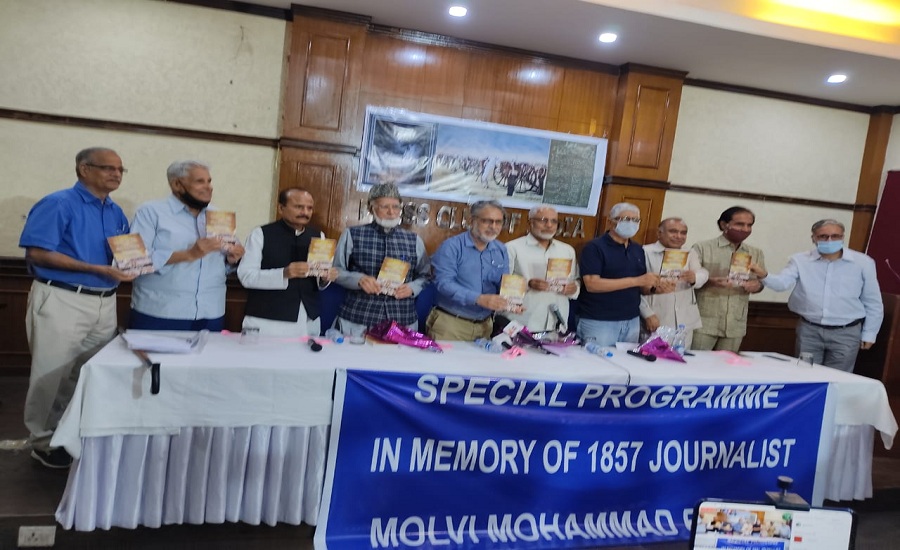
Masoom Muradabadi’s book was launched at the Press Club on Thursday by eminent journalists

The event was organised to launch the Hindi translation of journalist Masoom Muradabadi’s book on Maulvi Baqar.

New Delhi :

The Press Club of India on Thursday held a seminar to commemorate the death anniversary of Maulvi Mohammad Baqar, the first journalist who was executed by the British following the rebellion of 1857.

A Hindi translation of the book titled ‘1857 Ki Kranti Aur Urdu Patrkarita’ (The Revolution of 1957 and Urdu Journalism) authored by journalist Masoom Muradabadi was released at the seminar.

It chronicles the life of Baqar as a journalist and freedom fighter. Moreover, two journalists — Swati Mathur, a reporter with The Times of India, and Shams Tabrez Qasmi, the editor of popular news portal Millat Times — were also felicitated with an award named after Baqar.

A number of veteran journalists and writers spoke on the occasion paying tributes to the ‘first martyr journalist’. They described Baqar as an icon of Hindu-Muslim unity whose ideals are increasingly relevant in the present times.”

“Maulvi Muhammad Baqir was one of the great journalists who preferred martyrdom to collaboration with Britishers.” A U Asif, a senior journalist and member of Press Club’s managing committee, said. “He is the ideal and role model for the new generation of journalists.

Satish Jacob, a BBC veteran, said Baqar was a journalist who sacrificed his life for the sake of the nation. He described him a proponent of Hindu-Muslim unity.

Jacob said he is proud of the fact that he hails from old Delhi which gave birth to a person like Baqar. He said that Baqar had started an Imam Barah in the Kashmere gate area which is still functioning. The Imam Barah was built with the expressed goal of communal harmony, he added.

Noted journalist Meem Afzal, who has been a member of Parliament and India’s ambassador in four countries, lashed out at the current government for communal divide and accused it of obliterating the contributions of people like Baqar. He said that Baqar used his pen to fight for the idea of India.

Maroof Raza, another journalist, appealed for steps to find the original source and preserve the archives of ‘Delhi Urdu Akhbar’, the newspaper Baqar used to publish.

Jai Shanakar Gupta, senior journalist and a member of the Press Council of India, urged the government to get copies of the newspaper that Baqar edited from Britain where they are lying in a museum.

SQR Ilyas, journalist and president of the Welfare Party of India, said that the sacrifice of Baqar should inspire the present-day journalists to speak truth to power. He lauded the Press Club for commemorating Baqar.

Similar sentiments were echoed by Syed Aijaz Aslam, editor of Radiance Viewsweekly.

Mathur and Qasmi expressed their gratitude to the Press Club for felicitating them with the award. “This recognition in the form of an award in Maulvi Baqar’s name is a big thing for me, ” said Mathur.

Qasmi credited his whole team of Millat Times for the work that earned him the award.

source: http://www.clarionindia.net / Clarion / Home> Editor’ Pick / by Zafar Aafaq, Clarion India / September 16th, 2021