Tag Archives: Begum Hazrat Mahal

Sify columnist releases book on Indian Muslim freedom fighters

NEW DELHI :

FreedomFightersMPOs22dec2017

Patna:

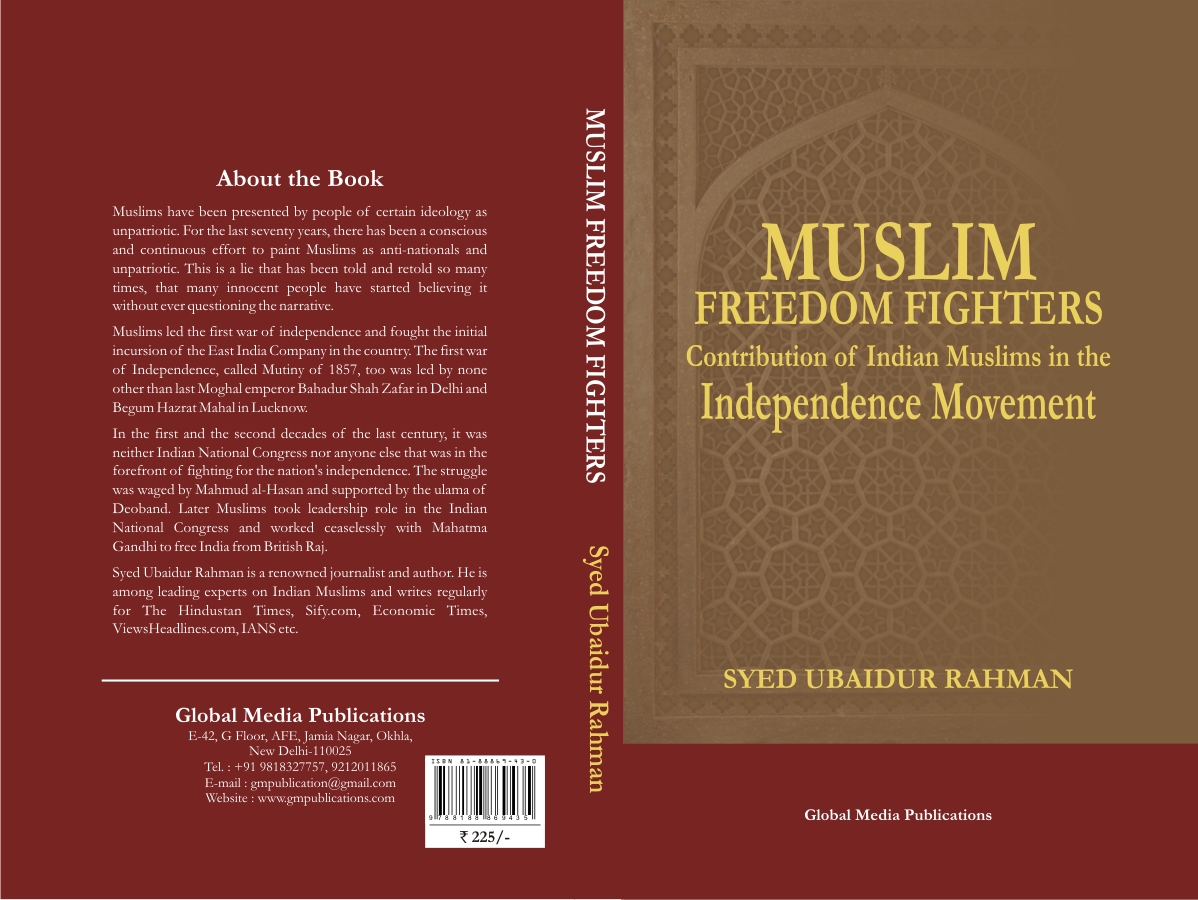
In a glittering ceremony, two books on the Muslim community’s contribution to the Indian freedom movement were launched in Patna last week. The function was presided over by Harsh Mander, former IAS officer and human rights activist.

The books ‘Muslim Freedom Fighters: Contribution of Indian Muslims in the Independence Movement’ and its Urdu version ‘Muslim Mujahideen-e-Azadi aur Tehrik-e-Azadi Mein Unki Khidmat’ have been authored by well-known Delhi based author and journalist Syed Ubaidur Rahman.

The two books try to fight the oft-repeated allegations that Muslims are anti-national and have not contributed for the freedom of the nation. The books nail the lie and prove that Muslims not just participated in the freedom movement, they went on to lead the freedom struggle for a long time. The first war of Independence or Mutiny of 1857 was led by Mughal emperor Bahadur Shah Zafar in Delhi and Begum Hazrat Mahal in Lucknow.

The Independence Movement in the first two decades of the twentieth century was led by Mahmud Hasan and ulama of Deoband and they had respect and support of everyone including Hindus and Muslims.

If anyone has any doubt about the Muslim contribution in the freedom movement, the fact that the Indian National Congress had as many as nine Muslims as its president till the year 1947 will remove such doubts.

While speaking on the occasion, Harsh Mander said that the divisive forces in the country are trying to divide the nation on the basis of religion and faith. He said that the danger from such forces for the national fabric and its unity has become grave.

Mander added that the threat to the communal amity in the country was never so high as is today as divisive forces are doing every thing to pit one community against the other and create a fear psychosis among the majority community prompting it to turn it against minorities.

Khursheed Mallick, a Chicago based urologist, philanthropist and director of IMEFNA said that the book is a timely reminder to the nation that Muslims and Hindus both sacrificed for the nation and this fact must be clearly told to our young generation. He said Muslims sacrificed heavily for the cause of the freedom of the nation and efforts must be made to tell the history.

Syed Ubaidur Rahman, the author of the two books, while speaking on the occasion said Muslims have been rather loath to write about the sacrifices they have made for the cause of the Independence and freedom. He said Muslims suffered badly throughout the freedom movement. They were the worst suffers in the wake of the mutiny of 1857 and its aftermath when Muslims were hounded across North India and beyond. Tens of thousands of Muslims lost their lives for the freedom.

Syed added that ulama of Deoband played a stellar role in the freedom movement. Unlike the common perception, they were secular to the core and when they established a government in exile in Kabul in 1915, they appointed Raja Mahendra Pratap as its President and Maulana Barkatullah Bhopali as its Prime Minister.

The book documents the lives of forty renowned Muslim freedom fighters including, Shaikhul Hind Maulana Mahmud al-Hasan, Maulana Barkatullah Bhopali, Hakim Ajmal Khan, Maulana Ubaidullah Sindhi, Maulana Abul Kalam Azad, Maulana Mohammad Ali Jauhar, Dr Maghfoor Ahmad Ajazi, Dr Mukhtar Ahmad Ansari, Ashfaqulla Khan, Maulana Hasrat Mohani, Maulana Muhammad Mian Mansoor Ansari, Asaf Ali, Husain Ahmad Madani, Aruna Asaf Ali (Kulsum Zamani), Peer Ali Khan, Saifuddin Kitchlew, Mohammed Abdur Rahiman, Captain Abbas Ali, Abdul Qaiyum Ansari, Prof. Abdul Bari, Moulvi Abdul Rasul, Nawab Syed Mohammed Bahadur, Rahimtulla Mahomed Sayani, Syed Hasan Imam, Sir Syed Ali Imam, M.C. Chagla, Yusuf Meherally, Justice Fazal Ali, General Shah Nawaz Khan, Allama Fazle Haq Khairabadi, Maulana Shaukat Ali, Syed Mahmud, Maulana Mazharul Haque, Badruddin Tyabji, Col Mehboob Ahmed, Begum Hazrat Mahal, Maulana Shafi Daudi, Rafi Ahmed Kidwai, Syed Mohammad Sharfuddin Quadri, Batak Mian .

The book launch function was organized at Anjuman Taraqqi Urdu and was presided over by Abdul Qaiyum Ansari, chairman of Anjuman Taraqqi Urdu Bihar.

Syed Ubaidur Rahman is a New Delhi based writer and commentator. He has written several books on Muslims and Islam in India including Understanding Muslim Leadership in India.

source: http://www.sify.com / Sify.com / Home> SifyNews> National / by SIFY.com / Friday – December 22nd, 2017
The Begum and the Mutiny

Kotwara, UTTAR PRADESH / FRANCE :

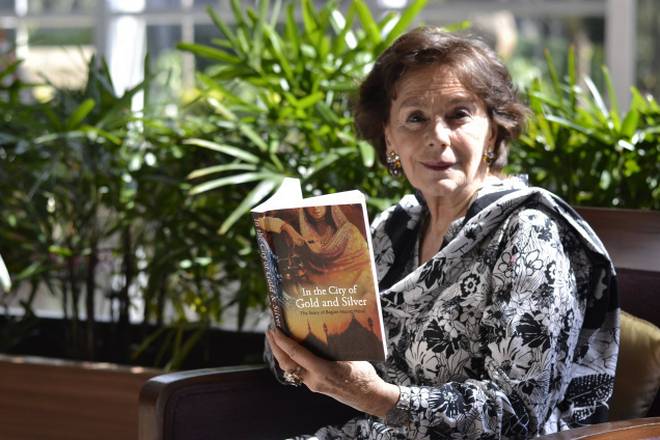
Kenize Mourad, author of ‘In the city of gold and silver – the story of Begum Hazrat Mahal’. Photo: Sangeetha Devi Dundoo

Hyderabad :

In the story of Begum Hazrat Mahal, Kenize Mourad found a story that belied misplaced notions of Muslim women of yore

Kenize Mourad, while researching for her book ‘In the City of Gold and Silver’, came across references to Begum Hazrat Mahal in documents written by the British. They referred to her as the ‘soul of the 1857 War of Independence’. “It is unfortunate and unfair that she has been forgotten in India,” says Kenize Mourad, in Hyderabad to launch her book ‘In The City of Gold and Silver – The Story of Begum Hazrat Mahal’ (Full Circle publications; Rs. 350).

Speaking to us in an interview, the author says, “Rani of Jhansi, Lakshmi Bai, is remembered because she died on the battlefield. She fought for about four or five months. Begum Hazrat Mahal fought the British for two years. It took the British nine months to gain control over Lucknow. The Begum continued her fight for a year after this.”

Kenize Mourad is of Turkish and Indian descent, Awadh to be precise. “I first visited Lucknow when I was 21 and heard about Begum Hazrat Mahal and her valour from my father (Raja Syed Sajid Husain Ali of Kotwara). Years later, I remembered the story and felt the Begum’s story had to be told,” says Kenize.

The author pored over documents and books in libraries of London, New Delhi and Lucknow. “It took me three years to find enough information. In Lucknow, I spoke to families whose ancestors had fought in the battle along with the Begum. Quite a bit of history in India follows an oral tradition,” explains Kenize.

She scouted libraries in London and came across six volumes of ‘Mutiny Papers’ documented by the British. An 1858 edition of The Times had stated ‘The Begum of Awadh shows greater strategic sense and courage than all her generals put together’. Kenize wanted to write about the Begum and dispel notions about Muslim women of yore. “The book is relevant in this time when Islam is misrepresented. The majority of Muslims, 95 to 98 per cent, is also being put in the same bracket as extremists, which is unfair. And these normal people are the first ones to suffer due to extremists,” says Kenize. “I wanted to show how a Muslim woman was strong enough to lead an army. The Begum was an intelligent woman who enforced justice and waived taxes on food for the poor,” says Kenize.

Kenize takes pride in raising her voice for underdogs all through her career as a journalist in France. “I’ve felt like a fighter for justice all my life. In my books, I have often written about the misrepresentation of the Quran,” says Kenize. History, she says, has intriguing accounts of women Muslim rulers. “There are instances of Turkish women holding important positions on their own right, not because they are mothers, sisters of wives of important men.”

Though Kenize was keen to present accurate historical facts in ‘In The City of Gold and Silver’, she took the liberty of weaving in a love story between the Begum and a dashing Hindu Raja. “I felt people will absorb an interesting historical novel than a dry book full of facts. Keeping the sociology of people in that era, I tried to recreate Awadh of those times,” says the author.

Kenize wrote the book in French. “In France, the book sold more than 70,000 copies. The pocket-friendly (abridged) version sold even more copies,” she says. The book has been translated in English by Anne Mathai and Marie-Louise Naville.

Talking about her roots in Lucknow, Kenize says, “During my first visit to Lucknow as a student, I was amused and spent six months there. Had it been a bigger city like Delhi or Mumbai, I might have stayed on. Opportunities for work were limited. And I wasn’t willing to sit at home and get ready to be married off,” she says. The topic of marriage reminds her of Hyderabad. “I was almost married off to a well-known Hyderabadi,” she says. “Through my cousin, Princess Niloufer, I happened to meet a gentleman from the Nizam’s family. He told Niloufer that he hoped for my hand in marriage. I found it odd that he hadn’t asked me directly. I was given to understand that I would be a ‘bird in a golden cage’. I turned down the proposal.”

This is Kenize’s first visit to Hyderabad. “I never visited this city thinking I may not be welcome here since I turned down the marriage proposal,” she laughs.

Next, Kenize wants to write about present-day Pakistan. “The country, as it exists today, is a tragedy. I want to write about Pakistan through fiction. It will take at least three to four years to work on the book,” she signs off.

source: http://www.thehindu.com / The Hindu / Home> Books / by Sangeetha Devi Dundoo / Hyderabad – January 17th, 2013

Begum Hazrat Mahal: The Pari Who Became a Revolutionary


BegumHazratMPOs01jun2016

Awadh(Lucknow), UTTAR PRADESH :

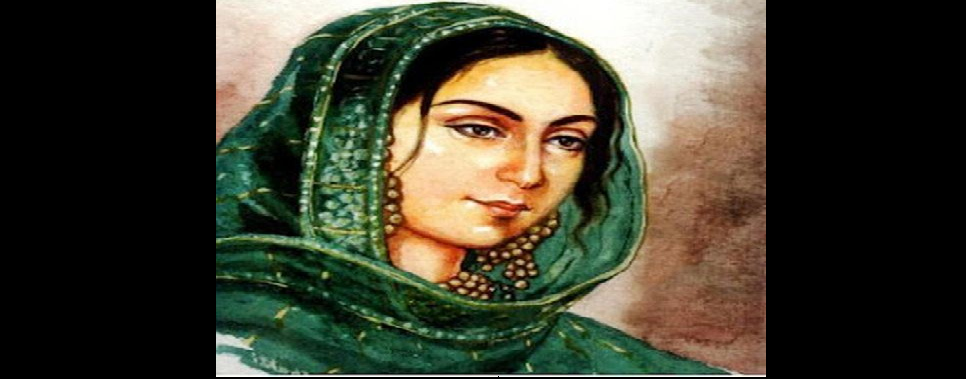
June, in particular is a good month to remember Begum Hazrat Mahal who led the first war of independence against the British in Lucknow. This Begum of Avadh had defied British forces of the East India Company in the great uprising of 1857.

She was one of the nine divorced women of Wajid Ali Shah, Lucknow’s last ruler.

“When the king left Lucknow on 13 March 1856 he took with him as well as his mother, three of his wives including Khas Mahal and Akhtar Mahal. An unknown number of wives were left behind in Lucknow as well as nine divorced women including Hazrat Mahal and her young son,” writes Rosie Llewellyn-Jones in The Last King in India.

Begum Hazrat Mahal took charge of the city despite her divorce from the king and her supporters included Raja Jailal Singh, a former Nizam of Azamgarh. It was Raja Jailal who fed support to the rebellion from the suburbs around Lucknow.

The other supporter defending Lucknow was Nana Sahib, a Maratha soldier and childhood friend of Rani Lakshmibai. Nana Sahib led the revolt against the British in Kanpur. Like Begum Hazrat Mahal he too retreated to Nepal after the British regained Lucknow in 1858.

Wajid Ali Shah was forced to leave Lucknow for exile in Calcutta, by the British. Lucknow was one of the most bitterly contested cities during this first war of independence against the British.

Between the exile of Wajid Ali Shah in March 1856 and the first war of independence in June 1857, Lucknow was defended by Begum Hazrat Mahal and she ruled as regent for 10 months. Her 12 year old son Birjis Qadr was crowned in the Baradari at Qaiserbagh, the palace built by his father.

After the British overpowered the freedom fighters, Begum Hazrat Mahal refused a pension and continued gorilla attacks on British military centers till November 1859. She spent the rest of her life in Kathmandu, Nepal and was buried there in 1879.

It may be recalled that fighting broke out at the end of June in 1857 against the British after soldiers mostly from the Avadh region heard that their mild mannered ruler was unceremoniously stripped of his throne and his kingdom by the British on grounds of mismanagement. Their first reaction was one of disbelief. Their second reaction was of anger. soldiers in different parts of north India took up arms and in Lucknow laid siege to the city’s British Residency where English and Anglo Indian inhabitants were hiding for four and a half months between July and November 1857.

But before Begum Hazrat Mahal transformed into a revolutionary she was a fairy. It may be recalled that apart from official wives and temporary wives there was yet another category of women, the pari or fairy who was often taken on as a temporary wife if the king found her pleasing and talented. The fairies were certainly an innovation of Wajid Ali Shah, poet prince and were recruited from the lower classes, including courtesans who lived mainly in Chowk, in the old city.

These women were not educated but after tuitions some of them acquired sophistication. Some fairies went on to become expert singers or dancers while others proved to be good for nothing.

Begum Hazrat Mahal’s maiden name was Muhammadi Khanum, and she was born in Faizabad. Her father was a slave called Umber owned by a Ghulam Hossein Ali Khan. Her mother was a Muslim mistress of Umber. A courtesan by profession, Muhammadi was taken into the royal harem after being sold by her parents.

She was later promoted to a fairy and was called Mahak Pari by the king. She became a begum after being accepted as a royal concubine of Wajid Ali Shah and the title Hazrat Mahal was given to her after the birth of their son, Birjis Qadr.

For some time Wajid Ali Shah was completely smitten by Hazrat Mahal. writing many poems for the dusky beauty.

Soon the king moved on to other women but in 1845 when he learned that Mahak Pari was pregnant, he immediately put her into purdah and gave her the title of Iftikhar-un-nisa or pride of all women.

Now this beautiful fairy, brave freedom fighter and pride of all women is immortalised in a documentary film directed by Mohiuddin Mirza and produced by the Films Division that was screened in the city by Lucknow Expressions Society in the presence of Kaukab Qadr Meerza, great grandson of Begum Hazrat Mahal and Manzilat Fatima, the warrior queen’s great great grand daughter.

“The aim is to never forget how the entire city had united under the leadership of Begum Hazrat Mahal to stand up against the British irrespective of religious and gender differences,” said an organiser of the event.

source: http://www.thecitizen.in / The Citizen / Home / by Mehru Jaffer / Monday – May 30th, 2016

Film on Begum brings Avadh’s queen to life

Lucknow:

It will be a royal evening for Lucknow coming Monday when in the company of the last Queen of Awadh, Begum Hazrat Mahal, the city will come face to face with its past. In the 137th death anniversary year of the Queen, an unsung hero of the first war of Independence of 1857, a documentary on her will be screened on May 30.

Claimed to be the first ever film on the Queen, the 26-minute documentary has been directed by national award-winning director Mohi-ud-Din Mirza. Commissioned by the Films Division, the film will be screened by the Lucknow Expressions Society along with the UP Tourism department. Prince Kaukab Qader Meerza, great grandson of the Queen, will also be coming to Lucknow from Kolkata for the day.

The screening comes with an aim to enlighten people about the sacrifices of the freedom fighter for the motherland. Documenting the history of Begum Hazrat Mahal as also including her direct descendants, it shows the Queen in her role as one of the first women revolutionaries in India’s independence struggle.

“It is for the first time that a film has been made on my great great grandmother who is someone that we have grown looking up to,” said Manzilat Khan, a direct descendant of King Wajid Ali Shah and Begum Hazrat Mahal. Khan will also be in the city on the day. It was after King Wajid Ali Shah was exiled to Matiaburj in Kolkata that the Queen fought valiantly against the British troops annexing Awadh, defeating them in Alambagh. She later took refuge in Nepal where she died on April 7, 1879.

“At the time when the independence of women was just a notion, she had a vision for the country’s freedom from the British. She chose to fight and take it on herself. Not many know about her struggle and the film will rightfully do that,” added Khan.

source: http://www.timesofindia.indiatimes.com / The Times of India / News Home> City> Lucknow / TNN / May 26th, 2016

India recalls Hazrat Mahal’s role in freedom struggle

Uttar Pradesh (India) / Kathmandu (Nepal) :

Kathmandu : (PTI) 

India today said Begum Hazrat Mahal, who had rebelled against British colonial rule in the country in 1857-58, will always be remembered for her contribution in India’s freedom struggle and described her as a “source of inspiration”.

Recalling Begum’s contributions towards the freedom movement of India, India’s Ambassador to Nepal Ranjit Rae laid a wreath on her tomb to commemorate her 137th death anniversary here.

“We must remember her with great honour as she has been a source of inspiration for us all,” Rae said.

Begum of Awadh and the first wife of Nawab Wajid Ali Shah, who was one of the heroes of freedom struggle of 1857, died on April 7, 1879 during her refuge in Nepal.

Noting that Mahal was one of the freedom fighters of the first freedom movement of India, Rae said she had always been remembered for her contributions in India’s freedom struggle.

He also offered to provide necessary assistance to protect and preserve one and a half century old Hazrat Mahal tomb located in the heart of Kathmandu.

“Hazrat Mahal has been a symbol of age old tie between Nepal and India,” Rae said.

Begum fiercely fought the British East India Company during the Indian Mutiny of 1857-58, with the help of her commander Raja Jailal Singh. When her forces regained power of Lucknow for a brief stint, her son Brijis Qadra was declared ruler of Awadh.

When the forces under the command of the British re-captured Lucknow and most of Awadh, she was forced to retreat. She then took refuge in Kathmandu along with 10-year-old Qadr and some other loyal supporters.

Begum’s rebellion was ignited by the demolition of temples and mosques by the East India Company to make way for roads.

source: http://www.ptinews.com / Press Trust of India (PTI) / Home> International / by Shrish B Pradhan / Kathmandu – PTI,  April 07th, 2016

India recalls Begum Hazrat Mahal’s contribution to freedom struggle

Uttar Pradesh (India) / Kathmandu (Nepal) :

BegumHazratMPOs08apr2016

Begum Hazrat Mahal was one of the freedom fighters of the first freedom movement of India, Rae said she had always been remembered for her contributions in India’s freedom struggle.

Kathmandu :

India today said Begum Hazrat Mahal, who had rebelled against British colonial rule in the country in 1857-58, will always be remembered for her contribution in India’s freedom struggle and described her as a “source of inspiration”. Recalling Begum’s contributions towards the freedom movement of India, India’s Ambassador to Nepal Ranjit Rae laid a wreath on her tomb to commemorate her 137th death anniversary here.

“We must remember her with great honour as she has been a source of inspiration for us all,” Rae said. Begum of Awadh and the first wife of Nawab Wajid Ali Shah, who was one of the heroes of freedom struggle of 1857, died on April 7, 1879 during her refuge in Nepal. Noting that Mahal was one of the freedom fighters of the first freedom movement of India, Rae said she had always been remembered for her contributions in India’s freedom struggle. 

He also offered to provide necessary assistance to protect and preserve one and a half century old Hazrat Mahal tomb located in the heart of Kathmandu. “Hazrat Mahal has been a symbol of age old tie between Nepal and India,” Rae said. Begum fiercely fought the British East India Company during the Indian Mutiny of 1857-58, with the help of her commander Raja Jailal Singh.

When her forces regained power of Lucknow for a brief stint, her son Brijis Qadra was declared ruler of Awadh. When the forces under the command of the British re-captured Lucknow and most of Awadh, she was forced to retreat. She then took refuge in Kathmandu along with 10-year-old Qadr and some other loyal supporters. Begum’s rebellion was ignited by the demolition of temples and mosques by the East India Company to make way for roads.

source: http://www.india.com / India.com / Home> News> World / by Wires English / April 07th, 2016