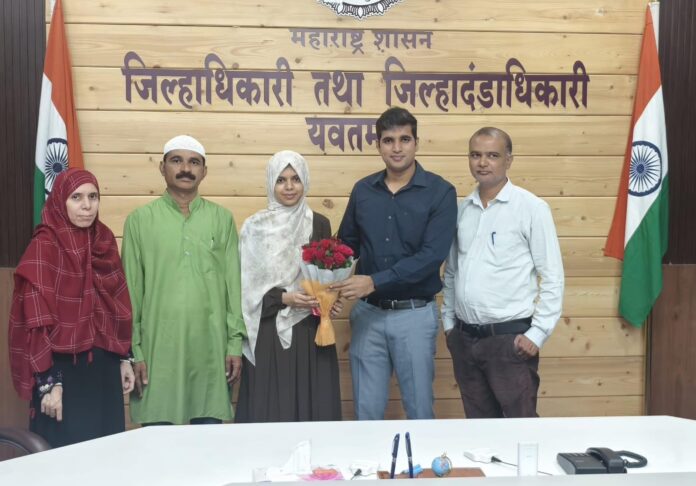
The Union Public Service Commission (UPSC) declared the results of the 2024 Civil Services Examination on April 22, with 1009 candidates clearing one of India’s most competitive exams. Among them, Adiba Anam has made history by becoming the first Muslim woman from Maharashtra to be selected for the Indian Administrative Service (IAS).
Hailing from Kalam Chowk in Yavatmal, a small town in eastern Maharashtra, Anam secured an all-India rank of 142. Her achievement has been widely hailed as a breakthrough for both women and minorities in the state. Her father, Ashfaq Ahmed, earns a living by driving an auto-rickshaw.
Raised in modest circumstances, Anam completed her schooling in Urdu medium from a local Zilla Parishad school. Despite limited resources, she consistently excelled academically—scoring 94% in her Urdu board exams and 92% in 12th grade with a science stream.
Speaking to India Tomorrow, Anam recounted her journey through UPSC. Her first attempt in 2021 ended at the preliminary stage. Undeterred, she progressed to the mains in her second attempt, and finally, in her fourth attempt, clinched success with a rank likely to earn her an IAS cadre.
“My parents never asked me to give up on my education. There were people who suggested I take up a small job to ease our financial burden, but my parents never let those voices affect me,” she said.
Anam noted the social barriers women often face in her community. “Yes, girls do face restrictions. But these challenges only overpower us if we allow ourselves to feel weak. Once we build our mental strength, those obstacles lose their power,” she said. Her message to young women: “Stay mentally strong. Chase your dreams with courage and determination.”
Initially aspiring to become a doctor, Anam couldn’t clear the NEET exam. It was then that her uncle, Nizamuddin Sheikh—a local NGO secretary in Yavatmal—encouraged her to consider civil services as a way to serve the public.
Adiba Anam draws inspiration from the poetry of Allama Iqbal. Two couplets, in particular, fuel her determination:
“Khudi ko kar buland itna ke har taqdeer se pehle, Khuda bande se khud pooche, bata teri raza kya hai, ” meaning, “Elevate your selfhood to such heights that even destiny, before shaping your fate, is compelled to ask you: ‘Tell me, what is it that you desire?’”
This powerful verse emphasizes self-empowerment, urging individuals to strengthen their character and willpower to such an extent that even fate bows before their determination.
“Amal se zindagi banti hai jannat bhi jahannam bhi, Yeh khaaki apni fitrat mein na noori hai na naari hai.” This translates in English as “Through actions, life can become either a paradise or a hell. This being (the human) made of dust is by nature neither angelic nor demonic.”
The couplet underscores the idea that our actions determine the quality and direction of our lives. Human beings are not inherently good (like angels) or evil (like demons); it is their actions (amal) that shape their destiny and define their identity.
Explaining the two couplets, she said, “These lines remind me of the power of action. If you just sit still, nothing will change. But if you act, if you try to change your situation, something will definitely happen,” she said.
Anam’s journey—from a small-town Urdu-medium student to a future IAS officer—stands as a powerful story of resilience, ambition, and the transformative potential of education.
Here is the list of 26 Muslim candidates who cleared the UPSC Civil Services Examination this year, with their ranks written in front of their names.
• Iram Chaudhary – Rank 40
• Farkhanda Quraishi – Rank 67
• Mohammad Muneeb Bhatt – Rank 131
• Adiba Anam Ashfaq Ahmed – Rank 142
• Wasim ur Rehman – Rank 281
• Md. Nayab Anjum – Rank 292
• Mohammad Haris Mir – Rank 314
• Mohammad Shaukat Azeem – Rank 345
• Alifa Khan – Rank 417
• Nadia Abdul Rashid – Rank 429
• Najma Salam – Rank 442
• Shakeel Ahmed – Rank 506
• Shah Mohammad Imran Mohammad Irfan – Rank 553
• Mohammad Aftab Alam – Rank 560
• Mohsina Bano – Rank 585
• Syed Mohammad Arif Moin – Rank 594
• Ghulam Haider – Rank 633
• Hasan Khan – Rank 643
• Ghanchi Gajala Mohammad Hanif – Rank 660
• Mohammad Salah T.A. – Rank 711
• Sadaf Malik – Rank 742
• Yasir Ahmed Bhatti – Rank 768
• Javed Mev – Rank 815
• Nazeer Ahmed Bijran – Rank 847
• Arshad Aziz Quresh – Rank 993
• Iqbal Ahmed – Rank 998
source: http://www.indiatomorrow.net / India Tomorrow / Home> Education / by Mohammad Akram / April 2025
As many as 97 Muslims from across India have appeared in the UPSC Civil Services Interviews after cracking the Civil Services Mains 2024 exams and now looking for a spot in the Final Merit List to be released with results to be declared on upsconline.nic.in and upsc.gov.in any time after April 17, 2025.
[Grok 3 Image for Representation]
UPSC Civil Services Result 2024:
As many as 97 Muslims from across India have appeared in the UPSC Civil Services Interviews after cracking the Civil Services Mains 2024 exams and now looking for a spot in the Final Merit List to be released with results to be declared on upsconline.nic.in and upsc.gov.in any time after April 17, 2025.
UPSC Civil Services 2024 Result Date
The Union Public Service Commission had conducted the Civil Services Main Exam 2024 from September 20 to 29, 2024. According to the Civil Services Main result announced on December 9, 2024, around 2,845 candidates had passed the written exam and were called for Personal Interviews.
The Personal Interview is the final stage of selection for the coveted Civil Services Posts that include IAS, IPS, IRS IFS and others. The candidates are called for Interviews after they clear Civil Services Preliminary exam followed by CSE Mains.
The Personal Interviews of the UPSC Civil Services exams are scheduled from January 7 to April 17, 2025. Accordingly, the UPSC Civil Services 2024 Result could be announced any time after the last interview slot which is April 17.
Muslims Passing UPSC Mains
Out of the total 2,845 candidates who cleared the Civil Services Main 2024 exam and called for Personal Interview, some 97 are Muslims and they are now eying for a place in the final merit list.
This is around 28 less than their last tally in 2023 when some 125 Muslims had cleared the UPSC Main Exam and were called for interview.
On the other hand, around 2,529 candidates had cracked the Civil Services Prelims and Main exams and called for Personal Interviews in 2022. Among them 83 were Muslims .
Th representation of Muslims in UPSC has been consistently between 3 to 4% in decades. The Civil Services result of this year will show if this changes or remains the same.
(Disclaimer: The UPSC does not identify candidates by their religion. The above list has been compiled based on the names of candidates as mentioned in the UPSC Main result released by the Commission. Few names are Muslim sounding but are also used by people belonging to more than one religion. Accrodingly, this list is not final. Also some names might have been missing from the list, or if included, they might not be necessarily a Muslim.)
Year-wise Performance of Muslims in Civil Services
In 2023, a total of 1,016 candidates were recommended by the Union Public Service Commission for different Civil Services posts. Of them 51 were Muslims .
In 2022, a total number of 933 candidates were recommended for IAS, IPS, IFS, IRS and other civil services posts. Of them 30 were Muslims .
In 2021, a total of 685 were recommended in the UPSC Civil Services 2021 Merit List. Of them, 21 were Muslims. This was the worst performance of Muslim candidates in a decade .
On ther hand, a total of 31 Muslims had cracked the Civil Services Exam (CSE), also known as IAS exam, in 2020 when UPSC had recommended 761 candidates for the top CS posts.
In 2019, 42 Muslims had cracked the exam whereas in 2018 just 27 Muslims had made it to the final result.
The years 2016 and 2017 were the brightest period for Muslim candidates. In 2016, 52 Muslims figured in the list of successful candidates whereas in 2017 their tally was 50.
In 2015, 34 Muslims were among the 1,078 candidates recommended by the Union Public Service Commission (UPSC) whereas 38 Muslims were in the list of total 1,236 candidates in 2014.
In 2013, a total of 34 Muslims had cleared the exam, whereas in 2012, 30 Muslims were among the successful candidates, four of them were among top 100.
Similarly in 2012, 30 Muslims were among the successful candidates and in 2011, 31 Muslims were among the 920 selected for the civil services.
Likewise, in 2010 among the 875 successful candidates 21 were Muslims with Dr. Shah Faisal of Kashmir topping the exam at the national level.
In 2009, a total of 31 Muslims were in the list of 791 successful candidates.
As per the past records, the UPSC declares the Civil Services Final Result few days after the final phase of interview. Accordingly, candidates who are aspiring to become future IAS, IFS, IRS and other such posts can expect their result any time after April 17, 2025.
[The writer, Aleem Faizee, is Founder Editor and CEO of ummid.com. He can be reached at aleem.faizee@gmail.com]
source: http://www.ummid.com / Ummid.com / Home> Education & Career / by Aleem Faizee (some editing) / April 15th, 2025
Yusufpur- Mohammadabad (Ghazipur) , UTTAR PRADESH / NEW DELHI :
As Jamia celebrates 100 years of its foundation, we extend our gratitude to Dr Mukhtar Ansari for his contribution
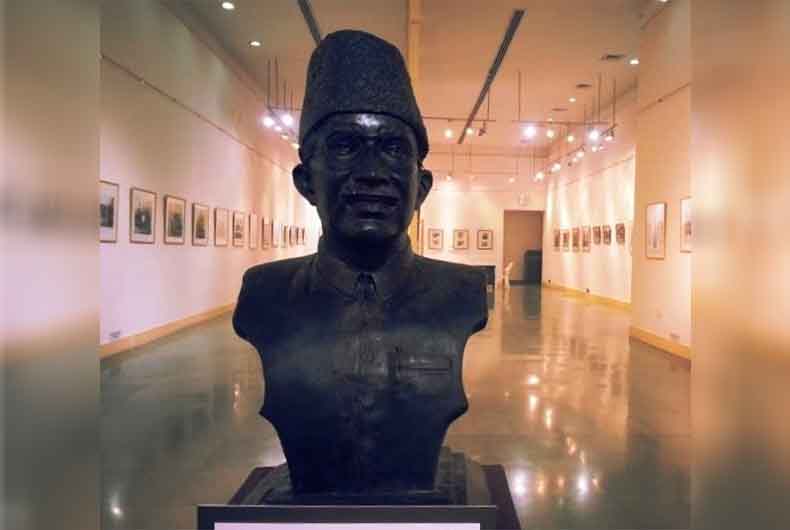
Dr M A Ansari’s bust during a photo-exhibition at M.F. Husain Art Gallery, JMI on 24 Dec. 2014. (Photo Courtesy: Aniket Dikshit)
The three most important persons who, undoubtedly, not only played the most significant role in the foundation of Jamia Millia Islamia, but also shifted it from the makeshift arrangement of Aligarh to Delhi’s Karol Bagh on 7 July, 1925, are Hakim Ajmal Khan, Abdul Majeed Khwaja and Dr Mukhtar Ahmad Ansari.
In view of upheavals faced in Aligarh, Jamia was shifted but problems existed. The problems that made many think that Jamia will not survive long. However, the trio’s efforts were no way trivial. They set the future course of Jamia as ‘an institution with a difference.’
Mukhtar Ahmad Ansari’s consistent efforts bore fruits. Not only did Jamia get its first house in Karol Bagh in 1931, it was also shifted to a much bigger plot of land of its own in 1936 in its present location in South Delhi’s Okhla, then a ‘non-descript village’ where now it has a panoramic sprawling campus.
However, the journey was not as simple as it might look to a casual viewer. Within those ten years, much sweat and blood went in to nurse the tender sapling whose seed was sown in Aligarh on 29 October, 1920. Dr Ansari’s contribution through all these years is one of the most unforgettable and astonishingly stout chapters in the history of Jamia Millia Islamia.
Born on 25 December, 1880 in Yusufpur-Mohammadabad, Ghazipur in eastern Uttar Pradesh, son of Haji Abdur Rahman and Ilahan Bibi, Mukhtar Ahmad Ansari, received primary and secondary education at Ghazipur and Allahabad, then studied medicine and graduated from Madras Medical College. He went to England from where he achieved M.D. and M.S. degrees. He earned the Master of Surgery degree from the University of Edinburgh in 1910. Being a top-class student and a pioneering surgeon he worked in some well-known hospitals of England where “he had a successful medical career”.
Dr Ansari had everything – money, fame, fortune, and life that could be lived luxuriously. This brief background is provided to underscore the significance of his passion, devotion and commitment not just for Jamia but for the country’s struggle for freedom as those were the years of heightened activism for independence during which Dr Ansari – through his active involvement in and unwavering support for freedom, emerged as a committed nationalist leader.
From England, Dr Ansari returned to India in 1910 and started medical practice at Delhi. His contact with leaders like Motilal Nehru, Hakim Ajmal Khan and Pandit Jawaharlal Nehru rekindled in him the desire to take part in the country’s political developments.
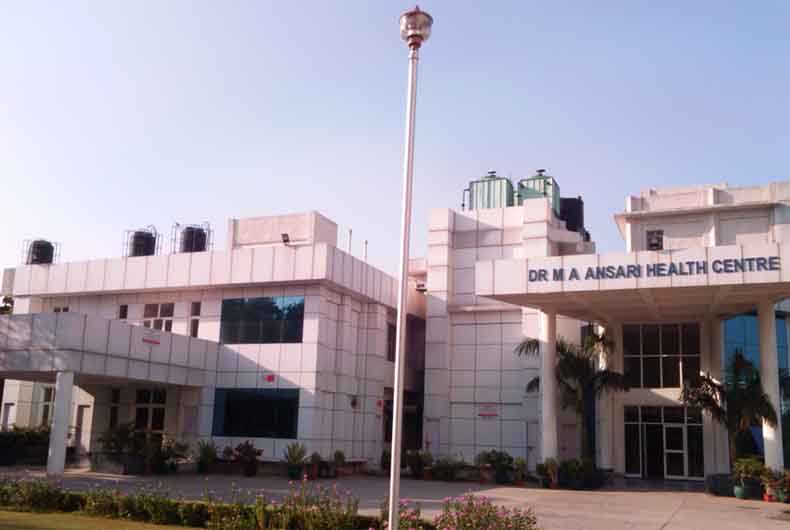
Dr M A Ansari Health Centre, Jamia Millia Islamia. (Photo: Manzar Imam)
During the Balkan Wars of 1912-13, he led a Medical Mission to Turkey to provide medical aid to the Turkish army. “The mission”, according to Dr. Burak Akçapar, Ambassador of the Republic of Turkey to India, “not only established two field hospitals, but also did other humanitarian and political work.”
This was among his first political works which won the hearts and minds of the Turkish public and leaders which created a deep bond between Turkey and Jamia. Many Turkish leaders and prominent literary figures visited Jamia. The series of ‘Extension Lectures’ that began was his brainchild. It was on his invitation that famous Turkish scholars Dr Husein Raouf Bey (1933) and Ms Halide Edib (1936) and Dr Behadjet Wahbi of Cairo (1934) then delivered their lectures at Jamia.
His role in the Khilafat Movement was pivotal and his presence both in the Congress and Muslim League was equally felt. His Delhi house ‘Darus-Salam’ was a meeting point for leading Congressmen. For many years he was General Secretary of Congress and remained a member of the Congress Working Committee all through his life.
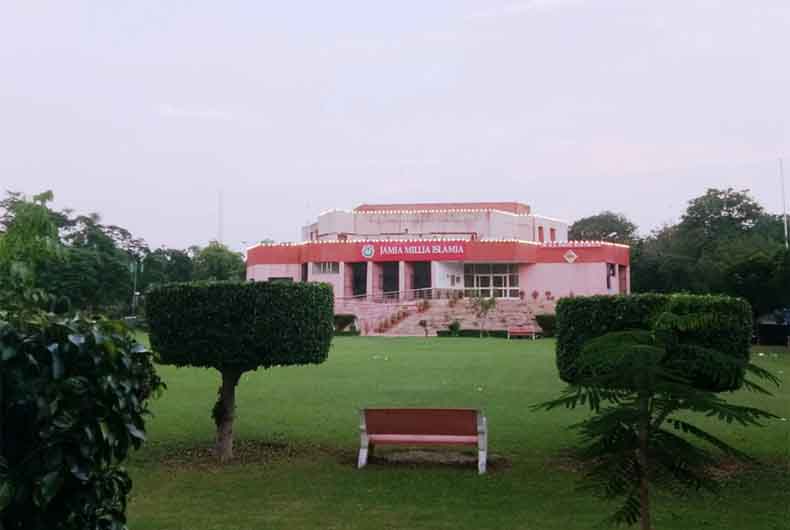
Dr M A Ansari Auditorium, Jamia Millia Islamia. (Photo: Manzar Imam)
Dr Ansari was the leader of the Khilafat delegation of 1920 which went to meet the Viceroy. He was also a member of the second delegation of Khilafat which went to England and other countries of Europe under the leadership of Maulana Mohammad Ali Jauhar. He was also president of the Delhi Khilafat Committee. During his presidential address at the Nagpur session of Muslim League in 1920 he demanded Swaraj.
When his name was proposed for the Secretary of the Foundation Committee of Jamia during its foundation, he requested not to appoint him for the post as it would require regular visits to Aligarh. Nevertheless, his interest in the activities of Jamia persisted.
Dr Ansari was among the front leaders of the Congress and was made its president in 1927. According to Prof Zafar Ahmad Nizami his name for the president of Congress was proposed at the instance of Mahatma Gandhi in 1924 who believed that “only he could make the efforts of Hindu-Muslim unity successful.”
Although Dr Ansari could not live long to see Jamia blossom into a beautiful university or see India breathing in freedom from the strangulating slavish life under the colonial rule, he had played his gigantic role both as a freedom seeker and as a founder of Jamia. He was a prominent member of the sixteen-member Foundation Committee formed on 29 October, 1920 to establish Jamia which would become a historic institution and the first one to be set up in response to call for boycott of the British Indian government-run, aided and supported academic institutions.
According to The British Medical Journal:
“As leader of the Congress movement, though at first opposed to the teaching of Gandhi on civil disobedience, he actively associated himself later with the various non-cooperative movements, and served at least one term of imprisonment.”
When it comes to Jamia as also to some other movements that were the currency of the 1920’s and 1930’s, it is very difficult to dissociate the trio of Hakim Ajmal Khan, Maulana Mohammad Ali Jauhar and Dr Mukhtar Ahmad Ansari, the “great Muslim trio of Indian politics”, as they were quite befittingly called so. However, each person has certain unique and individual personality traits and characteristics which separate him from others.
According to Dr Hamida Riaz (1988, p.119), Dr Ansari had a great passion for education. Initially, he highly appreciated Western education and culture and would keep himself completely away from what did not interest him. However, on the call of Mohammad Ali Jauhar, he participated in the medical delegation that went to Turkey and did a tremendous service. In a way, the beginning of international politics in India was made by Dr Ansari’s delegation.
Together with Hakim Ajmal Khan, Motilal Nehru and Maulana Azad, Dr Ansari formed a non-sectarian “Indian National Union.” He had opposed the Rowlatt Bill and participated in Home Rule and Non-Cooperation movements. In 1929, Dr Ansari formed the All India Muslim Nationalist Party. Besides Jamia, he was also associated with the foundation of Kashi Vidyapith, Benaras.
Faculty of Dentistry, Jamia Millia Islamia. (Photo: Manzar Imam)
Riaz (p.121) writes that all through his life he [Dr Ansari] “stayed away from sectarian groups” and continued his efforts to forge “Hindu-Muslim unity”. His wife Shamsun Nisa Begum too, was committed to the cause of women uplift.
Dr Ansari actively participated in the Jamia’s establishment, nurtured it, and, following the demise of Hakim Ajmal Khan in December 1927, served as its second Chancellor from 1928 to 1936. The financial needs that Hakim Sahab used to carry had fallen on his shoulder which he discharged diligently.
The “Ajmal Khan Fund”, set up exclusively for the purpose, was a result of his efforts. At a critical juncture when Jamia faced great financial crisis a Board of Trustees was created. Dr Ansari was appointed its chairman. It was at Gandhiji’s indication that industrialist Jamnalal Bajaj (1889-1942) was made its treasurer. Other bodies were also formed in which he was there.
As Chancellor of Jamia, Dr Ansari could not be an employee and Life Member of the ‘Anjuman Talim-e-Milli’. However, he extended all his support to all the bodies and continued to serve Jamia all his life. Remembering the services of Hakim Ajmal Khan and Dr Mukhtar Ahmad Ansari during a lecture in Jamia on 26 August 2014, former VC and renowned historian Prof Mushirul Hasan (d. 10 December 2018), terming the duo as the “real founders” of Jamia, had said, “Ansari raised money for Jamia and Hakim Ajmal Khan provided nobility and support.”
As mentioned earlier, Dr Ansari did not live long after Jamia was shifted to its present place in the national capital. He passed away on 10 May, 1936 and buried in the Jamia graveyard.
A radio speech which Dr Zakir Hussain had prepared for the 1936 Foundation Day of Jamia, which Dr Ansari could not hear as he passed away before it, sheds enough light both on the impact Dr Ansari had on Dr Zakir Husain and on his character and sphere of activity. It read:
[Dr Ansari] set out for a journey from which no one looks back…Dr Sahab’s personality was a fountain of blessings…a mainstay for anyone in times of need. His heart was a refuge where many would seek solace for their heartfelt grief.
As in life, in death too, he did not part ways from Jamia, writes Ghulam Haider, as he became the first among the founders of Jamia, to find his resting abode in Jamia Nagar where he was laid to rest three months before the primary madrasa of Jamia moved in.
Dr Mukhtar Ahmad Ansari, who died near Delhi on May 10th, at the age of 56, had been a member of the British Medical Association since 1909, and had gained distinction in India as a medical practitioner as well as in politics. In view of his services and to keep his memory as a prominent physician, Jamia has named its health centre and a big auditorium after him.
It was his sincerity for the national cause and his passionate commitment for Jamia that whenever Gandhiji would come to Jamia, he would definitely pay a visit to his grave. As Jamia celebrates 100 years of its foundation, we extend our gratitude to its architect for nurturing it with his consistent remedial care, unflinching commitment and great sacrifices!
[Sources: Celebrating India : Reflections on Eminent Indian Muslims 1857-2007, Meher Fatima Hussain (2009, Manak Publications, New Delhi), “Dr. Mukhtar Ahmed Ansari”, The British Medical Journal (Vol. 1, No. 3933 (May 23, 1936) p.1082, Mohammad Ali Jauhar, authored and published by Hamida Riaz (1988, Nagpur), Nuqoosh-e-Jamia (Jamia ki Kahani Jamia Walon ki Zabani or the Story of Jamia from Jamiites) by Ghulam Haider (2012, Maktaba Jamia Limited in collaboration with National Council for Promotion of Urdu Langue, New Delhi), www.jmi.ac.in.
Manzar Imam is a Ph.D. Candidate at Maulana Mohammad Ali Jauhar Academy of International Studies, Jamia Millia Islamia. He can be reached at manzarimam@rediffmail.com. The above article is ummid.com special series titled ‘Founders of Jamia Millia Islamia’. Read the first part here. To read the second article of the series click here. To read the 3rd article of the series, click here.]
source: http://www.ummid.com / Ummid.com / Home> India / by Manzar Imam, ummid.com / October 28th, 2020