INDIA :
A person of immense courage, resilience, simplicity and sacrifice, this communist leader is a beacon in the movement for women’s rights in India.
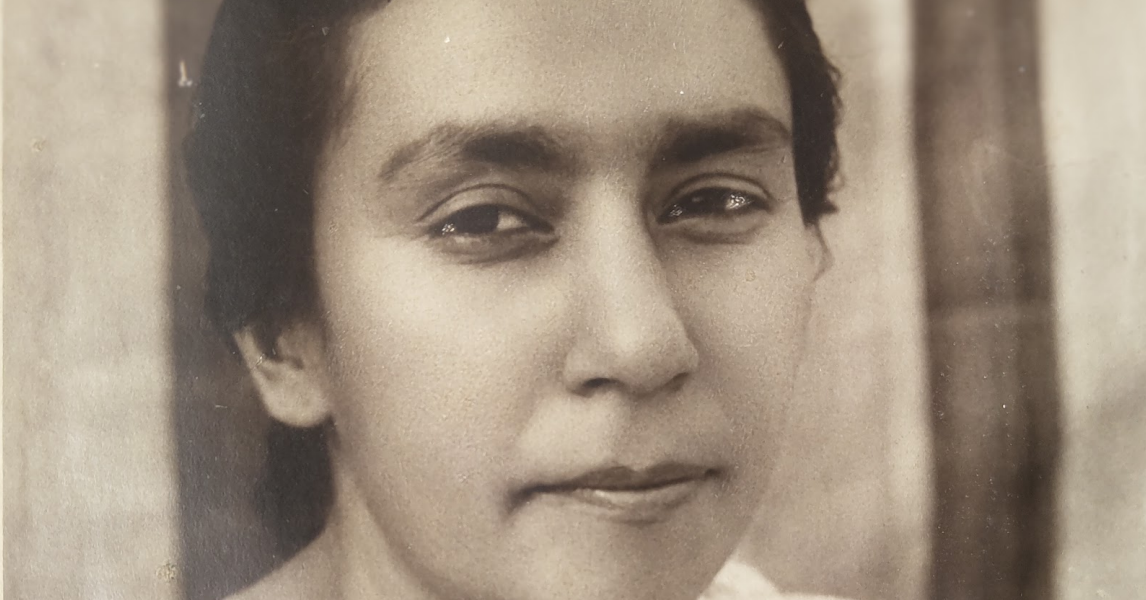
Hajrah Begum. Photo: By arrangement.
I sometimes feel that when future generations remember all of you, will they ever think of Alys (Faiz Ahmad Faiz’ wife) or me. We have always walked with you, although you were a step ahead of us. Sometimes you would look back to perhaps make sure that we were still there, following behind you. And we would reassuringly smile back although our hearts would cry out in pain.
– Excerpt from a letter by Razia Sajjad Zaheer, wife of Sajjad Zaheer, to Faiz Ahmad Faiz in June 1951 when Faiz and Zaheer had been imprisoned in the Rawalpindi conspiracy case.
In the opening pages of her novel, Aakhir e Shab ke Humsafar, the writer Qurratulain Hyder depicts a scene in a crumbling old house in the early 1940s in the old city of Dhaka where the protagonist (a young Bengali Muslim woman, Deepali) and her Christian friend (Rosie Banerjee) are welcomed by a young man called Mahmood ul Haque. In the conversation that follows, Rosie (a reverend’s daughter), is shown as possessing progressive ideals yet holds biases regarding Muslims; she thought of them as fanatics, toadies of the British and womanisers, not always in that order. So, while speaking to the mostly young Muslim men in this gathering Rosie is surprised to notice that many among them had Left leaning political views.
A back and forth ensues while Rosie’s hosts share a list of names of Muslim revolutionaries and radicals in India and elsewhere, like the Indian student Mirza Abbas who had been taught how to make bombs by the Russians, and of the great Indian revolutionary who died penniless in the US, Maulana Barkatullah. The Muhajareen, which included people like Shaukat Usmani, Fazal Ilahi Qurban and Ferozzuddin Mansoor, who had traveled to the Soviet Union in the early 1920s to study at the University of Eastern Toilers, were mentioned. Finally, Dada Amir Haider’s (the seaman/lashkar who became the member of the communist party in the US) name was added.
Hyder may have emphasised this history to situate herself as a Muslim in post-colonial India – in a post Nehruvian era – and to re-remember why Indian Muslims also had a right to be proud of their nationalist pasts; hidden and obscure histories of those Muslims who were part of India’s freedom movement and who followed radical nationalist politics. I present a glimpse from a more complex and important piece of writing to suggest that even in Hyder’s sympathetic treatment of the Muslim Left (at least in the earlier part of the novel) she forgets to mention radical Muslim women like Hajrah Begum, Razia Sajjad Zaheer and Rashid Jahan in her recounting of names. It may be possible that these women (and many more) had not become part of the national imagination by the early 1940s, the period in which the novel is situated. By the end of the novel, we also see Haider providing an implicit critique of the Left, where class positions may have trumped radical politics.
To be sure, Dr. Rashid Jahan has lately received much attention in print (Rakshanda Jalil 2014), and Razia Sajjad Zaheer’s daughter (Noor Zaheer) has recently published her mother’s biography (Alys Faiz and Tahera Mazhar Ali should be added to this list). In contrast, Hajrah Begum, the protagonist of this essay, a pioneer of the women’s movement in late colonial India and the first South Asian woman to become the member of the Communist Party of Great Britain (CPGB), has received negligible attention by historians and archivists alike. My preliminary effort here is to remember a person of utmost conviction and generosity of spirit as she navigated decades of politics in the communist movement in colonial and post-colonial India. To write about her, I delved into multiple forms of archives; the interviews she gave, her writings, the writings and experiences of her contemporaries, oral history with family members, memoirs, scraps of evidence available in “discarded” letters and more.
Hajrah Mumtazullah Khan was born in 1910 to Mumtazullah Khan and Natiqa Begum, in Sahranpur, (western Uttar Pradesh) where Mumtazullah Khan was then a tehsildar. She was second of six siblings, the eldest being Zakaullah Khan (the famous Pakistani architect, Kamil Khan Mumtaz’ father). There was another son Ikramullah Khan, between her and her sister, Zohra Sehgal (the famous performer and actor), and then Uzra Butt (another famous actor and performer), Amina Begum (founded Happy Dale School in Karachi) and Sabra Begum. The family traced its lineage to the Rohilla Pathans who had settled during the 18th century in Western UP in the areas of Najibabad, Moradabad Bedayun, Bareilly, Saharanpur and Rampur. Both parents, who were first cousins, were closely related to the ruling nawabs of Rampur.
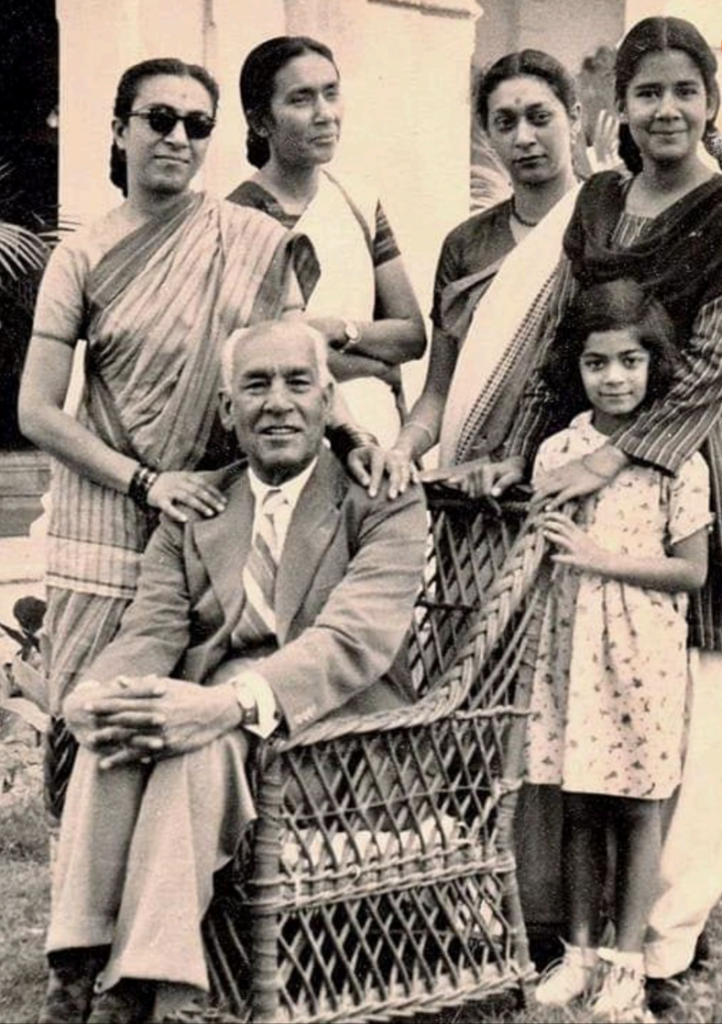
Hajrah Begum with her father, sisters and niece. Photo: By arrangement with her family.
Hajrah begum at the age of 10 was sent to the Queen Mary College in Lahore, where she was followed by her younger sisters. This was a segregated school for girls from elite households and although Mumtazullah Khan, their father, was a senior government servant the sisters may have been admitted due to their relations with the princely state of Rampur. While the girls were in school, their mother passed away. Until she completed her matriculation at the age of 17, the school’s close political atmosphere was partially balanced by her interaction with her elder brother Zakaullah Khan who was at Aligarh by the mid 1920s and would talk to young Hajrah during school holidays about how she should not stand up when ‘God Save the King’ was sung at her school as the British were not their real masters. A confusing time for Hajrah indeed, as at school, the Prince of Wales was portrayed as the most charming person in the world, while at home the brother was speaking about freedom from the British. In college and in his work life, Zakaullah Khan (who received an engineering degree from UK) was not perceived as politically active, but for a purdah observing Hajrah Begum, he was a godsend, bringing into her life ideas about a future freedom and struggles, the anti-colonial struggle, the struggle for economic and social justice. In contrast, while at school with a strict and segregated English medium education, the little that came from the outside was what the day scholars would share, songs related to the stage of the nationalist movement in the 1920s.
Charkha kaato to beda paar hai
Charkha swadeshi talwar hai.
Boli amma Mohammad Ali ki
Jaan beta Khilafat main de do.
In her interview (from the early 1990s) archived at the Nehru Memorial Library, Hajrah Begum speaks about her brother and K M Ashraf (who deserves a major biography of his own), who were close friends from Aligarh days and had gone to study together to UK in the late 1920s, as major influences in her emerging understanding of anti-British Nationalism, if not her eventual tilt toward communism.
Soon after she passed her matriculation exams, Hajrah Begum was married to her paternal aunt’s son, Abdul Jamil Khan who was a DSP in the police service. In her interviews she suggests that she resented that she was not asked about whether she wanted to get married or not and this feeling persisted throughout the very short marriage of three to four years. Being unhappy in her marriage (she could not adjust to the spousal life of an officer in the elite police service), she started spending time in Meerut where her father was now posted as a magistrate. This was the time (1929-1933) when the Meerut conspiracy case was ongoing against Indian trade unionists and three Englishmen for organising an Indian railway strike. At the culmination of the trial, 27 trade union leaders were convicted under a lawsuit based on the charge that in 1921, the leftist trade unionists, S.A. Dange, Shaukat Usmani and Muzaffar Ahmad with the help of several others had conspired to establish a branch of the Communist International in India.
In Meerut, her father’s house was frequented by people like Mahmud uz Zafar (of Angarey fame. He was her maternal uncle’s son and a future member of the Communist Party of India. He later married Rashid Jahan) who would discuss the case with her brother, Zakaullah Khan. It is during this period in the early 1930s that she told her husband that she wanted to end the marriage as she had become more interested in the people who were being tried in the conspiracy case and their cause. She did not see herself in a world where she would be entertaining wives of high British officials.
Her brother Zakaullah Khan also understood the situation and suggested that if she wanted to opt out of the marriage, then she needed to be economically independent. After her separation, rather than stay with her father, she went to live with her brother in Aligarh where K.M. Ashraf was a frequent visitor and would offer her books to read, like the Intelligent Woman’s Guide to Socialism and Capitalism by Bernard Shaw. Both, her brother and Ashraf, persuaded her to get advance training as a montessori teacher from England. She sold some of her jewellery and with partial financial support from her family, left for the UK with her son.
Her arrival in London in 1933 meant a lot of adjustments, including the care of little Sami (later, Lt. General Sami Khan, a much-decorated officer in the Indian Army) who was about a year-and-a-half-old at that time. While in London, she met with Sajjad Zaheer (a family friend, one of the founders of the Progressive Writers Movement and the future secretary general of the Communist Party of Pakistan), then a student and the leader of the underground group of left oriented students in London, Cambridge and Oxford. Through Sajjad Zaheer she reconnected with K.M. Ashraf, who had returned to the UK to complete his PhD. Others in the group were Shaukat Omar (the father of the late Pakistani journalist, Kaleem Omar, also the eldest son of Zafar Omar of the Indian Police Service and the writer of the Urdu detective novels, Neeli Chattri) and Z.A. Ahmad (later the secretary general of Communist Party of India of UP and member of the Upper House of the Indian parliament).
Hajrah Begum was the only woman member of this small group of Indian students. There were weekly study groups and conversations along with attempts to bring out newsletters to influence the Indian student population then residing in UK. Hajrah Begum, young and inexperienced at the time, was initially a quiet participant during these meetings. This changed when she visited the Soviet Union after answering an ad in the journal, Daily Worker. Her two weeks in the Soviet Union in the mid-1930s gave her first-hand knowledge of the transformations that the country was going through. According to her, it was not a paradise, but she was impressed by the spirit of the people who were not colonised, like India. People were striving to attain a modicum of economic and social emancipation. On her return, she became more confident in participating in group discussions and people started deferring to her in terms of her views and experience. Around this time, according to Z.A. Ahmad’s memoirs, Hajrah Begum along with Sajjad Zaheer and Ahmad were inducted as members of the Communist Party of Great Britain (CPGB). This was of course kept as a secret as the Communist Party in India was banned and there was strict surveillance of communist party members and supporters.
There is an incident that is worth sharing from her presence in London. In her interviews Hajrah Begum mentions how on May 1, 1934, she attended a worker’s event in Hyde Park, while there she was photographed with a red flag in her hand, and the image was published in the international Kodak magazine. The magazine captioned her photo as how South Asian women were being radicalised. The magazine also circulated in India and when it was seen by relatives and by her father there was much apprehension about what she was doing in Britain – studying or taking part in subversive politics.
During her time in London, she met Ben Bradlee, who was one of the defendants in the Meerut conspiracy case and a member of the CPGB and Shapurji Saklatwala (the famous Indian communist leader who was related to the Tata family and had given up his wealth to pursue communist politics in Britain). She also traveled to Brussels with Sajjad Zaheer as part of the delegation of students to the conference on the struggle against war and fascism. Ishaat Habibullah (father of the writer Muneeza Shamsie and grandfather of the novelist Kamila Shamsie) was the leader of this group. In the conference, the Indian student’s delegation took the position that there should be a broad front to fight not only against the approaching war and fascism in Europe, but also against imperialism and colonialism. This position was rejected by the conference, dominated by European attendees. As a protest, the Indian group walked out of the final sessions.
In 1935, the Seventh International Congress of the Communist International in the Soviet Union among other issues decided that the anti-colonial policy for communist parties and movements was to work with national anti-imperial forces against the rising threat of imperialism and fascism. Within the Indian context, the Indian National Congress was considered a bourgeois and nationalist party, the directive to Indian communists was to work in a broad front; a unity of all progressive forces in which the communist would collaborate and work with all who were anti-imperialist while retaining their distinct identity and work among workers and peasants.
With this understanding which was conveyed to the group by the then secretary general of CPGB, Harry Pollit, most members of the student group returned to India after completing their studies. A few months after reaching India, Sajjad Zaheer called a meeting of the “London Group”, and each one was asked about how they would like to proceed in their anti-imperialist politics. On her return, Hajrah Begum had taken a job in Karamat Hussain Girls College’s junior section in Lucknow. According to Z.A. Ahmad’s memoir, Sajjad Zaheer had started to practice law in Lucknow and was committed to the still underground communist party, K.M. Ashraf had started teaching, but was committed to the party’s directive, Mahmuduzzafar (Hajrah Begum’s cousin) was teaching at Islamia College in Amritsar, and he opted to be a party whole timer. Z.A. Ahmad left his job as the principal of a college in Hyderabad (Sindh) and decided to work for the party. Other members like Shaukat Omar, who was working for the Saigol Tea Company, for personal reasons did not want to leave his position but was willing to contribute to the party fund and provide other support. After this meeting, Hajrah Begum like her cousin Mahmud uz Zafar also became a whole timer. Hajrah Begum was recruited to work in the party office in Lucknow (typing, preparing notes, and documentation) under the directed supervision of the party’s secretary general, P.C. Joshi, whose identity was not known to her.
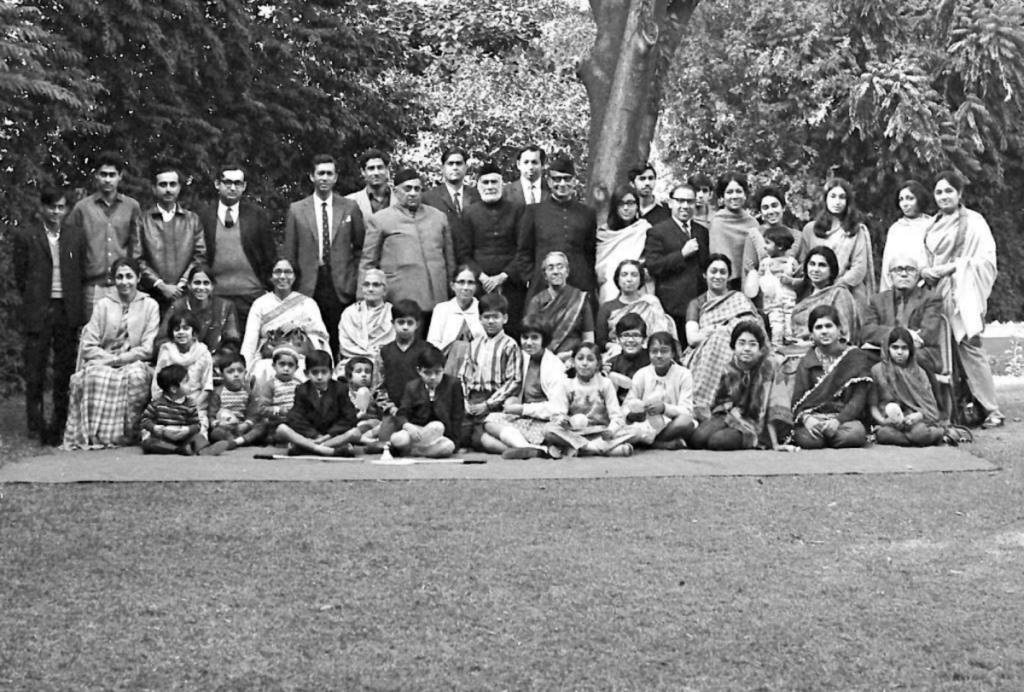
The entire extended clan in India around the late 1970s in Z.A. Ahmad’s official residence in Delhi. He was member of the Rajya Sabha in those days. Photo: Radha Khan.
Hajrah Begum and Z.A. Ahmad had known each other in London and eventually returned on the same ship from Britain with her son Sami. A growing understanding and common political commitments eventually led to their marriage on May 20, 1936. The marriage was solemnised by K.M. Ashraf (who had completed his PhD in Islamic history) and took place in Sajjad Zaheer’s home in Lucknow. The famous poet, Raghupati Sai Firagh Gorakhpuri was one of the witnesses. Soon the couple moved to Allahabad, as Ashraf and Z.A. Ahmad, along with other progressives like Rammanohar Lohia were given positions in Nehru’s kitchen cabinet when he was the president of the All-India Congress Committee. This was in keeping with the political line that members of the communist party (underground as it was) should work with anti-colonial forces. While Hajrah Begum continued her work with the underground communist party, she along with Rashid Jehan was also involved in organising the first All India Conference of the Progressive Writers’ Movement (Lucknow, 1936) where the famous writer Munshi Prem Chand gave the presidential address.
In Allahabad, she was part of a core group of young leaders who were working with the Congress Socialist Party (which was not banned), along with Z.A. Ahmed, K.M. Ashraf and Rammanohar Lohia; all of whom except Lohia were also members of the underground CPI. In this respect she had become one of the few early female members of the CPI. In Allahabad, she became active in organising railway coolies and press workers. By the late 1930s, she was working with the biri union, hawkers’ union, shop workers union, tin workers union and in eastern Uttar Pradesh (Azamgarh), and used this experience to organise tannery and textile workers in Kanpur. She was one of the first women from the communist party to work among farmers. She narrates in her interviews how she would walk miles in rural areas, travel the lowest class on trains, and sleep in mud huts on the floor with a single sheet. She always wore khadi (handloom) saris and lived and experienced the life of the people she was politically linked to, the underclass of towns and villages of British India. Speaking about women working on looms in villages of eastern UP (belonging to the Muslim julaha or weaver caste), she mentions how these women made the best saris, they were the bread earners of the family. Yet, like any other woman, the workers had to cook, take care of the children, attend to the demands of their husbands and in-laws and suffer all kinds of social oppression. It is these women she would organise for domestic rights, for better compensation of their products and for linking them with other women workers (industrial and rural) across the province.
In 1940, she became the organising secretary of the All-India Women’s Conference (AIWC), an organisation founded by educated and elite women committed to educational reform for women and children and to struggle for women’s rights. This was due to Hajrah Begum’s commitment to the cause of equal rights for men and women, rights for women in marriage and divorce, and equal compensation for women, especially in the industrial sector. In public forums, she raised issues related to the vagaries of housework and demanded the provision for creches in workspaces, along with maternity benefits for women workers. It is during this time that a debate also ensued within the now legal Communist Party (the ban on the party was lifted in 1942) on forming a women’s organisation. Although CPI’s all-male leadership would argue for women’s rights, they did not see a need for a separate group or women’s organisation. Even when senior leaders (like E.M.S. Nambroodripad, later the first elected chief minister of Kerala on a CPI ticket) circulated a paper within the party, advocating for women organisations and for the provision of lavatories and baths in rural areas, it was sarcastically referred as the “latrine document”. In contrast, Hajrah Begum in her writings in CPI outlets like People’s War (Quami Jang) would argue for an all-India organisation for women that necessarily may not be a communist women’s organisation, but consist of women from the working classes, the peasantry, the lower middle classes, the teachers and ordinary people.
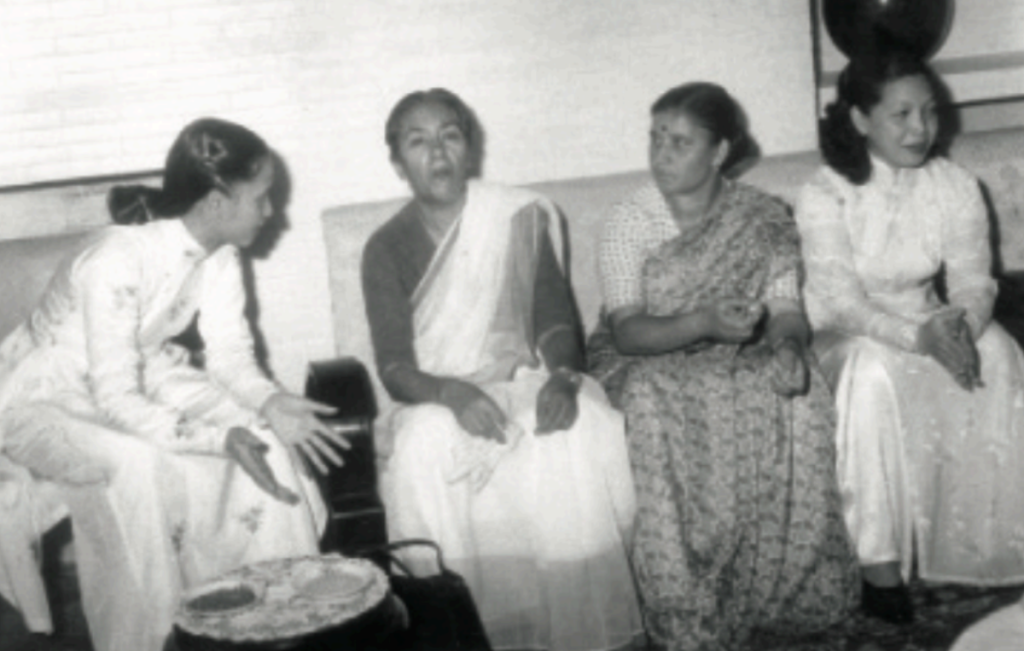
Hajrah Begum with Chinese delegates. Photo: Public domain.
Such an organisation was formed during the Bengal famine in the shape of the Mahila Atma Rakhsha Samiti (MARS) in Bengal. She travelled to Bengal during this time and reported first hand on the relief work done by the MARS, incorporating all classes of women, housewives, aunts, unmarried girls, the Calcutta elite and the peasant women from Barisal and Noakhali (both districts in East Bengal). While their men were at war, these women were committed to provide relief work and join the anti-colonial struggle. The famine and ensuing death and destruction in Bengal in the mid 1940s had opened the question of social justice and equality for all these women and they were ready to participate in their patriotic duty for justice and rights. This was not a unique case, Hajrah Begum had also witnessed and supported similar organisations, such as the Punjab Women’s Defence League based in Lahore which had similar aims as that of MARS.
It is during this time that she also edited the Urdu-Hindi Language organ of AIWC, Roshni. It is inspiring to read the fresh tone of editorials even almost 80 years after its publication. During the Partition violence, her editorials in Roshni were in solidarity with the plight of women, especially in Punjab. Her writings also made people aware of the need to unite against those who were dividing the people of the land. She emphasised that despite the violence and the division of the country, our commitment to the service for women will be the same and that we will continue to struggle against oppression of women on either side of the border.
After the division of British India, she and her husband did not migrate to Pakistan. It was a very difficult period for her as many close friends and family members (along with her elder brother whom she was very close to) did. Comrades like Syed Sajjad Zaheer were sent by the Party to Pakistan (he then returned in the 1950s after the decision on the Rawalpindi conspiracy case). K.M. Ashraf also came to Pakistan in 1948 and then left for the UK. But Z.A. Ahmad and Hajrah Begum continued to work with the CPI. Ahmad became the secretary general of the UP CPI and later represented the Party in the Indian parliament from the 1950s onwards for many years. Hajrah Begum herself continued to work within the Party and in the mid-fifties she ran for a position in the central committee of CPI. She eventually served as a member of the Central Control Commission of the Party; it was the top committee that deliberated on all complaints of anti-party behaviour. As a member of the Party, she was a participant at the World Peace Conference in Vienna in 1952 and became one of the founders of the National Federation of Indian Women (the women’s wing of CPI, as finally the Party had come around to the idea) and served as its general secretary from 1954 to 1962. Post-Independence in the 1950s and 60s she had several international travels representing the Party and continued to struggle against inflation and for women’s right to work.
§
The life of a revolutionary couple is never easy. Throughout the late 1930s and the 1940s (even after Independence) both Hajrah Begum and Z.A. Ahmad were either organising peasants and workers, doing Party work or were being persecuted by the authorities. Their daughter Salima Raza (radio artist, theatre director, performer, writer, who lives in Mumbai) was born in 1939. In her interviews with me, she narrated how, till they moved to Delhi, in the mid 1950s, when her father became a parliamentarian, the family could only afford a one-room (not one bedroom) apartment. The storage room would at times serve as a kitchen. Further, due to her parent’s political activity she hardly lived in her own home until she completed her matriculation in the mid 1950s, studying in at least 14 schools and staying with dozens of family members, family friends and strangers. In the early 1940s she lived in Lahore with her paternal grandparents. This was a time when Z.A. Ahmad was imprisoned in the Deoli Camp and Hajrah Begum was working on other political fronts.
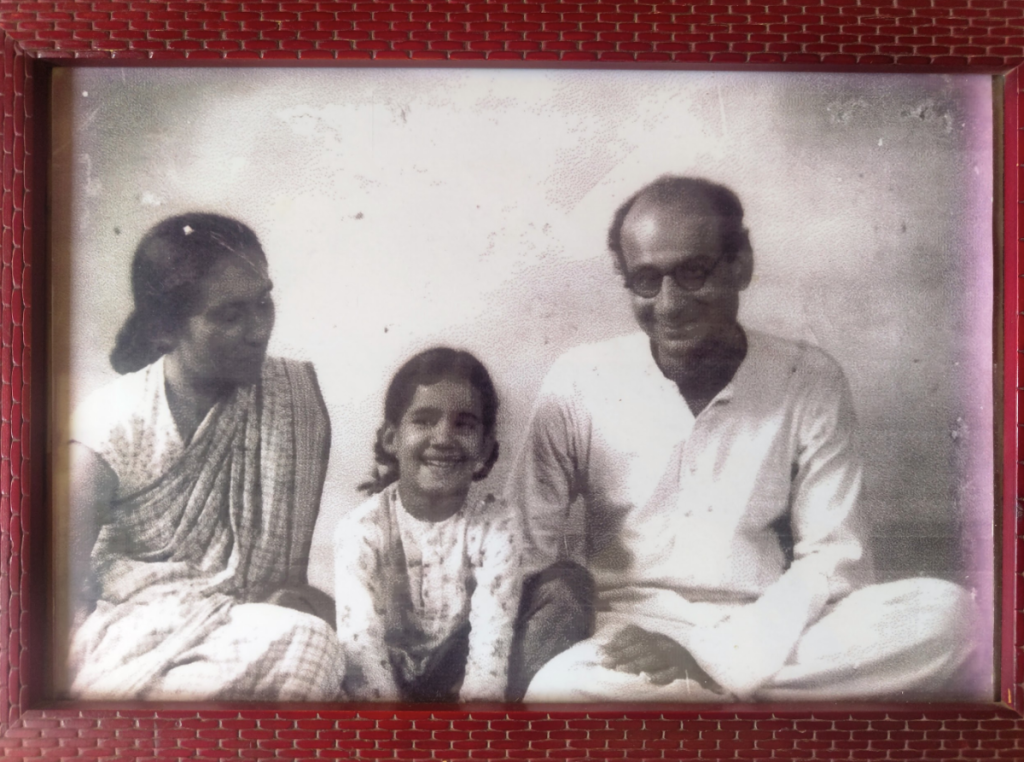
Hajrah, Salima and Ahmad. Photo: By arrangement with her family.
Salima Raza shared a story of when Hajrah Begum was arrested in 1949 (Nehru had decided to crack down on all communist activities) – she was a young girl of 10. Z.A. Ahmad was also underground and due to the radical leftward shift in CPI politics (under the influence of the then secretary general B.T. Ranadive) he had been suspended from party membership. One morning, Hajrah Begum, while living in Lucknow, asked her daughter to serve tea to the gentleman who was waiting for her to change. Soon Hajrah Begum emerged, gave the child Rs 5 and instructed the cycle rickshaw driver standing outside to take her daughter to Yashpal’s house (the famous Hindi writer). She instructed Salima Raza not to cry when she saw her mother leave in the parked car and told her that she should keep on raising the slogan “inquilab zindabad”. Hajrah Begum then got into a car that was waiting for her. She was in jail for the next five months and her daughter lived with family friends. Salima Raza remembers tears running down her cheeks, yet she continued to raise the slogan as long as she could see her mother’s car.
Despite hardships and the absences, there remained a deep bond of affection and care within the family and between Hajrah Begum and Z.A. Ahmad. In the late 1940s, when Ahmad was suspended from the party and was living underground in Lucknow, a friend arranged for the couple to meet. When they met, Hajrah Begum (who was still under the Party discipline) told Ahmad that the Party leader, Ranadive had ordered her to divorce Ahmad as he was not considered a true communist, but a revisionist. When Ahmad asked what Hajrah Begum had decided to do, she answered, “Marrying you was my own decision, the Party did not dictate me to marry you, and it cannot force me to divorce you either.” Ahmad writes in his memoirs how today this seems like a trivial issue, but in those days, it was unthinkable to not follow the Party directive.
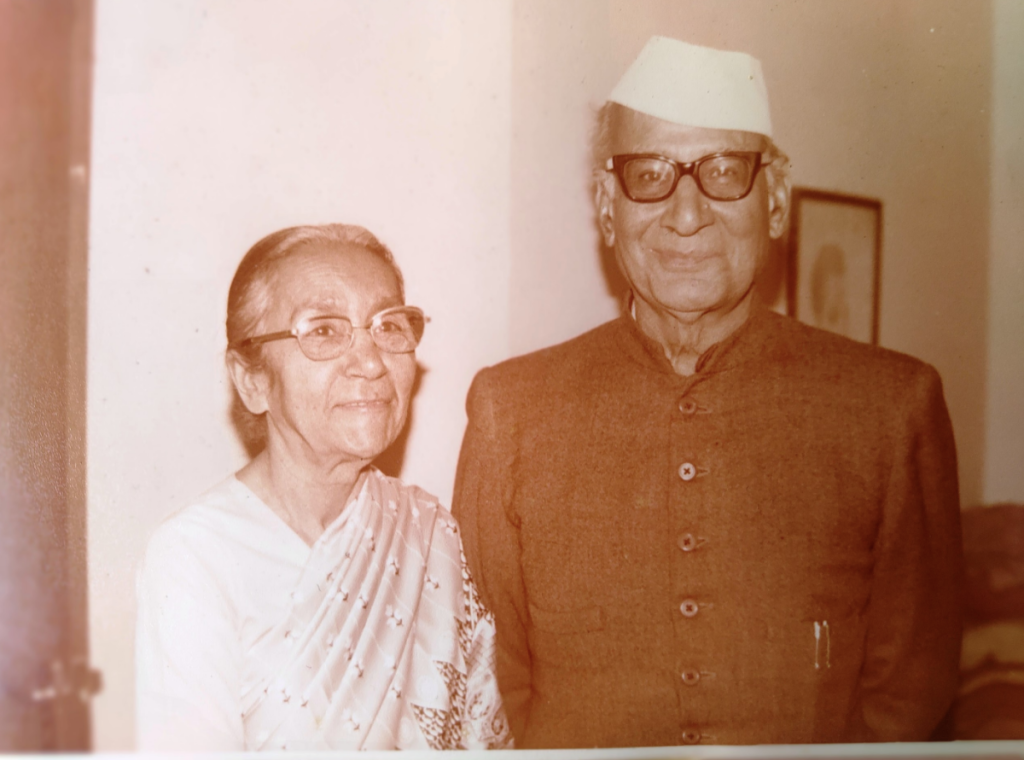
Hajrah and Ahmad. Photo: By arrangement with her family.
This long-lasting relationship of political commitment, care and companionship ended with Ahmad’s passing in 1999. Salima Raza, while talking to me, mentioned an anecdote about her mother that exemplifies her deep affection for her husband. Once after the death of her father, Salima Raza asked her mother (who was slowly losing her memory), what her name was. She answered, “Hajrah Begum.”
Salima Raza said, “But your name is Hajrah Begum Ahmad.
“No my name is Hajra Begum,” the answer came back.
“Where is Dr. Ahmad?” her daughter asked. The reply was, “He may have gone to the parliament, or perhaps he may have gone to a meeting.”
Her daughter persisted, “But there is no meeting. People say that he has passed away, but what do you say?”
Hajrah Begum replied, “No, this has not happened, if it was so, he would have told me… If nothing else, he would have sent me a post card.”
Hajrah Begum, a person of immense courage, resilience, simplicity and sacrifice, passed away on January 20, 2003, after a prolonged period of illness. These few lines from a longer poem, My Nani Amma, by her grandson Aamer Raza, captures her beautifully.
But how many nanis risked their lives for freedom and justice
And walked till the blood ran all over their feet?
How many nanis defied all tradition
With utmost respect for all those around them.
How many nanis have lived their lives with absolute belief in the correctness of their convictions, yet never indoctrinated their children?
And how many nanis have done really cool stuff, like conquering the British Empire,
And leading women’s movements.
Not many, I imagine. I wouldn’t have known of those things,
For you wouldn’t give the game away
All I knew was that I was lucky to have you.
Kamran Asdar Ali teaches anthropology at the University of Texas, Austin.
Note: An earlier version of the piece had misidentified Abdul Jamil Khan. The error has been corrected.
source: http://www.thewire.in / The Wire / Home> English> Analysis> History / by Kamran Asdar Ali / August 16th, 2025