Tag Archives: Malabar Rebellion

‘The Last of the Just’: Remembering Vakkom Majeed Through ‘Les Misérables’

KERALA :

Let us not forget him in a hurry. Let us not reduce him to a paragraph in history books. Instead, let us pass on his memory like a worn volume of Pavangal, read and reread, loved and lived, whispered from one generation to the next.
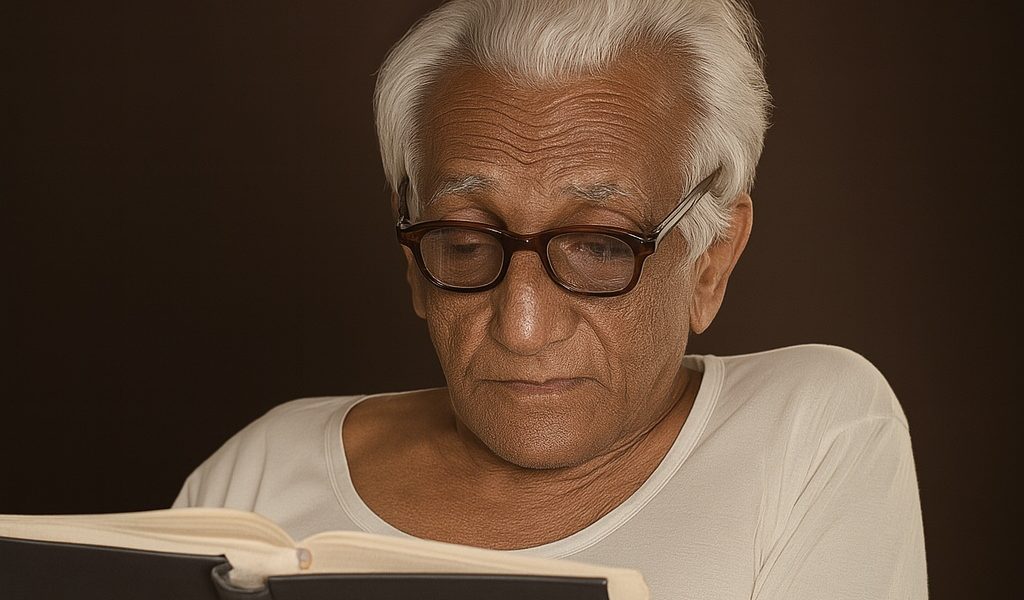
Vakkom Majeed (1909-2000). Photo: From KM Seethi’s archive.

Vakkom Majeed passed away on July 10, 2000.

“He never went out without a book under his arm, and he often came back with two.” 

— Victor Hugo, Les Misérables

In the long and rolling corridors of memory, some lives stay like verses, opening out slowly, sentence by sentence, chapter by chapter, never quite closing. Vakkom Majeed’s was one such life. A life commemorated not only by its fearless engagement with history, but by its quiet, intense companionship with books. On the 25th anniversary of his passing, as we also mark the 100th year of Pavangal, the Malayalam translation of Victor Hugo’s Les Miserables , it feels almost providential to recall him through the pages he so often inhabited.

Majeed Sahib, as many called him with reverence, moved with a book always kept under his arm, a bulwark against ignorance, a lamp in times of doubt. And among the many volumes he read and reread, Pavangal held a sacred space. Nalapat Narayana Menon’s 1925 translation of Hugo’s masterpiece was more than literature to him. It was revelation. He had devoured the original edition in his youth, and its characters never left him – Valjean’s anguish, Javert’s moral rigidity, the revolt in the streets of Paris, the quiet dignity of suffering souls. When he spoke of Pavangal, it was with a fervour one reserves for scripture. He did not read the novel, rather he lived it.

A.P. Udayabhanu, a veteran freedom fighter of Kerala, once described Majeed as a “moving encyclopaedia with at least one book in his hands.” But Majeed Sahib was more than a repository of knowledge. He was a seeker, a provocateur of conscience, a gentle fire that never flickered out. I have the sweetest of memories of my time spent with him, from childhood itself, I remember the rhythm of his voice as he discussed Bertrand Russell’s three-volume autobiography, Churchill’s sprawling accounts of World War II, or the 10-volume correspondence of Sardar Patel. There was never a trace of vanity in his learning. He read not to impress but to illuminate. And when he shared his readings – Azad’s Tarjuman al-Qur’an Muhammad Asad’s Road to Mecca, M. N. Roy’s The Historical Role of Islam, Arthur Koestler’s The Yogi and the Commissar, or Hugo’s Pavangal, like many – he spoke with the urgency of a man who felt truth must never be hoarded.

Born on December 20, 1909, in the storied Poonthran Vilakom family of Vakkom near Chirayinkil (Travancore), S. Abdul Majeed inherited a legacy of reform and resistance. His uncle, Vakkom Abdul Khader Moulavi, had already lit the flame of renaissance among Kerala Muslims. From his schooldays at St. Joseph’s High School, Anjengo, young Majeed was pulled into the vortex of reform movements and the call of the Indian freedom struggle. By the time the Quit India movement broke out, he was already a marked figure in Travancore, arrested, jailed, and later jailed again for resisting the plan of “Independent Travancore.”

But what set him apart – what made him more than just another freedom fighter – was the deep moral imagination that animated his politics. His understanding of rebellion was not ideological. It was profoundly ethical. Like Victor Hugo, he believed that human dignity must stand unshackled before the majesty of any state or creed. He condemned the ‘two-nation theory’ not because it was politically inconvenient but because it was morally vacuous. To him, the soul of India was plural, secular, and indivisible.

In 1948, he was elected unopposed to the Travancore-Cochin State Assembly from Attingal. But when his term ended in 1952, he walked away from practical politics, choosing instead the solitary path of reading, reflection, and moral clarity. While others sought power, Majeed Sahib sought wisdom. And in doing so, he became more relevant with age. Over the next decades, he would immerse himself in the philosophical and historical writings of Bertrand Russell, the radical humanism of M. N. Roy, and the emancipatory visions of Narayana Guru. He called for a “return of Ijtihad”, a freedom of thought within Islamic traditions, and dreamed of a society beyond caste and creed.

He never became rigid in doctrine. His politics was never a fixed ideology, but a conversation between ideas and reality. In our many conversations, I recall his thoughtful analysis of the Malabar Rebellion. He agreed with the thesis that it was fundamentally a revolt born of agrarian injustice but he was deeply saddened by its later communal turn. For him, the tragedy of history was when righteous anger was manipulated into sectarian hatred.

And always, there was a book in his hand. Always, a passage to quote. Always, a memory to share.

The last three decades of his life were his most contemplative. He reread the classics, interrogated nationalist histories, and engaged with young minds who came to him for guidance. To them, he gave not slogans but questions. When he spoke of Jean Valjean’s redemption, it was a commentary on our prison system. When he discussed Javert’s suicide, it became a parable about the dangers of legalism without compassion. When he recalled Fantine’s fall, it was a scathing critique of social hypocrisy.

He never forgot the moment when he visited the Indian National Army hero Vakkom Khader in the Madras Central Jail. It was Majeed Sahib who brought back Khader’s last letter to his father before his hanging, a task that broke his heart and steeled his resolve.

In 1972, when the nation celebrated the silver jubilee of independence, Majeed was awarded the Tamrapatra by Prime Minister Indira Gandhi. Later he was deeply perturbed by the excesses of Emergency. 

There was no trace of ceremony in his life. No pursuit of fame or favours. He lived in quiet dignity, read in solitude, and died in obscurity, on July 10, 2000. He left behind not an estate, not a political dynasty, but an idea of what it means to live ethically, read deeply, and act justly.

Today, as we remember him, the centenary of Pavangal seems to carry the tenor of prophecy. One hundred years since Jean Valjean entered Malayalam letters, and twenty-five since Vakkom Majeed left this world, the two seem braided, one fictional, one real, both intensely human. Majeed Sahib was Kerala’s own Valjean: hunted by regimes, misunderstood by many, but ultimately redeemed by the fire of truth and the grace of humility. 

Let us not forget him in a hurry. Let us not reduce him to a paragraph in history books. Instead, let us pass on his memory like a worn volume of Pavangal, read and reread, loved and lived, whispered from one generation to the next.

For in remembering Vakkom Majeed, we remember the best of what we once hoped to be.

K.M. Seethi is director, Inter University Centre for Social Science Research and Extension (IUCSSRE), Mahatma Gandhi University (MGU), Kerala, India. Seethi also served as Senior Professor of International Relations, Dean of Social Sciences at MGU and ICSSR Senior Fellow. 

source: http://www.thewire.in / The Wire / Home> History / by K.M. Seethi / July 11th, 2025
Mappila Haal: Celebrating 100 Years Of Malabar Uprising

KERALA :

This year marks the 100th anniversary of the eventful Malabar Uprising of 1921.

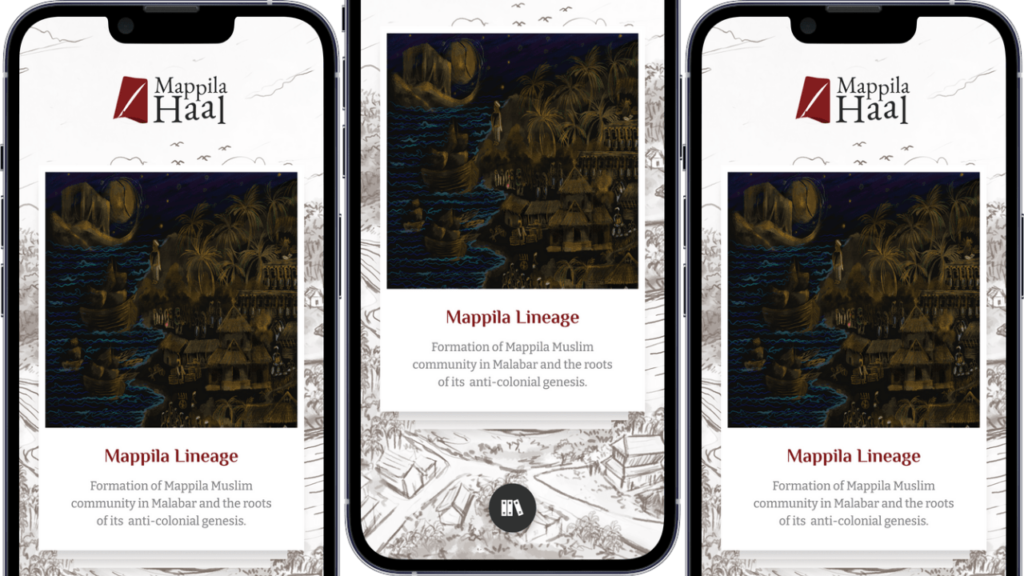
In this historic context, SIO Kerala has come up with a new venture: an interactive virtual exhibition titled ‘Mappila Haal’.

‘Mappila Haal’ is a comprehensive creative expression of the Malabar Uprising enabling the viewer to travel through the revolutionary days and nights.

SIO acknowledges the memories, discussions on various factors and celebration of the Malabar Uprising as a crucial socio-political engagement.

History is not merely a record of the past. For any community, history is a decisive factor in their present life. That is why history is said to be a never-ending dialogue between the past and the present. Historical narratives play a major role in shaping contemporary socio-political perspectives and imaginations.

Every community should have a deep understanding of their history, and they should record and promote it. Failure to do so will result in the tragedy of having to live in a history written by others. That condition will adversely affect their future. Because their history written by the mainstream-dominant ideologies will be understood as the real one. If the dominant powers decide to marginalize or annihilate any community forever, they will use history as an easy tool. For that, they will do injustice to history in two ways. One is to hide and erase the rich history of that community, and the other – to present a distorted narration of it.

How Islam and Muslims were treated in colonial historiography is an apt example of this. The colonial powers hid the prestigious and glorious history of Muslims all over the world.  Later, colonialism defined Islam and Muslims in their own way, based on which the history of Muslims was written – Islam is primitive, it was spread in the world by sword, Islam is utter terror, Muslims are savage, bloodthirsty, war-loving, violent and dangerous. Based on this definition, they presented a distorted version of world Muslim history. In doing so, they sought to create a public perception that the very presence of Muslims would be dangerous to any nation and all forms of social and political expression based on Islam reflects extremism and terrorism. The aim was to make people believe that they were the ones who needed to be eliminated. Thus, this narrative became a justification for all violence, injustice and genocide against Muslims. This is how history itself becomes the greatest instrument of oppression. It is in this colonial narrative that the roots of present-day Islamophobia too lie, be it global, national or in Kerala. 

Here comes the relevance of the remembrance and celebration of the Malabar Uprising. This is a time when Hindutva politics is gaining strength and the Sangh Parivar is working on the genocide of Muslims. Hindutva forces use the history of Muslims in two ways to facilitate ethnic cleansing: One is the attempt to erase the history of Muslims in India and to uproot the glorious roots of Muslims in this country. Second, to distort the history of Muslims in India into an anti-Hindu history. Through these two forms of violence against history, Hindutva quickly finds pace for its racist propaganda.  In other words, the Hindutva forces are trying to create a public conscience that the Muslims are a group that came from somewhere, that they have no roots in this country, that the history since their arrival here is one of violence, that their presence is a danger to the country and therefore they should be eradicated. The question of how one’s mind allows Muslims to be lynched to death in broad daylight turns irrelevant there.  When a person believes that Muslims deserve to be killed, he will not feel any remorse for killing them. 

In this particular political context, there is a special significance for popularizing and celebrating the memories of the Malabar Uprising.  By remembering the Malabar Uprising and the fighters involved within, we are also positioning ourselves against the Hindutva ideology.  The British colonial powers portrayed the Malabar Uprising as fanatic aggression. Such a propagation was quite natural because it was a battle against them. However, the Sangh Parivar is also propagating the Malabar Uprising as a brutal anti-Hindu massacre, inciting hatred against Muslims in its name and using the history of the Malabar Uprising as fuel to accelerate the aforesaid process of genocide.  In 1921 itself, the Hindutva forces propagated the Malabar Movement as a Hindu genocide and used it as a fertilizer for the formation of the RSS. 

Moreover, the historical point of the Malabar Uprising is constantly disturbing Hindutva politics in many ways.  One of them is that the Malabar Uprising reminds us of the crucial role of Muslims in the anti-colonial struggles that led to the formation of the nation of India.  Another is that the Malabar Uprising was also a struggle against the upper caste hegemony which is the foundation of Hindutva politics. That is why the Sangh regime’s dictionary of martyrs cannot include the names of the Mappila fighters. Therefore, remembering and celebrating the Malabar struggle is a strong statement against Hindutva politics.

The memory of the Malabar Struggle is also a memory of our own glorious tradition.  It also gives us an idea of ​​how strong and deep our roots are in this land.  It shows the pivotal role played by our ancestors in the freedom struggle of this country, social renaissance and civilizational development.  For the Muslim community in India, this memory and realization will provide the energy to move forward with self-respect in the face of several crises.

The Malabar Uprising had two main stages. One was the struggle against the colonial British forces. Second, the struggle against the feudal and caste lords who oppressed and exploited the peasants and lower castes like slaves. The extraordinary struggle led by Ali Musliyar and Variamkunnath Kunhahammad Haji shook the foundations of the colonial powers and the caste leaders. It instilled a new dream of liberation in the oppressed masses. It was these two brave leaders who gave direction to the Malabar Uprising in which thousands of agricultural workers and labourers rallied. Many non-Muslims too took part in the Malabar Uprising along with the Mappilas.

We also need to think about the theological factor that motivated the Mappilas to fight. The Islamic faith was the basic factor that inspired the Mappila warriors to take their own lives and go to battlefield. It is a part of the Islamic faith to stand for justice and to fight against injustice, discrimination, slavery and exploitation. The Qur’an and the Sunnah teach us to fight for the victims of injustice. It is part of Tawheed (monotheism) that slavery and obedience are permissible only to Allah. Believers do not accept slavery or obedience before another. And they believe that the struggle for truth and justice is Jihad in the way of Allah. The scholars of Malabar passed on these divine lessons of justice and liberation taught by Islam to the common Mappilas. That is how the struggles against the occupying forces and caste lords took place in Malabar from the sixteenth century onwards.

Indeed, a cosmopolitan component was involved in the Malabar Uprising. After a short gap, the anti-colonial struggle in Malabar gained momentum again in 1921, with the advent of the Khilafat Movement. Even the national movement became popular as a result of the influence of the Khilafat movement. The Khilafat movement and the political ideology of the Khilafat acted as a new force in the anti-colonial anti-caste struggle. Globally, western modernity strengthened its political power by overthrowing the Ottoman caliphate. It was on the basis of these political convictions that the Mappila community, having global perceptions, embraced the Khilafat movement.

The historical narratives formed by the dominant ideologies can be defended and overcome only when studies are carried out in the light of such different elements involved in the Malabar Uprising. In particular, it is imperative in modern times to enable a critical reading focusing on the agency of the warriors, theological thought, social position, and decolonization. The SIO came up with the idea of ​​a virtual exhibition based on the conviction that such alternative narratives and analyzes focused on these considerations should be brought to the fore.

In the context of the 100th anniversary of the Malabar Uprising, SIO’s main objective through this virtual exhibition is to look at the history of Kerala’s Muslim intellectual and struggle history through an alternative perspective, to enable the production of knowledge about it, and to celebrate it politically and culturally. This can only be comprehensive when the various narratives that have been formed post rebellion are critiqued and analyzed from a realistic perspective. This is a continuation of the knowledge politics that SIO has been raising from time to time. We mark this interactive virtual exhibition as a continuation of the knowledge politics that SIO promotes through its rejection of hegemonic ideas and its critical reading of knowledge such as history, politics, theology and aesthetics.

The virtual exhibition will be available on a mobile application with a feast of video contents, paintings, calligraphy, digital art, rare archives, exclusive photos, the timeline of the uprisings of Kerala Muslims, different narratives on the Malabar Uprising, articles, profiles, events and graphical maps of the places of rebellion.

‘Mappila Haal’ will also be marked as a critical alternative to the colonial and savarna narratives which portrayed the long intellectual and revolutionary tradition of Malabar against the colonial and caste powers as fanatic and barbaric.

You can download the app both on Google Play and on the App Store.

Amjad Ali EM is the President of the SIO Kerala. The original article was published in Prabodhanam weekly published on Dec 24, 2021 (Volume 78).

Note: The original article had used the word ‘rebellion’, which we have changed to ‘uprising’

source: http://www.thecognate.com / The Cognate / Home> History / by Amjad Ali E M / January 03rd, 2022