Tag Archives: Muslims of Chennai

Madrasa Imdadiya in Tamil Nadu Offers Light to Poor and Blind Muslim Students

Chennai/Ranipet, TAMIL NADU :

Visually-impaired children from deprived Muslim families gain education and dignity at the institution founded by Mohammad Usman in Chennai and Ranipet
Chennai :

In the busy streets of Chennai and surrounding districts, where poverty often limits opportunity, one institution is rewriting the story for visually impaired Muslim children. Madrasa Imdadiya, a semi-residential trust founded by Mohammad Usman, offers education, skills, and dignity to children who might otherwise have spent their lives begging.

Ashraf Khan, a Tamil teacher in a private college in Chennai, was born blind into a poor family. He recalls his early years at a small madrasa for blind students in Melvisharam, near Ranipet, as life-changing. Today, he earns about ₹50,000 per month. “Education saved my life,” he says.

Usman draws a stark contrast. He has often seen blind children on streets with equally deprived parents. “This is what happens with the poorest Muslims. When parents are blind and poor, the children end up on the streets,” he explains. This inspired him to act.

Founded in 2010, the madrasa now runs centres in Chennai and Ranipet, inspiring similar institutions in Pune, Ahmedabad, Aurangabad, and Kashmir. The Tamil Nadu centre, the largest, covers 5,000 square feet and hosts 50 blind students, including ten girls, with hostel staff managing daily needs.

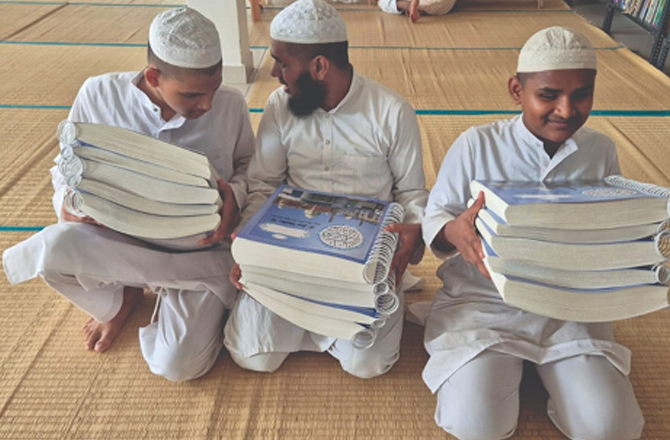
The madrasa blends religious and formal education, filling gaps left by government institutions. Students study the Qur’an, Hadith, and other religious texts in Braille, alongside school and college instruction via audio tools. Children with other disabilities are also accepted, though Braille education is separate.

Usman stresses self-reliance. “Some parents still take financial help from the trust, but many become self-reliant through their educated children. This is the real success,” he says. Students often pursue higher education, vocational training, or government jobs, with some returning as teachers.

The madrasa also produces copies of Qur’an in Braille, distributed free across India and abroad. Each copy costs about ₹3,500 to print. “All our students become Huffaz and complete Class 12 and degree education,” Usman adds.

Mobina (name changed), a blind and disabled girl who lost her father early, is a shining example. With the madrasa’s support, she now teaches in a government school and earns ₹75,000 per month. “Without this madrasa, I would have remained invisible,” she says.

Challenges remain, especially for girls. Deep social barriers, safety concerns, and marriage prospects keep many girls out of school. Usman says patience is key. “Families do not outright reject education but hesitate. Inclusion is about changing attitudes regarding gender, disability, and value,” he explains.

Disability activists note that blind children in poorer districts often lack access to formal education. Government schools exist only on paper, and families may be unaware of disability certificates, scholarships, or assistive technology. Without early intervention, entire families risk cycles of begging or informal labour.

Madrasa Imdadiya shows how targeted community efforts can break generational poverty and empower blind Muslim children. By providing education, accommodation, and skills, the madrasa transforms lives and reinforces that education is a right, not charity.

“Other communities invest in education, but we do not,” Usman remarks, highlighting a broader challenge within the Muslim community. Yet he takes pride in his students’ successes. With over 500 students across India benefiting from similar madrasas, he dreams of a school for blind children in every district and tuition centre in every village.

“Every story here is regrettable. Happy stories go to cities and private schools; they do not come to my trust’s madrasa,” he admits, underscoring the ongoing need for support for India’s most vulnerable children.

source: http://www.clarionindia.net / Clarion India / Home> Editor’s Pick> India / by Team Clarion / January 10th, 2026
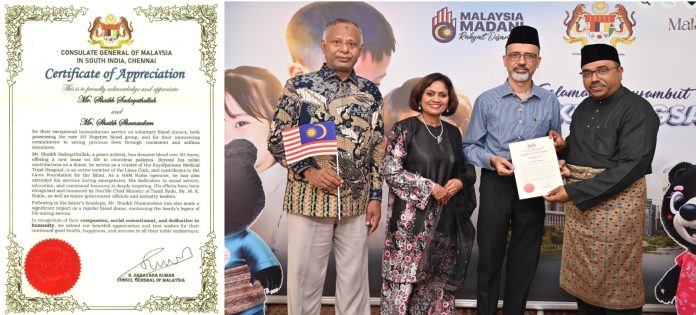
Malaysia Consul General honours father-son duo for service to humanity

Kayalpattinam / Chennai, TAMIL NADU :

The father-son duo Kayalpattinam native Shaikh Sadaqathullah (now a resident of Mannady in Chennai), a peace activist, HAM radio operator and blood donor and Shaikh Shamsudeen were honoured by the Malaysia Consul General K Saravana Kumar with a certificate of appreciation during the flag raising ceremony to commemorate the 68th Independence Day celebrations on Aug 31 at Consulate General of Malaysia located at Cenotaph Road in Teynampet neighbourhood, Chennai Metro.

​Service to humanity is a core principle in Islam. It emphasises kindness, compassion, and charity towards all individuals, regardless of their faith, colour, race or background. This principle is well-supported by various references from the Holy Qur’an and Hadith, illustrating the importance of helping others and fostering a harmonious society.

Islam places a high value on the preservation and saving of human life. The Holy Qur’an states, وَمَنْ أَحْيَاهَا فَكَأَنَّمَا أَحْيَا النَّاسَ جَمِيعًا (“And whoever saves a life (gives life to one) – it shall be as if he had saved (given life to) mankind entirely.” – Chapter 5 Verse 32. No doubt, blood donation is an act of kindness, charity, and assistance to others, and is highly rewarded in Islam. It is also a form of relieving others’ distress, which aligns perfectly with Islamic tenets and teachings and is considered a virtuous act in Islam.

Meet the father-son duo Kayalpattinam native Shaikh Sadaqathullah (now a resident of Mannady in Chennai) a peace activist, HAM radio operator and blood donor and Shaikh Shamsudeen who were honoured by the Malaysia Consul General K Saravana Kumar with a certificate of appreciation during the flag raising ceremony to commemorate the 68th Merdeka celebrations on Aug 31 at Consulate General of Malaysia located at Cenotaph Road in Teynampet neighbourhood.

Interestingly, the Almighty has gifted both the father and son with a rare blood group of AB Negative. While Shaikh Sadaqathullah had donated blood 53 times since 1993, starting from saving a patient Narayana for the latter’s heart surgery at Perambur Railway Hospital and his son Shaikh Shamsudeen had saved lives by donating 20 times since 2016. Notably, they were invited by Tamil Nadu Chief Minister M K Stalin to his chamber and appreciated them for their noble gesture.

It may be noted that Shaikh Sadaqathullah received recognition from Tamil Nadu State Branch of Indian Medical Association (IMA) with Dr M S Ashraf award under non-medical category during National Doctor’s Day fete held in Chennai (2022). A proud moment for him as he received the award from Dr J Radhakrishnan, former State Health Secretary and presently chairman and managing director of Tamil Nadu Power Distribution Corporation Ltd (formerly TANGEDCO). A commendation certificate and a shield were presented to him on the occasion.

As a peace activist, Shaikh Sadaqathullah played an active role in taking part in communal harmony events held in Chennai city sending a strong message of Mother Teresa – “We can do no great things – only small things with great love. He was closely associated with leading luminaries like Late Dr. B.S. Abdur Rahman, founder of United Economic Forum and All India Islamic Foundation, Dr. S.K. Khadri, Founder – Murthuzaviya Educational and Cultural Foundation of South India, Nawab Mohammed Abdul Ali, Prince of Arcot, Founder Secretary-General – Harmony India and L.K.S. Syed Ahmed, Past District Governor – Lions District 324-A1, Managing Partner – L.K.S. Gold House.

To be precise, Shaikh Sadaqathullah makes it a point to attend almost all the communal harmony functions fostering Universal Brotherhood for peaceful coexistence among different faiths. It is a matter of great pride for him to get the recognition from Malaysia Consul General during the nation’s 68th Independence Day.  Prophet Muhammad ﷺ said: “If one removes a hardship of a Muslim in this life, Allah will relieve a hardship from him on the Day of Judgment”. True to the words of wisdom, Shaikh Sadaqathullah and his son Shaikh Shamsudeen are doing yeomen services to the cause of Mankind.

[The author is former Indian Express and Deccan Chronicle chief]

source: http://www.radiancenews.com / Radiance News / Home> Pride of the Nation> Awards / by M Rafi Ahmed / September 02nd, 2025

Afshan Fathima breaks social shackles to take her place among MMA’s elite

Chennai, TAMIL NADU :

Mixed martial arts were never on the horizon for the 23-year-old from Anna Nagar in Chennai. Even sport wasn’t really part of the picture.

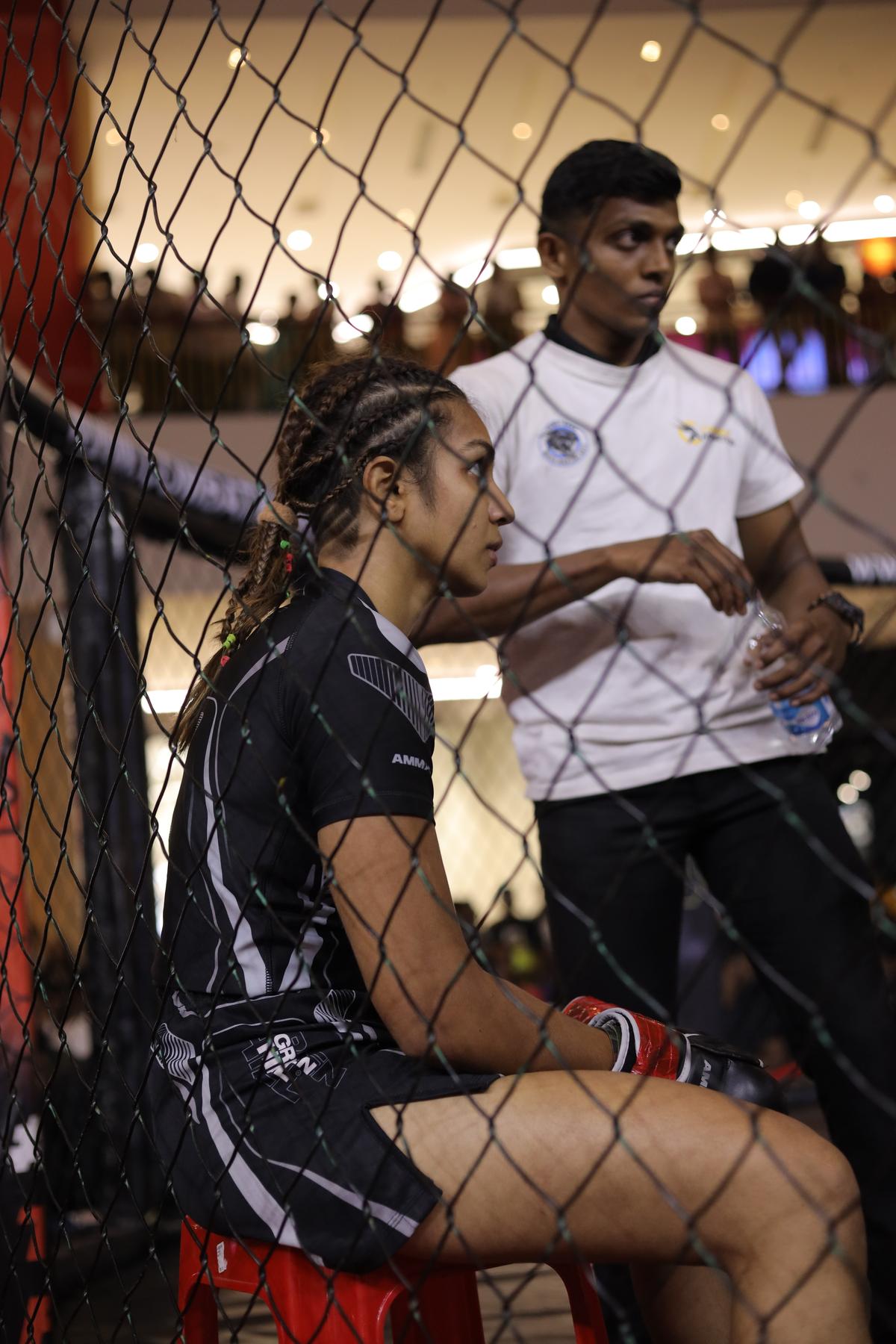
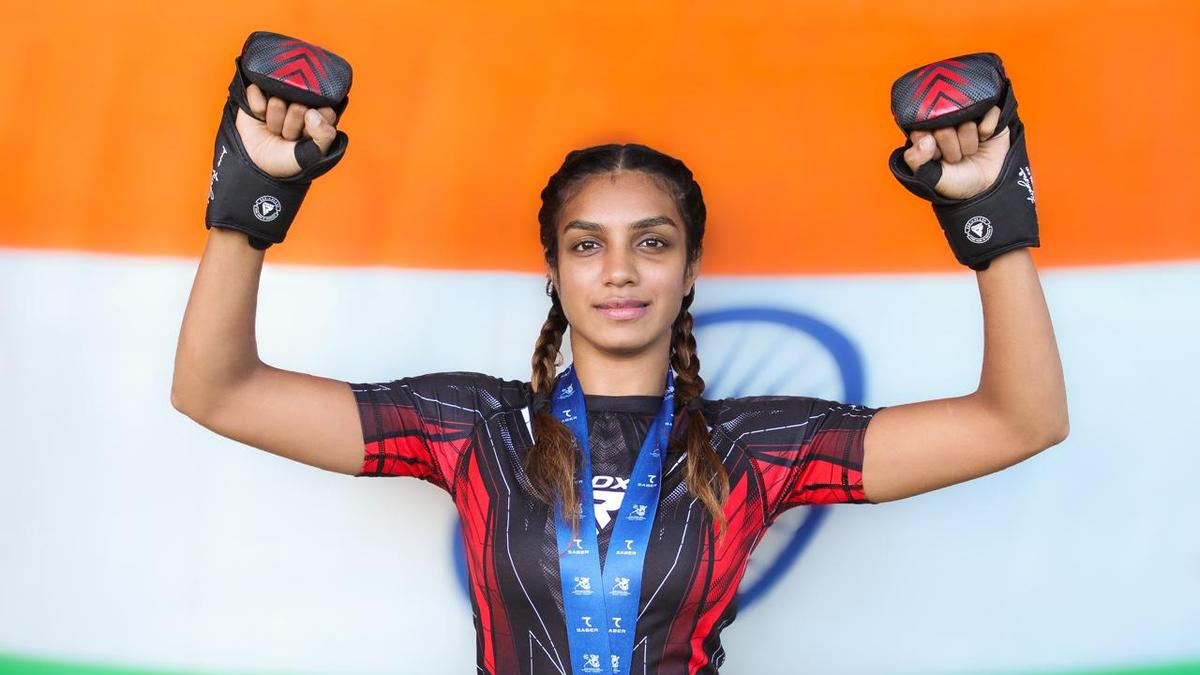
Afshan Fathima defied odds, reaching the final of IMMAF World Championships despite challenges and stereotypes. | Photo Credit: Special Arrangement

Afshan Fathima walked away from her very first bout of the 2024 IMMAF World Championships in Uzbekistan last week not only with a win but also with a prodigious, rapidly darkening contusion under her eye. Although the injury was caused by an accidental headbutt rather than a punch from her opponent, many thought it meant the end of her campaign in the women’s strawweight division (52.2kg) at her debut World Championship.

“Everyone who saw me thought I wasn’t going to be declared medically fit to take part in the next bout. But I did make it. And then after I won that bout, everyone thought my injury was not going to let me compete in the next bout. After every bout I fought, the other fighters thought I wasn’t going to be able to make the next round because of how big the swelling had got. But I kept doing this. There was no way I was going to quit,” she says.

By the time Afshan’s campaign at the IMMAF World Championships ended, she had gone further than any other Indian – reaching the final –at the premier global amateur competition in mixed martial arts. Amongst her wins, was a guillotine choke submission of Ireland’s Lisa Murtagh who trains at the prestigious SB Gym– with the same team as former UFC champion Connor McGregor – and picked up a decision win over reigning World champion Matilda Bachurina of Kazakhstan in the semifinals.

Afshan however couldn’t return from the competition with the gold medal she had hoped for. She ended up losing the final by a narrow points decision to Isabel Calvo of Spain. “Unfortunately, the day of my final coincided with the start of my period. It was pretty bad. I was puking and had really bad cramps. I wasn’t anything close to 100 percent,” she says. Afshan says she returned from the tournament with mixed emotions. “It stings of course to go so far and fall short in the final but at the same time, I’m a little happy that I at least came this far,” she says.

Few might not have predicted Afshan would get anywhere near where she’s gotten. “Even I wouldn’t,” she says.

Mixed martial arts were never on the horizon for the 23-year-old from Anna Nagar in Chennai. Even sport wasn’t really part of the picture. “There’s no one in my family who has chosen sports as a career,” says Afshan, the eldest of three sisters. That was the case for her as well. It wasn’t as if she wasn’t interested in sport. Some of her earliest memories are of watching WWE pro wrestling matches with her father and uncle. At school, she says she was one of the few children to actually make the most of the games period.

“Most of the other kids would be chatting with each other or catching up on their studies. I was the only one who would pester the games teacher to start a basketball match or something. I was also someone who used to roughhouse with my friends. They’d all tell me I was really strong or that I hit really hard. But I didn’t know what I was going to do with that. While I really wanted to play something, my family only really wanted me to study. My grandmother was a teacher and my aunt was a lecturer. I was also fairly good in studies so I had no option but to focus on my books. Perhaps if I was a bit dull, they might have been more open to the idea of putting me in sports,” she says.

It was only after her school when she began studying for a degree in Electrical Engineering at Hindustan Institute of Technology that Afshan says she finally got the chance to pursue her passion.

“I always wanted to do some sort of fitness activity. So, in my third year of college I joined a crossfit gym. The gym where I trained also had a sign for mixed martial arts classes although they didn’t have any instructors. That was the first time I had heard about mixed martial arts. Although they didn’t have classes at the gym. I did a Google search and found out about Combat Kinetics Chennai and coach Ajit Sigamani,” she says.

At that time, Afshan says she told her parents she was just staying back to play basketball in her college since she knew the alternative would be something they would never agree with.

“I’m from an extremely orthodox Muslim family. Back when I was in school and in college I would wear the burkha. I couldn’t even think of leaving the house if I wasn’t wearing the burkha. While my parents were supportive of my education, they would have drawn the line at my getting into a sport like martial arts. So I used to wear the burkha when I left home. Then, when I went into the gym, I would change into my gear and back into the burkha when I was heading back home. It almost felt like I was living two lives. I tried to balance those two lives as much as possible. I knew I would have to tell my family eventually but I was hoping I could ease them into it,” she says.

It was at the Combat Kinetics Gym though where she felt she truly belonged. “Because I had been somewhat sporty in the past, I didn’t really struggle getting physically in shape. I enjoyed doing all the push ups and pull ups. I absolutely loved actual combat training. A lot of our training in MMA is mixed gender and I sometimes would think just how scandalised my family would be if they walked in on one of our grappling sessions. But, I genuinely didn’t think too much about it when I started. I just got on with it. It wasn’t as though I’d stopped becoming religious or stopped praying but I think it’s what’s inside your heart that counts a lot more than what you are wearing on the outside,” she says.

Afshan says she knew she was someone who was meant to be a fighter when she stepped into the fighting cage for her first sparring session. “In contrast to a lot of the other individuals who were starting out, I was also someone who wasn’t scared of sparring. A lot of beginners are scared of being hit. They close their eyes and turn their head. When they get hit on the face for the first time, they decide, this isn’t what they want to do with their life. But fighting just came naturally to me,” she says.

Over time, Afshan’s parents have come to terms with her choices. | Photo Credit: Special Arrangement

Her biggest fight though would come outside the cage when her parents eventually found out that she was training in mixed martial arts. “My dad freaked out. There was a lot of screaming and shouting. They took away my phone and I wasn’t allowed to leave the house for a week. But I kept insisting that I would go and eventually my parents gave in,” she says.

Over time, Afshan’s parents have come to terms with her choices. “I don’t think my father and mother were personally against my taking up MMA. I think they were more concerned about what the society I came from would think about what I did. I think they first thought it was a weird sort of fad that I had picked up. Initially, as a compromise my father would drive me to the classes and bring me back right after. Later though, I learned how to drive a motorcycle and began to go myself. That gave him the confidence that I was really serious about what I was doing,” she says.

Within a few months of training, Afshan says she was sure combat sports was what she wanted to do with her life. “I can say I was a quick learner. As part of our training, we usually compete in boxing, judo and wrestling competitions. Within a few months of training, my coach entered my name in a district level competition in boxing. Although I was nervous since I hadn’t competed before, I ended up winning. Another few months later, I competed at my first national amateur championships in Lucknow that once again I ended up winning,” she says.

While the gold medal she won in Lucknow earned her some level of respect at home, Afshan knew it will always be hard for her parents to completely come to terms with her career. That was her key to becoming as independent as possible. “My parents have already gone far beyond their comfort zone to even accept that I can be an MMA fighter. Sometimes when they see me in shorts, they will grumble and say they gave me too much freedom. I like to live life on my own terms. I’ve never asked my parents for any money to fund my training or competition. My dad used to be in business but he had to shut that down after he made a lot of losses. I also have two younger sisters, who my parents are responsible for. At first, I used to beg my coach to charge me a nominal fee. I promised I’d pay him back when I started earning. After graduation, I worked in sales for Jaguar India but I realised I wasn’t getting the time to train like I wanted. I then started working as a coach in my MMA gym itself. MMA isn’t a sport where as an athlete you get easily sponsored by the government or private organisations. So, if I have to compete in competitions, I have to raise my own funds,” she says.

Afshan says she had to save up for a year in order to pay for her fight camp, nutrition, travel and competition fees for her first IMMAF World Championships this year.

It’s not been an easy journey and Afshan has to keep herself motivated even when it’s not the easiest to. Within her family, Afshan says she is a bit of a polarising figure. “Just because I’m a fighter doesn’t mean everyone’s opinion has changed. My family is still very conservative. A lot of people wonder why I’m still not married. Both my younger sisters wear the hijab and most of my cousins still wear the burkha. My relatives tell them not to hang around with me because I’m seen as a bit of a bad influence. My mother loves me but she will still come up to me and say that I should retire as a fighter and get married. But she doesn’t understand that I’ve only just started,” she says.

Afshan though doesn’t have any regrets. She’s already looking to her next target – turning professional. “The amateur system is mostly a way to get some sort of experience. I think I’m a fairly well-rounded fighter. The next level for a fighter is to turn professional. My coach and I are still weighing our options. We have some offers but I’m still to decide whether I want to compete for one more World Championship and win a gold or take the jump into professional fighting,” she says.

The professional ranks will be yet another giant step for Afshan to climb. She’s looking forward to it. “There’s this quote I always try to live by. It’s that the mountains you carry are the ones you have to climb. There’s no point taking pressure because of everything that I had to get through to get to where I am. When I look back, I think to myself ‘Wow, I’ve broken so many stereotypes not just for women but for Muslim women in particular. Every once in a while, some woman will come up to me and say she lives through me or that she wants her child to become like me. That gives me a lot of motivation. I’ve faced some hard obstacles. I can deal with next to anything,” she says.

source: http://www.sportstar.thehindu.com / Sportstar / Home> More Sports / by Jonathan Selvaraj / November 21st, 2024

Dr. B.S. Abdur Rahman: The Man who Died Young

Kilakarai (Ramanathapuram District) / Chennai, TAMIL NADU :

Death of Dr. B.S. Abdur Rahman has not only shocked who knew his mission and lifelong works but also those who have benefited by his devotion and those who took inspirations from him. His untimely death has brought a vacuam in Indian educational scenario and it is almost impossible to be filled up in near future.

Indian Muslim Community has legacy of Sir Syed Ahmad Khan, the founder of the Aligarh Muslim University before it, Dr. B.S. Abdur Rahman has achieved almost that place and has become another inspirational figure.

Dr. B.S. Abdur Rahman was born in kilakarai falling under Ramanathapuram district of Tamilnadu state in 1927. Due to his works and philanthropist bent of mind, Dr. Rahman became a well known personality who devoted himself for the upliftment of the economically weaker sections and minorities through their educational empowerment. He did not lagged behind in providing good facilities of health care to the deprived sections of society.

B.S. Abdur Rahman, Vice Chairman of Emirates Trading Agency LLC and Associated Construction and Investments Co. LLC (ETA-ASCON), the Dubai-based $2 billion industrial behemoth, was a multi-faceted personality, much like the diamonds he dealt with when he began in humble business in Sri Lanka, over half a century ago.

Diamond merchant, industrialist, educationist, philanthropist, shipping magnate, generous contributor and enthusiastic participant in many other business and social activities he is a renaissance man whose outlook was Millennial. Meaning, while his values were classical, his thinking was forward looking.

Kilakarai, on the coast of Ramanathapuram district in Tamil Nadu, where Abdur Rahman (fondly known as Sena Aana) was born, is a town made famous in the region by his illustrious ancestor, Vallal Seethakathi.

The forbears of Abdur Rahman migrated to Kilakarai from Arabia in the 12th century. Kilakarai, which means East Coast in Tamil, was a flourishing port to which mearchants from the east and west came. A densely populated area, predominantly by Muslims, it owned its prosperity to them.

From centuries they traded with Sri Lanka (then known as Ceylon), dealing in pealing in pearls, gemstones and conches. Even today, many of them live in Sri Lanka or do business with the island. Abdur Rahman too began his career in Ceylon. Among the pearl traders of Kilakarai was Buhari Aalim. Abdur Rahman was his son.

Aalim was an expert in valuing precious stones and pearls. He would hold a gem between his right thumb and index finger and, looking at it against the sun, study the quality of the watermark within to judge the worth of the precious stone. He would be unfailingly correct.

Watching his father at work, the young Abdur Rahman was soon able to understand the nuances of the trade. This training and experience helped him to become one of the most successful merchants in the diamond trade in due course. When Abdur Rahman first went to Colombo, he was fifteen years old. He had with him just Indian Rupees 149. He worked as an errand boy for diamond merchants, carrying their diamonds and other gems from sellers to buyers and back. He was at the time staying with some traders from Kilakarai and neighbouring villages. They allowed him to stay with them without any payment, but he had, instead, to fetch tea them from a nearby hotel, clean the rooms and perform other menial tasks.

A lesser person perhaps would have thrown in the towel. But Abdur Rahman was made of sterner stuff. Before long, he used his persuasive skills to obtain gemstones from another merchant and began trading in them. In time he became a successful gem trader. The base that Abdur Rahman built in Ceylon was to help him in all his future activities.

He began visiting Belgium, then as now, a centre of the gem trade, the USA, South America and set up business in Penang, Malaysia, Chennai, Kolkata (then Calcutta), and then in Hong Kong. It was in Hong Kong that his business flourished. Incidentally, Abdur Rahman was the first person from Kilakarai to go to Hong Kong.

In Hong Kong he launched the Precious Trading Company in 1954. Later, his very special brainchild, the Amana Group of Hong Kong, was established. It was under its banner that the multinational company ETA-ASCON came into existence.

He was a firm believer in education and took upon himself the task of educationally empower the poor and the deprived. He established a wide network of educational institutions. In 1967, he founded Seethakathi Trust and in 1979, All India Islamic Foundation to achieve his target of serving the community and nation. He founded twelve educational institutions including an Engineering University, a woman’s college, an Arabic College two boys schools, 3 girls schools, a woman Nursing college, a Teacher Training College, B.Ed College for woman and 2 hospitals beside orphanages in rural and urban areas. His biggest achievement was founding a 60 bed Yousuf Zulaikha hospital at Kilakrai and a 150 bed Crescent hospital at Madurai. He did not lagged behind in providing comfort of life to most deprived orphanages and founded Al Momin orphanages for boys and girls at Ottapidram, Tanjore, Kilakarai and Thiruvithancode of Tamilnadu.

Dr. B.S. Abdur Rahman was farsighted man and knew the importance of administration. He was well aware that to uplift community, it is very necessary that Muslim youths join Indian Administrative Services and so he established Crescent IAS and Carriers Guidance Academy in 1994 beside an Islamic Studies & Cultural Centre at Chennai.

His social works span to wide area. Dr. B.S. Abdur Rahman founded B.S. Abdur Rahman Zakat Fund Foundation in 2007 which provides educational grants for students. Through this foundation, B.S. Abdur Rahmand has maintained magniticence of Zakat which may be called a pillar of Islam and which is an instrument for survival of poor Muslims. He 1017 Self Help Group (SHG) which became beneficial to 17093 deprived and helpless women. He also founded and managed various other trusts like Yousuf Zulaikha (1993) Chennai for education, health care and women empowerment. United Economic Forum in 1994 and Seethakathi NGO in 2002.

He also establish new milestones in business field.

He was founder Chairman of Dubai based ETA – Ascon – Star Group and was treated a renowned Indian entrepreneur in UAE. It may be known that the group has a turn over US$ 5.5 billion and employs 50,000 people. With his visionary zeal and entrepreneurial spirit.

B.S. Abdur Rahman has been the guiding force behind many companies in India, among which the most important is the Buhari Group the Indian Multinational. The prominent companies and establishments under Buhari Group include East Coast Construction Ltd. (ECCI) 50 years in the field of construction, Coal & Oil and many other automobile dealership companies.

In recognition of his services he received many awards also.

The Aligarh Muslim University Students Union conferred him life membership while Sathyabama University awarded Honorary Doctorate in recognition of his contribution to Women Education.

In fact Dr. B.S. Abdur Rahman had became an inspirational force to young generation during his own life time. There are very few people who climb the ladder of success and remember the down trodden sections of the society or do anything meaningful for them.

Whatever Dr. B.S. Abdur Rahman has done for the manginalised and deprived sections of society will be always not only remembered but will also be documented in social and educational history of India. The best tribute to Dr. B.S. Abdur Rahman will be to follow the path shown by him not only in business but other fields also.

-Dr. Jasim Mohammad / Author is Editor of The Aligarh Movement monthly

source: http://www.hastakshep.com / Hastakshep.com / Home> Uncategorized / by Dr Jasim Mohammad / March 29th, 2019

Sustainability is a way of life, says Dr Samiullah Khan

Chennai, TAMIL NADU / Dubai, U.A.E :

Dr. Samiullah Khan

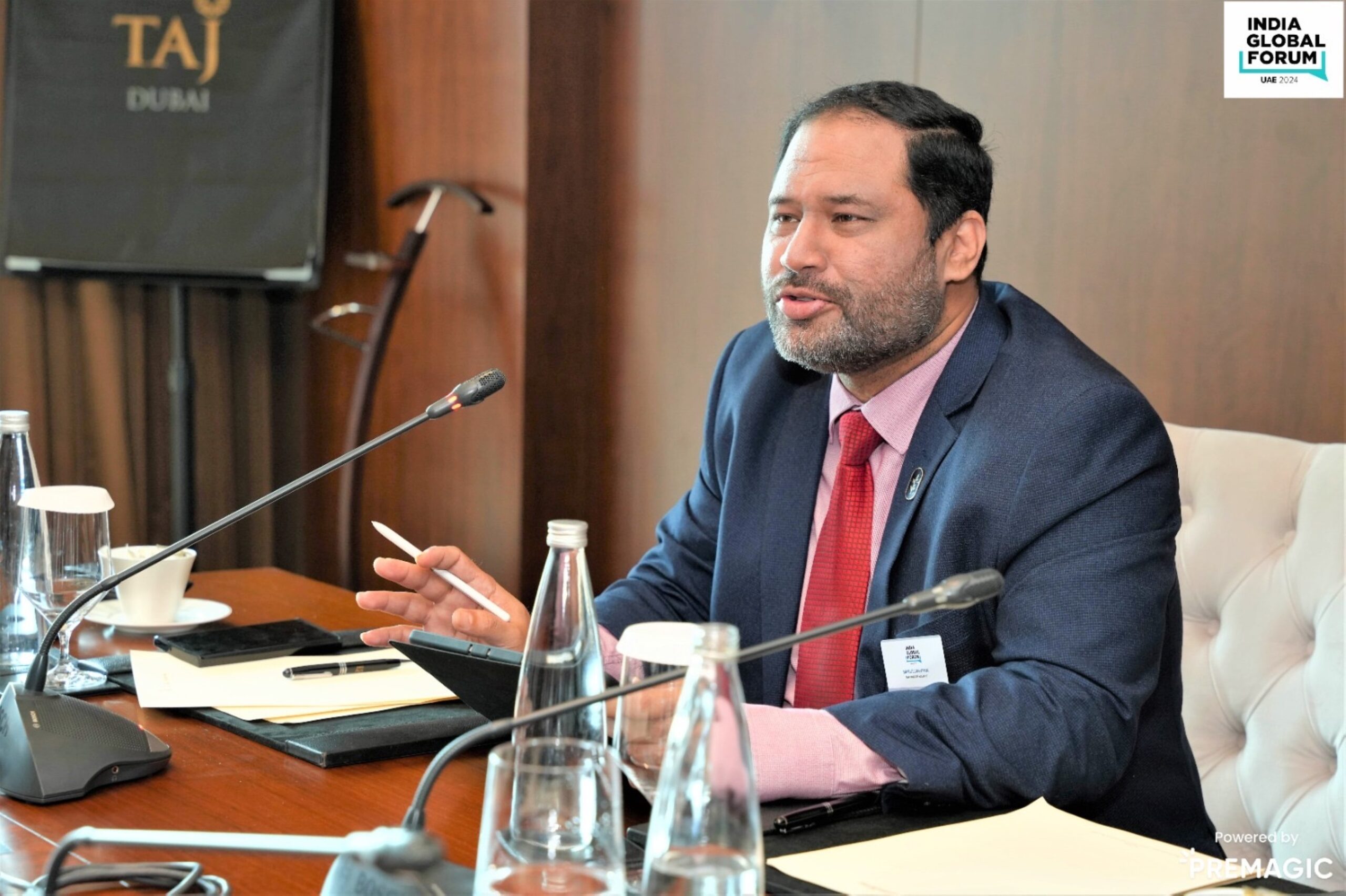
Sustainability is no longer a choice—it’s a way of life. This is an exciting field to explore. With AI, blockchain, IOT and other advanced technologies, we have the tools to build a truly sustainable future, stated by Dr. Samiullah Khan, one of the most influential voices in the UAE’s sustainability movement and Chief Sustainability Officer at Fakhruddin Holdings Dubai. Talking to Gulf Today, he said, “As the world intensifies efforts to combat climate change, sustainability has become more than just a buzzword – it’s a global imperative.”

Dr Khan also known as Dr Sam is a key figure in sustainability summits and discussions, often the first to evaluate innovative sustainability solutions that promise a greener future. For many, sustainability is a practice. For him, it’s second nature – ingrained since childhood in Chennai, India. “Wasting even a grain of rice was unacceptable in our home. Extra food was either shared with those in need or fed to cows, whose dung was used as manure in our garden,” he recalled.

These early lessons shaped his understanding of sustainability and the circular economy. His passion for technology and the environment led him to prestigious institutions such as Anna University, Cambridge University, MIT, Delft and Harvard.

His career began with Tata Motors, where he became among the youngest engineer to lead international operations into Bangladesh and Saudi Arabia and growing Tata’s market share to an impressive 96 per cent in the school bus sector.

After an illustrious 17 years with Tata and five years at SRM University, Sam found his true calling in 2015 as CEO of World Islands, He introduced air-to-water technology, harnessing humidity in the deserts of Dubai to generate clean drinking water, using Solar power – an innovation that gained significant traction in the desert landscape.

Recognised among the 100 Iconic Indians by the Indian Embassy in the UAE, Dr Sam soon became a leading advocate for sustainability, collaborating with individuals, private sector and government, notably with Marwan Bin Jassim Al Sarkal and playing a pivotal role in the “Dubai Can” initiative under the vision of Crown Prince of Dubai Sheikh Hamdan Bin Mohammed Bin Rashid Al Maktoum in initiatives to eliminate plastic bottles in Dubai.

As a Championing Green Innovation post COVID, Dr Khan focused on air quality, energy conservation, water purity, food security, waste management and circular economy.

Under his leadership, Smart Air Handling Units (S.A.H.U.) are being introduced to improve indoor air quality and reduce energy consumption by up to 40% compared to traditional HVAC systems.

The other initiatives included a centralised, organic mineral-enriched hydrogenated, Ionised, Alkaline drinking water system is being developed for healthier hydration as well as a radiant-cooled greenhouse café with hydroponics is being explored to boost UAE’s food security and comprehensive waste management and recycling systems, including composting, are being implemented.

source: http://www.gulftoday.ae / Gulf Today / Home> News / by Jamil Khan, Senior Reporter / June 17th, 2025

‘Yahya Ali’ streets in Chennai: From street name to gobbledygook

Chennai, TAMIL NADU :

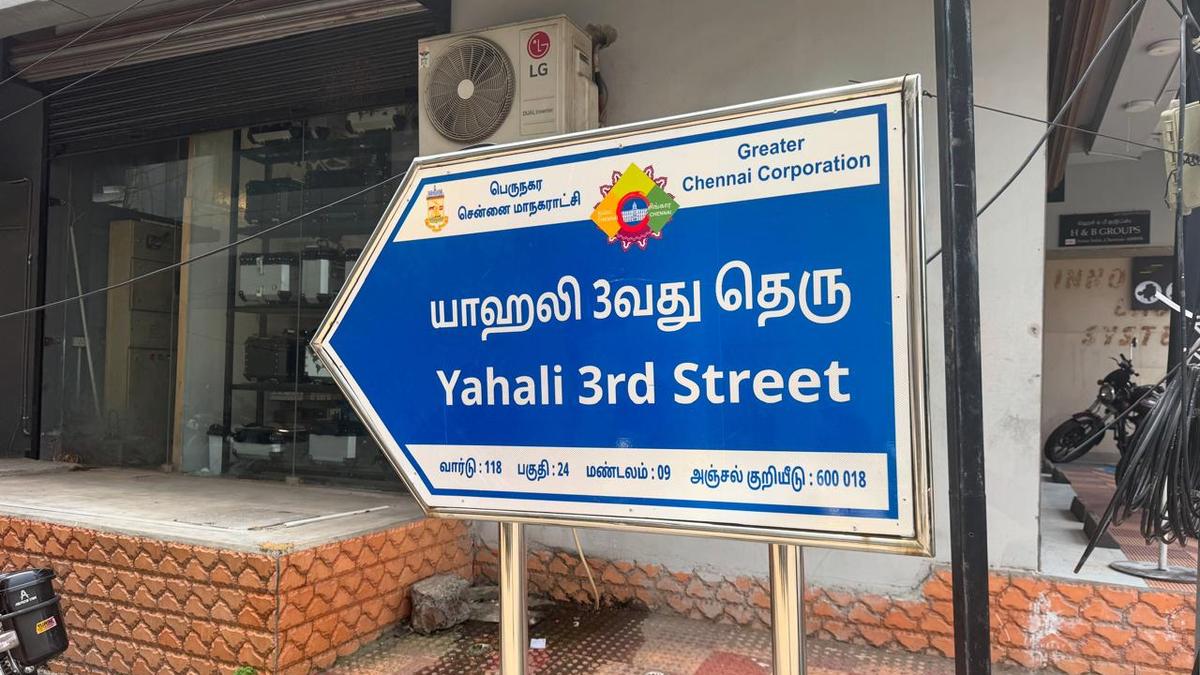
The correct name is Yahya Ali Streets – 1, 2 and 3, and they take their names from Justice Yahya Ali of the High Court of Madras.  | Photo Credit: Special Arrangement

The street sign says it all – Yahali 3rd Street. There are three of them, all connecting Anna Salai with G.N. Chetty Road, at Teynampet, very close to Semmozhi Poonga. Only Yahali is not the correct name. Google Maps has compounded matters further. You need to search under Yaya Hali Street if you need to find it. The correct name is Yahya Ali Streets – 1, 2, and 3, and they take their names from Justice Yahya Ali of the High Court of Madras.

The learned judge is not in public memory. When I spoke to a friend on this, he said that the Internet has no reference to such a judge, and I guess that would mean such a person did not exist. But he did. And when he died as a sitting judge in 1949, the High Court convened to condole his passing. The brilliant barrister and then Public Prosecutor V.L. Ethiraj led the mourners. He dwelt on the “keen intellect, great learning, profound human understanding and exquisite courtesy we found in that frail figure.” But to get full biographical details, we need to turn to the speech of an illustrious contemporary, V.C. Gopalaratnam, who spoke on behalf of the Madras Advocates Association.

Yahya Ali was born in August 1893 in Nellore, his father serving as Assistant Secretary in the Finance Department of the Nizams of Hyderabad. He graduated in History and Economics from the Presidency College in 1916 and then qualified in Law. He set up practice in Nellore and became Government Pleader and Public Prosecutor. He was a member of the Madras Legislative Council as well. In between, he became Chairman of Nellore Municipality, his election being testimony to the regard he enjoyed from all residents of the town. It was a place notorious for communal tension, and being a Hindu majority, it was considered impossible for a Muslim to win the ballot.

In 1926, Yahya Ali became District Judge, being posted in that capacity to various parts of Madras Presidency. His specialisation in matters concerning finance led to his being appointed by the then Imperial Government in 1942 as the Chairman of the Appellate Income Tax Tribunal where he equipped himself “with a thorough and exhaustive knowledge of Income Tax Law and Procedure.” In 1945 he became a judge of the High Court of Madras. It is interesting to note that he sat in judgment till the last day of his life, taking ill on April 21, 1949, and passing away the next day.

While these details are from Gopalaratnam’s speech during the condolence meet, we learn some more from what the then Chief Justice P.V. Rajamannar had to say. Yahya Ali, he noted, was a connoisseur of Telugu poetry and “he was a deeply cultured person – culture with the best ingredients of what I may call Moghul culture – urbanity, catholicity and instinctive love of all that was beautiful.”

What was his link to Teynampet? He was at the time of his death Mutawalli (trustee or guardian) of the Teynampet Mosque in which his family had taken a deep interest. It was also in the precincts of this mosque that Yahya Ali was buried. And eventually, a locality was named after him. And from there, the name has morphed phonetically as it were, to what it is now with street names changing accordingly.

I wish the Corporation would be more careful with street signs. We have suffered enough mutilation with truncation of many names to initials, morphing of others, and of course, name changes at the drop of a hat.

source: http://www.thehindu.com / The Hindu / Home> News> Cities> Chennai>My Madras / by Sriram V / June 11th, 2025

Mushawarat ex-president Navaid Hamid honoured with Qaide Millat Award

NEW DELHI :

Navaid Hamid

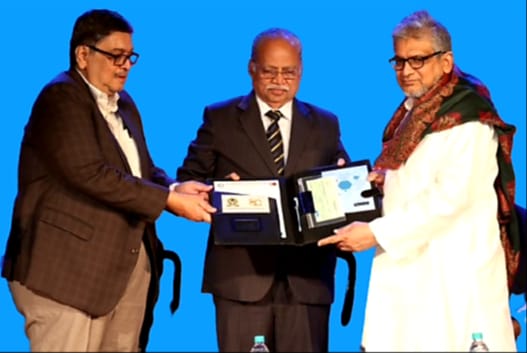
Former president of the All India Muslim Majlis-e-Mushawarat (AIMMM) and general secretary of the Movement for Empowerment of Indian Muslims (MOEMIM), Navaid Hamid, honoured with the Qaide Millat Award.

The award was presented by former Madras High Court judge, Justice KN Basha at an event held at a grand ceremony at the Music Academy on Saturday.

Renowned human rights activist John Dayal, and founder of the Sadbhavana Mission, distinguished scientist Professor Vipin Kumar Tripathi, were also honoured by the southern Indian institution, Qaide Millat Educational and Social Trust (Chennai).

The annual award is given for probity in political/public life and consists of a certificate of appreciation, a cash prize of five lakh rupees, and shawl.

Congratulating the awardees on the occasion, Justice Basha said he felt honoured and privileged to present the awards to individuals who serve as beacons of light amidst the darkness of the current environment while M G Dawood Miyakhan, general Secretary of the trust, said “the awardees are based on their unblemished track record of integrity in political and personal life in India”.

Retired CSI Bishop Dr V Devasagayam said while facilitating the awardees “we are here to recognise your services, support your initiatives and to wish that you continue your fight in spite of all the odds”.

The event was presided over by the president of the Qaide Millat Trust, Qazi Dr Salahuddin Muhammad Ayub, while announcement the awards and introduction of awardees were made by the Trust’s general secretary.

On this occasion, Dr S Sadiq, former Vice-Chancellor of Madras University, and retired CSI Bishop Dr V Devasagayam, were also honoured. General Secretary Dawood Miyan Khan, Treasurer S Mushtaq Ahmed, and Principal of Qaide Millat College, Dr MA Thawab, presented certificates of honour, prize, and shawls to the dignitaries.

The announcement of the 2024 Qaide Millat Award was made in February 2025. The award jury comprised Dr Vasanti Devi (former Vice-Chancellor), Dr V Devasagayam (former Bishop), Paneerselvam (Readers’ Editor, The Hindu), and Dawood Miyan Khan (general secretary, QEST).

Born on June 23, 1963, in the walled city of Delhi, Navaid Hamid has been associated with the All India Muslim Majlis-e-Mushawarat since the late 1980s. He served as its President from 2016 to 2023. A graduate in English from Zakir Hussain College, University of Delhi, Navaid Hamid has been actively involved in political and social work since his student days at the university.

During the UPA Government (2004–2014), he was appointed as a member of the National Integration Council for two terms. He is the founding secretary of the South Asian Council for Minorities (SACM) and also serves as the national general secretary of the Movement for Empowerment of Muslim Indians (MOEMIN). He has worked actively to support and uplift marginalized communities.

In 2008, at the Global Minorities Meet held in New Delhi and attended by delegates from 18 countries, Navaid Hamid was elected General Secretary of the Global Minorities Forum for Justice and Peace.

Previously, the Trust has presented the Qaide Millat Award to eminent personalities, including Teesta Setalvad and Nilakanoo (2015), N. Shankariah and Syed Shahabuddin (2016), Manik Sarkar and Muhammad Ismail (2017), Vice President of India Dr. Hamid Ansari and Aruna Roy (2018), AG Noorani and Thiru V mavalavan (2019), Harsh Mander and Bilkis Bano (2020), Dr Irfan Habib and Samyukt Kisan Morcha (2021), Thiru Veeramani and The Wire news (2022), N Ram (The Hindu) and Dr Abu Saleh Sharif.

The Qaide Millat award is presented in memory of Qaide Millat Maulvi Muhammad Ismail, a selfless servant of the community, freedom fighter, and a distinguished national leader. His significant contributions to the development of the country and community after independence are widely acknowledged.

As a member of the Constituent Assembly, a Member of Parliament in both the Lok Sabha and the Rajya Sabha, and as the founder-leader of the Indian Union Muslim League, his services are considered unforgettable. He was also among the founding members of the All India Muslim Majlis-e-Mushawarat (AIMMM).

The Qaide Millat Trust instituted this award on the 40th death anniversary of Maulvi Muhammad Ismail, and it is awarded annually to distinguished individuals active in public life.

source: http://www.theokhlatimes.com / The Okhla Times / Home> Local / by The Okhla Times / May 01st, 2025

Former President of MEASI, U. Mohammed Khalilulah is No More

Chennai, TAMIL NADU :

U. Mohammed Khalilulah, former President of MEASI, Anjuman-E-Himayath-E-Islam, All India Muslim Education Society, and Agent of Prince of Arcot Endowment, breathed his last on Tuesday at 4.45pm.

U. Mohammed Khalilullah was the legendary doyen of the Muslim community in Chennai, a highly respected, recognized and well-appreciated member of the chartered accountant fraternity, and a remarkable and graceful human being with the core inbuilt values of utmost decency and universal brotherhood.

Mr. Elias Sait, Hon. Secretary of MEASI and President of NCAA, in his condolence message, said: “Allah has called him back to the heavenly abode, taking him away from us. A big unmeasurable loss to our community, to his family, and to his innumerable friends and well-wishers.

“One of the saddest days for MEASI, AHI and many other Muslim institutions, and for all of us in this MEASI EC GROUP.

“All the staff of all MEASI institutions will be grieving over the loss of their father like figure for nearly three decades.

“Our condolences to his large family of daughter, sons and grandchildren, more particularly to his eldest granddaughter who took care of him so meticulously in every aspect, during the last years of his life. Allah give them the fortitude and sabar to bear this huge loss.”

At the time of transition of the services of Agent of Prince of Arcot Endowment from U. Mohammed Khalilullah to Nawabzada Mohammed Naser Ali on 29 November 2024, the Prince of Arcot, His Highness Nawab Mohammed Abdul Ali lauded Mr. Khalilullah for his decades of dedicated service to the Endowments. “His tenure of 31 years as the agent is marked by significant improvements and remarkable contributions to the development and overall progress of the institution,” he said.

source: http://www.radiancenews.com / Radiance News / Home> Latest News> Obituary / by Radiance News Bureau / February 27th, 2025

Indian teenage boy speaks, writes and reads 400 languages

Chennai, TAMIL NADU :

Mahmood Akram’s journey continues to inspire linguists, educators, and students worldwide, proving that dedication and passion can break barriers in education and learning.

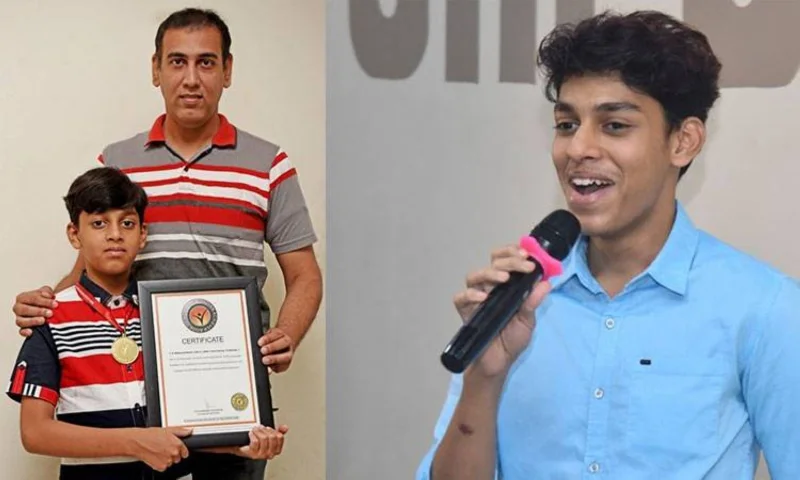
Nineteen-year-old Indian Muslim boy, Mahmood Akram, has astonished the world with his linguistic abilities and achieved what many consider impossible.

With the ability to write, read and type in 400 languages and speak 46 fluently, the Chennai-based Muslim teenager’s journey into languages began at an early age, guided by his father, Shilbee Mozhippriyan, who himself speaks 16 languages, according to media reports.

The young Indian boy believes English isn’t enough for global communication & wants to inspire people of Tamil Nadiu to learn more languages.

Akram’s extraordinary talent became evident when he learned the English alphabet in just six days and Tamil’s 299-character script in three weeks—a feat that typically takes months.

Encouraged by his father, a linguistics expert, he continued to explore languages, surpassing even his mentor’s knowledge by the age of six.

At just eight years old, Akram set a world record as the youngest multilingual typist. By 12, he had impressed German linguists by demonstrating fluency in 400 languages, securing another world record.

“I had struggled because I did not know the language of a particular state or country when I had to move to places like Israel, Spain, due to my job,” shares Shilbee, who also owns a doctorate in cognitive psychology among other degrees.

Akram’s journey continues to inspire linguists, educators, and students worldwide, proving that dedication and passion can break barriers in education and learning.

His passion for languages led him beyond conventional schooling. Unable to find suitable programmes in India, he pursued online studies through an Israeli institution, focusing on Arabic, Spanish, French, and Hebrew.

Inspired by his growing social media following, Akram began teaching languages at 14 through YouTube.

By 2024, he had conducted language workshops in Myanmar, Cambodia, Thailand, and Indonesia, sharing his expertise with students worldwide.

He is pursuing a BA in English Literature and a BSc in Animation at Chennai’s Alagappa University while also studying linguistics at the UK’s Open University.

Despite his academic commitments, he remains dedicated to refining his fluency across languages.

As Akram recalls, “My journey started at the age of four.” “My parents began teaching me Tamil and English alphabets, and I mastered the English alphabet in six days. They were astonished.” His aptitude didn’t stop there. He learnt the 299 alphabets of Tamil in just three weeks, a task that typically takes months.  

source: http://www.gulftoday.ae / Gulf Today / Home> Culture / by Gulf Today Report / February 19th, 2025

World Cup carrom champions return from USA

Chennai, TAMIL NADU :

Indian carrom team returns triumphant from World Cup in San Francisco, with Rashmi Kumari praising champions Srinivas and Khazima.

Some members of the World Cup-winning Indian carrom team on return in Delhi on Wednesday (November 21, 2024). From left, K Nagajothi, M Khazima, V Mithra, VD Narayan, Bharti Narayan, Rashmi Kumari, K Srinivas, and Aakanksha Kadam. | Photo Credit: Kamesh Srinivasan

It was a happy homecoming for the champion Indian carrom team from the World Cup in San Francisco, USA, on Wednesday (November 20, 2024).

Even though it was K. Srinivas and M. Khazima who won the individual men’s and women’s titles in a thrilling fashion, it was the World Champion Rashmi Kumari who was singing their praise, appreciating their high-quality game, in a chat with The Hindu.

The evergreen women’s champion Rashmi, who has won the national title 12 times, apart from three World titles, expressed admiration for Srinivas finishing brilliantly with a white slam, to emerge champion after trailing 16-20.

“It was a great finish,” said Rashmi.

On his part, Srinivas said that Mohd. Arif had executed nine slams through the World Cup with his brilliant play, and that he derived great satisfaction in winning in such great style with a slam, not giving the opponent any chance.

The 17-year-old Khazima, a first year student of Justice Basheer Ahmed Sayeed College in Chennai, had won a thriller 25-23, 22-25, 25-24 agaiinst Rashmi in the final for the women’s crown.

“I have great respect for Rashmi. I practised 12 hours a day to prepare for this World Cup. My father Mehboob Basha and former World Champion Maria Irudayam have guided me”, said Khazima, who won the doubles title with V. Mithra.

For one so young, Khazima was quite unselfish and was thinking more about improving the structure of the Chennai Nagar Carrom Coaching centre as and when she gets to meet the Tamil Nadu Chief Minister.

The small structure that gets flooded during the rains, has already produced many national champions, including Khazima’s brother.

It was a triple crown for both Srinivas and Khazima, as they not only won the singles but also the doubles and the team championships. Srinivas won the doubles title with Mohd. Arif.

The secretary of the All India Carrom Federation (AICF), Bharti Narayan, was delighted with the high quality performance of the Indian players, in sweeping every possible medal except one.

“Preeti Jakhotia of the USA played a superb game right through and beat two of our players, V Mithra in the third place match and K Nagajothi in the quarterfinals”, said Bharti.

The secretary general of the International carrom federation, VD Narayan said that the standard of the game was going up globally, and that the USA had done a great job of hosting the World Cup, acquiring 80 boards from India, and changing the frame to blue for a more impressive screen presence.

“We are planning to have the Asian championship every year, like the way Europeans conduct their championship. We have many plans to develop the game”, said Narayan.

“Khazima played a very aggressive game, pulling off many impressive shots. The loss in the final gives me the motivation to train better in the next four years,”, said Rashmi.

source: http://www.thehindu.com / The Hindu / Home> Sport / by Kamesh Srinivasan / November 21st, 2024