Tag Archives: Muslims of Deoband

Whiff of breeze from Deoband

Deoband, UTTAR PRADESH :

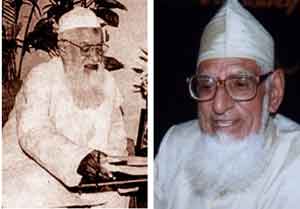
  Asad Madani (left) and Salim Qasmi

The quarter-century-old feud in Deoband seems to be coming to an end.

Stalwarts of Deoband, Maulanas As’ad Madani and Salim Qasimi have realised the futility of the dispute which led to a split in the world-famous Darul Uloom making way to two institutions, the old and a new one identified as “Waqf”. Personality clash between the two revered clans which dominated Darul Uloom, the then rector Qari Tayyib and scion of Maulana Husain Ahmad Madani, led to violent clashes in 1982 when firearms and knives were used to settle scores and the Madani group took over the institution allegedly with Indira Gandhi’s tacit support to Maulana Madani who was a Congress MP (Rajya Sabha) at the time.

The other group licked its wounds, moved on and built a new institution with same name and philosophy while the personality clash continued with disastrous results for the Muslim community in India and abroad which highly revered Deoband and many followed it too in matters of faith.

The split seemed final until recently when Maulana As’ad Madani was suddenly hospitalised during Haj, and on 28 January Urdu newspapers carried a report based on Jamiatul Ulama-e Hind sources that Maulana Madani is hospitalised in a critical condition in the King Fahd Hospital in Madinah.

Maulana Salim Qasimi took the initiative and phoned his archrival to enquire about Maulana Madani’s health and arranged for a meeting to pray for his health. This touched Maulana Madani deeply and on his return to India a few days later he wrote on 31 January to Maulana Qasimi thanking him and adding, “It is a fact that Hazrat Nanotwi, may his secret be sanctified, is the basis of this group. We do not equal even the dust beneath his feet. Whatever differences arose in the past were ill-fated. Let all that was said, done and occured be forgiven and not left for the Hereafter.” 

Maulana Qasimi reciprocated the feeling and said in his reply on 9 February that these sentiments are a reflection of his own old wishes. He added that “Prestige of the [Deoband] group lies in an end to hurting the way of the great past leaders and ending the disputes altogether. In my view, at the last leg of my life, it is my shared wish and effort that you and me should not leave behind for the new generation this unblessed heritage. Rather we should prepare to meet Allah the Almighty according to the tradition of the ancestors based on unity, accord, theoretical and practical unity and shared sincere wishes to serve knowledge and faith.”

Thus a new phase was inaugurated in the recent sad history of Deoband. The two groups, whose influence runs to many countries around the globe, were not even on talking terms only a few weeks ago. A number of meetings over tea and dinner have been held since between the two groups. According to a report, Maulana Anzar Shah Kashmiri, an important member of the Qasimi group, has gone to the extent of saying to Maulana Madani that “everything is now placed in your hands.” 

According to sources, both sides have agreed in principle to withdraw dozens of court cases which both sides had slapped against each other. A number of meetings have been held on various levels. Some resistance remains within both groups. The best outcome would be to merge the two darul ulooms into one (they stand facing each other) and both administrations absorbed into one. Even if vested interests prevent this desired outcome, the old enmity will give way to cooperation and mutual respect which in turn will be good omen for the entire Indian Muslim community. «

source: http://www.milligazette.com / The Milli Gazette Online / Home / by Zafarul-Islam Khan / 16-31 March 2025 / print edition

Obituary: Maulana Muhammad Salim Qasmi, an ocean of knowledge

Deoband, UTTAR PRADESH :

With scarcity of good ulama, the passing away of Maulana Muhammad Salim Qasmi, rector of Al-Jamia Al-Islamia Darul Uloom Waqf, Deoband, has sent a sense of gloom across India.

People have written obituaries describing his death as the loss of the last chain in the golden series of Khanwada-e-Qasmiyat, a metaphor used to describe the great legacy whose history got prominence with establishment of Darul Uloom in Deoband in 1867 against the backdrop of persistent British onslaught on Indians on the one hand and its ugly design to kill ulama in large numbers on the other hand, to mitigate the impact of resistance against the Colonial power.

Maulana Salim Qasmi was a witness to the British cruelty on Indians and the Indian ulama during the eventful years if Independence. He had lived those times as a young student of India’s most prominent madrasa that had been a great centre of anti-British movements like the Silk Letter Movement.

Being the great-grandson of Maulana Muhammad Qasim Nanautwi, Salim Qasmi knew well the role he had to play to live up to the reputation and expectations both of his family and its followers and admirers spread over countries and continents. He rightly did so. His demise thus has rightly been described as the end of that golden chain. However, as there are others from the same family trying to carry forward both the academic and social and historical legacy, will they be able to do justice with that, only time will tell.

Muhammad Salim was born on 8 January, 1926 at Deoband and received primary education from many teachers. He completed his studies in 1948 from Darul Uloom Deoband where his teachers included great luminaries like Maulana Hussain Ahmad Madani, Maulana Aizaz Ali, Allama Ibrahim Balyawi, Maulana Syed Fakhrul Hasan Moradabadi.

He is said to be the last surviving disciple of Maulana Ashraf Ali Thanwi from whom he studied Mizan, an important book of Arabic grammar. Soon after passing out, he was appointed a teacher there. However, later, due to a serious conflict and crisis then in Darul Uloom, he along with some other colleagues, decided to stay away from it and established Darul Uloom Waqf which he nurtured till his last breath. Besides looking after its administrative affairs as a rector, he also taught Bukhari Sharif, the well-known book of hadith. Earlier, he had taught Muslim Sharif, another important book of hadith.

Some of the key positions he held at the time of his death are as follows:

Chief Rector, Al-Jamia Al-Islamia Darul Uloom Waqf, Deoband,

Vice-President, All India Muslim Personal Law Board,

Member, Aligarh Muslim University Court,

Member of Advisory Board and Managing Committee, Darul Uloom Nadwatul Ulama,

Member of Advisory Board, Mazahir Uloom Waqf, Saharanpur,

Permanent Member of the Fiqh Council, Al-Azhar,Cairo,

President, All India Muslim Majlis-e-Mushawarat (before two fractions of it finally united),

Patron, Kul Hind Rabta-e-Masajid,

Patron, Islamic Fiqh Academy, India.

About his written contribution to the domain of knowledge, the website of Darul Uloom Waqf Deoband mentions that besides being:

… one of the top speakers of ulama, his articles and writings are also much admired. Some of the books are worthy to be mentioned here like (1) Mabaadi al-Tarbiyat al-Islami (Arabic), (2) Jaiza Tarjama Quran Karim, (3) Taajdar-e-Arz-e-Haram ka Paigham, (4) Mardaan-e-Ghaazi, (5) Ek Azeem Tarikhi Khidmat, (6) Safar Nama-e-Burma.

(7) The book Khutbat-e-Khatibul Islam (a collection of his speeches) has been published in 5 volumes. Moreover, there are many articles and scripts awaiting publication.

Formally, Maulana received bai’at (a reformative and self-actualization method historically in vogue for quite long as an Islamic tradition in certain schools of thought) at the hand of Maulana Shah Abdul Qadir Raipuri. However, he received much of the training from his glorious father, Qari Muhammad Tayyib (d. 17 July, 1983)

A remarkable trait of his personality was to maintain the dignity of a true aalim (religious scholar) by not partaking in sectarian lines as is the wont of some Ulama. He was therefore respected among all sections of Muslims and his views were very well received. Maulana Salim did not create the binary division of education between religious and modern. He believed that ‘the source of all streams of knowledge is one’.

In recognition of his services to the domain of knowledge and ideas Maulana Salim was honoured with many awards, some of which are as follows:

Nishan-e-Imtiyaz (Mark of Distinction) from the Government of Egypt for being a distinguished aalim of the Indian Sub-Continent,

Imam Muhammad Qasim Nanotwi Award,

Shah Waliullah Award.

Prominent leaders and ulama from different countries have expressed grief over the demise of Maulana Salim Qasmi. In her telephonic message, External Affairs Minister Sushma Swaraj said that Maulana Salim’s love for education was amazing. Outside the country he worked as an exemplary ambassador of education. Congress President Rahul Gandhi said Maulana Salim Qasmi illuminated the world through education and he would touch people through simplicity. Samajwadi Party chief, Mulayam Singh Yadav said that Maulana never asked anything for himself. He was a crown prince of education whose absence would be felt long.

Former Justice of Pakistan’s Shariah Court, Mufti Taqi Usmani described Maulana Salim Qasmi as an ocean of knowledge. His death is a huge loss to the Islamic world. The simplicity with which he lived is rare, he said adding, “His service in the field of education is a golden chapter”.

Member of Parliament and AIUDF President Maulana Badruddin Ajmal Qasmi termed the demise of Maulana Salim Qasmi as ‘end of an era’ whose enumerable services are worth to be written in golden words. Senior leaders Ahmad Patel, Ghulam Nabi Azad, Syed Shahnawaz Hussain and others also sent their condolence messages.

Maulana Syed Rabey Hasani Nadwi, President of All India Muslim Personal Law Board, who had closely worked with Maulana Salim Qasmi and had also been his classmate at Darul Uloom Deoaband, wrote an article in which he stated that Maulana Salim Sahab had acquired many of the qualities of his father Qari Tayyib Sahab and his great grandfather Maulana Qasim Nanautwi. He worked in a similar way from whom different sections of ummah benefitted. His death therefore has caused concerns about the void in the ummah and in religious circles.

Maulana Arshad Madani described Maulana Salim Qasmi’s death as a loss which does not seem to be filled in near future. “Whenever there is a crisis he would be remembered’ he said. The responsibility to protect the institution that he established falls on all of us.

Prof Humayun Murad said that Maulana knew well how to avoid confrontation and find peaceful and constructive ways. Darul Uloom Waqf Deoband is its living example.

Maulana Muhammad Sayeedi, nazim, Mazahir Uloom Waqf said, “In the passing away of Maulana Salim Qasmi, Mazahir Uloom has been deprived of one of its true guide and patron”. He was its member since 1988. Mufti Muzaffar Husain would trust him a lot and his suggestions were highly helpful.

As against the commonly held opinion of ulama who do not tire of speaking about the division of knowledge between religious and modern or worldly, Maulana Salim Qasmi, in June 2013, had in a public programme, very categorically said that all the available forms of knowledge are from Allah. There is nothing as religious and worldly knowledge.

Maulana Qasmi said that the division of knowledge (between religious and worldly) is a political creation because all streams of knowledge flow from God. He then asked heads of madrasas to invite people of other faiths to their madrasas and exchange views and, share their problems with them also.

As I write this obituary, his soft-spoken words remind me of the sincerity with which he would draw the attention of the people to real issues and to the approaches that need to be adopted to find their solution.

Maulana Salim Qasmi was among the important personalities who had set up the Darul Uloom Waqf. His colleagues Maulana Muhammad Nayeem Deobandi died a little over a decade ago on 23 August, 2007, Shaikhul Hadith Maulana Syed Anzar Shah Kashmiri died 10 years ago on 26 April, 2008, Mufti Khursheed Alam died on 7 February, 2012, while Maulana Salim’s younger brother Maulana Muhammad Aslam Qasmi, an outstanding orator, died about five months ago on 13 November, 2017. Finally, this great son of the great Khanwada-e-Qasmiyat passed away on 14 April, 2018. He is survived by four sons and two daughters.

May the Almighty grant him an exalted place in Jannah!

The author is a PhD Fellow at the Academy of International Studies, Jamia Millia Islamia and is also doing an online program “Contending Modernities” of the University of Notre Dame, USA.

source: http://www.twocircles.net / TwoCircles.net / Home> Articles> Indian Muslim> Lead Story / by Manzar Imam for TwoCircles.net / April 28th, 2018
Qasim Nanautawi : The Scholar who awakened Muslims through education

UTTAR PRADESH :

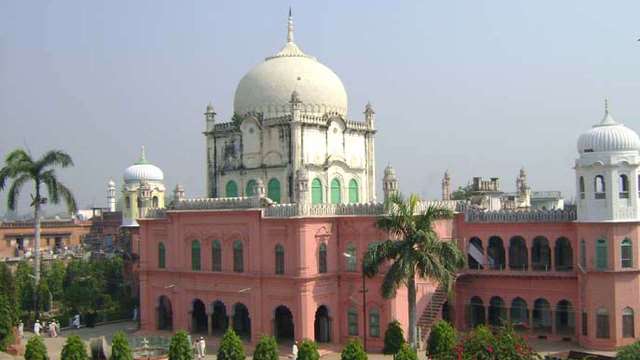
Darul Uloom Deoband

He is truly a forgotten warrior of the freedom movement. Few know about him and fewer are familiar with his name but delve into the pages of history and you realise that he deserves a better place.

He participated in the Indian Rebellion of 1857 in the Battle of Shamli between the British and the anti-colonialist ulema. The scholars were ultimately defeated at that battle.

He was Mohammad Qasim Nanautawi.

Nanautawi was born in 1832 into the Siddiqui family of Nanauta, a town near Saharanpur in Uttar Pradesh.

He was schooled at Nanauta, where he memorised the Quran and learned calligraphy.

At the age of nine, Nanautawi moved to Deoband where he studied at the madrasa of Karamat Hussain. The teacher at this madrasa was Mehtab Ali, the uncle of Mahmud Hasan Deobandi.

On the instruction of Mehtab Ali, Nanautawi completed the primary books of Arabic grammar and syntax.

Thereafter, his mother sent him to Saharanpur, where his maternal grandfather Wajihuddin Wakil, who was a poet of Urdu and Persian, lived.

Wakil enrolled his grandson in the Persian class of Muhammad Nawaz Saharanpuri, under whom, Nanautawi, then aged twelve, completed Persian studies.

In 1844, Nanautawi joined the Delhi College. Although was enrolled in the college, he would take private classes at his teachers’ home, instead of the college.

Nanautawi stayed in Delhi for around five or six years and graduated, at the age of 17.

After the completion of his education, Nanautawi became the editor of the press at Matbah-e-Ahmadi.

During this period, he wrote a scholium on the last few portions of Sahihul Bukhari.

Before the establishment of Darul Uloom Deoband, he taught for some time at the Chhatta Masjid. His lectures were delivered at the printing press. His teaching produced a group of accomplished Ulama, the example of which had not been seen since Shah Abdul Ghani’s time.

In 1860, he performed Haj and, on his return, he accepted a profession of collating books at Matbah-e-Mujtaba in Meerut. Nanautavi remained attached to this press until 1868.

In May 1876, a Fair for God-Consciousness was held at Chandapur village, near Shahjahanpur.

Christians, Hindus, and Muslims were invited through posters to attend and prove the truthfulness of their respective religions.

All prominent Ulama delivered speeches at the fair. Nanautawi repudiated the Doctrine of the Trinity, speaking in support of the Islamic conception of God.

Christians did not reply to the objections raised by the followers of Islam, while the Muslims replied to the Christians word by word and won.

Mohammad Qasim Nanautawi established the Darul Uloom Deoband in 1866 with the financial help and funding of the Muslim states within India and the rich individuals of the Muslim Indian community.

He conformed to the Sharia and worked to motivate other people to do so. It was through his work that a prominent madrasa was established in Deoband and a mosque was built in 1868. Through his efforts, Islamic schools were established at various other locations as well.

His greatest achievement was the revival of an educational movement for the renaissance of religious sciences in India and the creation of guiding principles for the madaris (schools).

Under his attention and supervision, madaris were established in several areas.

Under Muhammad Qasim Nanautvi’s guidance, these religious schools, at least in the beginning, remained distant from politics and devoted their services to providing only religious education to Muslim children.

Nanautawi died on 15 April 1880 at the age of 47. His grave is to the north of the Darul-Uloom.

Since Qasim Nanautawi is buried there, the place is known as Qabrastan-e-Qasimi, where countless Deobandi scholars, students, and others are buried.

Significantly, the elders of Deoband took more and more part in the struggle for the independence of the country.

After the establishment of Darul-Uloom, the period of participation in national politics began.

Darul-Uloom, Deoband, was a centre of revolution and political, training. It nurtured such a body of such a body of self-sacrificing soldiers of Islam and sympathisers of the community who themselves wept in the grief of the community and also made others weep; who themselves tossed about restlessly for the restitution of the Muslims’ dignity and caused others also to toss about.

They shattered the Muslims’ intellectual stagnation, they broke up the spell of the British imperialism, and, grappling with the contemporary tyrannical powers, dispelled fear and anxiety from the minds of the country.

They also kindled the candle of freedom in the political wilderness.

It is a historical fact that the political awakening in the beginning of the twentieth century was indebted to Deoband and some other revolutionary movements in the country, and the revolutionary freedom-lovers who rose up there were the products of the grace from the spring of thought of Deoband.

Then, after the establishment of Pakistan, the Indian leaders of Deoband guided the Indian Muslims in utterly adverse circumstances and helped keep up their spirits high. — IANS

source: http://www.muslimmirror.com / Muslim Mirror / Home / by Amita Verma / July 31st, 2022

Worth A Re-Read – A History of the Ulama in British India

UNITED INDIA :

DESIGN: Sarah Anjum Bari

Over the past few years, and particularly after their recent tussle with the government over the statue of Bangabandhu Sheikh Mujibur Rahman, the Ulama’s involvement in politics has come back under scrutiny in Bangladesh. Since the 10th century, the Ulama have been exercising strong authority over religious issues; yet they have been accused of failing to respond to modernity and to the changes in society.

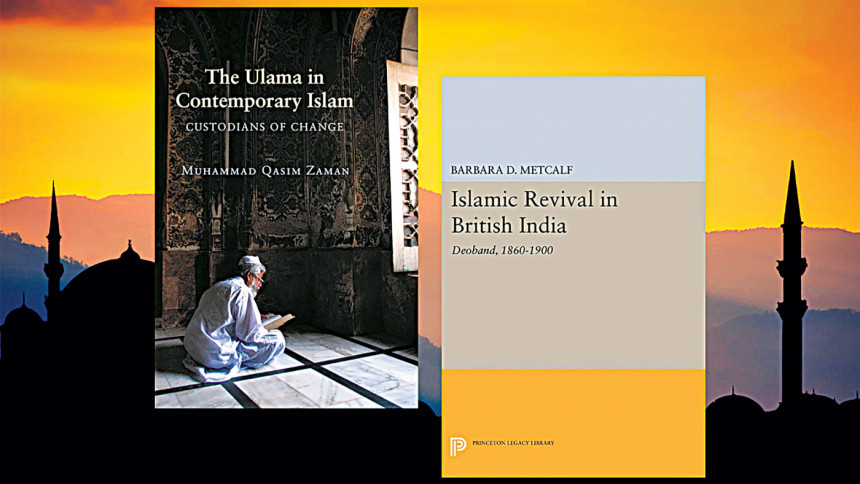
Against this backdrop, the actions, discourses, and history of the Ulama are well worth looking into. Muhammad Qasim Zaman’s The Ulama in Contemporary Islam: Custodian of Change (2002) and Barbara D Metcalf’s Islamic Revival in British India: Deoband, 1860-1900 (2016), both published by the Princeton University Press, are two outstanding studies in this regard. While Metcalf looks into the emergence, proliferation, and responses of the Deobandi Ulama to “modernity” when Muslim power in India was declining, Zaman looks at their strategy to establish authority in British India and Pakistan. 

Shifting sands of influence

In pre-British India, religious education was a private enterprise and individual tutelage was the usual mode of the dissemination of religious knowledge. This tradition was to change with the emergence of the Farangi Mahall Ulama as custodians of Muslim intellectual traditions.

The Lucknow-based Farangi Mahall Ulama were known by the family of Mulla Hafiz, who received a land grant from Mughal Emperor Akbar sometime in the sixteenth century. He was the ascendant of Qutbu’d – Din (d. 1691), a Mughal courtier who participated in the collection of Fatawa-yi ‘Alamgiri’. The latter is a collection of Fatwa to be used in the Mughal courts. The family and students who took lessons from this family were known by the name of Farangi Mahall. The activities of the Ulama of Farangi Mahall, however, were confined to producing graduates for princely services. Their most significant contribution was their systemisation of the curriculum—dars-i-Nizami—for religious education. As Metcalf informs us, this curriculum came to Bengal when a Farangi Mahall graduate was appointed as the first principal of the madrasa yi ‘Aliyah’, Calcutta in 1780. 

Farangi Mahall’s dominance declined and the centre for religious studies shifted from Lucknow to Delhi by the late 18th century. The person who played a key role in this shift was Shah Waliyu’llah, who advocated for more social and political responsibilities for the Ulama as opposed to those of the Farangi Mahall. Waliyu’llah’s successors had studied legal codes and written fatwa for the Muslim community, which had once become the main tool to disseminate religious instructions when the British were about to establish political authority over India. Besides claiming centrality of the hadith in the interpretation of the sharia, Shah Waliyu’llah discouraged blindly following the rulings of the earlier generations (taqlid). He suggested going back to the Quran or Sunnah for legal solutions. 

The 1857 revolution landed heavily upon the revivalist movement initiated by Shah Waliyu’llah. Suspecting the Ulama’s involvement, British colonisers took all religious institutions in Delhi under their control. Fourteen hundred people were shot by British soldiers in Kuchah Chelan, where Shah Abdul Aziz (son of late Shah Waliyu’llah) used to preach, according to Metcalf. The Delhi-based Ulama were forced to move to the countryside and establish a madrasa at Deoband in 1867. 

After the revolution, Deoband became the centre for Muslim intellectuals. They introduced formal religious education for Muslims in British India. Students had separate classrooms and a library, and the curricula were organised according to departments, such as Arabic, Persian, and others. A formal examination system was introduced and successful students were issued certificates of award. Graduates came from different corners of India. Most significantly, these graduates went back home and set up madrasas in their respective localities. By the end of the 18th century, nearly every town held the presence of the Deobandi Ulama.

One well known Deobandi Ulama was Muhammad Ashraf Ali Thanawi (1863-1943), who authored Bahishti Zewar (1981)—among the most popular books for Muslims of India, and masterminded the Dissolution of Muslim Marriages Act 1939—the first reformist legislation for Muslims of British India.

In the late 19th century, the Ulama played a crucial role in upholding the pride of their religion and their community through publications and public debate on religious issues. Their intellectual exercise peaked with the invention of print technology, multiplying the scale of the transmission of knowledge all over India. Publishing in local languages such as Urdu, instead of Arabic, was one of their effective strategies to establish authority. This also served as a medium of communication between common Muslims and the Ulama, and helped renew Muslim traditions against local customs. Following the birth of Pakistan on August 14, 1947, the Ulama consolidated their authority and forced the then government not to pass a law against sharia. Over the next few years, their continuous efforts would force the Pakistani government to establish a Supreme Sharia Board to oversee any inconsistencies between sharia and laws passed by the parliament. 

The historiography of these two books may be compared with Geoffrey G Field’s Blood, Sweat and Toil: Remaking the British Working Class, 1939-1945 (Oxford University Press, 2011), in which Field understands “class” from multi-dimensional approaches including its relationship with the state, society, and family. Similarly, Barbara Metcalf and Qasim Zaman define the Ulama as a class by providing a social and intellectual history of their presence in South Asia. Metcalf highlights their hardships in the post-1857 revolution and the silent “intellectual” revolution of the Deobandi Ulama. Hers is an excellent cultural history. Despite being published earlier, Zaman fills in what Metcalf’s study left to be addressed: it focuses on how the Ulama have played an active role in different social and political contexts, particularly in post-colonial Pakistan. He disapproves of the allegation that the Ulama are against changes. The common mistake that most studies make, says Zaman, is not to consider the social and political context within which the Ulama work. To him, the flexibility of sharia depends on a socio-political context. Zaman suggested that the Ulama do not respond to changes as not because they do not like it but because of their fear of losing authority over religious issues in a modern state. 

None of the above-mentioned studies, however, concerns the Ulama of Bangladesh. The growing presence of the Bangladeshi Ulama in the public sphere, particularly their increasing involvement in the political issues, merits investigation into—in Zaman’s words—their “transformation, their discourses, and their religio-political activism.” Could the Ulama in Bangladesh inherit the wind of the Islamic intellectual traditions? The question deserves to be addressed amongst others.

Dr Md Anisur Rahman is a legal historian at Asian University for Women. His research interests include Islam in Asia and South Asian Islamic Law and Society.

source: http://www.thedailystar.net / The Daily Star / Home> Reviews / by Md. Anisur Rahman / January 28th, 2021