This is 01 more than the tally of Muslim MLAs in Uttarakhand in 2017 when 02 Muslims had won amidst the BJP Tsunami.
Uttarakhand Election Result 2022:
The newly elected Assembly in Uttarakhand will have 03 Muslim MLAs, according to the final result announced by the State Election Commission Thursday.
This is 01 more than the tally of Muslim MLAs in Uttarakhand in 2017 when 02 Muslims had won amidst the BJP Tsunami.
The ruling Bhartiya Janata Party (BJP) has retained power in Uttarakhand winning a total of 47 seats – 10 less than its previous tally of 2017.
The opposition Congress has won 19 seats – an improvement of 08 seats as compared to its tally of 11 seats in 2017.
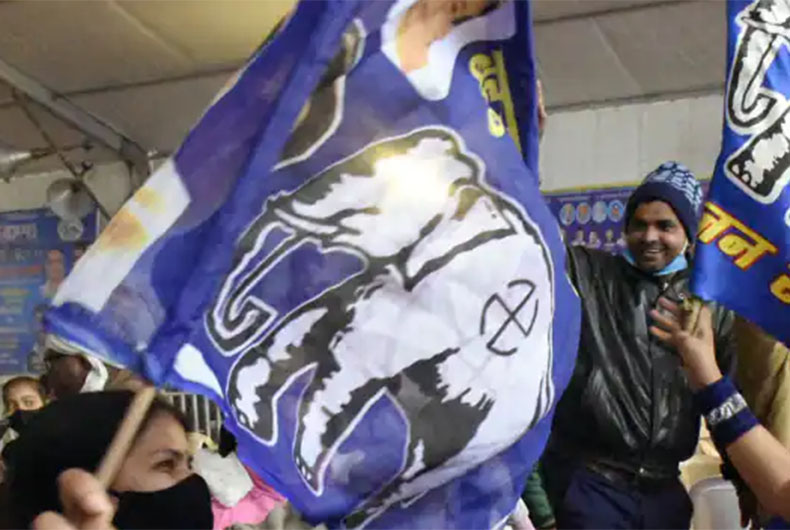
Mayawati’s Bahujan Samaj Party (BSP) has won 02 seats, according to the Uttarakhand Election 2022 Final result.
Among the 03 Muslim candidates who have won the 2022 Uttarakhand election 02 – Shahzad and Sarwat Kareem Ansari, are from BSP and 01 – Furkan Ahmad, is from Congress.
Shahzad of BSP has won the 2022 election from Laksar Assembly seat of Uttarakhand, defeating Sanjay Gupta of BJP by 10,440 votes.
Sarwat Kareem of BSP won the 2022 polls from Manglaur Assembly constituency defeating Qazi Mohammad Nizamuddin of Congress by 598 votes. Qazi Mohammad Mohiuddin had won the Manglaur seat in 2017.
On the other hand, Furkan Ahmad of Congress won the polls from Pirankaliyar assembly seat, defeating Munish Kumar Saini of BJP by 15,743 votes. Furkan Ahmad had won the same seat in the 2017 election.
source: http://www.ummid.com / Ummid.com / Home / by Ummid.com News Network / March 11th, 2022
Over 17,100 nationals rescued from the war-torn country so far.
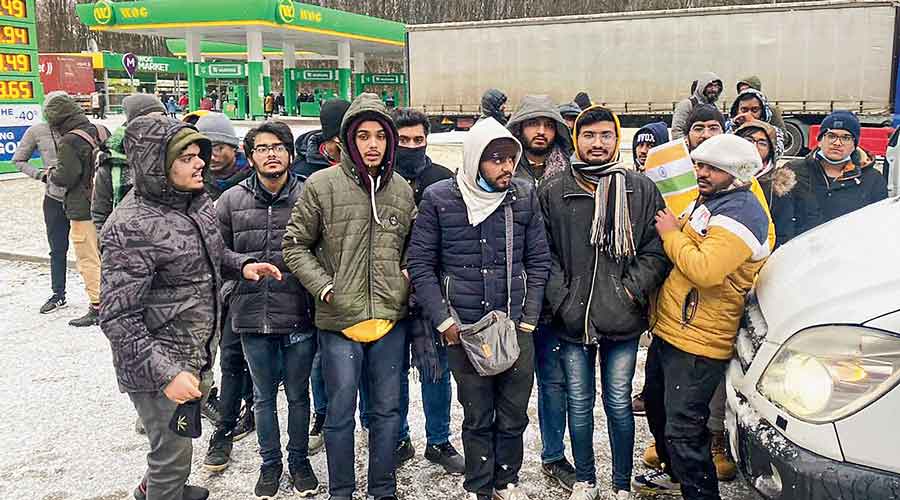
A medical student at the Sumy University, who did not wish to be identified, confirmed that the buses have arrived and students have started boarding the buses. File Picture.
Several Indian students stranded in the northeastern Ukrainian city of Sumy heaved a sigh of relief as their evacuation process started on Tuesday and hoped that they would be in a safe zone soon.
“The evacuation from Sumy has started. There was finally some good news on Tuesday. All Indian students will be evacuated from Sumy on Tuesday itself. They will be taken to a safe location from where they will be brought to India,” said Anshad Ali, a student coordinator.
A medical student at the Sumy university, who did not wish to be identified, confirmed that buses have arrived and students have started boarding the buses.
“We have been told that we will go to Poltava. I am praying that we reach a safe zone and this misery is over,” he told PTI from Sumy.
Union minister Hardeep Singh Puri told reporters here that 694 Indian students, who were stranded in Sumy, left for Poltava in buses on Tuesday.
“Last night, I checked with the control room, 694 Indian students were remaining in Sumy. Today, they have all left in buses for Poltava,” he said.
Prime Minister Narendra Modi held discussions with Russian President Vladimir Putin and Ukrainian leader Volodymyr Zelenskyy on Monday on ways to start the stalled evacuation process of the Indian students from Sumy, which is being pummelled by the invading Russian forces.
India has so far brought back over 17,100 of its nationals from Ukraine while Indian students remained stuck in Sumy, with their evacuation dependent on the facilitation of a safe passage by Russian and Ukrainian authorities.
“We stood in a queue for three hours in freezing cold on Monday, waiting to board the buses, and then, we were told that we cannot go. Thankfully, we left Sumi on Tuesday. I am hoping that we will be in a safe zone soon,” Aashiq Hussain Sarkar, another medical student, told PTI.
Sumy has been witnessing intense fighting between Russian and Ukrainian troops for days now. India has been making efforts to evacuate its citizens from the northeastern Ukrainian city, but with little success due to the heavy shelling and airstrikes.
With no electricity and water supply, ATMs running out of cash, melting snow to slake their thirst, and fast running out of supplies, hundreds of Indian students trapped in Sumy stood on roads every morning, hoping that “today would be the day” when they would be rescued from the savagery of the war that has engulfed Ukraine.
The wait, however, got longer as fierce fighting blocked their way to safety across the Russian border.
Exasperated, the students posted a video clip on social media platforms on Saturday, saying they had decided to walk to the Russian border in biting cold amid the fighting, raising fears about their safety on the corridors of power in New Delhi.
Soon after the video went viral, the Indian government asked the students not to take unnecessary risks and to remain in shelters and assured them that they would be rescued soon.
source: http://www.telegraphindia.com / The Telegraph Online / Home> India / by The Telegraph Bureau, PTI / New Delhi / March 08th, 2022
The Union minister also spoke to the students on their return from Bucharest and assured safety of the people who are yet to be evacuated.
Speaking to reporters at the airport, Scindia said that approximately 13,000 Indians are stranded in Ukraine as of now.
When Aarushi Mamgain, a third-year MBBS student, walked out of the Indira Gandhi International (IGI) Airport, she felt weak with relief. The wait for this moment had been a long and anxious one.
Mamgain, a resident of Dehradun, was among the 688 Indian nationals — mostly students — who were brought back on Sunday from the war-torn Ukraine onboard three flights arranged by the Union government as part of Operation Ganga.
While the first flight from Bucharest (Romania) with 250 passengers onboard landed in Delhi around 2.55am and was received by Union civil aviation minister Jyotiraditya Scindia and minister of state for external affairs ministry V Muraleedharan, the second, coming from Budapest (Hungary), brought 240 passengers and landed at 9.30am. Another Air India flight from Bucharest with 198 Indian nationals landed in Delhi at 5.35pm.
Speaking to reporters at the airport, Scindia said that approximately 13,000 Indians are stranded in Ukraine as of now. “You know it is an extremely sensitive situation there (Ukraine). In this situation, we are talking with each Indian national, including students, through telecommunications,” he said. “We will bring them back as soon as possible,” he said.
The Union minister also spoke to the students on their return from Bucharest and assured safety of the people who are yet to be evacuated.
“I know you all have been through a very, very difficult time, a very, very trying time. But know this that the PM is with you at every step, the Indian government is with you at every step, and 130 crore Indians are with you at every step,” he told the returnees.
“PM Sh @narendramodi Ji, along with all the government agencies are working round the clock to ensure every Indian is brought back home quick & safe. #OperationGanga,” Scindia tweeted later in the day.
Mamgaim said her scheduled flight to Delhi was on February 24, but the same day Ukraine closed its airspace for commercial flight operations. “I was on a train to Kyiv airport when I got to know about it. Though our college helped us get back to the premises and even cross the Ukrainian border, it was a situation I have never seen before and I wish that I never get to face it again,” she told HT as she stepped out of the airport.
Relieved at her safe return, she said she was worried for her friends still stuck at the border of the European country.
“When I was there, around 250 of us were awaiting our turn to enter Romania, but now there is a chaos at the Ukrainian border and thousands have gathered, waiting to return to India. I have been receiving calls from their parents and all this is making me anxious,” she said.
Following the Russian military offensive against Ukraine, India has brought back a total of 907 stranded citizens from that country since Saturday, when the first evacuation flight from Bucharest with 219 people on board landed in Mumbai under Operation Ganga.
Only 24 hours ago, most of these students were hiding in their university hostels, even as sounds of airstrikes and gun-firing rattled cities in Ukraine. For parents of some of these students, it was a miracle of sorts to see their children return safely.
“The last few days have been tough on all parents. It was getting tough to sleep, knowing our child is stuck out there and there is a war raging on,” said Brijesh Tyagi, who came from Yamunanagar to pick up his daughter.
Diya Devgun, a first-year MBBS student at the Uzhhorod National Medical University, said while the impact of the war was yet to reach the city in Western Ukraine, the threat of invasion loomed for weeks.
“My father had booked a flight for February 27 a couple of weeks in advance after it seemed like Russia may attack. But the attack happened before we had anticipated and all flights were cancelled. As fate would have it I am safely back in my country on the same date,” she said.
A trio of first-year students from the same university in Uzhhorod — Meraj Ahmed, Mohammad Izhar and Moin Khan — were among the 240 students who were ferried on a bus to neighbouring Budapest, from where the Air India flight AI1940 rescued them.
“There are still over 1,500 Indian students stuck in our university alone. Since only 240 could be accommodated in this flight, we were asked by the university administration to fill our details on an online portal, through which the 240 students were chosen randomly,” said Khan.
Chiming in, Izhar said while they only had to pay the fare of the bus, the flight tickets were booked by the Indian government. “We constantly kept receiving voice or video calls from our family members and this rescue operation came at the right time. It is possible Uzhhorod could be attacked soon,” he said.
A majority of the students rescued in the two flights on Sunday are from medical universities in western Ukraine. However, most of the students who spoke to HT said they knew of more students who are still hiding in bunkers.
“I personally know people stuck in Kharkhiv, who are hiding in bunkers and are short on food too. The situation is gradually becoming worse and we were lucky to be only 30 km away from the Hungarian border and could be rescued swiftly,” said Bansi Pratap Singh, another medical student who had only gone to Ukraine in December last year to start his course.
Harsh Yadav, a medical student at the Bukovinian State Medical University (BSMU) in Chernivtsi, was part of the flight that landed at 9.30am.
“Those stuck in major cities like Kyiv seem to be bearing the brunt of the attacks. While we were getting rescued, we were getting contacted by other students who are also desperately waiting to return,” Yadav said.
Government officials from different states were also present at the Delhi airport, from where students were ferried to their hometowns. Rahul, an official representing the Haryana government, said cabs had been arranged for all Haryana residents, while others could be picked up from the Haryana Bhawan in Delhi.
A similar arrangement has been made at the Karnataka Bhawan. “A list had been prepared of all Karnataka students and they will now be taken to the Karnataka Bhawan, from where their families can bring them home,” said Ravi Kumar, an official from the southern state.
(with agency inputs)
source: http://www.hindustantimes.com / Hindustan Times / Home> India News / by Jasjeev Gandhok, Neha Tripathi, New Delhi / February 27th, 2022
Payal Panwar, a final year medical student who returned to her Kotdwar home in Uttarakhand, said the stranded students need help of the Indian government and the Indian embassy people more.
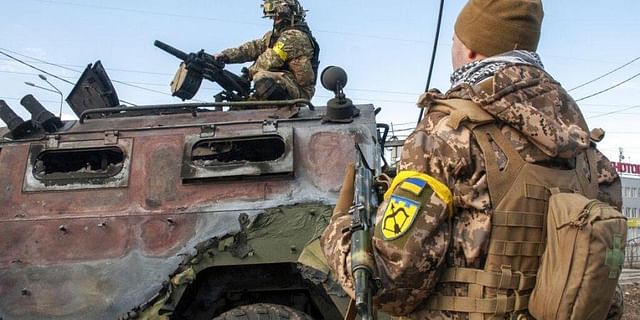
Ukrainian soldiers inspect a damaged military vehicle after fighting in Kharkiv, Ukraine, Sunday, Feb. 27, 2022. (Photo | AP)
Indore / Aurangabad / Dehradun :
Depleting food stocks and long queues for water are adding to the trauma of stranded Indian students in war-hit Ukraine awaiting evacuation amid reports of some being roughed up by security personnel and spending freezing nights out in the open.
As Indian and Ukrainian authorities on Monday described the situation as “complex” and “very difficult” in terms of evacuation of people, the students, joined by their parents, appealed to the Indian government to expedite efforts to evacuate them.
Russia launched its attack on Ukraine last Thursday.
“I want my son in front of my eyes as soon as possible,” said Kamini Sharma, who is praying for the safe return of Vibhor Sharma (22), a resident of Indore in Madhya Pradesh.
Vibhor is pursuing a medical course at the Ternopil National Medical University.
Payal Panwar, a final year medical student who returned to her Kotdwar home in Uttarakhand, said the stranded students need help of the Indian government and the Indian embassy people more while they are still inside Ukraine rather than when they have moved out of the war-torn country.
“The problems end when you cross the borders but while you are inside Ukraine it is really difficult with food supplies running out and no cash in ATMs. Stranded students need the help of Indian authorities while they are still inside Ukrainian borders,” said Payal, who studies in Ivano-Frankivsk city in western Ukraine.
Recounting her ordeal, she said around 60-70 Indian students had to book a bus and also walk a distance of 8-10 km in freezing cold to reach the Romanian border to get out of Ukraine.
Many ATMs could not dispense cash and long queues of men and women waiting for their turn for food supplies were seen at several points, she said.
Though happy and relieved to be reunited with her parents, Payal and her parents are worried about her brother who was still stuck in Kharkiv.
An Indian student who managed to reach the Kyiv train station said Ukrainian guards were not allowing students to board trains and also beating up people and made a fervent appeal to the Indian embassy to evacuate them as soon as possible.
“It’s getting difficult for us to stay here,” Ansh Pandita told PTI, as scores of Indian students, including women, sat huddled together at the teeming Vokzal railway station in the Ukrainian capital, holding a large tricolour aloft so they could be recognised in the crowd and also so no one from the group gets lost.
The group of about 100 students managed to reach the station but no one could board a train.
“Ukrainian soldiers are not allowing us to board the train to Hungary. In fact, they are not allowing any international resident to get out,” Pandita, a student of Taras Shevchenko National Medical University in Kyiv, said over the phone from the station.
“We requested them to at least allow the girls to go but that request too fell on deaf ears.”
The opposition Congress also alleged that Indian students were assaulted by security personnel on the Ukraine-Poland border.
“Students are crying out for help, requesting the Modi government to intervene but to no avail.
We saw a video last night on the Ukraine-Poland border where students are being beaten up,” party spokesperson Ragini Nayak told reporters.
India managed to accelerate its efforts to get its nationals out of Ukraine in the last 24 hours, though the situation on the ground continues to be “complex and fluid” in terms of evacuation of people, the Ministry of External Affairs (MEA) said.
It said a total of 1,396 Indians were brought back home in six flights as part of the evacuation mission and the total number of Indians who have left Ukraine since India issued the first advisory earlier this month is around 8,000.
An estimated 20,000 Indian nationals, mainly medical students, reside in Ukraine.
As the battle for Kharkiv rages on, at least three students from Maharashtra pursuing medicine in the city located in northeast Ukraine, narrated how they had to stand in long queues for a can of water, drink soda, stay in bunkers, and risk their lives to fetch food items amid bomb blasts.
Hritik Bapulohar, a first-year medical student from Palghar, said he had reached Kharkiv city only a couple of months back.
“We can hear bomb explosions as they are taking place in a periphery of around 500 metres from where we are currently staying in Kharkiv. We are struggling even for basic needs. As many as 500 students are staying in two bunkers for the past four days. When the curfew was lifted some of them left the hostel. The situation is worsening fast. I appeal to the Indian government to evacuate us urgently,” he told a Marathi news channel.
Bapulohar’s senior Aishwarya Patil, who hails from Sangli, said drinking water stocks have exhausted at their Kharkiv hostel.
“We are currently using soda water for drinking. After standing in queues stretching up to 2 km, we can get a can of five-litre water. Food prices have tripled since the war began. We are taking huge risks by stepping out to purchase food items. We are hiding as bomb blasts are happening here. During nights, we are given an hour for cooking by authorities. We cook using mobile flashlights,” she said.
Shivanjali Yadav, also from Sangli, said students and other Indians are asked to stay in bunkers in Kharkiv even though we don’t have much food and water with us.
“The students trapped in a bunker in the Kharkiv region are facing difficulties in arranging food, water. Some of them have fallen sick in freezing temperatures, few blankets, and dipping oxygen. There are also no transportation facilities available for them,” said one of the students who returned to Odisha.
Several students wanting to return to India from Ukraine had to spend two days under the sky in severe cold weather at the Romanian border after travelling by bus and then walking for 25 km, a mother of one of the students said.
“My son somehow boarded a bus from Ternopil to reach Romania. But, on the way, he had to get down from the bus due to some problem and the border was still far away,” the Indore-based Kamini Sharma, told PTI.
The woman said her son along with several other Indian students walked for 25 km to reach the border of Romania.
“But, these students, gathered at the Romanian border, had to stay under the open sky for two days in the harsh winter weather as they were not allowed to enter Romania immediately,” she said quoting the phone conversation with her son.
Sharma said she has now come to know that clearance has been given for the entry of these Indian students into Romania on Monday morning.
Ukrainian Ambassador Igor Polikha said his country is helping the stranded Indians and extending assistance in their evacuation notwithstanding the “very difficult” ground situation.
Polikha said he himself reached out to some of the Ukrainian border guarding commanders requesting them to assist the Indians who are trying to exit the country through land borders.
“The situation is very difficult and complex. My resources are limited. We are victims of aggression. Still, we are trying to help people including those from other countries,” he told a media briefing in Delhi.
Polikha said the circumstances at the Ukraine-Poland border crossing are challenging as lakhs of people including diplomats, foreigners and Ukrainian citizens are queuing up to exit the war-hit country.
Trapped inside a bunker in Kharkiv city of Ukraine, Assoiun Hussain (25), who hails from Kerala, told PTI over phone on Monday that he only had a loaf of bread in the last 48 hours.
He said the bunkers are freezing 24X7 and are overcrowded, adding that they also lack basic amenities like water or bathrooms with doors.
“We bought four to five bedsheets and arranged them together for makeshift beds. We are sleeping near railway tracks and on platforms. Our jackets are worn out because it is very cold here. The conditions are quite bad here,” Hussain said.
Indian students trapped in Ukraine have also alleged racial discrimination against them by the locals.
Recently, videos showing Indians being attacked did the rounds of social media.
In one of the videos shot during night time, a student wheeling his suitcase behind him is kicked by a guard in uniform.
In another video, students claimed that they were being thrown off the train parked at a railway station in Kyiv and beaten with sticks.
Manogya Bora (19), who recently returned from the Poland border to Lviv, alleged that Indians are being subjected to racist attacks and students were beaten up.
“People here are telling us to go back to Ukraine. The situation is much worse for boys. I have seen boys being beaten up,” she said.
Talking further about the pitiable conditions in the bunkers, Hussain said, “I received a loaf of bread today. I did not get food yesterday. The Ukrainian authorities are providing food and medicine, including insulin and food for babies. However, priority is given to Ukrainians not Indians.”
“We are only getting what is left after distributing to Ukrainians,” he said.
The student said getting food from outside is not a cakewalk with continuous shelling underway.
Moreover, no food supplies are available in the market, he added.
“There is only one supermarket and there is nothing in there — only juices and water. We have self-respect, we cannot beg them. The Ukrainian authorities allowed us to go out to get fod because some locals complained that because of us, they are running out of food fast,” he said.
“I tried going out today, but ran back as there was continuous shelling,” Hussain added.
Kharkiv is among the Ukrainian cities where the situation is dire with continuous shelling.
Thousands have taken refuge in metro bunkers to protect themselves.
Recently, a nine-storey residential tower was hit, killing an elderly woman, while about 60 people survived after hiding in the basement.
21-year-old Shana Shaji of Kerala said there is continuous shelling.
“It appears as if the building will fall apart,” she said.
Thousands of Indian students are stranded in Ukraine after the Russian Army launched a brutal offensive last week.
With the war now entering the fifth day, the Indian government has been carrying out evacuations of its citizens from Romania and Hungary — neighbouring countries of Ukraine.
When asked about the evacuation process, Hussain said the embassy has asked the students to reach the western border at their own risk.
“It is not possible for us to reach borders. There is heavy shelling outside. In trains and buses, the priority is being given to Ukrainians,” he said.
Gujarat native Ronak Sherasiya, an MBBS student in Ukraine, was meant to take a morning flight out of Kyiv on Thursday, on way to India, but fate has so far brought him only out of the conflict-hit eastern European country.
The 18-year-old, a first year student at the Bukovinian State Medical University (BSMU) in Chernivtsi, a beautiful town in western Ukraine, about 500 km from capital Kyiv, told PTI over phone that he had “finally crossed the Ukrainian border and was now in Romania”.
“I was part of a group of students who travelled in a bus provided by our university. We alighted a little before the border, and then walked. We reached Ukraine-Romania border on February 25 at around 4 pm (local time). There were about 2,000-3,000 people, mostly Indians at the border. It was a massive crowd, and only a couple of MEA officials, so processing took time. After waiting for hours, we finally crossed the border and entered Romania at about 6 am (local time) on February 26,” he said.
“We are now lodged in a sports complex on the Romanian side, but airport is still far away. We have been provided food, and WiFi connectivity has also been provided, but only limited number of people can join at a time. We are biding our time to fly out of Romania to India,” Sherasiya said.
Asked about various videos circulating on social media about alleged misbehaviour by security forces at some border area, he said, “Things are chaotic at the border area.”
“Ukrainian army personnel were asking people to move back, but when the commotion grew, some of the security personnel started firing in the air,” he claimed.
source: http://www.newindianexpress.com / The New Indian Express / Home> Nation / by PTI / February 28th, 2022
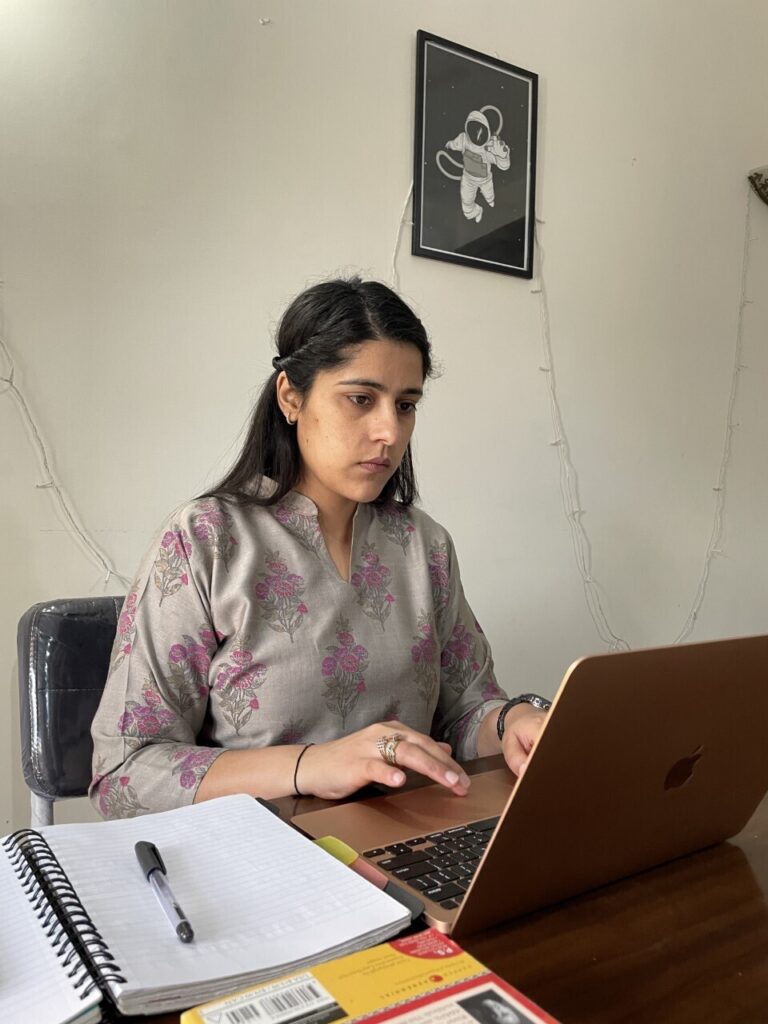
Safina Nabi has always felt like a storyteller and, as she put it, a “story listener.” As a child growing up in Kashmir, she would listen to radio programs with her grandfather, showing a natural curiosity about them. “I would have dozens of questions and he would explain [it to] me,” she said. “Growing up, I think journalism came naturally to me.”
Nabi started working in radio programming while studying for her master’s degree in journalism and mass communication at the University of Kashmir.
At one point, she hosted an hour-long live morning show. “I wasn’t interested in writing at all,” she said. “I loved to be in front of the camera, taking pictures or doing interviews.”
In 2014, Nabi was forced to move to Delhi due to flooding in Kashmir. While in Delhi, she began to take on writing jobs as a way to make some extra money. After several years of exploring different mediums and “trying everything,” she decided that writing was what she wanted to do.
Much of Nabi’s work explores issues of gender and how it intersects with health, conflict, social justice and human rights.
She has written for The Guardian, MIT Technology Review, Vice, Al Jazeera and more.
Her stories are built around strong female characters; she feels that people are the most important part of any piece.
Over the past couple of years, Nabi also started writing about her culture and community. She sees it as a way to preserve her heritage. “We [Kashmiris] are an ethnic group and we come from a minority background. We need to preserve our history, our language, and our cultural roots. I think one of the major and important ways to do that is to document them.”
Nabi has received two grants from the Pulitzer Center for her work, the first of which she found on IJNet. Initially, she wasn’t even sure she would apply because she was anxious about being rejected. “The tab remained [open] on my laptop for days and days,” said Nabi. Finally, she told herself she had to act. She applied and received a positive response within a week. “I was so excited about it,” she said. The project, Kashmir’s Tribal Women Fight the Stigma of Birth Control, focused on the lack of access to family planning resources for nomadic Kashmiri women. “I have received really great feedback. I really think [working independently] is something that has helped me grow, because I can tell the story the way that I want to,” Nabi said.
The ability to control the direction of her stories is incredibly important to Nabi. She spoke with frustration about the limitations of the journalism industry, and how difficult it was to get started as a young journalist with new ideas. “As a journalist who is juggling lots of other issues like internet gags and communication blockades, we don’t have the kind of time to actually research each and everything,” she said. Grants give her more freedom to control her stories, and resources like IJNet, she explained, help her find new opportunities.
Nabi’s most recent project is an in-depth piece funded by the Pulitzer Center. Titled, “How Kashmir’s half-widows are denied their basic property rights,” it highlights the struggles of Kashmiri women whose husbands have disappeared, but cannot be proven dead, leaving them in limbo.
Telling stories like this is what keeps Nabi going when facing situations like months-long internet and phone blackouts, government censorship and intimidation. “Who will tell the stories of these people who are suffering unnecessarily and [who] do not have avenues to reach out to people, to government, to authorities, and there is nobody to listen to them? I feel this is my obligation and this is my duty, to actually give voices to those people who cannot raise their voice, and I think that that’s something that keeps me pushing still,” she said.
It’s a very difficult phase of journalism in Asia right now, especially for women, Nabi explained. “In Kashmir, we don’t even have a women’s journalism association or a union. I think if we all come together collectively and take [up] that space, I’m sure the struggle is not going to end there, but at least we’ll have that kind of space where we will be able to share our vulnerabilities and our problems and discuss them, and be that support system for each other when in trouble.”
Nabi also noted the importance of media organizations and publications supporting and inspiring young women to become journalists. “I think it’s an obligation and duty of other [sites] like IJNet to give space and give more grants to journalists who come from these small backgrounds and give them chances, amplify their voices and their stories. That’s what will help more journalists to come out, especially women, and feel like, “Okay, there are some people who are making it big despite obstacles or struggles that they are facing.”
Photos courtesy of Safina Nabi.
source: http://www.ijnet.org / IJNET (Int’l Journalist Network) / Home> Newsletter > Journalist of the month / by Daniela Riddle / March 01st, 2022
Kalaburagi-based artist Mohammed Ayazuddin Patel will participate in a three-day International Art Festival titled Colours of the World organised in collaboration with Amman Greater Municipality and SMD Foundation at Ras Al Ain Art Gallery, Amman in Jordan.
The festival will be inaugurated under the patronage of Anwar Halim, Ambassador of India in Oman, on Saturday.
Artists from the U.S., Jordan, Canada, Taiwan, India and other countries are taking part in the art festival.
Mr. Patel will display his digital painting works based on Indian culture.
source: http://www.thehindu.com / The Hindu / Home> News> National> Karnataka / by Staff Reporter / Kalaburagi – March 02nd, 2022
Amidst the blitzkrieg from the Russian military, three students from Kodagu managed to leave the conflict zones in Ukraine and safely returned to India much to the relief of their family members who were pleading for their safe evacuation ever since Russian forces invaded Ukraine.
Alisha Sayyad Ali, Siniya V.J. and M.P. Nirmala, who managed to reach the borders in available modes of transport from their respective cities, returned on Wednesday in the evacuation flights operated by the Indian government.
The girls’ return was confirmed to The Hindu by the Kodagu district administration, whose officials were in touch with the stranded students since the war broke out. A few of the students from Kodagu and Mysuru are said to have reached Poland and are waiting for their evacuation. All of them are safe.
Siniya, who landed in Bengaluru airport on Wednesday evening, was welcomed by her family members.
Jose, her uncle, said Siniya had to walk about 20 km from her shelter in Kyiv along with other students to the railway station to reach Livv. She was evacuated from Budapest in Hungary to New Delhi.
“Minutes before Siniya was supposed to board a flight to Dubai on February 24 from Kyiv to join her sister for a vacation, Russian forces attacked Ukraine and the flights got cancelled. She had to rush back to her accommodation in available means of transport for her safety. Her 40-kg baggage was stuck in Kyiv airport and she flew to India with only a few pairs of clothes as all her belongings are at the airport,” Mr. Jose said.
Alisha, a student of Ivan Francisco Medical University, has also returned.
M.P. Nirmala, a student of Bogomoleth National Medical University in Kyiv, was stranded at a school after the invasion. Her mother Rajani was praying for her early return, pleading with the authorities for her evacuation. Ms Rajani said, “My daughter landed in Delhi this morning and is on her way to Bengaluru.”
Karthik, brother of Likith, who was stranded in Kharkiv with eight others, said his brother and some of his friends have reached Poland. “It was tough for them to reach the borders but they managed and are now away from the conflict zone Kharkiv which is under siege. They are waiting for their turn to board the next evacuation flights,” he said.
source: http://www.thehindu.com / The Hindu / Home> News> National> Karnataka / by Special Correspondent / Mysuru – March 02nd, 2022
Notably, Fathima’s father, Abdul Samad, an ex-Member of Parliament, won from the Harbour area during the 1958 urban local body polls.
AS Fathima Muzaffer led numerous anti-CAA protests in Chennai. (Photo | Special Arrangement)
Chennai :
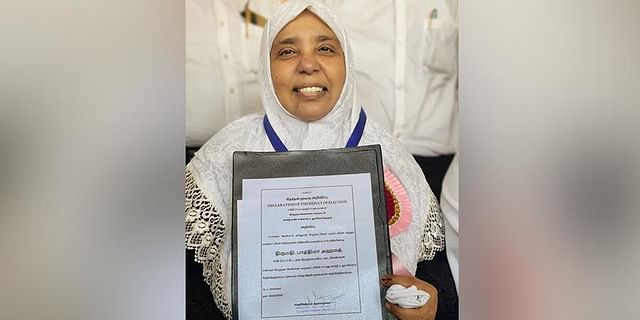
The woman, who led numerous anti-CAA protests in Chennai, AS Fathima Muzaffer from the Indian Union Muslim League (IUML)-DMK alliance emerged victorious in ward 61 of the Chennai Corporation on Tuesday by a huge margin of votes.
After five and a half decades, IUML’s own symbol (ladder) was used and this is the first time in the history of the party that a woman candidate has contested in Chennai.
Notably, Fathima’s father, Abdul Samad, an ex-Member of Parliament, won from the Harbour area during the 1958 urban local body polls. Fathima bagged 6,347 of 11,443 votes in her ward.
“It is a historic moment for IUML as we contested only from one ward and won. This is a silent answer to the ongoing hijab fiasco. Also, this is my first political campaign. I have been a social activist largely and hope to do the same as a councillor — serve the public,” said Fathima, who is also the national president of IUML’s women’s wing.
With numerous colleges, a prestigious stadium and four slums in her ward, Fathima says she wishes to bridge the gap between the elite and downtrodden.
“I want to implement a lot of youth programmes. Since this ward has good population of youth, it is crucial. Apart from this, social equality and communal harmony will always be at the forefront.”
Fathima’s family has been in politics for three generations.
Her grandfather, Moulana Abdul Hameed Baqavi was a freedom fighter and reportedly the first person to translate the holy Quran into Tamil.
She has also won a lot of awards in the field of social service for her work on women’s empowerment and education, especially in the Muslim community.
source: http://www.newindianexpress.com / The New Indian Express / Home> Cities>Chennai / by KV Navya, Express News Service / February 22nd, 2022
In the recently declared board results of senior secondary exams, girls topped the results in all the streams and outshined boys. Dedication and hard work were the common components among all the toppers.
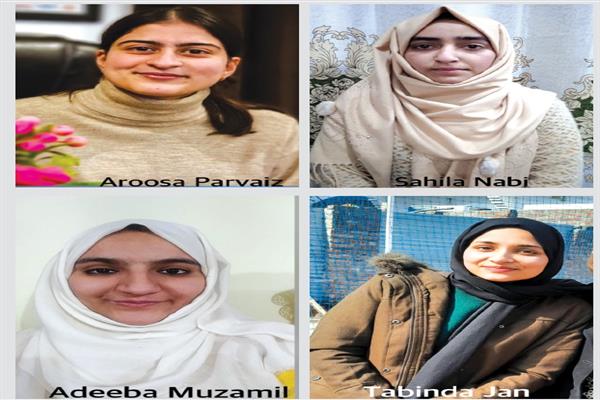
Adeeba Muzamil has topped the humanities stream with 496 marks. Hailing from the Batamaloo area of Srinagar, her father is a businessman and her mother, a homemaker.
Scoring 99.2% in her exams, she said she didn’t follow any schedule. She said, “I believe if you study for a few hours with concentration that’s better than studying all day. Parents often pressurize their children to study all day but this is not how it works.”
Her future plans are cracking the Indian Administrative Service (IAS) examination and want to work hard for it. “My secret to success is hardwork. You set a goal and try to achieve it,” she said.
Studying in Government Girls Higher Secondary Kothi Bagh, she said that her parents have played an important role in her success. Citing the struggles during online classes, she said “I am thankful to my principal and my teachers who never cared about the timing of the class and helped me even after the class.”
Talking about her stream, she said Economics is not easy and difficult as well and teachers have always been supportive.
“I used to make notes on my own. Whatever teachers in online class used to teach me and whatever I understood from the books, I made self-notes and studied from them,” she said.
Apart from studies, her hobbies are book reading and she would play games for recreational activities. William Shakespeare is one of her favorite writers and these days she is exploring other authors as well.
She believes that parents should not compare their kids with others. “I want to tell parents to stop comparing their children with others as each child is unique and possesses unique qualities. They should support them and believe them. Also, parents should not pressurize their kids to take subjects against their choice,” adding “Children should also take into consideration that if their parents believe them, they should give them something in return. They should make them feel proud.”
Talking about her subject she said, Humanities have good scope as well. She said, “In arts, people can further go for administration. Like society needs doctors and engineers, there is a need for a good administration as well.”
Sahila Nabi, a student of Kothi Bagh has topped the stream of Home Science. By self-study, she has scored 495 out of 500. Being the first person in her family to take home science, she believes the subject has much more to offer than what people think.
She said, “When I chose the subject, some people told me that I have to cook food only but when I explored it, I found it very interesting. It has interesting subjects like Home Management and it can help a person in life. I want to let people know that this subject is no less.”
She has decided to go further in the subject of child development which is one of the subjects of the stream. “I will do Ph. D in the subject and further would take teaching as my career,” she said.
Hailing from Eidgarh, she has received immense support from her family, she said, her father has never put his choices on her and let her do what she wants.
“I was a good student and did well in the 10th class examination. Everybody expected me to take science as there is a notion that a good student always takes science as his or her subject but I had other choices,” she said.
Having attachment with kids, she gives private tuitions to kids at home. In her free time, she paints and also teaches religious studies to children.
While talking about the utilization of time, she said, “Time should be spent on productive things. Excessive use of social media and over-gaming have misguided many youths and left them purposeless.”
From Kashmir Harvard School, Tabinda Jan has topped in Commerce. Hailing from Soura, she has secured 497 marks.
She believes her technique of self-studying keenly has made her successful. “I worked hard with full consistency and dedication. I am thankful to my teachers who provided better study material which really helped me,” she said.
Being an average student, she said motivation from her parents and teachers have made her successful. “I am thankful to my teachers because they motivated me and encouraged me. The internet connection was on and off usually but I had set my mind and thankfully I achieved it,” she said.
Talking about average students, she said, “I have seen average students getting demotivated and bullied. This should not happen. Those who couldn’t pass the exam should take go with positive approach and keep trying.”
Tabinda wants to follow her father’s footsteps and wants to be a Chartered Accountant.
A friendly extrovert girl always socializes and believes that her friends and cousins also played a key role. “One doesn’t have to get glued to the books only. You can maintain your social life as well,” she said.
From the same school –Kashmir Harward, Aroosa Parvaiz has topped in the science stream with 499 marks. Aspiring to be an engineer, she said that she has worked very hard to achieve success. “Sometimes I would study till late night as well because this was a big exam and it demanded so,” she said.
She said it takes her time to grab things so she would give extra time to her studies. “It depends on a person and their concentration level. I take more time to understand things than others,” she said.
While preparing for her exams, she had consulted NCERT books and had taken help from private tuition as well as school teachers.
Talking about herself, she said, “I am a very social person and active on social media but when exams approached, I stopped using all this and started working hard.”
While thanking her teachers, she said that they always helped her regardless of time. “Teachers always helped me when I had doubts and they were always available even at midnight,” she said.
Recalling her exam time, she said she used to be nervous but her friends, parents and teachers would always calm her down.
In her free time, she reads books, draws and plays other games. “When I am done with my studies, I do these things and when I used to get exhausted while studying, instead of watching TV or net surfing, I would take a nap,” she said.
source: http://www.risingkashmir.com / Rising Kashmir / Home / by Insha Latief Khan / February 14th, 2022
Militants hurled a grenade at a patrol party near Nishat Park in the district in north Kashmir on the evening of February 11, causing splinter injuries to five security forces personnel
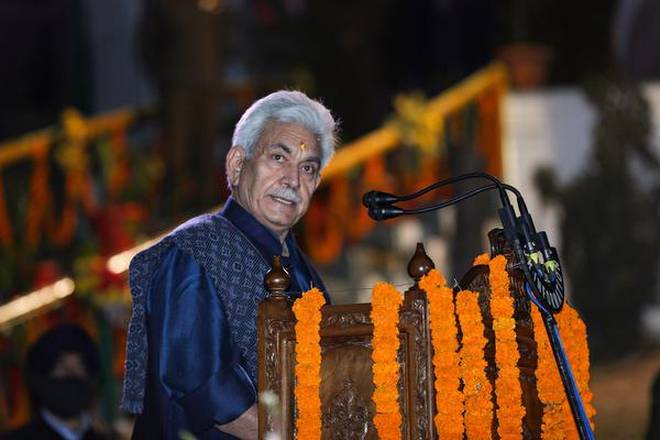
Jammu and Kashmir Lieutenant Governor Manoj Sihna has strongly condemned the Bandipora terror attack on February 12, which led to the death of one policeman and injuries to four others.
In a late night tweet, the Lieutenant Governor said, “Strongly condemn the heinous terror attack on our security personnel. I salute the bravery of martyr of J&K Police SPO Zubair Ahmad Shah. We will not forget. Each drop of tears will be avenged”.
Mr. Sinha expressed deepest condolences to the family of the deceased and wishing the injured speedy recovery.
Militants hurled a grenade at a patrol party near Nishat Park in the district in north Kashmir on the evening of February 11, causing splinter injuries to five security forces personnel.
The injured personnel were evacuated to a hospital but one of them succumbed. Security officials cordoned off the area and began a search operation.
Political parties across the board condemned the attack.
source: http://www.thehindu.com / The Hindu / Home> News> States> Other States / by PTI / Jammu – February 12th, 2022