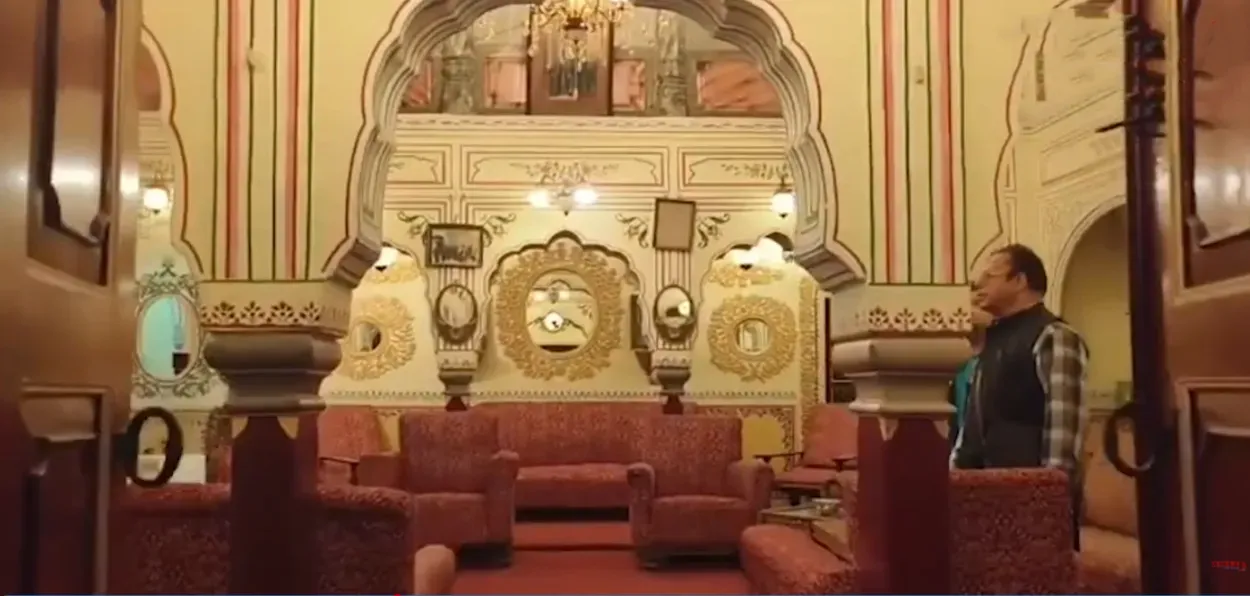
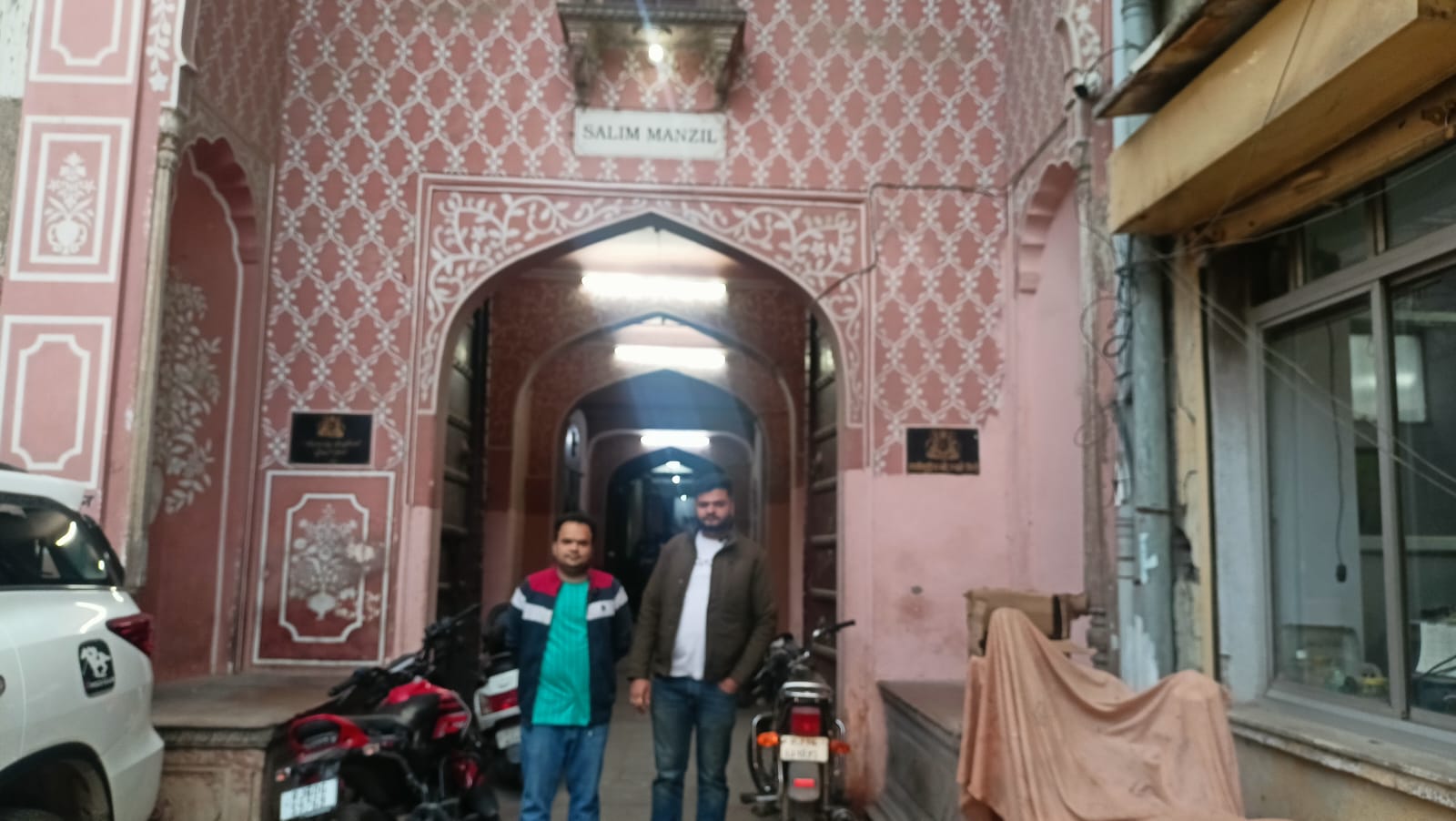
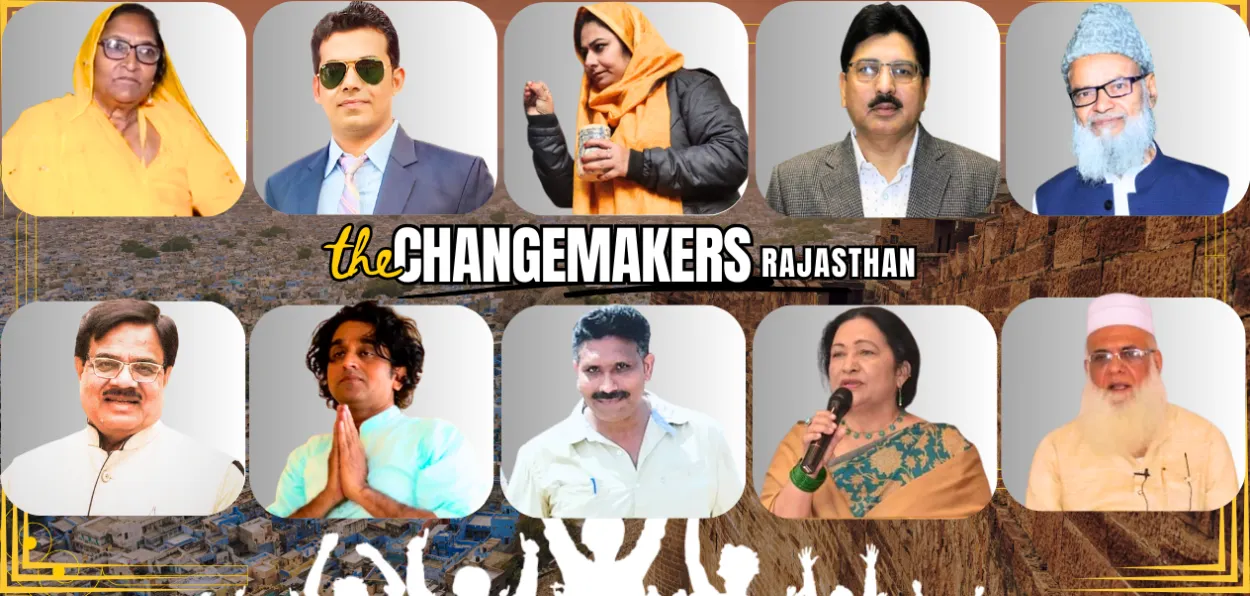
In the bustling streets of Jaipur at Haldio Ka Rasta, Johari Bazar, time suddenly seems to stand still. Amidst ancient stone walls, arched doorways and the stillness of history, stands the Salim Manzil, a majestic building which is a living legacy of more than two centuries.
The mansion houses a relic – a cap of Imam Hussain, the grandson and son-in-law of the Prophet Muhammad; it adds to its importance.
The story behind the ‘blessed cap’ reaching the haveli is interesting and part of its rich history.
The entrance to Salim Manzil
In the early 17th century, an ancestor of today’s inmates of Salim Manzil treated an Iranian king. The King wanted to reward him with gold, silver and valuable gifts, but he declined the offer and instead requested the cap of Hazrat Imam Hussain.
The King presented the relic and a certificate with the royal seal to him as a reward.
Since 1876, this blessed hat has been preserved in Saleem Manzil in a special glass-framed box kept in a hall called “Kala-e-Mubaraq”.
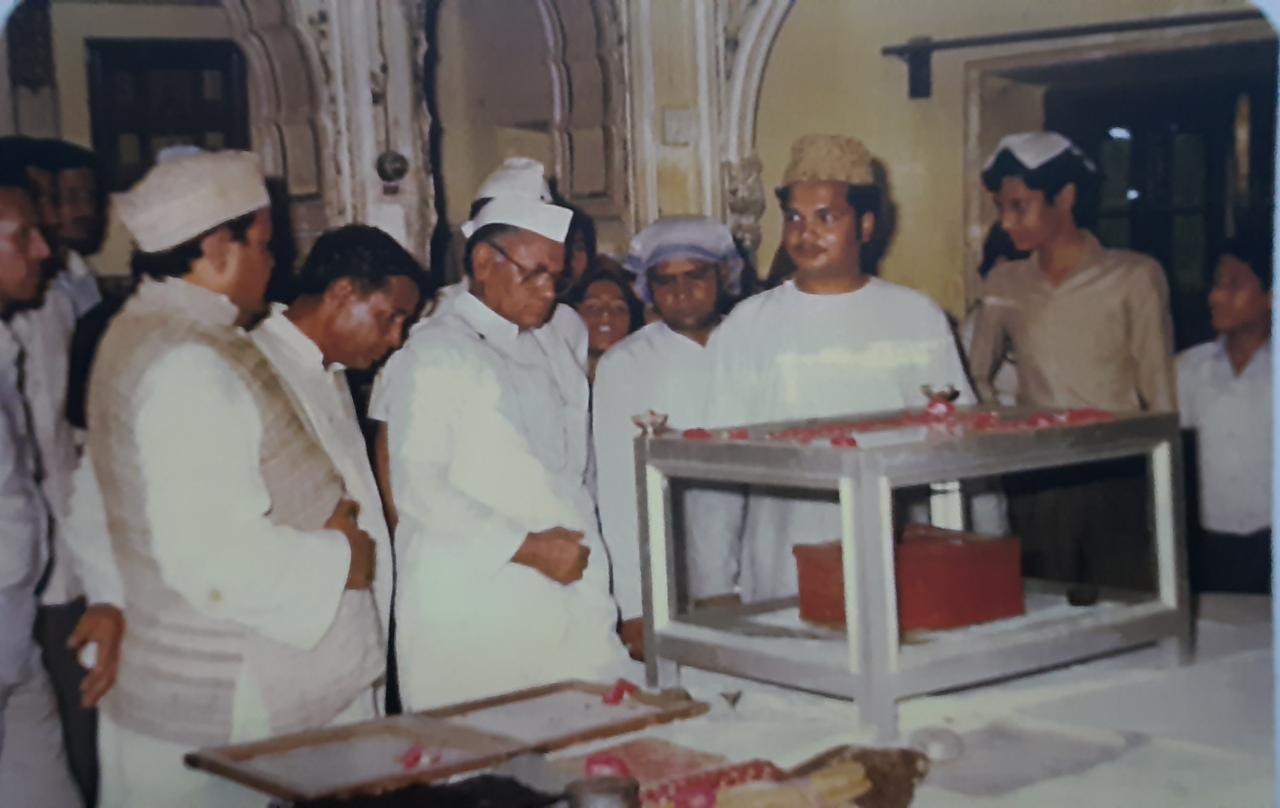
Every year on the 9th and 10th of Muharram, it is opened to the public. In those days, Salim Manzil is turned into a pilgrimage centre, and its air filled with spirituality.
People viewing the Blessed Cap of Hazrat Imam Ali
Today, Moinuddin Khan, 33 and his younger brother, Hussamuddin Khan, 27, are living in the mansion. The two brothers are not only maintaining this legacy, but also modernising its upkeep and display of artefacts.
Moinuddin Khan says that his ancestors came to Jaipur from Delhi around 1812 AD. At that time, Maharaja Jagat Singh of Jaipur State granted them a fiefdom and honour to his elder brother, Hakim Wasil Ali Khan.
This honour was for Wasil Ali Khan’s academic and medical expertise, and he was admitted to the Royal Court. One of the ancestors was the head of the intelligence department of Jaipur State, a sensitive position. He was responsible for the State’s security, political activities and gathering information needed for administration.
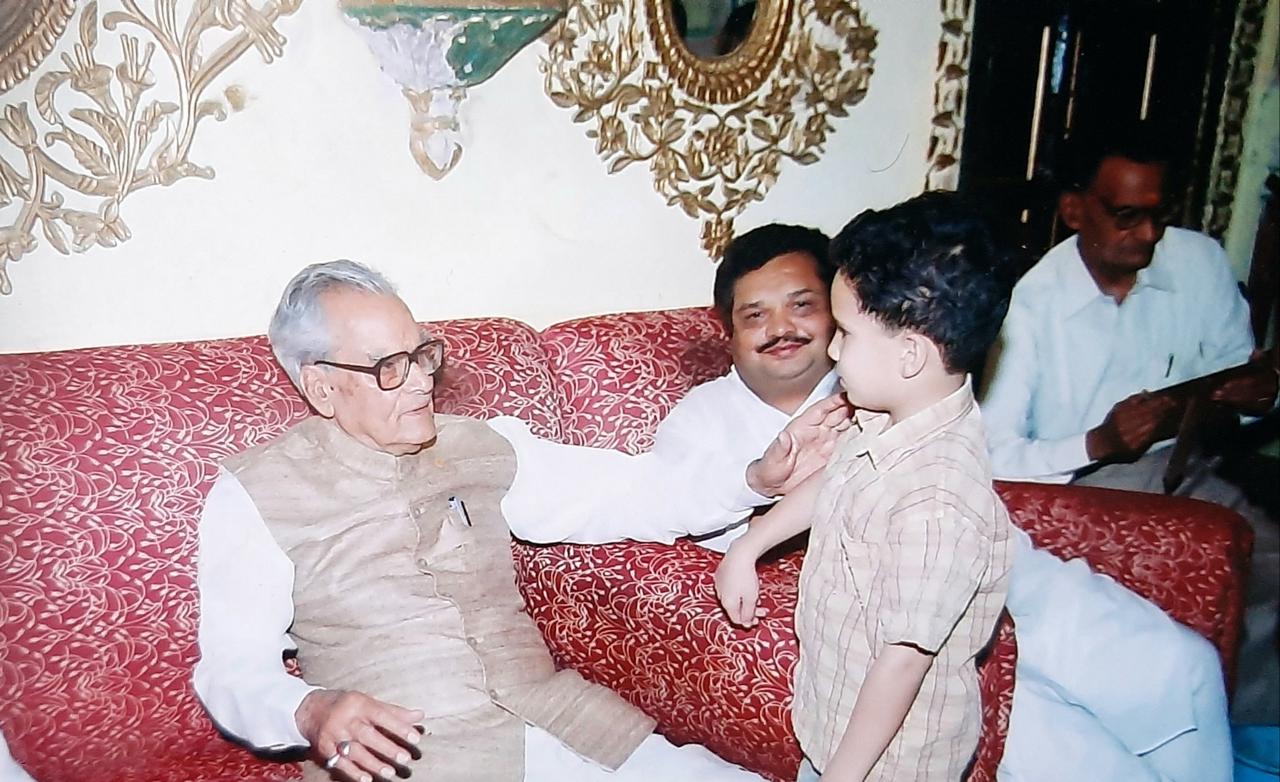
Bharion Singh Shekhawat with the inmates of Salim Manzil
Later, his son, Salim Ali Khan, worked in the same position.
The construction of Saleem Manzil began in 1867, and it was completed within three years. Spread over an area of about a bigha, the building was gifted by the Maharaja of Jaipur. Even today, the haveli’s traditional Rajasthani carvings, arches, high ceilings and lattice windows are a testimony to the architectural craftsmanship of that era.
Over time, many havelis were converted into commercial hotels, but Saleem Manzil retained its original identity. The family also received offers to convert it into a hotel, but they preferred to preserve the spirit of the heritage rather than market it.
Visitors inside the Salim Manzil
The mansion has been used as a set by many filmmakers for movies and web series. Moinuddin says he acted for the role of Sri Krishna in one of the web series. “We have a strong foundation in religion, but we also remain connected with art and dialogue.”
A large hall is decorated, the rooms are filled with the fragrance of perfume and roses, and the pilgrimage begins with Milad Sharif.
Devotees from Gujarat, Maharashtra and other parts of the country also arrive here. In those days, Shia Muslims read prayers and distribute Tabarak.
Moinuddin says that we consider it more of a trust than an inheritance. It is both an honour and a responsibility for us.
Many important persons have visited Salim Manzil. They include President Giani Zail Singh, Chief Ministers Haridev Joshi and Shiv Charan Mathur, Bhairav Singh Shekhawat (Vice President), Natwar Singh (Minister), Najma Haibabullah (Rajya Sabha Chairperson), and Supreme Court Justice Gyan Sudha Mishra.
Head of the family, late Naseemuddin Khan, popularly known as Pyare Mian, founded the All-India Hakeem Ajmal Khan Memorial Society to perpetuate his family’s legacy of Unani medicine and social service.
Today, Moinuddin and Husamuddin Khan are trying to connect this heritage with modern dialogue. They are planning to build a new hall for better management of the pilgrimage during Muharram.
They are sharing information about this heritage with the world through social media and digital means for transparency.
Amid myriad historic monuments of Jaipur, Salim Manzil is unique since it not only preserves the relics of history but is also a pilgrimage centre.
source: http://www.awazthevoice.in / Awaz, The Voice / Home> Stories / by Farhan Israeli, Jaipur / February 21st, 2026
Rajasthan is known for its sandy deserts, historical monuments, especially forts, vibrant culture, and above all, its brave people, some of whom are inspiring others and changing society for the better. Under our series ‘The Changemakers’, Awaz-The Voice, brings you ten such personalities of Rajasthan, who have done extraordinary and pioneering work. Batool Begum: A living legacy of musical heritage.
Batool Begum: Woman who took traditional music to the world
One name that resonates in the streets of Jaipur is that of Batool Begum. Born in Kerap village of Nagaur district, Rajasthan, this extraordinary singer is a living legacy of Indian classical music. Batool developed a deep passion for music in her childhood. Despite facing social and economic challenges, she continued her singing.
Her melodious voice and her passion for music not only earned her recognition as an artist but also proved that talent can break all barriers. Her art is a source of inspiration for her community and the entire Rajasthan.
Abdul Salam Johar: A lac bangle maker who received global recognition
The vibrant spirit of India’s Pink City, Jaipur, doesn’t only emanate from its colours and people but also from the traditional handicrafts that are made and sold here. Bangles worth lakhs are made in these streets, which are a symbol of the traditional beauty and hard work of thousands of its people.
Abdul Salam Johar is one such artist who not only preserved the traditional art of the State but also brought about a social change in a major way. Coming from the Manihar community, Johar was born in a family with little means, but his dreams were extraordinary. Seeing the struggles of his grandfather Hafiz Mohammad Ismail and parents Haji Abdul Aziz and Hajjan Qamar Jahan, he made hard work, dedication, and social service the main mantra of his life.
He began his journey from his ancestral shop ‘Indian Kangan and Colour Store’ located in Tripolia Bazaar of Jaipur, and today his wares are being sold under brands ‘Johar Design’, ‘Johar King’ and ‘Indian Crafts’ in the global markets. He is not only a successful entrepreneur, but also a social reformer who took his community and traditional art to new heights.
Abdul Latif ‘Arco’: A confluence of business and social service
Abdul Latif, who lives in Chini ki Burj in the capital Jaipur, and is known as ‘Arko’ in Rajasthan, is one such special personality. Born in a small village of Chomu in 1946, Abdul Latif’s father, Rahmatullah, and mother, Hafijan, taught him hard work, honesty, and the passion to help people, which became the basis of his life.
His company, Abdul Razzaq & Company (ARCO), is today a big name for social service along with electric motors, fans, and coolers. Apart from this, his hotel, ARCO Palace, is a symbol of his hard work and foresight. Abdul Latif’s story is not just of a businessman, but of a person who chose to work as a changemaker by combining his business and social responsibilities.
Qazi Nishat Hussain: A new voice breaking stereotypes
The voice rising from a small office located in the narrow streets of Johri Bazaar in Jaipur, the capital of Rajasthan, is today inspiring society to change. This voice is of Nishat Hussain, Rajasthan’s first Muslim female Qazi, social worker, and a strong advocate of the rights of Muslim women.
Her life journey is an example of courage, struggle, and change, which not only made thousands of women aware but also gave them a new direction to live.
Born in Sitabari Mohalla of Karauli district, Nishat’s childhood was spent in an environment of communal harmony. His family was the only Muslim family in the neighbourhood. There were three temples in front of her house. She says, “We did not know who was a Hindu and who was a Muslim.” In a backward area like Karauli, where girls’ education was not given importance, Nishat created history. She became the first Muslim girl in the district to pass the tenth standard, that too as the only Muslim student among 1200 girls. Today, she has become a torchbearer of the rights of Muslim women.
Captain Mirza Mohtasim Baig and Ruby Khan: An Inspiring couple in social service
An inspirational couple, Captain Mirza Mohtasim Baig and his wife Ruby Khan, hail from Jaipur. Captain Mirza is the first Muslim pilot of Rajasthan and has been operating national and international flights for the last 25 years. At the same time, his wife Ruby is an active social worker and politician.
Both believe that if one wants to bring change in society, then he has to take the initiative. Together, they had organised medical camps, documentation camps, free ration distribution, and offered financial help to families in the marriage of their daughters. The couple is an epitome of change brought about by spirited people.
Dr. Arif Khan: The village scientist who created history
Thirty-four years ago, a child was born in the small village of Masani in the Hanumangarh district of Rajasthan. Today, he is Dr. Arif Khan, a scientist who has brought laurels to India. In his village, most of the people toiled in the fields. His father, Advocate Farid Khan, wanted his son to become a doctor. His mother and grandfather also had the same dream. But there were few schools in Masani, and the path to making dreams come true was difficult. Still, Arif had a passion to do something extraordinary in his life.
With his hard work and dedication, he became a bio-scientist and brought glory to his family and village. His research on milk and food products brought a wave of change. His story proves that if the intentions are strong, then even a boy from a small village can become a scientist and make the country feel proud.
Mainuna Nargis: First Shia Muslim woman in art conservation
In a vast country like India, art conservation is important since it not only preserves history but also connects future generations to our heritage. Mainuna Nargis, the country’s first and so far the only Shia Muslim woman art conservator, does the same work. Born in Bahjoi, a small town in Moradabad district of Uttar Pradesh, Maimuna’s childhood was ordinary, but her dreams were extraordinary. Rajasthan has now become Mainuna’s second home.
Her father, a Policeman in UP, always encouraged her. After studying Fine Arts from Aligarh Muslim University (AMU), she did a diploma in Museology, which became the most decisive turning point in her life. Maimuna’s story is not just of professional success, but a story of passion, struggle, and self-confidence, which revived the broken pieces of history.
Yoga Guru Naeem Khan: Global journey from music to yoga
The life journey of Yoga Guru Naeem Khan, who rose from the streets of Jodhpur, the cultural capital of Rajasthan, to spread his spiritual aura on international platforms, is a unique example. He rose from a common man to a global yoga guru and presented yoga as a universal energy beyond religion, culture, and boundaries.
Naeem Khan was born in a family where music was in every breath. His grandfather, Ustad Umardin Khan, was the court musician of the Jodhpur royal family, while his maternal uncle was Padma Bhushan-awarded Sarod player Ustad Sultan Khan. However, with changing times, that traditional flame of music started to fade. Naeem and his brother got involved in business, but yoga gave Naeem a new direction, and he took it to a global platform.
Syed Anwar Shah: A man who introduced girls to education
Thirty years ago, a dream was born in a small room in Jaipur, which has today become the light of education for thousands of girls. This is the story of Syed Anwar Shah, whom people fondly call Master Anwar Shah. He not only dreamt of his daughter’s education, but also made it a means of progress for the daughters of society.
Today his educational institution, Al-Jamia-tul Alia, is spreading the message of knowledge and Islamic ethics not only in Jaipur, but also in the whole of India and abroad. After completing his M.A. in Public Administration from Rajasthan University in 1980, he dedicated his entire life to the welfare of society and the service of education. In 1995, when his daughter Alia was born, he decided to set up an institution for the education of girls, which would impart both worldly and divine teachings.
Today, his effort has become a boon for thousands of families.
Padma Shri Shakir Ali: Patron of Miniature Painting
It’s no exaggeration to say that Jaipur is the art capital of Rajasthan. And in the field of miniature painting, the name of Syed Shakir Ali comes to the fore spontaneously. This genre of painting is an identity of the state of Rajasthan.
Padma Shri awardee Syed Shakir Ali is not only a great practitioner of this art, but he is also the guardian of that heritage, which is an integral part of the cultural identity of Rajasthan. Born in 1956 in Jalesar village of Uttar Pradesh, Shakir Ali’s family soon settled in Jaipur, where his art got a new direction.
Today, he has given recognition to this traditional art of Rajasthan not only in India but also on international platforms.
source: http://www.awazthevoice.in / Awaz, The Voice / Home> The Changemakers / by Aasha Khosa, ATV / September 14th, 2025
A Muslim youth from Shahpura, Rajasthan, earns place in Indian youth basketball squad for South Asian Championship, inspiring local community and proving that dedication overcomes all challenges
New Delhi :
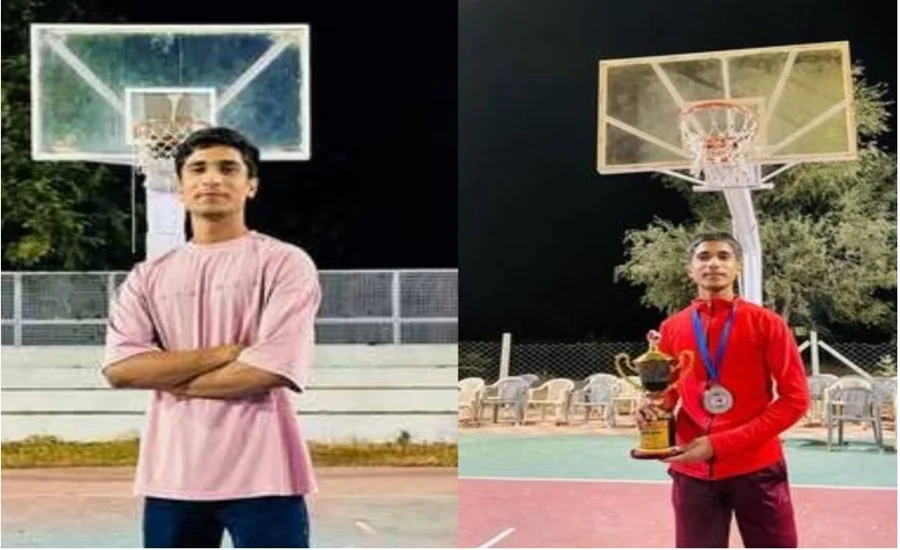
In a proud moment for both Rajasthan and the Muslim community, Mohammad Raza Khan, a young basketball player from Shahpura town, has been selected to represent India in the Youth Basketball Championship. His achievement has filled his family and local community with joy and hope.
Mohammad Raza Khan will participate in the South Asian Basketball Championship scheduled to take place in the Maldives on une 11. His selection to the Indian youth basketball team highlights not only his talent but also the determination and hard work that have brought him this far.
Raza Khan has been training hard at the Indian team’s camp in Indore, where he impressed coaches and selectors with his skills and discipline. “Raza showed remarkable focus and commitment during the training sessions,” said one of the coaches at the camp. “His talent is clear, and he deserves this opportunity to shine for India.”
News of Raza Khan’s selection was met with great happiness in Shahpura. Local residents, relatives, and sports fans gathered at his home to congratulate his father, Shabbir Hussain Khan. “We are very proud of Raza. His success is a shining example for all young people in our community,” said a neighbour. The atmosphere in Shahpura has been full of celebration and encouragement.
Mohammad Raza Khan comes from a humble middle-class family. Despite limited resources, his dedication, discipline, and passion for basketball have been unwavering. His journey serves as a strong reminder that with hard work and determination, barriers can be overcome.
Raza Khan’s achievement is also a proud moment for the Jaisalmer Academy, from where he hails. He is the ninth player from this academy to earn a place on the Indian basketball team, which speaks volumes about the academy’s contribution to nurturing young talent.
“The selection of Mohammad Raza Khan is a moment of great pride for Rajasthan and especially for the Muslim community,” said a local sports official. “His success shows that talent and commitment are found everywhere, regardless of background or economic condition.”
Residents of Shahpura are confident that Raza will not only represent India with distinction but also bring home a gold medal from the championship. “We all believe that Raza will make the country proud,” said a sports enthusiast in the town. “He is determined and ready to give his best on the international stage.”
Mohammad Raza Khan’s rise to the national team sends a strong message about the potential of young Indian Muslims in sports and other fields. It challenges negative stereotypes and shines a light on the hard work and talents often overlooked in smaller towns and communities.
This young athlete’s story encourages many others to follow their dreams, showing that with persistence, even those from modest beginnings can reach national and international levels of success.
Mohammad Raza Khan prepares to take part in the South Asian Basketball Championship, the hopes and prayers of Shahpura and Rajasthan go with him. His journey is a symbol of courage, dedication, and the bright future that awaits India’s youth when given equal opportunity.
source: http://www.clarionindia.net / Clarion India / Home> Editor’s Pick> India> Indian Muslims / by Mohammed Bin Ismail / June 05th, 2025
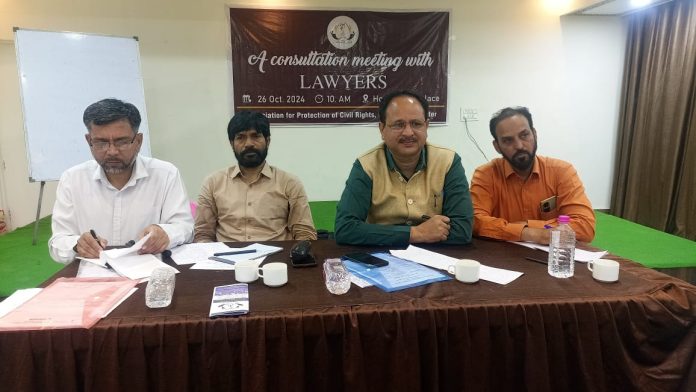
The Association for Protection of Civil Rights (APCR) organised a gathering titled “Consultation with Lawyers” at Hotel Arco Palace here Saturday. Around 50 advocates from across the state attended.
Syed Saadat Ali, APCR State President, urged the audience to prioritise helping the vulnerable, stating, “Until you assist those in need, you are not fully honouring your profession.”
He emphasised APCR’s ongoing commitment to supporting the weak.
APCR Vice President, Advocate Kaleem Ahmed, highlighted the challenge that victims’ families often face in conveying accurate information to authorities.
“It is our responsibility to assist these families by presenting the facts accurately to the administration and government, ensuring justice is served,” he said.
Advocate Munazir Islam, APCR Joint Secretary, addressed the concerning rise of “bulldozer culture” in Rajasthan, following trends seen in UP and MP. He called on advocates to remain informed and find solutions to counter this trend, noting APCR’s intervention in bulldozer cases in Udaipur, Jahazpur, and Bhilwara. He referenced a Supreme Court ruling on an APCR (Rashid Khan) petition, which stated that no home, whether owned by a criminal or not, should be subject to demolition without due process.
APCR General Secretary Muzammil Islam Rizvi, who moderated the event, introduced APCR’s initiatives in Rajasthan, highlighting its efforts to organise legal programmes, volunteer initiatives, seminars, and campaigns to promote legal awareness among the public. The meeting provided a platform for advocates to discuss their role in advancing justice and protecting civil rights, particularly concerning the increasing use of demolition machinery to enforce property laws.
source: http://www.radiancenews.com / Radiance News / Home> Latest News> Report / by Raheem Khan, Radiance News Bureau / October 28th, 2024
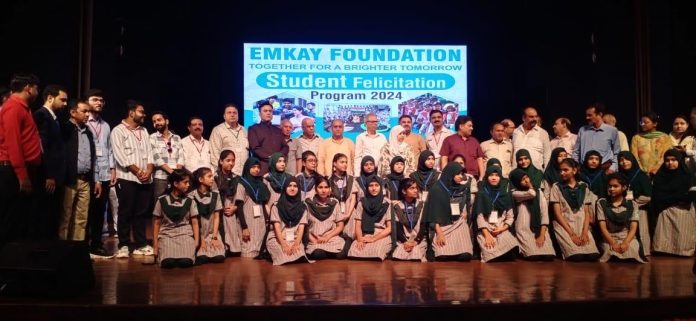
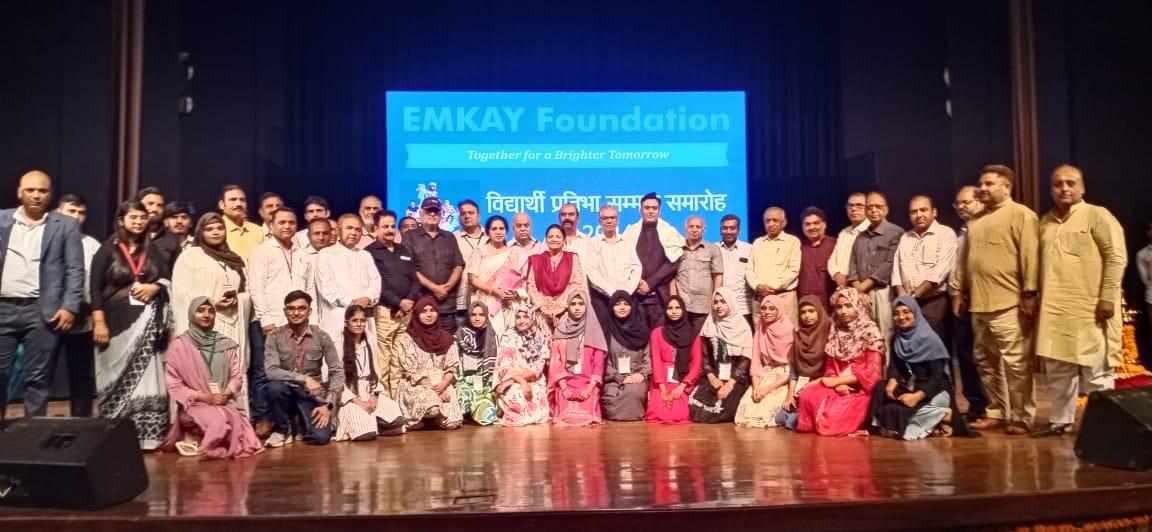
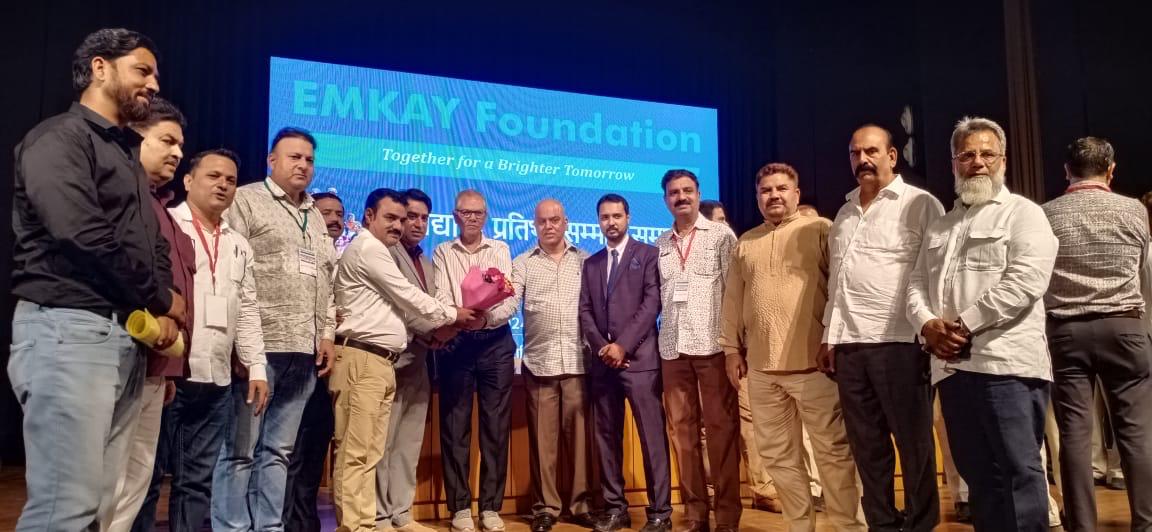
The EMKAY Foundation organized a Minority Student Talent Award Ceremony in Jaipur, with Indresh Kumar, convener of the Rashtriya Muslim Manch, as the chief guest.
Special guests included Jasvir Singh, former chairman of the Minority Commission, SS Agarwal, chairman of AIIMS Jodhpur, and Dr. Aslam Nagra, chairman of EMKAY Foundation.
Dr. Aslam Nagra explained that the ceremony honored advocates, doctors, and students who excelled in their 10th and 12th-grade exams. Out of 1,283 registered candidates, 300 students were selected for recognition.
Dr. Nagra noted that the EMKAY Foundation is the first of its kind, operating without registration, and despite challenges, he managed to fund the program independently. He expressed his commitment to organizing similar events in the future, particularly focused on education, to uplift the minority community. He emphasized that education is crucial for societal and national progress. Additionally, the foundation awarded scholarships of ₹51,000 each to four schools and one college.
Indresh Kumar stressed the need to raise awareness about education within the minority community. Jasvir Singh echoed this sentiment, stating that improving education for children is key to uplifting society.
Media coordinator Ayub Ali Mundori praised Dr. Aslam’s social work, highlighting his free diagnostic services for the needy, alongside his dedication to promoting education. He remarked that Dr. Aslam envisions education as a fundamental necessity, aiming for every child to have access to it and understand its importance.
Ayub Ali Nagra, founder of EMKAY Foundation, expressed his pride in the educational achievements of Muslim children. He noted the significant progress in the community and how Indian doctors and engineers are now recognized globally. He encouraged students to continue advancing in education, making a name for themselves, their families, and their country.
The event was attended by committee members Advocate Shamshul, Advocate Sarwar Alam, Bhupesh Yadav, Advocate Sikandar Ali, and many others.
source: http://www.radiancenews.com / Radiance News / Home> Pride of the Nation> Awards> Education> Latest News / by Raheem Khan, Radiance News Bureau / October 08th, 2024