A 26-year-old Hijabi girl who was inspired by Kalpana Chawla’s story, recently secured a commercial pilot’s license. She became Maharashtra’s first Shia girl to get the license.
The girl, Mohaddesa Jafri, daughter of Maulana Sher Mohammed Jafri and Aalema Farah Jafri recently returned from South Africa where she had undergone the training.
How did she become fan of Kalpana Chawla?
Mohaddesa Jafri was seven-year-old when Indian American astronaut Kalpana Chawla died in the Space Shuttle Columbia disaster in February 2003.
After Chawla’s demise, posters and banners were seen at multiple places in the country. When Jafri went out of home along with her father saw the posters and asked him about the astronaut.
Her father narrated Kalpana Chawla’s story and explained how brave she was. After listening to the astronaut’s story, Mohadddesa became a fan of Chawla.
After reading many articles on Chawla and watching her videos, Jafri informed her parents that she want to join the aviation industry.
Finally, in 2020, she joined a flying school in Johannesburg, South Africa. However, her relatives were not happy with her parent’s decision to send her for pilot training. The relatives commented that despite being Maulana and Alema, they sent their daughter for pilot training.
Ignoring the remarks against the decision, they allowed their daughter to continue pilot training as they were sure that it is not irreligious.
Who was Kalpana Chawla?
Kalpana Chawla was the first woman of Indian origin who went to space. She who was a Mechanical engineer had gone to space thrice.
The first two missions were successful. Her third flight which was on Space Shuttle Columbia in 2003 was not successful as the spacecraft disintegrated during its re-entry into the Earth’s atmosphere.
Apart from Chawla, six other crew members died in the disaster.
source: http://www.siasat.com / The Siasat Daily / Home> News> India / by Sameer / May 29th, 2022
Hamied has successfully steered Cipla on an accelerated growth path with a focus on boosting margins, without diluting the core values it stood for.
Synopsis
“I am humbled and honoured to receive the ET’s Businesswoman of the Year Award. This recognition belongs to each and every one of our 25,000 employees who stand with Cipla, putting patients’ interests before their own and upholding our purpose of Caring for Life,” Hamied, executive vice-chairperson, Cipla, told ET.
Samina Hamied represents a rich legacy. Her grandfather, KA Hamied, a freedom fighter and nationalist, founded Cipla in 1935, making it one of India’s oldest pharmaceutical companies. Her uncle Yusuf Hamied is the doyen of Indian pharma known globally for making affordable generic AIDS drugs accessible to millions of patients in Africa and other low- and middle-income countries.
“I am humbled and honoured to receive the ET’s Businesswoman of the Year Award. This recognition belongs to each and every one of our 25,000 employees who stand with Cipla, putting patients’ interests before their own and upholding our purpose of Caring for Life,” Hamied, executive vice-chairperson, Cipla, told ET.
Hamied has successfully steered Cipla on an accelerated growth path with a focus on boosting margins, without diluting the core values it stood for.
Both as executive director from July 2015 and as executive vice-chairperson from September 2016, Hamied has been instrumental in driving the company’s transformation from a traditional low-cost drug manufacturer to one with a young professional management and an aggressive approach towards inorganic expansion. Under her, Cipla also restructured its business and has also initiated cost-optimisation measures.
She spearheaded Cipla’s entry into the US market with strategic acquisitions of two generic companies, InvaGen Pharma and Exelan Pharma, for $550 million in 2015.
From FY15 to FY21, Cipla’s US revenue grew close to five times. US business contributed one-fifth of the total revenue in FY21.
Cipla’s revenue from operations grew at a compounded annual growth rate of 7% in the last 5 years to Rs 19,160 crore in FY21. Ebitda margin and net profit rose 12% CAGR in the last 5 years to 22.5% and Rs 2,405 crore, respectively, in FY21.
During Covid, Cipla launched antivirals, antibody cocktails, testing kits, masks and sanitizers. Cipla’s India business grew 15% year-on-year to Rs 7,736 crore.
Hamied focuses on board and governance issues, furthering Cipla’s global partnerships, shaping its corporate culture and hiring the right talent.
source: http://www.economictimes.indiatimes.com / The Economic Times / Home> English edition> Business News> Industry> Healthcare-Biotech> Healthcare / by ET Bureau / March 28th, 2022
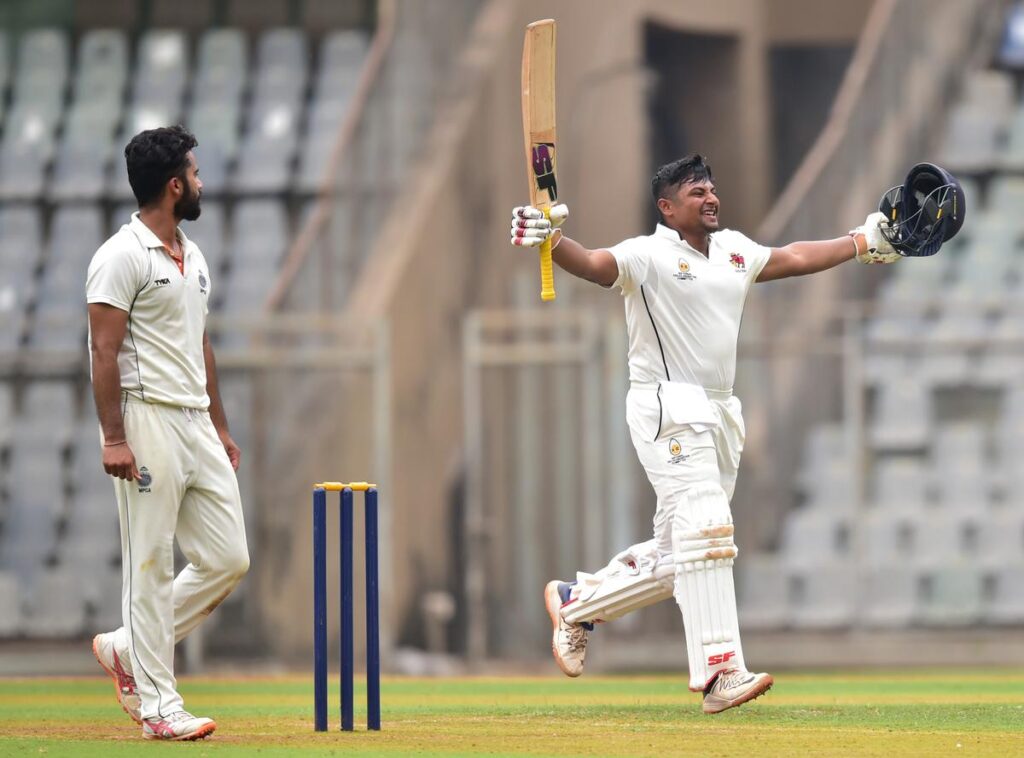
Sarfaraz Khan has rained runs in the domestic circuit. | Photo Credit: VIVEK BENDRE
Living father Naushad’s dream, hitting 400 balls every day, driving across north India to find a game or practice session during the lockdown, never settling for just a hundred — the prodigious Mumbai run-scorer offers an insight into his life and methods
You may have come across the 3 Ps and 3 Ds in self-help books. Sarfaraz Khan, the record-breaking Mumbai run machine, has been performing such exceptional feats that he deserves new terminology devised especially for him.
A kid from the by-lanes of Kurla, a central Mumbai suburb, Sarfaraz isn’t one for corporate jargon; he prefers ‘Bambaiya’ lingo. But having tracked his cricketing sojourn for over a decade, one can sum him up in the 4 Os: Obsession, Outstanding, Occupation and Opportunity. Let’s look at each of these facets.
Obsession
Hours after being adjudged the Player of the Match in Mumbai’s final Ranji Trophy league game in Ahmedabad, Sarfaraz reaches his home in Taximen’s Colony in Kurla at around 10 p.m. The first thing he asks his father Naushad is whether the ‘nets’ are booked for the morning.
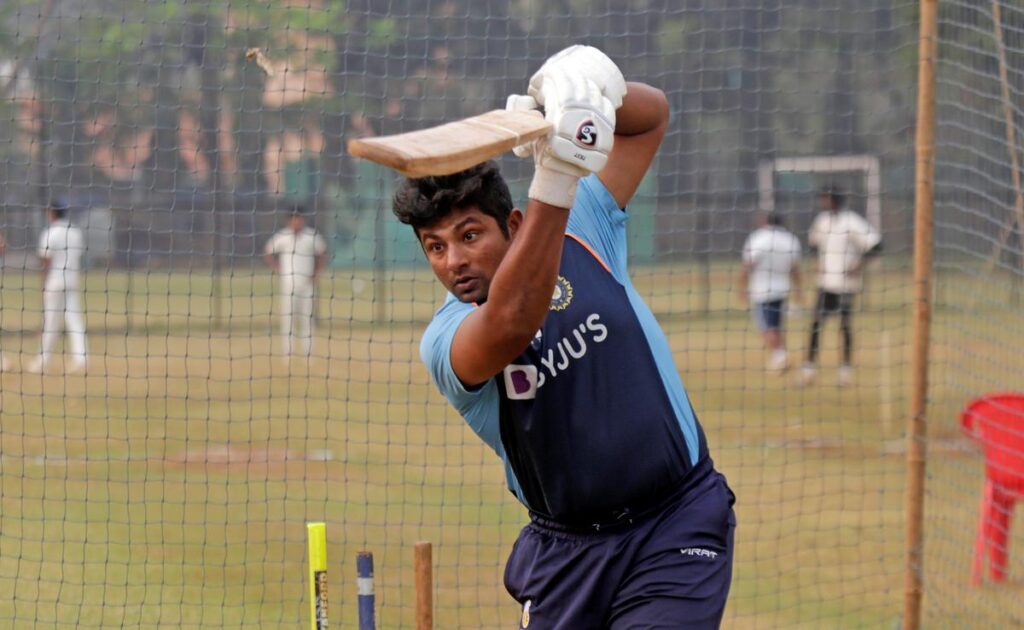
At 7 a.m. the next day, Sarfaraz is padded up at the Karnatak Sporting Association at Azad Maidan, ready for the daily drill of facing at least 200 balls in the session (he will repeat this dose on a makeshift turf pitch outside his house in the afternoon).
This is the routine Sarfaraz has followed ever since he was hailed as a ‘boy wonder’ in Mumbai’s school cricket circles a decade ago. The 24-year-old has had a topsy-turvy ride though. He has enjoyed the high of playing two Under-19 World Cups and being retained by an IPL franchise ahead of an overhaul. Then came a challenging phase when he left Mumbai for Uttar Pradesh before returning to the domestic powerhouse and establishing himself as a vital cog.
Sarfaraz’s stupendous success — he averages a staggering 77.74 in First Class cricket — has been driven by his determination and maturity at the crease. But the stocky batter says the runs are also a consequence of trying to repay his father’s faith and hard work. In many ways, he has been living his father’s dream.
Sarfaraz Khan at Cross maidan. | Photo Credit: EMMANUAL YOGINI
“I have struggled quite a lot. Especially with Abbu. Even after playing two World Cups, the IPL, to be lined up alongside 400-odd cricketers for selection trials (in Uttar Pradesh in 2016-17) and wear the badge of player No. 315, it was quite weird. I used to feel bad for Abbu. We used to stay in a hotel and Abbu would have sleepless nights,” says Sarfaraz, having taken a break from his morning drill and made way for Naushad, who has padded up to ensure the “net bowlers don’t feel like wasting their time”.
“He has worked so hard on me that I feel I have to do it for Abbu. I don’t know whether I will eventually end up playing for India but I want all his hard work to pay off. That’s what I am striving for. He has left everything for our cricket, so I am glad that he has that [chance] to see his son scoring so heavily in Ranji Trophy, that too for a team like Mumbai. To play for Mumbai in itself is a big deal. And to be able to play again means a lot.”
For a sense of the family’s obsession with cricket, sample this: during the pandemic-enforced lockdown, Naushad drove his sons and a couple of local net bowlers in an SUV all the way to Azamgarh, his ancestral town in Uttar Pradesh, to ensure they stayed playing cricket. For the next year or so, the Khans would drive to every town and city across north India that offered the opportunity to play a practice game or have an outdoor net session.
“Be it Meerut, Mathura, Ghaziabad, Azamgarh…. he would drive us all over north India. In Mumbai, people couldn’t drive down for two hours and here we were, travelling all over India in our car to play cricket,” Sarfaraz says.
“Abbu would drive us all over so that our cricket didn’t stop. Sometimes when I travel to other places in the north — be it Delhi or Jaipur or Mohali — I feel as if it’s a home game and not away. I am so used to playing in those conditions that acclimatisation is never an issue.”
Outstanding
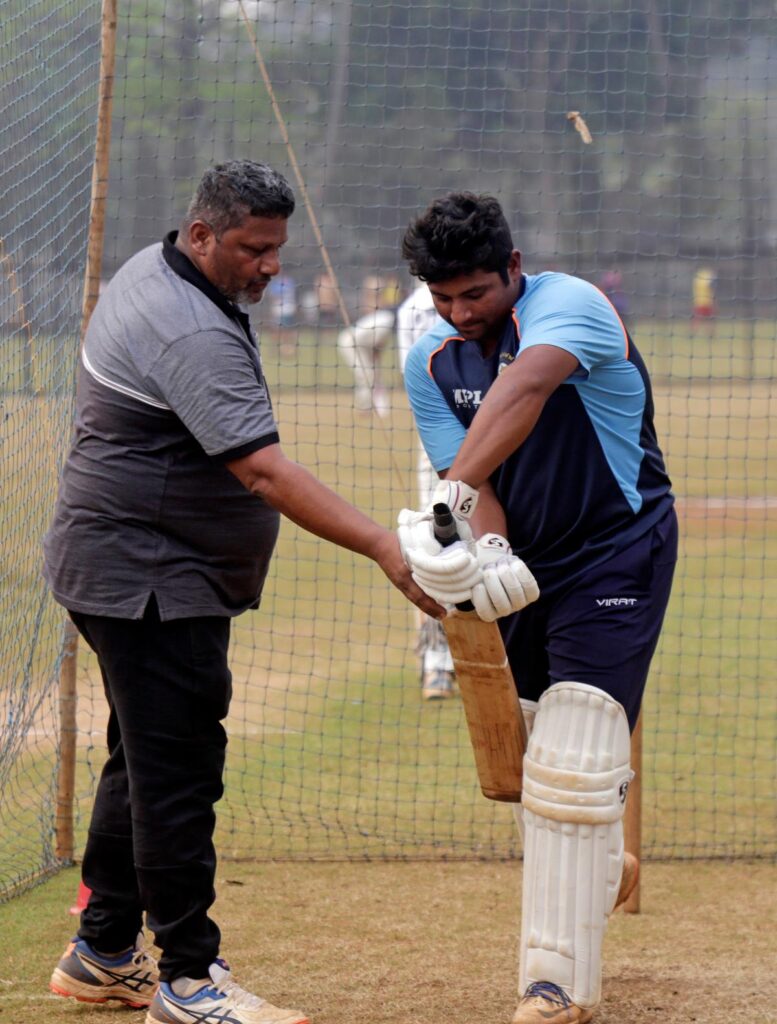
You cannot separate Naushad — a former Western Railway cricketer who has devoted his life to moulding Sarfaraz and his younger brother Musheer, an all-rounder, into classy cricketers — from Sarfaraz’s cricketing journey. But this day is about Sarfaraz. And Naushad realises it and doesn’t intervene even once when Sarfaraz is chatting with The Hindu.
Sarfaraz Khan at Cross maidan. | Photo Credit: EMMANUAL YOGINI
Ask the plain-speaking Sarfaraz how well he remembers his First Class hundreds and pat comes the reply: “Six centuries… ek (one) triple, three doubles because a triple is also counted as a double. And every century is 150-plus, the one I scored for UP was 150 (155), it is the lowest.”
He says it as a matter of fact. But his returns since returning to Mumbai in January 2020 after a three-year hiatus are gargantuan: 1,564 runs in 15 innings at 142.18! And he isn’t a wee bit surprised by his phenomenal consistency, be it for Mumbai or for India-A against an all-international bowling attack in South Africa.
“I used to score heavily in school cricket, so it feels the same. I have done the same all my life, be it at Azad Maidan or a club ground or at a big stadium, I just am used to going through the motions and scoring runs,” he says.
“Every day brings a new challenge, a new ball, a new set of bowlers and it just doesn’t feel like I scored a hundred yesterday. It just feels like I have to work all over again and go through the routine and the process all over again and score runs. That’s what I have done since school cricket and since I started training with Abbu.”
And what’s the secret behind his daddy hundreds? The response offers a peek into his mindset.
“A lot of players tend to play a rash stroke after getting to the hundred. Once I celebrate the hundred, I keep telling myself — obviously every batter wants to score a hundred — ‘your aim is achieved, now do it for the team by converting it into a big one’.
“Also, there are so many quality players who score hundreds,” he says. “If you want to stand out, you have to score big hundreds, so I wait for four-five balls after the hundred and then start playing freely. Till the 100, I tend to plan in 10s, once I cross the 100, I start looking at it in 20s or 30s because every 20-30 runs that I add, not only will I get to another milestone but I will be taking the team to safety.”
Occupation
In addition to being obsessed with making it big as a cricketer and living his father’s dream, a changed batting outlook has also helped Sarfaraz. He has begun treating the match as his “office” and batting as his “job”. He refers to a dialogue from M.S. Dhoni’s biographical feature film: “Duty ke baad bhi practice (Your practice continues even after office hours)”.
“For me, it’s duty ke pehle and office ke baad bhi practice (it’s practice both before and after office),” he says. “I don’t have an off day. If I am not playing a match, I face at least 400 balls a day once Daddy wakes me up at 5 a.m.”
So how does he put his astounding form into perspective? “I have always been grounded, whether I score or not. I know that you enjoy when you perform well but there are always more sad days in life. That’s why we don’t tend to get excited. Even when I score, I don’t throw parties, nor do I attend anyone else’s. I don’t celebrate my birthday, nor do I attend someone else’s birthday party,” Sarfaraz says.
“My Daddy says, ‘You have so many followers and fans, so if you end up being friends with everyone, someone will have his or her birthday. So if you attend a birthday party every day, when will you play cricket?’ So I don’t go out much nor does our household get over-excited with any achievement. For us, doing well is like our daily job. And I’ve been learning something every day. But I keep telling myself two things: not to repeat the same mistake and follow whatever Daddy says.”
Opportunity
As someone who adapts to red-ball and white-ball formats as seamlessly as he switches between “Abbu” and “Daddy” when he refers to Naushad, Sarfaraz is making a strong case for an India call-up. One can sense that he desperately desires that India cap, especially with the sensational form he has been in, but he spells his position out calmly.
“There would be at least 500 cricketers toiling around us here at the maidan right now. And each one of us aspires to play for India. Whenever the chance comes, I have to be ready for it. That’s all that I am prepping for. If I can do it, I know I shall make my Daddy happy. And that’s what matters the most,” Sarfaraz says, before padding up again and replacing Naushad in the nets.
While Sarfaraz’s range-hitting keeps fielders and bystanders on their toes, Naushad expresses the hope that Sarfaraz gets a chance at the earliest in his new IPL franchise, the Delhi Capitals.
Had the Ranji Trophy not been postponed due to the Omicron variant, Sarfaraz could well have triggered a bidding war instead of being bought at base price in the accelerated auction. But as he starts walking towards his father’s SUV — the same one that had turned into his virtual home-cum-cricket room during the lockdown — Sarfaraz has a parting shot.
“It’s not about the money. It’s about the opportunity.”
With the dazzling form and frame of mind he is in, don’t be surprised if Sarfaraz adds ‘Optimisation’ to his 4 Os the moment he gets an opportunity in the IPL.
source: http://www.thehindu.com / The Hindu / Home> Sport> Cricket / by Amol Karhadkar / March 19th, 2022
Shams Mulani has silenced all his critics with his sterling performance in the Ranji Trophy.
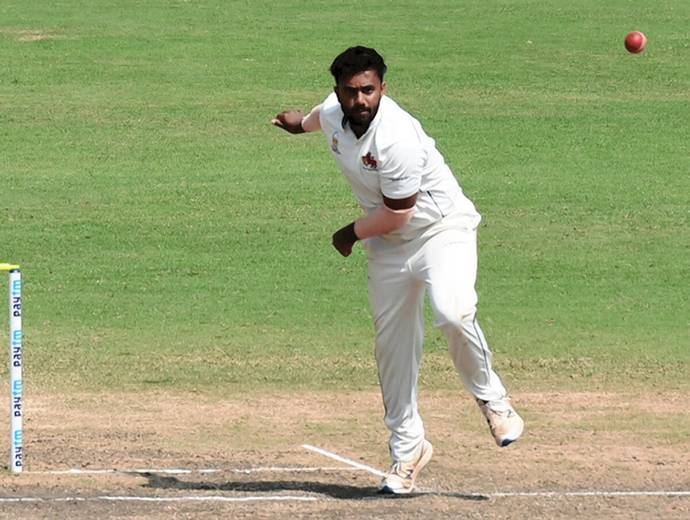
FILE PHOTO: Mumbai bowler Shams Mulani during a Ranji Trophy match at the M. A. Chidambaram Stadium in Chennai. – THE HINDU ARCHIVES
He made his First Class debut in 2018-19. He was Mumbai’s highest wicket-taker in the Ranji Trophy the following season.
Still, Shams Mulani ,the all-rounder, has always had to deal with murmurs of primarily being a white-ball bowler. Over the last fortnight, Mulani has silenced all his critics with his sterling performance bowling left-arm spin.
Mulani has picked a whopping 22 wickets in the first two league stages, including three consecutive five-wicket hauls. As a result, he is topping the wicket-takers’ chart in the Ranji Trophy. The southpaw, who is a couple of weeks shy of turning 25, hopes his performance versus Saurashtra and Goa should end the debate about spin-bowling skills in the longer format.
“I think it should because I never felt I was only a white-ball bowler. I feel that I am versatile and I can play all three formats pretty well as a bowler. That’s what I am trying to do,” Mulani told Sportstar on Monday, a day after being adjudged Player of the Match for his 11-wicket haul and a crucial 50 in Mumbai’s second essay.
“The tags are always going to be there, critics are always going to say something, you can’t help it. You just have to do what you do… let the ball and the bat do the talking.”
It was impressive to see Mulani using the width of the crease versus Goa, sensing the pitch at the Narendra Modi Stadium was offering turn from outside off-stump to right-handers. “I can say it’s a sense of maturity. Being around for a while, I have started reading the conditions better. The key to pick wickets is to assess the conditions, the batters and change your plan accordingly. I am glad it’s coming off,” he said.
Mulani stressed despite little red-ball cricket in the last two years, it’s his beginning at the Bengal Cricket Academy at Shivaji Park that meant he continued to work hard even while bowling with the red ball.
“Even when the whole focus was on limited overs (he was a Covid-replacement for Axar Patel in IPL 2021’s first half), I make it a point to carry at least one red-ball in my kit-bag all the time,” Mulani said. “That’s the basics. We started off bowling with it as kids and that’s what is going to hold us in good stead in the long-run.”
source: http://www.sportstar.thehindu.com / Sportstar / Home> Domestic / by Amol Karhadkar / Ahmedabad – February 28th, 2022