Tag Archives: Muslims of Tamil Nadu

Muslims emerging as important players ahead of Assembly elections in Tamil Nadu; welfare initiatives rolled out

TAMIL NADU :

Representational photograph

New Delhi :

Ahead of the Assembly elections in Tamil Nadu, scheduled for April-May 2026, the Muslim community is emerging as an important player in the poll-bound state, with Chief Minister M.K. Stalin rolling out several welfare initiatives aimed at benefiting them. Stalin has laid emphasis on the ruling Dravida Munnetra Kazhagam’s (DMK) historical ties with Muslims.

Muslims in Tamil Nadu constitute approximately 5.86% of the state’s population. Their number in the state was 42 lakh, as per the 2011 Census, and they primarily belong to the Tamil-speaking Labbai, Marakayar, and Rowther communities. With a history dating back to 7th century Arab trade, they are well-integrated, often using Tamil as their native tongue, and exhibit high social, literacy, and economic indicators compared to other regions.

In a powerful message to the ruling Bharatiya Janata Party (BJP) at the Centre, Stalin has claimed that Tamil Nadu is the “only state which is safe for Muslims” and described the DMK as a fortress that protects the minorities in the state. Because of this, incidents like mob lynching could not rear their head in Tamil Nadu, Stalin said at a function at Kumbakonam recently.

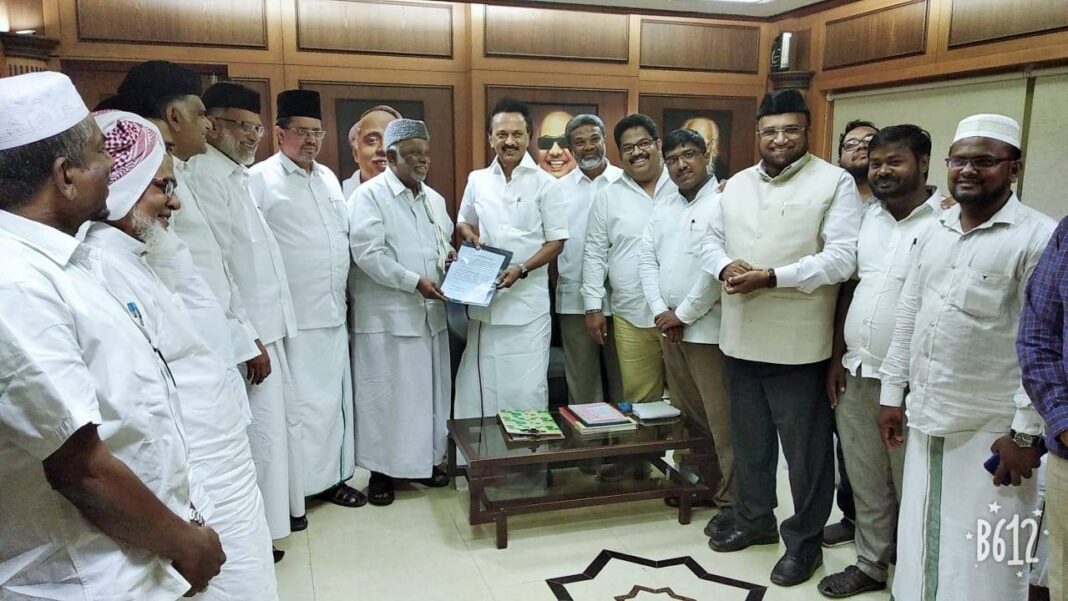
The occasion was the State Mahalla Jamaats Conference organised by Indian Union Muslim League (IUML) near Kumbakonam, in which office-bearers of around 8,000 Jamaats from across the state participated. In his address, Stalin launched a scathing attack on the Central Government, accusing it of using central agencies like the CBI, ED, and IT to intimidate political opponents and the public.

The Chief Minister remarked that he did not need to explain the current situation of the country further, implying a climate of pressure from the Centre. His remarks were indicative of the DMK’s strategy to consolidate minority votes by positioning itself as a primary defender against central interference and communal insecurity.

Stalin accused the Opposition All India Anna Dravida Munnetra Kazhagam (AIADMK) of betraying minority communities to appease central authorities in Delhi. He asserted that only the DMK-led Secular Progressive Alliance has the strength to defeat the anti-people AIADMK-BJP alliance in the upcoming Assembly elections.

Stalin announced five welfare schemes for Muslims on the occasion, including the establishment of a third Waqf Tribunal at Coimbatore and the increase of pension for Ulema registered with Tamil Nadu Waqf Board from Rs. 3,000 to Rs. 5,000, and the family pension from Rs. 1,500 to Rs. 2,500.

Stalin also announced that in the first phase of a scheme, 1,000 Ulema will receive the increased subsidy of Rs. 50,000 for buying two-wheelers. The Ulema play a pivotal role as Islamic scholars in Tamil Nadu’s Muslim societies, acting as guardians and interpreters of religious knowledge and law. They are highly respected for their deep understanding of Islamic theology, Sharia law, and the Hadiths, guiding the Muslim community on matters of faith and practice.

The other announcements included creation of burial grounds in City Corporation areas where there is none, and filling of 10 vacant posts of Urdu language teachers at the government high schools and higher secondary schools. Stalin said the efforts of those who were trying to disturb peace had been in vain, and added that they had formed in their own interest, an alliance of those who are servile by threatening with agencies like ED, CBI and IT.

Pointing at AIADMK’s support to the contentious Citizenship Amendment Act (CAA), 2019, the Chief Minister said the Leader of Opposition, Edappadi K. Palaniswami, has been continuing his betrayal of Muslims. “But for AIADMK’s support, the CAA Bill would have been defeated in the Rajya Sabha,” he said. He further pointed out that the DMK government had courageously declared the CAA would not be implemented in Tamil Nadu.

Stalin also referred to the DMK’s vote against the Triple Talaq Bill and Waqf Amendment Bill. “If the BJP alliance comes to power in Tamil Nadu, it will ruin the developed state. Only the DMK alliance has the courage and strength to stop it from coming to power,” he declared.

Pointing out that the DMK cadre have started their door-to-door campaign, he urged the IUML cadre, particularly the youth and women, to campaign for those who will protect and enable their growth. IUML chief K.M. Kader Mohideen, who presided over the meeting, said his party and members of Mahalla Jamaats will ensure the continuance of the Dravida model of governance.

The key aspects of Muslims in Tamil Nadu include their cultural fusion, social harmony, and concentration in towns like Kayalpatnam, Kilakkarai, Adirampattinam, and Melapalayam. Chennai also has a notable Muslim population, comprising about 9.45% of the capital city’s total population.

The Tamil Muslims are known for a unique synthesis of Tamil culture and Islamic faith, with strong traditions in trade and education, particularly in coastal towns. The community is primarily Sunni, with diverse, well-integrated, and long-settled, as well as some Dakani-speaking groups. The presence of ancient mosques like the Kilakaraj Jumma Masjid, built in 7th century, highlights early Islamic contact through maritime trade, while Tamil Nadu is often described as a model for communal coexistence because of its peaceful Muslim community.

source: http://www.indiatomorrow.net / India Tomorrow / Home> Debate / by India Tomorrow Correspondent / February 03rd, 2026
Madrasa Imdadiya in Tamil Nadu Offers Light to Poor and Blind Muslim Students

Chennai/Ranipet, TAMIL NADU :

Visually-impaired children from deprived Muslim families gain education and dignity at the institution founded by Mohammad Usman in Chennai and Ranipet

Chennai :

In the busy streets of Chennai and surrounding districts, where poverty often limits opportunity, one institution is rewriting the story for visually impaired Muslim children. Madrasa Imdadiya, a semi-residential trust founded by Mohammad Usman, offers education, skills, and dignity to children who might otherwise have spent their lives begging.

Ashraf Khan, a Tamil teacher in a private college in Chennai, was born blind into a poor family. He recalls his early years at a small madrasa for blind students in Melvisharam, near Ranipet, as life-changing. Today, he earns about ₹50,000 per month. “Education saved my life,” he says.

Usman draws a stark contrast. He has often seen blind children on streets with equally deprived parents. “This is what happens with the poorest Muslims. When parents are blind and poor, the children end up on the streets,” he explains. This inspired him to act.

Founded in 2010, the madrasa now runs centres in Chennai and Ranipet, inspiring similar institutions in Pune, Ahmedabad, Aurangabad, and Kashmir. The Tamil Nadu centre, the largest, covers 5,000 square feet and hosts 50 blind students, including ten girls, with hostel staff managing daily needs.

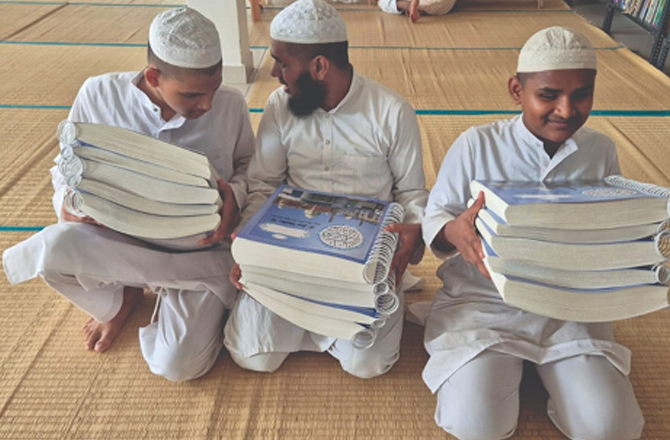
The madrasa blends religious and formal education, filling gaps left by government institutions. Students study the Qur’an, Hadith, and other religious texts in Braille, alongside school and college instruction via audio tools. Children with other disabilities are also accepted, though Braille education is separate.

Usman stresses self-reliance. “Some parents still take financial help from the trust, but many become self-reliant through their educated children. This is the real success,” he says. Students often pursue higher education, vocational training, or government jobs, with some returning as teachers.

The madrasa also produces copies of Qur’an in Braille, distributed free across India and abroad. Each copy costs about ₹3,500 to print. “All our students become Huffaz and complete Class 12 and degree education,” Usman adds.

Mobina (name changed), a blind and disabled girl who lost her father early, is a shining example. With the madrasa’s support, she now teaches in a government school and earns ₹75,000 per month. “Without this madrasa, I would have remained invisible,” she says.

Challenges remain, especially for girls. Deep social barriers, safety concerns, and marriage prospects keep many girls out of school. Usman says patience is key. “Families do not outright reject education but hesitate. Inclusion is about changing attitudes regarding gender, disability, and value,” he explains.

Disability activists note that blind children in poorer districts often lack access to formal education. Government schools exist only on paper, and families may be unaware of disability certificates, scholarships, or assistive technology. Without early intervention, entire families risk cycles of begging or informal labour.

Madrasa Imdadiya shows how targeted community efforts can break generational poverty and empower blind Muslim children. By providing education, accommodation, and skills, the madrasa transforms lives and reinforces that education is a right, not charity.

“Other communities invest in education, but we do not,” Usman remarks, highlighting a broader challenge within the Muslim community. Yet he takes pride in his students’ successes. With over 500 students across India benefiting from similar madrasas, he dreams of a school for blind children in every district and tuition centre in every village.

“Every story here is regrettable. Happy stories go to cities and private schools; they do not come to my trust’s madrasa,” he admits, underscoring the ongoing need for support for India’s most vulnerable children.

source: http://www.clarionindia.net / Clarion India / Home> Editor’s Pick> India / by Team Clarion / January 10th, 2026

Malaysia Consul General honours father-son duo for service to humanity

Kayalpattinam / Chennai, TAMIL NADU :

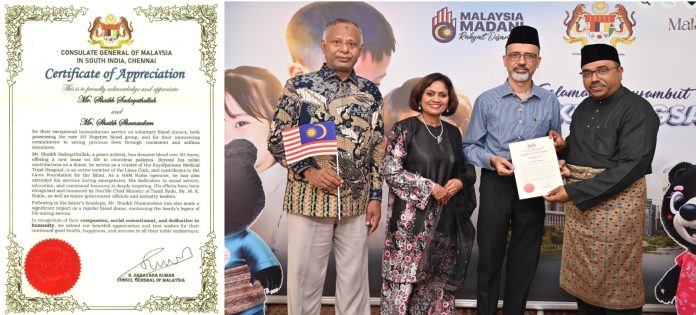
The father-son duo Kayalpattinam native Shaikh Sadaqathullah (now a resident of Mannady in Chennai), a peace activist, HAM radio operator and blood donor and Shaikh Shamsudeen were honoured by the Malaysia Consul General K Saravana Kumar with a certificate of appreciation during the flag raising ceremony to commemorate the 68th Independence Day celebrations on Aug 31 at Consulate General of Malaysia located at Cenotaph Road in Teynampet neighbourhood, Chennai Metro.

​Service to humanity is a core principle in Islam. It emphasises kindness, compassion, and charity towards all individuals, regardless of their faith, colour, race or background. This principle is well-supported by various references from the Holy Qur’an and Hadith, illustrating the importance of helping others and fostering a harmonious society.

Islam places a high value on the preservation and saving of human life. The Holy Qur’an states, وَمَنْ أَحْيَاهَا فَكَأَنَّمَا أَحْيَا النَّاسَ جَمِيعًا (“And whoever saves a life (gives life to one) – it shall be as if he had saved (given life to) mankind entirely.” – Chapter 5 Verse 32. No doubt, blood donation is an act of kindness, charity, and assistance to others, and is highly rewarded in Islam. It is also a form of relieving others’ distress, which aligns perfectly with Islamic tenets and teachings and is considered a virtuous act in Islam.

Meet the father-son duo Kayalpattinam native Shaikh Sadaqathullah (now a resident of Mannady in Chennai) a peace activist, HAM radio operator and blood donor and Shaikh Shamsudeen who were honoured by the Malaysia Consul General K Saravana Kumar with a certificate of appreciation during the flag raising ceremony to commemorate the 68th Merdeka celebrations on Aug 31 at Consulate General of Malaysia located at Cenotaph Road in Teynampet neighbourhood.

Interestingly, the Almighty has gifted both the father and son with a rare blood group of AB Negative. While Shaikh Sadaqathullah had donated blood 53 times since 1993, starting from saving a patient Narayana for the latter’s heart surgery at Perambur Railway Hospital and his son Shaikh Shamsudeen had saved lives by donating 20 times since 2016. Notably, they were invited by Tamil Nadu Chief Minister M K Stalin to his chamber and appreciated them for their noble gesture.

It may be noted that Shaikh Sadaqathullah received recognition from Tamil Nadu State Branch of Indian Medical Association (IMA) with Dr M S Ashraf award under non-medical category during National Doctor’s Day fete held in Chennai (2022). A proud moment for him as he received the award from Dr J Radhakrishnan, former State Health Secretary and presently chairman and managing director of Tamil Nadu Power Distribution Corporation Ltd (formerly TANGEDCO). A commendation certificate and a shield were presented to him on the occasion.

As a peace activist, Shaikh Sadaqathullah played an active role in taking part in communal harmony events held in Chennai city sending a strong message of Mother Teresa – “We can do no great things – only small things with great love. He was closely associated with leading luminaries like Late Dr. B.S. Abdur Rahman, founder of United Economic Forum and All India Islamic Foundation, Dr. S.K. Khadri, Founder – Murthuzaviya Educational and Cultural Foundation of South India, Nawab Mohammed Abdul Ali, Prince of Arcot, Founder Secretary-General – Harmony India and L.K.S. Syed Ahmed, Past District Governor – Lions District 324-A1, Managing Partner – L.K.S. Gold House.

To be precise, Shaikh Sadaqathullah makes it a point to attend almost all the communal harmony functions fostering Universal Brotherhood for peaceful coexistence among different faiths. It is a matter of great pride for him to get the recognition from Malaysia Consul General during the nation’s 68th Independence Day.  Prophet Muhammad ﷺ said: “If one removes a hardship of a Muslim in this life, Allah will relieve a hardship from him on the Day of Judgment”. True to the words of wisdom, Shaikh Sadaqathullah and his son Shaikh Shamsudeen are doing yeomen services to the cause of Mankind.

[The author is former Indian Express and Deccan Chronicle chief]

source: http://www.radiancenews.com / Radiance News / Home> Pride of the Nation> Awards / by M Rafi Ahmed / September 02nd, 2025

Annai Ambulance’s Basith drives hope and dignity for the poor in Rajapalayam

Rajapalayam (Virudhunagar District), TAMIL NADU :

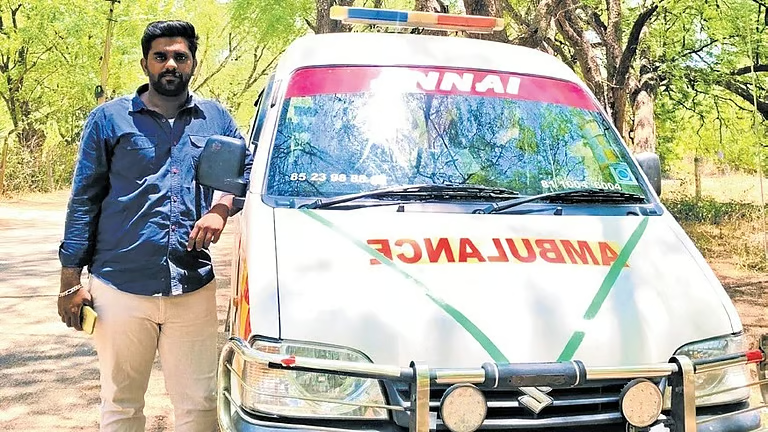
Raised by a single mother, Basith named his ambulance service ‘Annai’ as a tribute to her relentless care and sacrifices.

Basith named his ambulance service ‘Annai’ as a tribute to his mother for her relentless care and sacrifices Photo | Express

Virudhunagar :

Two years ago, the cries of a newborn filled the corridors of a hospital in Rajapalayam, but it was not a moment of joy. The 40-year-old mother’s cold body lay in front of her helpless grandmother, who clutched the child closely.

This is when Mohamad Basith (28), the proprietor of Annai Ambulance in Rajapalayam, stepped in. He drove them 15 km for a final journey to their home in Chokkanathanputhur, offering dignity and compassion without charging a dime.

Raised by a single mother, Basith named his ambulance service ‘Annai’ as a tribute to her relentless care and sacrifices. “Despite our financial struggles, my mother ensured that my sister and I received a proper education. From our childhood, we knew the value of food, sleep, and basic necessities,” he said.

In one instance, Basith shouldered the responsibility for a young girl raised by a single mother who was a daily wager. The girl was suffering from kidney-related ailments and required treatment in Tirunelveli. With no means to afford frequent hospital visits, the family turned to Basith, who ensured she was taken to the hospital over eight times. These are just two among the many free services that Basith has quietly been providing over the years. The idea of running his own ambulance service, free for the poor, first struck him while working as a driver, where he witnessed the ordeals families endured during crises.

“After completing my degree five years ago, I couldn’t find a job in my field. So, I worked as a private ambulance driver for two years. Seeing people suffer during emergencies moved me deeply, and that’s when I decided to start my own service, making sure to offer it for free to the poor and underprivileged,” he recalled.

Beyond ambulance services, Basith also helps destitute individuals and those facing mental health challenges by admitting them to shelter homes free of cost. At government hospitals, when attendants are unsure about procedures or struggle to arrange essentials like X-rays, he steps in to guide and assist them.

Since the Covid-19 pandemic, he has taken on the responsibility of performing final rites for the abandoned and homeless who pass away on the streets.

Basith is not alone in his work. His wife, Anisha Fathima (27), a nurse, supports him with the same compassion. She provides basic medical care and emergency help to the needy, all free of cost.

Looking ahead, Basith hopes to add more ambulances to his service and start a shelter home for underprivileged elders. In a world where compassion often takes a back seat, Basith and his service prove that a single act of kindness can create a ripple of hope for many in their darkest hour.

(Edited by Meghna Murali)

source: http://www.newindianexpress.com / The New Indian Express / Home> Good News / by Harini M / edited by Meghna Murali / September 14th, 2025

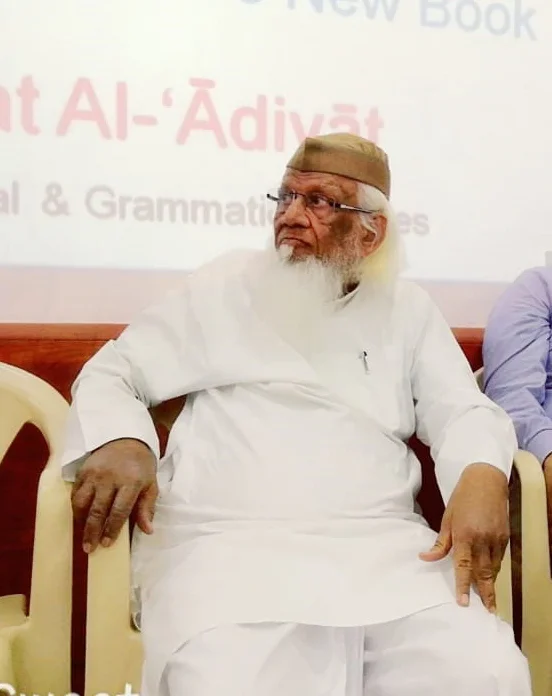
Renowned Scholar and Educator Dr. V. Abdur Rahim Passes Away

Vaniyambadi, TAMIL NADU / Madinah, SAUDI ARABIA :

He has written scores of books in Arabic, English and Urdu. One of his unique books is Attibyan which helps in teaching Qur’an to neo-Muslim brothers and sisters.

New Delhi :

Dr. V. Abdur Rahim, world renowned Islamic scholar, multilinguist, author, teacher and translator passed away in the holy city of Madinah on Thursday.

Author of several popular books on teaching Arabic language, Dr. Abdur Rahim was laid to rest in Jannat al Baqi cemetery near the Prophet’s Mosque after Friday noon prayers, reports reaching here said.

Dr. Abdur Rahim has written scores of books in Arabic, English and Urdu. One of his unique books is Attibyan which helps in teaching Qur’an to neo-Muslim brothers and sisters. The scholar was closely associated with Chennai-based Islamic Foundation Trust (IFT) and a majority of his books have been published by it. 

Dr. Abdur Rahim was born in the small town of Vaniyambadi in Tamil Nadu in 1933. After completing his secondary school studies, he joined Presidency College, University of Madras where he majored in English language and literature. He graduated in 1957. In 1964, he joined the prestigious Al-Azhar University in Cairo, from where he completed his M.Phil. and Ph.D. in Arabic philology.

Dr. Abdur Rahim adopted innovative teaching methodologies and pedagogical approaches, which revolutionised the teaching of Arabic. He joined the Islamic University of Madinah in 1969, where he played a pivotal role in the program of teaching Arabic as a foreign language. He also imparted his knowledge at various institutions, including the Islaamic University Omdurman Sudan, Khartoum University Sudan, and Arabic Institutions in Germany, Washington D.C., and British Guyana.

His most significant contribution to Arabic education was the development of the renowned Madinah Arabic Course. This comprehensive series of textbooks and audiovisual materials simplified the complexities of the Arabic language, making it accessible to learners from diverse linguistic backgrounds. His teaching not only facilitated learning but also promoted intercultural dialogue and understanding.

Beyond his teaching endeavors, Dr. Abdur Rahim served as the Director of the translations section at the King Fahad Qur’an Printing Press in Madinah, where he contributed to translating and interpreting the Qur’an into various languages, ensuring its accessibility to people worldwide.

In recognition of his exceptional contributions to Arabic language education, Dr. V Abdur Rahim was honored with the prestigious President of India Award. This recognition celebrated his tireless efforts in promoting Arabic language learning and fostering cultural understanding through linguistic knowledge.

source: http://www.clarionindia.net / Clarion India / Home> India / by Team Clarion / October 21st, 2023

Dr M G Anwar Batcha Celebrates 50 Years of Literary Service

Coimbatore, TAMIL NADU :

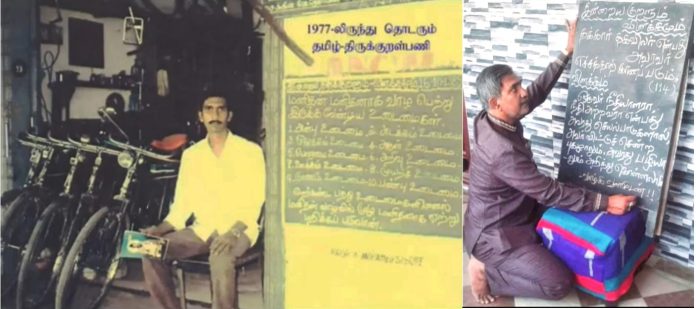
THEN AND NOW: Dr M G Anwar Batcha started writing a Thirukkural couplet with its meaning everyday since 1977 on a black board kept at a cycle shop at Coimbatore Gandhi Park. Post retirement, he continues his mission of popularising and promoting Thirukkural among the public.

So goes the inspiring quote of Missile Man of India Dr APJ Abdul Kalam – “Every small step taken with determination leads to great achievements.” Taking a cue from this, a former Tamil teacher Dr M G Anwar Batcha, known as Kural Yogi in the literary circle, celebrated 50 years of his literary journey penning books, writing a couplet with its meaning everyday on a board kept at a cycle shop at Gandhi Park in the heart of Coimbatore city since 1977.

It’s always fascinating to rewind the golden days of teaching, speaking at literary meetings and what not. As a faculty with 25-year service at Chokkampudur SBOA Matriculation Higher Secondary School in Coimbatore city, Thirukkural Batcha, a resident of Kuniyamuthur, took a trip down the memory lane to share his experience about Thirukkural, which is close to his heart.

It may be noted that a special story was featured on him in 2010 in The New Indian Express when S Kamalakannan was a senior photographer and during a routine round across the city found him writing a couplet on a black board. Worth mentioning that he makes it a point to sensitise people through his books and speeches at a plethora of events both inland and abroad. Words cannot express the amount of happiness he has in doing this literary service for over 50 years or so.

In all smiles, he said, “Life is indeed a journey filled with ups and downs, and how we navigate these fluctuations defines our resilience and character.” And that’s what Saint Thiruvalluvar had said in his 1330 couplets. Elaborating on it further, he remarked, “This ancient Tamil text is a profound testament to the intellectual and cultural achievements of Tamil civilization. Beyond its philosophical depth, the Thirukkural holds immense historical significance as a cornerstone of Tamil literature and a universal guide for human conduct. Shedding more light on it, he said Thirukkural’s focus on equality is evident in its rejection of caste discrimination, a radical stance in an era when hierarchical structures were prevalent.

Crossing a 50-year milestone,  Anwar Batcha no doubt is creating a silent revolution. All credit goes to his mentors Pulavar Rasiannan and Pulavar Arumugam, while studying at City Municipal High School at Variety Hall Road, who groomed him and brought the best out of him to be what he is now. In a step further, they motivated him to enhance his skills in Tamil.

To his credit, Anwar Batcha has awards including Tamil Nadu Government honour, Kural Neri Chelvar, Thirukkural Thoothar, Thirukkural Vendar and Thirukkural Thondar. And he penned a book on Thirukkural with English translation besides a book titled Valluvar Manimozhigal and Valluvaridam Kettathum Kidaithathum. Batcha is quite proficient in Urdu, Hindi, Malayalam and Telugu.

Retired, but not tired to actively involve in literary organisations like Thirukkural Aaivu Kazhagam, Ulaga Kalai Tamil Mandram, Coimbatore World Thirukkural Centre and organiser of Kovai Islamiya Tamil Sangam, Anwar Batcha did his doctorate on ‘Samuga Nokkil Thirukkuralum, Thirukkuranum’. US-based writer of inspirational maxims William Arthur Ward rightly categorised teachers thus: The mediocre teacher tells. The good teacher explains. The superior teacher demonstrates. The great teacher inspires. True to his words, Dr Anwar Batcha has inspired scores of his students who have made their ‘guru’ proud.

[The author is former Indian Express and Deccan Chronicle chief]

source: http://www.radiancenews.com / Radiance News / Home> Latest News / by M Rafi Ahmed / by Radiance News Bureau / August 16th, 2025

Afshan Fathima breaks social shackles to take her place among MMA’s elite

Chennai, TAMIL NADU :

Mixed martial arts were never on the horizon for the 23-year-old from Anna Nagar in Chennai. Even sport wasn’t really part of the picture.

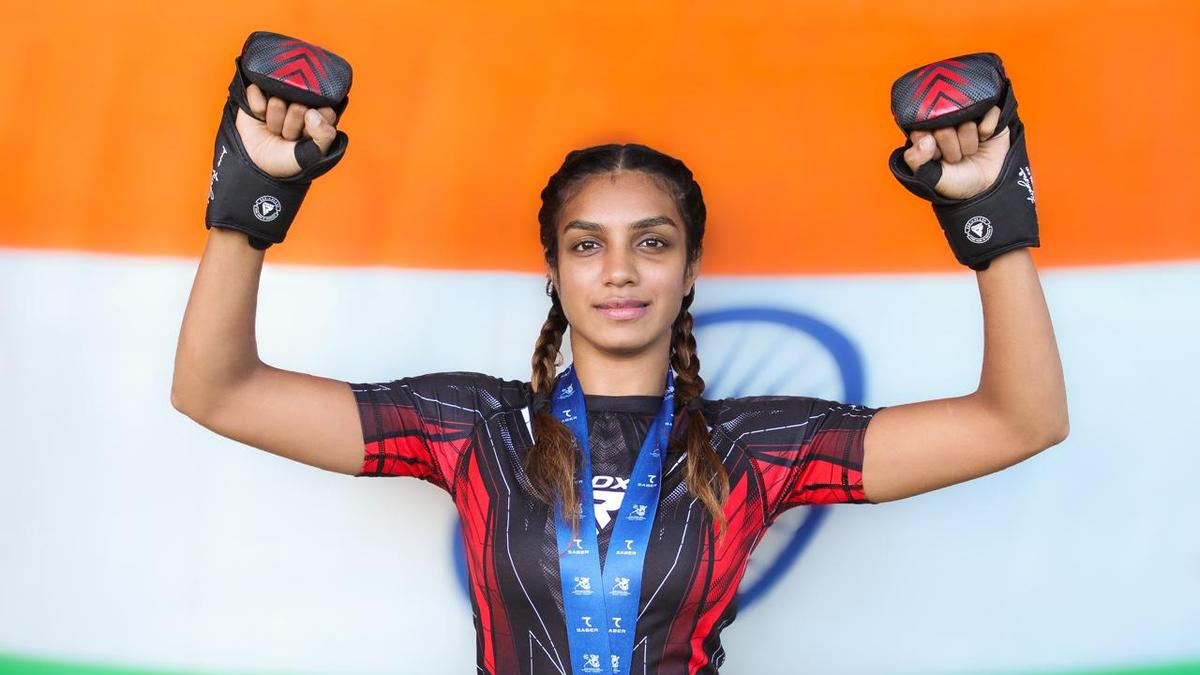
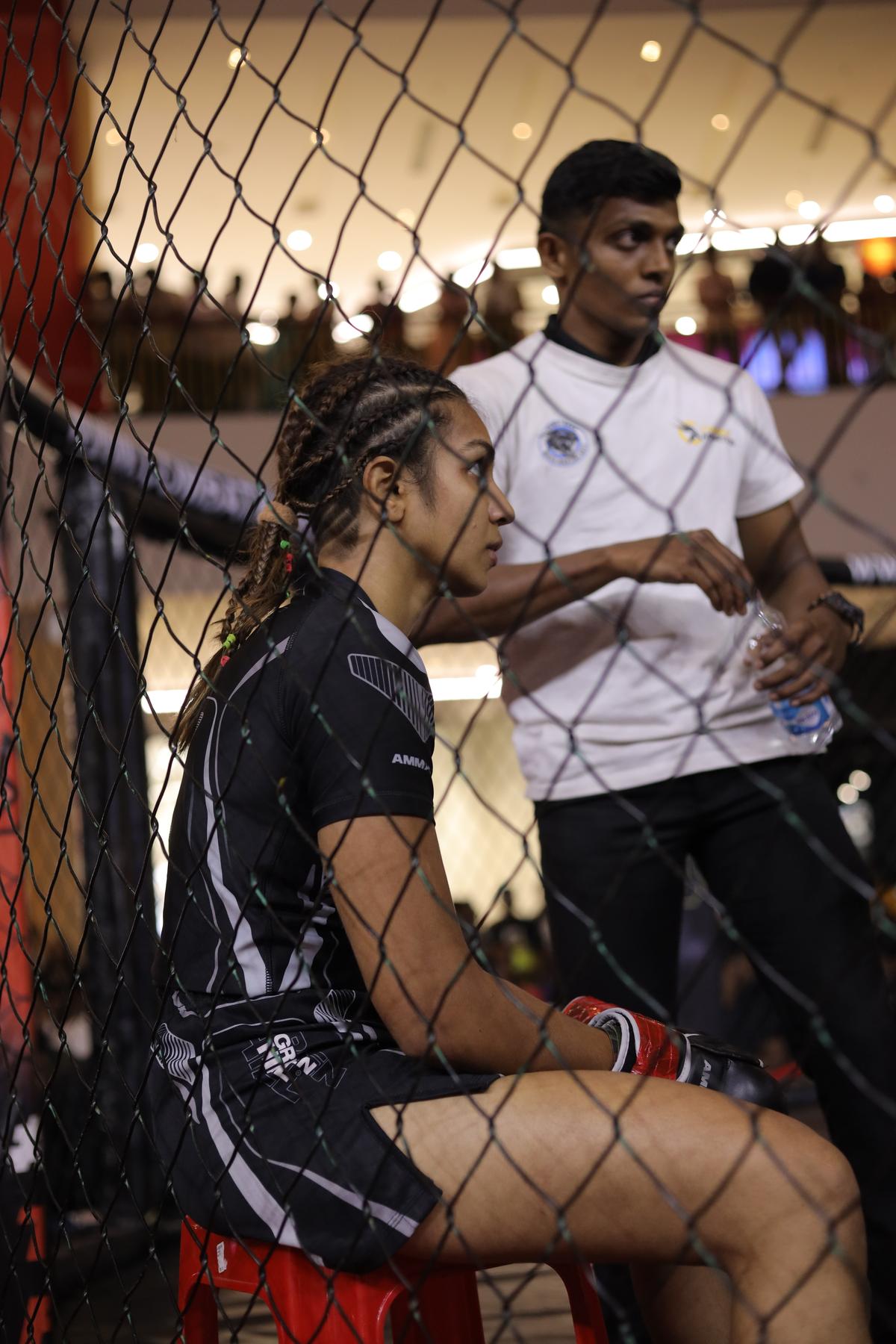
Afshan Fathima defied odds, reaching the final of IMMAF World Championships despite challenges and stereotypes. | Photo Credit: Special Arrangement

Afshan Fathima walked away from her very first bout of the 2024 IMMAF World Championships in Uzbekistan last week not only with a win but also with a prodigious, rapidly darkening contusion under her eye. Although the injury was caused by an accidental headbutt rather than a punch from her opponent, many thought it meant the end of her campaign in the women’s strawweight division (52.2kg) at her debut World Championship.

“Everyone who saw me thought I wasn’t going to be declared medically fit to take part in the next bout. But I did make it. And then after I won that bout, everyone thought my injury was not going to let me compete in the next bout. After every bout I fought, the other fighters thought I wasn’t going to be able to make the next round because of how big the swelling had got. But I kept doing this. There was no way I was going to quit,” she says.

By the time Afshan’s campaign at the IMMAF World Championships ended, she had gone further than any other Indian – reaching the final –at the premier global amateur competition in mixed martial arts. Amongst her wins, was a guillotine choke submission of Ireland’s Lisa Murtagh who trains at the prestigious SB Gym– with the same team as former UFC champion Connor McGregor – and picked up a decision win over reigning World champion Matilda Bachurina of Kazakhstan in the semifinals.

Afshan however couldn’t return from the competition with the gold medal she had hoped for. She ended up losing the final by a narrow points decision to Isabel Calvo of Spain. “Unfortunately, the day of my final coincided with the start of my period. It was pretty bad. I was puking and had really bad cramps. I wasn’t anything close to 100 percent,” she says. Afshan says she returned from the tournament with mixed emotions. “It stings of course to go so far and fall short in the final but at the same time, I’m a little happy that I at least came this far,” she says.

Few might not have predicted Afshan would get anywhere near where she’s gotten. “Even I wouldn’t,” she says.

Mixed martial arts were never on the horizon for the 23-year-old from Anna Nagar in Chennai. Even sport wasn’t really part of the picture. “There’s no one in my family who has chosen sports as a career,” says Afshan, the eldest of three sisters. That was the case for her as well. It wasn’t as if she wasn’t interested in sport. Some of her earliest memories are of watching WWE pro wrestling matches with her father and uncle. At school, she says she was one of the few children to actually make the most of the games period.

“Most of the other kids would be chatting with each other or catching up on their studies. I was the only one who would pester the games teacher to start a basketball match or something. I was also someone who used to roughhouse with my friends. They’d all tell me I was really strong or that I hit really hard. But I didn’t know what I was going to do with that. While I really wanted to play something, my family only really wanted me to study. My grandmother was a teacher and my aunt was a lecturer. I was also fairly good in studies so I had no option but to focus on my books. Perhaps if I was a bit dull, they might have been more open to the idea of putting me in sports,” she says.

It was only after her school when she began studying for a degree in Electrical Engineering at Hindustan Institute of Technology that Afshan says she finally got the chance to pursue her passion.

“I always wanted to do some sort of fitness activity. So, in my third year of college I joined a crossfit gym. The gym where I trained also had a sign for mixed martial arts classes although they didn’t have any instructors. That was the first time I had heard about mixed martial arts. Although they didn’t have classes at the gym. I did a Google search and found out about Combat Kinetics Chennai and coach Ajit Sigamani,” she says.

At that time, Afshan says she told her parents she was just staying back to play basketball in her college since she knew the alternative would be something they would never agree with.

“I’m from an extremely orthodox Muslim family. Back when I was in school and in college I would wear the burkha. I couldn’t even think of leaving the house if I wasn’t wearing the burkha. While my parents were supportive of my education, they would have drawn the line at my getting into a sport like martial arts. So I used to wear the burkha when I left home. Then, when I went into the gym, I would change into my gear and back into the burkha when I was heading back home. It almost felt like I was living two lives. I tried to balance those two lives as much as possible. I knew I would have to tell my family eventually but I was hoping I could ease them into it,” she says.

It was at the Combat Kinetics Gym though where she felt she truly belonged. “Because I had been somewhat sporty in the past, I didn’t really struggle getting physically in shape. I enjoyed doing all the push ups and pull ups. I absolutely loved actual combat training. A lot of our training in MMA is mixed gender and I sometimes would think just how scandalised my family would be if they walked in on one of our grappling sessions. But, I genuinely didn’t think too much about it when I started. I just got on with it. It wasn’t as though I’d stopped becoming religious or stopped praying but I think it’s what’s inside your heart that counts a lot more than what you are wearing on the outside,” she says.

Afshan says she knew she was someone who was meant to be a fighter when she stepped into the fighting cage for her first sparring session. “In contrast to a lot of the other individuals who were starting out, I was also someone who wasn’t scared of sparring. A lot of beginners are scared of being hit. They close their eyes and turn their head. When they get hit on the face for the first time, they decide, this isn’t what they want to do with their life. But fighting just came naturally to me,” she says.

Over time, Afshan’s parents have come to terms with her choices. | Photo Credit: Special Arrangement

Her biggest fight though would come outside the cage when her parents eventually found out that she was training in mixed martial arts. “My dad freaked out. There was a lot of screaming and shouting. They took away my phone and I wasn’t allowed to leave the house for a week. But I kept insisting that I would go and eventually my parents gave in,” she says.

Over time, Afshan’s parents have come to terms with her choices. “I don’t think my father and mother were personally against my taking up MMA. I think they were more concerned about what the society I came from would think about what I did. I think they first thought it was a weird sort of fad that I had picked up. Initially, as a compromise my father would drive me to the classes and bring me back right after. Later though, I learned how to drive a motorcycle and began to go myself. That gave him the confidence that I was really serious about what I was doing,” she says.

Within a few months of training, Afshan says she was sure combat sports was what she wanted to do with her life. “I can say I was a quick learner. As part of our training, we usually compete in boxing, judo and wrestling competitions. Within a few months of training, my coach entered my name in a district level competition in boxing. Although I was nervous since I hadn’t competed before, I ended up winning. Another few months later, I competed at my first national amateur championships in Lucknow that once again I ended up winning,” she says.

While the gold medal she won in Lucknow earned her some level of respect at home, Afshan knew it will always be hard for her parents to completely come to terms with her career. That was her key to becoming as independent as possible. “My parents have already gone far beyond their comfort zone to even accept that I can be an MMA fighter. Sometimes when they see me in shorts, they will grumble and say they gave me too much freedom. I like to live life on my own terms. I’ve never asked my parents for any money to fund my training or competition. My dad used to be in business but he had to shut that down after he made a lot of losses. I also have two younger sisters, who my parents are responsible for. At first, I used to beg my coach to charge me a nominal fee. I promised I’d pay him back when I started earning. After graduation, I worked in sales for Jaguar India but I realised I wasn’t getting the time to train like I wanted. I then started working as a coach in my MMA gym itself. MMA isn’t a sport where as an athlete you get easily sponsored by the government or private organisations. So, if I have to compete in competitions, I have to raise my own funds,” she says.

Afshan says she had to save up for a year in order to pay for her fight camp, nutrition, travel and competition fees for her first IMMAF World Championships this year.

It’s not been an easy journey and Afshan has to keep herself motivated even when it’s not the easiest to. Within her family, Afshan says she is a bit of a polarising figure. “Just because I’m a fighter doesn’t mean everyone’s opinion has changed. My family is still very conservative. A lot of people wonder why I’m still not married. Both my younger sisters wear the hijab and most of my cousins still wear the burkha. My relatives tell them not to hang around with me because I’m seen as a bit of a bad influence. My mother loves me but she will still come up to me and say that I should retire as a fighter and get married. But she doesn’t understand that I’ve only just started,” she says.

Afshan though doesn’t have any regrets. She’s already looking to her next target – turning professional. “The amateur system is mostly a way to get some sort of experience. I think I’m a fairly well-rounded fighter. The next level for a fighter is to turn professional. My coach and I are still weighing our options. We have some offers but I’m still to decide whether I want to compete for one more World Championship and win a gold or take the jump into professional fighting,” she says.

The professional ranks will be yet another giant step for Afshan to climb. She’s looking forward to it. “There’s this quote I always try to live by. It’s that the mountains you carry are the ones you have to climb. There’s no point taking pressure because of everything that I had to get through to get to where I am. When I look back, I think to myself ‘Wow, I’ve broken so many stereotypes not just for women but for Muslim women in particular. Every once in a while, some woman will come up to me and say she lives through me or that she wants her child to become like me. That gives me a lot of motivation. I’ve faced some hard obstacles. I can deal with next to anything,” she says.

source: http://www.sportstar.thehindu.com / Sportstar / Home> More Sports / by Jonathan Selvaraj / November 21st, 2024

Delhi IMA Honours Coimbatore Paediatrician Dr Jaleel Ahamed

DELHI / Coimbatore, TAMIL NADU :

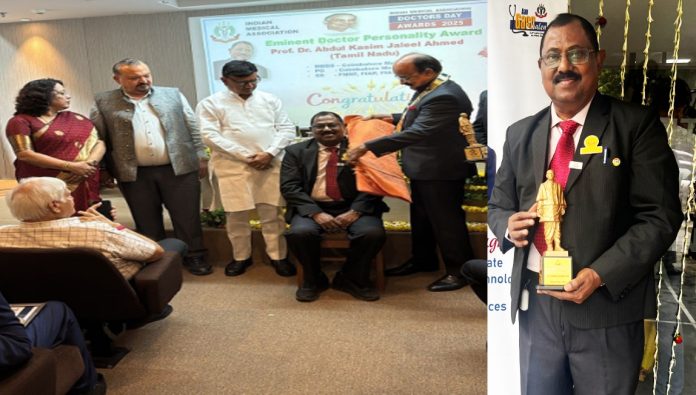
Yet another feather in the cap of paediatrician Dr Abdul Kasim Jaleel Ahamed as he was honoured with ‘Eminent Doctor Personality Award’ for the year 2025 at an event held at Indian Medical Association (IMA) headquartered in New Delhi. The occasion was during National Doctors Day

“Medicine cures diseases but only doctors can cure patients.” This thought-provoking quote of Swiss psychiatrist, psychotherapist, and psychologist Carl Gustav Jung is relevant in the context of noted paediatrician from Coimbatore Dr Abdul Kasim Jaleel Ahamed as he was honoured with ‘Eminent Doctor Personality Award’ for the year 2025 at an event held at Indian Medical Association (IMA) headquartered in New Delhi on the National Doctors Day event.

Indian Medical Association (IMA), the world’s largest association of doctors with over 4 lakh members and 1,800 branches across the country, held its prestigious national award ceremony in the nation’s capital on July 14, wherein scores of medical professionals in different categories were recognised with the honour by Chief Guest Dr Jitendra Goyal, Union Minister of Science and Technology besides the Guest of Honour Dr Anil Goyal, MLA from Delhi.

With over four decades of dedicated service, Dr Jaleel Ahamed carved a niche for himself in treating children at his Cloud One Smart Clinic at West Ponnurangam Road in RS Puram neighbourhood in Coimbatore city. No gainsaying the fact that the child specialist earned name and fame among the residents within and off the city. Noteworthy to mention, he earlier served as Chief Paediatrician and Neonatologist at Sri Ramakrishna Hospital for 34 years.

It is pertinent to point out that Holy Quran researcher, noted speaker, author and publisher Dr Ameer Althaf, in his book ‘Pettagam’ released in 2013 which is a compilation of 300 years history of Coimbatore Muslims, has a separate chapter on Dr A K Jaleel Ahamed.

He married the daughter of Sakkarai Mohamed Rowther, a philanthropist, who spared a considerable amount for charity even while running his transport company in the 1970s.  Those were the days when the less privileged and poor waited in front of Jungle Beer Dargah, Jamesha Dargah and Five Corner mosque during Jumma Ki Raat and on Jumma day.

Dr Jaleel Ahamed taking a cue from his father-in-law is doing his mite continuing his tradition in reaching out to the poor and the needy. Not to be left behind, Dr Jaleel’s service to mankind fetched him accolades from several quarters from far and near while not to speak of the recent IMA Delhi’s ‘Eminent Doctor Personality Award’ at a function organised in connection with ‘National Doctors Day’.

Making heads turn, Dr Jaleel treated an 800-gram test-tube baby claimed to be the country’s first while serving at Sri Ramakrishna Hospital as Chief Paediatrician & Neonatologist, which was the talk of the town then. Interestingly, the baby whom he had treated grew to become a graduate bringing pride to the paediatrician for his noble gesture. This particular incident finds a place in the Pettagam book.

Significantly, he was instrumental in donning the role of Organising ChairPerson – State Neocon 2007 and 2014, Organising Committee Ooty Pedicon (State IAP Conference 2005), Organising Committee , Kongu Pedicon (State IAP Conference 2017 Coimbatore, Organising ChairPerson – South Neocon 2018 in Chennai besides Organising Chairperson – State Neocon 2019 in Madurai, Organised Various CME and Neonatal and Paediatric Workshops in Coimbatore and was State & South Zone Coordinator for IAP Presidential Action Plans.

To his credit, he has numerous awards, including Sr Paediatrician Award, IAPTNSC Senior Neonatologist Award, NNFTN Academic Excellence Award, IMA Community Service Award UG, PG at Coimbatore Medical College during 1976 to 1981,1983-1985 besides Fellowship in Neonatology & Paediatric medicine.

Moreover, he had attended various International, National and State level conferences, workshops, CME programmes in Neonatology at Germany, Norway, Singapore, Italy, UK, South Africa, Dubai, Malaysia, Netherland, Athens, and Alexandria.

Adding more to this, Dr Jaleel said that he was part of the International vaccine summit during 2004 at Thailand and submitted various papers, presentations in paediatrics and neonatology and was selected as a special invitee to attend surfactant replacement therapy during 2006, 2007 in Norway (Oslo), and Italy (Ancona) while not speak of his participation at ESPGHAN summit held in UK, Czech Republic., Geneva, Scotland Visited Marburg, Germany as an observer in neonatology and paediatric nephrology during 2005.

He obtained observer fellowship in neonatology during 2012 at Texas Children’s Hospital USA. The list is endless as he is armed with many recognitions across the globe.

Radiance takes pride in felicitating Dr Jaleel Ahamed for the IMA honour for his dedicated service to the needy.

[The author is former Indian Express and Deccan Chronicle chief]

source: http://www.radiancenews.com / Radiance News / Home> Focus> Pride of the Nation> Awards / by M Rafi Ahmed / July 22nd, 2025

Dr. B.S. Abdur Rahman: The Man who Died Young

Kilakarai (Ramanathapuram District) / Chennai, TAMIL NADU :

Death of Dr. B.S. Abdur Rahman has not only shocked who knew his mission and lifelong works but also those who have benefited by his devotion and those who took inspirations from him. His untimely death has brought a vacuam in Indian educational scenario and it is almost impossible to be filled up in near future.

Indian Muslim Community has legacy of Sir Syed Ahmad Khan, the founder of the Aligarh Muslim University before it, Dr. B.S. Abdur Rahman has achieved almost that place and has become another inspirational figure.

Dr. B.S. Abdur Rahman was born in kilakarai falling under Ramanathapuram district of Tamilnadu state in 1927. Due to his works and philanthropist bent of mind, Dr. Rahman became a well known personality who devoted himself for the upliftment of the economically weaker sections and minorities through their educational empowerment. He did not lagged behind in providing good facilities of health care to the deprived sections of society.

B.S. Abdur Rahman, Vice Chairman of Emirates Trading Agency LLC and Associated Construction and Investments Co. LLC (ETA-ASCON), the Dubai-based $2 billion industrial behemoth, was a multi-faceted personality, much like the diamonds he dealt with when he began in humble business in Sri Lanka, over half a century ago.

Diamond merchant, industrialist, educationist, philanthropist, shipping magnate, generous contributor and enthusiastic participant in many other business and social activities he is a renaissance man whose outlook was Millennial. Meaning, while his values were classical, his thinking was forward looking.

Kilakarai, on the coast of Ramanathapuram district in Tamil Nadu, where Abdur Rahman (fondly known as Sena Aana) was born, is a town made famous in the region by his illustrious ancestor, Vallal Seethakathi.

The forbears of Abdur Rahman migrated to Kilakarai from Arabia in the 12th century. Kilakarai, which means East Coast in Tamil, was a flourishing port to which mearchants from the east and west came. A densely populated area, predominantly by Muslims, it owned its prosperity to them.

From centuries they traded with Sri Lanka (then known as Ceylon), dealing in pealing in pearls, gemstones and conches. Even today, many of them live in Sri Lanka or do business with the island. Abdur Rahman too began his career in Ceylon. Among the pearl traders of Kilakarai was Buhari Aalim. Abdur Rahman was his son.

Aalim was an expert in valuing precious stones and pearls. He would hold a gem between his right thumb and index finger and, looking at it against the sun, study the quality of the watermark within to judge the worth of the precious stone. He would be unfailingly correct.

Watching his father at work, the young Abdur Rahman was soon able to understand the nuances of the trade. This training and experience helped him to become one of the most successful merchants in the diamond trade in due course. When Abdur Rahman first went to Colombo, he was fifteen years old. He had with him just Indian Rupees 149. He worked as an errand boy for diamond merchants, carrying their diamonds and other gems from sellers to buyers and back. He was at the time staying with some traders from Kilakarai and neighbouring villages. They allowed him to stay with them without any payment, but he had, instead, to fetch tea them from a nearby hotel, clean the rooms and perform other menial tasks.

A lesser person perhaps would have thrown in the towel. But Abdur Rahman was made of sterner stuff. Before long, he used his persuasive skills to obtain gemstones from another merchant and began trading in them. In time he became a successful gem trader. The base that Abdur Rahman built in Ceylon was to help him in all his future activities.

He began visiting Belgium, then as now, a centre of the gem trade, the USA, South America and set up business in Penang, Malaysia, Chennai, Kolkata (then Calcutta), and then in Hong Kong. It was in Hong Kong that his business flourished. Incidentally, Abdur Rahman was the first person from Kilakarai to go to Hong Kong.

In Hong Kong he launched the Precious Trading Company in 1954. Later, his very special brainchild, the Amana Group of Hong Kong, was established. It was under its banner that the multinational company ETA-ASCON came into existence.

He was a firm believer in education and took upon himself the task of educationally empower the poor and the deprived. He established a wide network of educational institutions. In 1967, he founded Seethakathi Trust and in 1979, All India Islamic Foundation to achieve his target of serving the community and nation. He founded twelve educational institutions including an Engineering University, a woman’s college, an Arabic College two boys schools, 3 girls schools, a woman Nursing college, a Teacher Training College, B.Ed College for woman and 2 hospitals beside orphanages in rural and urban areas. His biggest achievement was founding a 60 bed Yousuf Zulaikha hospital at Kilakrai and a 150 bed Crescent hospital at Madurai. He did not lagged behind in providing comfort of life to most deprived orphanages and founded Al Momin orphanages for boys and girls at Ottapidram, Tanjore, Kilakarai and Thiruvithancode of Tamilnadu.

Dr. B.S. Abdur Rahman was farsighted man and knew the importance of administration. He was well aware that to uplift community, it is very necessary that Muslim youths join Indian Administrative Services and so he established Crescent IAS and Carriers Guidance Academy in 1994 beside an Islamic Studies & Cultural Centre at Chennai.

His social works span to wide area. Dr. B.S. Abdur Rahman founded B.S. Abdur Rahman Zakat Fund Foundation in 2007 which provides educational grants for students. Through this foundation, B.S. Abdur Rahmand has maintained magniticence of Zakat which may be called a pillar of Islam and which is an instrument for survival of poor Muslims. He 1017 Self Help Group (SHG) which became beneficial to 17093 deprived and helpless women. He also founded and managed various other trusts like Yousuf Zulaikha (1993) Chennai for education, health care and women empowerment. United Economic Forum in 1994 and Seethakathi NGO in 2002.

He also establish new milestones in business field.

He was founder Chairman of Dubai based ETA – Ascon – Star Group and was treated a renowned Indian entrepreneur in UAE. It may be known that the group has a turn over US$ 5.5 billion and employs 50,000 people. With his visionary zeal and entrepreneurial spirit.

B.S. Abdur Rahman has been the guiding force behind many companies in India, among which the most important is the Buhari Group the Indian Multinational. The prominent companies and establishments under Buhari Group include East Coast Construction Ltd. (ECCI) 50 years in the field of construction, Coal & Oil and many other automobile dealership companies.

In recognition of his services he received many awards also.

The Aligarh Muslim University Students Union conferred him life membership while Sathyabama University awarded Honorary Doctorate in recognition of his contribution to Women Education.

In fact Dr. B.S. Abdur Rahman had became an inspirational force to young generation during his own life time. There are very few people who climb the ladder of success and remember the down trodden sections of the society or do anything meaningful for them.

Whatever Dr. B.S. Abdur Rahman has done for the manginalised and deprived sections of society will be always not only remembered but will also be documented in social and educational history of India. The best tribute to Dr. B.S. Abdur Rahman will be to follow the path shown by him not only in business but other fields also.

-Dr. Jasim Mohammad / Author is Editor of The Aligarh Movement monthly

source: http://www.hastakshep.com / Hastakshep.com / Home> Uncategorized / by Dr Jasim Mohammad / March 29th, 2019

Maruthanayagam, alias Yusuf Khan, who equalled Clive and Hyder Ali in warfare

Panniyur (Ramanathapuram District) / Madurai, TAMIL NADU :

He was a servant of the British East India Company and the Nawab of the Arcot before turning against them.

He started his military career as Yusuf Khan, a Muslim convert, and fought in the early wars between the English and the French for the possession of southern India. It was through a conspiracy that the British captured him.

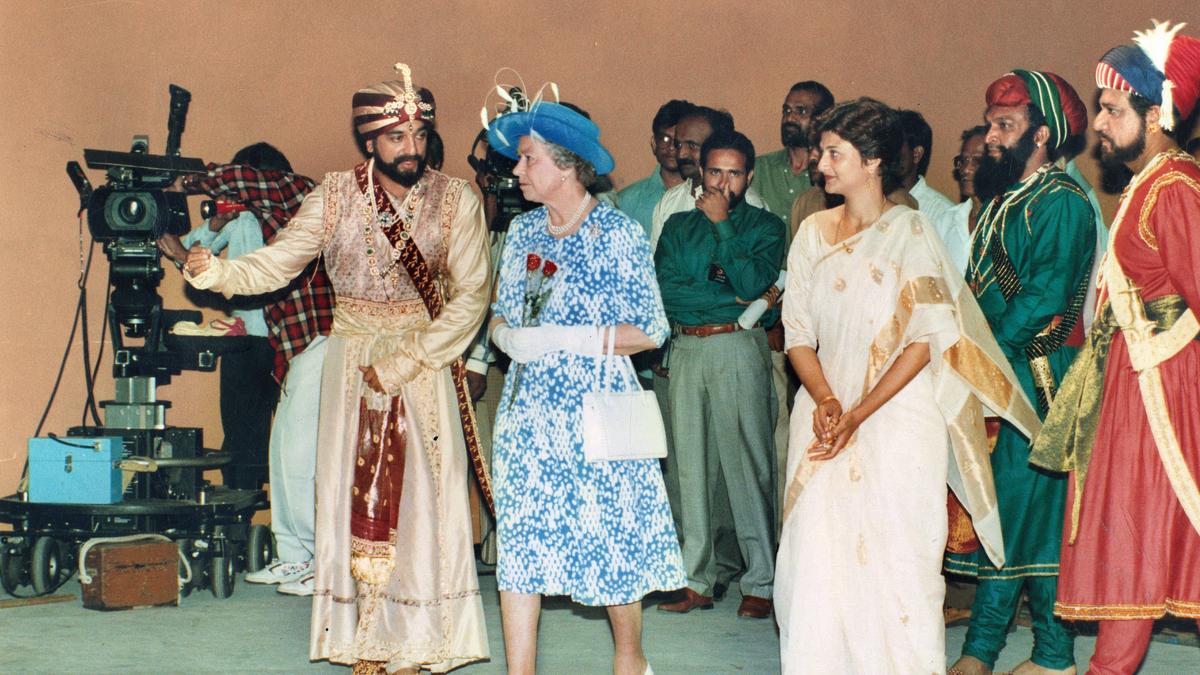
A surprise engagement: Kamal Haasan, director and actor of the film Marudhanayagam, explains a point to Queen Elizabeth on the sets on October 16, 1997. The Queen launched the shooting. | Photo Credit: THE HINDU ARCHIVES

Many were surprised when the visiting Queen Elizabeth launched actor Kamal Haasan’s dream film, Marudhanayagam, in 1997. It was a time when there was a demand for an apology for the Jallianwala Bagh massacre. But Maruthanayagam was a servant of the British East India Company and the Nawab of the Arcot before turning against them. It is a misnomer to call him Maruthanayagam as he built his military career as Yusuf Khan, a Muslim convert.

“Muhamed Yusuf — better known in his time as Yusuf Khan — was by far the ablest of the Indian soldiers who fought in the early wars between the English and the French for the possession of Southern India,” writes S.C. Hill, author of Yusuf Khan: The Rebel Commandant. Hill, an Indian Educational Service officer, was in charge of the records of the Government of India. Published in 1914, the book draws heavily on the Madras Records, the Orme Collection of Manuscripts in the India Office, The French and Dutch Archives, the Tamil poem, The War of the Khan Sahib, and documents at the British Museum.

A man of genius

“Yusuf Khan was, in fact, of the same type as Haidar Ali [Hyder Ali] — one of those men of genius who naturally comes to the front in times of great social and political unrest. Had he been left without outside interference to settle scores with his quarrel with his native suzerain, like Haidar Ali with the Raja of Mysore, there is absolutely no doubt that he would have succeeded in establishing his independence,” writes Hill. Historians depended on the memoirs of Ponnusami Tevan, manager of the Ramnad Zamindari, to trace the background of Maruthanayagam Pillai. The title, Pillai, became part of his name as he was born in the Vellala caste at Paniyur in Ramanathapuram district.

In his youth, he was wild and disobedient to his parents, and ran away to Pondicherry and served under a European for three years and a half. Then, he was dismissed for theft. According to the French account, his ears were cut off as a punishment. Hill, however, dismissed the accusation as groundless, saying it was never mentioned until after the death of Yusuf Khan and then only by those who, if not actually hostile, were certainly biased against him.

After leaving Pondicherry, he joined the army of the King of Thanjavur and subsequently Nawab Muhammed Ali of Arcot. According to another account, he joined another European, Brunton, after his dismissal. Brunton had him instructed in several languages. He entered the services of the British by joining a company of sepoys which he had raised himself in Nellore, under Robert Clive, shortly before the Battle of Kaveripakkam.

According to British officer Major-General Stringer Lawrence, Yusuf Khan was “brave and resolute but cool and sensible in action — in short, he is a born soldier and better of his colour I never saw in the country.”

Freed from trammels

It is not clear why he chose to become a Muslim, and Hill has a theory. Maruthanayagam Pillai wanted to avoid what befell Aryanatha Mudali, the great general of the 16th Century and founder of the Poligar (Palayakar) system in Madurai. J.H. Nelson, the author of The Madura Country Manual, says Aryanatha Mudali, despite being a great warrior and administrator, was dissuaded by his family from becoming the king because he was a Vellala. “For Yusuf Khan then to rise to the position to which he attained, it was necessary for him to be freed from whatever trammels might be imposed upon him by his religion. This was effected by conversion — voluntarily or by force is unknown — to Muhammadanism,” writes Hill. But the Nawab objected to the elevation of Yusuf Khan, though to a Muhammadan, the “lowly birth” was “no hindrance to his success”.

Appointed Governor

Yusuf Khan, however, was appointed a Governor by the British. He ensured peace in the provinces of Madurai and Tirunelveli, which belonged to the Nawab, but had been placed by him under the control of the Madras Council.

“The name of this hero, for such he was, occurs almost as often in the pages of the English historian (Robert Orme) as that of Lawrence of Clive,” Sir John Malcolm writes about Yusuf Khan, who later rebelled against the Nawab and declared his alliance to the French. This led to a war between Yusuf Khan and an alliance of the British and the Nawab, and the seizure of Madurai. The British captured Yusuf Khan through a conspiracy and one of the participants in the conspiracy was Srinivasa Rao, his diwan and chief adviser.

The British officer Marchand, who went with the conspirators, says he was seized in his darbar. But the Dutch account says the capture occurred in a private room. Bishop Caldwell, quoting a native account, says he was arrested at his prayers by Moossoo Marsan and his Hindu diwan Srinivasa Rao “He begged them to kill him there and then rather than deliver him to the Nawab. He was carried under guard to Marchand’s quarters,” says Hill.

On October 15, 1764, the Nawab wrote to Madras that the “Rebel was hung at five o’clock in the evening, which struck terror into the hearts of our enemies”. His body was dismembered. The head was sent to Tiruchi, the limbs were sent to Thanjavur, Palayamkottai, and Travancore. The trunk was buried at Sammatipuram, where the Khan Sahib’s ‘pallivasal’ still stands.

source: http://www.thehindu.com / The Hindu / Home> News> India> Tamil Nadu> In Focus / by B. Kolappan / August 09th, 2024